Buffalo is a renter-majority city of doubles, porches and lake-effect snow. This guide helps you compare areas, plan the everyday basics and prepare the practical steps of arriving.
Try the everyday errands around a new address, not only the journey to work.
01 /
Start with the decision in front of you
Buffalo asks three different questions of a newcomer, and this guide is organized around them. If you are still choosing where to live, start with the orientation and the neighborhood comparison, then read the housing section — Buffalo's market is mostly older rentals and modestly priced houses, and the differences that matter are stairs, heat, parking and what the rent includes. If you are moving with children, go to the schools section early: Buffalo Public Schools places students by application, not by automatic address assignment. If the address is already decided, the second half of the guide walks through the practical setup — utilities, waste, the curb for the moving truck, building access and the arrival sequence.
One caution before any comparison: Buffalo's official map has 35 planning neighborhoods, but everyday names — Elmwood Village, North Buffalo, South Buffalo, the East Side, the West Side — draw looser boundaries, and postal ZIP codes and school application geography are different maps again. Verify each address against the map that matters for the decision at hand.
02 /
Understand Buffalo before comparing addresses
Buffalo sits where Lake Erie narrows into the Niagara River, the seat of Erie County and by far the largest city in Western New York. The city is one municipality among many: neighboring Amherst, Cheektowaga and the Village of Depew are separate governments with separate rules, and a "Buffalo area" description is not the same as a Buffalo address. Confirm the municipality before comparing procedures.
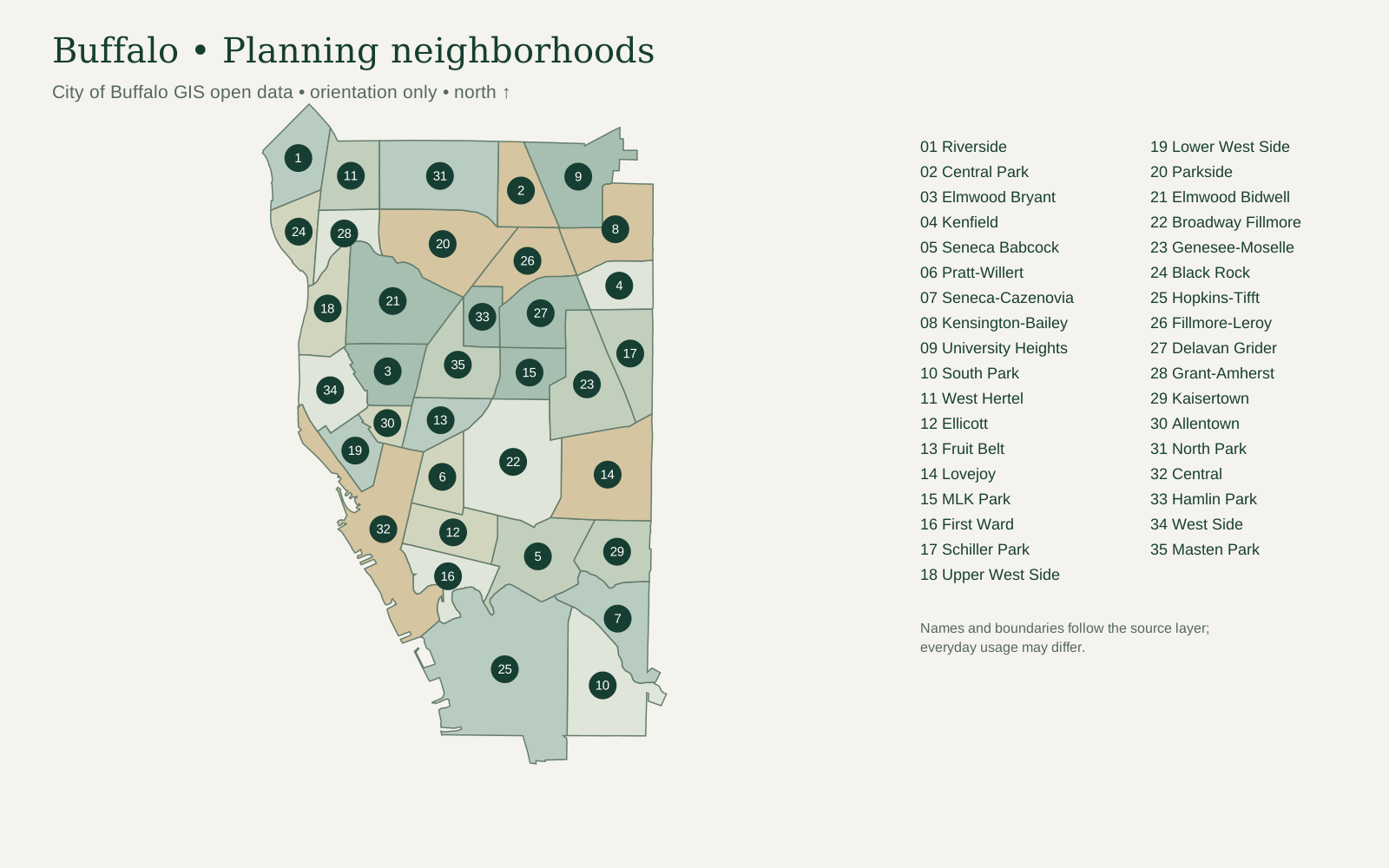
The city's own geography divides Buffalo into 35 planning neighborhoods, mapped below from the City's open-data layer. They are planning geography: everyday umbrellas cross them — "Elmwood Village" spans the Elmwood Bidwell and Elmwood Bryant planning neighborhoods, "North Buffalo" covers North Park and West Hertel, and "South Buffalo" covers Seneca-Cazenovia, South Park and their neighbors. Downtown is not one of the 35. None of these lines assigns a school or guarantees a building condition.
Three naming traps matter for movers. The University at Buffalo's South Campus is in the city at Main Street and Kenmore Avenue, but its North Campus is in Amherst — addresses marketed as "near UB" may sit in another town. Buffalo Niagara International Airport uses a Buffalo mailing address but is in Cheektowaga. And Amtrak's Buffalo-Depew station is in Depew; only the Exchange Street station is downtown. Two other colleges really are in the city: Buffalo State University on Elmwood Avenue and Canisius University on Main Street.
One more map matters to buyers: Buffalo's Preservation Board reviews all exterior work on local landmarks and in local historic districts — which include parts of Allentown, Hamlin Park and other older neighborhoods. If you are buying in one, renovations run through an extra approval step.
Use the numbered key to locate the areas discussed below. Open full-size map.
03 /
Find the area that fits your routine
Buffalo's official geography counts 35 planning neighborhoods; the six modules below are the areas with verified documentation, chosen to contrast housing types and access patterns. They are starting points for inspection, not rankings — school placement follows applications rather than addresses, and building conditions vary house by house.
Allentown & Downtown edge
The city's best-known historic district, just north of downtown: the National Register boundary-increase nomination documents its fabric building by building — residential blocks from the 1890s in brick and frame, with early apartment buildings among them.
Older row and frame housing plus small apartment buildings; expect stairs, stoops and shared entries, and check whether the address sits inside the local historic district, where exterior work gets an extra review.
Daily travel
Walkable to downtown; Main Street buses and Metro Rail stations serve the edge of the district.
Before choosing
Confirm where a truck can stand on the narrow streets and whether the building's entry faces the street or a rear yard.
Elmwood (Bidwell & Bryant)
The west-side streetcar district behind Elmwood Avenue: the National Register nomination describes a primarily residential area developed from the 1870s to the 1940s, with flats and multiple-family buildings common on some streets and a building boom in the 1890s–1910s.
Doubles, flats and single-family houses on tree-lined blocks; compare the specific building's stairs, porch and rear access rather than the avenue's reputation.
Daily travel
The 20 Elmwood bus runs the corridor; downtown is a short ride south.
Before choosing
Measure the staircase and the largest pieces; porch stairs and shared halls are the default, and winter adds an ice question on the steps.
Hamlin Park
An east-side streetcar neighborhood whose National Register nomination records a mix of doubles and singles — two-story frame dwellings with open porches, built out by the mid-1920s.
Classic Buffalo doubles: two stacked flats with separate entries; verify which entrance is yours and how the shared porch is used.
Daily travel
Bus routes on the surrounding avenues; check the stop and schedule for your actual routine.
Before choosing
Agree driveway use with the neighbor or landlord — many drives are shared or single-width — and walk the carry route from curb to door.
South Buffalo (McKinley Parkway)
A largely middle-class streetcar neighborhood — the McKinley Parkway district's draft registration form covers most of South Buffalo, with about five thousand freestanding frame and brick houses built mostly between the 1910s and 1950s. The state preservation board recommended the district for listing in September 2025.
Predominantly single-family houses with yards and driveways; the easiest truck access in the city, but check garage width and driveway length.
Daily travel
Bus routes serve the main avenues; the southern end of the city is farther from Metro Rail.
Before choosing
Confirm the collection-day and bulk rules for the address, and note this is the part of the city that took the November 2022 lake-effect band hardest.
Lower West Side (Prospect Hill)
The neighborhood beside the Peace Bridge: the Prospect Hill nomination documents homes built from the 1890s to the 1960s, single-family high-style and vernacular, and records the area's brush with demolition for a bridge expansion that did not proceed.
Compact older houses and doubles close to downtown; bridge traffic and border approach roads shape the nearest blocks — visit at the hours you would live them.
Daily travel
Among the city's best bus coverage, with downtown walkable; the Peace Bridge crossing is Canada-bound, not an errand route.
Before choosing
Verify which streets carry bridge-bound traffic at your block, and confirm the truck's position off the approach corridors.
University Heights
The city's northeast corner, named for the institutions around it: UB's South Campus at Main and Kenmore and the Metro Rail's University station anchor the area inside the official planning boundary.
A mix of doubles and singles with a large student-rental presence; leases and availability follow the academic calendar more than elsewhere in the city.
Daily travel
The Metro Rail's north end and Main Street buses make this the best-served car-light option outside downtown.
Before choosing
Ask whether the rental follows the academic year, and book August dates early — turnover concentrates there.
04 /
Compare the whole home, not just the advertised payment
Buffalo is a renter-majority city: 56.9% of households rent their home (ACS 2024 5-year, via Census Reporter). The median gross rent is $1,046 a month and the median owner-occupied value $164,200 — but medians describe the whole city at once, not the apartment in front of you, and listing sites' asking rents run above survey medians. Use them only to sanity-check a budget.
The stock explains the market. About 35% of Buffalo homes sit in two-unit buildings — the Buffalo double, two stacked flats under one roof — and another 8% in three-to-four-unit buildings, while about 61% of units were built before 1940. National Register nominations describe the streetcar neighborhoods as a deliberate mix of doubles and singles built for families seeking to rent or own. For a mover this means the differences that matter are physical: which floor, front stairs or back stairs, porch condition, where a truck can stop, and how heat is supplied. Radiators, woodwork and bay windows come with the charm; so do narrow staircases with landing turns.
When comparing two apartments, compare what the payment includes — heat above all, since Buffalo winters make an included-heat lease worth real money — plus hot water, parking and snow clearing. Read the lease's move-in and move-out rules, and inspect the access route: porch boards, stair rails, door widths, the shared driveway. Ask early how bulky disposal works when you leave; the city allows three bulk items a week with regular collection, and anything bigger has a seasonal schedule.
Compare usable rooms, heat arrangements and what the rent actually includes.
05 /
Test the complete daily journey
Buffalo's transit spine is NFTA Metro. The bus network covers the city and the suburbs with named routes — 8 Main, 20 Elmwood, 23 Fillmore-Hertel, 24 Genesee and many more — and the fares page lists a $2.00 single ride with fare capping: you ride free after $5 in a day, $25 in a week or $75 in a calendar month, paid by MetGo card or app. Metro Rail is a single light-rail line along Main Street, running on the surface downtown from Canalside to University Station by UB's South Campus, with 14 stations including Allen-Medical Campus, Delavan-Canisius College and LaSalle. A rail round trip is $4.00 — no free-fare zone is listed on the current fare page.
One caution for downtown rail trips: the line opened in 1985 and is mid-renewal. The Rail Renewal program and the city's Cars on Main Street project bring phased construction, station rehabilitation and occasional single-tracking; check service alerts for your travel date.
Intercity rail comes in two stations, and the difference matters. Exchange Street station — a new depot opened in November 2020 — sits downtown and handles Empire Service trains to Niagara Falls, Albany and New York City plus the Maple Leaf to Toronto. The Lake Shore Limited does not stop there: Chicago and Boston passengers use Buffalo-Depew, which is in the Village of Depew, outside the city. Check the station code on your ticket — BUF means Depew, BFX means Exchange Street.
For flights, Buffalo Niagara International Airport is in Cheektowaga, despite the Buffalo mailing address. NFTA's route 24 Genesee links downtown with the airport every 20–30 minutes, with a faster limited-stop 24L on weekdays at no extra charge. Drivers use I-190 along the river, the Kensington Expressway (Route 33) to the airport and the Skyway (Route 5) south; a car-light household is realistic near the rail corridor and the main bus avenues, but test the exact door-to-door routine — the grocery run, the school route, the late-evening trip home — before deciding.
Test the complete daily journey, including the walk at both ends.
06 /
Treat school placement as an application, not an address
Buffalo Public Schools does not place children by automatic neighborhood assignment. Placement runs through the district's Division of Admissions & Registration, and the enrollment pages describe a structure of applications, criteria schools, community-school criteria and lottery results — do not sign a lease counting on a specific school.
For the current school year, registration is in person only at Central Registration, 33 Ash Street (arrive before 2:30 pm), phone 716-816-3717. The requirements page lists two steps — a registration packet, then an application — plus the documents to bring:
Document group
How many
Examples
Proof of student age
One
Certified birth certificate or record of baptism
Proof of guardianship
One
Birth certificate naming the parent, court order, qualifying tax form
Parent/guardian photo ID
One
Driver license, permit or non-driver ID
Proofs of address
Two, in the parent/guardian name
Utility bill or pay stub within 30 days, current ID with address
For the following school year, families apply and the district mails placement letters each spring. The 2026-27 results page shows how the tracks work: criteria schools place by a per-school rubric — gifted and talented programs at Olmsted #156 and City Honors #195 mailed letters March 18, 2026; the criteria high schools (da Vinci #212, Hutchinson Central Technical #304, Middle Early College #415) mail in summer; and the Buffalo Academy for Visual & Performing Arts #192 admits by audition. Non-BPS students admitted to the criteria high schools register from July 1.
Neighborhood boundaries and community-school criteria exist inside this system, so check how your address fits before assuming a default school. Gather documents before the office visit, and if you arrive mid-year with an offer from a criteria school, confirm whether registration happens at Central Registration or the school itself.
07 /
Assign an owner and a start date to each household service
Electric service in Buffalo runs through National Grid, whose upstate New York territory covers the city; start, stop or transfer service online, and submit the request as soon as your date is fixed — no official lead time is published. Natural gas is National Fuel, the western New York gas utility, with online start and stop flows for existing lines and a separate landlord program for rental properties.
Water is the city's own: Buffalo Water (the Buffalo Water Board) handles billing with online payment, and its site notes that shutoff protocols have resumed for severely delinquent accounts. Buffalo Water publishes no tenant-account policy, so renters should ask the landlord how the account rides with the property and whether any balance follows the address; owners handle accounts directly at closing.
For internet, availability is address-specific and provider pages for Buffalo change often, so check the exact address with each provider before promising yourself a speed. In older doubles, ask which provider already wires the building — an installation booked before the move is easier than one booked from an empty apartment.
08 /
Plan for routine collection and the things you are leaving behind
Buffalo's Streets & Sanitation division collects weekly at properties paying the Residential User Fee. The rules that matter on moving day: garbage goes out only in the city-issued tote; recycling in the green tote (extra in clear bags, cardboard flattened); and the city's code allows three bulk items per week at the curb on the regular collection day — furniture, appliances, mattresses and carpet cut to four-foot sections. What never goes to the curb: TVs, computers, tires, construction debris and hazardous waste. Collection slides only for Christmas Day and New Year's Day.
A whole-house clean-out does not fit in three items a week. The city's Large Bulk Waste Collection runs only on designated days per Council District, in spring and fall, and is limited to four cubic yards — so disposal of what you are not taking needs to be planned weeks before the move, or hauled separately. If you are leaving a rental, confirm with the landlord whether the property is on city service at all; larger buildings use private haulers.
09 /
Arrange a legal place for the moving truck
Buffalo has no dedicated moving-truck permit. The official path for reserved curb space runs through the Department of Public Works: the city's Temporary No Standing Sign page directs anyone whose work requires temporary curb reservation to DPW, where the signs attach to a work permit. For a moving truck, that means the Street/Sidewalk Obstruction procedure.
The published requirements shape the calendar: submit documents at least 7 business days in advance; provide a certificate of liability insurance naming the City of Buffalo as additionally insured, with at least $1,000,000 in general and automobile coverage; and include a Maintenance and Protection of Traffic diagram — the address, cross streets, obstruction length, signage, the number of metered or paid spaces affected, and a pedestrian plan if the sidewalk is encroached. Submissions go to Room 512, City Hall. Downtown's Main/Pearl/Washington blocks and the Buffalo Niagara Medical Campus area each add a separate contact. No fee schedule is published on the form — ask when you apply, and tell us early so the paperwork lands inside your date.
Two adjacent rules round out the picture. Buffalo's residential permit program exists only in the Fruit Belt, and it covers personal cars — it does nothing for a truck. And day-of enforcement is real: if the reserved area is occupied when the truck arrives, the answer is the Parking Enforcement Division, not improvisation in a bus stop. Where a driveway or private lot exists, use it — private loading beats any curb arrangement.
10 /
Inspect the full route through the building
Most of Buffalo's housing predates elevators: about 61% of units were built before 1940, and the signature form is the two-story frame double with an open porch — the "Buffalo double" documented across the city's streetcar-era districts. That means the default move involves stairs: a straight run to a second-floor flat, sometimes a narrow turn at the landing, porch steps and often a shared front hall. Measure the largest pieces against the actual route before moving day — width, turns, ceiling at the landing — and check porch boards and railings before anyone carries a sofa across them.
Downtown, in University Circle-area complexes and in the larger apartment buildings, access runs through the property instead: elevators reserved in advance, a certificate of insurance from the mover, fixed moving windows. Ask for the written moving rules at both ends as soon as the date is set.
Whichever type, walk both routes: where the truck stops, which door is used, every stair and elevator between the truck and the room, and who unlocks what. Buffalo's winter adds one more item — who clears snow and ice from the steps and porch before the crew arrives; the city's code text on sidewalk clearing could not be verified this pass, so make it an explicit assignment with the landlord rather than an assumption.
11 /
Build a useful routine beyond the commute
Buffalo's everyday geography runs along its avenue corridors: Elmwood through the west side, Hertel in the north, Grant and Genesee through their districts. Metro Rail's Main Street line links the waterfront at Canalside with the university area at its north end, and the bus routes named for the avenues (8 Main, 20 Elmwood, 23 Fillmore-Hertel, 25 Delaware) show which streets carry daily errands. Test the routine you will actually live — the grocery run, the pharmacy, the school or daycare route — at the hours you would use it.
Two structural facts color daily life. The city's preservation districts and landmarks — administered by the Buffalo Preservation Board — mean many blocks keep their 19th-century fabric, and owners in local districts face an exterior-work review step. And the universities inside the city (Buffalo State on Elmwood, Canisius on Main, UB's South Campus at Main and Kenmore) set the rhythm of their surrounding blocks: fuller in late August, quieter in May.
Check the outdoor routine around the address you actually choose.
12 /
Plan for the season in which you will live and move
Buffalo's winter is the season that can cancel a moving day, and lake-effect makes it hyperlocal. The city's snow plan describes three tiers: typical events handled by the regular fleet; localized extreme lake-effect — the plan's own example is November 2022, when much of the city saw modest snow while the southern part received over four feet; and citywide blizzard conditions. Snow normals for the airport station (1991–2020) run about 95 inches a year, essentially October through April, with December–March the core. A December–March date deserves a forecast check with us in the final week and a backup date in mind.
During events, the city publishes parking-restriction information through 311 and its snow resources, and a separate seasonal program posts winter parking restrictions on NFTA bus routes from November 15 to April 1 — confirm the current season's terms before relying on any street. After the snowfall, agree explicitly with the landlord who clears the steps, porch and sidewalk; Buffalo's sidewalk rule could not be verified from an official text this pass, so do not assume it.
The other calendar is academic: Buffalo State, Canisius and UB's South Campus sit inside the city, and student-linked leases turn over around late August and May. End-of-month dates at those times book out first — our workload observation, not a city statistic.
Winter dates need a storm plan: lake-effect bands can close one side of the city while sparing another.
13 /
Turn the chosen home into an arrival plan
With the address decided, sequence the setup so nothing blocks the truck. Four to six weeks out: confirm the lease or closing date, start the school conversation if you have children — Buffalo places by application, and placement letters go out in spring — and book the move itself. Two to three weeks out: submit the National Grid and National Fuel start requests, line up internet installation for arrival week, and plan disposal of what you are not taking around the three-bulk-items-a-week rule. At least two weeks out: if the truck needs street space, the DPW obstruction documents — insurance certificate and traffic diagram — must be in at least 7 business days before the day.
In the final days: confirm building rules and elevator windows at both ends, finish packing, set aside what travels with you, and in winter check the forecast and any parking restrictions. In the first week after arrival: find your collection day and tote rules, test heat and hot water, and note where the nearest corridors — Elmwood, Hertel, Grant, Genesee — cover your errands.
14 /
Questions before you arrive
Is the airport in Buffalo?
No. Buffalo Niagara International Airport is in the Town of Cheektowaga — its own announcements dateline Cheektowaga, even though the mailing address reads Buffalo. NFTA route 24 links downtown with the airport.
My Amtrak ticket says Buffalo. Which station?
Two stations serve the city: Exchange Street (BFX) downtown, used by Empire Service and Maple Leaf trains, and Buffalo-Depew (BUF) in the Village of Depew, the only stop for the Lake Shore Limited. Check the station code on the ticket.
Does Buffalo have a moving-truck permit?
Not a dedicated one. Reserved curb space goes through the Department of Public Works: temporary No Standing signs attach to a work permit, and the Street/Sidewalk Obstruction procedure requires documents — including a $1,000,000 liability certificate — at least 7 business days ahead. A driveway or private lot skips all of it.
Is Metro Rail free downtown?
Not on the current fare page. NFTA lists a $2.00 single ride with fare capping — free after $5 in a day, $25 in a week or $75 in a calendar month — paid by MetGo card or app. Older references to a free above-ground zone do not appear in the current fares.
Does a Buffalo address assign my child's school?
No. Buffalo Public Schools places students through applications, criteria schools, community-school criteria and lotteries, with registration in person at 33 Ash Street. Placement letters for the following year go out in spring — do not sign a lease counting on a specific school.
How much snow does Buffalo actually get?
The 1991–2020 normals for the Buffalo airport station average about 95 inches a year, essentially October through April. Lake-effect bands make it hyperlocal: the city's own snow plan cites November 2022, when much of the city saw modest snow while southern Buffalo got over four feet.
Is the University at Buffalo in Buffalo?
Partly. UB's South Campus is in the city (Main Street and Kenmore Avenue); its North Campus is in Amherst. Check which campus an address or program refers to.
Official procedures and local resources are linked beside the answers above. Reopen the relevant page when arranging a date: fees, schedules and application requirements can change.