
Moving in New Jersey — Garden State communities

State moving guide

Moving in New Jersey: A Practical Guide by Sterling Oakbridge

Planning a move in New Jersey means working inside the most densely populated state in the country — pre-war city blocks along the Hudson, suburban townships on the Route 1 corridor, seasonal shore communities, and rural stretches in the northwest and the Pinelands. At Sterling Oakbridge, we treat every relocation as a logistics problem first: curb space, building access, truck routing, and the state and municipal rules that govern each address. This guide walks through what to expect when moving within New Jersey, between its metro areas, or across state lines, using verified state regulations and current Census data so you can plan each stage with confidence.

New Jersey planning

How to Use This New Jersey Moving Guide

This New Jersey moving guide is a practical reference for anyone relocating within the state. At Sterling Oakbridge, our aim is to present clear, evidence-based information about what moving in New Jersey actually involves. This guide does not rank or endorse moving companies. Instead, it documents the logistical conditions, regulatory requirements, and property characteristics you are likely to encounter across the state's cities, suburbs, shore towns, and rural areas.

Each section addresses a question that comes up repeatedly in New Jersey move planning: how urban, suburban, shore, and rural relocations differ; what the state requires of licensed intrastate movers; how truck routing works around the Garden State Parkway's heavy-truck restrictions and the Hudson River crossing rules; and where to find verified data on housing and migration. Every regulatory claim in this guide cites the official source it was verified against.

What this guide covers: - The practical differences between moving within New Jersey's dense urban core, its suburbs, its shore communities, and its rural northwest and south - How state mover licensing, municipal parking permits, and crossing restrictions affect your move - Where to find detailed information for the regions and counties where Sterling Oakbridge works

What this guide does not cover: - Endorsements or rankings of moving companies - Detailed pricing, reviews, or testimonials - International customs brokerage or direct ocean freight services

Use this guide as your starting point. For questions specific to your addresses, follow the links to our service pages or call a coordinator at (475) 221-2030. Whether you are moving across the street in Montclair or from the Shore to Sussex County, our goal is to give you the information you need to make sound decisions at every step.

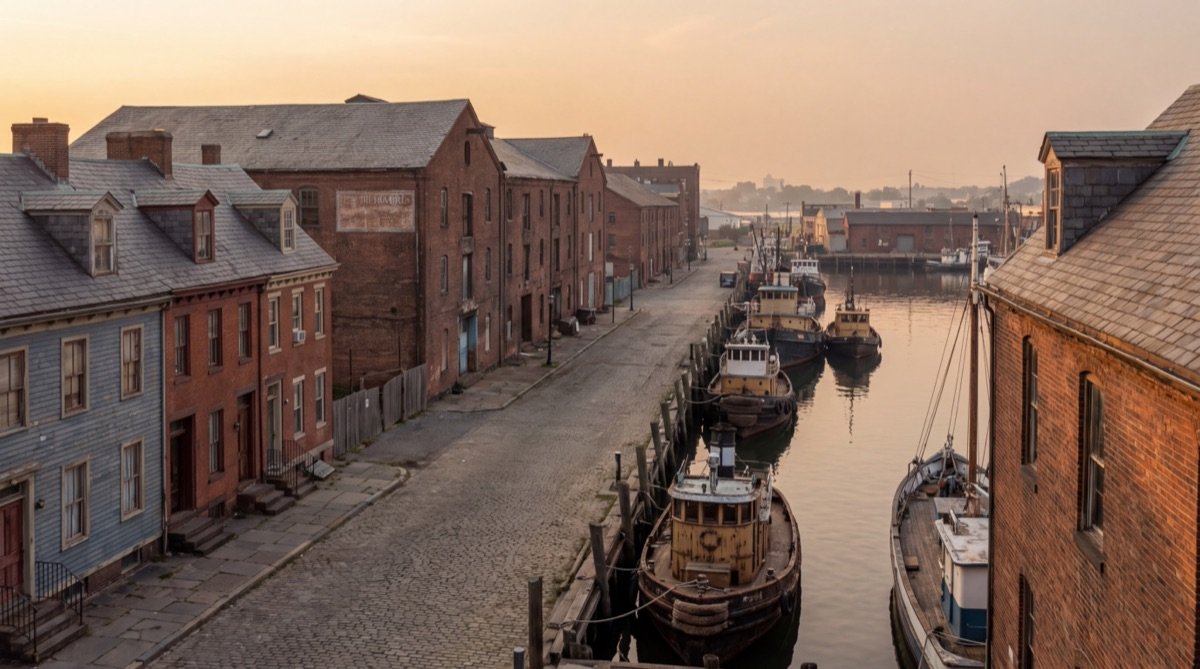
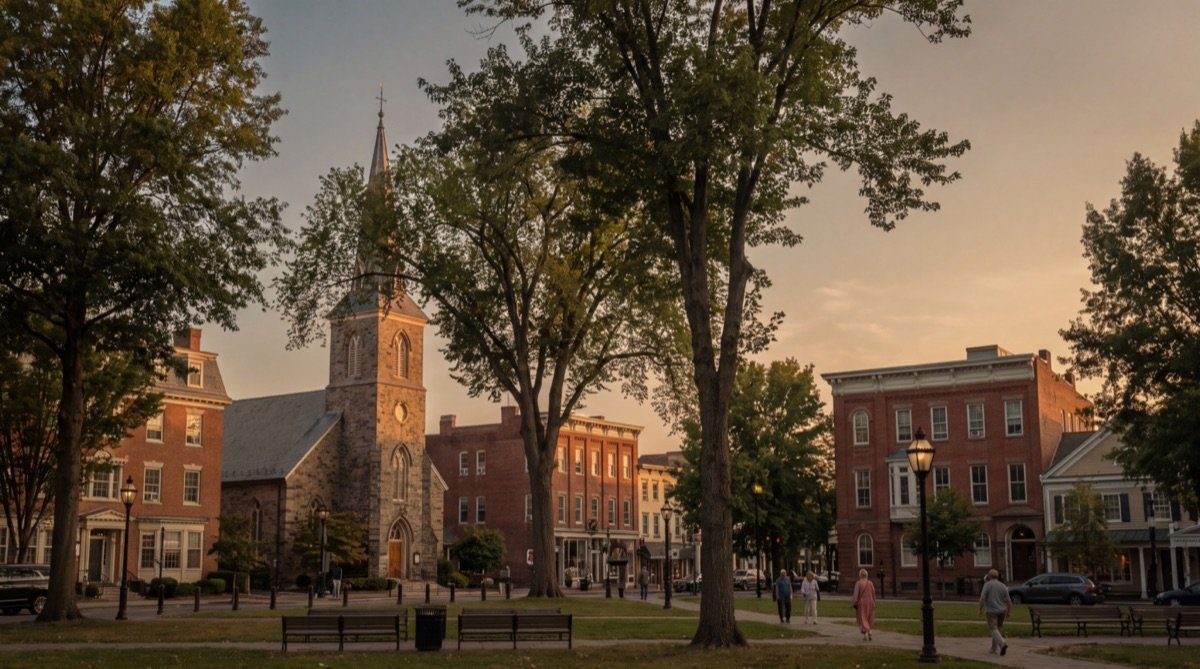
Three planning points within a statewide directory of twelve communities — coverage from the Gold Coast to the Shore.

New Jersey planning

Regional Moving Coverage and Hub Directory

New Jersey is compact — but its moving conditions change quickly from one county to the next. Sterling Oakbridge organizes its New Jersey coverage around regional hubs so that every community is served by a team that knows its streets, building stock, and permit offices. Our statewide service network is anchored by three tier-one hub groups: the Newark / Jersey City hub, serving the Gateway Region and Gold Coast; the Edison / Princeton hub, serving Central Jersey's Route 1 corridor; and the Toms River hub, serving the central Shore and Ocean County.

Around those anchors, our coverage extends through the state's most populous counties: Bergen County's established commuter suburbs along the Garden State Parkway and Route 4; Essex County's dense urban core in Newark and East Orange; Hudson County's waterfront high-rises in Jersey City and Hoboken; Middlesex County's corporate corridor around New Brunswick; and the Shore counties — Monmouth and Ocean — where seasonal, retirement, and beach-town moves dominate the calendar.

Because New Jersey has 564 municipalities, parking rules, permit processes, and even street-sweeping schedules can differ from one town to the next. The hub nearest your move handles that local verification as part of planning. If you are unsure which hub covers your community, a coordinator can confirm it in one call — smaller towns and boroughs are always covered by the nearest planning point.

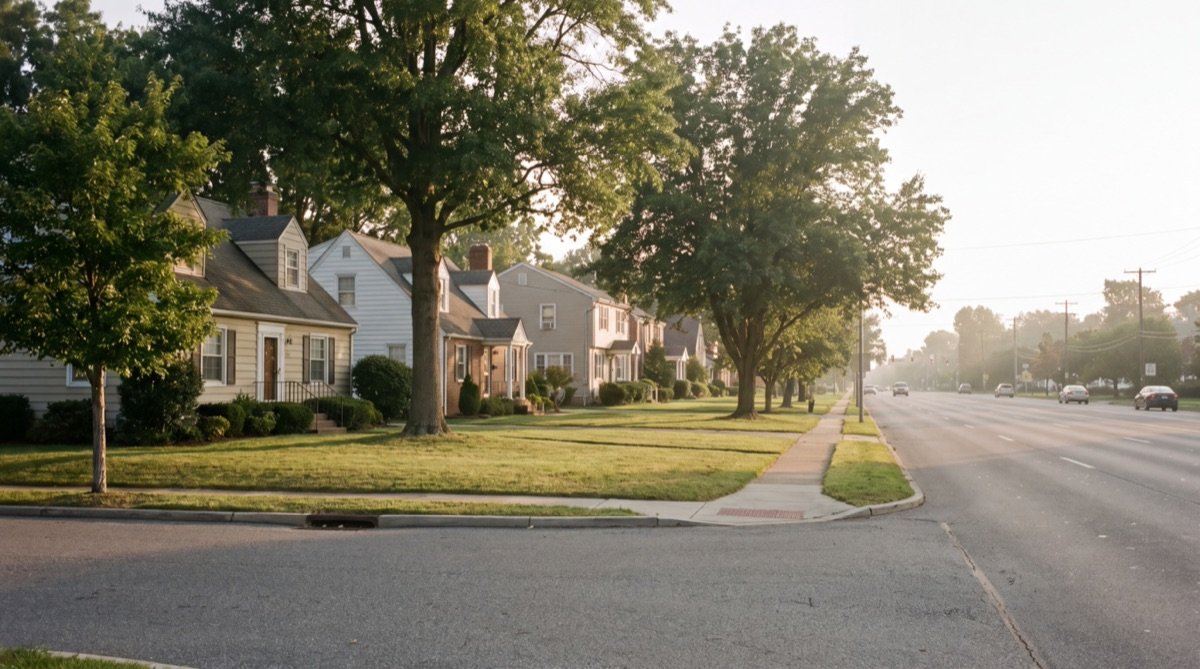
Elizabeth, New Jersey — residential neighborhood detail
A calm street-level view sets the local context without turning every illustration into a moving-truck scene.

Service network

Where we work in New Jersey

Three planning points and nine community references across the Garden State — every move begins with a survey and an itemized written estimate.

Newark / Jersey City, New Jersey — golden-hour city viewNJ

Newark / Jersey City

NJ's dual urban core — dense city-to-city and high-rise apartment moves along the PATH corridor and Gateway Region.

Key communities

Elizabeth Clifton Bayonne Kearny

Explore Newark / Jersey City hub
Edison / Princeton, New Jersey — golden-hour city viewNJ

Edison / Princeton

Central Jersey's Route 1 corridor — suburban family moves, Rutgers-area turnover and corporate relocations.

Key communities

New Brunswick Sayreville Old Bridge Plainsboro

Explore Edison / Princeton hub
Toms River, New Jersey — golden-hour city viewNJ

Toms River

Ocean County seat anchoring the central Shore — retirement moves, shore-house seasonals and Lakewood's fast-growing families.

Key communities

Lakewood Forked River Lacey Manahawkin

Explore Toms River hub
Trenton, New Jersey — golden-hour city viewNJ

Trenton

The state capital — government-office relocations and affordable starter-home moves at the Mercer County crossroads.

Key communities

Hamilton Square Hightstown Lawrenceville Ewing

Explore Trenton hub
Camden, New Jersey — golden-hour city viewNJ

Camden

South Jersey's Philadelphia-facing market — waterfront apartments and affordable rowhome moves across the Delaware from Center City.

Key communities

Sicklerville Glassboro Lindenwold Cherry Hill Mall

Explore Camden hub
Paterson, New Jersey — golden-hour city viewNJ

Paterson

Dense Silk City housing stock in Passaic County — high-volume apartment and multi-family moves.

Key communities

Clifton Passaic Fair Lawn Garfield

Explore Paterson hub
Morristown, New Jersey — golden-hour city viewNJ

Morristown

Morris County's historic county seat — upscale suburban and corporate moves near the I-287 office corridor.

Key communities

Dover Madison Parsippany Summit

Explore Morristown hub
Atlantic City, New Jersey — golden-hour city viewNJ

Atlantic City

The Shore's resort economy — casino-hospitality turnover, seasonal rentals and island bungalow moves.

Key communities

Pleasantville Ventnor City Brigantine Ocean Acres

Explore Atlantic City hub
Hoboken, New Jersey — golden-hour city viewNJ

Hoboken

Gold Coast's walkable mile-square city — young-professional apartment moves minutes from Manhattan.

Key communities

Union City West New York Weehawken Edgewater

Explore Hoboken hub
Hackensack, New Jersey — golden-hour city viewNJ

Hackensack

Bergen County seat — courthouse-district apartments and established suburb moves along the Route 4 corridor.

Key communities

Teaneck Paramus Ridgewood Fort Lee

Explore Hackensack hub
Montclair, New Jersey — golden-hour city viewNJ

Montclair

Upscale Essex suburbs — prewar homes, Watchung ridge streets, and NYC-commuter family moves.

Key communities

Bloomfield Verona Maplewood Glen Ridge

Explore Montclair
Vineland, New Jersey — golden-hour city viewNJ

Vineland

Cumberland County's interior — farm-country properties and affordable South Jersey homes.

Key communities

Millville Bridgeton Buena Rosenhayn

Explore Vineland hub

New Jersey planning

Moving Within New Jersey's Cities and Metro Areas

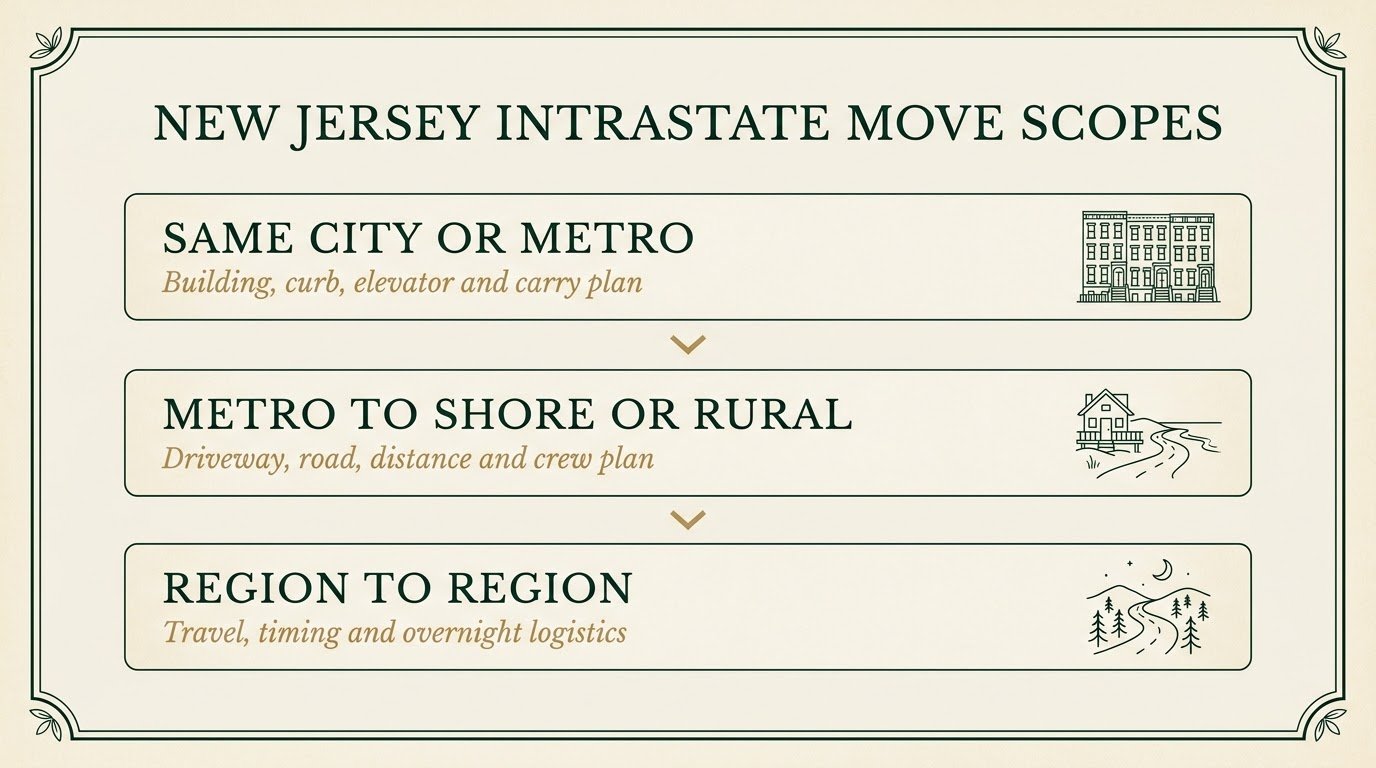
Moving within New Jersey usually falls into one of two patterns, and the planning differs between them. A local move stays inside a single municipality — a new apartment across Hoboken, a larger house elsewhere in your township. These moves are shaped by municipal rules: many New Jersey cities require a temporary no-parking permit to reserve curb space for the truck, and buildings with elevators or loading docks expect advance reservations. In the dense northeastern corridor, a move of a few blocks can still require a permit application, a posted notice period, and coordination with building management at both addresses.

A metro-area move crosses municipal lines inside the same region — for example, from Jersey City to Montclair, or from Edison to Princeton. In New Jersey these moves are short in miles but often significant in logistics. Northeastern New Jersey functions as an extension of the New York City metropolitan area, so congestion, toll crossings, and curb-space scarcity follow you between towns. Moves within the state that pass near Manhattan may touch Port Authority crossings with strict truck rules, and toll choices materially affect cost and timing.

Timing matters in both cases. Rush-hour traffic on the Turnpike, the Parkway, and the approaches to the Hudson crossings can add hours to a short move, and summer shore traffic compresses weekend scheduling across the state's southern half. Early-morning load-outs and mid-week move days routinely save meaningful time in North Jersey's urban core.

At Sterling Oakbridge, we plan both patterns the same way — survey, written scope, named crew — but we price and schedule them against the realities of the corridor they travel. Knowing which pattern your move follows helps you anticipate permits, tolls, and timing before the calendar is committed.

Paterson, New Jersey — dense urban residential blocks
Urban curb permits and suburban driveway conditions create different staging, parking, and carry plans.

City coverage

Major New Jersey cities we serve

Smaller communities are covered by the nearest service hub — ask a coordinator about yours.

Ask a coordinator

New Jersey planning

Urban, Suburban, Shore, and Rural Moves: What to Expect

New Jersey packs four distinct moving environments into one small state. In the urban northeast — Newark, Jersey City, Hoboken, Paterson, and the older Essex and Hudson County streetcar suburbs — moves contend with narrow pre-war streets, permit-only curbside parking, three-story walk-ups, and multi-family buildings with no loading zone. Many urban moves here need a municipal temporary no-parking permit and, when a full-size truck cannot reach the block, a smaller shuttle vehicle staged from a legal staging point.

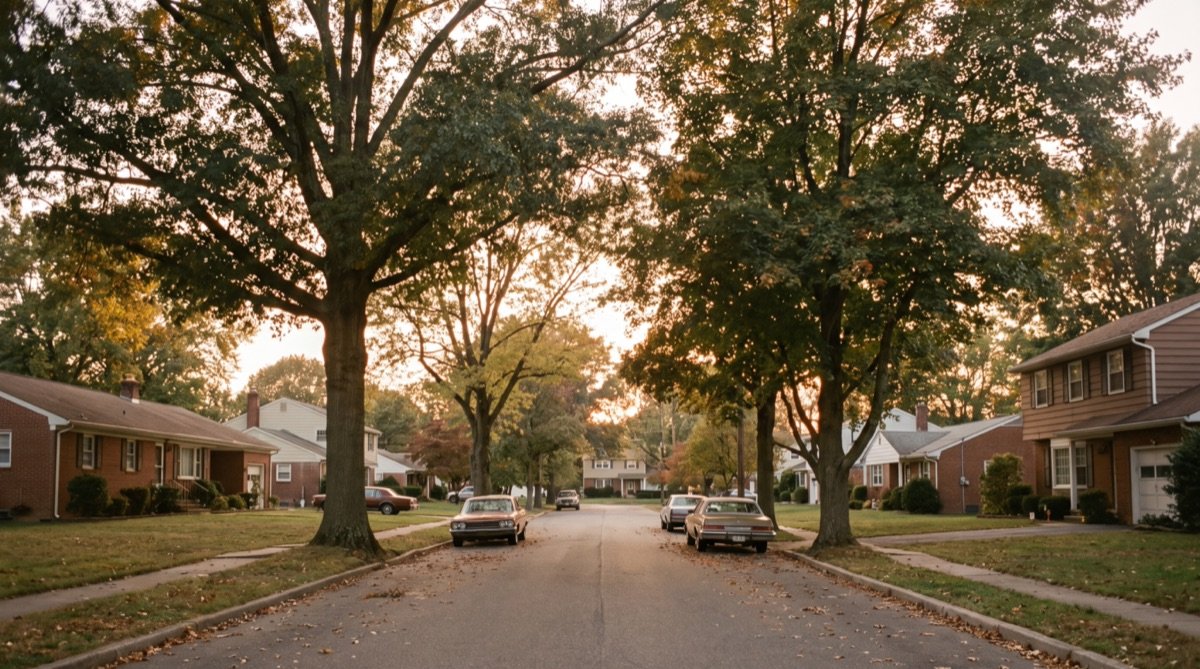
Suburban New Jersey — the township belt across Bergen, Morris, Somerset, Middlesex, and Mercer counties — offers driveways, garages, and wider streets, which simplify loading. The frictions here are softer but real: homeowners' association rules about truck parking and moving hours, cul-de-sac turning radiuses, and long interior streets that push the carry distance from the truck to the front door.

Shore moves follow their own calendar. From Long Branch to Atlantic City, many properties are seasonal — raised beach bungalows, condominiums, and summer rentals with tight turnover windows between Memorial Day and Labor Day. Access can mean pilings, exterior stairs, narrow island streets, and bridges to barrier islands that queue severely on summer weekends. Friday-southbound and Sunday-northbound congestion on the Garden State Parkway compresses scheduling windows throughout the season.

Rural New Jersey is smaller than people expect, but it exists: the farm country of Warren, Sussex, and Hunterdon counties, and the Pinelands communities of the southern interior. Here the challenges are distance and surface — unpaved lanes, properties set well back from the road, weight-restricted local bridges, and winter conditions that arrive earlier than on the coast. Across all four settings, Sterling Oakbridge plans access before move day, because in New Jersey the address itself usually determines the equipment and the crew size.

Trenton, New Jersey — residential property types
Older rowblocks, detached homes, narrow lots, and curb access can change truck placement and carry distance.

How a New Jersey move works

Five checkpoints from first call to final room.

Hudson waterfront high-rise, suburban township colonial, or shore bungalow — the sequence stays the same. Each checkpoint produces the information the next one needs, so move day never becomes the first time someone discovers a narrow stair, a municipal parking rule, or a storm restriction.

  1. 1

    Conversation

    Tell us the dates, both addresses, the inventory, and what needs special care.

  2. 2

    Survey

    We inspect the home in person or by video and verify access and parking at both ends.

  3. 3

    Plan and quote

    You receive an itemized written scope with crew, materials, timing, and price.

  4. 4

    Prepare and move

    The crew protects the property, packs to the inventory, loads, and transports.

  5. 5

    Deliver and place

    Inventory is reconciled item by item, and furniture is placed to the agreed plan.

Ready when you are

Have the dates and both New Jersey addresses?Share the two properties and the inventory. We will turn the survey into a written, itemized estimate.

New Jersey planning

New Jersey's Intrastate Regions and Moving Corridors

New Jersey's regions are defined less by distance than by character — the state is only about 170 miles end to end, yet a move between regions crosses meaningfully different housing stock, road networks, and local rules. Sterling Oakbridge uses the following working breakdown when planning intrastate relocations.

Major Intrastate Regions

  • The Gateway Region and Gold Coast: Essex and Hudson counties — Newark, Jersey City, Hoboken, Union City, and their neighbors — anchor the state's dense urban core, effectively an extension of New York City. Moves here are apartment- and multi-family-heavy, with curb permits, elevator reservations, and shuttle-truck staging as standard planning items.
  • North Jersey: Bergen and Passaic counties and the I-287 office belt through Morris County. Established commuter suburbs, corporate relocations, and steady family-move churn along the Garden State Parkway, Route 4, and Route 17 corridors.
  • Central Jersey: Middlesex, Mercer, and Somerset counties — the Route 1 corridor from New Brunswick through Princeton to Trenton. Rutgers-driven turnover, corporate transfers, and large suburban townships define this market.
  • The Jersey Shore: Monmouth and Ocean counties, from Red Bank and Asbury Park down through Toms River and Lakewood to Atlantic City. Retirement moves, seasonal shore houses, and fast-growing year-round communities, with a summer calendar that dictates scheduling.
  • South Jersey: Camden and the Philadelphia-facing suburbs across the Delaware River, plus Vineland, Millville, and the agricultural interior. Waterfront apartments and affordable single-family moves tied to the Philadelphia metro's road network.
  • The Northwest and Pinelands: Sussex, Warren, and Hunterdon counties in the highlands, and the Pine Barrens communities inland from the Shore. Longer travel distances, rural access roads, and terrain that affects truck and equipment choices.

Key Moving Corridors

New Jersey's intrastate moves run on a small set of backbone routes. The New Jersey Turnpike and parallel I-95 carry the northeast spine from the George Washington Bridge area to the Delaware crossings; the Garden State Parkway serves the Shore but prohibits heavy trucks north of Interchange 105, which pushes shore-bound moving trucks onto the Turnpike, I-195, or US-9; I-78 links the Lehigh Valley gateway to the ports and Newark; I-80 crosses the state's northern tier from the Delaware Water Gap to the George Washington Bridge area; and I-287 forms the suburban beltway that ties them together. Because these corridors are also some of the most congested in the country, departure time is a planning variable, not an afterthought.

Regional Considerations for Moving

A move from Morristown to Toms River is under sixty miles, but it crosses three different planning environments: suburban curb access, a toll-road routing decision forced by the Parkway truck rule, and shore-town parking. Sterling Oakbridge scopes every intrastate move against the regions it touches, so routing, permits, and crew equipment match the addresses rather than the mileage.

How move planning changes within the state.

County guides

Moving services by county

From the Gold Coast to the Shore, New Jersey plans by the county. Each county guide lists the communities we cover inside it.

Bergen County, New Jersey — atlas-style county outline
North JerseyPop. ~962,000

Bergen County

NJ's most populous county — established suburbs, NYC commuters and constant family-move churn along the GSP and Route 4.

Key communities

Hackensack Paramus Fort Lee

Explore Bergen County
Middlesex County, New Jersey — atlas-style county outline
Central JerseyPop. ~871,000

Middlesex County

The heart of Central Jersey — Route 1 corporate corridor, Rutgers-driven turnover and big suburban townships.

Key communities

New Brunswick Woodbridge Old Bridge

Explore Middlesex County
Essex County, New Jersey — atlas-style county outline
Gateway RegionPop. ~863,000

Essex County

Dense urban core of the Gateway Region — Newark's revival plus heavy apartment-move volume in its older suburbs.

Key communities

Newark East Orange Montclair

Explore Essex County
Hudson County, New Jersey — atlas-style county outline
Gold CoastPop. ~718,000

Hudson County

The Gold Coast — waterfront high-rises and young-professional moves with Manhattan skyline views.

Key communities

Jersey City Hoboken Union City

Explore Hudson County
Ocean County, New Jersey — atlas-style county outline
Jersey ShorePop. ~654,000

Ocean County

Retiree and Shore-county giant — senior moves, seasonal shore houses and Lakewood's booming households.

Key communities

Toms River Lakewood Point Pleasant

Explore Ocean County
Monmouth County, New Jersey — atlas-style county outline
Jersey ShorePop. ~645,000

Monmouth County

Affluent Shore suburbs — beach-town relocations from Red Bank to Asbury Park and horse-country estates inland.

Key communities

Long Branch Red Bank Asbury Park

Explore Monmouth County

Moving outside these primary six counties? We cover all 21 New Jersey counties via our regional service hubs.

Check your township access

New Jersey planning

New Jersey Housing Stock: Property Types, Age, and Access

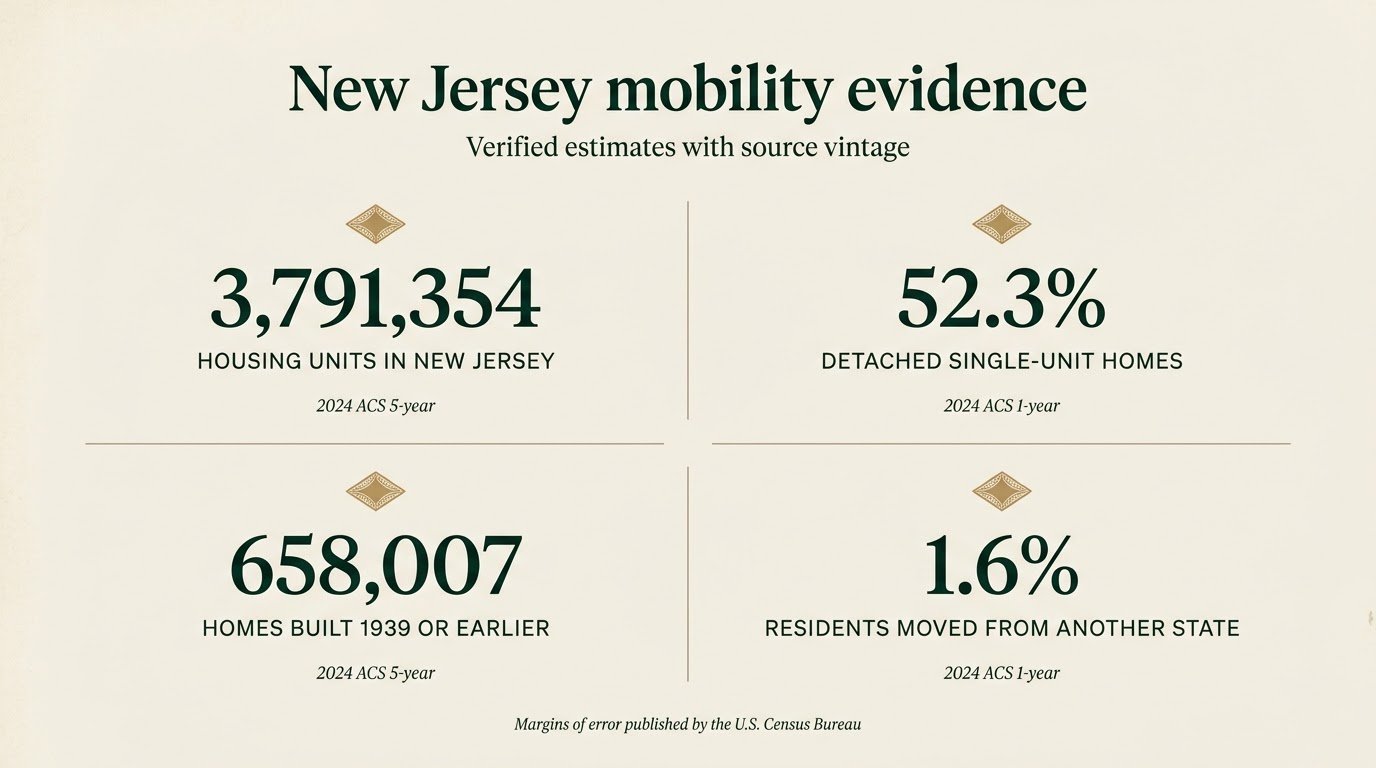
New Jersey's housing stock directly shapes how moves are planned, priced, and executed. According to the 2024 American Community Survey (ACS) 5-year estimate, the state contains 3,791,354 housing units.[^1] The 2024 ACS 1-year estimate reports that 52.3% of those units are detached single-unit structures — a lower share of detached homes than in most states, reflecting New Jersey's dense development pattern.[^2]

In practice, this means nearly half of New Jersey moves involve attached or multi-unit housing: the rowblocks and triple-deckers of Newark, Paterson, and Elizabeth; the brownstones and high-rises of Jersey City and Hoboken; garden-apartment complexes across the suburbs; and shore condominiums along the coast. These property types introduce building management rules, elevator reservations, certificate-of-insurance requirements, and shared hallways that must be protected during the move — details a coordinator confirms during the survey.

Age compounds the complexity. The 2024 ACS 5-year estimate counts 658,007 New Jersey housing units built in 1939 or earlier — 17.4% of the state's total stock.[^3] Pre-war construction typically means steep, narrow staircases, tight turns at landings, small doorways, and no elevators. Large furniture may require disassembly, banister protection, or — in the toughest cases — hoisting through a window. Sterling Oakbridge's on-site or virtual survey exists precisely to identify these conditions before move day rather than on it.

Access conditions vary by region. Urban blocks in Hudson and Essex counties often offer no legal place to put a truck without a municipal permit. Suburban properties usually allow driveway staging but may sit on long interior streets or cul-de-sacs. Shore properties can mean exterior stairs, pilings, and narrow island lanes. Rural homes in the northwest may sit behind long gravel drives. When you request an estimate, sharing photographs or a video walk-through of both properties lets us plan the right crew, equipment, and vehicle for the actual conditions.

For readers who want the underlying numbers, the following Census Bureau sources provide the detailed breakdowns:

[^1]: 2024 ACS 5-year B25024 [^2]: 2024 ACS 1-year Data Profile DP04 [^3]: 2024 ACS 5-year B25034

Sterling Oakbridge movers in branded green shirts unloading a branded truck on a sloped New Jersey driveway
Sloped drives, curbs, stairs, and the distance to the truck should be checked before move day.

New Jersey planning

New Jersey Intrastate Mover Licensing and Consumer Protections

New Jersey regulates household-goods movers more directly than many states, and knowing the framework helps you verify any company you consider. Intrastate movers — those operating entirely within New Jersey — are licensed and overseen by the New Jersey Division of Consumer Affairs, part of the Department of Law and Public Safety, through its Regulated Business Section under the Public Movers and Warehousemen program (N.J.A.C. 13:44D).

Licensing and Verification

Every public mover and warehouseman operating intrastate must hold a state license in one of three classes: PM (moving only), PW (warehousing only), or PC (a combination license). Before booking, you can confirm a mover's license status and complaint history through the state's online verification portal at newjersey.mylicense.com/verification/ or by calling the Division at (973) 504-6200.[^1] Hiring an unlicensed mover forfeits most of the protections described below.

Required Paperwork

State rules prescribe a specific document sequence. Before your move, the mover must perform an on-site or virtual survey of your goods and provide a written estimate calculated from its tariff of rates on file with the Division, along with the state-approved brochure “Important Notice to Consumers Using Public Movers and Warehousemen.” Once you select a mover, it must issue an Order for Service at least 24 hours before the scheduled move date, and a Bill of Lading when the move is completed.[^2] Binding (fixed-price) estimates may be requested, but movers are not required to offer them — so read the estimate type carefully before signing.

Liability Limits

Default mover liability in New Jersey is limited by regulation: under N.J.A.C. 13:44D-4.6, a mover is required to compensate only up to $1.00 per pound per article for loss or damage unless you purchase increased valuation or insurance.[^1] Movers are also not responsible for items of extraordinary value — jewelry, money, or valuable papers — which you should never pack with general household goods. For high-value belongings, ask about declared-value coverage in writing before move day.

For the complete consumer guidance, see the NJ Division of Consumer Affairs Public Movers and Warehousemen page and its consumer FAQ. Sterling Oakbridge encourages every customer to verify licenses and keep copies of the estimate, Order for Service, and Bill of Lading.

[^1]: NJ Division of Consumer Affairs — Public Movers FAQ [^2]: NJ Division of Consumer Affairs — Public Movers and Warehousemen

Accountability in the plan

A careful move leaves a paper trail.

New Jersey requires every licensed intrastate mover to survey your goods and provide a written estimate. We go further: three records are assembled during planning and travel with the move from the survey to final placement.

01 Condition record

Photographed inventory

Furniture, cartons, fragile finishes, and special-handling pieces are photographed before loading and reconciled item by item at delivery.

How the survey records condition

02 Written scope

Line-by-line planning

Crew, materials, protection, access, transport, timing, and placement appear as line items you can review and approve — the written estimate New Jersey law expects, explained before you sign.

What the written estimate includes

03 Property file

Access documentation

Municipal parking permits, curb space, crossing restrictions, and seasonal storm orders are collected and assigned to the plan before move day.

How difficult access is planned

New Jersey planning

Interstate Moves: What New Jersey Residents Need to Know

The moment a move crosses a state line — even the short hop from Fort Lee across the Hudson — it becomes an interstate move governed by federal rather than New Jersey rules. The Federal Motor Carrier Safety Administration (FMCSA) registers and oversees interstate household-goods carriers, and any mover you hire for a state-to-state relocation must hold federal operating authority.

FMCSA regulations entitle you to specific documents and disclosures, including a written estimate, a bill of lading that serves as your contract and receipt, and the federal consumer booklet “Your Rights and Responsibilities When You Move.” Interstate movers must also offer you a choice of liability coverage levels for your shipment. You can verify a carrier's federal registration and complaint record through FMCSA's online tools before signing anything.

Your destination state may layer on its own requirements — vehicle registration deadlines, driver licensing timelines, or its own intrastate mover rules if you book a local move at the far end. At Sterling Oakbridge, we track both the federal framework and destination-state requirements for every interstate job, and we encourage customers to review the official resources and ask questions early.

New Jersey planning

Seasonal and Weather-Related Moving Considerations

New Jersey's seasons shape moving logistics in two distinct ways: winter storms that can restrict commercial vehicles with only a few hours' notice, and a summer shore season that compresses traffic and scheduling across the state's southern half. Planning around both is part of a well-run New Jersey move.

Unlike Pennsylvania, New Jersey has no standing tiered winter vehicle-restriction plan. Instead, the New Jersey Department of Transportation issues per-storm commercial vehicle travel restrictions by Administrative Order, coordinated with neighboring states. During the February 22–23, 2026 blizzard, for example, restrictions applied in both directions on I-76, I-78, I-80, I-195, I-280, I-287, I-295, I-676, and NJ Route 440 — covering all tractor trailers, empty straight CDL trucks, passenger vehicles pulling trailers, recreational vehicles, and motorcycles, though not the Turnpike, Parkway, or Atlantic City Expressway. An emergency 35 mph speed limit can accompany such an order.[^1] Between December and March, a nor'easter can ground a moving day on short notice, so winter moves should always carry a contingency window.

Storm restrictions and their lifts are posted through 511NJ — the state's free traveler-information service, reachable at 511nj.org or by dialing 511 — and in NJDOT announcements. NJDOT's winter operation covers 13,341 lane-miles of Interstate, US, and state routes with 66 highway operations crews, 68 salt storage facilities holding up to 228,000 tons of salt, and more than 500 trucks.[^2]

Summer brings the opposite constraint. From Memorial Day to Labor Day, Friday-southbound and Sunday-northbound congestion on the Garden State Parkway and the shore approaches is severe, and shore-town turnover weekends pack rental changeovers into narrow windows. Sterling Oakbridge monitors 511NJ and NJDOT orders in winter and schedules shore moves around known traffic peaks in summer; we recommend customers keep at least one flexible day on either side of a winter or peak-summer move date.

[^1]: NJDOT Commercial Vehicle Travel Restrictions, February 2026 [^2]: NJDOT Winter Readiness FAQ

A Sterling Oakbridge coordinator in a branded green shirt checking icy brownstone steps in winter
Patchy snow, wet pavement, and shaded sidewalks can affect timing, footing, and the path from the home to the truck.

New Jersey planning

Truck Routing, Parking, and Permits in New Jersey

New Jersey's road rules impose more constraints on moving trucks than most states, and three of them shape nearly every route plan: the Garden State Parkway's truck prohibition, the Hudson River crossing restrictions, and municipal curb-permit systems. A move that ignores any one of them risks a detour, a fine, or a truck that cannot legally reach the address.

The Garden State Parkway Truck Rule

Heavy trucks — those registered at 10,000 pounds or more, with six tires or three or more axles — are prohibited on the Garden State Parkway north of Interchange 105 in Toms River.[^1] Most full-size moving trucks and all tractor-trailers therefore cannot use the Parkway's northern stretch into the New York metro area and must route via the New Jersey Turnpike, I-287, or US-9 instead. South of Interchange 105 the Parkway remains the primary shore corridor, which is why shore-bound moves often combine both road systems in a single run.

Turnpike and the National Network

The New Jersey Turnpike is fully open to trucks and forms part of the state's designated National Network under N.J.A.C. 16:32, alongside the Interstate highways and the Atlantic City Expressway. Large (102-inch-wide) trucks are expected to stay on the National Network except when seeking food, fuel, rest, repairs, or reaching a terminal by the shortest direct route — so moving trucks keep to the Turnpike and Interstates as long as practical before turning onto local roads.[^2]

Hudson River Crossings

Moves that cross into New York face strict Port Authority rules. The Holland Tunnel prohibits all recreational vehicles, all vehicles with four or more axles, and all combination vehicles — no tractor-trailers or semi moving vans at all. On the George Washington Bridge, trucks are permitted but must use the upper level; trucks, RVs, and combination vehicles are barred from the lower level. In the Lincoln Tunnel, trucks may not use the center tube, RVs are prohibited, and hazardous materials are banned in both tunnels. Width is limited to 8 feet 6 inches; height limits are 13 feet 6 inches on the George Washington Bridge and 13 feet in the Lincoln Tunnel.[^3] All six Port Authority crossings charge per-axle tolls, so crossing choice and E-ZPass materially affect a move's cost.

Municipal Curb Permits

Curb-space reservation in New Jersey is municipal, not state — and with 564 municipalities, the process varies town by town. In Hoboken, for example, residents and businesses purchase Temporary No Parking signs to reserve on-street space for a moving truck, sold in 4-, 8-, 12-, and 24-hour increments, with a real-time city map showing active reservations; the Division of Transportation and Parking handles applications at 201-420-2000, extension 1470.[^4] Other cities run similar systems under different names. Sterling Oakbridge verifies the permit requirement at both addresses during the survey — in dense North Jersey blocks, it is often the single detail that determines whether move day starts on time.

[^1]: NJ Turnpike Authority — Toll Calculator (Garden State Parkway vehicle classes) [^2]: NJDOT — Truck Routing Regulations (N.J.A.C. 16:32) [^3]: Port Authority of NY & NJ — Bridge and Tunnel Restrictions [^4]: City of Hoboken — Temporary No Parking Signs

Cherry Hill, New Jersey — suburban residential street
A correctly scaled 26-foot truck needs a clear driveway, safe approach, and enough turning room before loading begins.

Moving routes

From around the block to across the country.

Most New Jersey moves are short and local. We plan all three ranges the same way — survey, written schedule, named crew.

Local · inside New Jersey

Intrastate Corridors

Same-day or overnight point-to-point moves across the Turnpike, Parkway, and I-287 corridors.

Newark Trenton

Turnpike spine transit; capital-district placement on a written schedule.

Jersey City Princeton

Gold Coast high-rise staging to the Route 1 corridor; elevator windows at both ends.

Edison Toms River

Central Jersey to the Shore; routing planned around the Parkway truck rule.

Newark Cherry Hill

North-to-South Jersey run; Turnpike direct with a timed delivery window.

View local moving service

Regional · Northeast network

Tri-State & Mid-Atlantic

Expedited corridors across our East Coast network, under 400 miles.

New York City Jersey City / HobokenActive network
New York RingoesActive Guide

Urban departure planning followed by rural road, driveway, and long-carry decisions in Hunterdon County.

Hudson crossings set the truck plan — GWB upper level, per-axle tolls, building certificates on both sides.

New York Princeton

I-95 and NJ Turnpike shuttle; freight dock and curb permit management.

Philadelphia Cherry Hill

Delaware River bridge crossings; short-hop interstate under federal rules.

Newark Philadelphia

Turnpike end to end; guaranteed delivery time slots.

Explore regional white-glove

Dedicated vansLong-distance · coast to coast

National Corridors

Dedicated cross-country trucks with locked delivery windows and no consolidation.

New Jersey FloridaMajor corridor

Primary East Coast retirement & corporate relocation lane (I-95 corridor).

New Jersey TexasSouthwest lane

Austin, Dallas-Fort Worth, and Houston executive relocations.

New Jersey CaliforniaCoast to coast

Bay Area & Southern California; climate-controlled cross-country transport.

Dedicated trucks, direct delivery windows

Long-distance service

* All routes include in-home or video survey, itemized written estimate, and dedicated carrier protection.

Request custom route scope

New Jersey planning

Packing, Specialty Items, and Access Challenges

New Jersey's housing stock creates a packing environment unlike most states: 17.4% of its homes predate 1940, and nearly half of all units are attached or multi-unit structures. From the brownstones of Jersey City and the triple-deckers of Paterson to shore cottages raised on pilings, the building itself often dictates how belongings must be packed, protected, and carried.

Pre-war construction is the recurring challenge. Steep staircases with tight landings, narrow doorways, low basement ceilings, and no elevators mean large furniture frequently requires disassembly and reassembly, banister and door-jamb protection, and measured turns planned in advance. Upright pianos, armoires, and antique case goods may need custom crating or, where stairs genuinely cannot accommodate them, hoisting through a window — an option we evaluate during the survey, never improvise on move day.

Multi-unit buildings add a procedural layer: elevator reservations, certificate-of-insurance requirements, restricted moving hours, and hallways and lobbies that must be protected with floor runners and corner guards before the first carton moves. Shore properties bring exterior stairs, salt air, and moisture, which call for appropriate wrapping on wood furniture and electronics, especially for moves that include a storage leg.

For delicate or high-value belongings — artwork, antiques, instruments, collections — our Fine Art & Antiques service provides custom crating and condition-documented handling. Our Packing Services adapt to everything from a full-house pack in a Morristown colonial to a partial pack of fragile items in a Hoboken walk-up. Whatever the property, the survey produces a packing plan matched to its actual constraints.

Morristown, New Jersey — historic residential district
Pre-war housing stock sets the packing plan before the first carton is sealed.

New Jersey planning

Observed Migration Flows: New Jersey Inbound Moves

Census data offers one verified window into how many people move into New Jersey from other states. According to the 2024 American Community Survey (ACS) 1-year estimate, 1.6% of New Jersey residents age one or older — out of a base population of about 9.4 million — had lived in a different state one year earlier. This measures inbound interstate movers only: people whose previous residence was outside New Jersey.

The figure comes with important boundaries. It does not count people who moved within New Jersey, which is by far the larger share of all moves, and it does not capture outbound movers, international arrivals, or the reasons anyone relocated. The ACS table records where a resident lived one year ago — nothing more.

New Jersey is frequently described in coverage of moving-industry trends as a state with heavy outbound volume, and that pattern is consistent with the demand we see for out-of-state relocations from our New Jersey hubs. But this guide holds to a strict standard: the only migration statistic we cite is the verified ACS figure above. We do not have a verified state-to-state flow table in our source data, so we do not publish inbound-versus-outbound comparisons here.

For us at Sterling Oakbridge, the practical implication of interstate movement — in whichever direction — is that a significant share of New Jersey relocations cross state lines and therefore fall under federal rather than state moving regulations. Readers who want to explore the underlying data can consult the full table from the U.S. Census Bureau: 2024 ACS 1-year Subject Table S0701 (New Jersey).

Verified mobility evidence used in this guide.

New Jersey planning

Limits of Migration Data: What We Know and Don't Know About Why People Move

The ACS tells us how many people arrived in New Jersey from another state — 1.6% of residents age one or older in the 2024 1-year estimate — but it is silent on why. The survey does not ask about employment changes, housing costs, family circumstances, taxes, retirement, or any of the other motivations commonly cited in discussions of New Jersey's population movement.

Sterling Oakbridge uses observed migration figures to anticipate demand and schedule crews, not to explain behavior. Any claim about why people move into or out of New Jersey — whether attributing moves to property taxes, school districts, commute patterns, or cost of living — would go beyond what our verified data supports, so we do not make those claims.

The data's scope is also narrower than it first appears. The 1.6% figure covers only residents age one and older who crossed a state line; it excludes moves within New Jersey, outbound movers, international migration, and temporary relocations. Understanding motivations would require purpose-built survey research. Until such data exists in a verifiable form, our planning guidance rests solely on the observed flows the Census Bureau publishes, without inferred causes.

New Jersey planning

Planning Moves to and from Adjacent States

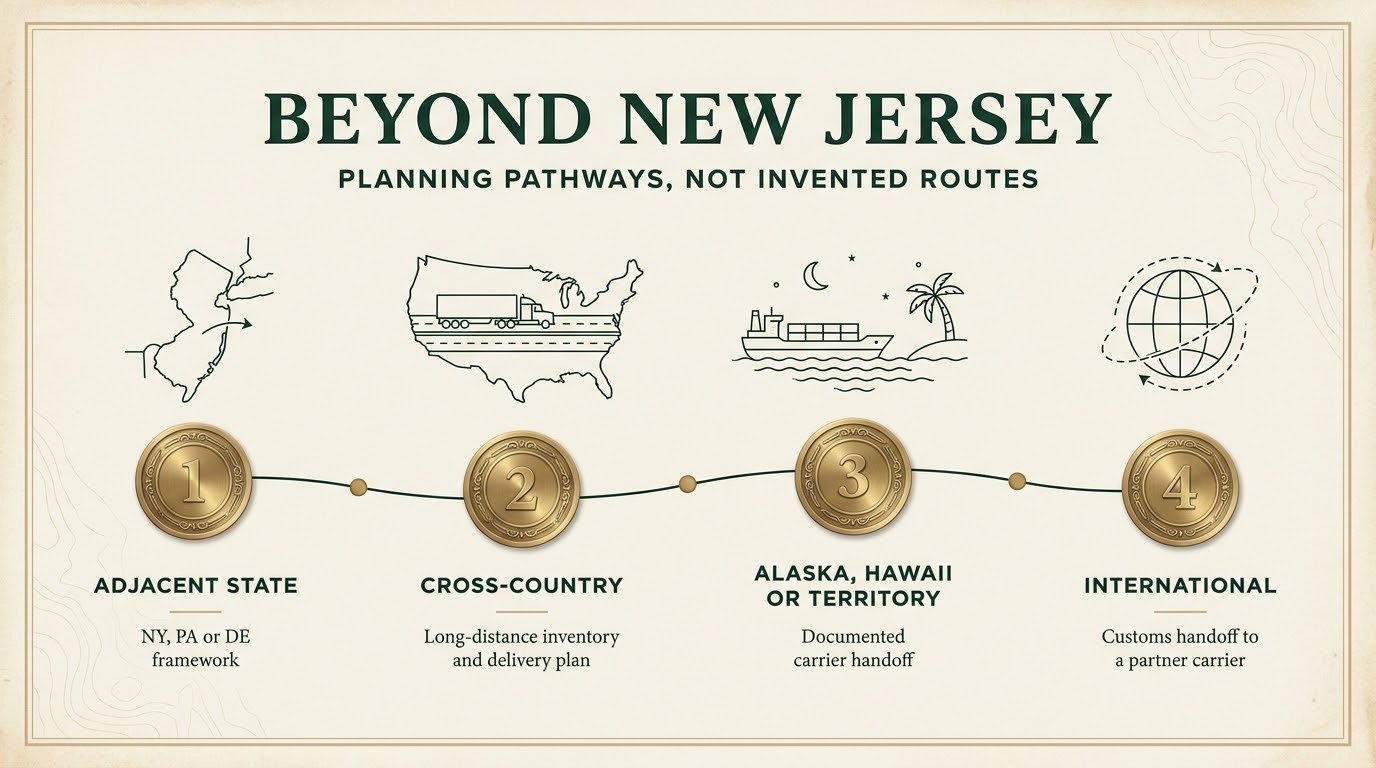
New Jersey borders three states — New York, Pennsylvania, and Delaware — and moves across each boundary carry distinct logistics despite short distances. These are interstate moves in the legal sense: federal FMCSA rules apply from the moment the truck crosses the line, regardless of how few miles separate the two addresses.

New York. This is New Jersey's busiest state-line corridor, concentrated on the Hudson River crossings. The Port Authority's restrictions directly shape truck routing: no combination vehicles in the Holland Tunnel, trucks confined to the upper level of the George Washington Bridge, and no trucks in the Lincoln Tunnel's center tube. Per-axle tolls at all six crossings make route selection a real cost decision, and building requirements — certificates of insurance, elevator windows, freight reservations — are common on both sides of the river. Many Jersey City, Hoboken, and Fort Lee moves are shorter than crosstown relocations yet involve more coordination.

Pennsylvania. Moves across the Delaware River connect South Jersey to the Philadelphia area and the I-78/I-80 corridors to the Lehigh Valley and the Poconos. Pennsylvania regulates its own intrastate movers through the Public Utility Commission — a separate framework from New Jersey's Division of Consumer Affairs — so a company handling the Pennsylvania end of a move operates under a different licensing regime. River crossings on the I-95, Betsy Ross, Ben Franklin, Walt Whitman, and Delaware Memorial corridors carry toll considerations of their own.

Delaware. The Delaware Memorial Bridge links South Jersey to Wilmington and points south, and the Cape May–Lewes Ferry offers a seasonal alternative for certain routings. Delaware-bound moves are straightforward logistically but still interstate: federal carrier rules, a written estimate, and a bill of lading apply throughout.

In all three directions, Sterling Oakbridge plans the crossing, the tolls, and the destination access as a single scope. Short miles do not mean simple moves — verify both ends before the date is set.

New Jersey planning

Long-Distance and Cross-Country Moves from New Jersey

A long-distance move from New Jersey begins with an advantage and a constraint. The advantage is position: the state sits at the junction of I-95, I-80, and I-78, so trucks can reach the Southeast, the Midwest, and New England without a wasted leg. The constraint is exit: getting a loaded truck out of the dense northeast corridor — around crossing restrictions, toll plazas, and metro congestion — requires the first hundred miles to be planned as carefully as the last thousand.

Route planning accounts for season as well as geography. Winter storms can trigger NJDOT commercial vehicle restrictions on New Jersey's interstates, and the same weather systems affect I-80 through Pennsylvania and the mountain corridors beyond. Summer brings shore traffic and peak-season scheduling pressure nationwide. A realistic calendar includes buffer days at both ends, especially for December-through-March departures.

Delivery coordination matters as much as transport. Long-distance moves run on scheduled pickup and delivery windows, and both addresses may impose their own requirements — elevator reservations, certificates of insurance, parking permits, or restricted delivery hours. Clear communication between the origin coordinator, the driver, and the destination contact keeps the window honest.

Sterling Oakbridge manages long-distance relocations from New Jersey with a written schedule at both ends and the same survey-first discipline as a local move. For details, visit our Long-Distance Moving service page.

Planning pathways for moves that leave the state.

New Jersey planning

Noncontiguous and International Moves: Handoff and Planning

Moves from New Jersey to Alaska, Hawaii, Puerto Rico, or international destinations involve a handoff: your household goods travel by truck to a port or terminal, then transfer to an ocean or air carrier for the over-water leg. That transfer point is where planning matters most, because responsibilities, documentation, and schedules change hands there.

For noncontiguous domestic moves, the ground leg works like any long-distance move — written estimate, inventory, scheduled pickup — but the shipment must be packed to survive a second handling at the port and the conditions of sea or air transit. Shipping schedules are fixed by the carrier, so the pickup date is planned backward from a confirmed sailing or flight, and some categories of items face restrictions on the water leg that do not apply on the highway.

International relocations add customs declarations, destination-country import rules, and documentation requirements that vary by country. Sterling Oakbridge handles the domestic leg — professional packing to export standard, inventoried loading, and coordinated delivery to the departure terminal — and hands off to established international forwarders for the ocean or air segment. We do not provide customs brokerage or direct ocean freight services, and we say so plainly: our role ends where the specialist's begins.

The common requirement across all handoff moves is early planning. Sailing schedules, container availability, and documentation lead times mean these relocations reward customers who begin the process well ahead of the target date. A coordinator can outline the sequence for your specific destination in a single planning call.

New Jersey planning

Cost Drivers and Regional Price Variation in New Jersey

Customers often ask whether moving costs more in one part of New Jersey than another. The honest answer: no verified public source establishes regional price levels for moving services within the state, so we do not claim any. What we can document are the specific factors that move a given job's cost up or down — and in New Jersey, several of them are unusually concrete.

The structural drivers are universal: the volume and weight of your shipment, the distance between addresses, the services you select (packing, storage, crating), and the labor time the properties demand. In New Jersey, labor time is shaped heavily by housing stock — a pre-war walk-up with three flights of stairs takes longer per carton than a ranch with a driveway, which is why the survey, not the zip code, sets the estimate.

The New Jersey-specific drivers are access and tolls. Municipal curb permits, building elevator windows, and shuttle-truck staging add real line items in dense urban moves. Tolls are material: per-axle charges at the six Port Authority Hudson crossings, Turnpike and Parkway tolls scaled by vehicle class, and route choices forced by the Parkway's truck prohibition can each change the cost of an otherwise identical move. Season matters too — late spring through summer is peak demand statewide, and shore-season weekends compress available scheduling.

Because no standardized regional pricing exists, the reliable path is a written estimate based on your actual inventory and both addresses. New Jersey law requires licensed movers to survey your goods and provide that estimate from a tariff on file with the Division of Consumer Affairs — use it. At Sterling Oakbridge, the written scope itemizes crew, materials, tolls, access arrangements, and timing so you can see exactly what drives your number.

New Jersey planning

Planning Your New Jersey Move: Timeline and Key Steps

A smooth New Jersey move is built on a calendar, and the state's regulatory sequence gives that calendar its fixed points: the mover's survey, the written estimate, the Order for Service at least 24 hours before move day, and the Bill of Lading at completion. At Sterling Oakbridge, we recommend the following milestones, adjusted for your own dates.

8 Weeks Before Moving: - Request written estimates from licensed movers and verify each company's PM, PW, or PC license at newjersey.mylicense.com/verification/. - Walk through your home and list everything, flagging pieces that need disassembly, crating, or special handling. - If you want professional packing, reserve Packing Services now — peak-season slots fill first.

6 Weeks Before Moving: - Sort decisively: donate, sell, or discard whatever is not making the trip. - Give notice required by your lease, and ask both buildings about elevator reservations, moving hours, and certificate-of-insurance requirements. - Start collecting boxes and materials for anything you plan to pack yourself.

4 Weeks Before Moving: - Confirm your date, sign with your mover, and make sure you receive the Order for Service at least 24 hours before move day — New Jersey law requires it. - Book Storage if your dates do not align, especially around shore-season turnovers or closing gaps. - File address changes with utilities, schools, and subscription services.

2 Weeks Before Moving: - Apply for municipal temporary no-parking permits at both addresses where required — Hoboken-style TNP systems and their equivalents elsewhere have lead times. - Pack non-essentials and label every carton with its destination room. - Set aside documents, jewelry, and valuables; movers are not responsible for items of extraordinary value, and these travel with you.

1 Week Before Moving: - Assemble a first-night kit: medications, chargers, toiletries, basic tools, and cleaning supplies. - Reconfirm the crew arrival window, the permit postings, and the building reservations at both ends. - Check 511NJ if your date falls in storm season.

Moving Day: - Be on site for the load-out, walk the crew through the inventory, and keep the paperwork within reach. - Do a final sweep of every room, closet, and storage area before the truck departs. - At delivery, reconcile the inventory item by item and keep your Bill of Lading — it is your record of the completed move.

New Jersey planning

Service Options, Routes, and Final Checklist

Sterling Oakbridge provides a full range of moving services across New Jersey, scaled to the size and complexity of your relocation. Every service level follows the same discipline — survey, written scope, named crew — and the differences lie in how much of the work we take off your hands.

Local Moving covers relocations within a New Jersey community or metro area, planned around permits, building rules, and room-by-room placement. White-Glove Moving is our fully managed option: complete packing, crating, inventoried transport, and placement by one dedicated crew from first carton to final room. Long-Distance Moving handles interstate relocations with scheduled pickup and delivery windows, and Storage bridges closing gaps and phased moves with climate-controlled, inventory-tied space.

Routing in New Jersey is never autopilot work. Our coordinators choose between the Turnpike, I-95, I-287, I-78, I-80, and the Parkway's permitted stretches based on the truck's size class, the season, and the day's restrictions — and they route around the crossings the shipment cannot legally use. Multi-stop moves and storage legs are sequenced so the shipment is handled as few times as possible.

Before move day, run the final checklist: - Your written estimate and Order for Service are in hand, and the crew, date, and arrival window are confirmed. - Parking permits, elevator reservations, and building certificates are secured at both addresses. - Everything is packed and labeled, with fragile and high-value items flagged for the crew. - Valuables, documents, and your first-night kit travel with you, not on the truck. - Your coordinator's direct line — and (475) 221-2030 — is saved in your phone.

Choose the service level that matches your household, verify the route against your addresses, and work the checklist. That is how a New Jersey move is done properly. Sterling Oakbridge is ready when you are.

Verified data

New Jersey planning data

Planning factEstimateVintageSource
The 2024 ACS 5-year estimate counts 3,791,354 housing units in New Jersey.3,791,354 housing units2024Source
In the 2024 ACS 1-year estimate, 52.3% of New Jersey housing units were detached single-unit structures.52.3 percent of housing units2024Source
The 2024 ACS 5-year estimate counts 658,007 New Jersey housing units built in 1939 or earlier — 17.4% of the state's total stock.658,007 housing units (17.4 percent)2024Source
In the 2024 ACS 1-year estimate, 1.6% of New Jersey residents age one or older had lived in a different state one year earlier.1.6 percent of population age 1+2024Source
Intrastate household-goods movers in New Jersey must be licensed by the NJ Division of Consumer Affairs under the Public Movers and Warehousemen program (N.J.A.C. 13:44D), in PM, PW, or PC license classes; licenses are verifiable at newjersey.mylicense.com/verification/ or (973) 504-6200.2026Source
NJ movers must survey the goods (on-site or virtual), provide a written estimate from their filed tariff plus the state consumer brochure, and issue an Order for Service at least 24 hours before the scheduled move date.2026Source
Default NJ mover liability is limited to $1.00 per pound per article (N.J.A.C. 13:44D-4.6) unless the customer purchases increased valuation; items of extraordinary value are excluded.$1.00 per pound per article2026Source
Heavy trucks registered at 10,000 lbs or more (6 tires or 3+ axles) are prohibited on the Garden State Parkway north of Interchange 105 (Toms River); shore-bound moving trucks route via the NJ Turnpike, I-287, or US-9.2026Source
Under N.J.A.C. 16:32, the NJ Turnpike, Interstate highways, and the Atlantic City Expressway form New Jersey's designated National Network, which large (102-inch) trucks must use except for food, fuel, rest, repairs, or terminal access.2026Source
Port Authority crossing rules: the Holland Tunnel prohibits all combination vehicles and vehicles with four or more axles; trucks must use the George Washington Bridge upper level; trucks are barred from the Lincoln Tunnel center tube; width limit 8 ft 6 in, height limits 13 ft 6 in (GWB) and 13 ft (Lincoln).2026Source
NJ has no standing tiered winter vehicle-restriction plan; NJDOT issues per-storm commercial vehicle travel restrictions by Administrative Order (the Feb 22–23, 2026 order covered I-76, I-78, I-80, I-195, I-280, I-287, I-295, I-676, and NJ 440, but not the Turnpike, Parkway, or Atlantic City Expressway), with updates posted to 511NJ.2026Source
NJDOT's winter readiness operation covers 13,341 lane-miles with 66 highway operations crews, 68 salt storage facilities (up to 228,000 tons of salt), and over 500 trucks; 511NJ provides year-round traveler information at 511nj.org or by dialing 511.13,341 lane-miles2026Source
Curb-space reservation for moving is municipal in New Jersey: Hoboken, for example, sells Temporary No Parking signs in 4-, 8-, 12-, and 24-hour increments through its Division of Transportation and Parking (201-420-2000 x1470).2026Source

Planning answers

Know how a New Jersey move will be run.

Licensing, written estimates, weather windows, and access — the best time to resolve them is before the calendar is committed.

Ask a coordinator
How does New Jersey regulate moving companies for intrastate moves?

Intrastate movers are licensed by the NJ Division of Consumer Affairs under the Public Movers and Warehousemen program (N.J.A.C. 13:44D), in PM (moving), PW (warehousing), or PC (combination) license classes. Before any move, a licensed mover must survey your goods, provide a written estimate from its filed tariff and the state consumer brochure, and issue an Order for Service at least 24 hours before move day. Verify any mover's license at newjersey.mylicense.com/verification/ or call (973) 504-6200.

What is my mover liable for if something is damaged during a New Jersey move?

By default, less than most people expect: under N.J.A.C. 13:44D-4.6, a mover must compensate only up to $1.00 per pound per article for loss or damage unless you purchase increased valuation or insurance. Items of extraordinary value — jewelry, money, valuable papers — are excluded entirely and should travel with you, never on the truck. Ask for declared-value coverage in writing before move day if your shipment warrants it. Source: NJ Division of Consumer Affairs

How do moves work in dense North Jersey cities like Hoboken or Jersey City?

Urban New Jersey moves run on permits and reservations. Most dense municipalities require a temporary no-parking permit to reserve curb space for the truck — Hoboken, for instance, sells Temporary No Parking signs in 4-, 8-, 12-, and 24-hour increments through its Division of Transportation and Parking. Buildings add elevator windows, certificate-of-insurance requirements, and restricted moving hours, and walk-up blocks may need a smaller shuttle vehicle. We verify the permit process at both addresses during the survey. Source: City of Hoboken

What should I know about moving to or from the Jersey Shore?

Two rules shape shore moves. First, heavy trucks (10,000 lbs or more registered weight) are banned from the Garden State Parkway north of Interchange 105 in Toms River, so full-size moving trucks often route via the Turnpike, I-287, or US-9. Second, the summer season — Memorial Day to Labor Day — brings severe Friday-southbound and Sunday-northbound congestion and tight rental-turnover windows. Mid-week, off-peak move dates work best. Source: NJ Turnpike Authority

How do I coordinate a move between New Jersey and New York City?

Hudson crossings dictate the truck plan. The Holland Tunnel prohibits all combination vehicles and vehicles with four or more axles, so tractor-trailers cannot use it; trucks must take the George Washington Bridge's upper level; and the Lincoln Tunnel bars trucks from its center tube. All six Port Authority crossings charge per-axle tolls, so route choice affects cost directly. These are also interstate moves — federal FMCSA rules apply despite the short distance. Source: Port Authority of NY & NJ

How does New Jersey's housing stock affect packing and move day?

New Jersey has 3,791,354 housing units, of which 52.3% are detached single-unit homes and 658,007 (17.4%) were built in 1939 or earlier. Pre-war homes mean steep stairs, tight turns, small doorways, and no elevators — conditions that call for disassembly, property protection, and sometimes hoisting rather than improvising on move day. Nearly half the state's units are attached or multi-unit, adding building rules to the list. The survey identifies all of this in advance. Source: 2024 ACS

Can winter weather cancel or delay my New Jersey move?

Yes — New Jersey issues per-storm commercial vehicle restrictions by NJDOT Administrative Order rather than a standing tiered plan. During the February 2026 blizzard, restrictions covered tractor trailers and other vehicle classes on I-76, I-78, I-80, I-195, I-280, I-287, I-295, I-676, and NJ 440 (but not the Turnpike or Parkway). Orders are posted to 511NJ, sometimes with only hours of notice, so December-through-March moves should keep a flexible backup date. Source: NJDOT

What is the recommended timeline for planning a New Jersey move?

Begin eight weeks out: request written estimates and verify mover licenses at newjersey.mylicense.com/verification/. At six weeks, sort and declutter, and ask both buildings about elevator and insurance requirements. At four weeks, sign with your mover and arrange storage if dates gap. At two weeks, apply for municipal no-parking permits at both addresses and pack non-essentials. At one week, reconfirm the crew, permits, and reservations, and check 511NJ in storm season. Keep your Bill of Lading after delivery — it is your record of the completed move.

How many people move into New Jersey from other states each year?

The 2024 American Community Survey 1-year estimate reports that 1.6% of New Jersey residents age one or older had lived in a different state one year earlier, from a base population of about 9.4 million. The figure counts inbound interstate movers only — it excludes moves within New Jersey, outbound movers, and international arrivals, and the ACS does not record why anyone moved. Source: 2024 ACS

A plan for your actual move

Request your free written estimate.

Meet a coordinator at your home or walk us through both New Jersey properties by live video. We will review the inventory, access, packing, timing, and placement before preparing an itemized written quote.

A Sterling Oakbridge move coordinator in the planning office