Vermont / City relocation guide

Moving to Burlington

Moving to Burlington means choosing both a home and a workable daily routine. Lakefront paths, older residential blocks, downtown apartments and the North Avenue corridor offer different starting points. Confirm the municipality, test the address and connect possession, school registration, utilities and lawful truck access before moving day.

Woman with a tote walking past a bookshop and bakery on a brick storefront block
A useful neighborhood comparison includes the walk to everyday shops from the actual front door.

01 /

Choose the route that matches your decision

If you are still choosing a home, begin with the neighborhood comparisons, housing costs and everyday travel. Compare specific properties against the same routine: the start of work, school pickup, groceries, an evening return and the journey in winter. An attractive listing is only one part of a workable address.

If you are moving with children, read the school section early. Burlington elementary placement involves preferences and available capacity; the nearest school is not an automatic assignment. Keep the school process moving while you confirm the lease or purchase and obtain the documents staff need.

If you already have an address, start with possession, utilities and the full carrying route. Then settle the truck or container position, building permissions, packing and waste. Put a named owner and confirmation beside each dependency. “Someone is handling it” is difficult to use when keys or access are delayed.

The Burlington moving page explains the services and information for an estimate. This guide handles the local decisions you can make alongside that review. You do not need to finish every administrative task before asking about the move, but you do need to identify what remains uncertain.

02 /

Confirm the city, then test the block

This guide concerns the City of Burlington, Vermont. Do not extend its rules to every address described as Burlington or to the wider Burlington–South Burlington area. Confirm the legal municipality on the property record or with the local office, then use that municipality’s schools, street authority and service information.

Within the city, begin with the pattern you need: a North Avenue residential setting, an older Old North End block, a downtown apartment, a South End address or a Hill Section home. These are starting points for inspection. A neighborhood name does not tell you the number of units, school assignment, heating fuel, parking right or the width of the entrance.

The City’s New North End planning page still distinguishes proposals and public review from existing conditions. The downtown and waterfront plan contains older project descriptions and schedules. Use planning sources to understand character and direction, then verify the present building and street. Do not count an anticipated development as an available home or completed amenity.

Check the last part of the approach as carefully as the general location. Burlington identifies private and unaccepted streets that are outside its accepted public network. For a shared or private lane, determine the owner, maintenance arrangement and person who can permit a delivery. A paved surface and a street sign do not settle those questions.

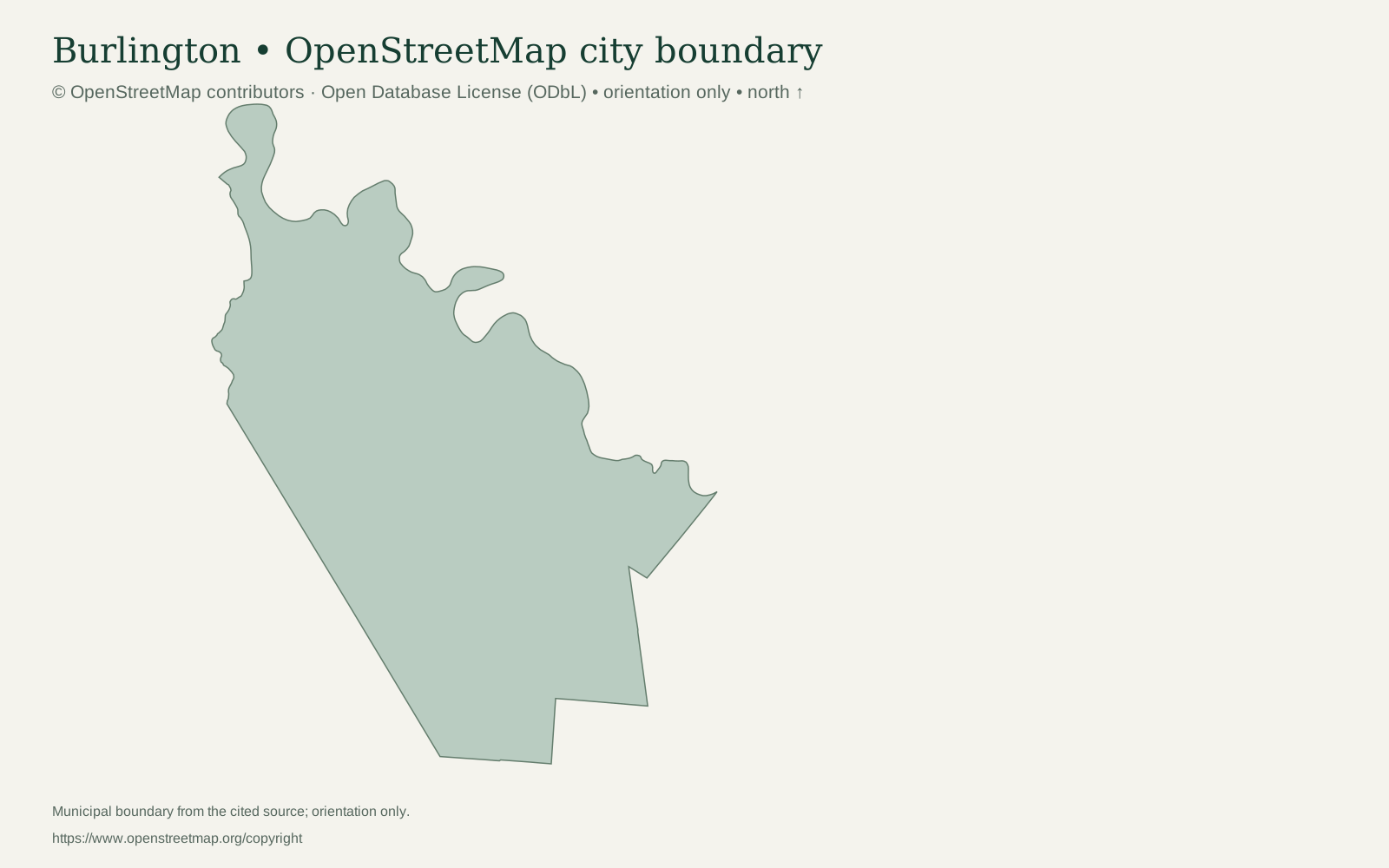
The map gives municipal orientation using an attributed outline. It does not establish an exact property line, flood status, school boundary or legal truck route. Use the relevant official address-based process for each of those decisions, and keep the full street address and unit number consistent in your records.

Burlington Vermont municipal boundary from OpenStreetMap, north upward, with contributor attribution
© OpenStreetMap contributors, ODbL. Municipal outline for orientation; not neighborhood, school, parcel or flood boundaries and not a truck route. Open full-size map.

03 /

Find the area that fits your routine

These six comparisons describe Burlington settings and checks for a home, not rankings or official school zones. The City’s residential-pattern study shows substantial variety within named areas. The municipal outline uses OpenStreetMap data under ODbL; it does not draw neighborhood, parcel or school boundaries.

New North End / North Avenue

A North Avenue-oriented residential setting with a current neighborhood planning process. Proposed intersection and development concepts should be checked against what exists today.

New North End plan: current draft and review process ↗
Housing & setting
The City’s housing study records many postwar medium-lot homes here, alongside other forms. Compare the actual dwelling, yard, heating setup and driveway.
Daily travel
Test Route 7 and the route to work, shopping and the lakefront path for your day and direction.
Before choosing
Confirm driveway turning space, winter parking and the distance from the chosen address to everyday stops. A plan’s future center is not an existing service.

Old North End

Residential streets connect toward the waterfront and downtown; the neighborhood greenway runs between Sherman Street and Mansfield Avenue.

Old North End neighborhood greenway ↗
Housing & setting
Older small-lot and multi-unit settings call for checking the actual unit entrance, shared stairs and storage. A front facade may serve several households.
Daily travel
Walk the greenway connection and the route to the bus stop, including street crossings and the final uphill or downhill portion.
Before choosing
Check curb extensions, planters, narrow approaches, shared-driveway rules and the location of the legal loading entrance.

Downtown and waterfront

The City plan treats Church, Main and Pearl streets, the rail-yard area and waterfront as related but distinct urban settings.

Downtown and waterfront planning areas ↗
Housing & setting
Compare an apartment’s entrance, service elevator, waste room and parking arrangement rather than assuming all central buildings work alike.
Daily travel
Test the walk to the Downtown Transit Center, groceries and the waterfront from the actual door.
Before choosing
Ask about delivery windows, street restrictions, noise at the hours you use the home and the authorized route through common areas.

South End / Pine Street

The City’s South End plan documents a mix of industrial, arts, food and employment uses. The immediate block matters when comparing residential choices.

South End plan: industry, arts and neighborhood context ↗
Housing & setting
Check whether the home is a conventional house, an apartment or part of a converted building; inspect access and the neighboring use directly.
Daily travel
Use the current Route 5 timetable and check how the Pine Street and Champlain Parkway stops connect to the address.
Before choosing
Review workday traffic, driveway permission, shared loading areas and any construction affecting the approach. Proposed redevelopment is not proof of completed housing.

Hill Section

The City’s residential study identifies larger-lot and extra-large-lot patterns among the Hill Section’s housing settings.

BTV Neighborhood Code: residential building and lot patterns ↗
Housing & setting
A larger home or setback can mean a longer private carry. Inspect the individual building’s floors, basement entrance, porch and driveway rather than relying on the neighborhood label.
Daily travel
Walk the actual gradient and crossings between home, school, work and transit. A short map distance is not the same as an easy daily route.
Before choosing
Measure turns, stairs and driveway slopes; establish who clears the private path and whether a large vehicle can enter and leave lawfully.

Oakledge / Flynn Avenue

A South End park-edge comparison centered on the Flynn Avenue approach to Oakledge and its shoreline, woods and Greenway connection. This is a descriptive area, not a separate municipality.

Oakledge Park: Flynn Avenue and Greenway access ↗
Housing & setting
Compare homes by their actual site and entrance. Proximity to a park does not establish a particular housing type, public parking right or water view.
Daily travel
The park’s primary access description identifies Flynn Avenue sidewalks and the Greenway; test the connection from the home.
Before choosing
Confirm the public/private boundary, everyday parking and the carrying route. Park visitor spaces are not automatically an authorized moving staging area.

04 /

Compare the home, the running costs and the access

The ACS 2024 five-year estimates, covering 2020–2024, describe Burlington’s housing stock rather than today’s listings. About 58.5% of its 17,504 occupied homes were renter occupied and 41.5% owner occupied. Median gross rent was $1,649 and median owner-occupied value was $444,800. These are different measures, neither a quote for a particular home nor a current asking price.

Of an estimated 18,079 housing units, about 33.9% were detached single-unit structures, 25.5% were in two-to-four-unit buildings and 38.4% were built before 1940. The occupied-home denominator used for tenure differs from the total-unit denominator used for building type and age. These estimates help explain why the actual unit, stairs and shared spaces deserve inspection.

QuestionWhat to obtainWhy it changes the plan
What is the full monthly cost?Rent or ownership payment, utilities, parking, storage and any recurring building charges.A lower advertised payment can leave important costs outside the comparison.
Who controls shared space?Lease or association rules for stairs, entrances, driveway and waste area.Shared use can limit both everyday storage and delivery access.
What fits through the entrance?Door, vestibule, stair and landing measurements.A room that fits furniture does not guarantee a usable route into it.
When can you receive belongings?Written possession time, keys and any move-in reservation.A signed agreement may still leave a gap before physical access.

For a rental, confirm the exact unit, included appliances, heating fuel, water-billing arrangement and which party orders trash service. Ask about any existing covered recycling cart and where it is stored. Review the move-in condition record and photographs with the responsible person; distinguish existing wear from something noticed during delivery.

For a purchase, connect the closing team’s schedule with the seller’s move-out and utility handoff. Ask whether all rooms, outbuildings and agreed storage areas will be empty when possession begins. If the date changes, one person should update the mover, utility contacts and access reservations rather than relying on separate assumptions.

When you inspect the home, test the route you will actually use with bags, a stroller or mobility equipment. Look at lighting, handrails, threshold height and the place where a wet coat or winter boots can be kept without blocking a hall. These are property checks, not guarantees about an entire neighborhood or the condition of every older building.

Bedroom with an open wardrobe of winter coats, boots on a tray, a radiator and a clear doorway into the hall
Check where coats, boots and luggage will fit while keeping the doorway and hall usable.

05 /

Use the current route and the right fare method

Green Mountain Transit’s current schedules page links an August 2026 Burlington bus guide updated on September 17. Use the route page for the direction and day you need, then check service alerts before travelling. A timetable from an earlier season or a route name alone is not enough to establish the stop nearest your door.

Route 7 serves the North Avenue corridor, while Route 5 provides the Pine Street connection with current Champlain Parkway stops. Test the walk at each end, the correct side of the road and your last useful return. If your schedule includes weekends or late work, compare those trips separately from a weekday morning.

GMT’s published fare chart lists a $2 regular single fare and $1 discounted fare. Ride Ready by GMT app and smart-card payments can reach a $4 regular daily cap or $50 over the applicable 30-day period; discounted caps are $2 and $25. Cash and ordinary contactless bank-card or mobile-wallet payments do not receive those caps. Cash requires the exact amount, and free transfers are no longer offered. Shopping Specials remain fare-free.

That distinction matters when budgeting a routine with connections. Paying contactlessly does not necessarily mean you are using the capped Ride Ready account. Ask GMT to confirm discount eligibility and the account setup that applies to you, especially if you are paying for several people or using an employer or campus program.

The current bus guide describes wheelchair lifts or ramps and paratransit eligibility assistance at 802-540-2468. Contact the operator before relying on a particular accessibility arrangement or special service. The stop approach, pavement and destination entrance also need to work for the passenger; accessible equipment on a bus does not answer every part of the journey.

For driving, compare the actual commute and parking arrangements rather than a citywide travel-time claim. Confirm whether a home’s parking is assigned, shared, permitted or separately rented. An everyday parking permit or paid garage session is a different matter from permission to stage a moving vehicle. Use the street-access section for that decision.

Two passengers waiting beside a bus stop as a bus displaying DOWNTOWN stands next to the sidewalk
Check the boarding side, destination display and return option as part of the full daily journey.

06 /

Complete registration and confirm the placement

Begin with Burlington School District’s registration page and the 2026–27 instructions. The published initial application window was January 2 through February 27, 2026; applications afterward are considered on a rolling basis with available space. Those spring dates do not mean a family arriving later should wait until another year.

Choose the correct route. A student new to BSD begins with preregistration. The current form offers 2026–2027 and asks for the student’s legal name, date of birth, entry date and grade, household address and guardian contact details. Staff review it and send further instructions. Follow the email to create or connect the PowerSchool account and complete the remaining registration; the initial submission is not a confirmed school place.

Existing BSD preschool families, including those receiving Act 166 funding through a partner program, use the kindergarten forms in their existing PowerSchool account. Returning-student updates are also a different process from a new registration. If a sibling is already enrolled, ask how to connect the new child without creating a duplicate record.

For 2026–27 kindergarten, the instructions state that a child must turn five on or before September 1, 2026. The district separately explains consideration of certain early-entry requests. Ask staff about that process if relevant instead of treating an exception as automatic admission.

Elementary placement is not a simple address-to-school guarantee. The current-year instructions request first, second and third preferences. Capacity, siblings, proximity and, for magnet schools, representative family-income balance inform the decision. The district’s placement explanation says middle-school placement follows the home address rather than the elementary school attended. Confirm the offered school and transport arrangement before making a plan that depends on a particular building.

The residency instructions list one housing document, such as a current property-tax bill, closing or mortgage document, formal lease or notarized landlord letter, plus one listed corroborating address document. Examples in the second group include a utility bill, Vermont identification or a recent bank statement with financial details redacted. Use the school’s list for your situation; do not send private documents to a mover.

If ordinary proof is unavailable, ask the school office about the alternative affidavit and its notarization requirements. The packet contains both general instructions and an alternative form, so staff should identify what you need to complete. Where custody or guardianship changes the record, obtain the requested documentation through the school’s process rather than assuming a lease resolves it.

Families experiencing homelessness or unstable housing should contact the district’s liaison or student-support staff promptly. Policy C13 provides immediate enrollment for eligible students even when normally required records are missing, along with the relevant school-of-origin and support procedures. A missing utility bill should not cause a family to abandon that route.

Complete the annual health information and speak with the school nurse about records, medication and accommodations through BSD Health Services. Finally, confirm the assigned school, first attendance day, daily travel and any afterschool arrangements. Keep a short list of outstanding items and the staff contact helping with each; a submitted online form is only one stage of the handoff.

07 /

Separate electricity, water and the heating account

Start by asking which services the address actually uses and which are included in the lease or managed by the owner. Confirm the unit and account location precisely. A building may have separate electricity accounts but a shared water meter; the right process for one service does not establish the process for another.

Burlington Electric’s start/stop instructions tell first-time residential customers and new commercial customers to call 802-865-7300. Returning customers have online start, stop and move options. The form does not accept same-day connections; starts are on business days, and new-service requests should not be submitted more than two weeks ahead through that form. A same-day emergency requires a call and separate confirmation.

For termination, the electric form allows requests no more than four weeks ahead and excludes same-day, weekend and holiday termination. Requests after 4:30 p.m. count as the following day. Coordinate the requested time with packing, final cleaning, alarms and the receiving household. Keep the utility’s confirmation rather than assuming the date selected in a form has resolved every handoff condition.

Water uses a property-based arrangement. Under the City’s tenant-billing rules, a tenant can be added only when the rented space has an individual meter and receives a separate bill. The property owner remains the primary party and must complete the tenant agreement. A shared-meter duplex does not become two tenant accounts just because the units have different occupants.

Coordinate the owner’s approval, mailing information and move-in date. The City does not provide a final-reading service for an ordinary tenant departure; it recommends recording the meter at a mid-month exit to help calculate the balance. Give move-out notice and clarify how the owner and tenant will settle the bill. A new tenant change can remain pending while an earlier balance is unresolved.

For a sale, use the separate ownership-transfer procedure. The seller or representative submits the final-reading request at least two business days before the requested reading. The published fee is $30 per reading; a changed closing after a final bill has been processed can require another request and fee. Agree who pays the closing balance once, and make sure the new owner’s details are correct.

If the home has existing VGS natural-gas service, use VGS’s account process. New customers must speak with the provider; returning customers can use the applicable form. Its stated follow-up contact is not a guaranteed activation time, and deposits may apply. Confirm whether the property instead uses another heating fuel, and arrange any appointment or access directly with the relevant provider.

Schedule internet and other installations after checking landlord permission, equipment location and access. Keep the outgoing account active for the agreed period and record the return of leased equipment. Before delivery, verify the essential services needed to occupy the home and name the person who will resolve any failed activation.

08 /

Plan where the cartons and bulky items will go

Burlington’s collection information separates City residential recycling from private trash hauling. Commercial recycling is also handled by private providers. Ask the landlord, association or hauler who holds the account, which containers belong to the property and what the normal collection day covers. An empty curb does not create an authorized bulk pickup.

Residential recycling must be in an approved covered cart at the curb by 7 a.m. Cardboard must be cut to no more than two feet by two feet and placed inside the cart. The City no longer collects material left outside the approved covered container. Arrange for excess cartons before unpacking fills a shared hall or the available cart.

Use the route and holiday information for the address. For the listed observed holidays, the FAQ says collection resumes on the following week’s regular day; do not assume a next-day catch-up. Confirm the current schedule and keep materials secured while waiting. If age or mobility makes cart handling difficult, ask DPW about assistance rather than placing it somewhere the crew cannot collect it.

The CSWD drop-off center at 339 Pine Street is the smallest site. It does not allow trailers or oversized furniture and large loads. It accepts the listed small materials, bagged household trash, food scraps and recycling subject to its limits. Check the vehicle and load before driving there; it is not an all-purpose destination for the contents of a moving truck.

For mattresses and box springs, the live CSWD A–Z search directs customers to Milton, 36 Landfill Road, or Williston, 1492 Redmond Road. Each component is charged separately. Published disposal fees are $10 for crib size, $27 for twin or futon, $32 for double/full/queen and $37 for king/California king. A $1 facility fee applies per visit. A queen mattress with its separate box spring therefore involves two item charges, not one.

Both larger sites list Tuesday through Saturday, 8 a.m. to 3:30 p.m., but check closures, quantity, condition and current fees before loading. Ask about any wrapping or handling requirement for the particular mattress. If hiring a hauler, confirm the service includes the item, lawful destination and charges; the site’s disposal fee is not a pickup-service price.

Keep special materials out of ordinary mixed recycling. Sort batteries, electronics, paint, plastic wrapping and other packing waste through the material-specific guidance. Food scraps have their own collection or drop-off arrangement. A symbol on an item, a moving-box label or the fact that something is plastic does not establish acceptance in the blue-bin stream.

Before the old lease or possession period ends, book removal of anything that will not travel and verify that a donation recipient actually accepts it. Keep the collection confirmation and a fallback that fits the remaining access time. Leaving furniture beside a shared dumpster can create a problem for the next occupant without completing disposal.

09 /

Follow the placement, reservation and permit sequence

Begin with Burlington’s Parking Services page and its linked moving-pod and trailer guide. Describe what will be placed, its width and length, how long it will remain, the street or private property involved and how people will pass. Treat the delivery vehicle’s working space and the container’s resting position as separate parts of the setup.

Proposed setupCity guide’s routeStill confirm
Pod or trailer on the residence’s designated private parking or driveway.No City placement authorization in the guide’s stated private-property case.Owner consent, surface, delivery clearance and any building or association restrictions.
Pod or trailer in a designated public parking stall for three days or less.Allowed under the guide’s conditions.Ordinary parking restrictions, dimensions and whether an exclusive reservation is needed.
Street occupation for more than three days, or a position outside designated public parking.Obstruction-permit route.Approval of the actual location, required documents, fees and conditions.
Exclusive space for loading or unloading.DPW signs for nonmetered areas or meter bags for metered spaces.Issue, posting, timing, enforcement and removal instructions.

The guide limits pods and trailers to eight feet in width and requires legal parking. It identifies hydrants, accessible spaces, sidewalks, driveways, designated loading zones and other time-restricted spaces as areas not to block. Do not interpret a container allowance as permission to interrupt a pedestrian route or occupy another reserved use.

For a nonmetered reservation, DPW can issue No Parking signs, collected at 645 Pine Street. For metered public parking, the guide lists bags at $30 per day for each space. Confirm the number of spaces needed for the actual equipment and working clearance. Paying an ordinary meter, using cones or leaving a handwritten note is not the published reservation process.

Ask for the instructions that accompany the issued signs: the approved dates and times, how and when to post, what evidence to keep, who to contact if a vehicle remains and when to remove the signs. The moving guide does not publish a universal notice period. Obtain that answer before promising a pickup date; a rule for a demonstration event is not automatically the moving rule.

If an obstruction permit applies, use the DPW right-of-way page and its official application link. The portal requires sign-in to proceed. Ask DPW which plans, insurance or other submissions apply to your proposed occupation; the general construction guidance should not be treated as a universal checklist for every brief moving stop. Request the current review time and fee rather than inventing either from an older schedule.

Confirm the approval and space before the truck is dispatched to load. If the location is unavailable, the decision-maker needs time to obtain a different lawful position or revise the move. A longer carry affects the work; a different street or sidewalk arrangement may require different permission. Tell the mover what changed and agree the consequence before treating the fallback as ready.

10 /

Connect the curb approval to the building’s permission

Public-street permission ends at a different boundary from the landlord’s or association’s authority. You may have an approved curb position and still lack permission to use a driveway, service entrance or elevator. Obtain both sets of conditions and make them compatible with the planned sequence.

Trace the route from the proposed truck position to the final room. Include a vestibule, half-flight, courtyard, basement turn or second elevator if the route uses one. Measure the narrowest openings and the turning space for the largest pieces. Share photographs of the actual path, with doors and gates in the position they will have during the move.

Ask who can reserve and release the elevator, whether other occupants share it, how long the slot lasts and what happens if it is late or unavailable. Establish whether the building requires a certificate of insurance, specific protection, a union arrangement or another contractor condition. These are questions for that property, not claims about every Burlington building.

Identify the recipient and basis of each access payment or deposit, its due date and any return conditions. Keep receipts with the reservation. A fee paid to a building does not itself reserve a City street space, and a City approval does not authorize work beyond the building’s allowed hours.

When an access window is short, ask what may be prepared earlier: protected staging, elevator lining or packed cartons in an approved area. Keep corridors and exits usable. Plan the pickup and destination windows in travel order, allowing for the actual work between them. If one point slips, name who decides whether to continue, pause or use the agreed alternative.

11 /

Test the routine beyond the listing

The City describes the Burlington Greenway as an eight-mile paved lakeshore path, starting near Oakledge in the South End and continuing toward the pedestrian bridge over the Winooski River. The Oakledge access description also identifies the Flynn Avenue approach, the park’s woods and shoreline, and connections through the Greenway.

Use those amenities as part of a real route test. Walk from the home to the path or park, then back with the time and effort you expect in everyday use. Check crossings, slopes, lighting and the place where a bike, stroller or mobility device will be stored at home. A nearby destination on a map may still involve an awkward entrance or crossing.

Try the grocery, pharmacy, work and school routes at the hours you will use them. If you depend on a bus, identify a return option when an appointment or shift runs late. If you drive, separate visitor parking from the household’s assigned space and the rules for a second vehicle.

For the first week, prioritize a usable sleeping area, essential food and medication, working utilities and confirmed daily travel. Leave a manageable place for empty cartons without blocking doors. Keep the remaining administrative tasks on a short list with their contacts so unpacking does not hide a school email, service appointment or collection deadline.

Two adults walking beside the lake, with a bench on the shoreline and a cyclist farther along the paved path
A lakeside path is useful when the complete walk or ride from home also works for your routine.

12 /

Use declared winter restrictions and a cleared private route

Burlington’s snow and ice control plan describes parking bans declared for particular storm conditions. The general ban runs from 10 p.m. to 8 a.m.; downtown Zone F uses midnight to 6 a.m. The plan calls for declaration by 3 p.m. Separate posted signs or bagged meters can also set snow-removal restrictions for a street.

Check the actual City notice, VT-Alert information and 802-658-SNOW before leaving equipment overnight. Recheck if weather or removal operations change. Do not assume that a previous reservation overrides a new restriction or that a passenger-car garage alternative can accommodate the moving vehicle’s height, length or weight.

Identify who clears the private driveway, porch, steps and landing. Inspect after the public plow passes and again if temperatures change. Have the contact, tools or agreed service available early enough to make the receiving route usable before arrival. The City’s snow plan is an operational framework, not a guaranteed completion time for your address.

In wet or windy weather, keep cartons sheltered and assign a dry staging area that does not block exits. Discuss floor protection with the mover and building contact. If the approach becomes unsafe or a restriction removes the legal parking position, use the pre-agreed decision point and alternative rather than pushing the work through an unresolved access problem.

Resident pushing snow aside at the curb beside a cleared sidewalk and the private path to a clapboard house
Recheck the connection between the street and private path after a plow leaves snow along the curb.

13 /

Make a first-week plan and a usable fallback

Work backward from when you can actually receive the belongings. Write down the person releasing keys, the confirmed possession time, the building reservation and the legal vehicle position. The household’s preferred date is not a substitute for those confirmations. Update the mover when one of them changes.

Before pickupOn arrivalDuring the first week
Confirm possession, street and building permissions, services and inventory.Check the route, keys, utilities and room destinations.Finish school and account follow-ups, collection arrangements and condition records.
Keep documents, medication and essentials with the household.Keep shared corridors and exits open while unloading.Flatten and sort cartons without overfilling the covered cart.
Name the fallback decision-maker and deadline.Pause the affected step when an approval or safe route fails.Close the remaining tasks with their responsible contacts.

A useful Plan B states the trigger, decision time, responsible person and confirmed alternative. For example, if the seller cannot release the home by the agreed checkpoint, the authorized person must decide before the receiving window disappears. A revised date, approved alternative location or storage needs actual availability, access and agreed costs.

Plan for people as well as furniture. Keep essential belongings reachable, decide where the household can wait and preserve medication, childcare and pet arrangements. Identify who notifies the building, utility contact and moving company. State what confirmation is required to resume the original plan.

If the move is urgent, separate what can still be arranged from deadlines that cannot be compressed. Describe the remaining uncertainty openly. A submitted permit, a voicemail to a landlord or a tentative storage inquiry does not equal permission, keys or capacity.

When you are ready to discuss the work, use the Burlington estimate section with the inventory, access details and open questions. Keep the administrative checklist alongside the move plan so the shipment, household and receiving property are ready for the same handoff.

14 /

Questions before you arrive

Does a Burlington address guarantee a particular elementary school?

No. BSD uses family preferences and available capacity, with other placement factors. Confirm the offered elementary school; middle-school placement follows the home address through a separate district determination.

Can I reserve the curb just by paying a meter?

The City publishes a separate reservation route: DPW meter bags for metered spaces and issued No Parking signs for nonmetered areas. Confirm the setup and sign instructions; ordinary meter payment does not make a space exclusively yours.

Do I need a permit for every moving pod?

The City guide distinguishes private-property placement, short stays in designated public spaces and longer or otherwise located street occupation. Apply the relevant case and obtain property consent or obstruction approval where required.

Can a new resident start Burlington Electric entirely online?

The current start/stop instructions require first-time residential customers and new commercial accounts to call. Returning customers have applicable form options, with business-day and advance-submission limits.

Can I take a mattress to the Pine Street drop-off center?

No. CSWD’s mattress instructions name Milton and Williston. Mattresses and box springs are charged separately, and the facility fee is additional. Check current condition, quantity and handling requirements before transport.

Does every contactless bus payment receive a daily cap?

No. GMT’s current caps apply through Ride Ready app or smart-card payments. Cash, contactless bank cards and ordinary mobile-wallet payments do not receive the same capping treatment.

What should be confirmed before the truck loads?

Confirm possession, keys, the receiving route, building window and legal vehicle position. Name who decides if any of those fails and establish a real alternative with access, capacity, costs and a plan for the household.

Your next step

Bring the plan together

Use the Burlington moving page to prepare the inventory, access details and questions for your estimate.

Sources & useful local resources

Official procedures and local resources are linked beside the answers above. Reopen the relevant page when arranging a date: fees, schedules and application requirements can change.

Housing

City and neighborhood orientation

Street access and seasonal preparation

Waste and unpacking

Schools

Daily travel

Utilities