Ohio / City relocation guide

Moving to Cleveland

Choose a Cleveland home with the daily journeys and arrival arrangements in view. This guide brings together housing context, neighborhood maps, school enrollment, utilities, collection and public-space procedures.

Two adults walking beside brick storefronts and tables along the wall
Test everyday journeys from the home’s real entrance.

01 /

Choose the decision that comes next

If you are comparing homes, start with the area comparisons and the housing checks. Keep the questions consistent across viewings: total monthly cost, condition, usable storage, parking, entry and the journeys the household will make. An attractive room does not settle whether a large piece of furniture can reach it.

For a household with children, use school enrollment while choosing the address. Establish the assigned school, the correct application route and the documents you can produce. School placement, transportation and childcare need their own confirmations; they do not follow automatically from signing a lease.

Once an address is chosen, organize service transfers, truck access and building permission. Give each task an owner and a date for a decision. Keep requested dates separate from confirmed appointments, and record who can resolve a problem on arrival day.

Keep a small arrival folder accessible throughout packing. Include the lease or closing instructions, service confirmations, school correspondence, the building contact and moving documents. Save useful phone numbers outside email. The first night needs working access, essential belongings and a usable room even if the rest of the home is still in boxes.

02 /

Confirm the municipality and the boundary that matters

This guide concerns Cleveland city, Ohio, in Cuyahoga County. Confirm the municipality for the full street address and unit before applying its parking or waste instructions. A broad Cleveland-area description can refer to another community; school districts, utility territories and building management have separate responsibilities.

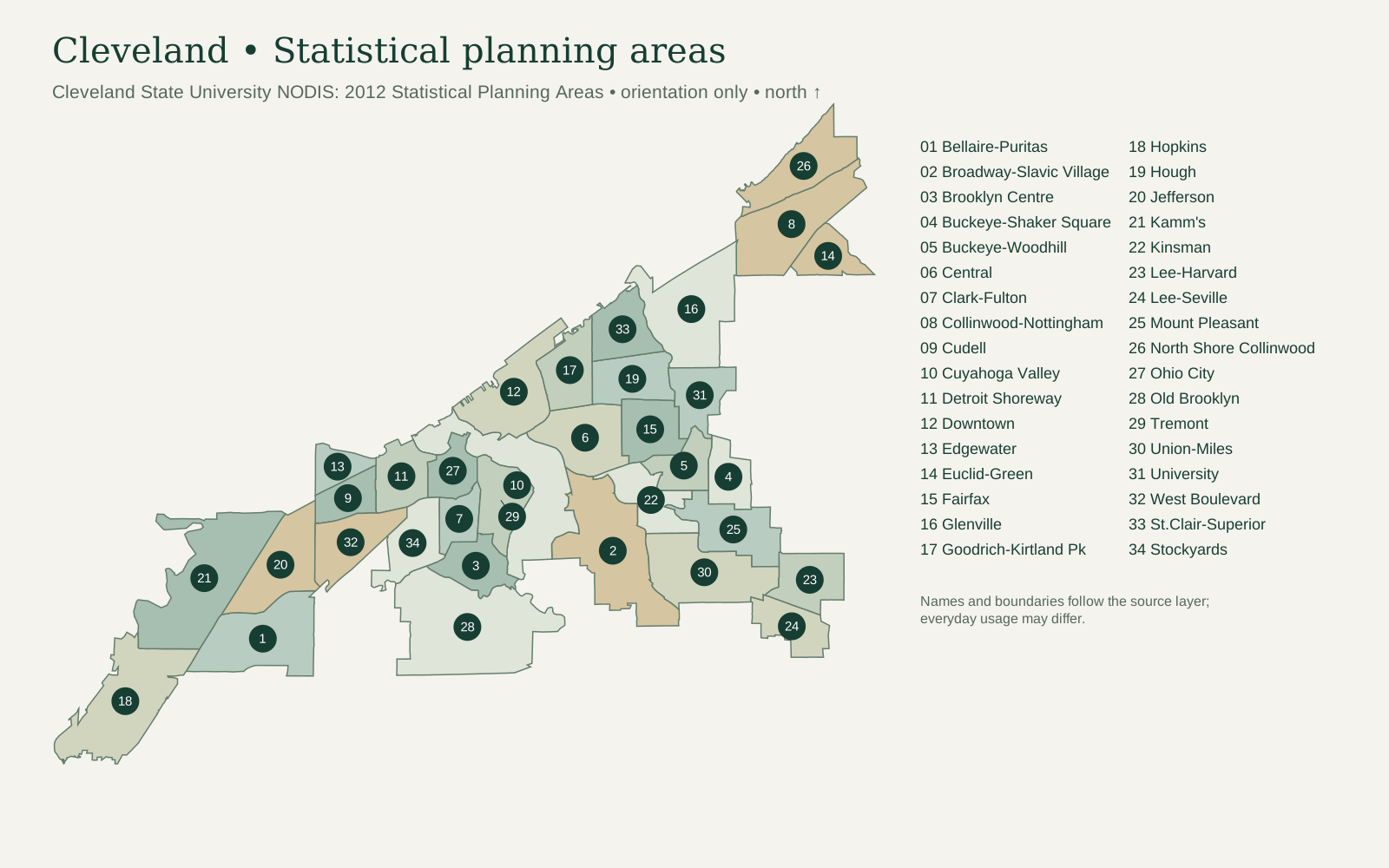
The orientation map uses 34 Statistical Planning Areas from Cleveland State University’s NODIS map collection. Its geography is the source’s 2012 neighborhood scheme, based on older Census mapping. It helps distinguish Downtown, west-side areas and the east-side University area, but it does not establish today’s school assignment, ward, truck route or service eligibility.

The six area comparisons use separate maps from the same primary collection. Their street and boundary context helps you plan a viewing and test journeys. They are not current housing listings or a ranking of schools, safety or investment prospects. Check the particular building, its manager and the route you would actually use.

Keep four address checks separate: the authority controlling the curb; the district and school handling enrollment; the provider for each utility; and the person controlling keys, stairs or lifts. Resolve them while choosing the property, when an inconvenient access condition can still change your decision.

Map of 34 Cleveland Statistical Planning Areas with a numbered key
Cleveland State University NODIS: 2012 Statistical Planning Areas based on older Census geometry, generalized for orientation. These are not current wards, school assignments, service boundaries or truck routes. Open full-size map.

03 /

Find the area that fits your routine

Use these six areas to compare the exact street and home. The distinct CSU maps show 2012 Statistical Planning Areas and street context; they do not establish current housing availability, quality rankings or school boundaries.

Downtown

The CSU map places Downtown along the lakefront and the east side of the Cuyahoga, with Euclid, Superior, St. Clair and the numbered east-side streets organizing its inland grid. Its mapped area extends beyond the immediate Public Square blocks.

Downtown statistical planning area map: 2012 boundaries ↗
Housing & setting
For an apartment or converted building, confirm the actual loading door, lift and manager’s receiving hours. The mapped district does not identify which buildings offer a lift.
Daily travel
Test the walk to the chosen rail or bus stop and the complete return trip. A station connection does not establish access through a private building.
Before choosing
Check the current street zone, event restrictions and authorized delivery entrance. Record any separate building attendant or lift charge.

Ohio City

The 2012 map distinguishes Ohio City from Downtown across the river and from Tremont to the southeast. Lorain Avenue, Detroit Avenue, Bridge Avenue and West 25th Street provide useful reference corridors within and alongside its street network.

Ohio City statistical planning area map: 2012 boundaries ↗
Housing & setting
Inspect the particular home’s stairs, entrance and outside space. Ask which door and driveway belong to the unit before planning a shared or upper-floor move.
Daily travel
Compare the actual route from the address to the relevant stop and across major corridors. Verify current service rather than using the map as a timetable.
Before choosing
Check curb signs, the distance to the correct door and permission to use any side or rear access. Keep loading out of a neighboring property’s space.

Tremont

The CSU map places Tremont southeast of Ohio City, beside the Cuyahoga Valley. It shows West 14th Street, Scranton Road and the crossings around the interstate corridors as distinct parts of the local network.

Tremont statistical planning area map: 2012 boundaries ↗
Housing & setting
Measure the home’s threshold, porch steps and stair turns. A side entrance or lower-level room may need a separate route from the one used during a viewing.
Daily travel
Test how the actual street connects across highway or rail corridors. A nearby destination can require a less direct pedestrian journey.
Before choosing
Confirm the vehicle approach, turning room and lawful position before committing to a carrying route. Do not infer usable public access from an aerial view.

Detroit Shoreway

The mapped district lies west of Ohio City and includes the Detroit Avenue corridor and a grid of numbered west-side streets. The 2012 boundary separates it from Edgewater and Cudell on the west and Stockyards farther south.

Detroit Shoreway statistical planning area map: 2012 boundaries ↗
Housing & setting
Compare the particular side-street home or corridor apartment, including which stair and outside areas are shared. The neighborhood boundary does not prove a building type.
Daily travel
Check the walk to current Detroit Avenue or other relevant bus stops, then test the trip at the hours you will use it.
Before choosing
Identify the exact door, legal curb and any driveway permission. A short map distance to the shore does not establish a direct park entrance.

University

The CSU map labels this eastern Statistical Planning Area University. Euclid Avenue runs through it, with Mayfield Road, East Boulevard and the rail corridors helping distinguish its different approaches from adjoining Hough, Fairfax and Glenville.

University statistical planning area map: 2012 boundaries ↗
Housing & setting
For the specific rental or managed residence, check the entrance, unit floor, storage and receiving rules. A broad University-area description is not proof of proximity to a particular campus entrance.
Daily travel
Test the exact HealthLine, rail or bus journey and the last walk. Confirm which stop and entrance serve the destination rather than relying on a neighborhood label.
Before choosing
Keep school district, building management and any institutional access rules separate. Obtain the actual delivery window and curb arrangement.

Old Brooklyn

The 2012 map places Old Brooklyn south of Brooklyn Centre, with Pearl, Broadview, State and Memphis roads organizing different parts of the area. Brookpark Road and the southern freeway corridor provide useful geographic reference points.

Old Brooklyn statistical planning area map: 2012 boundaries ↗
Housing & setting
Inspect the particular house or apartment, including driveway use, shared entrances and any separate basement or garage inventory. Verify the route rather than assuming direct vehicle access.
Daily travel
Compare the actual corridor serving the address and the journey in both directions. Check current stops and the crossings needed to reach them.
Before choosing
Distinguish the named Cleveland neighborhood from another municipality or postal description, then verify curb permission, steps and the receiving contact.

04 /

Compare the actual home with the city’s housing mix

The ACS 2024 five-year estimates describe Cleveland over 2020–2024. They estimate 169,683 occupied homes, of which 41.7% were owner occupied and 58.3% renter occupied. Median gross rent was $945 and median owner-occupied value was $102,000. These are period estimates for the city, not present asking prices or a budget for any one neighborhood.

Housing measureCleveland estimateQuestion at the property
Owner / renter tenure41.7% / 58.3% of occupied homesWho controls access, upkeep and service accounts?
Median gross rent$945Which utilities and recurring charges are included now?
Median owner value$102,000What do current property evidence and condition show?
Detached / attached one-unit homes45.9% / 7.7% of all housing unitsCan the proposed approach and entrance serve the inventory?
Two-unit / three-to-four-unit structures14.5% / 5.3% of all housing unitsWhich stair, door, yard and parking space belong to the unit?
Buildings with five or more units26.1% of all housing unitsWhat shared-building receiving conditions apply?
Built before 194048.6% of all housing unitsWhat are the actual door, stair and landing dimensions?

Structure and age shares use 201,141 total housing units, including vacant units; tenure uses occupied homes. Small other structure categories and rounding explain the remaining share. The Cleveland Census profile supplies additional context and uncertainty. Neither a city median nor a construction date can establish an individual property’s condition.

For a rental, record the full recurring cost: rent, separately paid utilities, parking, storage and any building charges that actually apply. Confirm who holds water service, whether energy meters are separate, which outside areas are shared, and how maintenance or snow clearing is handled. Ask to see the entrance used for deliveries, not only the doorway shown during a viewing.

For a purchase, coordinate possession and keys with the closing arrangements before confirming delivery. Measure large furniture against the whole route into the home. Inspect porch steps, low ceilings, turns and the final room; check any garage or basement items separately. An attractive open room does not remove a narrow door earlier in the route.

Keep one comparison sheet for all shortlisted homes. Test the journeys the household makes at realistic times, then record the practical differences. Separate a documented property condition from an assumption based on the neighborhood name. Ask the owner or manager to confirm any promise on which your moving or arrival plan depends.

Two closed branded kraft cartons beside living-room furniture
Keep a usable room and clear doorways while unpacking.

05 /

Test the exact RTA journey and fare method

Greater Cleveland RTA operates bus, rail and HealthLine services. Use its current route information for the exact stop, direction, service day and return journey. The walk between a home and a stop matters as much as the route shown on a map, especially where a large road or rail corridor interrupts the direct line.

RTA’s airport information identifies Red Line service to Cleveland Hopkins, with the station on the lower level of the terminal complex. Check the actual timetable and any rail replacement service for your travel date. A convenient passenger connection does not determine a moving truck’s approach or parking permission.

The published fares list a $2.50 full cash fare and a $5 daily pass. Cash requires exact change and another full fare on each bus or train; choose a valid pass or account method when your trip requires transfers. Check the eligibility documents for any reduced fare before relying on it.

The newer account-based fare system works through a Smartcard or an account in the Transit or EZfare app. Tap or scan on every boarding. Full-fare caps are $5 daily, $25 over seven days and $95 monthly. Cash put directly in a bus farebox and pre-purchased tickets or passes do not count toward those caps. A single account cannot pay for multiple people on the same trip.

For a longer-term commute, distinguish adopted schedules from proposals. In its September 11, 2026 announcement, RTA delayed a second round of service cuts until after the planned May 2027 special election. That decision does not promise an unchanged route indefinitely. Test the current journey before choosing a home, and recheck when schedules change.

For a household with a car, inspect the actual parking arrangement and the route to the home in both directions. Record garage clearance, access hours and any separate charge. Keep transit planning, resident parking and moving-day curb arrangements as distinct tasks.

White and navy bus at a curb with passenger doors facing the sidewalk
Check the stop, direction, fare method and return journey.

06 /

Choose the enrollment route and confirm transportation

Begin with CMSD’s 2026–27 enrollment page. It links the School Finder and Student Enrollment system. Search the full home address and the child’s grade, compare the available programs, and contact the Office of School Choice and Enrollment at 216-838-3675 to settle placement. The district says students who attended and finished 2025–26 should not resubmit documents through the new-student link.

The registration FAQ asks for a birth certificate, immunization record, proof of address, the guardian’s state ID, a withdrawal form or recent report card/transcript, and custody documents when applicable. Income evidence, a physical exam and Ohio Benefits confirmation are identified as Pre-K requirements. Keep those additional preschool requirements separate from an ordinary older-student transfer.

Proof-of-address examples include a mortgage or lease, recent utility bills, payroll documents or recent tax statements. If you have just moved and cannot produce the usual documents, contact enrollment before postponing school attendance. The FAQ does not establish a universal thirty-day document age, so ask what the office will accept for your particular circumstances.

Families who are homeless, doubled up for economic reasons or otherwise in transition should contact Project ACT at 216-838-0210. Households where another language is spoken are directed to the Multilingual Welcome Center at 3145 West 46th Street, 216-838-0140. For an IEP or suspected disability, contact Special Education at 216-838-7733. Explain the situation before assuming the ordinary paperwork path is the only option.

The linked student enrollment form records three school choices, prior enrollment, the home address, custody, language, medical or 504 needs and IEP information. That printable form is revised April 2022; use the current enrollment office or portal for submission instructions. The separate English checklist link was unavailable, so rely on the district’s current FAQ and request any additional checklist directly.

For 2026–27, kindergarten children must turn five on or before the first kindergarten day, August 28, 2026. The current school-year information lists August 24 for grades 1–12 and a September phase-in for preschool. A family arriving after those dates should ask for its actual first attendance day and unfinished steps rather than treating an opening-day date as a new-resident deadline.

School choice depends on space and the services a student needs. Keep more than one realistic option and obtain the assignment confirmation. The district’s FAQ allows applications from outside its boundaries when a place is available, but says transportation is not provided for those enrollments. Do not assume a nearby school or a choice application guarantees a particular seat.

Check the separate transportation rules. The FAQ describes mileage eligibility, different arrangements by grade and limits for special transfers or voluntary assignments. It also says address updates may take 24–48 hours to reach transportation. Confirm eligibility for the exact school and address, then check the assigned stop and the Edulog Parent Portal; call 216-838-0000 if a late registration leaves the assignment unclear.

Before the first day, save the enrollment confirmation, school contact, arrival instructions and transportation arrangement. Identify who will accompany or receive the child and how after-school care fits the schedule. A place on a school list, a submitted form and a confirmed school-day routine are different stages.

07 /

Arrange water ownership and each energy account separately

Ask the owner or manager which services are included and which accounts you must arrange. Record the full unit address, possession date and the last day service is needed at the old home. A requested start date is not a confirmed appointment; keep the provider’s response with your arrival documents.

Water and the property owner

Cleveland Water’s service FAQ tells buyers and sellers to call 216-664-3130 after title has transferred and the deed is recorded. The former account receives a final bill as of the transfer date, and a new account is created for the purchased property. The new owner’s responsibility begins on that transfer date.

A renter who wants to pay directly can ask about a Tenant Deposit Account at the Customer Service Center, 1201 Lakeside Avenue. Bring a lease and photo ID; the required deposit depends on the property’s location. The bill retains the owner’s name and is sent to the tenant’s address. Confirm this arrangement with the landlord instead of assuming a tenant can simply replace the owner on the account.

Electricity

Establish the actual electric provider at the address. For a Cleveland Public Power property, its start-service page says processing can take up to 48 hours. The public form asks for contact details, the service and billing addresses, unit, requested date and identifying information. Existing CPP account holders moving within its service area use the transfer form with the current account and old and new service dates.

If the property is served by a FirstEnergy company, use its start, stop or move request. The online route may need at least two business days, and the provider confirms by email whether it can meet the requested date. The move requirements identify the new address or meter, account or identification details and desired dates. Different rules can apply when stopping an Ohio landlord-managed account; confirm the actual stop date before electricity is no longer available.

Natural gas and remaining services

Enbridge Gas Ohio’s published community list includes Cleveland. Confirm whether the particular property has gas and an existing meter. Its start-service instructions recommend at least seven business days’ notice. New customers register; current customers can manage service orders in their account or call 1-800-362-7557.

If the gas meter is off, indoors or obstructed, an adult aged eighteen or older must provide access. The provider also says electricity must be on and it must light at least one appliance. Coordinate those conditions with the property owner and the appointment; do not schedule the household’s arrival around an unconfirmed request. A new connection without a meter follows a different construction process.

Check internet availability for the precise unit and arrange any technician access through the manager. Keep account identifiers in the provider’s secure process, not in shared moving instructions. At handover, record what has been confirmed, what still needs an appointment, and which contact can resolve an unavailable service.

08 /

Match move-out disposal to the eligible service and date

Cleveland’s household collection rules cover single-family homes and multifamily properties with up to four units. The city supplies black trash carts and blue recycling carts on request. At a larger building, ask the manager which private or property service applies before following a city curbside schedule.

Place carts out the night before collection or by 6 a.m. on collection day. Keep waste inside the cart, leave three feet between carts and preserve access for the collection vehicle. Do not use the truck-loading plan to block containers or place furniture where it prevents normal collection.

The waste and recycling guide describes an opt-in recycling program with no additional enrollment charge. Confirm that the address is enrolled and that the proper cart is available. Separate accepted paper, cardboard, bottles, jars and cans from waste, and follow the current material instructions. Keep packing material contained until its permitted collection rather than filling a shared hallway.

Bulk furniture and mattresses

The city describes collection of up to three bulk items per eligible home on its regular day during the first full week of each month. Mattresses and cloth furniture must be wrapped in plastic. Use the 2026 collection calendar to check the marked bulk week and holiday treatment; not every holiday produces the same delay.

The 311 service page also offers a bulk-pickup request and asks for 24–48 hours’ notice before the scheduled collection day. That booking route requires an account. Because the routine bulk-week description and the request wording do not fully explain how they interact, confirm the exact address, items and date with 311 before setting anything out. A request should not be treated as permission for collection on any week.

For an eligible resident’s drop-off, the waste page lists up to four free visits a year at Ridge Road Transfer Station, limited to four cubic yards per visit and trailers no larger than four by eight feet. Regular waste disposal is listed for Saturdays, while other materials have their own schedule. Confirm proof of eligibility, the material and current opening arrangements before loading a vehicle.

Keep electronics, household chemicals and construction debris out of an ordinary furniture pile. The city publishes different routes and restrictions for these materials, and its guide and web text do not describe every electronic item consistently. Ask about the specific item instead of assuming that anything too large for a cart is acceptable bulk waste.

Plan disposal separately from the move. Confirm who wraps, removes and transports unwanted pieces, and where cartons will be stored if the collection date falls after departure. A mover’s packaging removal is an agreed service; municipal collection eligibility does not add it automatically to the moving scope.

09 /

Follow the obstruction process for the actual footprint

The city’s parking-permit page assigns permits for obstruction of streets, parking meters and sidewalks to Assessments and Licenses, 601 Lakeside Avenue, Room 122, 216-664-2174. It requires proposed start and finish dates and work hours, with application at least 12–14 business days before the proposed start. Begin the conversation while choosing a move date, not after the truck has been dispatched.

  1. Define the operation. Give the exact side of the street, address, date, hours, truck size and required length. Identify any ramp, sidewalk use or storage container. Ask whether ordinary lawful parking is enough or whether an obstruction, meter restriction or another authorization applies.
  2. Use the current city route. The ROW permitting page links the active permit portal and names rightofwaypermits@clevelandohio.gov. Ask the office which application category fits the move. The public portal has both Public Service and Right-of-Way sections; their labels alone do not settle the permit type.
  3. Prepare the location and access details. The linked obstruction application asks for the applicant, location, dates and hours, street or sidewalk area affected, and a sketch explaining traffic and pedestrian access. It is a January 2022 form still linked by the city. Confirm the current submission requirements rather than assuming every construction field applies to a household move.
  4. Confirm the charges and conditions. The ROW fee table distinguishes residential, commercial and Central Business District locations, partial or full occupation, and the length or duration. It lists $20 per month for residential street/sidewalk obstruction; CBD partial street occupation starts at $50 per week per twenty linear feet. Those categories are not a universal moving quote. Have the office classify the footprint and confirm the total.
  5. Agree on reservation and setup. Obtain the city’s directions for any authorized signs, meter handling, posting period or traffic assistance. Name the person installing, checking and removing the setup. The sources do not establish one universal moving-truck sign deadline, so resolve that with the permit owner rather than borrowing another city’s practice.
  6. Confirm before arrival. Keep the issued permission, permitted hours and responsible contact available. If the position cannot be used, agree on a lawful alternative and the added carrying distance. A submitted application and a manager’s approval do not themselves authorize public-space occupation.

The May 2026 contractor registration guidance expressly distinguishes obstructing the ROW for materials or vehicles from excavation: mere obstruction does not by itself require ROW contractor registration. A permit can still be required. Ask about the actual operation rather than automatically applying construction bonds or excavation requirements to a moving truck.

Ordinary street parking has its own summer 2026 zone rules, including different downtown and neighborhood schedules and special-event restrictions. The parking FAQ explains plate and zone payment and the maximum session shown in the app or station. Paying for that session does not reserve an exclusive loading area or authorize a separate obstruction.

Finally, coordinate this public-space plan with the building’s receiving window. Keep the entrance, pedestrians and required access clear. Record who pays each municipal or property charge and what changes if the date, footprint or vehicle changes before the move.

10 /

Make building permission match the physical route

Obtain the property’s moving instructions from the owner or manager who can authorize access. Identify the entrance, floor, unit, usable hours and person opening the doors. At a shared building, ask how the move is coordinated with residents and other deliveries, and whether the service lift or corridor is actually available for the whole agreed window.

Measure the route from the truck position to the destination room. Include porch steps, narrow doors, stair turns, low ceilings and any separate storage area. An approved street position does not establish that a sofa fits inside, and a wide lobby does not settle the dimensions of the next door or landing. Send useful photographs and measurements to the estimator.

Ask about protective materials, a certificate of insurance, an attendant, contractor registration and any other building-specific condition. If a labor or union requirement is raised, request its written scope and the contact responsible for arranging it. These are questions for the particular property, not a claim that every Cleveland building imposes the same conditions.

Record charges or deposits separately: amount, recipient, payment deadline, basis and return conditions. Clarify what belongs to the building and what belongs in the moving estimate. Obtain written permission for any preparation before a short moving window, such as delivery of packing materials, without assuming that furniture can be staged in a shared exit or hallway.

Make pickup and delivery windows work in sequence with travel and handling between them. They need not occur at the same time, but both must be achievable. Identify the person who can release the old home and the person who can receive the new one. If a lift fails or keys are delayed, know when to choose a revised window or confirmed storage before the vehicle is loaded.

Finally, inspect the route again just before the move. Remove loose obstructions, secure pets and keep residents informed through the appropriate manager. A previously approved route may change because of maintenance or another delivery. Have a decision-maker available to resolve changes before the crew begins carrying.

11 /

Test daily errands from the actual front door

Choose a few ordinary trips before deciding that an address works: food shopping, pharmacy, school or care, work and a place to spend time outdoors. Walk the real route at a representative time. Record crossings, steps, entrances and the return journey, rather than comparing only straight-line distances.

Cleveland Metroparks’ Lakefront Reservation information identifies several separate places and access points, including Edgewater, Wendy Park and east-side lakefront facilities. A home described as near the lake does not establish a direct pedestrian entrance. Check the actual route, current closures and the facilities needed by your household.

At the new building, locate the mail area, waste storage, bicycle storage and any shared laundry or parking. Ask which spaces belong to the unit and what access arrangements continue outside office hours. Confirm a delivery address format that includes the correct unit, especially where front and side entrances serve different homes.

During the first week, establish the local routines that were previously automatic. Save the manager’s contact, confirm household service dates, find the correct transit stop and check where essential supplies can be obtained. Keep one room functional and preserve the route to the entrance while remaining cartons are unpacked.

If a routine depends on an appointment, a specific program or an accessible entrance, verify it directly with the operator. General neighborhood descriptions are useful for orientation; the particular household’s needs require a more exact check.

Two people walking on a lakeside path beside grass and a bench
Find the actual public entrance and check current path conditions.

12 /

Use current winter notices and a workable weather fallback

The city’s winter policy explains that Public Safety may declare a temporary Snow Emergency Parking Ban. During a declared ban, streets with red-and-white snow restriction signs cannot be used for parking, and violating vehicles may be cited or towed. Check the current announcement and the exact street before relying on a loading position.

Home and business owners are responsible for clearing sidewalk snow, sleet and ice. Agree with the owner or manager who clears the property approach, porch steps and landing before delivery. Inspect the whole route again on the day: a cleared sidewalk alone does not establish that the final steps and threshold are usable.

For wet or leaf-covered conditions, arrange a clear route and appropriate floor protection through the property manager and mover. Keep materials from obstructing the doorway and confirm a place for wet outerwear or equipment. These are practical property preparations, not a claim about a measured local peak moving season.

If conditions prevent safe access, use a specific decision time and named contact to choose the next step. Confirm a later receiving window or real storage availability, account for waiting and additional handling, and specify what must change before delivery resumes. Keep household essentials accessible if the delivery schedule changes.

Woman with a snow shovel beside a cleared sidewalk and porch approach
Arrange clearing and inspect the whole carrying route before arrival.

13 /

Turn separate confirmations into an arrival plan

Before loading, confirm possession of the destination, the usable entrance, the receiving person and essential services. Check the approved truck location and any required setup. Review the inventory with the mover and identify what stays behind. Keep documents, medicines, identification, chargers and first-night belongings with the household rather than at the back of the shipment.

Give the receiver a room plan and clear labels for major items. Keep children, pets and visitors away from the carrying route. A person authorized to approve placement or a scope change should remain reachable through delivery; a key holder who cannot make decisions may not be enough to resolve a problem.

Define Plan B before it is needed. Name the observable trigger, such as keys not released by a specific decision time or a failed lift inspection. Identify who decides, the lawful alternative window or actual storage reservation, and the people who must be notified. Account for additional handling, waiting and temporary accommodation, then specify what must be confirmed before delivery resumes.

At handover, check the inventory and record concerns while the relevant item can be inspected. Save the paperwork and service confirmations. Verify the next collection day, school start and remaining technician visits. Keep cartons and unwanted items within the agreed disposal plan, and leave the entry and essential rooms usable while the rest of the household settles in.

Use the Cleveland moving page to bring the inventory, access information, packing choices and unresolved timing into the estimate discussion. The better the receiving conditions are defined, the easier it is to discuss the actual work and a practical fallback.

14 /

Questions before you arrive

Does a Cleveland mailing address settle every service boundary?

No. Verify the actual municipality, school arrangements and each utility for the full address and unit. Neighborhood maps are orientation tools; they do not determine service eligibility or building access.

Are the housing figures current asking prices?

No. The ACS 2024 five-year estimates describe the 2020–2024 period across Cleveland city. Compare present listings, included utilities, property condition and the actual terms of the home you are considering.

Can I choose a CMSD school and assume transportation follows?

Confirm both separately. Placement depends on space and required services, while transportation has distance, grade and assignment conditions. Obtain the school confirmation and the actual travel arrangement before the first attendance day.

Can a tenant put Cleveland Water entirely in their own name?

The published tenant deposit arrangement retains the owner’s name on the bill while sending it to the tenant. Ask the landlord and Cleveland Water about the lease, photo ID, location-based deposit and billing arrangement.

Can I leave a mattress out when I move?

Confirm collection eligibility, the bulk date and any required request with 311. The city requires mattresses and cloth furniture to be wrapped in plastic. Keep items contained until the authorized collection or arrange an eligible disposal alternative.

What should be confirmed before the truck is loaded?

Confirm possession, keys, usable entry, essential services, the receiving person and the permitted truck position. Agree on a decision time and a confirmed fallback if any of those conditions fail.

Your next step

Bring the plan together

Use the Cleveland moving page to prepare the inventory, access details and questions for your estimate.

Sources & useful local resources

Official procedures and local resources are linked beside the answers above. Reopen the relevant page when arranging a date: fees, schedules and application requirements can change.

Housing and orientation

Daily services and seasons

Neighborhood maps

School enrollment

Truck access and public space

Utilities

Getting around