Ohio / City relocation guide

Moving to Dayton

Use this Dayton guide to compare a home and prepare the practical steps of arrival. Explore six historic areas, then confirm the school, utilities, street access and collection arrangements for your exact address.

Two adults walking past brick storefronts and a bicycle secured beside the sidewalk
Try the complete connection between the home and daily destinations.

01 /

Begin with the decision that controls your move

If you are still choosing a home, compare the actual unit, access and recurring journeys. Use the district descriptions to decide what to inspect, then visit the entrance and the streets you would use. A familiar area name does not establish a school assignment, parking entitlement or the condition of an individual property.

If children are moving with you, verify the school address and the transport arrangement together. Complete the district’s document and appointment process before assuming enrollment is finished. A chosen school outside the assigned attendance area can create a separate family transport responsibility.

If you already have an address, work through utilities, building access, truck occupation and disposal. Give each unfinished task a contact and confirmation date. Your arrival plan should also cover a delayed key handover or unavailable essential service, so that the household and the shipment have a workable next step.

02 /

Distinguish Dayton city from its wider address area

This guide covers the City of Dayton. Nearby municipalities and townships have their own responsibilities, even when a listing or mailing address uses Dayton as a regional description. The city’s neighborhood GIS layer also includes polygons explicitly marked outside the city, including Kettering, Oakwood and surrounding townships. Its full extent is not a map of Dayton service eligibility.

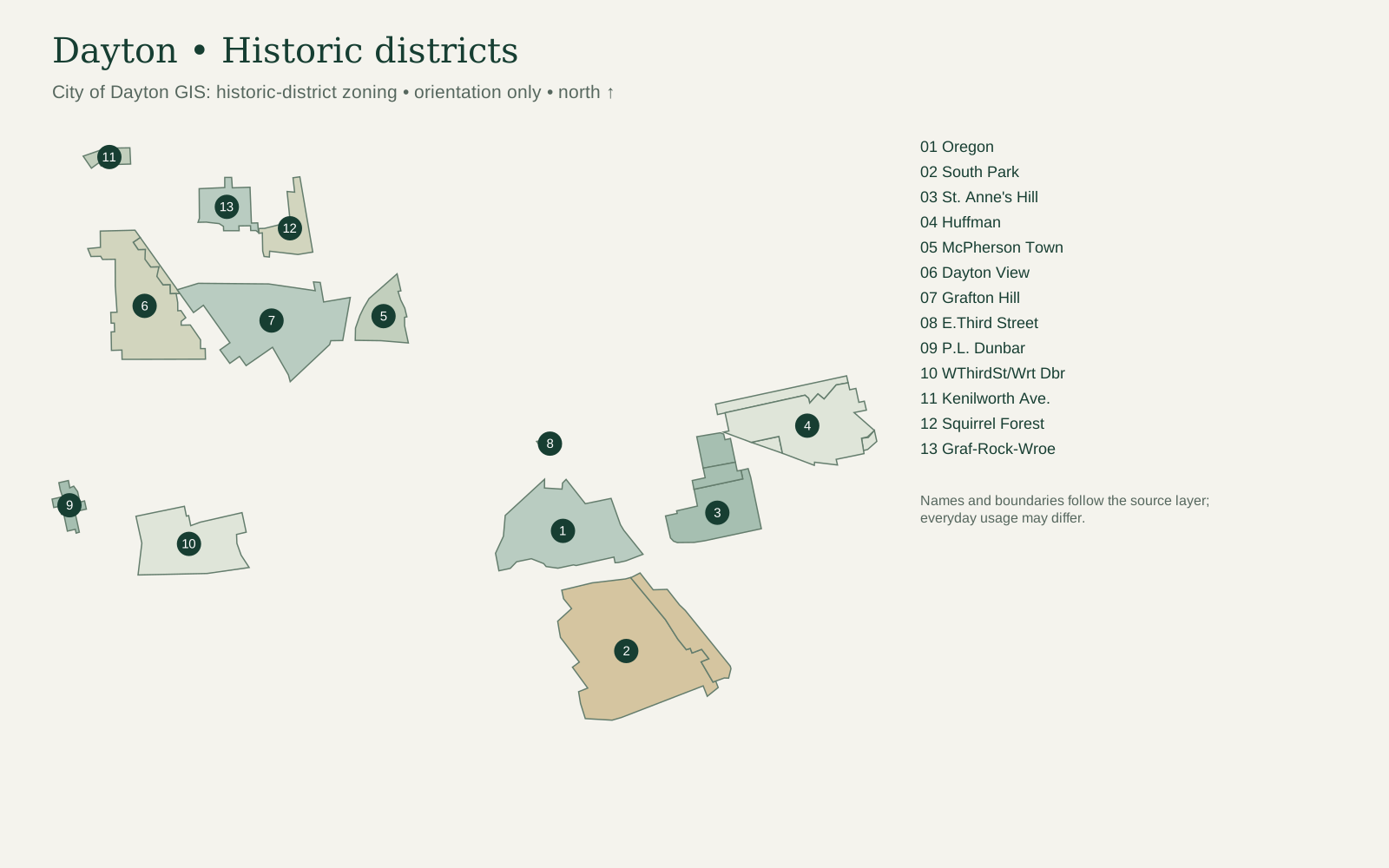
The orientation map here uses the dedicated historic-district zoning layer: 20 features grouped under 13 source names. The outlines show selected historic zoning areas, not every neighborhood or the complete municipal boundary. A district can contain more than one zoning piece, and some names in the key are abbreviated in the city source.

The six comparisons below focus on Oregon, South Park, Grafton Hill, McPherson Town, Dayton View and St. Anne’s Hill. They use separate historical nominations to explain street and building patterns. National Register descriptions, locally designated districts and broader neighborhood names need not share exactly the same boundary.

Locate the chosen address, its real entrance and the destinations you will visit repeatedly. Check river crossings, major roads and the approach from a current bus stop. Use a property or district lookup for the actual decision; the map is an orientation aid and does not assign a school or approve a truck route.

Map of thirteen named historic zoning districts in Dayton from official City GIS
City of Dayton historic-district zoning, generalized from 20 source features with source names retained. This is not the complete city boundary, an attendance map or a truck route; some key labels are abbreviated in the official layer. Open full-size map.

03 /

Find the area that fits your routine

These six historic-area comparisons use separate primary nominations. They explain physical patterns and what to inspect; they do not rank current availability, prices, safety or schools. Broader neighborhood names, National Register boundaries and the local historic-zoning map need not be identical.

Oregon

The 1974 nomination describes a compact residential and commercial district, with East Fifth Street and Wayne Avenue forming important edges. Its older brick and frame buildings provide historical context; the nomination’s condition assessments and business descriptions are not a current inventory.

Oregon Historic District nomination (1974) ↗
Housing & setting
Check the particular dwelling or upper-floor unit, including stairs, porch steps and any rear entry. Establish which rooms and storage spaces belong to the lease and whether deliveries use the front or another approach.
Daily travel
Try the actual journey from the unit to current bus stops and everyday destinations. Check the crossing of major roads rather than treating a short straight-line distance to Downtown as a travel-time promise.
Before choosing
Identify the lawful truck position and any interaction with adjacent businesses or residences. Confirm the doorway, moving window and carrying distance with the person who controls access.

South Park

The historical nomination describes residential streets south of Downtown, with cottages, vernacular houses and a commercial edge along Wayne Avenue. It also distinguishes the nominated area from the wider neighborhood. Use that building pattern without assuming every current property has the same layout.

South Park Historic District nomination ↗
Housing & setting
Inspect the entrance, porch and route through the house, especially for a converted multi-unit building. Check how larger furniture reaches upper rooms and whether any storage or rear area is included in the move.
Daily travel
Test the route toward work, school and a current transit stop from the exact entrance. Confirm major-road crossings and the return trip at the relevant hour rather than relying on the neighborhood label alone.
Before choosing
Ask whether a driveway, alley or curb position is actually available for the proposed vehicle. Plan disposal around the property’s collection point so outgoing items do not block the receiving path.

Grafton Hill

The 1985 nomination places Grafton Hill northwest of the river and central business district. It describes houses with varied late-nineteenth- and early-twentieth-century forms, substantial porches and some carriage houses. These features guide inspection; they do not establish present availability or condition.

Grafton Hill Historic District nomination (1985) ↗
Housing & setting
Measure steps, porch turns and the actual doorway before deciding how a large piece will enter. In a subdivided house, identify the unit’s own entrance, shared circulation and the route to any separate storage.
Daily travel
Check the bridge or road connection used for the actual daily destination. Locate the current stop and test the walk in both directions, including any grade or crossing that affects your household.
Before choosing
Confirm permission for any side or rear route and the distance from the authorized truck position. Discuss delicate exterior features and needed protection with the owner before fixing the handling plan.

McPherson Town

The 1986 nomination describes a residential area on the north bank of the Great Miami opposite Downtown, with Victorian houses and an early-twentieth-century apartment component. The river and Main Street connection help explain its position; historic building counts are not used as current housing data.

McPherson Town Historic District nomination (1986) ↗
Housing & setting
Compare the actual property’s entrance, stairs and internal turns. For an apartment, establish the receiving door and any shared passage; for a house, inspect the porch and access to rooms beyond the front entrance.
Daily travel
Walk the complete bridge and street connection to the destination you will use. Check the present bus service and evening return rather than assuming every trip works the same way because Downtown is across the river.
Before choosing
Locate the proposed curb position and any restricted approach. Keep a clear route between the vehicle, entrance and final rooms, and identify who can resolve an access problem during the moving window.

Dayton View historic area

The 1983 nomination describes the historic area near Salem Avenue with substantial brick and wood houses, porches and carriage houses. It is a defined historic district within a broader Dayton View context. Older descriptions of occupancy and condition do not establish the present state of a listing.

Dayton View Historic District nomination (1983) ↗
Housing & setting
Inspect the specific building and clarify whether it is a single home or divided into units. Confirm the usable stair, landing and doorway dimensions as well as the route to any included basement or outbuilding.
Daily travel
Test the walk to the current stop and the journey along or across Salem Avenue where relevant. Compare the actual route to the household’s destinations, including the return connection and any required transfer.
Before choosing
Confirm the municipality and the property’s receiving arrangement. A wide-looking street or large lot does not itself authorize truck loading or use of a private drive; obtain the applicable permissions and dimensions.

St. Anne’s Hill

The historic nomination describes residential streets east of Downtown, between the Oregon and Huffman contexts, with a Fifth Street commercial spine. Vernacular houses, cottages and larger Victorian forms appear in the source. Use these as inspection prompts, without importing its old vacancy or condition statements.

St. Anne’s Hill Historic District nomination ↗
Housing & setting
Check the actual entrance, setbacks and route through the dwelling. For a smaller cottage or an upper unit, measure turns and room access rather than assuming a compact exterior means the furniture plan will be straightforward.
Daily travel
Try the route to the relevant current bus stop and everyday destinations. Check how major streets and the southern highway edge affect the connection; the district description is not a navigation or commute-time estimate.
Before choosing
Agree on a permitted truck position, private access and the receiving window. If a railing, door or other exterior feature would need alteration, have the owner resolve the required approval before relying on that approach.

04 /

Compare the whole housing commitment and the usable rooms

The ACS 2024 five-year housing tables describe 2020–2024. Dayton had an estimated 58,477 occupied homes, with 48.4% owner occupied and 51.6% rented. Median gross rent was $918 and median owner-occupied value was $100,600. These are citywide historical estimates, not current asking prices or a valuation for one of the districts below.

Across 70,335 housing units, including vacant units, 63.8% were detached houses and 6.9% attached houses. Two-unit buildings accounted for 3.3%, three- or four-unit buildings 5.9%, and buildings with at least five units 19.1%. An estimated 36.7% of units were built before 1940. Those figures suggest useful inspection questions but do not establish an individual building’s condition.

Compare written costs for the exact home: rent or purchase terms, deposits, utilities, parking, storage and any building fees. Establish which charges are included and which services you must arrange. Record the possession date separately from the date on which a moving vehicle and crew may use the property.

Property questionEvidence to obtainWhy it changes the move
Which entrance serves the unit?Photographs, access instructions and measurementsFront and rear doors can lead to different stairs or shared areas.
What fits along the whole route?Door widths, turns, landings and large-item dimensionsA room large enough for furniture does not guarantee a usable approach.
Who controls services and access?Written lease terms and named contactsThe owner, utility and building manager may control different steps.
When can the property receive the shipment?Confirmed keys and moving windowA signed agreement does not by itself confirm the receiving arrangements.

Inspect shared stairs, porch surfaces, basement access and any outbuilding included in the move. Ask whether the proposed loading position belongs to the property or the public street. Photograph anything the estimator cannot understand from the address alone. Keep your inspection notes with the inventory so a later change can be explained precisely.

Living room with a blue sofa, reading chair and branded kraft carton
Measure the approach as well as the final room.

05 /

Try the current route in both directions

Greater Dayton RTA is the local transit operator. Its current fare table lists a regular fare of $2.40 for each boarding, with a $5.50 daily cap and a $70 cap over a rolling 31-day period. Tapp Pay works through a smartphone or smartcard; scan or tap every time you board. Cash is not accepted aboard vehicles, although it can be used at supported locations to load an account.

A rolling cap is different from buying a calendar-month pass. Set up the payment method and enough account value before the first journey. Reduced fares and other services have their own conditions. For a household without suitable phones, check the smartcard and loading options instead of assuming every passenger must use an app.

Use the current route timetables for the actual day and time. The September 6, 2026 service changes altered Routes 6, 12 and 17, introduced X12 and temporarily discontinued Route 28 and the North Community Connector. Route 17 also has an evening routing variation after 6:30 p.m. A route description saved before that change may no longer represent your journey.

Test the walk from the correct entrance to the stop, any transfer and the last part of the trip. Repeat the exercise for the return journey, including evenings or weekends when relevant. Check current stop notices and leave room for disruption; a nearby bus line is not a guarantee of a convenient one-seat commute.

If driving or cycling is essential, inspect the complete connection and where the vehicle or bicycle will be kept. Confirm the property’s parking arrangement in writing and distinguish it from temporary truck loading. For an apartment above a business or behind another building, begin the route at the door you will actually use.

City bus at a sidewalk stop
Check the current route, fare method and return trip.

06 /

Complete the documents, appointment and travel plan

Start with the actual school district and address. DPS’s Find Schools page links a North/South zone map and a middle-school address lookup. The static map still carries a 2025–2026 filename, so confirm the current assignment with the district. A historic district on the orientation map is not a school attendance zone.

The 2026–2027 enrollment instructions give August 19, 2026 as the kindergarten age-five cutoff. Gather parent identification, the child’s birth certificate or accepted identity document, proof of the custodial parent’s address dated within 60 days, previous grade records and applicable court custody papers. The page accepts several address documents, including a qualifying lease and utility or cable bill. It says immunization records are requested if available and are not required for enrollment; ask the school about separate health requirements. A notarized statement does not replace court-issued custody documentation.

The student enrollment form also asks about language, emergency contacts, previous schooling, IEP/ETR or 504 support and housing circumstances. Bring the information that applies to your child. If records or conventional address documents are missing, contact the Enrollment Center about the appropriate route rather than deciding that the child cannot enroll.

Choose the online, hybrid or in-person process that you can complete. All routes finish with a scheduled and attended enrollment appointment. Use the district’s appointment booking service; allow a separate 20-minute appointment for each child. Virtual appointments require the relevant forms and readable supporting documents to be uploaded beforehand. If you cannot upload them, arrange the in-person route.

The Enrollment Center is at 136 South Ludlow Street, with phone 937-542-5555. The enrollment page identifies free parking behind 115 South Ludlow, a different address from the office. Check the confirmation for your appointment mode and time. Keep the district’s enrollment or assignment confirmation and ask when the child should attend; completing a web form alone does not establish that the process is finished.

Families already in DPS can use the change-of-address form to report the move, but should also confirm any assignment and bus consequences. A choice transfer within the district is different from registering a newly arriving child. Tell staff whether the move changes the home address, the preferred school or both.

For residents of another district, the 2026–2027 open-enrollment application is a separate request submitted to the Enrollment Center, not an individual school. It requires annual renewal, assigns transportation to the parent and allows denial under its stated conditions. The form specifically says Fairborn and Mad River do not participate and that their residents attending DPS are charged tuition. Do not treat a requested school as approved until the district confirms it.

Read the transportation instructions alongside the placement. K–8 yellow-bus eligibility includes living more than one mile from school or transportation specified in an IEP; confirm the actual assignment and route. The linked out-of-quadrant waiver makes the parent responsible for transport when selecting a school outside the district-assigned quadrant. That condition matters even when another general distance rule appears to fit.

Grades 9–12 use RTA for ordinary school travel. The district’s 2026 riding guide and current routes are the starting point for practicing the trip. Ask about the student’s applicable fare arrangement and prepare the payment method before the first ride. For K–8, obtain the current bus details through the district’s My Ride K–12 instructions; disability-related arrangements should be resolved with the relevant district office.

07 /

Separate owner responsibility from the name on the bill

Before possession, list each service, its provider, the person responsible for the account and the requested change date. Confirm whether water or other charges are included in the lease. A general utilities list for Dayton does not verify coverage, an appointment or the account arrangement at a particular unit.

Under the city’s water service rules, the property owner remains responsible for water, sewer and stormwater charges even when billing is in a tenant’s name. Agree with the owner who will contact the city, how the handover reading will be handled and which charges the household pays. Keep that agreement and the actual account confirmation.

The start, stop and transfer page directs existing-service questions to 937-333-3550. For a change of occupant, ask about transferring billing and obtaining a final reading. New construction follows a separate Water Engineering route. Physical meter removal, called a Meter Take, is also different from an ordinary billing-name change and can require access if the meter is inside.

Where an actual shutdown is appropriate, the page links stopping water-related charges to the Meter Take. Waste-container removal is a separate Public Works step after the meter work and off/out date, while stormwater charges can continue for impervious surfaces. Do not request meter removal simply because you are moving between occupied homes; have the owner and city establish the correct action.

The published service-fee table distinguishes a $10 special meter read, a $15 resumption charge and a $55 small-meter set charge, among other services. These are separate items, not a promise that every move costs one fixed amount. Ask which action is necessary and which current charges apply before approving work.

For electricity, AES Ohio’s new-customer instructions require a call to 800-433-8500 rather than an online start request. The provider asks for at least three business days’ notice and identity, contact and credit-check information. A refundable deposit or guarantor may be needed. Existing customers have separate transfer or stop routes. Confirm the effective date and any access conditions before relying on electricity at arrival.

For gas, the CenterPoint service portal separates a new start from an existing account’s transfer, stop or additional service. Use the full service address and ask whether an appointment or access is required. A request is not the same as confirmed activation, so retain the provider’s instructions and arrange the responsible adult if needed.

As checked September 26, 2026, National Fuel’s Ohio transition notice says to continue using CenterPoint until the sale is finalized. It describes automatic account transfer and continued transitional support, not a requirement to create a second account immediately. Follow the current bill and official notice when arranging a later move; a pending ownership change should not interrupt the practical task of confirming service at the new address.

Finally, test the services that the property is expected to have when keys are handed over. Tell the owner promptly about a problem and keep the utility’s reference number. Arrange internet and any other household services against the actual unit and installation access, rather than assuming the previous occupant’s setup transfers automatically.

08 /

Book the right collection before placing items outside

First establish who collects waste at the property. The city’s waste collection page covers its service, but a managed building may have its own arrangement. Use the address-specific collection schedule and confirm the cart location, collection point and current holiday adjustments. The same collection day does not guarantee a particular arrival time.

The set-out guidelines require containers or booked bulk items out by 6:30 a.m. on the collection day. Remove carts from the curb, alley or front yard by 8 a.m. the next day. Keep containers at least five feet from objects and three feet apart, with handles toward the home. Keep lids closed, bag ordinary rubbish and separate metal and yard material as instructed.

For unwanted furniture, book bulk collection in advance through Dayton Delivers or 937-333-4800. Each address has a designated Friday once a month. The stated allowance is five large items and/or 25 small bags or boxes. Confirm the actual load and date before setting it outside, particularly when a move-out deadline falls before the next collection.

The listed items include furniture, appliances, mattresses and box springs; mattresses and box springs must be wrapped. Carpet should be tied in rolls no more than four feet long and two feet in diameter. Properties with curb service use the front collection point clear of obstructions; those with alley service use the property edge at the alley line. Ask about preparation for the specific appliance instead of copying another city’s rules.

Keep the discard pile separate from the moving inventory so it is not loaded by mistake. Count the items and cartons before making the booking, and tell the collector about anything outside the published categories. A regular refuse cart should not be surrounded by overflow just because a household is leaving.

If collection timing, building rules or the quantity do not fit, arrange an authorized alternative with the owner or a disposal provider. Confirm the destination and any fees before transport. Keep the entrance, public path and truck approach clear while waiting; the moving service and municipal collection are separate arrangements.

09 /

Get the applicable street-use instructions for the actual move

Begin with the physical operation: the exact address and unit entrance, date and hours, vehicle length, loading side, required curb length and any effect on a sidewalk or traffic lane. Include a sketch or photographs showing intersections, meters, driveways and other restrictions. Distinguish a vehicle using lawful ordinary parking from a request to keep space exclusively available or obstruct part of the right of way.

The city’s Civil Engineering page identifies Street Privilege Permits for closures and special use or work in public space. Its contact directory gives 937-333-4081 for that function. Ask the office to classify the proposed household move and supply the applicable form. The office’s answer should connect to the actual vehicle and property, not just the general word “moving.”

The linked right-of-way ordinance concerns provider systems, while the registration application and street-cut rules concern activities such as utility occupation and excavation. Their registration charges, plans and construction timing are not established as household loading requirements. The event-planning instructions also send street-use applicants to Civil Engineering, but do not create a moving-specific exemption or fee.

The online permit page currently describes status lookup rather than an online application service. Do not assume a building-permit form or payment screen is the correct route. The public materials reviewed did not settle an ordinary moving reservation’s fee, lead time or sign-posting interval; obtain current instructions directly from the responsible office.

  1. Confirm the category. Explain whether you need ordinary parking, reserved curb space, a meter arrangement, a sidewalk restriction or a lane closure. Ask what application and supporting information are required.
  2. Confirm timing and charges. Ask when a complete request must arrive, how long review may take and which fees or deposits apply. Leave room for any approved posting period and corrections to the plan.
  3. Set the access conditions. Ask about pedestrian clearance, traffic control, signs, meter handling and the person responsible for installation or removal. Do not treat self-placed cones or handwritten signs as authorization.
  4. Obtain the actual decision. Keep the issued document or written instructions and check the location, date, hours and vehicle conditions. Submission alone does not establish that the requested occupation is approved.
  5. Align the building and crew. Confirm the same window with the property manager and estimator. Provide the authorized position and disclose the carrying distance, steps and receiving entrance.
  6. Prepare a lawful alternative. If the preferred space cannot be used, identify another position or time with the appropriate owner. Have a contact available to resolve a blocked space without improvising an unauthorized closure.

The Passport Parking instructions cover payment for a metered parking session, not exclusive loading rights. Keep ordinary parking payment, permission for special street use and the building’s receiving approval as three distinct questions. A private loading area is useful only when the property owner authorizes its use and the vehicle can actually reach it.

10 /

Connect the authorized truck position to the final room

Walk the entire route with the largest item in mind. Note steps, uneven surfaces, door widths, handles, closers, railings and the space available to turn. Include a basement, attic, separate storage room or upper-floor landing when it is part of the inventory. A route description should identify the obstacle precisely enough for the estimator to plan the work.

For a managed building, ask about move reservations, receiving entrances, lift dimensions, protection materials and required documents. Confirm who opens the door and who can approve an adjustment on the day. For a house, establish whether a porch, driveway, gate or neighboring passage can be used and whether the owner must arrange anything beforehand.

The city’s historic-district guidance distinguishes local designation and review of exterior work. Living in an older or designated property does not mean ordinary furniture carrying is a construction project. However, if access would require altering a door, railing or exterior feature, have the owner check any necessary approval before promising that route.

Send photographs of the difficult parts with actual measurements. Separate items that can be disassembled under the agreed scope from anything needing another specialist or a different plan. Do not remove building components or rely on an unapproved path merely to make the move fit the original window.

At the destination, decide which rooms should receive furniture first and where packed cartons can stand without blocking exits. Keep the building contact and estimator’s information together so a late change in access can be assessed against the original plan, including any additional carry or waiting.

11 /

Test the journeys that will shape an ordinary week

Choose a short list of destinations that matter to your household: work, school, groceries, pharmacy, care appointments and a place to walk. Try each route from the actual building entrance. Check the return journey and opening hours as well as the outward trip. A listing’s distance to Downtown does not establish how well those particular journeys fit together.

RiverScape MetroPark provides a riverfront destination on the Great Miami. The pavilion, café and Bike Hub use 237 East Monument Avenue, while the interactive fountain has a separate 111 East Monument entrance. Seasonal facilities have their own dates and hours; the park being accessible does not mean fountains, rentals or skating are operating during your visit.

Walk the connection to the park or another regular destination, including road crossings and any change between street level and a river path. Consider the route at the time you would use it and whether the household’s mobility needs fit the actual surface and entrance. An attractive path beside water may still be different from a practical daily connection.

Before moving week, identify an accessible grocery option and a place to obtain basic household supplies. Keep essential prescriptions and care contacts available. If a household member depends on a particular service, confirm the appointment or delivery arrangement directly rather than treating a map listing as availability.

For the first days, leave room to revise the routine. Record which journey or access issue still needs a solution, then check the relevant operator or property contact. The aim is a workable ordinary week, with the necessary services and entrances confirmed at the new address.

Woman walking a leashed dog on a riverfront path, with a seated person nearby
Check the actual entrance, route and seasonal facility hours.

12 /

Use the current weather and property responsibilities

Dayton’s published 2025–2026 Snow and Ice Control Plan assigns the owner or occupant responsibility for clearing an abutting sidewalk within a reasonable time, ordinarily no more than 12 hours after the storm ends. It also prohibits obstructing public streets, sidewalks, hydrants and signs with removed snow; the quoted provision allows the tree lawn immediately in front of the property. Check for the latest seasonal plan and current conditions before the move.

Agree who will clear the complete approach, including porch steps, a side path and the place where equipment crosses the threshold. Inspect the route again before work begins. City road treatment is not a promise that the property’s steps or private loading area are ready at a particular time.

In wet conditions, plan the indoor protection and where cartons can wait without blocking the entrance. In hot conditions, keep essential household items accessible and coordinate the work window with the property’s rules. If conditions make the agreed approach unusable, discuss another confirmed time or receiving arrangement before the shipment reaches a locked or inaccessible property.

The University of Dayton visitor directions identify the main campus approach at 300 College Park Avenue. A campus-related move needs the relevant building’s own receiving or move-in instructions. Confirm those dates, parking and access directly; the presence of a university does not establish a citywide moving peak or guarantee street availability.

Recheck local route notices and the property contact shortly before the move. Keep the household’s essential bag and any backup accommodation information separate from the shipment. The practical question is whether the confirmed entrance, services and receiving window still work under the conditions expected that day.

Cleared path and stone porch steps at a brick house with snow beside the route
Confirm who will clear the whole approach before arrival.

13 /

Assign owners to the first-day tasks and the fallback

Before departure, confirm who will hand over keys, when the unit can be entered and which entrance receives the shipment. Keep the owner or manager’s phone number, utility confirmations, school appointment details and street-use instructions where they can be retrieved without opening packed cartons.

TaskConfirmation to keepIf it is not ready
Keys and building accessNamed contact, entrance and agreed windowContact the owner before unloading into an unapproved area.
Essential utilitiesEffective date, appointment conditions and referenceAsk the provider and owner for the next workable step.
School startCompleted enrollment, placement and travel instructionsResolve the missing step with Enrollment or Transportation.
Truck loadingCity instructions and property approvalUse an authorized alternative position or window.
Waste and unwanted itemsCollection date, preparation and accepted quantityArrange a confirmed disposal alternative before leaving the property.

On arrival, walk through the property before placing furniture. Identify any access issue or condition that differs from what was agreed. Confirm the rooms, keep exits open and set aside what the household needs immediately. Photograph relevant property conditions for your own handover records.

If a key, utility or receiving arrangement fails, tell the responsible contact and the moving company promptly. Discuss the actual choices, including a revised window or separately agreed storage, with their costs and access conditions. A useful Plan B names a person who can make the decision and a place the household and belongings can lawfully go.

After delivery, retain the moving documents, check items while accessible and report concerns through the applicable process. Finish the address and service changes, remove unpacked materials through the agreed route and confirm that the old property’s handover tasks are complete. Keep unresolved issues visible until their owner supplies confirmation.

14 /

Questions before you arrive

Does a Dayton mailing address mean Dayton city services?

No. Confirm the municipality, school district and provider for the exact property. Nearby jurisdictions appear in regional address and map contexts but have separate responsibilities.

Can I reserve a moving space by paying the meter?

No. Meter payment does not establish exclusive loading rights. Ask Civil Engineering at 937-333-4081 which Street Privilege or parking arrangements apply to your actual operation.

Is DPS enrollment complete after I submit the online form?

No. The district’s process also requires the supporting documents and a scheduled, attended enrollment appointment. Keep the final assignment and start instructions, and confirm transportation separately.

Should I request water-meter removal when I move out?

Not automatically. A billing transfer and final reading are different from physical meter removal. Coordinate the appropriate action with the owner and city, including separate waste and stormwater billing.

Can I leave a mattress with ordinary rubbish?

Arrange Dayton bulk collection in advance and wrap the mattress or box spring. Confirm the address-specific Friday, collection point, quantity and any special preparation before placing it outside.

Can I pay cash when boarding a Dayton RTA bus?

RTA does not accept cash aboard vehicles. Prepare a Tapp Pay phone account or smartcard and load value through a supported method before boarding.

Are the historic-area descriptions current housing recommendations?

They explain verified street and building patterns from dated sources. Compare the actual home, current terms and daily routes; the descriptions do not rank safety, schools or affordability.

Your next step

Bring the plan together

Use the Dayton moving page to prepare the inventory, access details and questions for your estimate.

Sources & useful local resources

Official procedures and local resources are linked beside the answers above. Reopen the relevant page when arranging a date: fees, schedules and application requirements can change.

Housing context

Geography and neighborhood context

Schools and enrollment

Water and energy

Getting around and everyday life

Street access and seasonal preparation

Trash, recycling and disposal