Maryland / City relocation guide

Moving to Frederick

Frederick combines an older downtown street grid with planned residential communities and commercial corridors. Compare actual addresses and daily journeys, then confirm the school, utility, collection and moving arrangements that apply to the chosen property.

Brick downtown buildings and two pedestrians beside a street crossing
Test everyday journeys from the actual address.

01 /

Choose an address by testing the decisions that matter

Start with a short list of the journeys and property features that your household needs. The useful comparison is between real addresses: the room you would rent or buy, the entrance you would use and the trip you would make on an ordinary weekday. A neighborhood description can narrow the search, but it cannot establish a school assignment, parking entitlement or a workable furniture route.

For each candidate, record the floor, stair and elevator situation, storage, laundry, heating system and responsibility for utilities. Ask which outdoor areas and parking spaces belong to the unit. If a driveway is shared, identify how vehicles can enter and leave independently. Walk the route from the proposed loading position to the final room and note any fixed restriction.

Keep three dates separate until they are confirmed: when you may legally occupy the property, when keys and access are available, and when belongings will arrive. A lease start does not necessarily include an unrestricted elevator reservation or permission to use a private driveway. Resolve those details with the owner or manager before fixing the delivery sequence.

Use the neighborhood comparisons for physical and planning context, then work through schools, utilities and disposal for the exact property. Save the current instructions and reference numbers in one place. Where a public office must decide an application, leave that step visibly open until you have its answer; a form submission is not the same as permission.

02 /

Separate the City of Frederick from the wider county

Establish the municipality before choosing a public-service procedure. Frederick is a city within Frederick County, Maryland; the county includes other municipalities and unincorporated communities. A postal address, property listing or regional commute description may use Frederick without placing the home inside city limits. Confirm the boundary and the service provider for the exact parcel before arranging collection, a curb reservation or utility changes.

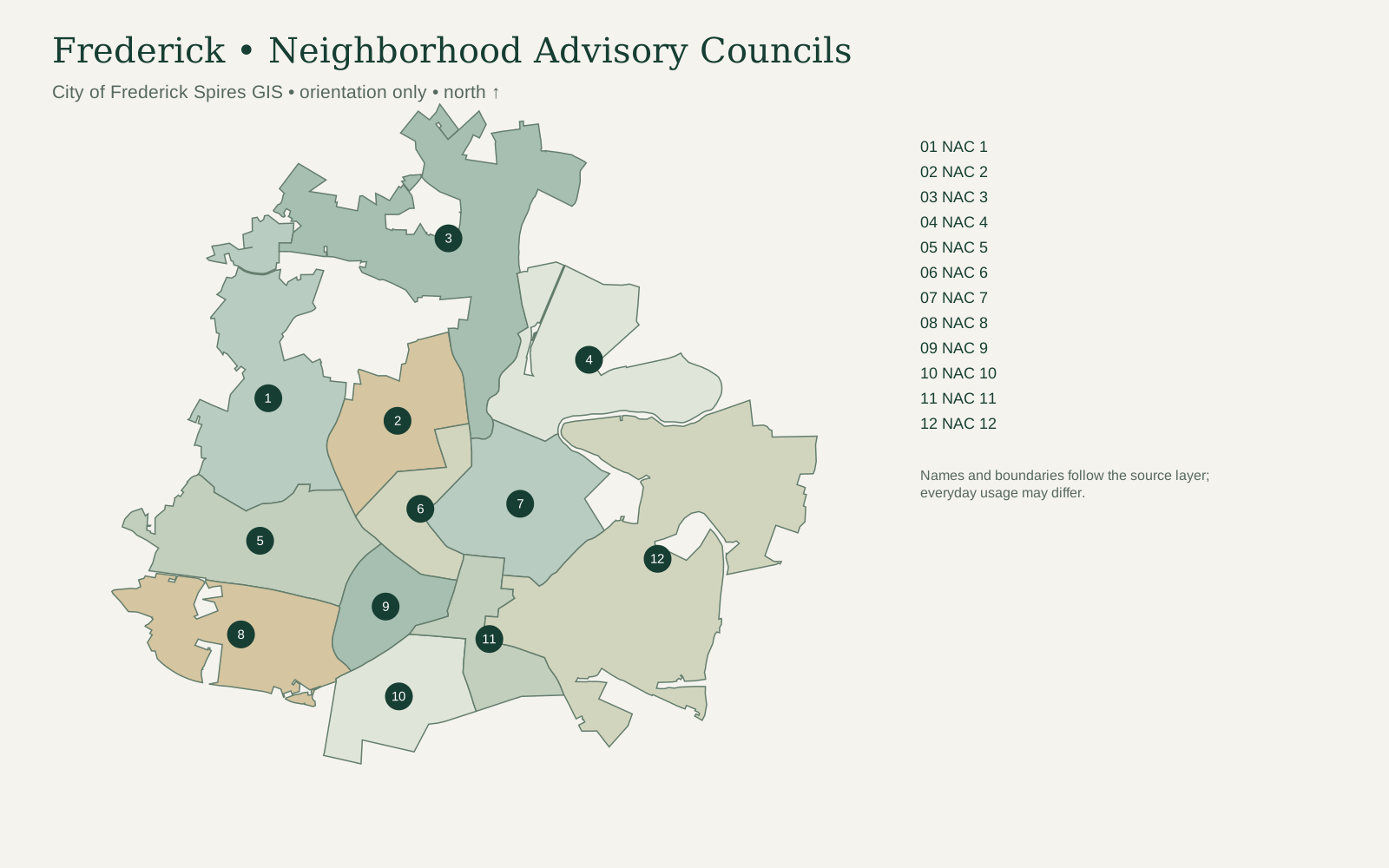
The City has twelve Neighborhood Advisory Councils, or NACs. These provide a way to raise local questions and contact neighborhood coordinators. They are distinct from City Council voting districts, school attendance areas and private community associations. Use the address finder linked from the City’s NAC page to identify the appropriate council; meeting locations do not establish a school assignment.

The map below uses the twelve NAC polygons from the City’s own mapping service. Its numbers follow the council numbers. It is an orientation aid for discussing parts of the city, not a parcel survey, driving route or assurance that a truck can stand on a particular street. The six area comparisons describe different housing and planning settings and are not intended to replace these administrative boundaries.

Downtown and the historic core call for close attention to entrances, upper floors and everyday parking. A planned community can introduce association rules, private spaces or separate management arrangements. Commercial-corridor proximity may make some errands convenient, but the useful test is the actual crossing, stop or driveway you will use. Check both ends of a daily journey at the time you expect to travel, including the return trip.

The twelve numbered Neighborhood Advisory Council areas of Frederick from official City GIS
City of Frederick Spires GIS: NACs 1–12, generalized for orientation. These are community-advisory areas, not school zones, parcel boundaries or truck routes. Open full-size map.

03 /

Find the area that fits your routine

These six comparisons use planning and historic records to explain different parts of Frederick. They are not rankings or school assignments. The map shows the twelve official Neighborhood Advisory Councils from City of Frederick Spires GIS; the area names below describe practical search locations rather than six exclusive mapped districts.

Downtown and the historic core

The 1988 expanded historic-district nomination describes a downtown grid with a concentration of commerce along Market and Patrick streets, and attached brick houses on surrounding residential streets.

Frederick Historic District expanded nomination, 1988 ↗
Housing & setting
For an older house or upper-floor apartment, inspect the actual stair, doorway and service arrangement; historic form does not establish interior condition.
Daily travel
Try the walk to everyday destinations and check the actual route home after your usual return time.
Before choosing
Confirm local historic-overlay status, routine parking and the permitted unloading position.

Baker Park edge

The City lists Baker Park at North Bentz and West Second streets with paths, play and sports facilities and on-street parking. Use the park as a geographic anchor for comparing nearby homes.

Baker Park: facilities and access ↗
Housing & setting
Compare the specific property and entrance rather than assuming all homes near the park share one building type.
Daily travel
Walk the entrance and street crossings you would actually use; proximity on a map does not settle access.
Before choosing
Check parking signs, event arrangements and the full furniture route at the chosen address.

Golden Mile and adjoining neighborhoods

The City identifies the Golden Mile as a two-mile commercial corridor along U.S. Route 40 serving surrounding neighborhoods. A new small-area plan is under development; proposed changes are not completed improvements.

Golden Mile Small Area Plan update ↗
Housing & setting
Compare a specific home or apartment with the corridor access, management rules and utilities included.
Daily travel
Test crossings, bus stops and the actual route to shops instead of assuming nearby stores are comfortably reached on foot.
Before choosing
Confirm the building entrance, private parking rights and current construction around the property.

East Street corridor

The adopted 2017 corridor plan records a mix of residential, commercial and industrial settings and identifies redevelopment opportunities. Its proposals should be checked against what exists at the address today.

Adopted 2017 East Street Corridor Small Area Plan ↗
Housing & setting
Inspect the actual use and layout of an apartment, converted building or nearby house; a development concept is not an available home.
Daily travel
Compare the route to downtown or the station with current sidewalks, crossings and service schedules.
Before choosing
Ask about active work, permitted entrances, loading arrangements and adjoining operations.

Whittier

The City’s residential-development inventory identifies Whittier as a planned neighborhood development. The community has its own resident association and property-specific documents.

2010 major residential developments inventory: Whittier PND ↗
Housing & setting
Identify whether you are considering a house, townhouse or condominium and obtain the rules applying to that unit.
Daily travel
Test the actual journey to work, shopping and the assigned school, including the return trip.
Before choosing
Clarify ownership of parking areas, move hours, shared-space use and who authorizes access.

Worman’s Mill and Mill Island

City planning records identify Worman’s Mill as a planned neighborhood development and Mill Island as one of its portions, with detached residential lots and adjoining open-space parcels documented in the 2022 report.

2022 Mill Island at Worman’s Mill planning staff report ↗
Housing & setting
Check the exact dwelling and association responsibilities; a nearby open-space parcel is not part of a private yard.
Daily travel
Test the route from the home to your daily destinations rather than assigning one commute to the entire development.
Before choosing
Confirm lot limits, shared or private spaces, delivery instructions and a truck position approved by the responsible owner.

04 /

Compare the home, ongoing costs and control of shared space

The ACS 2024 five-year profile for Frederick city covers the 2020–2024 period. It estimates 33,584 occupied homes, with 58.8 percent owner-occupied and 41.2 percent renter-occupied. Median gross rent is $1,764 and median owner-occupied home value is $401,500. These are historical survey estimates for the municipality, not current asking prices or a quote for any neighborhood.

Across all 35,421 housing units, about 31.8 percent are detached single-unit homes, 32.5 percent attached single-unit homes and 35.6 percent units in buildings containing two or more homes. About 12.1 percent were built before 1940. The tenure and structure percentages describe different universes, so do not treat the number of units as the number of occupied households. Citywide figures help frame a search; they cannot predict a particular building’s condition or monthly bills.

Compare actual costs on the same basis: rent or mortgage, association charges where applicable, utilities, parking, insurance and the ordinary journey to work or school. Ask which charges are included and which are separately billed. Confirm the heating fuel, cooling arrangement, laundry, storage and responsibility for exterior maintenance. Obtain the terms for the unit you are considering, rather than relying on another resident’s arrangement.

For a home in the local Historic Preservation Overlay, the City regulates treatment of designated exteriors, including demolition, and describes Historic Preservation Commission review with limited exceptions. Ask the owner about the property’s actual designation before planning to alter a railing, doorway, window or other exterior feature. National Register documentation and local regulatory boundaries serve different purposes; a historic-looking house is not enough to determine the required approval.

Planned communities can combine several housing forms. The Whittier Community Association describes single-family homes, townhouses and condominiums in its community and provides resident documents. Request the current rules for your property: ownership of a driveway or parking space, delivery hours, where a container may stand and who can approve a move. Do not assume that every shared-looking area belongs to the City or is available for staging.

If daily parking depends on a City residential permit, verify address eligibility and the spaces where it applies before committing. The published program lists eligible streets and has calendar-year validity. A permit is subject to posted restrictions and does not guarantee an open space at the door. Distinguish the household’s routine parking plan from the temporary arrangement needed for a moving truck.

During a viewing, follow the path from the lawful unloading position into the final room. Record narrow halls, door swings, stair turns and any elevator limit. Clarify who supplies keys and who can authorize access if the owner is away. A property that suits the household still needs an arrival plan that works for the actual furniture and shipment.

Two branded kraft cartons beside a sofa and a broad living-room window
Keep the carrying route clear while organizing rooms.

05 /

Test local travel and the Washington journey separately

Transit Services of Frederick County currently advertises free rides and describes ten Connector routes in Frederick and the surrounding urbanized area, as well as shuttles and connections to MARC. Start with the route serving the actual home and destination. Free service is useful only if the stop, operating day and last return journey fit your routine.

Use the County’s route and schedule directory for current Connector and shuttle timetables. Check weekday and weekend service separately, including any transfer and the walk at each end. A stop shown nearby on a map may require crossing a large road or using a path that is awkward with a stroller, luggage or mobility device. Make the trip in both directions before treating it as a dependable part of the housing decision.

Transit-plus and ADA paratransit are separate service arrangements for eligible riders, with preregistration described by the County. If those services are relevant, establish eligibility, booking rules and the actual trip coverage directly. Do not assume that living near a fixed-route stop completes a paratransit application or that every county service operates on the same schedule.

The MARC Brunswick Line connects Frederick and Monocacy with Washington Union Station on a commuter timetable. Check which trains actually serve the Frederick branch: a train on the Brunswick Line can serve a different branch or station. The published timetable is oriented to weekday peak travel. Review the current schedule and service alerts for the date of travel, and work backward from the arrival time you need.

For travel on or after September 28, 2026, review the announced Brunswick and Camden timetable changes. The update retimes some Frederick-branch trains and introduces a Baltimore through service from Brunswick. Frederick passengers connect to that service by a Meet the MARC shuttle at Point of Rocks; the announcement does not describe a through train starting at Frederick station. Check the complete trip and return connection for the intended date.

A rail commute includes reaching the station, any station-parking arrangement, the train itself and the onward journey from Union Station. Check the last usable return service and your alternative if work finishes late. Do not use a single best-case driving estimate to compare homes. For a driving commute, try the specific approach and return at realistic times and account for parking at the destination.

For downtown errands, the City’s street-parking page lists enforcement Monday through Saturday from 9 a.m. to 6 p.m., with parking free after 6 p.m. and on Sunday. Some identified zones now allow four hours, including an extension through ParkMobile; elsewhere the posted limit continues to apply. Payment methods include app, web, text or telephone, and the City lists a transaction fee. Read the sign at the space instead of assuming a rule for the entire downtown.

Frederick Municipal Airport supports general aviation, business aviation and flight training. Its presence does not establish a scheduled passenger-airline connection for your trip. For an airline arrival, select the actual airport and flight, then arrange ground travel to the home with time for keys and access. Keep that personal arrival plan separate from the delivery window for household belongings.

Two people on a sidewalk beside the boarding door of a white and blue bus
Check the route, stop and return service for your actual journey.

06 /

Use the current Frederick County enrollment path

Frederick County Public Schools in Maryland assigns students by their home location. Start with the district’s 2026–2027 boundary maps and feeder information, entering the exact address and checking the elementary, middle and high school layers separately. A nearby school, a subdivision name or another child’s assignment does not establish the receiving school for your household. Confirm uncertain addresses with FCPS before relying on a listing or lease advertisement.

The district’s current enrollment page links the 2026–2027 PowerSchool portal and gives the document checklist. The school year began August 19, 2026; select the portal for the year in which the child will attend. The district also supplies a printable enrollment form for families unable to use the online system. If a document cannot be uploaded, the page allows delivery or mailing to the assigned school with the student’s name visible.

Prepare proof of the child’s date of birth. The published list allows a birth certificate, physician’s or hospital certificate, baptismal or church certificate, a parent’s affidavit, or passport/visa. Use an accepted document and ask the school about any uncertainty in names or records. The list contains alternatives; do not assume that every family must produce the same single document.

For residence, the page lists a signed settlement agreement and deed, signed lease or rental agreement, property-tax bill, or a current water, gas, electric or cable bill. Where the parent and child live in a home they do not own or rent, the actual owner or renter provides the accepted residence evidence and completes the notarized FCPS Parent Residence Affidavit Multi-Family form. Arrange that step early so a missing host signature does not delay the school’s review.

Provide the Maryland immunization certificate, form 896, or other proof of immunizations. The page separately identifies additional documents that can be submitted later: the physical-exam record, parent photo identification and previous high-school transcripts or report cards where relevant. If the last physical was more than nine months before the school year starts, FCPS says the record may wait until that year’s examination is completed. Ask the school about the current health checklist and any outstanding requirements rather than assuming a portal submission settles them.

For kindergarten enrollment, a child ordinarily must turn five on or before September 1 of the calendar year in which the August school year begins. The district describes separate early-entrance, maturity-waiver and alternative-kindergarten procedures. These are specific applications, not automatic exceptions. Follow the applicable current instructions if the age cutoff or the intended program does not fit the ordinary entry path.

The general new-student page says a student transferring between FCPS schools should contact the receiving school to arrange an enrollment meeting rather than use the new-student form. The kindergarten page distinguishes children attending pre-K at their home school, who need not re-enroll there, from those who attended an out-of-district pre-K program and need to re-enroll for the upcoming year. Pre-K applications also have their own annual process. Tell the school the child’s exact current status.

After complete submission, a school representative should contact the family to finish enrollment and resolve documents. If there is no contact after five business days, the district directs families to follow up with the school. Retain the submission confirmation, school contact and list of missing items. Confirm the start date, transportation, meals and any support arrangements before the first morning; successful upload is one stage of enrollment, not a substitute for the school’s confirmation.

07 /

Coordinate electric, gas and owner-held water accounts

Ask the owner or manager for the actual providers and metering arrangement before opening accounts. Record which services are included in the rent, which are individually metered and who pays any shared charge. Identify the heating and hot-water fuels; a gas company serving the region does not establish that a particular unit has a gas connection or that the tenant controls it.

Potomac Edison’s Maryland information distinguishes electric delivery from a customer’s choice of generation supplier. Confirm the utility for the address and review any supply contract separately. Changing a supplier is not the same task as putting electric service for a newly occupied home into the correct name.

The FirstEnergy start, stop or move request says processing may require at least two business days and that an email will confirm whether the requested turn-on date can be met. Requests can be made up to ninety days ahead; weekend and holiday moves are not available through the published service arrangement. Submit early enough to resolve a date or access issue, retain the confirmation and coordinate service at both the old and new addresses.

Washington Gas’s service-territory page includes Frederick County but notes that some county areas are served by BGE. Check the address instead of assigning one supplier to every Frederick postal address. For a home served by Washington Gas, its start and stop instructions require at least two working days of notice, excluding weekends and holidays, and access to start service. Initiation fees depend on whether the gas is already on; confirm the current applicable charge when arranging the account.

Washington Gas also identifies dependencies between services: electric service must be active for gas appliances with electronic ignition, and water must be active before a gas water heater can be lit. Ask whether a technician needs entry and who will be present. At the departing home, confirm that the account has actually closed; inability to reach a meter or failure to complete the stop request can leave responsibility unresolved.

The City’s water and sewer billing page says accounts are maintained in the property owner’s name and changed when a property transfers. A renter should clarify payment responsibilities with the landlord rather than assume that an ordinary tenant account transfer is available. A buyer or settlement representative should use the property-transfer request form, which requests the property, buyer, seller, settlement date and forwarding details. Confirm the settlement and billing process with Utility Billing at 301-600-1421.

For service or meter problems, use the appropriate City water and sewer contact. Keep the property-specific account references privately with your move records. Arrange internet or other communications for the actual unit and a date when someone can provide entry. Verify active service and functioning heat, water and communication after possession; an application or appointment alone does not establish that the home is ready for occupation.

08 /

Separate routine trash, recycling and booked bulky collection

First establish whether the property receives City service, County recycling or a privately arranged building service. Ask the manager where residents may place material and which containers belong to the unit. A Frederick mailing address or the presence of nearby carts does not answer who collects from a particular building.

The City’s residential trash instructions distinguish automated collection using City carts from rear-load collection handled by a crew. Trash is collected weekly, with setout after 5 p.m. and before midnight on the evening preceding the collection day. Use the linked address tool for the day and check City holiday changes. The published household service quantity is up to 180 gallons per collection.

For rear-load collection, the City allows cans or bags up to 35 gallons and 50 pounds each and requires residents to supply the receptacle. Material should be near the public street and at least five feet from a hydrant. Automated collection accepts City-issued carts, positioned with the metal bar and opening toward the street and at least three feet from obstructions. Apply the instructions for your collection method; do not combine them into a single cart rule for every home.

Moving cartons should be sorted before the first collection day. The City’s recycling page identifies Frederick County as the provider of biweekly recycling for single-family households and distinguishes multifamily and business arrangements, which may need private service. Follow the County link for accepted materials, cart requests, address schedules and current disruptions. Materials are not accepted in plastic bags. Keep packing film, foam and mixed packing waste separate until you know the correct destination.

The City page directs participating households to put the blue recycling cart out by 6 a.m. on the collection day. Ask the property contact which cart belongs to the residence and where it is normally placed. Flatten cartons to fit the applicable collection instructions and keep the carrying route clear while unpacking. If a large quantity will not fit, ask about an approved additional drop-off or collection arrangement instead of leaving an unbooked pile.

Frederick’s bulk-trash program provides one free scheduled pickup per household per year, described as approximately ten items. The request must include an itemized list. For more than ten items or another collection in the same year, contact Sanitation at 301-600-1377 about the fee and arrangement. Reserve the collection before moving day and retain the confirmed date rather than treating a request as immediate authorization to set out furniture.

Mattresses and box springs appear on the accepted list with a limit of three per household. Clarify how the City counts your proposed combination, and whether any preparation requirement applies, when booking. The published list does not provide a separate mattress price for the ordinary annual pickup. Do not borrow a landfill price, a neighboring county’s rule or a special-event allowance as the cost for this service.

Place accepted items in the usual collection location, such as the curb or corral. City crews do not enter homes, fences or private property to retrieve them. Appliances requiring refrigerant removal and equipment containing fuel or oil have separate preparation issues; describe them accurately in the request. Donation, reuse and paid removal also need their own confirmed acceptance and appointment. Keep disposal separate from the moving inventory so nothing is loaded or left behind by mistake.

09 /

Frederick truck-space procedure, posting and enforcement

Start with the exact street segment and the space needed for the vehicle and loading operation. Record the address, side of the street, proposed date and hours, approximate vehicle length and whether a ramp or liftgate will be used. Identify meters, accessible spaces, driveways, hydrants, bus stops and pedestrian routes. A convenient location is only a proposal until the responsible office confirms that it may be used.

The City’s No Parking sign policy expressly includes moving, with a limit of three parking spaces. Signs are obtained through the Parking Department, and pricing varies by location. The separate funeral and memorial-service prices on that page do not establish the price of moving signs. Ask for the total applicable to the actual location and dates, together with any deposit or return condition.

The Parking Department FAQ identifies the office at 2 South Court Street and the contact number 301-600-1429. Before collecting signs, ask when the request must be made, who may post them, the required advance posting period, how the restricted hours must be shown and whether the City records vehicles already present. The public moving-sign summary does not establish a general posting lead time, so obtain that instruction directly for your booking.

Enforcement is a separate question from purchasing signs. The City-hosted Police General Order 265, approved September 23, 2019, says officers distinguish signs and vehicle lists prepared by City staff from those prepared by private citizens. For City placement, the order describes checking the City-generated record of vehicles already present. Vehicles present before the signs were placed, or cases without the required list, do not receive enforcement under that process.

The same published order says that when a private citizen places the signs or generates the vehicle list, officers do not issue a citation or tow under that provision; they may attempt to locate the vehicle owner. If removal cannot be arranged, the resident is directed back to Parking. Because the document bears a 2019 approval date, ask the Department to confirm the current procedure and any later instructions. Do not promise that a purchased sign will cause an occupied vehicle to be removed.

Check the City’s street-sweeping restrictions and the signs already posted on the block. Street-parking payment, a residential permit and a loading pass are different permissions. None should be treated as an automatic reservation for a multi-hour household move. Describe any proposed lane obstruction, sidewalk occupation, dumpster or portable storage container and ask whether another authorization or department is involved.

On private property, obtain the owner’s or association’s written arrangement for the actual truck position and access period. Confirm who controls the space, whether the truck may wait there and how other residents retain access. A private parking bay beside a City street remains a different enforcement situation. Do not assume that the City’s temporary-sign process controls the association’s lot or that a manager can authorize occupation of the public street.

Send the confirmed parking instructions and any reference number to the moving contact. Keep a lawful fallback: another approved position, a revised arrival period or an arrangement that the owner and mover have reviewed. If that alternative increases the carry or changes equipment needs, have it reflected in the work discussion before the day. Never use cones, household objects or the truck itself to create an unauthorized closure.

Recheck the block shortly before arrival for current restrictions, road work or a snow emergency. If a vehicle occupies the intended space, use the official contact and follow the confirmed instructions. Pause the affected unloading while the situation is resolved; a blocked plan is not permission to obstruct a hydrant, driveway or pedestrian route. The Frederick moving page explains the access information to include in the estimate.

10 /

Check the route inside and outside the property

Start where the vehicle can lawfully stand and follow every part of the delivery route. A level sidewalk can lead to a steep private walk; a wide porch can lead to a narrow vestibule; an upper-floor room can be reached only through a tight turn. Record each change rather than describing the property simply as a house or an apartment.

Measure the clear opening with the door in its usable position, the stair width between fixed features and the landing space needed to turn. Photograph low ceilings, projecting radiators and handrails. Ask the mover to assess the route for unusually long, heavy or delicate pieces. Do not treat a straight-line measurement of the item as proof that it can negotiate a turn.

Obtain the manager's current move instructions for a shared building. Confirm the entrance, hours, elevator reservation if applicable, required insurance documentation and floor protection. Identify who can unlock doors and authorize use of common space. A resident's ability to enter through a door does not establish that it may be held open for a delivery.

Ask where belongings may be staged while leaving exits and other occupants' routes clear. Confirm lighting and the responsibility for clearing private steps, snow and ice. Keep pets, children and visitors away from the carrying path. If another household is moving or a contractor is working that day, agree how the space will be shared before either operation arrives.

Any proposed removal of a door, railing or exterior element needs the owner's approval and any applicable review. If the existing route does not work, discuss permitted alternatives, disassembly or specialist handling before scheduling. The Frederick moving page explains how those access details should be included in the estimate discussion.

11 /

Try ordinary errands before choosing the home

Build a short test route from each candidate address: food shopping, pharmacy, a park or outdoor walk, the school or childcare journey and any recurring appointment. Check entrances and crossing points rather than measuring only straight-line distance. Repeat the route with the bags, stroller or mobility requirements that matter to your household.

Baker Park provides an established outdoor anchor near downtown, but the entrance closest to your home and the route to it still need checking. The City publishes information about the Baker Park carillon and performances; use current schedules for a planned visit. A park described in a neighborhood module is not a promise that every nearby street has the same access, facilities or atmosphere.

For shopping along a commercial corridor, look at how you reach the store and return home. A nearby business across a busy road may work well by car and poorly on foot. Check the actual bus connection if you intend to use transit, and avoid treating a planning proposal for a future connection as an existing path. Revisit the location when you expect to make the trip.

During the first week, verify mail and package delivery, the location of shared bins, building entry arrangements and the contact for urgent property issues. Keep keys and access codes secure, and learn how visitors or service technicians enter without blocking other residents. These small operating details are often more useful than a broad neighborhood label once you are living in the home.

Two walkers following a park path beside a small creek and autumn trees
Try the entrances and everyday routes you expect to use.

12 /

Plan for the actual weather and current street restrictions

The City’s snow-removal page describes a snow emergency announced two hours before it takes effect. Vehicles must be removed from designated snow-emergency routes within that notice period. Check the route signs and current City announcement; an earlier parking arrangement should not be assumed to override an emergency restriction.

Property owners are directed to clear sidewalks within twelve hours after snowfall ends. The City also instructs residents not to put snow into streets or sidewalks. Confirm with the property contact who clears the public frontage, private walk, steps and landing, and how treatment is arranged if ice returns. Responsibility should be settled before a scheduled delivery, including who can respond if the owner is absent.

A cleared sidewalk does not establish that every entrance step is ready. Inspect the whole route from the truck to the final room and look for a plow bank at the curb, shaded ice, drainage across the walk or a slippery threshold. Leave the carrying path usable and keep exits and access for other residents open.

In other seasons, plan for the conditions on the actual day: wet cartons, a slick walkway, heat exposure or limited daylight can change how belongings should be staged. Keep weather-sensitive items protected and avoid leaving them outside without an agreed receiving arrangement. Ask about any active building work or public event affecting the block, using current notices rather than assuming an annual date or closure.

If conditions make the agreed operation impractical, contact the mover and property representative before improvising. Confirm whether the arrival time, approved truck position or carrying method must change. A useful contingency identifies the responsible person and the next permitted step; it should not depend on an unconfirmed driveway, entrance or curb space.

Resident carrying a shovel along a cleared sidewalk beside lightly snow-covered stoops
A cleared sidewalk does not confirm the steps are ready; inspect the full approach.

13 /

Keep the last checks and the first night manageable

Before moving day, assemble the confirmed addresses, unit numbers, keys, contacts, inventory and any building or public-space permissions. Send material changes to the mover, including a different floor, extra stop or unavailable entrance. Confirm that the person receiving the shipment can be present and can make decisions about room placement.

Keep medicines, essential documents, chargers, basic toiletries and a change of clothes in a personal bag that stays accessible. Separate the belongings needed for children, pets and the first night. Do not load the keys, permission paperwork or information needed to open the home among cartons that will be difficult to retrieve.

At arrival, walk the route before unloading. Check that the approved space and entrance remain usable, point out the destination rooms and identify anything excluded from the shipment. Keep shared exits clear. If access or possession has changed, pause the affected operation and agree the next step with the property contact and mover rather than improvising an unauthorized route.

During the first week, verify that utilities and communication services are active under the agreed arrangements, school registration has progressed to a confirmed start and waste is going out on the correct schedule. Arrange bulky-item collection separately if still required, and break down cartons to the accepted size as rooms are unpacked.

Keep a short list of unfinished tasks with the responsible office, reference number and next action. A submitted enrollment form, meter-rental request or service order may still need review or an appointment. The Frederick moving estimate section helps collect the inventory and access details for the moving work; retain the separate property and municipal confirmations alongside it.

14 /

Questions before you arrive

Does a Frederick mailing address mean the home is in the City?

No. Check the municipal boundary and the actual provider for the property. A regional or postal description does not establish City trash collection, parking authority or water service.

Are the map areas school attendance zones?

No. They are the City’s twelve Neighborhood Advisory Councils. Use FCPS address-based school maps and confirm the assignment with the district.

When is a child ordinarily eligible for kindergarten?

Frederick County Public Schools in Maryland ordinarily requires the child to be five by September 1 of the calendar year in which the school year starts. Separate early-entry and waiver processes have their own requirements.

Can a renter put City water service in their own name?

The City says water and sewer accounts remain in the property owner’s name and change when the property transfers. Clarify a renter’s payment responsibilities with the landlord and confirm any unusual arrangement with Utility Billing.

Can furniture and mattresses go out with ordinary trash?

Use a confirmed bulk appointment. The City describes one free pickup per household per year of approximately ten listed items, with mattresses and box springs limited to three per household. Ask about additional items or pickups before setout.

Will No Parking signs guarantee an empty moving space?

No. Ask Parking who posts them, what City records are required and what current enforcement is available. The published police order distinguishes City placement from private placement and limits citation and towing.

What should be confirmed before the first night?

Possession, working keys, usable access, utility service and a receiving contact should all be confirmed. Keep essential belongings accessible and retain school, collection and account follow-up details for the first week.

Your next step

Bring the plan together

Use the Frederick moving page to prepare the inventory, access details and questions for your estimate.

Sources & useful local resources

Official procedures and local resources are linked beside the answers above. Reopen the relevant page when arranging a date: fees, schedules and application requirements can change.

Housing

Neighborhood context

Waste

Orientation

Transport

Truck space

Everyday life

Utilities

Weather

Schools