Glens Falls is a compact older city on the Hudson River at the Adirondack edge — half of its housing predates 1940, and its streets run on small-city rules. This guide helps you compare areas, plan the everyday basics and prepare the practical steps of arriving.
Try the everyday errands around a new address, not only the journey to work.
01 /
Start with the decision in front of you
Glens Falls asks three different questions of a newcomer, and this guide is organized around them. If you are still choosing where to live, start with the orientation and the neighborhood comparison, then read the housing section — the market is mostly older houses and small apartment buildings, and the differences that matter are stairs, driveways, heat and who clears the snow. If you are moving with children, go to the schools section: registration runs in person through the district office on Quade Street, and elementary placement follows a zone map. If the address is already decided, the second half of the guide walks the practical setup — utilities, trash, the curb for the moving truck, building access and the arrival sequence.
One caution before any comparison: "Glens Falls area" is not a legal place. The City of Glens Falls is a small municipality ringed by the Town of Queensbury; the Village of South Glens Falls sits across the Hudson in Saratoga County; the hamlet of West Glens Falls is in Queensbury, not in the city; and the Village of Lake George, eight miles north, is a separate municipality with its own rules. SUNY Adirondack and the Aviation Mall are in Queensbury. Verify the municipality of every candidate address before comparing procedures — a Queensbury address does not follow city rules, and vice versa.
02 /
Understand Glens Falls before comparing addresses
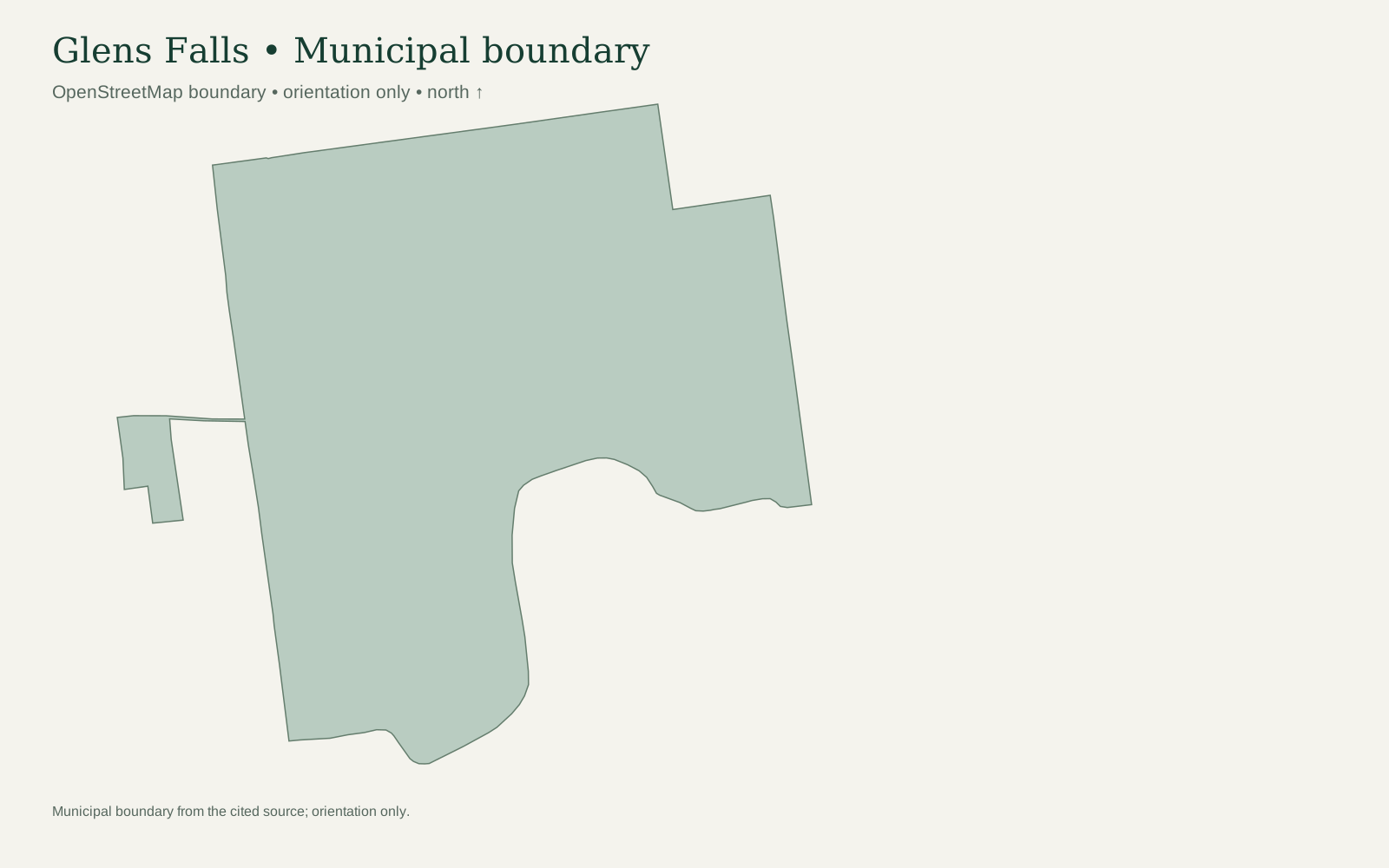
Glens Falls is a city of about 14,800 people in Warren County, sitting on the Hudson River where the Northway (I-87) meets the southeastern Adirondacks. The city itself is compact — a few square miles of grid streets around a downtown core where Glen, Warren and Ridge Streets meet at Centennial Circle — and it is genuinely walkable in a way the surrounding towns are not. The map below shows the single municipal boundary, from OpenStreetMap data; everything outside that line is another municipality's jurisdiction, whatever the mailing address or the listing site says.
The city's own internal geography runs on five wards — the Department of Public Works organizes its yard-waste schedule by ward — and on neighborhood names that are informal rather than official: downtown, the East End, the Fredella block, the Crandall Park area. Historic recognition clusters on the grid: more than forty individual National Register listings line Warren, Glen and Ridge Streets, and the city's one National Register historic district, the Fredella Avenue block, preserves a remarkable set of concrete-block houses from 1912 to 1918.
Regionally, Glens Falls functions as the service center for the southern Adirondacks. CDTA buses radiate from the Ridge Street terminal downtown; the nearest Amtrak stop is in Fort Edward, about six miles south; the region's airport is Albany International, roughly 45 miles south. Lake George village — the resort town most outsiders picture — begins eight miles north, across the Queensbury line.
Use the numbered key to locate the areas discussed below. Open full-size map.
03 /
Find the area that fits your routine
Glens Falls has no official neighborhood map — the city runs on five wards and informal names. The six areas below are the ones a household is most likely to compare, chosen for their verified character from city pages and National Register records. They are starting points for inspection, not rankings; building conditions vary house by house, and the municipal line against Queensbury matters more than any neighborhood label.
Downtown & Centennial Circle
The civic and commercial core where Glen, Warren and Ridge Streets meet: city offices, shops, restaurants, the arena and the library, with apartments above and behind the commercial streets.
Expect older buildings and conversions rather than houses; compare what the rent includes and ask for written moving rules where a building is managed.
Daily travel
The strongest transit position in the region: the Ridge Street terminal is here, all seven CDTA routes start downtown, and everything civic is a short walk.
Before choosing
Downtown streets have a three-hour parking limit until 5 p.m. and nothing parks on-street overnight; the truck plan — window, position, lot backup — belongs in the lease conversation.
East End
The Warren Street corridor east of downtown: an older working neighborhood of houses and former industrial properties, now the subject of the city's East End Rising brownfield-area planning effort, whose steering committee met through late 2025.
Mixed older stock in transition — some renovated, some awaiting it; inspect the specific house and block rather than the corridor's reputation.
Daily travel
City blocks close enough to downtown for a short bus ride or walk; confirm the exact stop you would use.
Before choosing
Brownfield-area planning signals change ahead; check property condition, heat and the curb individually, and ask what is planned for the immediate block.
Fredella Avenue
The city's one National Register historic district: a single short block of concrete-block Classical Revival houses built by Joseph J. Fredella, with significant years 1912 and 1918 — an intact piece of early-20th-century worker housing.
Compact early-1900s houses on small lots; the construction is masonry block, which changes insulation and renovation questions.
Daily travel
A close-in residential block; walk the actual distance to the downtown terminal or your usual stop.
Before choosing
Historic-district status means exterior character is documented; check what alterations the block's status and city review mean for any planned work.
Feeder Canal corridor
The city's eastern edge follows the Glens Falls Feeder Canal, a National Register-listed structure dating to 1829–1832, recognized for its engineering and transportation history; the towpath corridor is now a recreation spine.
East-side residential blocks within reach of the canal path; housing varies street by street between older homes and former industrial-edge properties.
Daily travel
Car-oriented on this edge; test the drive or bus connection to downtown rather than assuming it.
Before choosing
Confirm the property's relationship to the canal corridor and trail, and check drainage and basement history near the waterway before signing.
Bay Street & the library blocks
The blocks between downtown's civic core and the residential grid, where late-19th-century apartment construction survives: Smith Flats on Bay Street, an 1895 Renaissance/Queen Anne building, holds a National Register listing.
Apartment flats in older buildings close to the core — shared entries, stairs, and the trade of space for walkability.
Daily travel
Among the most walkable residential positions in the city; the Ridge Street terminal is a short walk.
Before choosing
Verify where tenants park overnight (streets are banned 2–6 a.m.) and where a moving truck may stand on these narrower streets.
Crandall Park area
The city's north-side residential area, anchored by its signature green spaces: Crandall Park with its pond, and the Cole's Woods trail system with groomed ski trails in winter.
Predominantly detached houses on quieter streets — the stock where Glens Falls' pre-1940 single-family half concentrates; expect driveways, yards and full-home maintenance questions.
Daily travel
More car-shaped than the core; check the nearest bus stop and the realistic drive to downtown and the Route 9 corridor.
Before choosing
Winter access and plowing order matter on residential streets; agree snow clearing and confirm where a truck can turn and stand on moving day.
04 /
Compare the whole home, not just the advertised payment
Glens Falls is close to an even tenure split: 52.3% of households own and 47.7% rent (ACS 2024 5-year, via Census Reporter). The median gross rent is $1,077 a month and the median owner-occupied value is $212,200 — figures that describe the whole city at once, not the house in front of you, and listing sites' asking prices run above survey medians. Use them only to sanity-check a budget.
The stock explains the market. About half of the city's homes are detached single-family houses, but nearly one unit in three sits in a two-to-four-unit building, and 50.9% of all units were built before 1940 — Victorian and early-20th-century construction is the norm, not the exception. For a mover this means the differences that matter are physical: which floor, stairs or a straight carry, where a truck can stop, how heat is supplied and who shovels the walk. Bay windows, porches and radiators come with the charm; so do narrow staircases with landing turns and driveways too tight for a large truck.
When comparing two homes, compare what the payment includes — heat, hot water, parking, snow clearing, trash service — the lease's move-in and move-out rules, and the condition of the access route: porch boards, stair rails, door widths. Two Glens Falls specifics deserve early questions. Trash is private here: there is no municipal collection, so ask who the building's hauler is and what it costs. And there is no city bulky pickup at move-out, so the plan for whatever you are not taking belongs in the budget from the start.
Compare usable rooms, light, the heating arrangement and what the rent actually includes.
05 /
Test the complete daily journey
Since January 1, 2024, Glens Falls transit is CDTA: Greater Glens Falls Transit merged into the Capital District Transportation Authority, buses were rebranded, and the network kept its shape. Seven routes radiate from the Ridge Street terminal downtown — CDTA's Warren County page lists them: 402 to SUNY Adirondack, 404 to Hudson Falls and the Fort Edward Amtrak station, 405 to South Glens Falls and Moreau, 407 to West Glens Falls, 411 and 412 up the Route 9 corridor to Walmart and the Aviation Mall, and 419 to Lake George Village. Buses run weekdays roughly 6:30 a.m. to 9:45 p.m. and Saturdays 8 a.m. to 6 p.m.; no Sunday fixed-route service is listed. The cash fare is $1.50 since the April 2025 Navigator fare alignment. Check current schedules before building a routine on any single route.
For rail, the stop is Fort Edward–Glens Falls (FED) — note the first name. The station is a platform beside the historic Delaware & Hudson depot at 70 East Street in Fort Edward, about six road-miles south of downtown, served by the Adirondack (New York–Montreal) and the Ethan Allen Express (New York–Burlington). CDTA route 404 connects the Ridge Street terminal to the station; otherwise the last leg is a car or a ride. For flights, Albany International Airport is the region's airport, roughly 45 miles south down the Northway — plan on a car, taxi or shuttle for that run.
Is a car-free household realistic? Downtown, partly: the core is walkable, the bus network covers the daily triangle of city, Queensbury shopping corridor and Lake George, and everything civic sits within a few blocks. But the honest test is the journey you will actually make — the grocery run, the school route, a January evening trip home after the last bus — so test it from the exact address before deciding.
Test the full bus journey, including the walk at both ends and the last departure.
06 /
Register in person — and check the elementary zone first
The Glens Falls City School District is compact: one high school, one middle school and three elementary schools — Big Cross, Jackson Heights and Kensington Road. Registration is not an online form. Per the district's registration page, new families register in person at the District Office, 15 Quade Street, where the registrar walks through the paperwork; central registration answers at 518-792-1212.
Three calendar facts shape a family's timing. Kindergarten registration happens at "Kindergarten Round-Up" events at each elementary school in May. Universal Pre-K is allocated by lottery in April, with a waiting list (518-792-0107) once classes fill. And mid-year arrivals register directly at the district office whenever they land.
Elementary placement follows the district's Registration Zones map: each address has a "home" elementary school, and the district says most students are placed there. But it is candid about the exception — when a building's class sizes hit their upper limit, the superintendent has occasionally placed families registering mid-year in the building with the fewest students instead. If a specific elementary matters to your housing choice, check the zone map before signing, and treat placement as likely rather than guaranteed.
07 /
Assign an owner and a start date to each household service
Electricity and natural gas are National Grid — the city's own Climate Action Plan names National Grid as the delivery utility for Glens Falls. Start, stop or transfer service through National Grid's start/stop service process; submit the request as soon as your date is fixed, and confirm whether the account at your address is in the landlord's name or yours.
Water and sewer are municipal: the city runs its own Water Filtration Plant, reservoirs and wastewater treatment plant, bills quarterly, and answers billing questions at 518-761-3814. Note for owners: the quarterly bill carries a capital charge calculated from the property's assessed value, so the number follows the assessment roll. For renters, the city publishes no tenant-account policy — ask the landlord who holds the account and whether any water cost is folded into the rent before you sign.
For internet, availability is address-specific in a city of older buildings; check providers against the exact address and ask which service already wires the building. In a pre-war two-family, an installation booked before the move is much easier than one booked from an empty apartment — and in January, the water department's standing advice to prevent frozen pipes is worth reading before your first cold snap.
08 /
Trash is private here — plan collection and disposal yourself
The fact that surprises newcomers: Glens Falls has no municipal household trash collection. The city's own FAQ lists rubbish and garbage hauler licenses among the City Clerk's permits — collection is a private market. In a multi-unit building the landlord arranges it; in a house you hire a hauler yourself. Ask before you move in who collects, what day, and what it costs, and put the cans out accordingly.
Bulky disposal is the sharper constraint. The Department of Public Works does not haul junk at all. The city's junk removal guide lays out the hierarchy: if it is reusable, put it at the curb with a "FREE ITEMS" sign for three to four days; whatever nobody takes is your responsibility to dispose of properly — abandon it and it is illegal dumping under state law, reportable to the police. The working routes are a hired licensed hauler, a rented pickup, or the transfer stations.
What you are leaving
How it goes out
Reusable furniture and appliances
Curb with a "FREE ITEMS" sign, 3–4 days; then your responsibility
Everything else bulky
Hire a licensed hauler (the DPW page links a list) — there is no city pickup
Self-hauled loads
Queensbury transfer stations: Ridge Road Tue/Thu/Sat, Luzerne Road Wed/Fri/Sat — for Glens Falls property owners
Yard waste
Seasonal open pickup plus weekly bagged pickup by ward, 50-lb biodegradable bags only
Yard waste is the one thing the city does collect: open pickup runs in spring and fall (fall 2026: October 19 to November 27), with weekly bagged collection by ward in between — Tuesday Ward 3, Wednesday Ward 2, Thursday Wards 4 and 5, Friday Ward 1. Bags must be biodegradable paper, under 50 pounds, with leaves/grass and brush bagged separately. Whatever the item, a pile at the curb on moving day is not a legal disposal route in Glens Falls.
09 /
Arrange a legal place for the moving truck
Glens Falls is easier on moving trucks than the big permit cities — and stricter than it looks. The city's parking page states the frame plainly: parking on all city streets is free; on-street parking is allowed from 6 a.m. to 2 a.m.; nothing parks on a city street overnight, year-round; downtown streets carry a three-hour limit until 5 p.m., then unlimited. There is no moving-truck reservation program and no street-occupancy permit to apply for — the right-of-way permit is for excavation and curb cuts, not for parking a truck.
So the procedure is a decision path rather than a permit:
Private space first. If either address has a driveway, lot or loading area, plan around it and get the property's permission in writing. Most Glens Falls residential moves load from a driveway or a quiet side street.
Fit the street window. Schedule arrival after 6 a.m. and clear the street well before 2 a.m. On downtown blocks, either keep the truck inside a three-hour window before 5 p.m. or start after 5 p.m. when time is unlimited.
Know the lots. Overnight parking is allowed in the municipal lots on Elm, Exchange, Ridge and Warren Streets; the Elm Street lot is all free and first-come. Useful for a car, not a loading position.
Anything unusual, call ahead. If the job needs a downtown curb all day, a lane, or a position near a hydrant or bus stop, call the Department of Public Works at 518-761-3834 before the date. Improvising on the morning is how tickets happen — posted signs control, and enforcement is real.
One seasonal override: in winter the city posts snow emergency alerts through its Alert Center, and the overnight ban exists precisely so plows can work the curb lane. A February move needs the forecast in the plan, not just the calendar.
10 /
Inspect the full route through the building
Glens Falls access questions are mostly wood and stairs. The typical older two-to-four-unit building has a shared front entry, a porch with a few steps, a staircase with a landing turn, and doors sized for 1910. Measure the largest pieces against the actual route — width, turns, ceiling at the landing — and check porch boards and railings before anyone carries a sofa across them. Side driveways on compact lots are often narrow or shared; agree their use with the landlord and neighbors before moving day.
Downtown conversions and the larger apartment buildings add paperwork: ask the property manager for written moving rules, whether a certificate of insurance is required from the mover, whether an elevator must be reserved, and whether moves are confined to set windows. Get the answer from both ends — a plan that works at the origin but not the destination is only half a plan.
For both types, walk the full route before the day: where the truck stops within the city's parking windows, which door is used, every stair and landing between the truck and the room, and who unlocks what. Then match the two ends together with time windows that overlap usefully.
11 /
Build a useful routine beyond the commute
Glens Falls' everyday geography rewards a look on foot. Downtown orbits Centennial Circle, where Glen, Warren and Ridge Streets carry the shops, restaurants and civic buildings; the city's community page lists the pieces — Crandall Public Library, the Harding Mazzotti Arena (the former Civic Center), the Business Improvement District and the seasonal events calendar. Arena nights change the parking picture downtown, which the city's parking map acknowledges by marking the arena's event lots.
The green anchors sit at the edges: the Recreation Department stewards Crandall Park and its pond on the north side, the Cole's Woods trail system, East Field, City Park and the Fire Road Ice Rink. The Feeder Canal corridor runs along the city's east side, a National Register-listed engineering landmark with a trail that residents use year-round.
Test the routine you will actually live: the grocery run, the pharmacy, the school or daycare route, a late-evening trip home after the buses stop. Glens Falls empties and fills with the Adirondack tourism calendar — summer weekends on Route 9 are not January weekdays — so visit a candidate address at the hours you would use it before deciding.
Check the parks and errands you will actually use around the address you choose.
12 /
Plan for the season in which you will live and move
Winter is Glens Falls' scheduling season, and the city's rules are built around it. The year-round overnight street-parking ban — 2 a.m. to 6 a.m., every night — exists so plows can clear the curb lane; it applies in July too, but it bites in January. When storms warrant, the city posts snow emergency alerts through its Alert Center; sign up for Notify Me when you arrive so the declaration reaches you rather than surprising your car.
After the snow, the clock starts on sidewalks: the abutting property owner must clear them within five hours of the storm's end, or by 1 p.m. the next day after overnight snow. Plowing priorities run major thoroughfares first, secondary streets as the storm continues. Residents can pick up sand at the DPW facility at 230 Dix Avenue during business hours. If you rent, check the lease for who actually shovels — the legal exposure sits with the owner, but the boots are often the tenant's. The water department also publishes cold-weather guidance on preventing frozen pipes, worth reading before your first hard January.
The other calendars are gentler. There is no university inside the city, so no late-August turnover crunch; the yard-waste windows (spring and fall open pickup) matter more for move-out cleanups than any academic date. Summer brings the Adirondack tourist season — festival weekends downtown and heavy Route 9 traffic toward Lake George — which is a travel-time buffer, not a reason to avoid a June date. From our own workload, end-of-month and month-start dates book first in any season; mid-month gives you more room.
Winter dates need a storm plan: overnight street parking is banned year-round.
13 /
Turn the chosen home into an arrival plan
With the address decided, sequence the setup so nothing blocks the truck. Four to six weeks out: confirm the lease or closing date, check the elementary zone map if you have children (kindergarten Round-Up is in May, the UPK lottery in April), and book the move itself. Two to three weeks out: open the National Grid start/stop request, settle the water account question with the landlord or the city's billing line at 518-761-3814, choose a trash hauler if the building doesn't provide one, and book internet installation for arrival week. At least a week out: collect written building rules at both ends and fix the curb plan — private space first, the 6 a.m. to 2 a.m. street window, downtown's three-hour limit until 5 p.m.
In the final days: confirm the access plan, finish packing, set aside what travels with you, and in winter check the forecast and the city's alert feed. In the first week after arrival: learn your trash day from the hauler, test heat and hot water, note the nearest grocery and pharmacy, sign up for Notify Me alerts, and register at the district office on Quade Street if you have school-age children. If you bought rather than rented, note the water bill's capital charge follows the property assessment — worth understanding before the first quarterly bill surprises you.
14 /
Questions before you arrive
Is Lake George part of Glens Falls?
No. The Village of Lake George is a separate municipality about eight miles north, past the Queensbury line — its procedures, parking and rules are its own. CDTA route 419 connects the Ridge Street terminal in downtown Glens Falls with Lake George Village.
Do I need a car in Glens Falls?
Downtown, partly not: the core is walkable and CDTA buses run weekdays roughly 6:30 a.m.–9:45 p.m. and Saturdays 8 a.m.–6 p.m., with no Sunday fixed-route service listed. But the Amtrak station is six miles away in Fort Edward, the airport is about 45 miles south in Albany, and winter is real — test the exact journeys you will make before deciding.
Who collects my trash in Glens Falls?
No city crew — household trash is private. The City Clerk licenses rubbish and garbage haulers; in multi-unit buildings the landlord usually arranges collection, in a house you hire a hauler yourself. Ask who collects, on what day and at what cost before you move in.
Can I leave unwanted furniture at the curb when I move out?
Only briefly, as reuse: the city's junk removal guide allows a curb placement with a "FREE ITEMS" sign for three to four days. After that it is your responsibility — DPW does not haul bulky items, and abandonment is illegal dumping. Hire a licensed hauler or self-haul to the Queensbury transfer stations on their open days.
Can anything park overnight on a Glens Falls street?
No. On-street parking is allowed from 6 a.m. to 2 a.m., year-round — the ban keeps the curb lane clear for plows. Overnight parking is allowed in the municipal lots on Elm, Exchange, Ridge and Warren Streets.
How do I register my child for school in Glens Falls?
In person at the district office, 15 Quade Street — the registrar walks you through the paperwork, and central registration answers at 518-792-1212. Kindergarten registration happens at May Round-Up events; Universal Pre-K is allocated by April lottery.
Does my Glens Falls address guarantee a specific elementary school?
Mostly, but not absolutely. The district's Registration Zones map assigns each address a "home" elementary school, and most students are placed there — but when class sizes hit their limit, the superintendent has placed mid-year registrants in the building with the fewest students. Check the zone map before signing a lease if a specific school matters.
Official procedures and local resources are linked beside the answers above. Reopen the relevant page when arranging a date: fees, schedules and application requirements can change.