New York / City relocation guide

Moving to Hauppauge

Begin a Hauppauge relocation with the exact property and the services attached to it. The hamlet spans two towns, while road, school and library boundaries answer different questions. Use the comparisons and practical steps below to turn a promising address into a workable arrival plan.

Two adults walking on a sidewalk beside low brick shops and a planted verge
Test ordinary errands from the home, including the actual crossings and walking path.

01 /

Build an address-based arrival plan

Before choosing a moving date, create a short record for the actual property: town, unit, owner or manager, school district, water account arrangement, electricity, heating fuel, waste service and road owner. Use the lease, purchase documents and the responsible organizations to confirm each entry. A Hauppauge postal address is a starting point, not a complete service assignment.

Divide the work by dependency. School registration needs the district and living arrangement. Utilities need the address, account responsibility and possession date. Truck planning needs the vehicle and receiving entrance. Put unresolved questions next to the person who can answer them, rather than treating a submitted request as confirmation.

Visit the home at the times you expect to leave and return. Walk the route to a bus stop or everyday shop, including crossings and sections without a continuous pedestrian path. Test the trip with your ordinary luggage, child or mobility needs in mind. A nearby destination on a map may require a different practical approach.

Keep one arrival folder with the lease or closing details, district correspondence, service confirmations, building instructions and moving paperwork. Save the important contacts on your phone as well. The purpose is to make the first night and first working or school day possible even if one appointment changes.

02 /

Separate the hamlet, the towns and the nearby choices

Hauppauge is an inland Long Island community in Suffolk County, spanning the Towns of Smithtown and Islip. The Smithtown comprehensive plan describes the Smithtown portion through residential land, commercial corridors and the Innovation Park. Its planning boundary and historical land-use inventory are not the same thing as the entire Census-designated place.

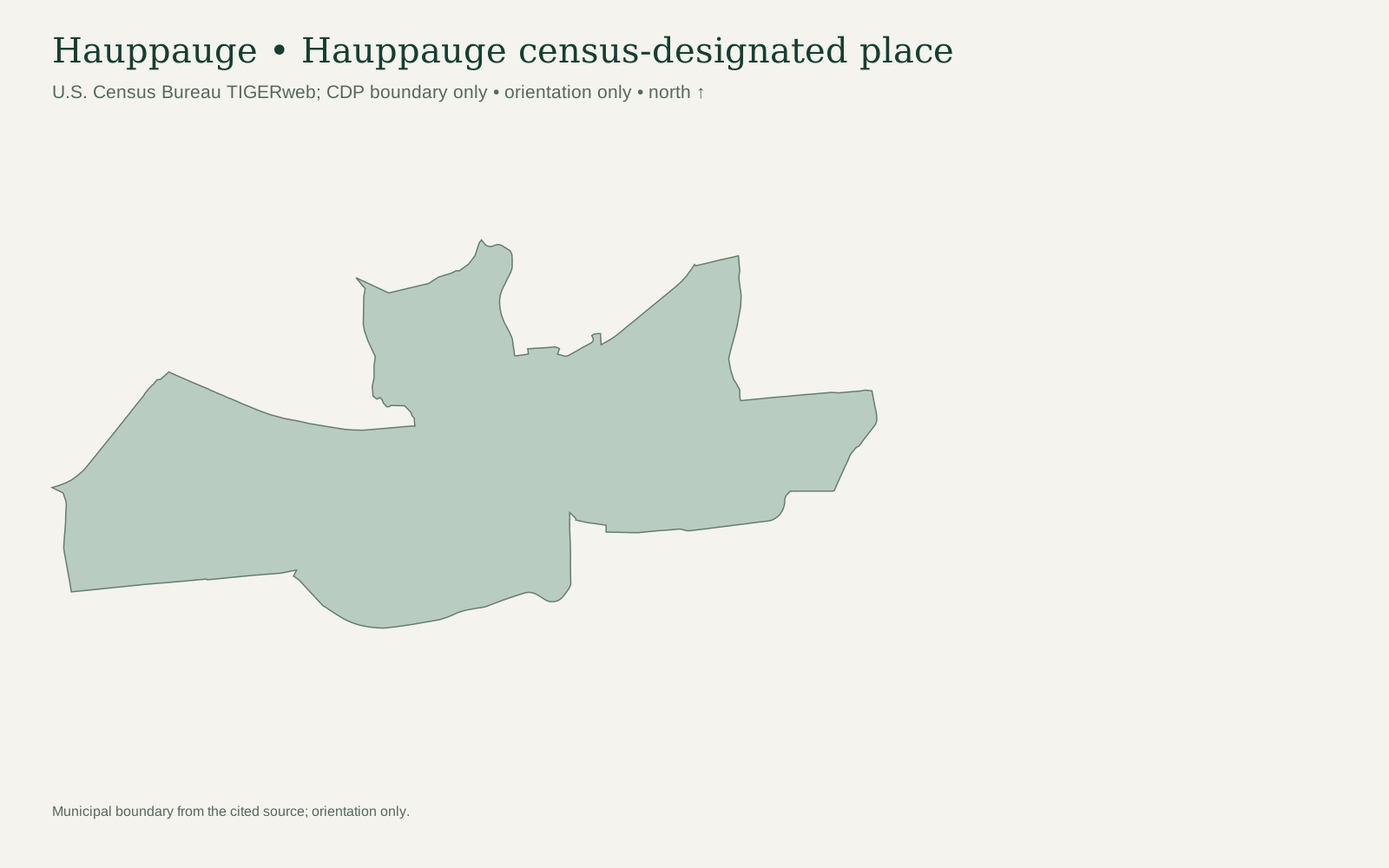
The map uses the U.S. Census Bureau CDP boundary. It provides a geographic outline for orientation and the housing statistics below. It does not identify a property's town, school assignment, library district, road-maintenance authority or an approved route for a truck.

The area comparisons include Hauppauge itself, the Innovation Park business setting and four nearby communities. Commack, Nesconset, Smithtown hamlet and Islandia are separate comparisons, not invented subdivisions of Hauppauge. The Village of Islandia is an incorporated village; its official overview identifies three school districts serving portions of the village.

Read a planning document according to its date and purpose. The adopted plan contains older inventories and proposed improvements; the 2019 workshops record residents' concerns and ideas. A proposal for more sidewalks, a new use or an improved town center does not establish that construction is complete. Inspect the existing route and property you would actually use.

Orientation map outlining Hauppauge census-designated place in Suffolk County, New York
U.S. Census Bureau TIGERweb CDP boundary, generalized for orientation. This outline does not show town, school or library districts, nearby community boundaries or approved truck routes. Open full-size map.

03 /

Find the area that fits your routine

Compare two Hauppauge settings and four separately named nearby communities. The source for each is shown below. Planning workshops are dated context, not proof that proposed improvements are complete; none of these comparisons ranks safety, school quality or residents. Confirm the individual property and service boundaries before choosing.

Hauppauge: residential streets and Route 111

The adopted Smithtown plan places detached residential land, open space and commercial activity around the Hauppauge Road/Smithtown Bypass corridor alongside the larger business area. The account covers the Smithtown portion and includes older land-use data.

Smithtown comprehensive plan: community plans and existing land use ↗
Housing & setting
Inspect the particular house, entrance levels, driveway and distance from the road.
Daily travel
Test the actual crossing and route to the services you will use; a commercial corridor is not a continuous pedestrian route.
Before choosing
Confirm Smithtown or Islip, the road owner and school district for the address. Proposed changes in the plan are not proof of completed work.

Innovation Park: business-location context

HIA-LI identifies the Long Island Innovation Park at Hauppauge as the business area it supports. This comparison is useful for choosing a work destination or evaluating a nearby home; it is not a claim that the park is a residential neighborhood.

Long Island Innovation Park at Hauppauge ↗
Housing & setting
For a business property, inspect the authorized dock, service entrance and receiving floor.
Daily travel
Test the journey to the actual building and its employee or visitor entrance.
Before choosing
Confirm security, delivery access and the particular property manager; employment counts and future residential proposals do not establish a housing option.

Nearby Commack

Smithtown’s Commack workshop discusses Commack Corners, Jericho Turnpike and other commercial corridors within a wider residential community. The dated record captures planning concerns, rather than confirming that its suggested new center or pedestrian links were built.

Commack community workshop ↗
Housing & setting
Compare the specific home and its distance from the commercial road.
Daily travel
Walk the route across the relevant junction and inspect present sidewalk continuity.
Before choosing
Verify the current property and responsible town or service district; do not carry Hauppauge’s school or collection procedure across the boundary.

Nearby Nesconset

The Nesconset workshop distinguishes residential areas and the Smithtown Boulevard/Nesconset Plaza corridor. It records ideas about a more connected community center; those ideas are not evidence of a completed project or a current amenity.

Nesconset community workshop ↗
Housing & setting
Inspect the individual home or managed building and any shared approach.
Daily travel
Check the real crossing and last stretch from a bus stop or shopping destination.
Before choosing
Confirm district assignments and current access conditions, especially where a listing uses a nearby community name broadly.

Nearby Smithtown hamlet

The Smithtown community workshop focuses on Main Street, the downtown area and connections to the rail station within a wider residential setting. It is distinct from the Town of Smithtown, which also contains several other hamlets.

Smithtown community workshop ↗
Housing & setting
Compare the actual building and whether the receiving entrance faces Main Street or a side or rear approach.
Daily travel
Check the station approach and the applicable parking map before choosing a rail routine.
Before choosing
Treat workshop suggestions as dated proposals. Verify the present address, loading position and school boundary independently.

Nearby Village of Islandia

Islandia is a separate incorporated village with residential and business properties and Suffolk Greenbelt context in its official overview. The village identifies portions served by Hauppauge, Central Islip and Connetquot school districts.

Islandia: separate village, residential and business context ↗
Housing & setting
Inspect the exact home, association arrangements if any, and the driveway or common-road access.
Daily travel
Test the trip to the actual workplace or station and check the public entrance for any recreational route.
Before choosing
Verify the village rules and school district. A nearby Hauppauge postal reference does not resolve either one.

04 /

Use the housing data as context, then inspect the property

The ACS 2024 five-year estimates, covering 2020–2024, put Hauppauge CDP at about 85.3% owner-occupied and 14.7% renter-occupied among occupied homes. The estimated median gross rent is $2,646 per month and median owner-occupied value is $652,900. These are survey estimates for the whole CDP, not current asking prices, appraisals or quotations for a particular home.

About 76.7% of housing units are in detached single-unit structures and another 6.4% in attached single-unit structures. Approximately 1.4% were built before 1940, while about 40.3% fall in the 1960–1969 category. These figures help frame the search; they do not establish the condition, layout or accessibility of an individual building.

At a detached home, follow the real daily and delivery entrances. Check whether the garage leads to the living level, whether a split-level arrangement introduces short flights, and whether the basement stair has enough turning and headroom for the intended furniture. Measure large items against the narrowest part of the route, including the receiving room.

For a rental, request the written responsibility for electricity, heating, water, lawn work, snow clearance and waste. Establish which meters and spaces serve your unit. Ask about repairs, access for service appointments, permitted occupancy, parking and the procedure for changing the household. Confirm the actual terms before estimating the monthly total from rent alone.

For a managed development, obtain delivery hours, gate instructions, insurance requirements and any elevator or loading reservation. A townhouse can still have common-road rules and an association contact. Inspect the authorized loading position and the distance to the door, rather than assuming the parking place closest to the unit is available to a truck.

Keep the moving inventory aligned with the home you choose. If a piece will not fit or the receiving room changes, resolve that before delivery. Separate a furniture purchase, utility visit or contractor appointment from the moving crew's time so the same narrow driveway or entrance is not promised to several people.

Two closed branded kraft cartons beside a sofa in a bright living room
Keep a usable route through the room while cartons await unpacking.

05 /

Test the whole commute and the correct vehicle route

Use the current Suffolk County Transit route directory for the address and travel day. Route 6 connects Hauppauge stops, Central Islip LIRR, MacArthur Airport and other destinations along its route. That connection is useful for planning, but the exact stop, direction, timetable and return trip still need checking.

Trace the walk from the front door to the boarding point. Identify the correct side of the road, crossing, shelter or waiting space and any gap in the path. Check the final walk at the destination too. If a trip involves a bus and train, allow for the actual connection and have an alternative for a missed service; a map line does not guarantee a convenient transfer.

Check SCT service notices alongside the schedule. The fall 2026 network items presented through the September public-hearing process were proposals, including changes to the Suffolk Clipper and on-demand areas. Use the service that is confirmed for your travel date, rather than assuming every proposed change has started.

For a rail commute, compare the station connection with the home and destination. The Town of Smithtown station-parking page separates restricted and unrestricted parking information for Smithtown, Kings Park and St. James. Read the map and conditions for the chosen station; a train ticket does not establish a parking entitlement or guarantee an empty space.

Long Island MacArthur Airport is a regional travel option and identifies a connection with Ronkonkoma/MacArthur Airport station. Check the terminal transfer and the operating hours that match your flight. A regional airport or station reference should not be read as a claim that it sits inside the residential area under consideration.

Plan the moving vehicle separately from the household car. NYSDOT parkway guidance excludes commercial vehicles and warns about low bridges. Give the driver the complete destination and loading entrance, and have the route checked for vehicle height, weight, restrictions and the last turn. Do not send only a passenger-car navigation link.

White bus with a blue stripe and an open front door beside two people on a sidewalk
Check the correct boarding side, timetable and final walk for the actual journey.

06 /

Confirm the district, then complete the registration sequence

Verify the school district for the actual address before selecting an enrollment process. A Hauppauge mailing address or proximity to a school does not assign a child to it. Nearby Islandia alone includes portions of Hauppauge, Central Islip and Connetquot districts, according to the village. If the address belongs to another district, follow that district's procedure.

For a home in Hauppauge Public Schools, begin with the district's new-student registration page. The published K–12 process starts with three short forms. After those are received, the district emails further instructions and the registration application. The initial forms are therefore the opening step, not proof that enrollment, school placement or transport is complete.

The initial registration form asks for a separate response for each child, with parent contact details, the child's date of birth and grade, current address, residence type and living or custody arrangement. Use the actual present circumstances. If you are waiting for possession of the new home or sharing another residence, ask registration how your situation should be documented.

The residency questionnaire includes permanent and temporary living arrangements and an option for families who do not yet know the school. It explains immediate-enrollment protections under McKinney-Vento for eligible students who lack documents normally needed. Contact registration about that route when applicable; do not delay seeking assistance simply because the ordinary paperwork is incomplete.

The home-language questionnaire asks about languages used, previous education, possible language-related needs and special-education history, including an IEP. Prepare prior-school contacts and relevant records so the district can arrange the appropriate follow-up. State the language in which you would like school communications.

The emailed application supplies the next documentation steps. The public registration page says originals may need to be mailed, dropped off or shown. Ask the registrar which age, residence, health and prior-school documents apply, how to provide them securely, and what is still outstanding. The registration contact is 631-761-8260. Keep the response and confirm the assigned school and first attendance date.

UPK follows a separate lottery and waiting-list process. The published eligibility is district residence and a fourth birthday on or before December 1 of the current year, with first kindergarten eligibility the following September. Children already eligible for kindergarten are excluded. The 2026 lottery application deadline was March 27 and the lottery date April 14; a later move calls for a current waiting-list inquiry, not an assumption that a place remains available.

For school transportation, assigned routes are in the Infinite Campus Parent Portal. Registration assists with portal access; the Transportation Coordinator is available at 631-870-5786. Check the assigned stop, pickup and return arrangements after the address is confirmed. The district also provides request forms for stop changes and private or parochial transportation; the latter has an April 1 deadline, so ask how a later relocation is handled.

Prepare a first-day handoff as carefully as the application: emergency contacts, authorized pickup, medication instructions, records still being transferred and how the child gets home. Ask when a requested change becomes effective. A submitted transport request is not the same as an assigned route.

07 /

Separate account transfers from visits to the property

Ask the seller or landlord which services are individually metered, which are included in the payment and who is authorized to open or close each account. Verify the heating fuel and any shared arrangement. Do not order a gas transfer merely because National Grid serves parts of Long Island, or confuse an existing connection with a request for new construction.

For an existing SCWA-served home, the residential moving-in application distinguishes an owner occupant from a lease tenant. It requests contact and property details, a needed-by date and photo identification, with instructions to black out identification numbers before upload. Confirm the applicable initiation charge and any tenant deposit on the form before submitting, and keep the service confirmation.

For departure, use the SCWA moving-out process: prepare the account number, forwarding address, closing date and contact details. The published processing period is five business days, with representative follow-up. Coordinate the closing account and the new resident's account rather than assuming a change of occupancy automatically ends your charges.

A physical water turn-on has separate access requirements. SCWA normally requires the customer or another adult aged at least eighteen to be present; its unattended release is an exception with conditions, not a substitute for understanding the plumbing. Arrange access and resolve signs of a leak before expecting water to remain on.

the PSEG Long Island moving page separates starting, stopping and transferring electric service. The new residential service form begins with identity, current address and contact information before the location stage. Use the official process or customer service to confirm the requested date; do not treat a completed first screen as an active account.

The residential stop-service form states a minimum of 72 hours for online requests, with 800-490-0025 for an earlier date. It asks for the service account, stop date and final-bill address. That published stop-service notice does not establish the earliest available new-service appointment. Keep start and stop confirmations separately, especially when dates overlap.

For a National Grid gas-served address, the Long Island moving-service page asks for at least a week, describing five to seven days' notice to arrange a physical visit. Its contact page also mentions 24 hours for starting or stopping. Because those notices differ, begin with the longer planning window and confirm the actual appointment at 800-930-5003.

The gas appointment checklist requires an adult aged at least eighteen throughout the visit and safe access to the meter and relevant equipment. Agree access with the owner, secure pets and keep the contact phone available. Arrange internet installation and any heating-fuel delivery separately; move-in day is easier when these visits have an identified adult and an unobstructed work area.

08 /

Use the collection system for the correct town

Confirm the service attached to the property, including whether a managed building has its own contractor and enclosure. Moving does not turn an ordinary collection into a full-house cleanout. Sort reusable items, cardboard, ordinary refuse, furniture, mattresses, electronics and hazardous materials before the final week.

On the Smithtown side, start with the current refuse and recycling page and its 2026 calendar and district map. Use the address to identify the carter and collection days. The calendar distinguishes paper recycling from commingled recycling; keep clean moving cardboard with the correct stream and follow the district's current setout instructions.

Smithtown's furniture and mattress guidance says these bulk items are not collected with regular trash and directs residents to their carter. Large household appliances use the separate 631-269-4548 collection contact. Tell the carter exactly what you have, including mattress and box spring as separate items, and obtain the date, preparation instructions and quantity limit before setting them outside.

The Municipal Services Facility provides another resident-disposal route with its own accepted materials, hours and charges. Confirm that your specific load is accepted before borrowing a vehicle or loading it. A facility's existence is not permission to bring every item from a moving cleanout.

On the Islip side, the residential disposal guide directs residents to the address schedule and requires setout before 6 a.m. Its general pail and garbage limit is fifty pounds per item. Non-metal bulk furniture, mattresses and box springs count toward a total of three bulk items on the last regular garbage collection of the week. Metal items follow a separate Wednesday stream. Confirm any additional preparation for the particular item.

The same Islip guide places clean cardboard in the alternating Wednesday paper/cardboard collection and treats soiled cardboard differently. Mattresses and box springs are excluded from the furniture drop-off option at the Multi-Purpose Recycling Facility. Do not assume the Hauppauge cleanfill landfill is a general household dump; ask Environmental Control at 631-595-3630 where the actual load belongs.

Keep the agreed disposal items separate from the moving inventory. Leave carts or bins as required by the property arrangement, clear the loading route and photograph the emptied rooms. If a pickup cannot happen before key handover, arrange an authorized alternative rather than leaving a pile for the next occupant.

09 /

Work through the road owner, permission and signs

Identify the place. Record the exact curb side or driveway, nearest cross street, truck size, date, hours, requested length and any effect on a travel lane or sidewalk. Get the owner's approval for private property. Islip's non-maintained-road list distinguishes county, state and other roads; a Hauppauge address does not make the nearest town office the owner of every road.

Start with the responsible department. For a Smithtown town road, Highway is 631-360-7500 and Traffic Safety is 631-360-7635. For an Islip town road, DPW lists Highway at 631-224-5600, right-of-way work at 631-224-5610 and Traffic Safety at 631-224-5535. Ask who can decide the particular loading or temporary-parking request and obtain a referral if the road belongs elsewhere.

Distinguish active loading from reserving space. Islip's TC5 provisions allow active loading/unloading within the commercial-vehicle parking rule, while retaining other traffic restrictions. Commercial parking on town roads is separately prohibited from 9 p.m. to 6 a.m. Its truck-exclusion provision has a delivery/pickup exception; that local exception does not override parkway restrictions or authorize an unsafe approach.

Check the applicable application. Explain whether you need ordinary lawful loading, an exclusive curb area, a lane restriction, a container or work on the road itself. Smithtown's road-opening application and Islip's right-of-way work permit concern construction-related work. Do not submit one as a household moving reservation without the department confirming that it applies. A general moving-reservation fee, lead time and sign procedure are not established by those forms.

Get the full decision in writing. If an application is required, confirm who submits it, the supporting sketch or insurance, review period, charge, payment method and how the issued permission is received. Make sure the approved location, date and hours match the move. An application receipt or a paid fee alone does not tell you that the requested arrangement is approved.

Resolve signs and enforcement. Ask whether official temporary signs are available or required, who supplies and posts them, how early they must be posted, and whether photographs or an inspection prove compliance. Confirm who verifies the posting and whom to contact if a vehicle remains. Keep copies and follow the authority's directions; homemade cones or notes should not be treated as an enforceable reservation.

Keep the pedestrian route usable. Islip's sidewalk code has a limited exception for temporarily placing household furniture during loading or unloading, without unnecessary delay and for no more than one hour. This is not permission to use the sidewalk as long-term storage. Plan continuous movement into the property and ask about any proposed obstruction before the day.

Prepare the alternative. If the authority cannot approve the requested position, agree another lawful location or loading window with the mover and owner. Confirm the longer carry, equipment, time and cost before relying on it. If the curb is occupied or emergency restrictions take effect, pause and contact the responsible authority; do not block a lane or organize your own tow.

10 /

Inspect the route from the loading position to the room

Confirm keys and possession before scheduling delivery to the property. Establish which entrance the crew may use, who can unlock gates or shared doors and whether any building staff must attend. Get the actual loading and elevator reservation where applicable, including the start and finish times.

At a detached house, walk the driveway, front path, steps and interior route with a tape measure. Check the turn into the driveway, overhead clearance, slope and surface condition. A passenger car fitting through a gate does not demonstrate that a box truck can enter or turn. Identify where the owner permits a vehicle to stand and how emergency access remains open.

Measure the narrowest door openings, stair turns, landings and low ceilings against the large furniture. For a split-level home, count each flight and identify the receiving level. Photograph an alternative garage or side entrance as well, while noting whether it creates another tight turn or a longer carry.

For a managed property, request its written moving rules and insurance wording early enough for coordination. Ask about floor and wall protection, service-elevator dimensions, reserved corridors and waste removal. Do not assume permission at one building transfers to another property in the same development.

Keep a simple receiving-room plan ready. Mark items staying behind, doors that must remain closed and fragile surfaces. Clear loose rugs, garden tools and deliveries from the path. If the route changes after a visit, send updated photographs before the truck arrives.

11 /

Check library eligibility and ordinary errands

Hauppauge Public Library eligibility follows the Islip portion of the Hauppauge School District. It is not an entitlement attached to every address carrying the Hauppauge name. Check the district before applying; the library normally requires an in-person application and suitable identity/address evidence, with a homebound exception.

The Smithtown Library serves its own special library district. Its card page lists acceptable proofs of residence, including current address identification and specified bills or statements, and an alternative for residents without those documents. Choose the applicable library process and check how a temporary digital card becomes a full borrowing card.

Build a first-week errand route from the actual home: groceries, pharmacy, library and any regular appointment. Walk the final stretch and crossings rather than measuring only driving distance. Check opening hours and whether a household member can complete the trip independently when the car is elsewhere.

For recreation, identify the actual public entrance, path and facility rules before choosing a routine. The nearby Islandia overview includes Suffolk Greenbelt context, but that does not settle access, parking or opening conditions for every trailhead. Photos on these pages illustrate representative settings rather than a documented address or promised amenity.

Set aside the equipment needed for daily life while unpacking: chargers, basic kitchen items, work materials, pet supplies and suitable outdoor clothing. Keep the entry and one room usable first. This gives the household a practical base while cartons are still being sorted.

Two adults and a leashed dog walking on a paved wooded path beside a bench
Inspect the public entrance and ordinary walk rather than relying on a nearby map marker.

12 /

Plan for wet entrances and the correct winter restrictions

Check the path after rain as well as on a dry visit. Leaves, puddles, loose mats and uneven concrete can affect carrying and ordinary access. Identify the person responsible for clearing steps, maintaining handrails and removing a plow bank at the driveway. Keep lighting and the house number visible for appointments after dark.

Smithtown chapter 293 prohibits parking on a public highway during a snowstorm or other specified emergency affecting that part of the road and provides for removal. Confirm the current municipal notice before expecting a vehicle to remain at the curb.

Islip TC3 prohibits residential- and business-street parking between 3 a.m. and 6 a.m. from December 15 through March 15. During a declared snow emergency, its code bars residential-street parking and adds business-district provisions; follow the current town notice for the affected location. The separate commercial-vehicle overnight rule still needs checking for a moving truck.

Islip's sidewalk provisions require the responsible owner or occupant to keep the sidewalk clear of snow and ice. Agree that work with the landlord or manager before a winter arrival. If conditions make the loading or walking route unusable, arrange a revised plan instead of assuming a booked date overrides the restriction.

Resident holding a closed umbrella beside wet concrete entrance steps after autumn rain
Recheck the wet path, steps and landing before treating access as ready.

13 /

Sequence the first night and the first week

Before leaving the old home, confirm possession of the new one, utility dates, required adult attendance and the agreed truck position. Keep essential documents, medicines, chargers, clothing and first-night bedding with you. Identify anything the mover should not load and who handles the final property check.

On arrival, meet the crew at the authorized entrance and confirm the room plan. Keep access to meters, exits and the utility technician's work area clear. Check the delivered inventory and record any concern through the agreed process while the relevant item is accessible.

During the first working days, close the remaining account and address tasks. Confirm the school's attendance and transport arrangements, find the collection days, complete the applicable library process and keep any service appointment that requires someone at home. Check the first bills against the dates you requested.

For an occupied curb, contact the authority named in the arrangement. For a missing key or unavailable elevator, contact the property manager. For a delayed closing or utility visit, discuss a revised delivery window or storage with the mover before further handling. Each alternative should have a responsible contact, confirmed access and an understood effect on the work.

Keep packaging contained until the correct collection or agreed removal. Do not leave furniture in a shared corridor or rely on a waste pickup that has not been arranged. Finish with clear entrances, usable rooms and the paperwork saved in one place.

14 /

Questions before you arrive

Is Hauppauge one municipality?

No. It is a hamlet and CDP spanning Smithtown and Islip. Confirm the town for the property, then check school, library and road boundaries separately.

Are the nearby area comparisons neighborhoods inside Hauppauge?

No. Commack, Nesconset, Smithtown hamlet and Islandia are separately identified nearby choices. Innovation Park is a business setting, not a residential-neighborhood promise.

Does the school registration form complete enrollment?

The three initial forms begin Hauppauge Public Schools registration. The district then sends the application and further instructions. Confirm documents, school placement, attendance date and transport separately.

Can a late arrival still seek a UPK place?

Contact the district about the current waiting list and eligibility. The published 2026 lottery dates have passed, and a move into the district does not guarantee a place.

Who handles water when I rent?

Check the lease and provider. SCWA has a residential application for lease tenants as well as owner occupants, but you must establish who is responsible for the particular account and any required appointment.

Can I leave a mattress with ordinary garbage?

Use the procedure for the correct town. Smithtown directs bulk and mattress questions to the carter; Islip includes mattresses and box springs in its limited bulk collection on the last regular garbage day of the week.

Does permission to load guarantee an empty curb?

No. Confirm the location, applicable authorization, official-sign process and enforcement contact. Keep an alternative lawful position or loading window ready if the planned space cannot be used.

Your next step

Bring the plan together

Use the Hauppauge moving page to prepare the inventory, access details and questions for your estimate.

Sources & useful local resources

Official procedures and local resources are linked beside the answers above. Reopen the relevant page when arranging a date: fees, schedules and application requirements can change.

Housing

Schools

Weather

Truck space

Everyday life

Waste

Transport

Orientation

Regional access

Area context

Utilities