Ohio / City relocation guide

Moving to Mansfield

Use this Mansfield guide to compare a home and organize the steps that follow. Explore six area and street comparisons, then check the school, services, street access and everyday journeys for the exact address.

Woman with a grocery tote walking past brick storefronts
Test the connection between the home and everyday destinations.

01 /

Start with the decision you need to make

If you are choosing a home, compare the unit, its access and your regular journeys before comparing neighborhood labels. Visit the entrance you would actually use, trace the route from a legal loading position and test the walk to transport or daily destinations. A larger lot or a central address can create different practical advantages without settling whether the property works for you.

If children are moving with you, confirm the district and assigned school from the residential address. Gather records before the old school closes its file, complete the applicable registration process and obtain a first attendance date. Transportation is a separate question; a school acceptance or a nearby bus route does not by itself confirm a school-bus stop.

If the address is settled, make one arrival record covering possession, building access, water, energy, waste collection and the shipment. For each item, record the person handling it, the date needed, the evidence of confirmation and the fallback if it fails. A request sent to an office or utility belongs in the record as pending until the responsible party confirms the arrangement.

Keep the people’s arrival separate from the truck’s arrival. Keys, somewhere suitable to stay, medicines, pets and work or school commitments need a usable plan even if the receiving property or delivery window changes. Share material changes while there is still time to choose an alternative.

02 /

Understand the city, streets and map

This guide concerns the City of Mansfield in Richland County, Ohio. Treat a listing’s mailing address, the municipal boundary and the school district as separate checks. Nearby municipal names and a Mansfield postal address do not establish which office controls a parcel or which provider serves it. The city boundary layer is an orientation reference; use the actual property record and responsible office when an administrative decision depends on the location.

Downtown centers on Main Street, Park Avenue and Central Park. The older commercial core, the Park Avenue West corridor and residential streets farther west and southwest offer different building and approach patterns. A straight-line distance does not capture slopes, a major-road crossing, the location of the usable entrance or the return connection after work.

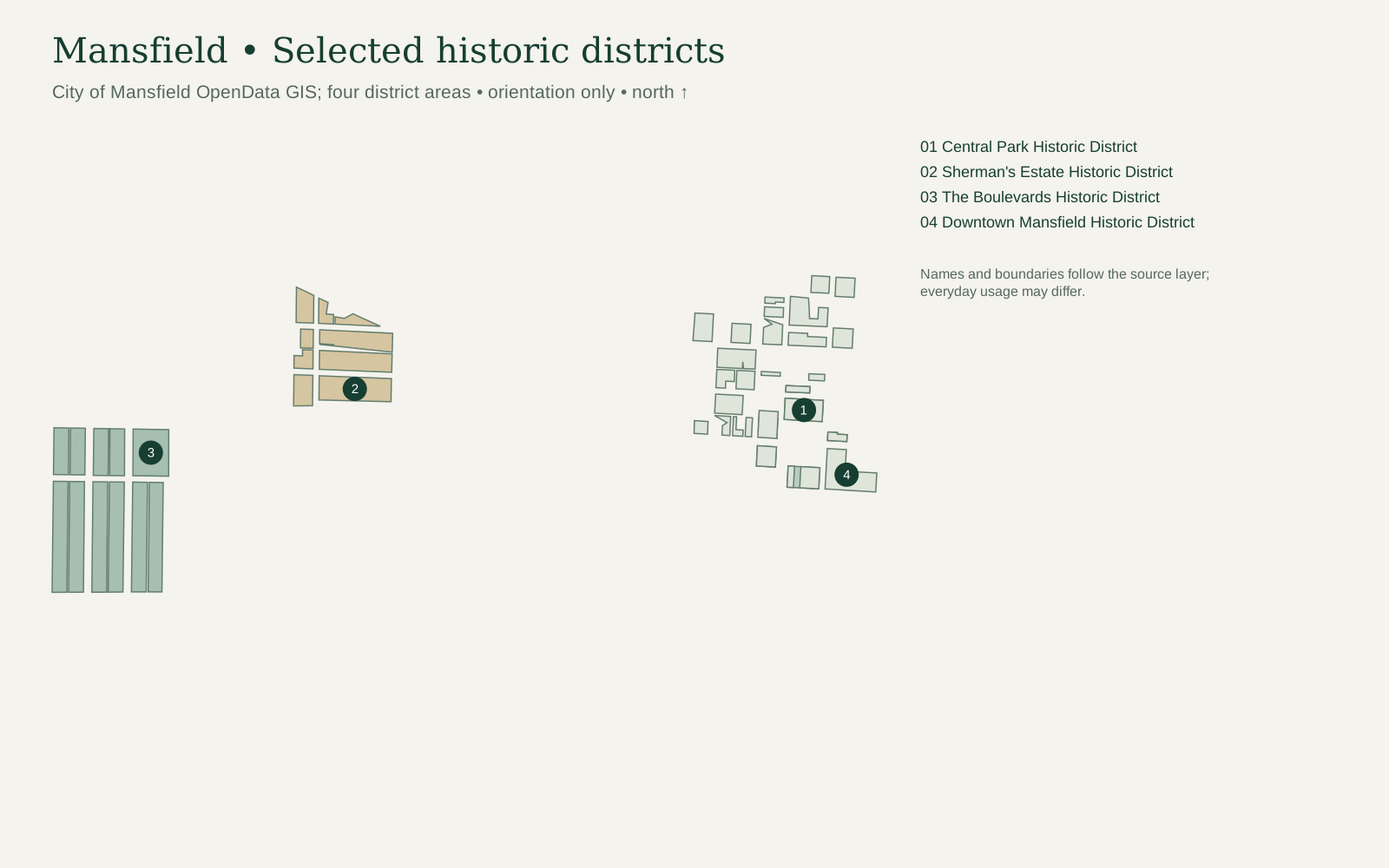
The map below selects four areas from the city’s historic GIS layer: the three named local districts and the Downtown Mansfield national district. The downtown areas overlap. The same source also contains individual landmarks and other historic sites; these are not all shown as if they were neighborhoods. The map is neither the full city boundary nor a school attendance or truck-routing map.

The Main Street project page describes improvements from First to Fifth Streets, including sidewalks, utilities and a planned traffic-pattern conversion. Check the current traffic information and your building’s entrance on the intended date. The historical nomination’s street direction is not a substitute for current navigation or confirmation that a construction phase is finished.

Four selected historic district areas in Mansfield from the city GIS layer
Four selected district areas from City of Mansfield OpenData: three local districts and the Downtown national district. Overlaps and interior rings are retained. This is not the full city boundary, a school attendance map or a truck route. Open full-size map.

03 /

Find the area that fits your routine

These six comparisons cover historic districts, a corridor and a park edge. The city’s 2015 preservation plan provides historical physical context for the residential areas, alongside their separate primary sources below. Use the descriptions to choose what to inspect; they do not rank current prices, availability, safety or schools.

Downtown and Central Park

The historic nomination describes a predominantly commercial core around Main Street and Central Park, with buildings of different heights and eras. It provides building context; its older traffic description is not current routing advice.

Downtown Mansfield Historic District nomination ↗
Housing & setting
Inspect the particular upper-floor unit or other residential space offered. Check its separate entrance, stair or lift, waste storage and delivery arrangement rather than assuming a shopfront provides access to the home.
Daily travel
Test the actual walk to Stanton Transit Center and the relevant stop, including the return after work. Recheck Main Street access against current project information.
Before choosing
Confirm the loading position and how residential delivery interacts with businesses, shared entries and works. Separate a building’s receiving agreement from public street permission.

The Boulevards

The city’s preservation plan describes an early twentieth-century residential area south of Park Avenue West, with landscaped boulevards and bungalow and revival-style houses. Local design criteria give this district its own property-review context.

The Boulevards design review criteria ↗
Housing & setting
Inspect porch steps, the inside turn and any side or rear approach. Ask whether the home has been divided and establish which access and parking rights belong to the unit.
Daily travel
Try the journey from the actual block to the appropriate Park Avenue or nearby bus connection. A park-facing address still requires checking crossings and the final walk.
Before choosing
If access depends on changing a porch, opening or major front-yard feature, have the owner check the district criteria first. Do not treat the boulevard or adjacent green space as spare truck staging.

Sherman’s Estate

The 2015 plan describes a compact early twentieth-century residential area north of Park Avenue West. Its local review criteria differ from the Boulevards, including specific treatment of sidewalk alterations and enclosing front-yard fences.

Sherman’s Estate design review criteria ↗
Housing & setting
Compare the individual entrance, stairs and usable rooms with the larger-house appearance. Check parking and any shared building access rather than assuming a historic single-house form still has one occupant.
Daily travel
Trace the route along the actual street grid to daily destinations and current transit stops. Check the crossing and the return path at the times the household normally travels.
Before choosing
Have the owner resolve any exterior or sidewalk alteration proposed for access. Obtain a specific legal loading position and confirm who can authorize use of a driveway.

Woodland

The preservation plan describes development largely from the 1920s through the 1940s, with curved streets, larger landscaped lots and changing terrain. Its account notes an automobile-oriented layout and an absence of sidewalks in the original design.

Mansfield Historic Preservation Plan ↗
Housing & setting
Inspect the current walk, driveway grade, garage connection and entrance rather than inferring step-free access from the size of the property. Check turns within the house against larger furniture.
Daily travel
Test a real pedestrian route and the distance to a useful bus stop; do not assume a continuous sidewalk. Compare the recurring journeys and parking requirements of the household.
Before choosing
Check truck turning space and private-drive permission, drainage and winter treatment. Historical description does not establish the present condition of a particular street or property.

Park Avenue West corridor

The National Register multiple-property nomination follows the corridor from Main Street toward Trimble Road, describing slope changes, substantial older houses and commercial conversion. It is a varied corridor, not one uniformly residential block.

Historic Resources of Park Avenue West ↗
Housing & setting
Confirm the actual legal and practical use of a listed property, the rooms offered and the entrance serving them. A former house used for several purposes can have separate access and service arrangements.
Daily travel
Read the current Route 1 sheet and test the walk from the property to the relevant stop. Check crossings and direction as well as the apparent proximity of a destination along the avenue.
Before choosing
Measure the carrying distance and establish the truck position without relying on a front lawn, neighboring drive or former carriage-house approach. Confirm any building-specific constraints.

South Park and its surrounding approaches

This comparison uses South Park as an everyday destination and orientation point, rather than inventing a separate official neighborhood. The city describes walking trails, a playground and historical facilities at the Brinkerhoff Avenue park.

Mansfield parks and South Park ↗
Housing & setting
Inspect the actual nearby home and its entry route; proximity to open space says nothing by itself about interior layout, stairs, tenancy or condition. Confirm which yard or drive is included.
Daily travel
Walk the route to the usable park entrance and your other daily destinations. Check street crossings, path conditions and the operating times of any facility you intend to use.
Before choosing
Do not assume park space is available for private loading or parking. Confirm the property’s receiving arrangement, and check whether an event affects the specific approach on your date.

04 /

Compare the property and its complete monthly cost

The ACS 2024 five-year housing estimates provide citywide context for Mansfield. About 50.5% of occupied homes are owner-occupied and 49.5% are renter-occupied. Estimated median gross rent is $814, while median value for owner-occupied homes is $119,600. These are 2020–2024 survey estimates, not current asking rents, a quote for a particular home or a prediction of its sale price.

Of the estimated housing stock, 59.3% consists of detached homes, 6.5% attached homes, 8.2% buildings with two units, 6.3% buildings with three or four, and 16.3% buildings with five or more. About 24.6% was built before 1940. Tenure uses occupied homes as its denominator; structure and age use housing units. The differences matter when reading the figures, but they do not tell you the condition of an individual building.

For a rental, establish which entrances, rooms, parking areas and storage spaces are included, who handles water and waste accounts, and what access restrictions apply. For a purchase, coordinate possession and utility responsibility with the closing arrangements. In either case, compare the usable property rather than relying on a photograph that omits steps, a narrow hall or a shared entry.

Property questionWhat to obtainWhy it affects arrival
Which entrance serves the home?Inspection of the complete permitted routeFront and rear entrances can have different stairs and carrying distances.
What fits through the route?Door, landing, turn and large-item measurementsA room large enough for furniture may still be hard to reach.
Who pays and controls services?Lease or closing terms and named contactsThe resident, owner and provider may each control a different step.
When can the property receive a delivery?Possession and building confirmationA planned closing date is not the same as a released key or reserved lift.

Build a monthly budget from the actual rent or financing, taxes or association charges where applicable, utilities, parking, waste service and recurring travel. Keep one-time deposits, connection work, building fees and moving services separate. Ask for the basis and recipient of a charge before treating it as part of a mover’s estimate.

Rust-brown leather sofa, walnut bookcase and branded kraft carton in a living room
Measure the route into the room as well as the room itself.

05 /

Match the journey to the route and last useful trip

Richland County Transit publishes the current route sheets, fares and transfer rules. An adult single ride is $2, a day pass $5 and a monthly pass $50. Reduced categories have separate conditions. Have exact cash ready if paying aboard: drivers do not make change. Request a transfer when paying, since it is not issued later; transfers are valid at Stanton Transit Center and cannot be used for a return trip on the issuing route.

Use the route sheet that serves the journey. Route 1 follows Park Avenue West, Route 2 covers Lexington and West Cook and Route 8 covers Glessner and Marion. Their first and last departures differ. A general system-hours statement does not mean a particular bus will be available after your appointment, shift or connection. Check the correct direction, stop, final useful departure and walking portion at both ends.

RCT Flex is an early and late service pilot with routes 17 and 18. Its published summaries give different overall operating hours, so use the detailed timetable beginning May 4, 2026 and confirm a critical trip with RCT at 419-522-4504. The pilot is not a promise of permanent late-night coverage across the city.

Flex can deviate up to a quarter mile from an established route when arranged at least 24 hours ahead, subject to availability, for an additional $2 per trip. This is a booked deviation with a pickup window; it is not a request the driver must fulfill anywhere on demand. Check the current route and conditions before using it as the only way home from a new work schedule.

Dial-A-Ride has a separate disability-based certification process and service area. The published application route involves the individual and an appropriate clinician; request details from RCT. The stated fare is $4 each way, with one assisting aide allowed without an extra fare. Confirm eligibility and arrangements before the first trip, rather than treating the service as a general household taxi.

Test your ordinary week: groceries, work, school, appointments and an evening return. Compare a workable transit journey with the actual costs and parking arrangements of driving. Keep a backup for a missed final connection or a trip outside the relevant service window.

White and blue bus with an open front door beside a waiting woman
Check the specific route and last useful return trip.

06 /

Complete registration and the transport handoff

Begin with the home’s residential address and the district serving it. A Mansfield mailing address or a neighborhood name is not a school assignment. If Mansfield City Schools is the responsible district, use its student registration page to identify the relevant school building and contact. Explain the student’s grade, intended start date and any records or placement questions before assuming the process is complete.

Prepare the household and student records

The general registration page asks for the household address and primary contact phone, proof of residency showing the guardian’s name and address, and parenting agreements or court/custody papers where applicable. For the student, prepare the birth certificate, health and medication details, immunization records, doctor information, hospital choice and relevant IEP, ETR or 504 documentation.

Use the district’s FinalForms portal for online pre-registration, and supply the required supporting documents. The district explicitly asks families to contact the school building after online pre-registration to discuss the next steps. A created account or submitted form does not mean all records have been received or that the student may begin attending on your preferred day.

If you are staying temporarily with someone, do not yet have the usual address document, or need clarification about guardianship, contact the school before substituting an informal note. Explain the circumstances and ask what applies to the family. Keep the person handling the matter and any requested follow-up together with the registration record; do not assume a rule from another city applies here.

Use the current kindergarten route

For 2026–27, kindergarten registration says a child must be five on or before August 19, the first day of school. It describes online paperwork, review and a confirmation email, followed by contact from the building secretary. Documents can be provided in person or uploaded. Its list marks the Social Security card optional and includes a lease agreement as one form of residency evidence; court papers apply when relevant.

A child already in the district’s pre-kindergarten program has a separate contact route for the transition. Ask the current building rather than creating duplicate assumptions about the enrollment record. The kindergarten page also routes school-assignment and open-enrollment questions to the superintendent’s office at 419-525-6400, extension 1001. A preference for another school needs its own confirmed process.

Confirm the ride before the first morning

The linked Walkers and Riders policy describes distance thresholds of more than one mile for preschool through sixth grade and more than two miles for seventh through twelfth grade in the attendance area. It uses the nearest traveled public road and allows a walk of up to half a mile to a designated stop. The document is undated and uses conditional wording; obtain the actual assignment from Transportation at 419-525-6303.

Tell the school about any relevant support plan and coordinate specialized transport where needed. The transportation page also requires approval for a different stop or extra rider and two signed parent notes, one for the driver and one for the school office; capacity can affect approval. An address change is therefore not simply a matter of walking to another bus.

Before attendance begins, confirm the start date, school contact, received records, pickup and return arrangements, who may collect the child and what happens during a closure or early dismissal. Arrange an adult fallback that does not depend on the moving crew finishing at a particular hour.

07 /

Set up accounts according to ownership and occupancy

Ask the owner or seller which services are active and which accounts must change. Separate a billing transfer from physical meter work, restoration after a shutoff or installation for a new building. Record the service address, responsible account holder, requested start and stop dates, access requirements and the provider’s confirmation. A working tap or light during a viewing does not establish an account in your name.

City water and sewer

Mansfield’s Utility Collections FAQ distinguishes new owners from tenants. A purchaser needs the new-owner service application, proof of ownership such as a settlement statement or deed, and valid photo identification. The application includes the closing date and the owner’s responsibility for the service. Confirm the effective date and any meter access with Utility Collections rather than assuming the closing agent completed the utility step.

For tenant billing, the Direct Billing Agreement needs both the owner’s and tenant’s signatures, the address and account information. The owner continues to receive the specified notices and remains subject to property-owner responsibilities. Arrange the owner’s cooperation early; a renter cannot replace the shared agreement with the purchaser’s form.

To stop service in your name, contact Utility Collections at 419-755-9785 or through its published contact route to request a final meter reading. Distinguish that step from removal of a meter at a vacant property. The FAQ says minimum charges can continue without usage and describes a city meter-removal charge; removal is not an automatic instruction for every change of occupant. Have the office confirm the correct action and final billing address.

Electricity and gas

Confirm the provider at the actual property from an existing bill or the utility’s address check. For a FirstEnergy account, its start, stop or move form says processing may require at least two business days and that an email will confirm whether the requested turn-on date can be met. Keep that confirmation, and distinguish a normal occupied-property account change from new construction or an electrical meter reset.

Columbia Gas of Ohio provides separate start, transfer and stop routes. Its web guidance asks for at least one business day, while its customer brochure prefers at least 48 hours. Start early enough to obtain a confirmed arrangement and any required access. Check the new address rather than assuming service or account programs transfer unchanged; supplier-choice participation at the old address does not automatically establish the same arrangement at the new one.

Keep identity and account details within the provider’s secure process. For internet and other services, confirm the specific unit, installation slot and any permission to access common equipment. If a service is delayed, decide who can meet a technician, how the household will manage the gap and whether receiving the shipment remains practical.

08 /

Arrange the hauler, bulk items and recycling separately

Before move-in, ask whether the property’s owner or the household contracts for refuse collection. Use the Richland County hauler directory as a starting point, then confirm coverage for the address, collection day, containers, setout instructions, included volume and additional charges. The city’s registration page still links a list dated 2023, so do not treat that old document as proof of a provider’s current registration.

Make a separate list of items that will not move: usable furniture, mattresses, appliances, electronics, cartons and material needing special disposal. Arrange the right destination and collection date before the property must be empty. A regular trash account does not automatically include a whole-house clearout, a dumpster or unlimited large items.

Book large items before putting them outside

Ask the chosen hauler about the exact item, quantity, fee and preparation. If Rumpke is serving the property, its bulk instructions require arranging collection and wrapping and sealing mattresses, box springs and upholstered furniture in plastic. It counts a mattress and box spring as one large item, but the service arrangement and allowance still need confirmation. Drawers should be emptied and secured; construction debris has a different disposal route.

Other haulers may have different terms. Confirm who physically takes each item to the permitted pickup position, and avoid leaving it outside simply because keys are being returned. If collection is later than possession ends, obtain an agreed alternative instead of transferring the problem to the next resident or blocking the sidewalk.

Use the correct recycling stream

The county recycling facility at 1125 National Parkway accepts specified recyclable materials and states that it does not accept household trash or mixed-material items such as furniture, pianos and hot tubs. Its published hours are Tuesday through Saturday, 8 a.m.–4 p.m., with a noon–12:30 p.m. closure and holiday exceptions. Check before loading a vehicle, particularly for an item with a disposal charge.

Flatten cardboard and keep accepted materials clean and dry. The staffed facility accepts food and beverage glass, while the satellite drop-off list gives a different accepted stream and does not list glass. Do not assume the rules are interchangeable. At a full drop-off, return when space is available rather than leaving material beside the bins.

Appliances and electronics have their own list and fees. The current page lists $10 for specified refrigerators, freezers, air conditioners, dehumidifiers and microwaves, with certain other listed appliances accepted without charge. It takes cash or check, not cards. This is a facility drop-off arrangement, not a promise that someone will collect an appliance from the home.

Keep paint, chemicals, batteries and other special material out of ordinary packing decisions until the appropriate disposal route is confirmed. Do not put an unwanted or leaking item into the shipment just to clear a room. Give the mover a clear boundary between the belongings being transported and items awaiting a separate service.

09 /

Classify the street use before relying on a space

Start with a sketch or photographs showing the address, side of street, truck size, date, duration and total working footprint. Include the rear door or liftgate area, pedestrian route, nearby entrances, drives and any part of the sidewalk or travel lane that would be occupied. Explain whether the vehicle can stay entirely on permitted private property.

Contact Engineering at 419-755-9702 and ask which office and approval apply to this exact temporary arrangement. The ROW encroachment form is a two-page application asking for applicant contacts, address, business or resident status, parcel number, a description and a PDF site map with dimensions and property lines. Its examples include a business sign and awning. It does not establish that every household moving truck should use this form.

Ask the office to classify the request before completing an unrelated application. Get the applicable fee, submission lead time, review period, permitted dates and hours, sign or notice requirements, responsibility for placement and removal, and any inspection or traffic-control conditions. If none are required for the proposed lawful position, ask what parking limits and access conditions still apply. Not finding a published moving form is not proof of an exemption.

Keep other procedures separate. The overload application asks for an ODOT permit and a route within the city on non-state-maintained roads; the carrier must determine whether the actual vehicle needs that permission. The event application has its own fees and timing, which should not be copied into a household-move plan. Its Police Traffic contact is 419-755-9738 for the relevant traffic questions.

Before committing to the position, resolve the building’s separate permission for its entrance, private drive, delivery window and any shared space. Paying for ordinary parking or receiving property consent does not itself authorize blocking a public route. Obtain and share the actual conditions with the mover, including how pedestrian and emergency access will remain available.

For downtown work, check the project’s current traffic information and recheck the entrance near the date. Agree on a decision deadline if approval or access is still uncertain. A fallback might use another lawful position, a different receiving window or a deferred delivery, but its carrying distance, extra handling, cost and person authorized to approve it must be settled. Do not improvise cones, closure or a private access route as a substitute for permission.

10 /

Confirm the route, people and access window

Trace the route from the permitted unloading point to the actual rooms. Include changes of level, door swing, stairs, narrow landings, turns, garden gates and the route into a basement or outbuilding if those spaces are included. Take measurements and photographs that make a restriction understandable before an estimator or crew arrives.

For a shared or managed property, ask who reserves the lift or delivery entrance, what documentation is required and how long review takes. If the building requests a certificate of insurance, obtain the exact requirements and recipient. Ask about any staffing or union condition without assuming it applies to every Mansfield building. Identify the responsible person and any separate charges.

A short receiving window needs a sequence. Confirm what preparation is allowed beforehand, where protected items or materials can wait and which part of the work must happen during the reserved period. Do not assume packing, lift use and truck loading can all be compressed into the same slot. Keep common corridors and exits available while work proceeds.

In a historic property, use the local preservation guidance if the proposed route depends on changing an exterior feature. A national designation, local district and individual landmark have different scopes. Ask the owner to establish the actual requirement and complete any approval before it becomes part of the moving plan.

Record the contact who can resolve a locked entrance, unavailable lift or another delivery occupying the space. Give that person the relevant window and arrange a backup contact. Access instructions that cannot be acted on when the truck arrives are an unresolved dependency, even if the lease has been signed.

11 /

Test the places that make up an ordinary week

Visit the routes that matter after the first day: food shopping, work, school, appointments and a place to spend time outdoors. Check the actual entrance, walking connection, parking or bus stop and the return trip. A nearby destination on a map may have its accessible entrance on another side or a timetable that does not fit your routine.

South Park at 100 Brinkerhoff Avenue provides walking trails, a playground and green space, with historical facilities that open seasonally or for events. Treat the park and its historical village as different availability questions. A publicly accessible path does not mean every building, pavilion or activity is open whenever you arrive.

Review the park rules and any reservation requirement for the activity you intend. Check the path from the home as well as the destination itself, particularly if it involves crossing Park Avenue or navigating a slope with a stroller or mobility aid. The South Park edge in the comparisons is an orientation aid, not a claim that every nearby parcel belongs to one formal neighborhood.

For downtown appointments or shopping, confirm how ongoing street work affects the trip and where a vehicle or bus can actually stop. For an evening routine, check the final return connection. Keep a second workable route for an essential journey during the first weeks while you learn the area.

Man reading on a park bench with a path and playground nearby
Check the actual entrance and facility availability.

12 /

Make weather preparation address-specific

Mansfield’s still-linked snow policy, revised in 2018, puts first- and second-priority streets ahead of neighborhood zones and describes limited salting within those zones. This explains why adjoining streets may receive different treatment; it does not promise that a particular approach will be ready at a certain time or constitute a newly issued winter plan.

Agree with the owner or manager who clears the driveway, sidewalk, steps and landing and when they will recheck it. Inspect drainage, lighting and handrails on the actual route. A cleared road does not settle the condition of a shaded stair, sloping private drive or a walkway narrowed by stored snow.

For a vacant home, confirm how heat and water will be managed before occupancy and who will inspect the property. Use the utility and property owner’s instructions for the specific system; a general moving checklist cannot establish whether exposed plumbing or a disconnected service is protected. Avoid arranging physical shutoff or meter removal without understanding the next occupant’s needs.

Choose a weather decision time with the mover and receiving contact. If the approach cannot be used, confirm the alternative window or receiving arrangement, who authorizes the change, the costs and where the household will stay. A forecast is a reason to prepare that decision, not proof that the move must be delayed.

Wet path and two brick steps leading to a burgundy front door
Prepare the entire route for the conditions on arrival.

13 /

Bring the confirmations together before delivery

Review the arrival record before the final packing day. Confirm possession and keys, the permitted entrance and truck position, the inventory, receiving hours, essential utilities and the people who can make decisions. Keep school enrollment, transport and waste arrangements visible as separate tasks rather than assuming they follow automatically from the address change.

Mark what is confirmed, what is requested and what remains unresolved. Set a decision deadline for any dependency that could stop delivery: a closing, a property handover, street approval or an unavailable lift. Tell the mover about changes early enough to discuss a realistic alternative.

If this happensDecision ownerConfirm before relying on Plan B
Keys or possession are delayedHousehold and property contactNew access time, suitable accommodation and any real storage arrangement.
The loading position is unavailableStreet authority, property contact and moverLawful alternative, carrying route, time and revised work or cost.
A required service is not activeAccount holder and providerConfirmed activation, technician access and household needs during the gap.
The receiving window cannot be usedBuilding contact and authorized customerAnother approved window and the conditions for resuming delivery.

Give each fallback a trigger, a person who may approve it and a time by which the decision must be made. Check the people, pets, extra handling and costs as well as the belongings. An unbooked storage unit, an assumed later lift slot or a space someone might leave at the curb is not yet a confirmed alternative.

On arrival, inspect the agreed route, explain room labels and keep one reachable receiving contact. Record any changed instruction with the moving documents. Use the Mansfield moving page to bring the inventory, services and access questions into the estimate discussion.

14 /

Questions before you arrive

Does a Mansfield mailing address establish city and school services?

No. Confirm the municipality, school district and provider for the residential parcel. Postal names, municipal boundaries, attendance areas and utility service territories serve different purposes.

Is FinalForms the last step in school registration?

No. The district’s registration instructions require supporting records and follow-up with the school building. Confirm receipt, assignment and the first attendance date; transportation is a separate handoff.

Which water form does a renter need?

The Direct Billing Agreement is signed by both tenant and owner. A purchaser uses the new-owner application. Confirm the effective date and required identification with Utility Collections.

Can I leave a mattress with normal trash?

Confirm your hauler’s bulk service first. Rumpke’s instructions, when applicable, require scheduling and sealed plastic wrapping. That provider’s rule is not a citywide allowance for every household.

Can I take discarded furniture to the county recycling facility?

The facility’s accepted-materials page says it does not accept furniture or ordinary trash. Arrange a hauler or another confirmed disposal destination before the home must be empty.

Does RCT Flex serve every address late at night?

No. It has specific pilot routes, scheduled trips and limited booked deviations. Use the dated timetable and confirm the actual journey with RCT, especially the last return connection.

What should be settled before the truck is dispatched?

Confirm possession, the legal truck position, usable route, receiving window and decision-maker. Resolve critical utilities and agree on a triggered, costed fallback for any dependency that remains uncertain.

Your next step

Bring the plan together

Use the Mansfield moving page to prepare the inventory, access details and questions for your estimate.

Sources & useful local resources

Official procedures and local resources are linked beside the answers above. Reopen the relevant page when arranging a date: fees, schedules and application requirements can change.

Housing context

Maps and area context

City services and property preparation

Schools and family preparation

Transport

Utilities

Waste and recycling