New York / City relocation guide

Moving to New York

New York is five boroughs of walk-ups, towers, brownstones and garden apartments, with its own rules for everything. This guide helps you compare areas, plan the everyday basics and prepare the practical steps of arriving.

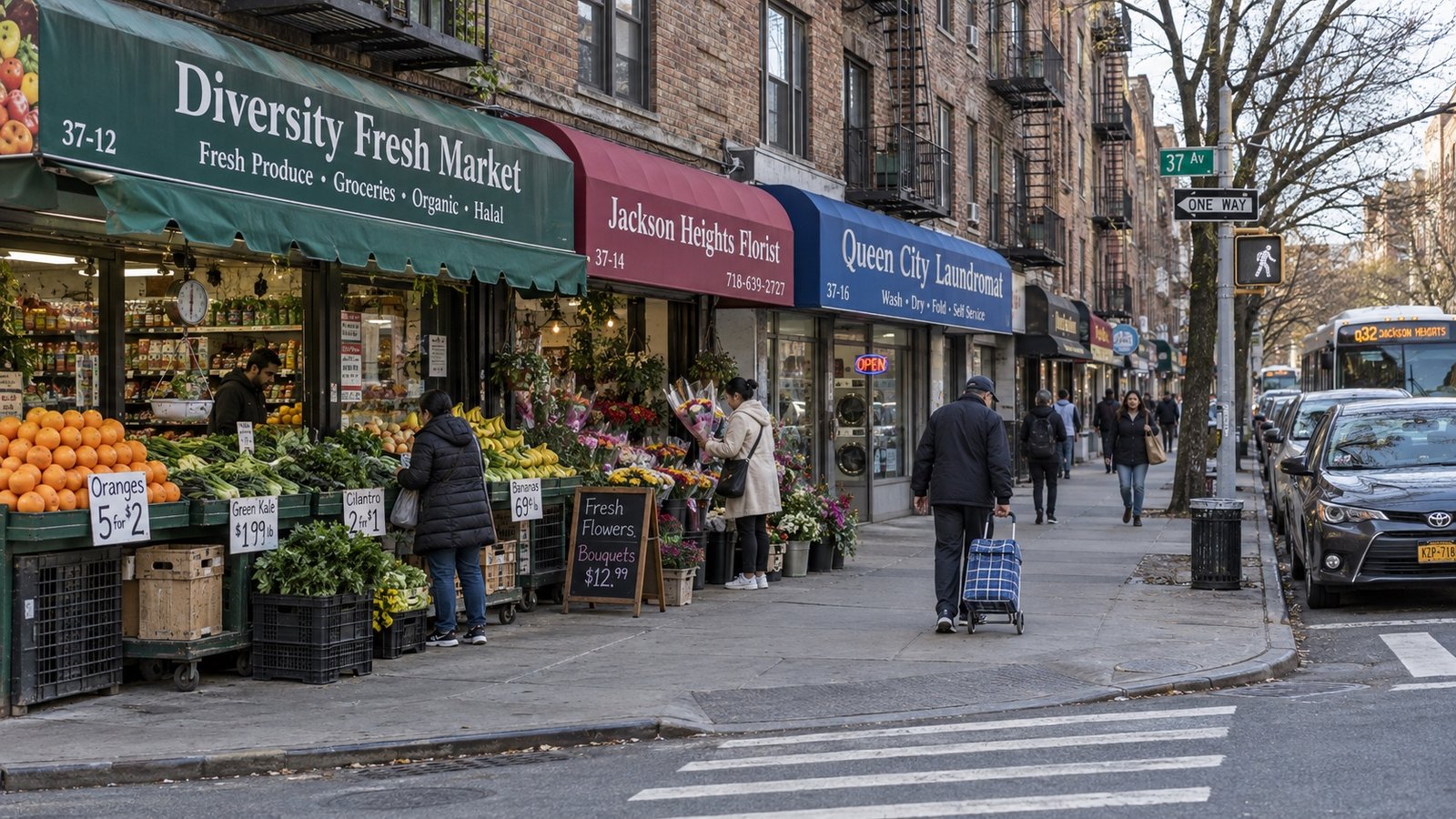
A neighborhood commercial corner with older brick buildings and pedestrians.
Try the everyday errands around a new address, not only the journey to work.

01 /

Start with the decision in front of you

New York asks three different questions of a newcomer, and this guide is organized around them. If you are still choosing where to live, start with the orientation and the neighborhood comparison, then read the housing section — two in three households here rent, and the differences that matter are the building type, the floor, and what the rent includes. If you are moving with children, go to the schools section early: the city's application calendar is fixed, and kindergarten for next fall closed in January. If the address is already decided, the second half of the guide walks through the practical setup — utilities, trash, the curb for the moving truck, building access and the arrival sequence.

One caution before any comparison: boroughs are counties, neighborhoods are informal, and postal names cross both. A "Brooklyn, NY" address and a "New York, NY" address can sit on the same block. Verify each address against the map that matters for the decision at hand.

02 /

Understand New York before comparing addresses

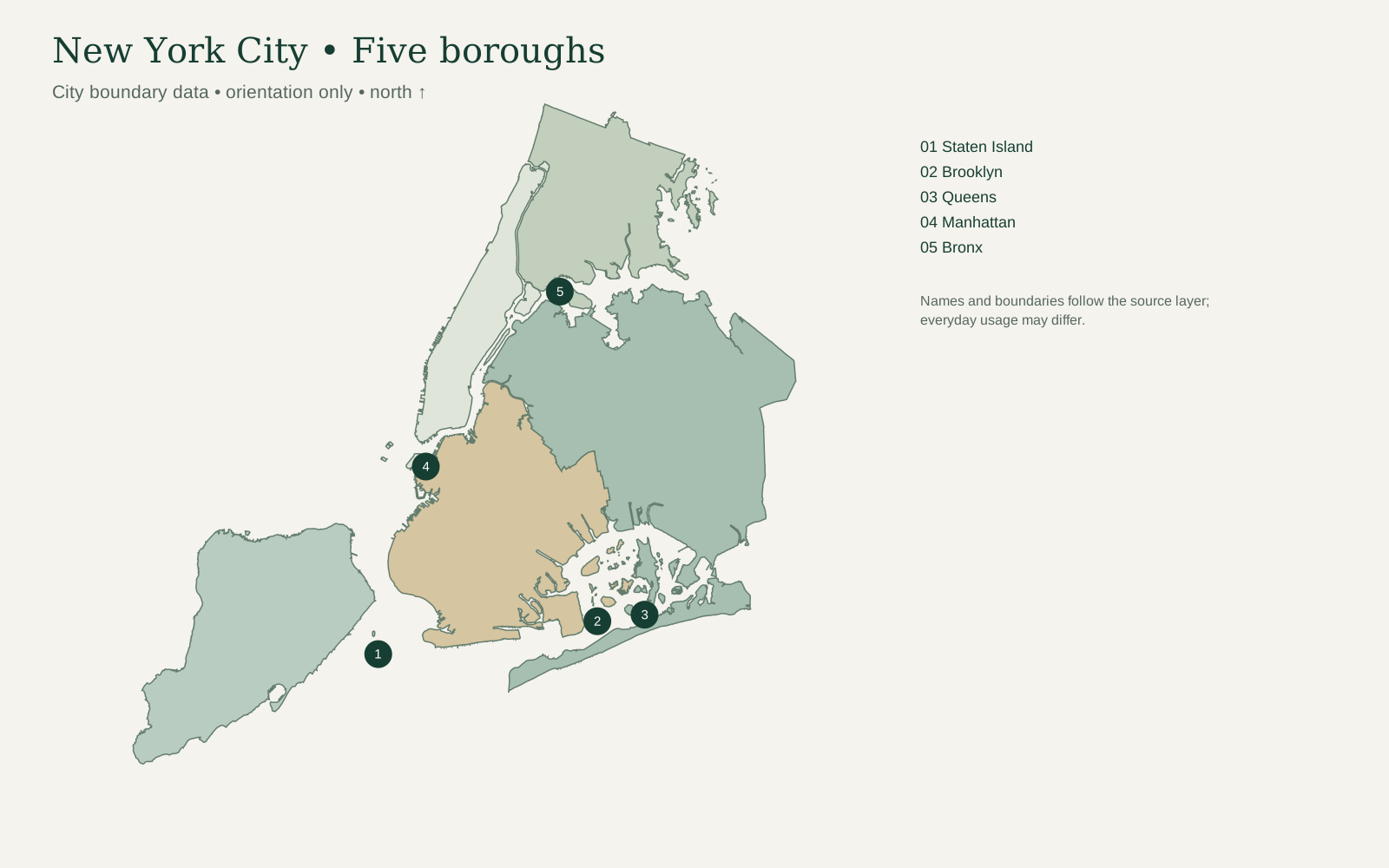
New York is one city of five counties: Manhattan (New York County), Brooklyn (Kings), Queens, the Bronx and Staten Island (Richmond). The boroughs are the legal layer; the famous neighborhood names — SoHo, Astoria, Riverdale — are informal, with boundaries that shift by who is talking. The map below shows the five boroughs.

For a mover, the structural fact is the stock: about a third of the city's homes sit in buildings of 50 units or more — the towers with their own moving rules — while two-to-four-unit houses and pre-war walk-ups carry the other share. Which you are in changes the move more than the neighborhood name does. Two naming traps: "New York, NY" postal addresses cover only part of the city, and Newark's airport (EWR) is in New Jersey.

New-York orientation map with numbered area key
Use the numbered key to locate the areas discussed below. Open full-size map.

03 /

Find the area that fits your routine

New York has hundreds of informal neighborhoods; the seven modules below use the Landmarks Preservation Commission's own designation reports to contrast the city's real housing types — a Manhattan walk-up district, a tower district, Brooklyn brownstones, a Bronx hill, Queens garden apartments and a detached suburb, and Staten Island's ferry hill. They are starting points for inspection, not rankings — school placement follows applications, and building conditions vary door by door.

East Village & Lower East Side (Manhattan)

The LPC designation report for the East Village/Lower East Side Historic District documents the city's signature walk-up stock — tenements and pre-law apartment houses from the 19th and early 20th centuries.

East Village/Lower East Side HD report (LPC) ↗
Housing & setting
Walk-up apartments in older tenements; stairs are the default, and hallways are narrow.
Daily travel
Dense subway and bus coverage; a car-light area.
Before choosing
Measure the stair and the stoop against the largest pieces; some furniture came in through a window.

Upper East Side (Manhattan)

The LPC designation report documents the area's mix: pre-war apartment houses on the avenues, brownstones on the side streets, and post-war towers.

Upper East Side HD report (LPC) ↗
Housing & setting
Managed buildings dominate; expect COI requirements, elevator reservations and fixed moving windows.
Daily travel
Subway and bus coverage is dense; the park and the avenues set the daily pattern.
Before choosing
Collect the building's written moving rules early; weekend and hour restrictions are common.

Park Slope (Brooklyn)

The Park Slope designation report documents one of the country's largest brownstone districts — rows of 19th-century houses with stoops.

Park Slope HD report (LPC) ↗
Housing & setting
Brownstones, often divided into floor-through apartments; the stoop and the narrow stair define the move.
Daily travel
Subway lines at the edges; buses along the avenues; parking is tight.
Before choosing
Stoop steps plus a narrow stair is the classic carry; measure both, and check the tree-lined curb for the truck.

Riverdale (Bronx)

The Riverdale designation report documents a different Bronx: large houses on landscaped lots above the Hudson.

Riverdale HD report (LPC) ↗
Housing & setting
Detached houses and driveways — the city's suburban end; truck access is easier, the hills are real.
Daily travel
Car-oriented with express buses; test the actual commute.
Before choosing
Confirm driveway grade and length; check what the sale or lease says about exterior changes in the district.

Jackson Heights (Queens)

The Jackson Heights designation report documents the city's landmark garden-apartment district — planned 1920s blocks around interior gardens.

Jackson Heights HD report (LPC) ↗
Housing & setting
Garden-apartment complexes with management rules; interior courts change where a truck can stop.
Daily travel
Subway and bus coverage at the edges; a car-light area.
Before choosing
Ask management which entrance the move uses and whether the courtyard path is allowed for furniture.

Douglaston (Queens)

The Douglaston designation report documents an early suburb within the city: detached houses on curving streets near the Nassau line.

Douglaston HD report (LPC) ↗
Housing & setting
Detached houses with driveways; the easiest truck access in the city.
Daily travel
Car-oriented; the LIRR station serves the area.
Before choosing
Confirm driveway dimensions and grade; check the district rules for exterior changes.

St. George (Staten Island)

The St. George designation report documents the hill above the ferry terminal — older houses on steep streets, minutes from the free ferry.

St. George HD report (LPC) ↗
Housing & setting
Older houses on hills; stairs and grades define the carry.
Daily travel
The free Staten Island Ferry to Lower Manhattan is the daily link; buses serve the hill.
Before choosing
Measure the grade and the stairs; plan the truck's position on the hill carefully.

04 /

Compare the whole home, not just the advertised payment

New York is a renter's city: 67.2% of households rent their home (ACS 2024 5-year, via Census Reporter). The median gross rent is $1,821 a month and the median owner-occupied value $777,600 — medians that hide enormous range between a Staten Island house and a Manhattan tower; use them only to sanity-check a budget.

The stock explains the market. About 33% of units sit in 50+-unit buildings, 21% in two-to-four-unit buildings, 9% in detached houses, and 38% were built before 1940. For a mover the operative split is walk-up versus managed building: stairs, stoop and shared hall on one side; elevator reservation, certificate of insurance and fixed windows on the other. A large share of rentals is rent-stabilized — ask before you sign, because it changes your renewal rights.

When comparing two apartments, compare what the payment includes — heat and hot water are commonly included, electricity rarely — the lease's move-in rules, and the condition of the access route: the stairs, the elevator, the service entrance. Ask early who handles disposal when you leave; the building's trash room and the city's collection day are both part of the answer.

Compact branded Medium and Book cartons beside a sofa and radiator in a lived-in pre-war apartment.
Compare usable rooms, what the rent includes and the building's moving rules.

05 /

Test the complete daily journey

New York is the American city where a car-free household is normal. The MTA runs the subway and buses at $3 a ride (express buses $7.25), with OMNY tap-to-pay; the subway runs around the clock. Rail hubs: the LIRR and Metro-North at Penn Station and Grand Central, NJ Transit across the Hudson, and PATH to New Jersey. The Staten Island Ferry is free, daily, year-round; NYC Ferry runs paid routes on the East River and beyond.

For flights: JFK and LaGuardia are in Queens; Newark Liberty is in New Jersey — all three are the region's airports, and the ticket's airport code is the thing to check. Test the real door-to-door routine from a candidate address — the walk to the station, the wait, the transfer — at the hour you would actually travel, including late evening.

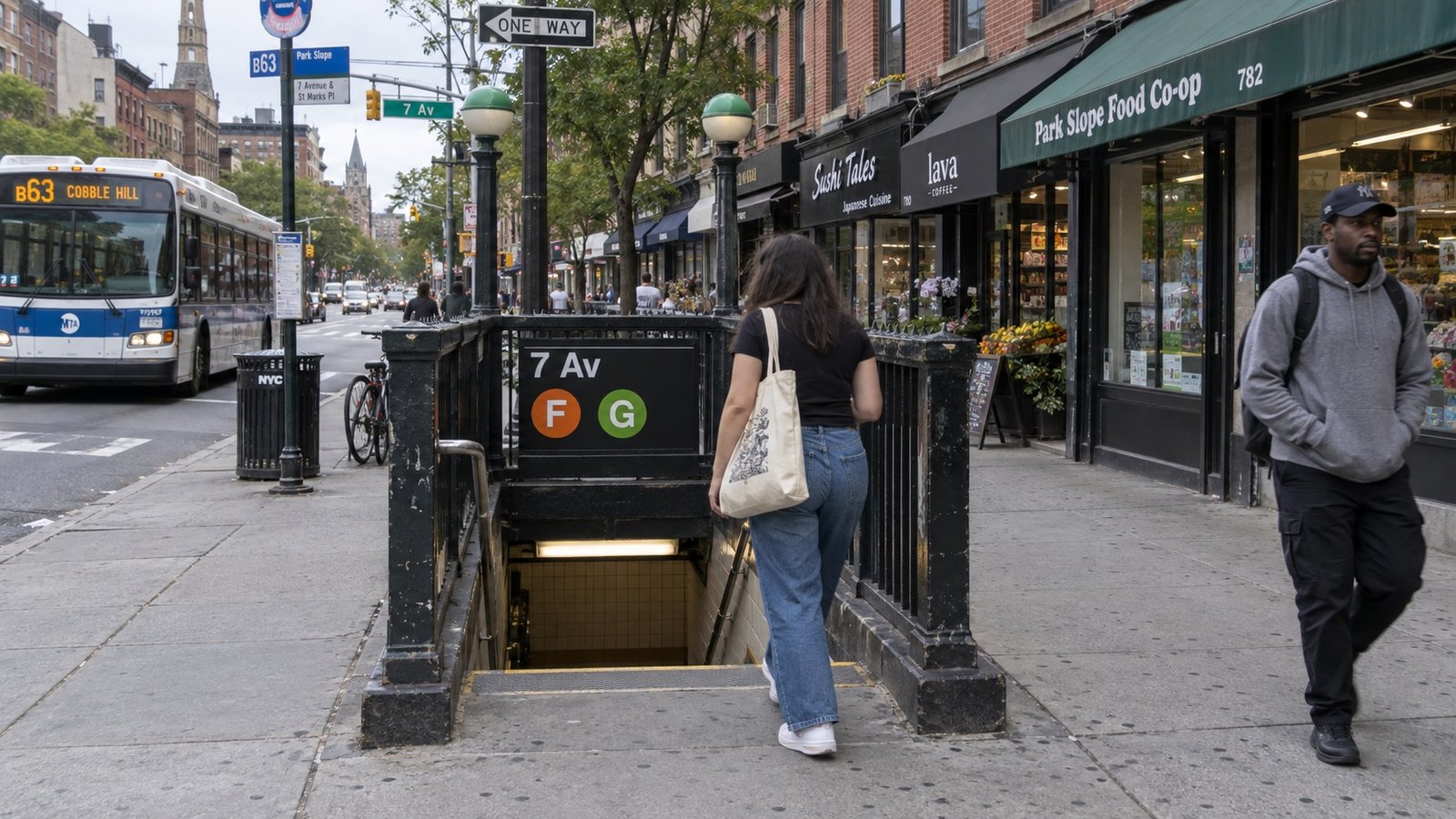
A city street with a subway entrance and a bus among older buildings.
Test the complete daily journey, including the walk at both ends.

06 /

Treat school placement as an application, not an address

New York's public schools run on applications through the Department of Education's enrollment pages and the MySchools system. Elementary school is zoned by address — but the zone does not guarantee a seat at the zoned school, and middle and high school run on application. For kindergarten, the 2026-27 application closed January 23, 2026; families who missed it can still participate late, per the DOE's kindergarten page.

Plan the calendar before the lease: application windows are fixed months ahead of the school year, and a summer arrival falls after most of them. If you arrive mid-year, the DOE's Family Welcome Centers handle registration in person. Gather the child's identity and age documents, proof of the New York address and immunization records before starting.

07 /

Assign an owner and a start date to each household service

Electricity is Con Edison citywide; start service online or at 1-877-779-6943, as soon as your date is fixed. Gas is Con Edison or National Grid depending on the borough — check by address. Water and sewer are the city's own Department of Environmental Protection; the account rides with the property, so renters almost never open one — confirm with the landlord.

For internet, check address-level availability before promising yourself a provider or a speed; in older buildings, ask which provider already wires it. An installation booked before the move is easier than one booked from an empty apartment.

08 /

Plan for containers, collection days and the things you are leaving behind

New York's trash is mid-revolution: since November 12, 2024, buildings with one to nine residential units must set out trash in containers, and from June 1, 2026 that means the official NYC Bin (Mayor's Office). Larger buildings use their own bins or, in pilot areas, on-street Empire Bin containers. Collection days are by address — look yours up after arrival.

The rule that matters at a move: bulk items — furniture, large items — go out on the regular collection day, up to six at a time, free. Mattresses and box springs must be sealed in plastic bags (any color except red or orange) or they are not collected, and improper disposal can bring a fine. A clean-out bigger than six items takes multiple weeks or a private hauler — plan it before moving day.

09 /

Arrange a legal place for the moving truck

New York has no moving-truck permit, and the standing rules shape the day. For parking purposes a truck is a commercial vehicle, and the city's rules prohibit street storage and nighttime parking of commercial vehicles, with special Midtown rules on top. So the truck works from a legal position for the day, and nobody leaves it overnight on a residential street.

The better instrument is the building: many properties keep a service entrance, a loading dock or a back-of-house path that beats any street position — ask for it first, along with the elevator reservation. Where the street is the only option, choose a legal position near the entrance and plan the carry around it. Double-parking with hazards is a ticket-and-tow gamble we do not take.

One timing note: alternate-side parking suspensions (the published calendar) change where cars may stand, but they do not create truck rights; the commercial-vehicle rules still apply.

10 /

Inspect the full route through the building

In New York, access is usually the move. In a walk-up: the stoop, the narrow stair, the landing turns, the fifth-floor door. Measure the largest pieces against the actual route before the day — width, turns, ceiling at the landing — and remember that some pieces came in through a window or were assembled inside.

In a managed building: the certificate of insurance, the reserved elevator or protected service path, the fixed moving window, sometimes weekday-only rules, and a superintendent who controls the doors. Ask for the written moving rules at both ends as soon as the date is set — this is the single most common place a New York move slips. Some buildings charge move-in or move-out fees; those belong to you and the building, not the mover.

Whichever type, walk both routes before the day: where the truck stops, which door is used, every stair and elevator between the truck and the room, and who unlocks what. A plan that works at the origin but not the destination is only half a plan — confirm the two ends together, with time windows that overlap usefully.

11 /

Build a useful routine beyond the commute

New York's everyday geography is the subway map plus the bodega radius: the daily test is the walk to the station, the grocery run, the pharmacy, the school drop-off, a late-evening trip home. Neighborhood names are informal — the same block can carry two names — so evaluate the specific address, not the label.

Historic district blocks add one practical wrinkle: in the city's Landmarks Preservation Commission districts, exterior changes go through a review step — relevant if you are buying a house you plan to alter. Test the routine you will actually live, at the hours you would use it, and in the season you will move.

Two older residents play chess at a neighborhood park table, with a family walking and a basketball court beyond.
Check the everyday routine around the address you actually choose.

12 /

Plan for the season in which you will live and move

New York's winter matters less for accumulation than for parking: storms suspend alternate-side cleaning (the suspension calendar carries the notices), and a suspended-cleaning day does not make a truck position legal by itself. Watch the forecast in the final week of a winter date and keep a backup date in mind.

The bigger calendar is the lease cycle: rentals traditionally turn over around the first of the month, late summer is the densest stretch, and the academic year adds pressure. End-of-month and late-August dates book out first — our workload observation, not a city statistic. If your dates are flexible, mid-month and mid-season dates give you more room.

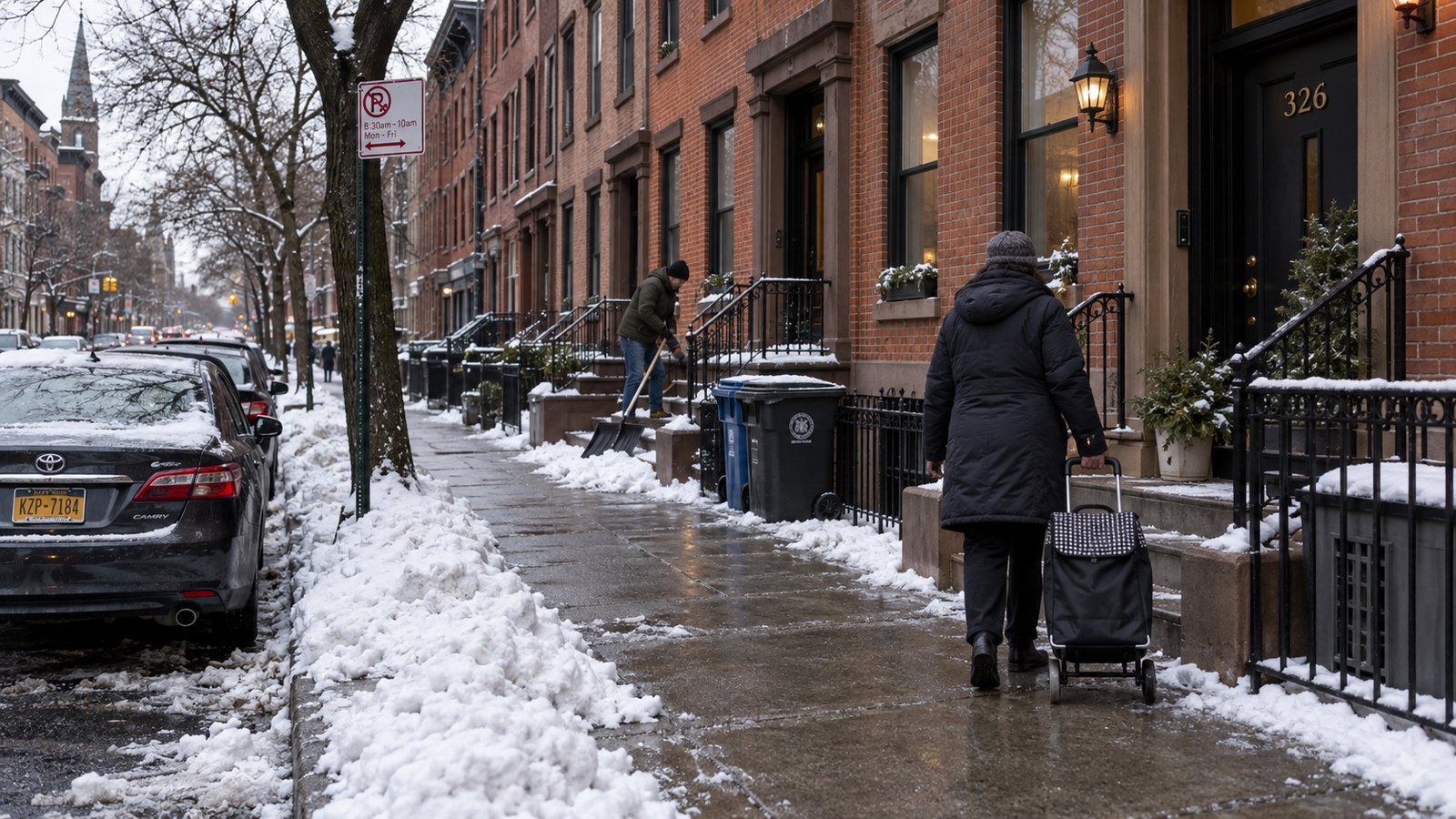
A city residential street after snowfall with plowed piles and cleared sidewalks.
Winter dates need a plan: storms suspend cleaning rules but not truck rules.

13 /

Turn the chosen home into an arrival plan

With the address decided, sequence the setup so nothing blocks the truck. Four to six weeks out: confirm the lease or closing date, start the school conversation if you have children (the application calendar is fixed months ahead), and book the move itself. Two to three weeks out: start the Con Edison request, confirm the gas utility by address, line up internet installation, and collect the building's moving rules — COI, elevator window, fees — at both ends.

In the final days: confirm the elevator reservations, confirm the truck's position, finish packing, set aside what travels with you, and check the forecast and any parking suspensions if it is winter. In the first week after arrival: look up your collection day, learn the container rules for your building's size, test heat and hot water, and note which station and which entrance you will actually use.

14 /

Questions before you arrive

Is Newark airport in New York?

No — Newark Liberty (EWR) is in New Jersey. JFK and LaGuardia are in Queens. All three serve the region; check the airport code on the ticket.

Does my New York address assign my child's school?

Elementary school is zoned by address, but the zone does not guarantee a seat at the zoned school, and middle and high school run on applications through MySchools. Kindergarten applications for the next fall close in January — plan the calendar before the lease.

Do I need a car in New York?

Most New York households do not drive daily: the subway and buses run at $3 a ride around the clock, the Staten Island Ferry is free, and rail hubs cover the region. Test the exact door-to-door routine from your address before deciding.

How does trash work in New York?

Buildings with one to nine units must set out trash in containers (since November 12, 2024; the official NYC Bin from June 1, 2026). Collection days are by address. Bulk items go out on the regular day, up to six; mattresses must be sealed in plastic bags or they are not collected.

Can I leave unwanted furniture on the curb when I move out?

Bulk items go out on the regular collection day, up to six per day, free. A clean-out bigger than that takes multiple weeks or a private hauler — plan it before moving day.

Is my apartment rent-stabilized?

A large share of New York rentals are. Ask before you sign — rent stabilization changes your renewal rights — and the state's housing agency keeps the registry.

Do buildings really require insurance certificates?

Most managed buildings require the mover's certificate of insurance plus a reserved elevator or service window. Collect the written rules from both buildings as soon as your date is set.

Your next step

Bring the plan together

Use the New York moving page to prepare the inventory, access details and questions for your estimate.

Sources & useful local resources

Official procedures and local resources are linked beside the answers above. Reopen the relevant page when arranging a date: fees, schedules and application requirements can change.

City rules & services

Housing & neighborhoods

Getting around

Schools & enrollment

Utilities