Newark is New Jersey's most populous city — a renter-majority city of walk-ups, towers and a choice-based school system. This guide helps you compare areas, plan the everyday basics and prepare the practical steps of arriving.
Try the everyday errands around a new address, not only the journey to work.
01 /
Start with the decision in front of you
Newark asks three different questions of a newcomer, and this guide is organized around them. If you are still choosing where to live, start with the orientation and the neighborhood comparison, then read the housing section — Newark's market is mostly rentals in older multi-family buildings, and the differences that matter are stairs, light, parking and what the rent includes. If you are moving with children, go to the schools section early: Newark runs a single application-and-matching system with fixed windows, not automatic assignment by address. If the address is already decided, the second half of the guide walks through the practical setup — utilities, waste, the curb for the moving truck, building access and the arrival sequence.
Read the guide in any order, but keep the dependency in mind: the school window, the building's elevator calendar and the curb instrument all have their own clocks, and the moving date is the last thing to fix, not the first. The households whose moves go smoothly usually treat the paperwork as part of the move rather than as an errand after it.
One caution before any comparison: Newark organizes itself into five wards and about twenty named neighborhoods, but ward lines, neighborhood names, postal ZIP codes and school zones all draw different maps. Verify each address against the map that matters for the decision at hand. And one boundary warning: Jersey City, named alongside Newark in some regional listings, is a separate city with its own municipal rules — nothing in this guide applies there.
02 /
Understand Newark before comparing addresses
Newark is the seat of Essex County and New Jersey's most populous city: 310,178 residents to Jersey City's 294,078 in the ACS 2024 5-year estimates (via Census Reporter). It sits where the Passaic River meets Newark Bay, with the seaport and Newark Liberty International Airport along its southeastern edge. The city's own traffic ordinance draws its boundaries in practice: street lists run to the Irvington, East Orange, Hillside and Elizabeth lines. Each of those neighbors is a separate municipality with separate rules, and a "Newark area" address is not always a Newark address — confirm the municipality before comparing procedures.
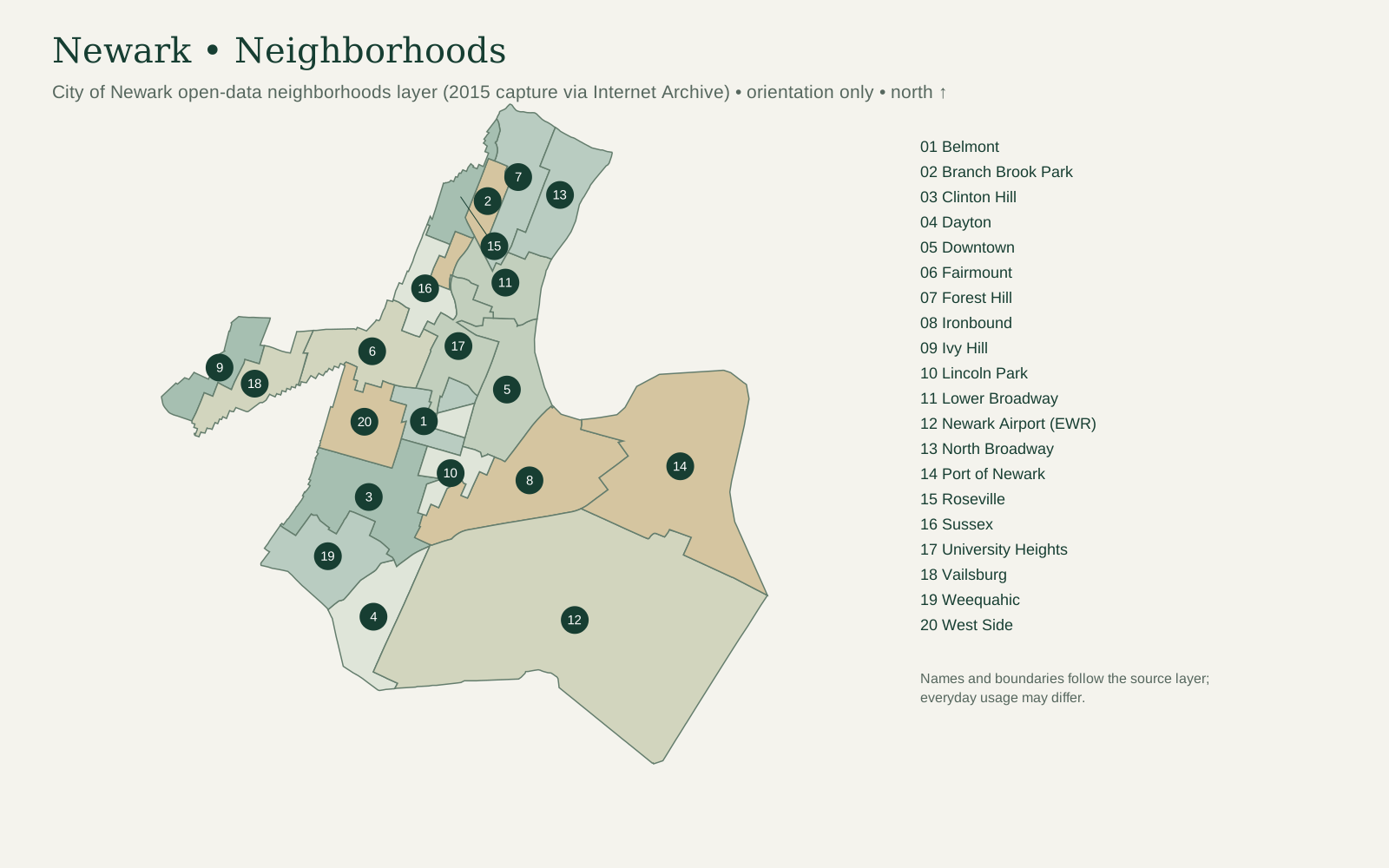
Politically, Newark is divided into five wards — North, South, East, West and Central — each with its own council member. Everyday geography works in named neighborhoods instead: Downtown, the Ironbound (the East Ward's everyday name), Forest Hill, Weequahic, Vailsburg, University Heights, Lincoln Park and more. The map below uses the city's open-data neighborhoods layer, preserved from the city's former open-data portal — the names and shapes are the city's own, though the layer is an older capture and boundaries are planning geography, not service promises.
One naming habit matters for movers: locals use wards and neighborhoods interchangeably ("the East Ward" means the Ironbound), listings use neighborhood names loosely, and ZIP codes cross everything. When a procedure depends on location — a permit zone, a trash zone, a school preference — verify it against the specific address, not the area name.
Two pieces of Newark's working geography are worth knowing even if you never use them. The southeastern edge is industrial: the city's own neighborhood mapping shows the seaport and the airport as Newark territory, and freight traffic shapes the roads around them — not a residential market, but a real factor in truck routes citywide. And downtown's blocks, documented in the Four Corners historic nomination, hold New Jersey's earliest skyscrapers — the office core that still decides which buildings run moves by freight elevator and certificate of insurance.
Use the numbered key to locate the areas discussed below. Open full-size map.
03 /
Find the area that fits your routine
Newark's official geography works in five wards; everyday life works in about twenty named neighborhoods. The eight below are the ones a household is most likely to compare, chosen for their verified character from national-register nominations, city data and campus pages. They are starting points for inspection, not rankings — school placement follows the Newark Enrolls system described below, and building conditions vary house by house. The map's boundaries come from the city's open-data neighborhoods layer (a 2015 capture preserved by the Internet Archive) and may differ from everyday usage.
Downtown
Newark's business core around Broad and Market Streets. The national-register nomination for the Four Corners district describes 22 blocks holding New Jersey's earliest skyscrapers — the old bank, insurance and department-store buildings — with small retail at street level today.
Residential life here means apartments in towers and conversions; expect managed buildings with elevators, set moving windows and certificate-of-insurance requirements. Compare what the rent includes and ask for the written moving rules before signing.
Daily travel
The strongest transit position in the state: Newark Penn Station (NJT, PATH, Amtrak), Broad Street Station and the light rail all meet downtown.
Before choosing
Downtown curb space is metered and enforced — meter rental through the Parking Authority belongs in the planning conversation, and the loading arrangement and elevator booking come before the date.
Ironbound (East Ward)
The East Ward — "otherwise known as the Ironbound" in the national-register nomination for Riverbank Park, which calls it the most heavily industrialized and densely populated neighborhood in Newark. The nomination also documents the neighborhood's 11-acre Olmsted Brothers park on the Passaic riverbank.
Dense blocks of two- and three-story multi-family houses; expect shared entries, stoops and tight side yards. Compare the staircase and the entry you will actually use.
Daily travel
Immediately east of downtown: many addresses are a short walk or one bus ride from Newark Penn Station.
Before choosing
Street width and legal stopping positions vary block by block on these dense streets; confirm where the truck may stand before booking the date.
Forest Hill
A 57-block historic district on a ridge in the North Ward: the nomination describes turn-of-the-century mansions, pre-World War II middle-class homes and late-19th-century working rowhouses, with commercial frontage on Mt. Prospect Avenue and Branch Brook Park along the western edge.
Predominantly houses rather than apartments, with porches and driveways — and the maintenance questions that come with older construction.
Daily travel
Light rail stations at Davenport Avenue, Bloomfield Avenue and Branch Brook Park serve the park side of the district; test the walk to the specific stop you would use.
Before choosing
Older single-family stock means checking porch stairs, narrow drives and basement access; confirm what the sale or lease says about snow clearing and repairs.
Lincoln Park
A well-preserved collection of late-19th-century urban townhouses around two triangular parks — four-acre Lincoln Park and the smaller Clinton (Colleoni) Park — just south of downtown. The nomination calls the district largely residential, with fabric from the post-Civil War era.
Townhouses and small apartment buildings; entries are often shared, with stoops rather than driveways.
Daily travel
Immediately south of downtown — Broad Street forms the district's eastern boundary, so buses and both rail stations are close.
Before choosing
Stoops and shared entries concentrate the carry; confirm where the truck may stand on these narrower streets.
Weequahic
A residential district in the city's southeastern corner organized around Weequahic Park: 311 acres with an 80-acre lake — the largest in Newark — designed by the Olmsted Brothers in 1901. US-22 and a rail line bisect the park into two halves serving different blocks.
Streets of houses and small apartment buildings around the park; compare the specific block's condition and which side of the park an address sits on.
Daily travel
Downtown lies a few miles north; test the door-to-door trip you would actually make, including the walk at both ends.
Before choosing
The highway and rail line split the district's park access, and the airport corridors sit just east — check traffic and truck routes for the actual address.
University Heights
The campus district west of downtown: NJIT gives its address as University Heights, and Rutgers University–Newark (195 University Avenue) and Essex County College (303 University Avenue) operate here as well. Student-linked rentals shape the surrounding blocks.
Apartments and multi-family houses geared partly to the academic calendar; ask how the lease handles the turnover months around late August and May.
Daily travel
Newark Broad Street Station at 25 University Avenue sits at the district's edge, and the light rail links the area to Newark Penn Station.
Before choosing
Blocks near campuses turn over with the academic year; confirm move-in windows, elevator bookings and curb space early, especially in late August.
James Street Commons
A mixed-use historic district in the Central Ward of distinctive low-rise brownstones — the nomination counts mostly two- and three-story masonry buildings — with shops along Halsey Street, Washington Street and Central Avenue.
Older masonry walk-ups and apartments above storefronts; compare the entry, the stairs and the floor you will actually use rather than the block's reputation.
Daily travel
Adjacent to downtown's west side; Broad Street's buses and both rail stations are a short walk east.
Before choosing
Pre-war masonry buildings vary widely in condition; check windows, heat and stairways as carefully as the rooms.
Vailsburg
A neighborhood on Newark's western edge, mapped in the city's open-data neighborhoods layer. District-level documentation is thinner here than for the national-register areas, so treat listings' descriptions with care and verify by address.
Verify housing type block by block — the city layer maps the name and extent, not the housing stock.
Daily travel
South Orange Avenue is the area's through street toward the Oranges; test the door-to-door trip you would actually make.
Before choosing
Confirm ward, trash zone and permit-parking status by address — western Newark mixes city streets and county roads.
04 /
Compare the whole home, not just the advertised payment
Newark is a renter's city: 75.6% of households rent their home (ACS 2024 5-year, via Census Reporter). The median gross rent is $1,392 a month and the median owner-occupied value $373,700 — but medians describe the whole city at once, not the apartment in front of you, and listing sites' asking rents run above survey medians. Use them only to sanity-check a budget.
The stock explains the market. About two in five Newark homes sit in two-to-four-unit buildings, another one in seven in buildings of fifty units or more, and 23.7% of all units were built before 1940. For a mover this means the differences that matter are physical: which floor, stairs or elevator, where a truck can stop, how heat is supplied and who clears the sidewalk. Newer downtown towers come with elevators and booking windows; older walk-ups come with character and narrow staircases.
Read the survey numbers as texture, not as pricing. The roughly 40% share of two-to-four-unit buildings means most renters will tour a house-turned-apartments, not a complex: expect a landlord rather than a management office, radiators rather than central air, and a porch staircase rather than a freight elevator. The one-in-seven share in fifty-unit buildings is the other Newark: downtown and campus-edge towers with booking windows, loading rules and amenity pricing. Both are normal here; they are simply different move logistics wearing the same ZIP code.
When comparing two apartments, compare what the payment includes — heat, hot water, parking, snow clearing — the lease's move-in and move-out rules, and the condition of the access route: steps, stair rails, door widths, the hall you will share with neighbors. Ask early how the building handles bulky disposal; Newark runs scheduled pickups and service-center drop-offs rather than open curb piles, and the building may have its own arrangement.
One Newark-specific protection is worth checking before you sign: the city has a rent control ordinance, and the Division of Rent Control keeps files on residential properties open for public inspection. The office can tell you whether a specific apartment is covered, what the legal base rent is, and which increases and surcharges the ordinance permits. Coverage depends on the building, not on the neighborhood, so treat it as a per-address question — and remember the division does not adjudicate lease disputes, only rent-regulation matters.
Finally, read the lease for the logistics, not just the money: move-in and move-out windows, elevator booking, certificate-of-insurance requirements, who clears snow, and what happens to a security deposit if the stairs or hall are scuffed. In a city where three in four households rent, landlords answer these questions every month — the answers should be in writing before your movers are.
Compare usable rooms, light, storage and what the rent actually includes.
05 /
Test the complete daily journey
Newark has the deepest transit bench in New Jersey, and a car-light household is realistic in much of the city. Newark Penn Station is the hub: NJ Transit's Northeast Corridor, North Jersey Coast and Raritan Valley lines; PATH trains toward the World Trade Center and the rest of Manhattan; Amtrak intercity service; and the Newark Light Rail all meet there. Amtrak's station page lists nine services stopping at Newark Penn, from the Acela and Northeast Regional to the Crescent and Vermonter.
A mile north, Newark Broad Street Station carries the Montclair-Boonton and Morris & Essex lines toward the suburbs. Between and beyond the two stations runs the Newark Light Rail: NJ Transit's Broad Street Extension has linked the two stations since 2006 with a stop at NJPAC/Center Street, and the line continues north through the city — including Davenport Avenue, Bloomfield Avenue and Branch Brook Park stations — to Grove Street in Bloomfield.
For flights, Newark Liberty International Airport sits at the city's southeastern edge: Northeast Corridor and North Jersey Coast trains stop at the airport rail station, the AirTrain ride to the terminals is included in the NJ Transit ticket, and NJ Transit puts New York Penn Station about 30 minutes and $17.25 away (adult fare, as published at the time of writing). Drivers should know that several major Newark streets — Broad Street, Central Avenue, Springfield Avenue, Bloomfield Avenue, Broadway and others — are actually Essex County roads maintained by the county, which matters when you report a problem or plan a truck approach.
The practical test is the last mile, not the network map. From a candidate address, walk the route to the stop or station you would actually use, at the hour you would use it: the light rail's Branch Brook Park-area stations serve the north side, Broad Street Station serves University Heights and the north downtown blocks, and Penn Station anchors downtown and the Ironbound edge. Households keeping a car should price the whole arrangement — many downtown and campus-adjacent buildings charge separately for parking, and street parking near the stations is metered or permit-restricted.
For trips beyond the region, Newark Penn doubles as an intercity station — Amtrak's service list covers the Northeast Corridor spine in both directions plus long-distance trains south and west — and the airport adds one more layer: because Northeast Corridor and North Jersey Coast trains stop at the airport's own rail station, the same commute hub can also be your departure gate. Few American cities this size put local rail, intercity rail, a subway link to Manhattan and an international airport on one network; the constraint in Newark is rarely the network, only your address's place on it.
Test the complete daily journey, including the walk at both ends.
06 /
Treat school placement as an application, not an address
Newark does not assign children to a neighborhood school by default. Newark Enrolls is the city's universal enrollment system: one SchoolMint application covers district schools, participating charter schools, magnet schools and Head Start programs, and placements come out of a matching process with fixed annual windows. A Newark address gives you residency priority and a neighborhood preference at many schools — it does not reserve a seat.
Milestone (2027-28 cycle)
Date
Application window opens / All Schools Fair
October 24, 2026
Application window closes
January 15, 2027
Match results released
March 22, 2027
Registration deadline for new matches
April 9, 2027
The dates above are from the current enrollment timeline; the cycle repeats annually, so check the page for the year you need. Ninth-grade applicants to selective high schools also sit an entrance exam in late January.
How the match works matters for strategy. Per the system's FAQ: each student receives one offer, to the highest-ranked school on their list with space; lower choices are cancelled automatically. Siblings get priority at non-magnet schools, and remaining seats favor students who live in the school's neighborhood. Magnet and specialized schools apply their own criteria — test scores, grades, auditions — and rank their own applicants. A student matched nowhere is matched back to their current school if possible, or placed in the closest neighborhood school with seats. Rank only schools you would accept.
Because the system is a lottery with priorities rather than first-come, the ranking itself is the strategy. List your true preferences in order — the algorithm tries to give you the highest-ranked school with space, and everything below your offer disappears. Listing a school you would not accept does not improve your chances elsewhere; it only risks an offer you will refuse. Families aiming at magnets should read each school's criteria months before the window: test scores, grades and attendance records take time to assemble, and auditions happen in November through January, inside the window.
After the match, registration happeegistration happens in SchoolMint — and a child new to the district must complete a nurse meeting (in person or by webinar) before registration finishes, so gather health and immunization records early. Arriving mid-year, or after the window? The district's Newark Enrolls page keeps a "Need Placement Now" path open year-round; the Board of Education is at 765 Broad Street, (973) 733-7333.
Two details families miss. First, the application covers more than K-12 district schools: Head Start and community-based pre-K providers participate, so the early-childhood decision runs through the same system and the same window. Second, language access is a stated right, not a favor — the district commits to providing information and communication in a family's language, through the school principal, the parent liaison, or the BOE line above. Whatever your situation, do not sign a lease counting on a specific school: sign it for the apartment, and treat the school as an application.
07 /
Assign an owner and a start date to each household service
Electricity and natural gas are PSE&G territory — the city's own traffic ordinance names the company among the utilities working in Newark. Start, stop or transfer service through PSE&G's moving page. No official lead time is published, so submit the request as soon as your date is fixed rather than the week of the move.
Water and sewer are municipal: the city owns and operates its own water system, with retail service inside Newark (and part of Belleville) and wholesale supply to several neighboring towns. Bills are paid through the Department of Water and Sewer Utilities — online, in person at City Hall, by phone at (973) 733-6370 or by mail — and the account rides with the property address. Renters usually confirm the arrangement with the landlord rather than opening accounts; the department publishes no tenant-account policy, so ask in writing before you sign.
For internet, the city ordinance names Verizon and Optimum as utilities operating in Newark, and both market wired service in the city; availability is address-specific, so check the exact address before promising yourself a speed. In older multi-family buildings, ask which provider already wires the building — an installation booked before the move is easier than one booked from an empty apartment.
Water quality is an active program, not a footnote: the department publishes an annual consumer confidence report and runs a lead service line replacement program with a lookup tool for individual service lines. If the building is older, check its service-line status and read the current report before move-in. For anything else the city runs — reporting a missed collection, a pothole, a broken hydrant — Newark's service line is the 4311 contact center, reachable through the city's site.
08 /
Plan for routine collection and the things you are leaving behind
Newark's Department of Public Works collects household trash twice a week by zone — Zone A on Mondays and Thursdays, Zone B on Tuesdays and Fridays — and the city's "Locate My Zone" tool maps your address to its zone. The department is based at 62 Frelinghuysen Avenue, (973) 733-3644.
Recycling is mandatory under city ordinance and also runs twice weekly by zone: paper and cardboard one day, bottles, cans and containers the other, with set-out between 6 p.m. and 2 a.m. Two rules catch newcomers: never bag recyclables in plastic (loose in the bin, per ordinance), and flatten and tie cardboard. Violations risk fines or refused collection. Homeowners can pick up a free recycling bin at the DPW headquarters with a photo ID and proof of residency.
For the things a move always produces — the broken chair, the mattress, the last shelf — Newark runs scheduled pickups and accepts drop-offs at its service centers Monday through Saturday, 7 a.m. to 3:30 p.m. The published pages list no item limits or mattress-specific rules, so ask about your actual items when you book. Whatever the answer, a curb pile on moving day is not a legal disposal route in Newark — and in larger buildings the landlord's hauler, not the city, may be the right channel.
Two habits keep you out of trouble. Set-out timing is enforced — trash and recycling go out in the evening window for your zone, not days ahead — and illegal dumping carries city fines, so a departing household should never leave furniture "for anyone who wants it." If you are unsure whether an item qualifies for pickup, ask when you schedule; the city would rather answer the question than ticket the curb.
Moving out has its own sequence. Two to three weeks before the date, schedule the pickup for everything you are leaving and confirm what the crew will and will not take; photograph the items at the curb spot so the pickup matches the booking. On the last day, the apartment should be broom-empty — anything left after the truck leaves becomes a dispute with the landlord, not a city service. If you are the owner rather than the tenant, the same rule applies at sale: clear before closing, because the service centers close at 3:30 p.m. and do not take appointments at the door.
09 /
Arrange a legal place for the moving truck
Newark publishes no single "moving truck permit" page — after following the full official chain (Parking Authority, city permit office, the online permit portal and the traffic ordinance), the answer is a decision path with three branches. Identify which space the truck will use, then use the matching instrument.
Branch 1: a metered space. The Newark Parking Authority rents specific meters at a flat $45 per day per meter, Monday through Saturday, and bags them so the space is held. Rentals are coordinated directly through the rental office at (973) 623-6335 — call ahead, because availability and bagging are arranged case by case.
Branch 2: an un-metered street or sidewalk. If the truck or a container will occupy street or sidewalk space, the city's online permit portal lists Street and Sidewalk Occupancy permits under the Department of Engineering, Traffic & Signals. The Parking Authority's FAQ points all parking permits to the city's Office of Permits at 920 Broad Street, Room B-17, (973) 733-6390. Neither office publishes fees or lead times online — treat this as a multi-week task, apply early, and keep the written confirmation with the moving papers.
Branch 3: a posted residential permit zone. Under the city's traffic ordinance (Title XXIII), listed streets require a resident, business or school parking permit — but contractors' service and delivery vehicles may park without one while service is being rendered. A moving truck actively loading or unloading fits that exemption; anything parked beyond the working window does not. Wherever the truck stands, everyday enforcement is real: the Parking Authority enforces non-moving violations generally Monday through Saturday, 9 a.m. to 6 p.m., with longer hours in some areas, and alternate-side street-cleaning rules apply on posted blocks. And remember the override from the seasonal section: snow rules can cancel any on-street arrangement. If the building offers a driveway, lot or loading dock, use it — private loading beats any street arrangement, but get the property's instructions in writing.
Timing is the hidden constraint in all three branches. Neither the meter-rental office nor the permit portal publishes a processing time, so build the sequence backwards from the moving date: decide the branch, confirm it with the Office of Permits at (973) 733-6390, secure the written confirmation or the bagged meters, and only then treat the date as locked. A reservation request is not an approval — whoever in your household owns this task should be able to show the document, not just the submission receipt.
Do not confuse the truck's arrangement with the household car's. Newark's residential permit zones are for residents' vehicles, issued per address with annual renewal; they do nothing for a moving truck, and a moving arrangement does nothing for your car. If the new block is a permit zone, apply for the resident permit through the same Office of Permits after you have the lease — the ordinance requires vehicle documents showing the address, so this is an arrival task, not a moving-day one.
10 /
Inspect the full route through the building
On one Newark housing type, access means stairs: two-to-four-family houses and brick walk-ups with shared entries, tight landings and doors built for a narrower century. The Ironbound's blocks are the densest in the city — the national-register documentation for its riverfront park says exactly that — and Forest Hill's older stock mixes grand houses with working rowhouses. Measure the largest pieces against the actual route: width, turns, ceiling at the landing.
On the other type, access means paperwork: downtown towers and larger complexes run moves through the property manager. Expect elevator reservations, fixed moving windows and a certificate of insurance requested from the mover; some buildings require protective padding in elevators and corridors, booked in advance. Ask for the written moving rules at both ends as soon as the date is set.
Whichever type, walk both routes before the day: where the truck stops, which door is used, every stair and elevator between the truck and the room, and who unlocks what. A plan that works at the origin but not the destination is only half a plan — confirm the two ends together, with time windows that overlap usefully and a curb arrangement matched to the building's window.
Three questions deserve written answers from each property. Who is authorized to book the elevator or loading area, and how far ahead? Does the building require a certificate of insurance from the mover, at what coverage levels, and with whom named? And are there charges tied to the move — a deposit, a porter fee, a weekend surcharge — and who pays them? Downtown towers answer these routinely; smaller buildings may never have been asked. Either way, the estimate conversation goes faster when the property's rules are already collected.
11 /
Build a useful routine beyond the commute
Newark's everyday geography rewards a look on foot. In the north, Branch Brook Park — a national-register landscape shared with Belleville — holds the region's largest cherry-blossom display, and NJ Transit runs light rail service to three park stations. In the southeast, Weequahic Park spreads 311 acres around an 80-acre lake, an Olmsted Brothers design from 1901. In the Ironbound, Riverbank Park packs fields, courts and a running track into eleven acres — the only green riverbank on this stretch of the Passaic.
Downtown carries the arts infrastructure: the Newark Museum of Art at 49 Washington Street anchors the downtown arts district, and the light rail's NJPAC/Center Street stop serves the performing arts center next door. The museum's collections and the center's season give the downtown core its evening and weekend life — the hours when a neighborhood either works for you or does not. Each part of the city leans on its own avenues — Ferry Street through the Ironbound, Bloomfield Avenue in the north, Springfield Avenue in the west — for groceries and errands. Test the routine you will actually live: the grocery run, the pharmacy, the school or daycare route, a late-evening trip home from Penn Station. Visit a candidate address at the hours you would use it before deciding.
The city's recreation department maintains parks and centers in every ward — from the big county landscapes above to neighborhood playgrounds with pools and indoor gyms — and each ward's list is published on the city site. When you compare two addresses, compare the park, the library branch and the grocery within a ten-minute walk, not just the apartment; in a city this compact, the daily errands define the neighborhood more than the skyline does.
Check the outdoor routine around the address you actually choose.
12 /
Plan for the season in which you will live and move
Winter is Newark's scheduling season. The city's traffic ordinance sets two layers of snow rules. First, whenever snow covers the street, parking is prohibited on a long list of major roadways — including stretches of Broad Street, Ferry Street, Springfield Avenue, Market Street, Elizabeth Avenue and Bloomfield Avenue — until they are plowed. Second, when the city declares a snow emergency, alternate-side parking applies on posted snow-emergency streets: south and east sides on Monday, Wednesday and Friday, north and west sides on Tuesday, Thursday and Saturday. During the February 2026 storm, the city opened designated school parking lots in all five wards so residents could move cars off the street; sign up for the city's alert system when you arrive.
The alert system matters: snow declarations, lot openings and plowing updates go out through the city's Alert Center and notification subscriptions, and they move faster than any forecast recap. Make the signup part of your first week, before you need it.
Winter also tests the housing itself. Before signing, ask how heat is supplied and who pays for it — older multi-family stock mixes steam, hot-water radiators and separate furnaces, and the answer changes both the budget and the moving-day checklist (nobody wants the heat transfer appointment scheduled for the day after the truck). Frozen-pipe alerts and no-heat hotlines exist precisely because January exposes the buildings that were neglected.
After the snow, sidewalks are the household's practical problem: agree in the lease who shovels at both addresses, and clear the route before the truck arrives — plows may push snow back onto freshly cleared walks and curb cuts. If a move lands in the snow months, keep a backup date and watch the forecast in the final week.
The other calendar is academic: NJIT, Rutgers University–Newark and Essex County College all operate inside the city, and student-linked leases turn over around late August and again in May. End-of-month dates at those times are the first to book out — our workload observation, not a city statistic. If your dates are flexible, mid-month and mid-season dates give you more room.
Winter dates need a storm plan: snow rules change where anything may stand.
13 /
Turn the chosen home into an arrival plan
With the address decided, sequence the setup so nothing blocks the truck. Four to six weeks out: confirm the lease or closing date, start the school conversation if you have children — the Newark Enrolls window opens in late October for the following school year — and book the move itself. Two to three weeks out: open the PSE&G start-service request, line up internet installation for arrival week, and book any bulky pickup or service-center run at the old address. At least two weeks out: confirm building rules and elevator windows at both ends, and start the curb instrument — the meter rental or the occupancy permit — since neither publishes a lead time and both need confirmation in hand before the date.
In the final days: confirm the bagged meters or permit, finish packing, set aside what travels with you, and check the forecast and snow-rule status if it is winter. In the first week after arrival: find your trash zone and recycling days, pick up a free recycling bin if you own the home, test heat and hot water, and note the nearest grocery, pharmacy and — in winter — the school lot you would use during a snow emergency. If children are starting school mid-year, use the "Need Placement Now" path and schedule the nurse meeting early.
The first month decides how settled the home feels. Update the address with PSE&G, the water account holder and your employer; register with the city's notification subscriptions; learn the trash zone's two days and the recycling split; and walk the nearest light rail or bus connection once without luggage before you need it with them. If anything municipal confuses you — a missed pickup, a broken meter, a blocked drain — the 4311 line is the city's front door.
Buyers and sellers have two extra tasks on this calendar. The water account rides with the property, so the closing needs the water and sewer balance settled — raise it with the department before the closing date rather than after. And if the sale leaves a gap between possession dates, plan the storage stage when you book the move; reopening the plan mid-month is harder than building the gap in from the start.
14 /
Questions before you arrive
Is Jersey City covered by this guide?
No. Jersey City is a separate municipality with its own permits, schools and utilities — it appears in regional listings next to Newark, but nothing on this page applies there. This guide covers the City of Newark only.
Does my Newark address assign my child's school?
No. Newark Enrolls is a universal application-and-matching system covering district, charter, magnet and Head Start programs. Newark residency gives priority, and many schools give a neighborhood preference after siblings, but seats come from the annual match — one offer per student — not from the address alone. Mid-year arrivals use the year-round placement path.
Do I need a car in Newark?
Many households manage without one: Newark Penn Station combines NJ Transit, PATH, Amtrak and the light rail, Broad Street Station covers two more rail lines, the light rail reaches the North Ward and Bloomfield, and NJ Transit trains serve the airport rail station with the AirTrain included. Test the exact door-to-door routine from your address before deciding.
Who provides water and sewer service in Newark?
The city itself — Newark owns and operates its water system through the Department of Water and Sewer Utilities, with billing online, at City Hall or by phone. The account rides with the property address, so renters should confirm the arrangement with the landlord rather than expecting to open an account.
How do I arrange a legal place for the moving truck?
Match the instrument to the space: rent and bag metered spaces through the Newark Parking Authority ($45 per day per meter, Monday to Saturday), apply for a street or sidewalk occupancy permit through the city's permit portal for un-metered space, and rely on the ordinance's working-contractor exemption in posted residential permit zones. Confirm the choice with the city's Office of Permits at (973) 733-6390 well before the date.
What happens to street parking during a snow emergency?
Once snow covers the street, parking is prohibited on Newark's listed major roadways until they are plowed; a declared snow emergency adds alternate-side parking rules on posted snow-emergency streets. During major storms the city opens designated school parking lots across the five wards for residents' cars.
Which colleges are actually in Newark?
NJIT (University Heights), Rutgers University–Newark (University Avenue) and Essex County College (University Avenue) are all in the city, and their calendars drive a late-August and May turnover in student-linked rentals.
Official procedures and local resources are linked beside the answers above. Reopen the relevant page when arranging a date: fees, schedules and application requirements can change.