New York / City relocation guide

Moving to Poughkeepsie

Poughkeepsie is a renter-majority Hudson River city of older two- and three-family homes, a five-railroad-route station and one critical boundary trap. This guide helps you compare areas, plan the everyday basics and prepare the practical steps of arriving.

A corner store beside older brick apartment buildings with a bicycle at a rack and distant pedestrians.
Try the everyday errands around a new address, not only the journey to work.

01 /

Start with the decision in front of you

Poughkeepsie asks three different questions of a newcomer, and this guide is organized around them. If you are still choosing where to live, start with the orientation and the neighborhood comparison, then read the housing section — the city's market is mostly rentals in older multi-family buildings, and the differences that matter are stairs, light, parking and what the rent includes. If you are moving with children, go to the schools section early: registration runs through one central office, by appointment, with a document list. If the address is already decided, the second half of the guide walks through the practical setup — utilities, waste, the curb for the moving truck, building access and the arrival sequence.

One caution before any comparison: the City of Poughkeepsie and the Town of Poughkeepsie are separate municipalities, and everyday speech, mailing addresses and apartment listings rarely tell you which one a place is in. Verify the municipality of every candidate address first — this guide is about the city.

02 /

Understand Poughkeepsie before comparing addresses

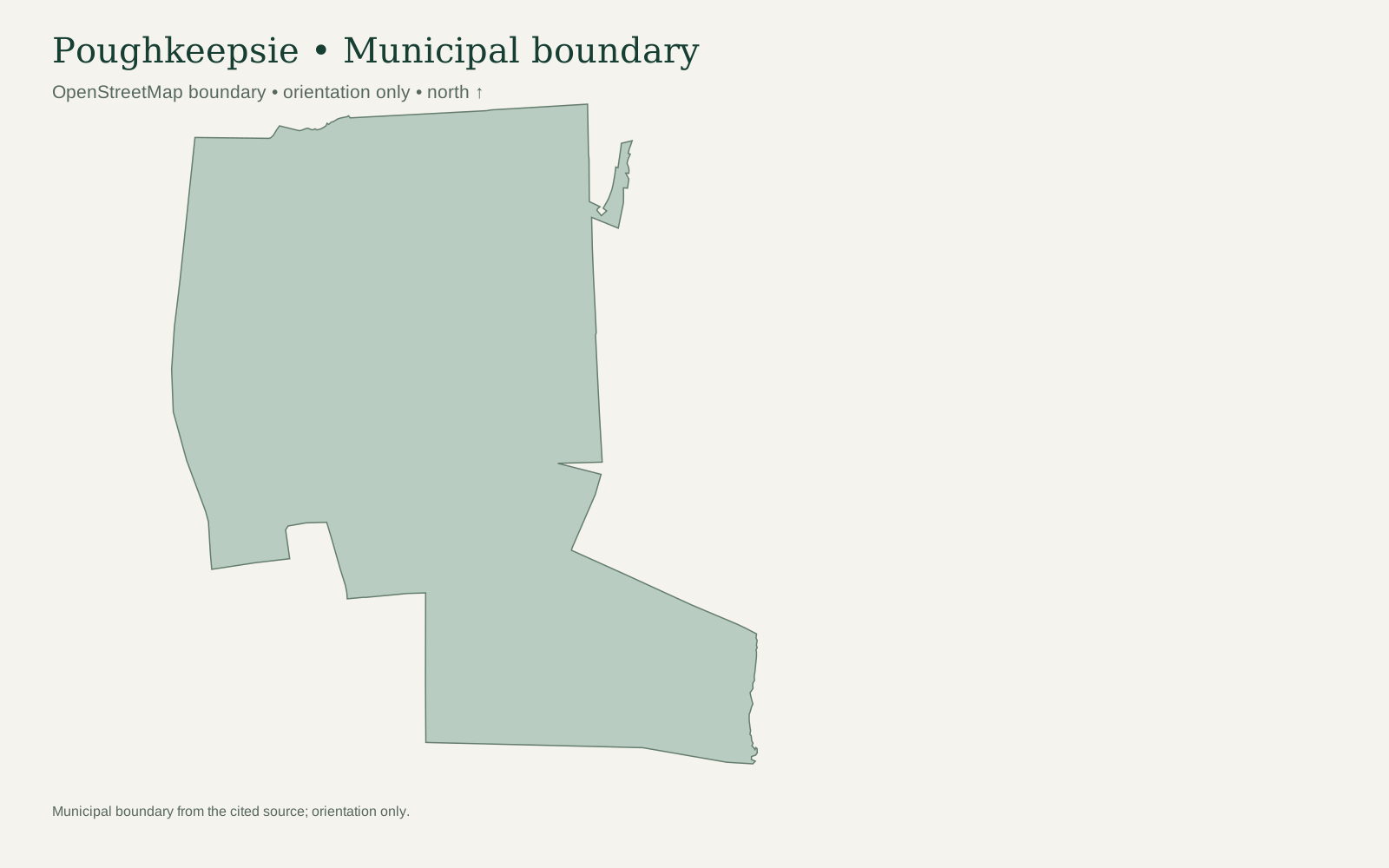
The City of Poughkeepsie is a compact, older city on the east bank of the Hudson River, the county seat of Dutchess County. Main Street runs from the river uphill to the east and divides the city's everyday geography — even the trash schedule is defined as Northside and Southside of Main. The US 9 expressway and the Routes 44/55 arterials frame the street grid, so many crosstown trips pass through a short list of corridors. The map on this page shows the city's municipal boundary (OpenStreetMap geometry); the city fronts the river on the west and is otherwise entirely surrounded by the Town of Poughkeepsie.

That surrounding town is the first thing to understand. The Town of Poughkeepsie is a separate municipality with its own government, town code, police and school districts — the city merely shares its name and a mailing designation. A "Poughkeepsie, NY" address can legally be in either. If an address is in the town, everything municipal in this guide — permits, sanitation, snow rules — comes from the town instead.

The second trap is the colleges. Vassar College, Marist University and Dutchess Community College all advertise Poughkeepsie addresses — Marist's official contact line reads 3399 North Road, Poughkeepsie, NY 12601 — but all three campuses sit outside the city boundary shown on the map, in the town. Apartments marketed as "near Vassar" or "near Marist" are town apartments under town rules.

Inside the city line, the verifiable geography is historic. Main Street itself was converted to a pedestrian mall in the 1970s and reopened to vehicles in 2001, and the blocks around it hold seven National Register historic districts — Union Street, Mill Street-North Clover, Academy Street, Garfield Place, Balding Avenue, Dwight-Hooker and the Main Mall Row — documented in the neighborhood modules below. The Mid-Hudson Bridge has carried Routes 44/55 to Highland since 1930, and the 2009 Walkway Over the Hudson turned the old railroad bridge into the city's signature crossing on foot.

Poughkeepsie orientation map with numbered area key
Use the numbered key to locate the areas discussed below. Open full-size map.

03 /

Find the area that fits your routine

Poughkeepsie has no official neighborhood map; what it has is documented fabric. The eight areas below are anchored in verifiable records — seven National Register historic districts plus the waterfront and station district — chosen because their character can be sourced, not asserted. They are starting points for inspection, not rankings: school placement runs through the central registration office, and building conditions vary house by house.

Union Street

The city's oldest-listed residential district: the National Register documentation covers about eight blocks of downtown Poughkeepsie centered on Union Street, with Late Victorian houses and periods of significance running through the whole 19th century.

Union Street Historic District — NPS NRIS ↗
Housing & setting
Older houses and small multi-family buildings on a downtown-edge grid; expect shared entries, stoops and the maintenance questions of 19th-century construction.
Daily travel
South of Main Street — inside the county Route K Southside loop, with the train station and Transit Hub a short ride or walk away.
Before choosing
Verify where a truck can stop on these narrower streets, and check stoop stairs and shared-hall rules with the landlord before moving day.

Mill Street–North Clover

A 1972-listed National Register district spanning Mill, Mansion, Vassar and North Clover Streets and the Davies and Lafayette Places — second-half-of-the-19th-century blocks on the corridor that runs downhill toward the station and the Walkway entrance.

Mill Street-North Clover Street Historic District — NPS NRIS ↗
Housing & setting
19th-century houses, many now multi-unit; compare the specific staircase, floor and entry you will actually use rather than the street's reputation.
Daily travel
Mill Street is the signed walking route from the station to the Walkway's Parker Avenue entrance; the Route J Northside loop links the area with the Transit Hub.
Before choosing
Mill Street is a designated Snow Emergency Route — winter residents and moving trucks both lose this curb first in a declared emergency.

Academy Street

The National Register district covers Academy Street between Livingston and Montgomery Streets, documented for Late Victorian and mixed-period architecture with significance in community planning and development across 1825–1949.

Academy Street Historic District — NPS NRIS ↗
Housing & setting
A largely residential north-side street of older houses in various stages of multi-unit conversion; inspect the entry, stairs and porch condition house by house.
Daily travel
North of Main Street on the Route J Northside loop; Main Street and downtown are a walk downhill.
Before choosing
Academy Street is a signed Snow Emergency Route — plan winter parking accordingly, and confirm with the landlord who clears the sidewalk within the city's 12-hour rule.

Garfield Place

A small 1972-listed district covering both sides of Garfield Place, with documented periods of significance in 1825–1874 — one of the city's intact mid-19th-century residential streets.

Garfield Place Historic District — NPS NRIS ↗
Housing & setting
A short street of older houses; the intimate scale means every carry runs past neighbors — settle driveway and curb use with the landlord early.
Daily travel
North of Main Street, within the Route J Northside loop's reach; check the exact stop you would use daily.
Before choosing
On a narrow historic street, measure the truck approach before booking: a right-of-way permit or an off-street solution needs to be settled before moving day.

Dwight–Hooker

A 1982-listed district covering Dwight Street from Hamilton to Hooker and 79–85 Hooker Avenue, documented for Late 19th- and 20th-century revival styles built between 1875 and 1924.

Dwight-Hooker Avenue Historic District — NPS NRIS ↗
Housing & setting
Turn-of-the-century houses on a south-side grid; expect porches, stoops and older mechanicals — compare what the rent includes and who maintains the exterior.
Daily travel
South of Main Street in the Route K Southside loop area; Hooker Avenue is one of the city's principal south-side corridors.
Before choosing
Hooker Avenue is a designated Snow Emergency Route; side-street driveways here are often shared, so agree their use before the truck arrives.

Balding Avenue

A 1982-listed National Register district covering Balding Avenue between Mansion and Marshall Streets, documented as Late Victorian with periods of significance from 1850 to 1924.

Balding Avenue Historic District — NPS NRIS ↗
Housing & setting
Older north-side housing close to the Mansion Street corridor; multi-unit conversions are common — verify which floor and entry come with the unit.
Daily travel
North of Main Street; the Route J Northside loop and Main Street buses put the station within a short ride.
Before choosing
Ask early about building-wide rules in converted houses — shared halls, laundry access and where toters live between collection days.

Main Street Corridor

The city's commercial spine: the Main Mall Row National Register district (1982) documents early-commercial buildings from 1850–1874 along the stretch from 315 Main Mall to 11 Garden Street — a street that spent the late 20th century as a pedestrian mall and reopened to vehicles in 2001.

Main Mall Row Historic District — NPS NRIS ↗
Housing & setting
Apartments above and behind commercial storefronts, including documented conversions like the Luckey Platt building; expect managed-building rules rather than private stoops.
Daily travel
The strongest position in the city: county bus routes J and K both serve the corridor, and the station sits at Main Street's western end.
Before choosing
Downtown curb space is metered with a two-hour maximum on weekdays — a moving truck here needs the right-of-way permit or a building loading arrangement, agreed in writing.

Waterfront & Station District

The city's Hudson River edge: the 1918 Beaux-Arts station at 41 Main Street anchors a district of riverfront parks and attractions, with the Walkway Over the Hudson's east entrance at 61 Parker Avenue — a signed three-quarter-mile walk from the platform.

Walkway Over the Hudson directions — NYS Parks (archived) ↗
Housing & setting
Limited residential stock near the river itself; most renters here look at the blocks immediately uphill toward downtown and the Mill Street corridor.
Daily travel
The city's transit anchor: Metro-North Hudson Line trains to Grand Central and five Amtrak routes at one station, plus county buses at the adjacent Transit Hub.
Before choosing
If you are choosing this area for the train, test the actual walk from the specific address at commuting hours — including the uphill return in winter.

04 /

Compare the whole home, not just the advertised payment

Poughkeepsie is a renter's city: 61.2% of households rent their home (ACS 2024 5-year, via Census Reporter). The median gross rent is $1,400 a month and the median owner-occupied value $283,700 — but medians describe the whole city at once, not the apartment in front of you, and listing sites' asking rents run above survey medians. Use them only to sanity-check a budget.

The stock explains the market. About one in three Poughkeepsie homes sits in a two-to-four-unit building, roughly one in four in a detached single-family house, another one in nine in a building of 50 units or more, and about 41% of units were built before 1940. For a mover this means the differences that matter are physical: which floor, stairs or elevator, where a truck can stop, how heat is supplied and who clears the sidewalk. Older radiators, tall windows and plaster walls come with the charm; so do narrow staircases with landing turns. In the oldest stock, ask how the place is heated and what the recent winter bills ran — pre-war windows and radiators make the answer worth having before you sign.

When comparing two apartments, compare what the payment includes — heat, hot water, parking, snow clearing — the lease's move-in and move-out rules, and the condition of the access route: stoop steps, stair rails, door widths. Ask early who handles bulky disposal when you leave; the city's bulky pickup runs by sign-up, its transfer station is closed, and buildings above a few units typically use private carters through the landlord rather than city collection.

A furnished living room with a tall window, radiators below and sealed moving boxes stacked by the wall.
Compare usable rooms, light, storage and what the rent actually includes.

05 /

Test the complete daily journey

Poughkeepsie's rail position is unusually strong for a city its size. Poughkeepsie station, at the foot of Main Street, is the north end of Metro-North's Hudson Line — MTA describes Hudson Line service as running between Grand Central Terminal and Poughkeepsie, roughly hourly with supplemental trains. The station is accessible, with a waiting room open daily 6 a.m. to 9 p.m. The same building is an Amtrak stop served by five routes — the Adirondack, Empire Service, Ethan Allen Express, Lake Shore Limited and Maple Leaf — putting Albany, Montreal, Toronto, Chicago and New York on one platform.

Dutchess County Public Transit runs the bus network. Two routes loop the city itself: Route J (Poughkeepsie Northside) and Route K (Poughkeepsie Southside), both through the train station and the county Transit Hub; letters A through G radiate to Fishkill, Beacon, Hyde Park, Rhinebeck, Millbrook and Pawling. Fares are $1.75 a ride ($0.75 reduced), $45 for 44 rides or $62 for a 31-day pass, cash accepted on board.

On foot, the Walkway Over the Hudson's east entrance at 61 Parker Avenue is a three-quarter-mile signed walk uphill from the station; the state park crosses the river to Highland. Drivers cross on the Mid-Hudson Bridge (Routes 44/55), which uses cashless tolling; US 9 and the Routes 44/55 arterials frame the city's road grid. Test the routine you will actually live — the door-to-door commute, the grocery run, a late-evening return — from the specific address before deciding.

A Main Street block of older brick commercial buildings with a county bus at a stop.
Test the complete daily journey, including the walk at both ends.

06 /

Register through the central office, with documents, by appointment

The Poughkeepsie City School District serves the city — and only the city; town addresses feed other districts, so verify the district before comparing procedures. The city district runs five elementary schools, one middle school and one high school, with a separate pre-K lottery and kindergarten registration track.

Enrollment is centralized and appointment-based. The district's enrollment page states that all students register through the Central Registration Office, 9 a.m. to 3 p.m., Monday through Friday, by appointment only (845-437-3480). Fillable registration forms — published in English and Spanish — are completed electronically and emailed ahead; grades 1–12 forms may also be mailed to the Central Registration Office, 18 S. Perry St., Poughkeepsie, NY 12601.

Bring the document set, because registration is not processed without it: proof of identity for the parent or guardian, proof of custody where applicable, the student's vaccination record and a physical for pre-K and kindergarten, proof of birth, and proof of residency — a current utility bill, a signed lease or a rent receipt, with residency affidavits available for harder cases. Families returning to the district complete a new packet at Central Registration rather than reusing an old file. Two fine-print items matter for planners: placement is made by the building principal, and if class sizes reach their maximum at the neighborhood school, the district may assign a child to another elementary school outside the attendance area. Do not sign a lease counting on a specific building. For the youngest children, note that pre-K runs on its own lottery with a separate registration track — watch the district's announcements for the application window rather than assuming a seat.

07 /

Assign an owner and a start date to each household service

Electricity and natural gas run through Central Hudson Gas & Electric, the regulated Mid-Hudson utility whose service territory covers the valley from the New York City suburbs to the Albany area, and which Dutchess County lists as the area's gas and electric utility. Central Hudson publishes no start-service lead time we could verify, so submit your start, stop or transfer request as soon as your date is fixed, and have identification and the service address ready.

Water and sewer are municipal: the City of Poughkeepsie's water comes from the Hudson River through a treatment facility the city owns and operates jointly with the town — about 11 million gallons a day. Billing questions route through the city's finance office, but the city publishes no tenant-account policy, so renters should confirm with the landlord whether the water account rides with the property rather than opening anything themselves.

For internet and cable, the county's utility page lists Spectrum, Verizon and Optimum as the area's cable and digital companies; availability is address-specific, so check the exact address before promising yourself a speed. In older multi-family buildings, ask which provider already wires the house — an installation booked before the move is easier than one booked from an empty apartment.

08 /

Plan for routine collection and the things you are leaving behind

The city collects garbage and recycling from residential properties using city-issued toters — black lid for garbage, blue for recycling. The sanitation rules are specific: toters go out no earlier than 5 p.m. the night before collection and return to the rear of the residence within 16 hours after; garbage must be bagged inside the toter; contaminated recycling is rejected; violations bring fines from $25 to $2,500, and the property owner answers for tenants' compliance. Larger buildings and businesses use qualified private carters licensed by the county — in a bigger complex, the landlord's hauler, not the city, is your answer.

The collection schedule splits the city at Main Street: north of Main, garbage runs Mondays and Thursdays; south of Main, Tuesdays and Fridays, with recycling on the same days by street list. Yard debris goes out Wednesdays from April into December.

The rule that surprises movers: bulky items are not a curb privilege. The city's DPW runs curbside bulk pickup by sign-up — the Fall 2026 sign-up notice is posted on the DPW page — and the transfer station is closed until further notice, so self-hauling is not currently an outlet. A 2020 city sanitation study documented the system's shape: scheduled curbside pickup of up to five bulk items per address for $35, waived for disabled residents and those 65 and older. Confirm current terms with the DPW at 845-451-4111 well before move-out.

What you are leavingHow it goes out
Furniture and bulky itemsCity sign-up curbside pickup — book ahead; the 2020 documented terms were $35 for up to five items
Mattress or box springNo separate city program found — route it through the bulky sign-up pickup, never in recycling
Self-hauled loadsNot currently possible — the city transfer station is closed until further notice
Apartment-building trash (larger complexes)Private carter through the landlord — ask the manager, not the city

Whatever the item, a curb pile on moving day is not a legal disposal route in Poughkeepsie.

09 /

Arrange a legal place for the moving truck

Poughkeepsie has no moving-truck reservation system, no posted temporary-no-parking sign service and no online request form. What it has is a permit, and the whole procedure runs through the Department of Public Works at 26 Howard Street (845-451-4111). The DPW's permit page lists exactly one relevant instrument: the General Right-of-Way Work Permit.

For a moving truck, the applicable category is Street and/or Sidewalk Closure (obstruction), at $100 per week. The form's published conditions: the applicant shows general public liability insurance of at least $500,000 naming the permit holder and the City as additional insured, plus workers' compensation proof; the work zone gets warning devices — reflective signs, barricades, cones or tape; full and partial street closures are reported each day by calling 845-451-4111; the permit's duration is set at application by agreement with the Commissioner of Public Works or a designee; the entire fee is paid at application; and the permit can be revoked without warning if conditions are not met. A dumpster or container on the street uses the same form's Temporary Dumpster category at $50 per week, with placement rules — ten feet from hydrants, no blocked traffic or driveways, warning devices, no debris left around it.

Three planning consequences follow. First, lead time: because duration and approval are agreed with the Commissioner, apply days to weeks ahead, not the morning of the move. Second, responsibility: the form expects an insured applicant, so decide early whether the household or the mover holds the permit — raise it during the estimate, and keep the approved permit with the moving papers. Third, the alternatives: a private driveway, lot or loading area usually beats a street permit, but get the property's instructions in writing either way.

Two city rules frame the permit. Downtown, street meters are enforced Monday through Friday, 8 a.m. to 6 p.m., at $0.25 per 15 minutes with a two-hour maximum — a metered space cannot host a moving day. And in winter, a declared snow emergency clears all vehicles from signed Snow Emergency Routes on ticket-and-tow terms under the city's Snow Safety Guide — the permit does not override an emergency, so winter dates need the storm backup plan described in the seasonal section.

10 /

Inspect the full route through the building

On one Poughkeepsie housing type, access means wood and brick: raised stoops, shared front halls, staircases with tight landings, sometimes a narrow shared driveway to a rear entrance. Measure the largest pieces against the actual route — width, turns, ceiling at the landing — and check stoop boards and railings before anyone carries a sofa across them. Agree driveway use with the landlord and neighbors; many drives are shared or single-width.

On the other type, access means paperwork: larger complexes and managed buildings run moves through the property manager. Expect elevator reservations, fixed moving windows and a certificate of insurance requested from the mover; some buildings require protective padding in elevators and corridors, booked in advance. Ask for the written moving rules at both ends as soon as the date is set.

Whichever type, walk both routes before the day: where the truck stops, which door is used, every stair and elevator between the truck and the room, and who unlocks what. A plan that works at the origin but not the destination is only half a plan — confirm the two ends together, with time windows that overlap usefully.

11 /

Build a useful routine beyond the commute

Poughkeepsie's everyday anchors cluster within walking distance of each other. On Market Street, the Adriance Memorial Library — the Poughkeepsie Public Library District's main branch at 93 Market Street — is a Classical Revival building on the National Register; the Bardavon 1869 Opera House at 35 Market Street is the city's theater. On the waterfront, the Mid-Hudson Discovery Museum at 75 North Water Street anchors the family end of the riverfront, and the Walkway Over the Hudson — entrance on Parker Avenue, a signed walk from the train station — is the city's shared backyard in the sky. Walkers who want the long circuit can follow the Walkway Loop Trail across the old railroad bridge to Highland and back over the Mid-Hudson Bridge's pedestrian walkway. The library district's second branch, on Boardman Road, sits in the town — one more everyday reminder that the city line matters.

Main Street is the errand spine, with groceries and services strung along it and the side avenues. Test the routine you will actually live: the grocery run, the pharmacy, the school or daycare route, the walk to the station at the hour you would use it. Visit a candidate address at the hours you would use it before deciding — a block that is lively at noon can be empty after six, and the reverse.

A public park lawn with mature trees turning color, curved paths and city buildings above the tree line.
Check the outdoor routine around the address you actually choose.

12 /

Plan for the season in which you will live and move

Winter is Poughkeepsie's scheduling season, and the city's Snow Safety Guide sets the terms. The city's most important roads — Main Street, Mill Street, Academy Street, Hooker Avenue and the other signed Snow Emergency Routes listed in City Code §13-214 — are cleared first, and when a snow emergency is declared, all vehicles must be removed from those routes; vehicles left behind are ticketed first and may then be towed at the owner's expense, and only vehicles with snow tires or chains may use the routes during the emergency. During a declared emergency, the city opens its municipal lots for free parking — know your nearest lot before you need it.

After the snow, the clock starts on sidewalks: property owners and occupants must clear snow and ice from sidewalks — and any fire hydrant in front of the property — within 12 hours after the snow stops (City Ordinance §15-11). Plows will push snow back onto freshly cleared walks and driveway entrances; the guide recommends clearing a space to the left of your driveway so plowed snow lands there instead. If you rent, check the lease for who actually shovels — the legal duty sits with owners and occupants, but the boots are often the tenant's.

The academic calendar that dominates so many college towns barely touches the city's rental rhythm: Vassar, Marist and Dutchess Community College are all in the town, not the city. Ordinary lease cycles rule here — and in our own scheduling experience, end-of-month dates book out first while mid-month dates stay easier to get. That is a workload observation, not a city statistic. If your dates are flexible, mid-month and mid-season dates give you more room, and any winter date deserves a storm backup.

A residential street after snowfall with plowed snow along the curb and a cleared sidewalk.
Winter dates need a storm plan: snow emergencies change where anything may stand.

13 /

Turn the chosen home into an arrival plan

With the address decided — and verified as the city, not the town — sequence the setup so nothing blocks the truck. Four to six weeks out: confirm the lease or closing date, book the school registration appointment if you have children, and book the move itself. Two to three weeks out: submit the Central Hudson start-service request, line up internet installation for arrival week, and sign up for the city's alert notifications so snow emergencies and service changes reach you by text or email. If children are registering, gather the school documents now — the signed lease and utility bills you will use for school residency proof are the same papers the moving and utility setups generate, so keep one folder. At least a week out — and preferably more, since duration is agreed with the Commissioner: apply for the right-of-way permit if the truck needs the street, confirm building rules and elevator windows at both ends, and book the bulky sign-up pickup at the old address if you are leaving furniture.

In the final days: confirm the permit is approved and in hand, finish packing, set aside what travels with you, and check the forecast and the city's snow-emergency status if it is winter. In the first week after arrival: learn whether you are north or south of Main Street and which collection days that means, test heat and hot water, and note the nearest grocery, pharmacy, municipal lot and Snow Emergency Route. If you bought rather than rented, confirm with the city how the water and sewer account transfers at closing — the city publishes no tenant-or-owner policy, so ask directly.

14 /

Questions before you arrive

What is the difference between the City and the Town of Poughkeepsie?

They are separate municipalities that happen to share a name and a mailing designation. The city is the compact urban core on the Hudson; the town surrounds it on all landward sides with its own government, town code, police and school districts. A "Poughkeepsie, NY" address can be in either, and municipal procedures — permits, sanitation, snow rules — come from whichever municipality the address is actually in. Check before comparing anything.

Are Vassar College, Marist or Dutchess Community College in the city?

No — all three carry Poughkeepsie mailing addresses but sit outside the city boundary, in the Town of Poughkeepsie. Apartments advertised as near a campus are town apartments under town rules, and the city's moving, parking and sanitation procedures in this guide do not apply to them.

Does my Poughkeepsie address assign my child's school?

Not automatically. All students register through the district's Central Registration Office by appointment, with identity, custody, vaccination, birth and residency documents. Placement is made by the building principal, and if a neighborhood school's classes reach capacity, a child may be assigned to another elementary school in the district. Pre-K has its own lottery track.

Do I need a car in Poughkeepsie?

Many households manage without one near the core: Metro-North's Hudson Line runs hourly service to Grand Central from the foot of Main Street, five Amtrak routes share the station, and county bus routes J and K loop the city's Northside and Southside through the Transit Hub. Test the exact door-to-door routine from your address — including late evenings — before deciding.

Can I leave unwanted furniture on the curb when I move out?

No. The city collects bulky items through a sign-up curbside pickup — book with the DPW ahead of move-out — and the transfer station is closed until further notice, so self-hauling is not an outlet. A curb pile risks sanitation fines of $25 to $2,500, billed to the property owner.

What happens to street parking during a snow emergency?

When the city declares a snow emergency, all vehicles must leave the signed Snow Emergency Routes — Main Street, Mill Street, Academy Street, Hooker Avenue and the other listed corridors. Vehicles left behind are ticketed and may be towed, and only vehicles with snow tires or chains may use the routes during the emergency. The city opens municipal lots free during declared emergencies.

How do I get to the Walkway Over the Hudson?

The east entrance is at 61 Parker Avenue in the city, about three-quarters of a mile uphill from the Metro-North and Amtrak station on a signed walking route. The state park crosses the Hudson to Highland, and the Walkway Loop Trail combines it with the Mid-Hudson Bridge pedestrian walkway.

Your next step

Bring the plan together

Use the Poughkeepsie moving page to prepare the inventory, access details and questions for your estimate.

Sources & useful local resources

Official procedures and local resources are linked beside the answers above. Reopen the relevant page when arranging a date: fees, schedules and application requirements can change.

City, Town & neighborhoods

Getting around

Schools & enrollment

Utilities & internet

Trash, recycling & disposal

Truck access & parking

Snow & seasonal rules

Everyday & places