Maryland / City relocation guide

Moving to Salisbury

Salisbury combines a riverfront downtown, older residential districts and routes connecting communities across the Lower Eastern Shore. Compare the exact home with the journeys and services you need, then confirm the practical steps for arrival. This guide concerns Salisbury, Maryland, in Wicomico County.

Two adults walking past brick storefronts on a downtown sidewalk
Test ordinary journeys from the actual home and entrance.

01 /

Choose the decision that comes next

If you are comparing homes, start with the area comparisons and the housing checks. Keep the questions consistent across viewings: total monthly cost, condition, usable storage, parking, entry and the journeys the household will make. An attractive room does not settle whether a large piece of furniture can reach it.

For a household with children, use school enrollment while choosing the address. Establish the assigned school, the correct application route and the documents you can produce. School placement, transportation and childcare need their own confirmations; they do not follow automatically from signing a lease.

Once an address is chosen, organize service transfers, truck access and building permission. Give each task an owner and a date for a decision. Keep requested dates separate from confirmed appointments, and record who can resolve a problem on arrival day.

Keep a small arrival folder accessible throughout packing. Include the lease or closing instructions, service confirmations, school correspondence, the building contact and moving documents. Save useful phone numbers outside email. The first night needs working access, essential belongings and a usable room even if the rest of the home is still in boxes.

02 /

Separate the city, neighborhood labels and regional destinations

This is the City of Salisbury in Wicomico County, on Maryland’s Eastern Shore. It is distinct from places named Salisbury in North Carolina, Massachusetts and elsewhere. A Salisbury postal address does not by itself settle municipal service eligibility, road ownership or the school serving a home. Use the city’s public GIS to check the property and its context.

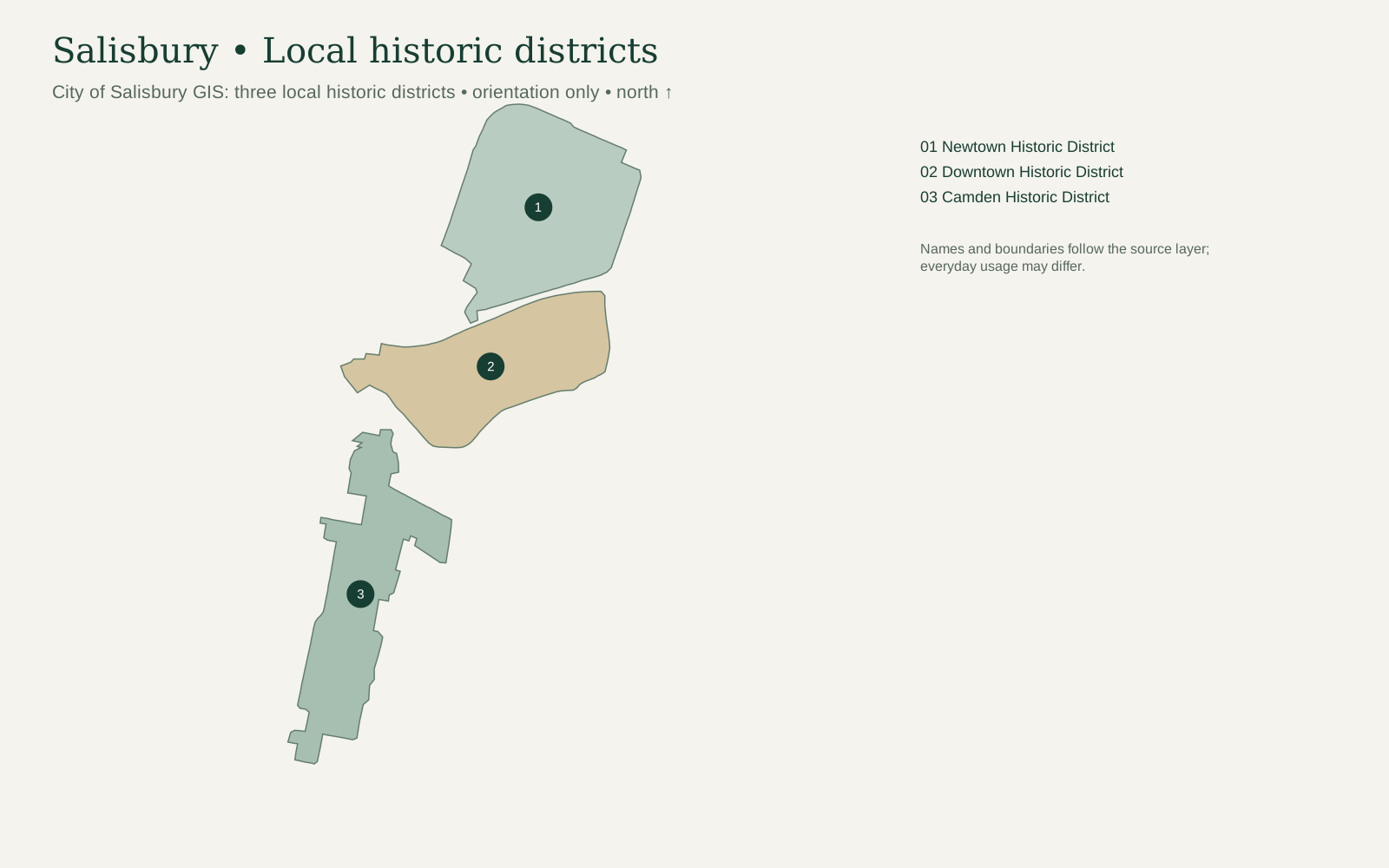
The map here shows the three local historic districts in the city’s current GIS layer: Newtown, Downtown and Camden. These are selected designated areas, not a map of every neighborhood or the whole municipality. The six comparisons below include broader program areas and a park corridor; their boundaries serve different purposes.

Salisbury University places its main campus at the south end of the city, around Camden Avenue and US 13 Business. Check the actual campus building and entrance for a regular journey. Main-campus directions do not identify every university facility, and a university address does not authorize access to a residence hall or campus loading space.

Salisbury Regional Airport lists its terminal at 5485 Airport Terminal Road. Treat an airport arrival and arrival at the home as separate journeys, with a confirmed ground transfer. Do not use a downtown pin as a substitute for the terminal or assume that a place’s Salisbury mailing address makes the same municipal rules applicable.

Distinguish US 13 and US 50 from their Business routes when reading directions. The route a passenger car uses for a viewing is not a verified truck route. Give the mover the full address, permitted entrance and any known restrictions; the carrier must plan a route suitable for its vehicle and the actual conditions.

Numbered map of the Newtown, Downtown and Camden local historic districts in Salisbury, Maryland
City of Salisbury GIS: three local historic districts, generalized for orientation. These shapes do not cover every neighborhood and are not school zones, flood zones or truck routes. Open full-size map.

03 /

Find the area that fits your routine

Use these six areas to choose properties to inspect. Downtown, Camden and Newtown have distinct historic contexts; West Side and Johnson’s Lake are compared using published housing-service program maps, and City Park is a corridor description. Those sources do not establish safety rankings, current vacancies or a common boundary for every public service. Check the individual address.

Downtown

The central commercial and cultural area connects shops, galleries and public activity with the Wicomico river setting. Its street frontage and mixed destinations create a different daily context from a detached-house block.

Downtown Salisbury: shops, culture and river setting ↗
Housing & setting
For an apartment or mixed-use property, inspect the actual residential entrance, floor and separation from business deliveries. The district label does not establish that a lift exists.
Daily travel
Test the walk to Calvert Street services and the actual return journey; confirm downtown parking independently.
Before choosing
Ask about the receiving door, shared corridor, authorized curb and building hours.

Camden

The city design guide describes a planned early twentieth-century residential layout around North, South and Middle Boulevards, with setbacks and varied domestic architecture. Camden also includes historic rowhouse development.

Historic district design guide: Camden history and building form, 2017 ↗
Housing & setting
Compare porch access, side approaches and room dimensions at the individual property. Historic descriptions do not tell you whether a house has since been divided or altered inside.
Daily travel
Try the route to the actual south-city or campus destination, including road crossings and its permitted entrance.
Before choosing
Check the local historic designation before exterior work, and confirm off-street parking rights in writing.

Newtown

The Maryland Historical Trust survey describes an older residential district north of US 50, with closely spaced frame houses, varied architectural styles and many substantial porches. The survey documents historic built form, not current condition.

Newtown Historic District: architectural survey and 2004 eligibility determination ↗
Housing & setting
At a larger older home or conversion, measure stairs, landings and the route to upper rooms; inspect which entrance serves the unit.
Daily travel
Compare the walk toward downtown with the actual crossing and the bus stop serving your journey.
Before choosing
Verify the address against current local-district mapping and check the carrying route before arranging large furniture.

West Side

The published Neighborhood Housing Services map identifies a program area west of the river, extending across several street patterns. It is a housing-service geography rather than proof of one uniform neighborhood or current municipal boundary.

West Side program-area map, March 2007 ↗
Housing & setting
Compare actual houses and rentals street by street. The map establishes location, not age, tenure, price or condition at a particular property.
Daily travel
Test the bridge or street crossing needed for daily destinations and check the relevant weekday bus stops.
Before choosing
Confirm city jurisdiction, road access, the assigned school and the property’s parking arrangement separately.

Johnson’s Lake area

The 2018 NHS map places the combined Newtown/Johnson’s Lake program area alongside the water and streets including Lakeside Drive and Monitor Court. The northern lake-side comparison is broader than the local Newtown historic district.

Newtown / Johnson’s Lake program-area map, August 2018 ↗
Housing & setting
Inspect the exact entrance, storage and any slope or drainage concern at the property; lake proximity does not establish an individual flood determination.
Daily travel
Try the route from the home to a usable stop or shopping entrance instead of assuming a continuous waterfront shortcut.
Before choosing
Use current parcel and service information; do not treat a 2018 program outline as a school or utility boundary.

City Park corridor

The municipal park guide places City Park along Beaverdam Creek between Snow Hill Road and Memorial Plaza. This comparison concerns homes near that corridor, not an official residential district drawn by the park map.

City Park, Doverdale, Lake Street and other municipal parks ↗
Housing & setting
Compare the individual home’s building type, entrance and outdoor responsibilities. A nearby park does not establish private access or dedicated resident parking.
Daily travel
Visit the public entrance you would use, then test the route to work, school and ordinary shopping.
Before choosing
Check facility hours, street parking and the full carrying route; verify any property-specific water or drainage concern separately.

04 /

Use citywide estimates as context, then inspect the home

The ACS 2024 five-year housing tables describe the City of Salisbury over 2020–2024. Of an estimated 13,168 occupied homes, 27.1% were owner occupied and 72.9% rented. Median gross rent was $1,318, and median owner-occupied home value was $227,300. These are survey estimates for an earlier period, with margins of error, not current asking prices or a quote for any neighborhood.

Among all estimated housing units, 37.9% were detached single-unit homes and 12.8% attached single-unit homes; about 11.8% were built before 1940. Those categories help explain why viewing different building types matters. A modern interior can still sit behind an older stair, shallow landing or narrow door. Survey age alone tells you neither the condition nor the work a specific home needs.

For a rental, obtain a written breakdown of rent, utilities, deposits, parking and any move-related charges. Ask who receives each payment and what the lease says about its return or adjustment. Check whether heat, cooking and hot water use electricity or gas, and whether water is billed to the owner or directly allocated to the tenant. Confirm the arrangement before opening accounts.

Inspect the entrance you will actually use. A front porch may not be the approved delivery door; a rear approach may add steps or a longer carry. Measure the narrowest opening and stair turn, and check the path to bedrooms, basement storage and any upper floor. Compare the dimensions with the largest pieces before deciding what will fit.

For a purchase, coordinate possession and key release with the closing professionals. Ask the appropriate inspector about the building’s condition and the responsible owner about outstanding work. Historic exterior review and an ordinary household move are separate matters. If your plans include an exterior alteration, verify the property’s designation and the required review before arranging the work.

Test the daily setting as well as the building. Visit at the time you expect to leave for work and return, inspect crossings and lawful parking, and identify the actual grocery, pharmacy and school journeys. Keep safety impressions, school preferences and current listings separate from what the historic sources and Census estimates can establish.

Two closed branded kraft cartons beside a sofa in a bright living room
Keep a usable room and a clear path while unpacking.

05 /

Compare the exact route, direction and operating day

Use the current Shore Transit schedule index to start a journey comparison. A route name is not enough: find the boarding stop, direction, operating day, arrival time and return trip. Check the walk from the stop to the front door, including crossings and lighting, before deciding that a home works without a car.

The September 8, 2026 Route 116 timetable covers West Salisbury and Delmar on weekdays. Its printed schedule includes Calvert Street, the Centre at Salisbury and selected stops farther north and west. It also shows a service gap from 11:06 a.m. to 12:15 p.m. and states that the route does not operate under Code Orange weather service. A nearby stop does not guarantee a bus at every hour.

Route 253 connects Salisbury, Princess Anne and Pocomoke on weekdays, with the Salisbury University Maggs stop among its listed destinations. The two regional loops have different patterns: Route 432 runs through Salisbury, Ocean City and Pocomoke, while Route 452 covers the reverse ordering. The current fall/winter brochures list those loops Monday through Sunday. Check the actual stop and trip; daily operation does not mean every destination has frequent service.

Read the schedule notes as well as the times. Some stops are served only on selected trips, and events or reduced weather operation can change service. The brochures advise calling ahead for designated flag stops and warn that service there is not guaranteed; a listed timed stop is the clearer choice when an arrival matters. Confirm a workable return trip before leaving.

The published adult single-ride fare is $3 with exact cash; the brochures list other fare products and eligibility rules separately. Paratransit is an eligibility-based service with its own reservation requirements, not an automatic substitute for a missed fixed-route bus. Contact Shore Transit at 443-260-2300 for the service that fits the journey.

If driving, compare the actual workplace entrance and parking arrangement rather than the distance to a district label. Account for school drop-off, errands and the return journey. Test the route yourself when possible; this guide does not promise commute times or assume that a regional bus connection replaces a direct trip.

Two adults on the sidewalk beside the passenger door of a white and blue bus
Check the boarding side, route, operating day and return journey.

06 /

Confirm Wicomico enrollment, documents and the first school day

Public-school enrollment here is through Wicomico County Public Schools. Begin with the district’s K–12 registration page and its linked School Locator. Enter the actual residence to identify the home school, then confirm the result with that school if a boundary, unit or special circumstance is unclear. A neighborhood name or a Salisbury postal address is not a school assignment.

For kindergarten in 2026–27, a child must be five on or before September 1, 2026. The district describes a separate waiver for delaying kindergarten where appropriate; do not treat it as ordinary early admission. For an older child, tell the school the prior grade and school, any existing Wicomico record and the anticipated move date so staff can identify the correct entry or record-update process.

Prepare the child’s birth certificate, immunization record and current physical form, plus an IEP or IFSP where applicable. The parent or legal guardian needs a driver’s license or state-issued picture ID and two residency documents in their own name. The district’s list pairs a mortgage or property-tax document, or a current rental agreement, with a current gas, water or electric bill showing the service address.

If the household cannot yet provide that combination, contact enrollment staff before submitting substitute documents. Explain the actual living arrangement or change of address and ask which process applies. Do not assume that another household’s utility bill or a closing date alone will be accepted. Keep sensitive documents in the district’s designated system.

The online path uses an Aspen Family Portal account. Follow the registration link, request an account and choose the parent/guardian registration option. Complete a separate registration for each child and upload the required records. The district provides computer and mobile instructions, including desktop-site mode for phones. An account and an application are steps in the process, not confirmation that attendance can start.

Prekindergarten has its own eligibility and application route. Pre-K 4 requires age four by September 1 of the coming school year; Pre-K 3 is available through private providers. The district prioritizes Tier I applicants, including income at or below 300% of the poverty guideline, children experiencing homelessness or in foster care, and priority for children with an IEP. Placement also depends on program availability.

For Pre-K, add income evidence to the child, guardian and residency documents: the current page requests four consecutive recent pay stubs and W-2s or a 2025 tax return, with a Maryland benefit eligibility letter where applicable. Complete applications are reviewed, and families outside the priority criteria may be waitlisted. The published 2026 acceptance-mailing schedule ran through August; for a move during the school year, ask staff about current space and the next step rather than waiting for those past mailing dates.

Arrange help with the home school or call 410-677-4400; enrollment questions can go to enroll@mywcps.org. Keep the confirmation and ask what remains outstanding. For a returning student or a transfer within the county, have staff reconcile the existing record before creating a duplicate application. This is a practical check, not a claim that the district uses one identical form for every situation.

Finally, confirm attendance and transport separately. The 2026–27 student handbook links school-assignment, special-permission and transportation procedures; a preferred school is not an approved exception. Obtain the actual bus or walking arrangement, stop and start date, and make a temporary family plan if transportation is still being arranged. Tell the school about accessibility or support needs early enough for the responsible staff to respond.

07 /

Identify the account holder and service already present

Before requesting service, list what the home actually uses: electricity, any natural gas, water and sewer, internet and any owner-managed services. Obtain the lease or closing allocation for each account. A provider serving Salisbury does not establish availability at every address, and starting an account is different from installing a new connection.

For municipal water and sewer, Salisbury Waterworks directs billing and account questions to Utility Billing at 410-548-3115. Give the property address, ownership or tenancy situation, possession date and existing account details if available. Ask who is responsible for the account, how the final reading and bill are handled, and what confirmation is needed before occupancy.

The Finance forms page includes documents with specific purposes. Form 301 concerns a realtor’s inspection activation at a foreclosure property; Form 302 concerns a transferred foreclosure property and its authorized realtor. These are not general instructions for every new tenant. The published forms do not establish a universal household transfer deadline, so obtain the correct process from Utility Billing for your situation.

For an address served by Delmarva Power, its start, stop and move service path says requests can be made up to 120 days ahead and asks for at least three days to begin or end service. Confirm the address and date in the actual application or with customer service at 1-800-375-7117. Treat those published lead times as planning guidance; retain the accepted service date and any conditions before relying on power for arrival.

Chesapeake Utilities' gas-service forms distinguish starting, stopping and transferring service, and separate activation at an existing meter from a new physical installation. Check whether the property already has gas service and which appliances depend on it. A move request cannot by itself establish that a new line or installation will be ready.

The utility’s Maryland customer guide asks for the customer’s name, service and billing addresses, former service address, contact details, identification information and requested start date. A deposit may be required. When leaving, provide a disconnection date and forwarding address for the final bill. If interrupted service must be restored, the guide requires an adult aged at least 18 to be present so the technician can access and check the appliances.

For internet, verify service at the exact unit and obtain the installation or activation confirmation directly from the provider. Ask the owner about access to wiring or a shared communications room. Keep a practical temporary connection available if work or school depends on it. A coverage map or an appointment request is not evidence that the connection is already usable.

Review all confirmations before loading. Agree who can let a technician in, keep essential documents and medicines accessible, and preserve power and water at the old home until the agreed handover. If the destination lacks a necessary service, make the decision about a later arrival or temporary accommodation before alternatives disappear.

08 /

Confirm the collection day and book bulky items separately

Salisbury’s sanitation instructions assign weekly residential collection by quadrants formed by US 13 Business and US 50: southwest on Tuesday, northwest on Wednesday, southeast on Thursday and northeast on Friday. Multi-unit complexes with common containers have a separate Monday, Wednesday and Friday pattern. Confirm the actual property arrangement and holiday notice with the city or building manager.

Set material out by 6 a.m. on collection day and return containers by 11 p.m. that day. The city asks for cart handles and wheels toward the house and clearance from parked vehicles, signs and poles. Trash belongs bagged inside the container with the lid closed; loose overflow bags are not part of ordinary pickup. Keep the moving truck and staged belongings out of the collection approach.

For the city’s 95-gallon trash cart, contact Utility Billing at 410-548-3115 about purchase and account arrangements. Recycling bins are available through Field Operations at 410-548-3177. Check what is already assigned to the property before buying or removing a cart. At a managed building, ask which shared containers residents may use and how cardboard is handled.

Flatten moving cartons and remove the packing material before setting cardboard beside the recycling container as directed. There is a current source conflict about plastics: the sanitation page excludes them for the present, while the recycling page and its brochure still list plastics numbered 1 and 2. Ask Field Operations for the current accepted list before putting plastic out. Do not treat the older brochure as resolving that conflict.

Unwanted furniture and mattresses need the separate paid bulk collection process. The published guide schedules regular bulk pickup on Mondays and gives a $30 base charge for three items. Call Finance at 410-548-3110 to pay and have the request passed to Sanitation, then confirm the collection date and item classification. Additional appliance charges can apply; ask for the current total rather than calculating from an older accessory-fee list.

Mattresses, box springs and upholstered or fabric-covered items must be wrapped in plastic and sealed with tape under the bulk instructions. Prepare them before the confirmed collection and place accepted items out by 6 a.m. Keep them clear of the carrying route. Construction debris, hazardous materials and other excluded items need a different disposal arrangement; an ordinary bulk booking does not authorize every object left after a move.

Free bulk weeks have specific registration windows and exclusions. The September 2026 notice scheduled pickup for September 21–25, with registration ending at noon on September 18. That registration window has passed. It limited the service to three items and excluded multi-unit complexes, appliances and construction material. Do not plan a future move around an unannounced free pickup; use the regular process or wait for a new dated notice.

Choose disposal before moving day where possible. Separate items traveling to the new home, items staying with the property and confirmed collections. Tell the mover about any agreed packaging-removal service and keep that scope distinct from city collection. An unwanted sofa should not become an unplanned second delivery or an obstruction outside the building.

09 /

Follow the obstruction application through to a usable curb

The public DID101 obstruction-permit page covers temporary occupation or obstruction of Salisbury’s public streets and rights-of-way. It applies to city-controlled public space; a private driveway, a state road or a different municipality can involve another owner. Begin with Infrastructure and Development at 410-548-3170 and describe the proposed household move rather than choosing a permit solely by its name.

Prepare the exact frontage, date, hours, vehicle size and proposed position. Explain whether the plan occupies parking spaces, a sidewalk, a bicycle lane or a travel lane, and how people will pass safely. Include the path to the building and any driveway or emergency-access conflict. These details let the city identify the category, controls and review needed for the actual activity.

The portal requires submission at least 48 hours before work begins. Its Apply Online link leads to an account sign-in or registration page. The public overview is readable, but the full applicant-specific form and review conditions require that next stage. Allow time for a complete application, questions, approval and any required street setup; 48 hours is not a guaranteed turnaround or permission to proceed without approval.

The public portal and the signed FY2027 fee ordinance list a $75 base fee for general obstruction of public streets or ways. The ordinance took effect July 1, 2026. Separate listed categories include a $50 sidewalk closure, a $100 lane closure including a bicycle lane, and a $250 street closure, with additional conditions and extended-duration charges. Ask the city to classify your plan and confirm the total; these entries are not a promise that every moving truck pays one flat fee.

Ask who provides and posts any required temporary signs, how far in advance they must be installed, whether inspection or confirmation is required, and whom to contact if the approved area is occupied. The public material reviewed does not establish one universal sign-posting deadline for household moves. Obtain the conditions for your permit instead of borrowing a 24-hour or 72-hour rule from another city.

The Parking Authority handles city parking facilities and related questions; its office number is 410-548-3195. The downtown parking FAQ describes weekday enforcement and two-hour on-street limits in the defined downtown area. Moving to another space on the same street does not restart that timed period under the FAQ. A payment grace period is not loading permission, and a passenger-car garage is not a confirmed location for a moving truck.

Do not confuse the separate fleet and construction-vehicle permits with a household reservation. The construction procedure requests project details and contractor credentials and can be free for qualifying construction vehicles. That does not make an ordinary residential move eligible for the same permission. Explain the actual use and obtain the applicable authorization.

Before the day, keep the approved location, conditions, payment record and responsible contacts together. Confirm who checks the space and who can authorize a change. If it is unavailable, use an agreed lawful alternative and tell the mover about the new carrying distance, waiting or revised window. Do not create an improvised loading area across a sidewalk, lane or neighbor’s access.

10 /

Make building permission match the physical route

Obtain the property’s moving instructions from the owner or manager who can authorize access. Identify the entrance, floor, unit, usable hours and person opening the doors. At a shared building, ask how the move is coordinated with residents and other deliveries, and whether the service lift or corridor is actually available for the whole agreed window.

Measure the route from the truck position to the destination room. Include porch steps, narrow doors, stair turns, low ceilings and any separate storage area. An approved street position does not establish that a sofa fits inside, and a wide lobby does not settle the dimensions of the next door or landing. Send useful photographs and measurements to the estimator.

Ask about protective materials, a certificate of insurance, an attendant, contractor registration and any other building-specific condition. If a labor or union requirement is raised, request its written scope and the contact responsible for arranging it. These are questions for the particular property, not a claim that every Salisbury building imposes the same conditions.

Record charges or deposits separately: amount, recipient, payment deadline, basis and return conditions. Clarify what belongs to the building and what belongs in the moving estimate. Obtain written permission for any preparation before a short moving window, such as delivery of packing materials, without assuming that furniture can be staged in a shared exit or hallway.

Make pickup and delivery windows work in sequence with travel and handling between them. They need not occur at the same time, but both must be achievable. Identify the person who can release the old home and the person who can receive the new one. If a lift fails or keys are delayed, know when to choose a revised window or confirmed storage before the vehicle is loaded.

Finally, inspect the route again just before the move. Remove loose obstructions, secure pets and keep residents informed through the appropriate manager. A previously approved route may change because of maintenance or another delivery. Have a decision-maker available to resolve changes before the crew begins carrying.

11 /

Test ordinary errands and public places from the actual door

Build a first-week routine around the places the household will use: food shopping, pharmacy, work, school, a library and an outdoor walk. Try the route and the return trip at a realistic time. A straight-line distance can hide a road crossing, an indirect bus journey or an entrance on the other side of a large property.

The city’s park guide places City Park along Beaverdam Creek between Snow Hill Road and Memorial Plaza. It also describes smaller facilities such as Doverdale and Lake Street parks. Choose the actual entrance and activity you need; check hours, current access and any reservation requirement. The general presence of a park does not establish that every facility or restroom is open whenever you arrive.

the Wicomico Public Libraries card policy offers free cards to people who live or work in Maryland and to residents of Delmar, Delaware’s 19940 ZIP code. Bring current address evidence, such as an appropriate bill or signed lease. Children under 14 need a parent or legal guardian’s signature and address proof. If address evidence is temporarily unavailable, the policy allows limited borrowing, with proof due by the next visit or within 60 days, whichever comes first.

Arrange the first usable room before trying to finish every box. Put everyday medicines, school or work equipment, chargers, food basics and pet supplies where they can be reached. Keep exits and utility equipment clear while unpacking. A small working base makes it easier to deal with appointments and deliveries without turning the whole home into a temporary storage aisle.

Two adults walking on a paved path beside water, grass and mature trees
Visit the actual public entrance and path before building it into a routine.

12 /

Prepare for the conditions that can change access

The city’s snow guidance requires property owners to clear a sidewalk path four feet wide along the property within 24 hours after snowfall stops. If snowfall ends between 5 p.m. and 7 a.m., the stated deadline is before 2 p.m. Arrange responsibility with the owner or manager before a winter handover and check the actual steps and landing before carrying begins.

During declared snow emergencies, parking and vehicle restrictions can apply on emergency routes. City guidance prioritizes those routes and says residential streets are plowed after more than four inches, once emergency routes are passable. This is an operating priority, not a promise of a cleared curb by the time your truck arrives. Check live notices and the property’s approach.

Rain and fallen leaves need a practical response too. Agree who clears and lights the entrance, where wet outerwear will go and how the carrying route stays usable. Do not infer property-level flood exposure from proximity to the river or from the historic-district map; obtain the relevant parcel information and professional advice if that issue affects a purchase or lease.

For a campus-related move, obtain the institution’s actual residence-hall or facility instructions and date. University presence alone does not establish a citywide turnover rule or a measured seasonal price premium. Company workload observations and the availability of your chosen building are separate matters, so give the estimator several dates that are genuinely possible.

Resident holding a closed umbrella beside wet porch steps and a white handrail
Confirm that the approach, steps and landing are ready for carrying in wet weather.

13 /

Turn separate confirmations into an arrival plan

Before loading, confirm possession of the destination, the usable entrance, the receiving person and essential services. Check the approved truck location and any required setup. Review the inventory with the mover and identify what stays behind. Keep documents, medicines, identification, chargers and first-night belongings with the household rather than at the back of the shipment.

Give the receiver a room plan and clear labels for major items. Keep children, pets and visitors away from the carrying route. A person authorized to approve placement or a scope change should remain reachable through delivery; a key holder who cannot make decisions may not be enough to resolve a problem.

Define Plan B before it is needed. Name the observable trigger, such as keys not released by a specific decision time or a failed lift inspection. Identify who decides, the lawful alternative window or actual storage reservation, and the people who must be notified. Account for additional handling, waiting and temporary accommodation, then specify what must be confirmed before delivery resumes.

At handover, check the inventory and record concerns while the relevant item can be inspected. Save the paperwork and service confirmations. Verify the next collection day, school start and remaining technician visits. Keep cartons and unwanted items within the agreed disposal plan, and leave the entry and essential rooms usable while the rest of the household settles in.

Use the Salisbury moving page to bring the inventory, access information, packing choices and unresolved timing into the estimate discussion. The better the receiving conditions are defined, the easier it is to discuss the actual work and a practical fallback.

14 /

Questions before you arrive

Does a Salisbury mailing address establish city services?

No. Check the municipality, road owner and service provider for the actual property. Postal labels, historic districts and school assignment boundaries serve different purposes.

Are the housing figures current asking prices?

No. They are citywide ACS 2024 five-year estimates covering 2020–2024. Compare current listings and the full cost of each property separately.

Is prekindergarten the same registration path as kindergarten?

No. Pre-K has age, priority, income-document and space conditions. Kindergarten has its own age requirement and K–12 registration path. Obtain placement confirmation from Wicomico County Public Schools.

Do all Shore Transit routes run on Sunday?

No. The current 116 and 253 schedules are weekday services, while 432 and 452 list Monday through Sunday. Check the actual route, stop, date and return trip.

Can a mattress go out with ordinary trash?

Arrange a separate accepted bulk collection, confirm payment and the date, and wrap the mattress in plastic sealed with tape. A free bulk week has separate dated registration rules.

Is a construction parking permit suitable for a household move?

Do not assume so. Describe the move to the city and confirm the applicable obstruction or parking procedure, fees and any sign requirements.

What if utilities or keys are not ready?

Tell the mover before loading where possible. Confirm a later receiving window or available storage, the decision-maker, costs and accommodation for the household. Keep a requested date separate from an accepted appointment.

Your next step

Bring the plan together

Use the Salisbury moving page to prepare the inventory, access details and questions for your estimate.

Sources & useful local resources

Official procedures and local resources are linked beside the answers above. Reopen the relevant page when arranging a date: fees, schedules and application requirements can change.

Housing and geography

Schools and family

Truck access and parking

Weather and seasonal access

Utilities

Transport and everyday life

Waste and recycling