Stamford is a small city with two housing worlds — downtown towers and dense older neighborhoods, plus the wooded lots of North Stamford. This guide helps you compare areas, plan the everyday basics and prepare the practical steps of arriving.
Try the everyday errands around a new address, not only the journey to work.
01 /
Start with the decision in front of you
Stamford asks three different questions of a newcomer, and this guide is organized around them. If you are still choosing where to live, start with the orientation and the neighborhood comparison, then read the housing section — the market splits sharply between managed towers downtown, older multi-family streets in the mid-city neighborhoods, and single-family North Stamford. If you are moving with children, go to the schools section early: Stamford assigns schools by attendance zone and runs a separate magnet lottery with fixed dates, so the address and the calendar both matter. If the address is already decided, the second half of the guide walks through the practical setup — utilities, waste, the street permit for the moving truck, building access and the arrival sequence.
One caution before any comparison: Stamford's official Neighborhood Statistical Areas, postal ZIP codes, school attendance zones and everyday neighborhood names draw different maps. Greenwich, Darien and Norwalk are separate municipalities with their own rules — a "Stamford area" description and a Stamford address are not the same thing. Verify each address against the map that matters for the decision at hand.
02 /
Understand Stamford before comparing addresses
Stamford sits on Long Island Sound in Fairfield County, with I-95 and the Merritt Parkway (Route 15) crossing it east to west and the Metro-North New Haven Line running along the coast. Downtown and the South End form the dense core around the Stamford Transportation Center; the mid-city neighborhoods — Springdale, Glenbrook, the West Side, Cove — fill the flats north of the railroad; and North Stamford, roughly the northern half of the map, is a different city entirely: single-family houses on wooded lots along winding ridge roads.
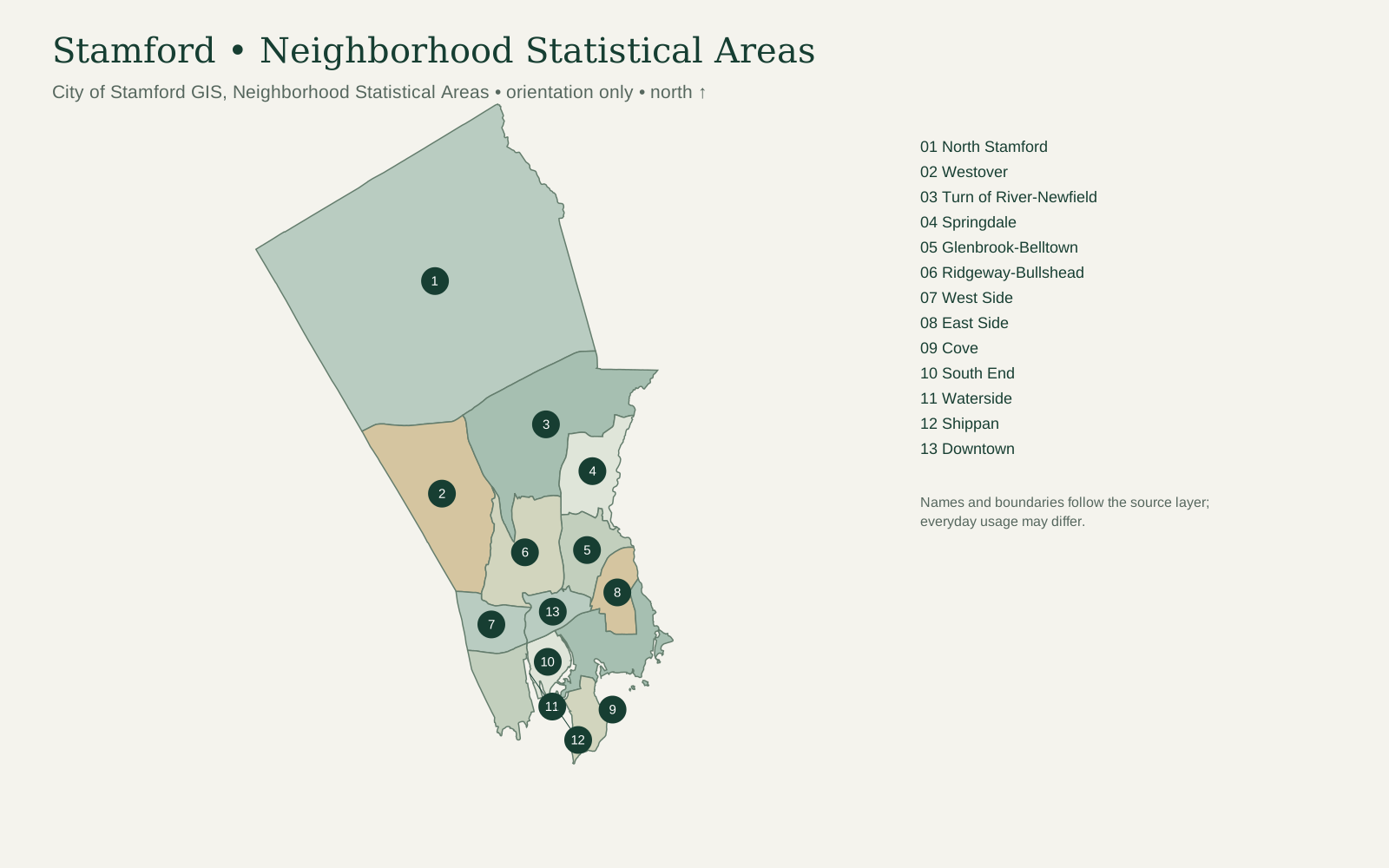
The city's own GIS divides Stamford into 13 Neighborhood Statistical Areas, mapped below from the City's open layer: North Stamford, Westover, Turn of River-Newfield, Springdale, Glenbrook-Belltown, Ridgeway-Bullshead, West Side, East Side, Cove, South End, Waterside, Shippan and Downtown. They are planning geography: postal ZIP codes cross them, school attendance zones follow their own lines, and everyday usage blends names — the Harbor Point redevelopment area, for example, sits inside the South End, and Belltown rides with Glenbrook in the city's layer. None of these lines assigns a school or guarantees a building condition.
Two boundary facts matter for movers. The towns next door — Greenwich to the west, Darien and Norwalk to the east — are separate municipalities, so procedures in this guide stop at the city line; a listing described as "Stamford area" may not be in Stamford at all. And the Merritt Parkway, although it crosses the city, is closed to moving trucks under the state's parkway restrictions: no box trucks, no trailers, nothing over 8 feet tall or 24 feet long. I-95 and the Post Road carry the truck traffic instead.
Use the numbered key to locate the areas discussed below. Open full-size map.
03 /
Find the area that fits your routine
Stamford's GIS maps 13 Neighborhood Statistical Areas; the eight below are the ones a household is most likely to compare, chosen for their verified character from city documents and national-register nominations. They are starting points for inspection, not rankings — school assignment follows the attendance zones described below, and building conditions vary house by house.
Downtown
Stamford's business and transit core around the Transportation Center — office and apartment towers, restaurants and the UConn Stamford campus. The national-register district along Atlantic, Main and Bank Streets preserves the early-20th-century commercial blocks beneath the newer high-rises.
Expect managed apartment towers and condo buildings with elevators, set moving windows and certificate-of-insurance requirements. Compare what the rent includes and ask for the building's written moving rules before signing.
Daily travel
The strongest transit position in Connecticut outside New Haven: Metro-North express trains to Grand Central, Amtrak, CTtransit buses and the I-Bus to White Plains are all at or near the station.
Before choosing
Confirm the loading arrangement, elevator reservation procedure and any metered-curb plan early; downtown curb space is metered and enforced, so the truck position belongs in the lease conversation.
South End
A peninsula south of downtown, cut off by the railroad. The national-register nomination documents a working-class district of 1870–1930 buildings — Victorian Gothic cottages, vernacular row houses and early three-deckers — alongside the Harbor Point redevelopment area that has added new towers along the waterfront.
A sharp mix: older two- and three-family houses with stairs and shared entries, and new managed apartment buildings with elevator booking and moving rules. Verify which world your address is in.
Daily travel
Walkable to the Transportation Center; Washington Boulevard, Atlantic Street and Pacific Street are the main spines, with CTtransit buses along them.
Before choosing
In older blocks, check where a truck can stop on narrow streets and ask about shared-hall rules; in new buildings, ask for the loading dock and elevator window before signing.
West Side
A dense residential district west of downtown along Stillwater Avenue. Its Hubbard Heights historic district is, per the national-register nomination, one of Stamford's few intact early-20th-century platted neighborhoods of single-family homes — Colonial Revival, Tudor Revival and Craftsman houses from about 1904 onward.
Older single- and multi-family houses; expect porches, shared driveways and stairs rather than elevators, plus some mid-century apartment buildings.
Daily travel
Stillwater Avenue buses run toward downtown; the West Side is closer to downtown than to any rail station, so test the bus-to-train connection.
Before choosing
Shared driveways and basement-storage questions belong in the lease; check porch stairs and railings as part of the access survey.
North Stamford
The northern half of the city and nothing like the core: wooded single-family lots along winding ridge roads. The Long Ridge Village historic district preserves Colonial, Federal and Greek Revival houses along tree-lined Old Long Ridge Road.
Almost entirely detached houses on larger lots — wells and septic appear this far out, and driveways can be long, steep or unpaved. Ownership dominates; rentals are scarce.
Daily travel
A car is effectively required; the Merritt Parkway crosses the area (cars only — trucks are prohibited) and the nearest rail stations are Springdale or downtown.
Before choosing
Walk the driveway before moving day: length, grade and turnaround decide whether a large truck reaches the door or the move needs a shuttle plan.
Springdale
A mid-city neighborhood organized around its own Metro-North station on the New Haven Line, with a retail strip along Hope Street. The city is rebuilding the station area for walkability — new crossings at Hope Street and Clearview Avenue, sidewalks, bus shelters and a kiss-and-ride — under its Springdale TOD project.
Older multi-family houses and small apartment buildings near the station, single-family streets farther out; expect stairs and driveways more often than elevators.
Daily travel
A genuine rail advantage: your own station on the New Haven Line, with a city-managed permit and daily parking lot, plus Hope Street buses.
Before choosing
Narrow side streets near the station concentrate the carry — confirm where the truck can stand and whether the street is on the snow alternate-side list.
Glenbrook
A mid-city neighborhood northeast of downtown with its own Metro-North station and a retail spine along Glenbrook Road. City capital work at the Glenbrook–Hope Street junction — realigned intersection, new crosswalk, a small community greenspace — reflects the area's walkable, transit-oriented scale.
Older multi-family stock and modest single-family houses; shared entries, porches and driveways are the norm, with some larger garden-apartment complexes.
Daily travel
Glenbrook station on the New Haven Line, with a city-managed permit and daily lot; Glenbrook Road and Hope Street buses connect downtown.
Before choosing
Confirm driveway rights in multi-family houses and the truck's position on narrower blocks; the station area is busy at commute hours.
Shippan
The Shippan Point peninsula south of the Cove, where Shippan Avenue meets Harbor Drive and Magee Avenue. The city describes that junction as the gateway to the Shippan Point neighborhood, Cummings Park and Beach, the Shippan Avenue commercial district and the Shippan Landing office park.
Primarily single-family houses, some waterfront, with apartments nearer the avenue; beach-area streets carry seasonal parking rules (May–September) in several permit zones.
Daily travel
Car-oriented at the point itself; buses run along Shippan Avenue, and downtown is a short ride north.
Before choosing
If the street is in a seasonal permit zone, the moving truck still needs its own arrangement — household permits do not cover it; check the zone map before booking.
Cove
The east-side waterfront district around Cove Island Park and Cove Harbor, covered by the city's Cove–East Side neighborhood plan. Residential streets of older houses and small multi-family buildings sit between the park and the East Side's avenues.
Older single- and two-family houses plus small apartment buildings; expect driveways and yards more often than downtown, and the access quirks of pre-war construction.
Daily travel
Local buses along Cove Road and East Main Street; downtown is a short ride west, and I-95 access is close by.
Before choosing
Several Cove-area streets fall in seasonal residential permit zones (May–September) — check the zone list, and confirm the curb plan before the truck arrives.
04 /
Compare the whole home, not just the advertised payment
Stamford's market is nearly balanced between renting and owning: 51.2% of households rent their home (ACS 2024 5-year, via Census Reporter). The median gross rent is $2,276 a month and the median owner-occupied value $624,400 — but medians describe the whole city at once, from a North Stamford colonial to a Harbor Point studio, and listing sites' asking rents run above survey medians. Use them only to sanity-check a budget.
The stock explains the market. Nearly 28% of Stamford homes are in buildings of 50 units or more — the downtown and South End towers — while single-family detached houses are about 34%, concentrated in North Stamford, Westover and Turn of River. In between, Springdale, Glenbrook, the West Side and the South End hold the older multi-family stock: about 19% of the city's homes were built before 1940, including the South End's documented three-deckers and row houses. For a mover this means the differences that matter are physical: which floor, stairs or elevator, where a truck can stop, how heat is supplied and who clears the sidewalk.
When comparing two homes, compare what the payment includes — heat, hot water, parking, snow clearing — the lease's move-in and move-out rules, and the condition of the access route: stair rails, door widths, the elevator booking process in a tower. Parking deserves its own question: downtown buildings may include a garage space or charge separately for one, older multi-family streets lean on driveways and the curb, and North Stamford houses assume a car per adult. In managed buildings, ask for the written moving rules before signing; in older multi-family houses, ask the landlord how trash and bulky disposal work for your unit, since the city's address lookup does not cover condominiums.
For buyers, the waterfront and flood question is real on the Sound-side peninsulas — the South End, Waterside, Shippan and the Cove sit at or near sea level, and a mortgage lender may require flood insurance there. None of this is visible in a listing photo; walk the block, check the approach at commute hours, and read the lease or the inspection report for the unglamorous systems: heat, hot water, windows and stairs.
Compare usable rooms, light, storage and what the rent actually includes.
05 /
Test the complete daily journey
Stamford has the strongest rail position of any Connecticut city its size. The Stamford Transportation Center anchors the Metro-North New Haven Line — express trains run to Grand Central — and Amtrak serves the same station with Acela, Northeast Regional and Vermonter trains; it logged 398,475 Amtrak trips in FY2025. The station is fully accessible, the ticket office runs daily 6:10 a.m.–10:10 p.m., and tickets are easiest in the TrainTime app. Glenbrook and Springdale have their own New Haven Line stations, with city-managed permit and daily parking lots — permits have been virtual since November 2024.
CTtransit's Stamford Division runs local buses across the Greater Stamford area, many seven days a week, connecting with Norwalk's buses and Westchester's Bee-Line; its I-Bus is an express between downtown Stamford and White Plains, NY. A local ride costs $1.75 for two hours, or $3.50 all day, with the Token Transit app or a Go CT Card for payment. For drivers, I-95 and the Merritt Parkway are the east–west spines — but remember the parkway's vehicle restrictions apply to anything truck-sized, which matters when your household goods arrive.
Test the routine you will actually live: the walk to the platform or the bus stop, the grocery run, the school drop-off, a late-evening trip home. Downtown and the South End are workable without a car; North Stamford generally is not. Visit a candidate address at the hours you would use it before deciding.
Test the complete daily journey, including the walk at both ends.
06 /
Learn your zone, then your options
Stamford Public Schools assigns children by attendance zone — unlike Connecticut's choice districts, your address determines your default school. Start with the district's student registration page, which links the School Look Up tool for your address's zone. On top of the zones runs a magnet system: four intradistrict magnets (Hart, Toquam, Westover, Scofield Middle) and three interdistrict magnets (Rogers International K-8, Strawberry Hill K-8, AITE high school) that also enroll students from surrounding towns. Hart, Toquam and Westover are zoned magnets — families inside their attendance areas need no lottery; everyone else applies through it.
Track
Schools
Who enrolls
Zoned magnet
Hart, Toquam, Westover (elementary/K-8)
Attendance-area families by address; others by lottery
District-wide magnet
Scofield Magnet Middle School
All seats by lottery, Stamford residents
Interdistrict magnet
Rogers International (K-8), Strawberry Hill (K-8), AITE (9-12)
Lottery; at least 25% of seats go to surrounding towns
The lottery runs on a fixed calendar. For the 2027-28 school year it opens September 15, 2026, applications are due January 15, 2027 at 4 p.m., the drawing is February 16, acceptances are due March 9 and registration closes April 1. Waitlists for the current 2026-27 year stay active until December 1, 2026. An out-of-attendance-zone placement (OOAZ) process exists for non-magnet exceptions. Do not sign a lease counting on a specific magnet seat.
To register a new student, gather documents before you book anything: the child's birth certificate, your photo ID, two proofs of address — a lease plus a utility bill if you rent, a notarized residency form plus two utility bills if you are not on the lease, or a deed, tax bill or mortgage statement plus a utility bill if you own — and the HAR-3 health record with a current physical and immunizations, required before the child attends. Then complete the online registration form and submit documents by upload, by appointment at the SPS Welcome Center (11 W. North Street, in Cloonan Middle School, (203) 977-5312), at the school office, or by email to OFCE@stamfordps.org. Kindergarten requires age five by September 1.
07 /
Assign an owner and a start date to each household service
Stamford is single-utility territory for energy: Eversource lists Stamford in both its Connecticut electric and gas territories, so one account covers both. Start, stop or transfer service through an Eversource.com online account; no official lead time is published, so submit the request as soon as your date is fixed.
Water is Aquarion Water, which publishes Stamford's water-quality reports. Its start/stop process splits by tenure: buyers and sellers route service through the property closing, while tenants can hold an account only with a lease of at least six months and, for single-family rentals, a $100 security deposit; where a building shares one service line or one meter, the landlord keeps the account. Aquarion also notes that wastewater (sewer) processes are exclusively for property owners — renters should confirm the sewer arrangement with the landlord rather than opening anything.
For internet, Optimum and Frontier both list Stamford service; availability is address-specific, so check the exact address before promising yourself a speed. In older multi-family houses, ask which provider already wires the building — an installation booked before the move is easier than one booked from an empty apartment.
08 /
Plan for routine collection and the things you are leaving behind
Stamford's Recycling & Sanitation department runs curbside trash and recycling collection with city-issued toters, and an address lookup tells you your pickup day — the lookup covers residential properties, single- and multi-family, but not condominiums, whose collection runs through the association. Missed pickups and toter requests go through the city's service-request system.
For everything that does not fit the toter, the verified route is self-haul. Residents can get a dump permit at the Scale House — bring a Stamford-registered passenger-vehicle registration, or a utility bill plus registration — and then dump 200 pounds free per day. There are two sites: the Scale House at the end of Harborview Avenue handles vehicles over 200 pounds and anything with combination or commercial plates, while the Katrina Mygatt Recycling Center at 130 Magee Avenue takes recycling and drop-off materials. Arrive at least 30 minutes before closing.
What you are leaving
How it goes out
Everyday trash and recycling
City toters at the curb on your address's pickup day (not condos)
Furniture and move-out leftovers
Self-haul to the Scale House with a dump permit: 200 lbs free per day
Recyclables and drop-off materials
Katrina Mygatt Recycling Center, 130 Magee Avenue
Mattress or box spring
State stewardship program; retailer take-back when buying new
Mattresses follow the state's stewardship program — manufacturers fund the recycling — and the Mattress Recycling Council explains Connecticut's options, including retailer take-back when a new mattress is delivered. Whatever the item, an unscheduled curb pile on moving day is not a plan: if you have more than you can self-haul, arrange disposal before the truck arrives or raise it during your moving estimate.
09 /
Arrange a legal place for the moving truck
Stamford has no separate parking authority; two city desks control the curb. The main instrument for a moving truck is the Engineering Department's Street Use (Obstruction) permit: city policy requires it for any obstruction to public travel on any street or sidewalk — a truck occupying a lane, a ramp across a sidewalk, a container at the curb. The application needs a written description of the location and work, a certificate of insurance, and a schedule of dates and times approved by the City Engineer. File online through the city's permit portal or in person at the Engineering Department, 888 Washington Boulevard, 7th floor, (203) 977-4189. The published fee schedule sets a street or sidewalk closure at $200 per four-week period for ordinary-scale work with no daily fees; larger road closures add per-lane daily fees. The schedule is a standing document — confirm the current amount when you apply.
Three adjacent rules round out the picture. On metered downtown blocks, the Parking Meter Rental Application through Cashiering & Permitting (888 Washington Boulevard, 1st floor, Mon–Fri 8:15 a.m.–4:15 p.m., 203-977-4979) is the way to hold metered spaces — its exact terms are not published online, so call early. On streets signed for residential permit zones — 48 zones, some enforced only May through September near the beaches — a household permit covers personal cars, not a moving truck. And a declared snow emergency overrides everything on signed snow-emergency routes.
The working sequence, in order: check whether your street sits in a residential permit zone and whether it is a snow-emergency route; decide whether the truck can stand legally without obstructing travel — a legal parking space it fits inside needs no permit at all; if a lane, sidewalk or oversized position is involved, file the Street Use (Obstruction) application with your dates and let the City Engineer's office confirm the schedule; if the spaces are metered, arrange the meter rental in parallel. Put the approved position and hours into the household's shared plan, confirm everything again in the final week, and keep the confirmation with the moving papers.
If the building offers a driveway, lot or loading dock instead, use it — private loading beats a street permit, but get the property's instructions in writing. Either way, match the truck's window to the building's window, and keep the snow Plan B from the seasonal section in reach for winter dates.
10 /
Inspect the full route through the building
In Stamford's towers — downtown, Harbor Point and the larger complexes along the rail corridor — access is paperwork. Expect elevator reservations, fixed moving windows, protective padding in cabs and corridors, and a certificate of insurance requested from the mover; some buildings allow moves only on weekdays or outside peak elevator hours. Ask the property manager for the written moving rules at both ends as soon as the date is set, and share them with us before the estimate is finalized.
In the older neighborhoods, access is carpentry. South End three-deckers and row houses, Springdale and Glenbrook multi-family blocks and West Side Victorian-era houses share the same physics: narrow staircases with landing turns, shared front halls, porch steps, and doorways sized for another century. Measure the largest pieces against the actual route — width, turns, ceiling at the landing — and check porch boards and railings before anyone carries a sofa across them. Agree driveway use with the landlord and neighbors where drives are shared.
North Stamford adds a driveway question: long, steep or unpaved approaches may not take a large truck to the door, which turns into a longer carry or a smaller shuttle vehicle. Walk both routes before the day — where the truck stops, which door is used, every stair and elevator between the truck and the room — and confirm the two ends together, with time windows that overlap usefully.
11 /
Build a useful routine beyond the commute
Stamford's everyday geography rewards a look on foot. Downtown packs restaurants, shops and the library into a few blocks around the transportation center; each mid-city neighborhood leans on its own strip — Hope Street in Springdale, Glenbrook Road, Stillwater Avenue on the West Side, Shippan Avenue's commercial district. The city's park system is the shared backyard: city parks include Cove Island Park — with the city-owned Terry Conners Ice Rink, operating since 1973 — Cummings Park and Beach on the Sound, and Scalzi Park between downtown and the West Side.
UConn's Stamford campus has sat downtown since 1998, which keeps the core younger and busier in term time. Test the routine you will actually live: the grocery run, the pharmacy, the school or daycare route, a late-evening trip home from the train. Errands differ sharply by area — downtown and the South End put daily needs within a walk, mid-city neighborhoods spread them along the avenues, and North Stamford turns every errand into a drive, so price that time honestly. Visit a candidate address at the hours you would use it — downtown after five, a Springdale side street on a school morning, a North Stamford road after dark — before deciding.
Check the outdoor routine around the address you actually choose.
12 /
Plan for the season in which you will live and move
Winter is Stamford's scheduling season. When a major storm is expected, the mayor may declare a snow emergency: parking stops on signed snow-emergency routes — red-and-white signs mark them — and residents can move cars to the Bell Street, Summer Street and Bedford Street municipal garages. Plow crews need 8–10 hours after snowfall ends for final cleanup, so the morning after a storm is rarely a working curb. Sign up for the city's alert system when you arrive.
Two quieter rules matter year-round in the winter months. On a published list of narrow streets, alternate-side parking takes effect automatically whenever accumulation exceeds two inches — no declaration needed — alternating sides by calendar date from 8 a.m. to 8 a.m. And sidewalks must be cleared within 12 hours after a storm; the city enforces it by citation, so settle with the landlord or seller who actually shovels at both addresses.
The other calendar is academic and corporate: UConn Stamford sits downtown, and the late-August and May lease cycle around it adds demand to the region's usual end-of-month turnover; corporate start dates cluster in the same weeks. End-of-month dates at those times are the first to book out — our workload observation, not a city statistic. If your dates are flexible, mid-month and mid-season dates give you more room.
Winter dates need a storm plan: snow-emergency routes change where anything may stand.
13 /
Turn the chosen home into an arrival plan
With the address decided, sequence the setup so nothing blocks the truck. Four to six weeks out: confirm the lease or closing date, run the school zone lookup and gather registration documents if you have children — the proofs of address take the longest to assemble — and mark the magnet lottery window (applications for the following fall close in mid-January) if you intend to apply. Book the move itself in the same weeks. Three to four weeks out: open the Eversource account request, line up internet installation for arrival week, and ask the property manager for written moving rules at both ends. If the truck needs street space, file the Street Use (Obstruction) permit application now — it requires a certificate of insurance and an approved schedule, so it is not a day-before task — and call Cashiering & Permitting if metered spaces are involved.
In the final days: confirm the permit or meter arrangement, confirm elevator windows, finish packing, set aside what travels with you, and check the forecast and snow-emergency status if it is winter. In the first week after arrival: find your trash day by address (condo residents ask the association), test heat and hot water, locate the nearest grocery and pharmacy, and note the snow-emergency route signs and the municipal garage you would use in a storm. If you are buying or selling rather than renting, route the water service through the closing and confirm what the sewer account expects of the new owner.
14 /
Questions before you arrive
Are Greenwich, Darien and Norwalk part of Stamford?
No. They are separate municipalities with their own permits, schools and utilities. Everything in this guide applies to Stamford addresses only — confirm the municipality before relying on any procedure here.
Does my Stamford address assign my child's school?
Yes, by default: Stamford Public Schools uses attendance zones — check the School Look Up on the district's registration page. Magnet schools are a separate track with a lottery (for 2027-28: apply September 15, 2026 through January 15, 2027), and an out-of-attendance-zone process covers other exceptions.
Do I need a permit for a moving truck on my street?
If the truck, ramp or a container will obstruct public travel on a street or sidewalk, Stamford's Street Use (Obstruction) permit applies — file with the Engineering Department online or at 888 Washington Boulevard, with insurance and an approved schedule; the published fee is $200 per four-week period at ordinary scale. Metered spaces go through Cashiering & Permitting's meter rental. A residential parking permit covers household cars, not trucks.
Can the moving truck take the Merritt Parkway?
No. Connecticut prohibits box trucks, tractor-trailers, trailers and any vehicle over 8 feet tall, 24 feet long or 7 feet 6 inches wide on the Merritt, Wilbur Cross and Milford parkways. Plan I-95 or local arterials for the truck; the restriction applies even though the parkway crosses Stamford.
Do I need a car in Stamford?
It depends on the neighborhood. Downtown and the South End work car-light: the Stamford Transportation Center has Metro-North express trains and Amtrak (Acela, Northeast Regional, Vermonter), CTtransit Stamford buses run seven days on many routes, and the I-Bus links downtown to White Plains. Glenbrook and Springdale have their own rail stations. North Stamford and much of Westover generally require a car.
How do I get rid of furniture I am not taking?
Self-haul with a city dump permit: Stamford residents may dump 200 pounds free per day at the Scale House (end of Harborview Avenue) with a Stamford-registered vehicle; recycling goes to the Katrina Mygatt Recycling Center at 130 Magee Avenue. Mattresses use the state's recycling program. Book disposal before moving day rather than leaving a curb pile.
What happens to street parking in a snow emergency?
When the mayor declares a snow emergency, parking stops on signed snow-emergency routes and vehicles may use the Bell Street, Summer Street and Bedford Street municipal garages. Separately, on listed narrow streets, alternate-side parking activates automatically once accumulation passes two inches. Sidewalks must be cleared within 12 hours after the storm.
Official procedures and local resources are linked beside the answers above. Reopen the relevant page when arranging a date: fees, schedules and application requirements can change.