Ohio / City relocation guide

Moving to Toledo

Use this Toledo guide to compare a home and organize the steps after choosing an address. Explore six central neighborhood comparisons, then check schools, services, transport and access for your actual household.

Woman with a canvas bag walking beside older brick shopfronts
Test the home’s connection to everyday destinations.

01 /

Start with the decision you need to make

If you are choosing a home, compare the unit, its access and your regular journeys before comparing neighborhood labels. Visit the entrance you would actually use, trace the route from a legal loading position and test the walk to transport or daily destinations. A larger lot or a central address can create different practical advantages without settling whether the property works for you.

If children are moving with you, confirm the district and assigned school from the residential address. Gather records before the old school closes its file, complete the applicable registration process and obtain a first attendance date. Transportation is a separate question; a school acceptance or a nearby bus route does not by itself confirm a school-bus stop.

If the address is settled, make one arrival record covering possession, building access, water, energy, waste collection and the shipment. For each item, record the person handling it, the date needed, the evidence of confirmation and the fallback if it fails. A request sent to an office or utility belongs in the record as pending until the responsible party confirms the arrangement.

Keep the people’s arrival separate from the truck’s arrival. Keys, somewhere suitable to stay, medicines, pets and work or school commitments need a usable plan even if the receiving property or delivery window changes. Share material changes while there is still time to choose an alternative.

02 /

Separate the neighborhood, municipality and destination

This guide concerns the City of Toledo in Lucas County, Ohio. A Toledo postal address, a neighborhood name and a school district describe different things. Confirm the parcel’s actual municipality and providers before applying city procedures. Ottawa Hills, Oregon, Sylvania and Rossford are separate communities, not additional Toledo neighborhoods.

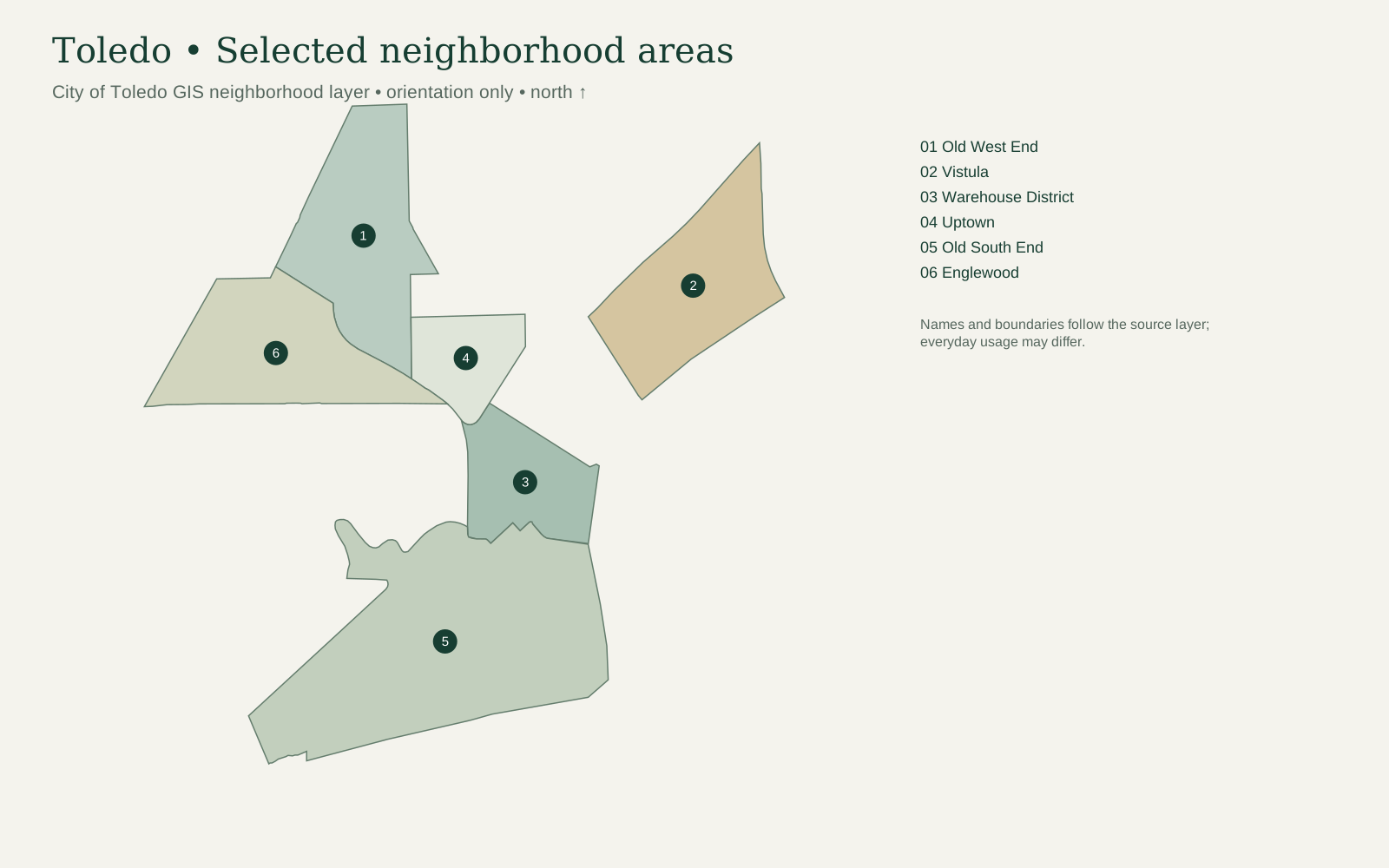
The map uses the city’s neighborhood and community-area GIS for six selected central neighborhoods: Old West End, Vistula, Warehouse District, UpTown, Old South End and Englewood. It is a way to locate the comparisons below, not a complete map of every Toledo neighborhood. These planning areas do not establish historic-review boundaries, school assignment, parcel conditions or a permitted truck route.

Read an address in relation to your real destinations. The University of Toledo directory places Main Campus at 2801 West Bancroft Street and Health Science Campus at 3000 Arlington Avenue. The Lake Erie Center is in Oregon at 6200 Bay Shore Road. A commute or delivery described only as “to the university” can therefore leave the important destination unresolved.

The six area comparisons use city-hosted plans and design guidance. Those documents explain established street patterns and historical land use, while also proposing future improvements. A proposed connection, shop or redevelopment should not be treated as an operating amenity. Visit the current entrance and verify any facility that materially affects your decision.

For each candidate, save the full street address and unit number, property contact, school inquiry, routine travel destinations and likely loading position. This creates a useful comparison even when two homes share the same neighborhood label but have different daily arrangements.

Six selected central Toledo neighborhood areas from the City of Toledo GIS
City of Toledo GIS: six selected central neighborhood areas, not the whole city. Orientation only; not historic-review boundaries, parcel, school, flood-risk or truck-route guidance. Open full-size map.

03 /

Find the area that fits your routine

Compare six central Toledo neighborhoods using city-hosted plans and the selected-area map. This is a starting set, not an exhaustive list or a ranking. Planning dates matter: historical surveys and proposed improvements do not replace a visit to the current property. Confirm its school, services, journey and receiving conditions separately.

Old West End

The city’s 2025 design guidelines describe broad grid streets, mature trees and varied historic houses, including large Queen Anne homes and more modest frame houses. Some larger homes were divided into apartments.

Old West End historic design guidelines ↗
Housing & setting
Look at the actual unit arrangement, porch and stair route; exterior scale does not establish interior clearance.
Daily travel
Test the exact journey from the entrance to your destination and current stop.
Before choosing
Check shared passages and whether proposed exterior work falls within historic-review requirements.

Vistula

The 2020 plan’s field survey describes single-family and duplex homes, multifamily housing toward the edges and south, Summit Street commerce and industrial riverfront areas. These are planning-era conditions.

Vistula neighborhood master plan ↗
Housing & setting
Compare the current building, unit entrance and service arrangements rather than assuming one housing form throughout.
Daily travel
Use the actual Summit corridor stop and direction where relevant, then check the return.
Before choosing
Inspect the immediate surroundings and confirm any advertised improvement; planned projects are not completion evidence.

Warehouse District

The 2022 plan connects the downtown district with venues, the Farmers Market and nearby Middlegrounds. Its study area extends beyond one neighborhood and includes proposals for future connections.

Warehouse District and Middlegrounds master plan ↗
Housing & setting
For a managed or mixed-use property, ask about the unit’s entrance, receiving arrangements and shared facilities.
Daily travel
Check Huron, Broadway and the actual route across or around Swan Creek for your destination.
Before choosing
Confirm loading hours and current access around events; do not infer a reserved bay from a central address.

UpTown

The 2019 plan describes a mix of businesses, social services and educational institutions northwest of downtown, with arts and entertainment activity along Adams Street.

UpTown master plan ↗
Housing & setting
Inspect the specific home or apartment and its relationship to nearby nonresidential uses.
Daily travel
Test the walk, bus connection and destination entrance at the hours you need.
Before choosing
Verify present-day services and the property’s receiving route; the plan is not a current business directory.

Old South End

The 2017 plan describes small single-family homes and Broadway as a commercial spine, with development shaped by the canal and later streetcar connections.

Old South End master plan ↗
Housing & setting
Measure the particular porch, doorway, stairs and any rear or shared access.
Daily travel
Check the current Broadway corridor service and your actual walking route to it.
Before choosing
Confirm the loading side, private maintenance responsibilities and how large items can reach their rooms.

Englewood

The 2022 plan records mainly single-family housing, multifamily uses along North Detroit and Dorr, commerce toward the north and Smith Park as a local open-space anchor.

Englewood community plan ↗
Housing & setting
Compare current property condition and unit layout; proposed land-use changes are separate from the existing home.
Daily travel
Test the specific Dorr or North Detroit journey and current stops; Route 5’s university pattern changed in September 2026.
Before choosing
Check the parcel, services and current access independently of proposed redevelopment or greening in the plan.

04 /

Use citywide figures as context for an individual home

The ACS 2024 five-year housing estimates cover 2020–2024, not today’s listings. About 53.3% of Toledo’s occupied homes are owner-occupied and 46.7% renter-occupied. Estimated median gross rent is $901 a month and median owner-occupied value is $114,500. These are citywide statistical measures with uncertainty, not asking rents, sales quotations or a budget for a particular neighborhood.

Housing measureCitywide estimateUse when comparing a property
Detached single-unit homes65.2% of all housing unitsInspect the actual entry, stairs and private maintenance duties.
Attached single-unit homes3.0%Check shared access and responsibility for adjoining areas.
Two-unit buildings5.3%Confirm the unit entrance, meters and shared spaces.
Three- or four-unit buildings4.4%Ask who controls corridors, waste and receiving hours.
Buildings with five or more units20.0%Check management rules, service arrangements and lift access.
Built before 194031.0%Inspect condition and usable dimensions rather than relying on age alone.

Tenure percentages use occupied homes; structure and age percentages use all housing units, including vacant ones. The figures do not imply that every older home has the same condition, layout or renovation history. Ask for the information relevant to the particular property and use qualified inspections where needed.

For a rental, read who pays water, energy, waste and other charges, and who maintains the steps, sidewalks and shared entrance. Identify whether the unit has separate meters and whether the landlord needs to complete water billing authorization. Confirm the keys, possession date, deposits and move-in instructions with the actual parties rather than treating an advertised availability date as the final arrangement.

For a purchase, coordinate possession and services with closing. A home can have a usable room layout but a difficult receiving route: measure the door, landing, stair turn and ceiling clearance for large furniture. Include any garage, basement or detached space in the access review. If building work is planned, keep construction permission and waste separate from the household move.

Compare the total practical commitment: housing payment, services, routine travel, maintenance and access conditions. A citywide median cannot tell you whether a particular property meets that household budget or gives you the space and journey you need.

Blue sofa, walnut table and branded kraft carton beside an open hallway
Measure the route into a room as well as the room itself.

05 /

Check current routes, payment and the journey home

Begin with TARTA’s route directory and your exact starting and ending stops. Compare the weekday journey with the day and hour you will actually travel. Include the walk to the stop, transfer, destination entrance and return service; proximity to a route is not enough if the last useful trip leaves before your work or appointment finishes.

The September 20, 2026 service change is especially relevant near the university. Route 5 stays on Dorr Street and no longer enters the University of Toledo Transit Center or serves Flower Hospital; the notice directs Flower Hospital riders to Route 2. The Route 5 page still links a June timetable showing the older pattern. Use the newer notice and ask TARTA at 419-243-7433 to confirm your stop and connection if the sources disagree.

For other central journeys, examine the Summit corridor on Route 15 and Front/Broadway corridor on Route 12 where relevant to the address. These are starting points for a route check, not promises that every home in Vistula or Old South End has a nearby usable stop. Check active detours and the direction of travel before walking to a boarding point.

The current fixed-route fare and payment rules list a $1.50 adult single ride with a two-hour transfer. Account-based caps are $3 per day, $15 per week and $45 per 31-day period when using an eligible TARTA card or the specified Tap & Ride method consistently. Ordinary ticket or pass purchases do not automatically contribute in the same way, and Flex and Move trips are outside this cap arrangement. Check the payment method before budgeting a series of trips.

TARTA Flex is a separate zone-based service. The general within-zone fare is $3; crossing between zones adds another $3 under the published rules. Book from 30 minutes ahead to the previous day and confirm capacity and the return. Its suburban and eastern zones do not make every Toledo address a general door-to-door destination. Expanded coverage for riders aged 65 or over and eligible Move customers has additional conditions, including a zone endpoint.

TARTA Move requires an eligibility application and approval. Its posted fare is $3 per trip, with reservations up to seven days ahead and defined service conditions. Confirm eligibility, assistance needs and both legs at 419-382-9901 rather than assuming that a move into Toledo creates immediate access. Public passenger transport is also separate from transporting the household shipment.

For flights, the official Toledo Express Airport site gives 11013 Airport Highway, Swanton. Plan the actual airport connection and current flight itinerary separately from the downtown journey. For any essential first-day commitment, have an alternative that remains usable if the chosen service or connection is unavailable.

White and red city bus with an open passenger door beside a waiting woman
Check the current stop, direction and return journey.

06 /

Complete enrollment, assignment and transportation separately

Start with the child’s residential address, grade and school year. The TPS street-directory page provides the address-based assignment reference and Student Data contact, 419-671-0102. Its 2026–27 directory distinguishes street prefixes, types, odd and even number ranges, and elementary and high-school assignments. Match the whole address and ask the district to resolve uncertainty; a neighborhood name or nearby school is not an assignment.

Next choose the appropriate path from TPS enrollment. New Student Registration covers pupils who have never attended TPS and those returning after not attending the previous school year. Returning Student Registration covers pupils who completed the previous year in TPS, including children progressing from a TPS preschool to kindergarten. Do not create a duplicate new-student record merely because the home address changed.

The kindergarten page links the current flyer: a child must be five on or before September 2, 2026 for the 2026–27 intake. Its March 5 open house is a past event, not a continuing application deadline. The flyer lists a birth certificate, parent photo ID, immunization record, custody papers where applicable and one proof of residence. Examples include a lease or mortgage record and specified bills or address records. Call 419-671-9101 for kindergarten questions and confirm which documents the school needs in your situation.

The new-student instructions walk through a Family Account, household and student information, address and grade, and the zoned-school lookup. The household needs an email address; parents or guardians should agree which account will manage the record. Enter emergency contacts, health information, previous school and other requested details through the district’s designated system, then review the agreements and signature. Keep personal records in that secure channel.

Use the form’s validation and summary before submitting, and save or print the receipt. If records will be brought to the school later, the district’s instructions say registration remains pending until the records arrive. Contact the school about corrections after submission and confirm any missing documents, final assignment and first attendance date. A completed online step is not the same as confirmation that every requirement is satisfied.

The linked PowerSchool entry can redirect to its account sign-in page. If you cannot find the appropriate school-year form, use the TPS instructions and school contact rather than selecting an old example. The public intradistrict-choice example still refers to 2022–23; ask for current eligibility, deadlines and availability if requesting another school. If “No Zoned School” appears, have Student Data check the address and formatting instead of assuming the child is outside the district.

Transportation needs its own confirmation. The K–8 page describes service for eligible pupils living more than one mile from school and uses address and grade for the lookup. The high-school page says pupils ride yellow school buses, not TARTA buses. Confirm the actual stop, pickup time and effective date for the current year; for an IEP-related change, contact the School Assistance Center promptly.

If the household is temporarily staying with others after losing housing or lacks conventional residency documents, ask the district’s McKinney-Vento assistance team about the applicable path. The listed contacts are 419-671-0403 and 419-671-0411. Do not assume missing a standard lease automatically prevents enrollment. Ask the school about language assistance or help uploading records when needed, and keep the first school day separate from the moving truck schedule.

07 /

Establish ownership, billing responsibility and actual activation

Create a service list for the property: water and sewer, electricity, any gas service, internet and services arranged through a landlord or association. For each, record the provider, responsible account holder, requested date and actual confirmation. Check existing bills or the property owner for provider identity; the city name does not by itself establish the service territory or whether an account is included in rent.

Toledo’s water customer-service guidance says the city contracts with the deed holder. A buyer should check outstanding charges or liens before closing. The new-service instructions direct the owner to apply after closing with ownership evidence, including the Lucas County Auditor’s record. A vacant property still needs the appropriate account, including applicable storm-water charges. Contact 419-245-1800 to resolve account questions.

If physical water turn-on is needed, arrange it separately from the online application. The city describes a mutually agreed appointment at least 24 business hours later, with an adult present or another agreed way to reach the inside meter. The mailed contract must be signed and returned with photo identification within 14 business days under the published instructions. Confirm what is needed for the specific property and keep the visit and paperwork deadlines visible.

For rentals, the landlord–tenant agent authorization can direct bills to the tenant as the owner’s agent, but the owner remains liable. The form requires the relevant signatures and owner identification, and a new form is needed for a new tenant. Agree responsibility in the lease and ask the owner to complete the city’s process. Paying a bill or receiving mail does not itself transfer the city contract into an unrelated tenant account.

The central customer-service page says all customers are billed monthly, while the new-service page retains older quarterly wording. Use the current account confirmation for the first bill and billing dates rather than planning from that older passage. At handover, record the agreed service responsibility and any meter information the provider asks for without assuming it replaces an account change.

Where the property is served by Toledo Edison, use FirstEnergy’s start, stop or move process. It may require at least two business days, allows requests up to 90 days ahead and says move requests are unavailable on weekends and holidays. Its email confirms whether the requested turn-on date can be met. Toledo Edison customer service is 1-800-447-3333. Confirm the old stop and new start separately when an overlap is needed.

Where Columbia Gas serves the property, its start, stop or move page asks for account or identity information, addresses and effective dates. The online guidance requests at least one business day of notice; its customer brochure recommends applying preferably 48 hours ahead. Neither is a guarantee of physical activation. Apply early, confirm any access appointment and check supplier or billing-program enrollment: Customer Choice participation ends at the old address when that service is cancelled.

Keep essential services active through the period when the home is occupied or needs protection. Arrange internet installation for a time when someone can provide access, and keep a workable connection for urgent work if installation is pending. A submitted request belongs in the arrival record as pending until the provider confirms the effective arrangement.

08 /

Use the current bulk rules and a separate packaging plan

Confirm that the property uses the city’s residential collection arrangement and identify its day and container responsibility. The Toledo trash and recycling page describes weekly trash in the gray container and recycling in the blue container every other week. Bag ordinary trash, set containers out the night before collection and bring them back promptly. A managed building may have a different arrangement that the landlord needs to explain.

Bulk pickup changed on January 5, 2026. The city now lists up to five bulk items or bundles each week, on the regular trash day, without scheduling. Each must weigh under 40 pounds. The former monthly scheduled program ended in December 2025; do not rely on that older appointment process.

Preparation still matters. Bag loose rubbish; bundle branches, wood and rugs within the listed 3-by-4-foot dimensions; flatten or remove protruding nails. Mattresses must be bagged or wrapped. That instruction does not waive the weight limit, and many mattresses or large pieces will need another arrangement. The city does not collect from the alley side under these rules. Ask Republic Services at 419-936-2511 about the exact item before leaving it outside.

The excess-waste guidance treats a large move-out, cleanout or renovation as a separate disposal job when it exceeds residential limits. Arrange an appropriate hauler or dumpster and confirm placement permission. Do not split an unsafe or ineligible item into an improvised curb pile or assume a moving company’s service automatically includes municipal disposal.

Hoffman Road Landfill at 3962 Hoffman Road lists household furniture and mattresses among its accepted materials. Confirm current hours, charges, item restrictions and residency evidence at 419-936-3077 before loading a vehicle. The city pages differ in the proof described for special free-disposal opportunities, so bring the requested evidence and verify eligibility. Be prepared to unload your own vehicle; a free event is not an everyday unrestricted disposal service.

For the packing materials, Lucas County recycling guidance accepts clean, dry flattened cardboard and the listed paper, container, glass and carton categories. Keep plastic bags and film out of the curbside recycling bin and do not bag the recyclables. Food, textiles and electronics use other routes. Separate clean reusable cartons from damp or contaminated material as you unpack.

The Clean Toledo Recycling Center opened in June 2026 at 3900 Creekside Avenue. Its published hours are Tuesday–Saturday, 8:30 a.m.–4:30 p.m., with proof of Toledo residency and self-unloading. Consult the specific acceptance list for cardboard, electronics, scrap metal and other items. It is not a substitute for unlimited household rubbish, hazardous waste or appliances containing refrigerant. Plan disposal before the old property’s handover date.

09 /

Follow the meter request and classify other street uses

Start with a photograph or marked map of the proposed position: exact address, street side, meter numbers if present, date, time, vehicle dimensions and unloading side. Trace the carry from that position to the property. Identify driveways, crossings, bus stops, hydrants and pedestrian access so the request describes the actual arrangement rather than a general wish to park nearby.

For metered spaces, ParkSmart’s meter-bag form includes “Moving Truck” as a purpose. Its embedded map helps identify the meter numbers, which the form requests one per line. Supply the location, requested date range and company and contact details. The form also lists dumpsters and construction, but those options do not mean the rules for those activities are interchangeable.

Before relying on the request, ask ParkSmart at 419-242-7515 to confirm the exact spaces, availability, lead time, charge, approval and any bagging or posting arrangement. Establish who installs any controls and when they become effective, what proof to keep, and whom to contact if a vehicle remains in the space. The public form does not itself publish a complete fee or posting timetable.

The meter page lists Monday–Friday, 8 a.m.–6 p.m. metered hours and a two-hour parking limit. Ordinary payment covers the applicable parking session; it does not reserve a truck-length space, authorize a lane blockage or override a posted restriction. Do not use your own cones or signs as evidence that a public position has been approved.

For an unmetered curb, sidewalk obstruction, traffic-lane use or storage container, ask Toledo Traffic Management to identify the appropriate permission for that use. The contact in its current permit packet is 419-245-1300. Explain whether the object is a vehicle actively loading, a container remaining overnight or a construction installation. Ask what pedestrian route and traffic controls are required, who provides them and whether another department must approve the placement.

The 2026 right-of-way opening form is a construction and utility packet. Its deposit, excavation charges and seven-business-day lane-closure notice should not be assumed to apply to every household loading request. Similarly, a petition to change block parking restrictions is not a temporary moving reservation. Choosing a form with the wrong scope can leave the intended use unresolved.

The carrier should also check the actual vehicle and route against Toledo’s heavy-hauling and truck-route guidance where applicable. An oversize or route-deviation permit is separate from a meter bag. Before delivery, share the written conditions with the mover and building contact. If the position is unavailable, confirm a lawful alternative, its carry distance and any revised time or cost before the truck attempts to use it.

10 /

Connect the street arrangement to the receiving room

Walk the full route before the inventory is finalized. Start at the permitted unloading position and inspect the surface, slope, gate, steps, landing, door, corridor, stair turns or lift, and destination room. Measure the narrowest usable point with doors in their actual operating positions. Photograph changes of direction and low overhead features, not just the front of the building.

Ask who controls each part of the route. In a shared house, one tenant may not be able to authorize a common passage or a temporary door change. In a managed building, a reserved lift can still be unavailable until someone supplies a key, protection or access release. Confirm capacity and dimensions, shared use, loading hours and the person who handles a delay.

Obtain building-specific instructions for certificates, approved entrances, protective materials and any union or contractor requirements. These are questions for the property, not a citywide assumption. For each charge, identify what it covers, who imposes it and how it is paid. Tell the mover about conditions that change staffing, timing or the carrying route.

If the receiving slot is short, agree which packing and preparation can happen earlier. Keep the actual carrying within the permitted window and identify a fallback if the preceding user runs late. Do not assume the customer entrance, passenger lift or a neighbor’s driveway is available simply because it looks convenient.

Check the route again close to arrival for maintenance work, parked vehicles, ice or changed access. Keep one reachable contact with authority to approve the receiving instructions. A workable route needs both physical clearance and permission to use it.

11 /

Try the week you expect to live

Test the journeys that recur: groceries, school, work, appointments and outdoor space. Start from the actual doorway and use the intended transport at a representative time. Check the crossing, pavement, stop location and destination entrance rather than measuring only a straight-line distance on a map.

The Warehouse District plan identifies the market, downtown venues and Middlegrounds as important anchors, while the UpTown plan describes a mix of institutions, services and activity around Adams Street. Those planning descriptions help orient a visit; they do not confirm today’s opening hours or the completion of every proposed connection. Check the facilities you personally need.

For a campus household, use the relevant building in the university directory and obtain its current receiving instructions. For a household relying on public transport, test the return journey with groceries or the belongings you normally carry. Consider whether the walk and entrance remain usable in rain or winter.

Keep the first few days practical. Have medicines, basic food, chargers, necessary documents and a suitable place for children and pets available independently of unpacking. This lets the household function while cartons are still being sorted and service appointments are being completed.

Man sitting beside a riverside path with another person walking behind him
Try the ordinary journeys and entrances your household needs.

12 /

Confirm the live restriction and clear the private approach

The city’s snow-removal guidance prioritizes main arteries, emergency facilities and bus routes before residential streets. It describes different treatment for residential roads and does not promise that every side street will be cleared by a particular receiving time. Inspect the actual approach rather than inferring its condition from a major road.

The Safety Director may activate a parking ban on snow-emergency or bus routes. Check current city instructions and the signs on the proposed loading street; this is not a standing ban on every Toledo street whenever snow falls. Coordinate any changed position with the authority and mover before relying on it.

Property owners are responsible for keeping sidewalks safe under the city’s guidance, and snow must not be pushed into the road. Agree who clears the driveway, sidewalk, steps and landing, including a final check before arrival. Keep drainage and door openings usable during rain or thaw conditions, and tell the mover if the approach changes.

TARTA’s Level 3 snow plan may keep fixed-route and Flex service operating with delays and altered Hub boarding, while Move is limited to medical-emergency trips. Bus operation is not permission for unrestricted private driving. Check current emergency instructions and the actual service before an essential journey.

If weather prevents lawful or usable access, identify the decision time, property contact and confirmed alternative receiving window. Include the household’s accommodation, pets and essential services in that decision. Avoid treating an unconfirmed later slot as a complete fallback.

Cleared path and brick steps leading to a green door after light snow
Check the private approach before the receiving window.

13 /

Bring the confirmations together before delivery

Review the arrival record before the final packing day. Confirm possession and keys, the permitted entrance and truck position, the inventory, receiving hours, essential utilities and the people who can make decisions. Keep school enrollment, transport and waste arrangements visible as separate tasks rather than assuming they follow automatically from the address change.

Mark what is confirmed, what is requested and what remains unresolved. Set a decision deadline for any dependency that could stop delivery: a closing, a property handover, street approval or an unavailable lift. Tell the mover about changes early enough to discuss a realistic alternative.

If this happensDecision ownerConfirm before relying on Plan B
Keys or possession are delayedHousehold and property contactNew access time, suitable accommodation and any real storage arrangement.
The loading position is unavailableStreet authority, property contact and moverLawful alternative, carrying route, time and revised work or cost.
A required service is not activeAccount holder and providerConfirmed activation, technician access and household needs during the gap.
The receiving window cannot be usedBuilding contact and authorized customerAnother approved window and the conditions for resuming delivery.

Give each fallback a trigger, a person who may approve it and a time by which the decision must be made. Check the people, pets, extra handling and costs as well as the belongings. An unbooked storage unit, an assumed later lift slot or a space someone might leave at the curb is not yet a confirmed alternative.

On arrival, inspect the agreed route, explain room labels and keep one reachable receiving contact. Record any changed instruction with the moving documents. Use the Toledo moving page to bring the inventory, services and access questions into the estimate discussion.

14 /

Questions before you arrive

Does the neighborhood name establish my school and services?

No. Confirm the municipality, school assignment and provider for the full residential address and unit. Mailing names and planning areas do not settle those responsibilities.

Can a tenant put Toledo water service entirely in their own name?

The city contracts with the deed holder. Its tenant-agent form can direct bills to a tenant, while the owner remains liable. Coordinate the current authorization and lease responsibilities.

Do I still schedule a monthly bulk pickup?

The current city program changed in January 2026 to weekly pickup without scheduling, limited to five eligible items or bundles, each under 40 pounds. Confirm overweight items separately.

Does wrapping a mattress make it eligible regardless of weight?

No. The wrapping instruction does not remove the under-40-pound condition. Ask Republic Services about the particular mattress or arrange another approved disposal route.

Is the June Route 5 PDF enough for a university journey?

Use the September 20 service notice as well. It removes the UT Transit Center deviation and Flower Hospital service from Route 5. Confirm current stops and connections.

Is a submitted school registration the final enrollment confirmation?

The school reviews the record and documents. Save the receipt and confirm outstanding requirements, assignment, first attendance date and transport separately.

Where do I turn the address checks into a moving estimate?

Use the Toledo moving page with the inventory, entrance photographs, building instructions, confirmed loading position and any unresolved dependency.

Your next step

Bring the plan together

Use the Toledo moving page to prepare the inventory, access details and questions for your estimate.

Sources & useful local resources

Official procedures and local resources are linked beside the answers above. Reopen the relevant page when arranging a date: fees, schedules and application requirements can change.

Maps, housing and neighborhood comparisons

City services and move preparation

Loading and street use

Transport and daily journeys

Household service providers

Schools and family preparation