New Jersey / City relocation guide

Moving to Toms River

Toms River is a large owner-majority township at the Jersey Shore — mainland suburbs, a downtown county seat, and a stretch of the barrier island. This guide helps you compare areas, plan the everyday basics and prepare the practical steps of arriving.

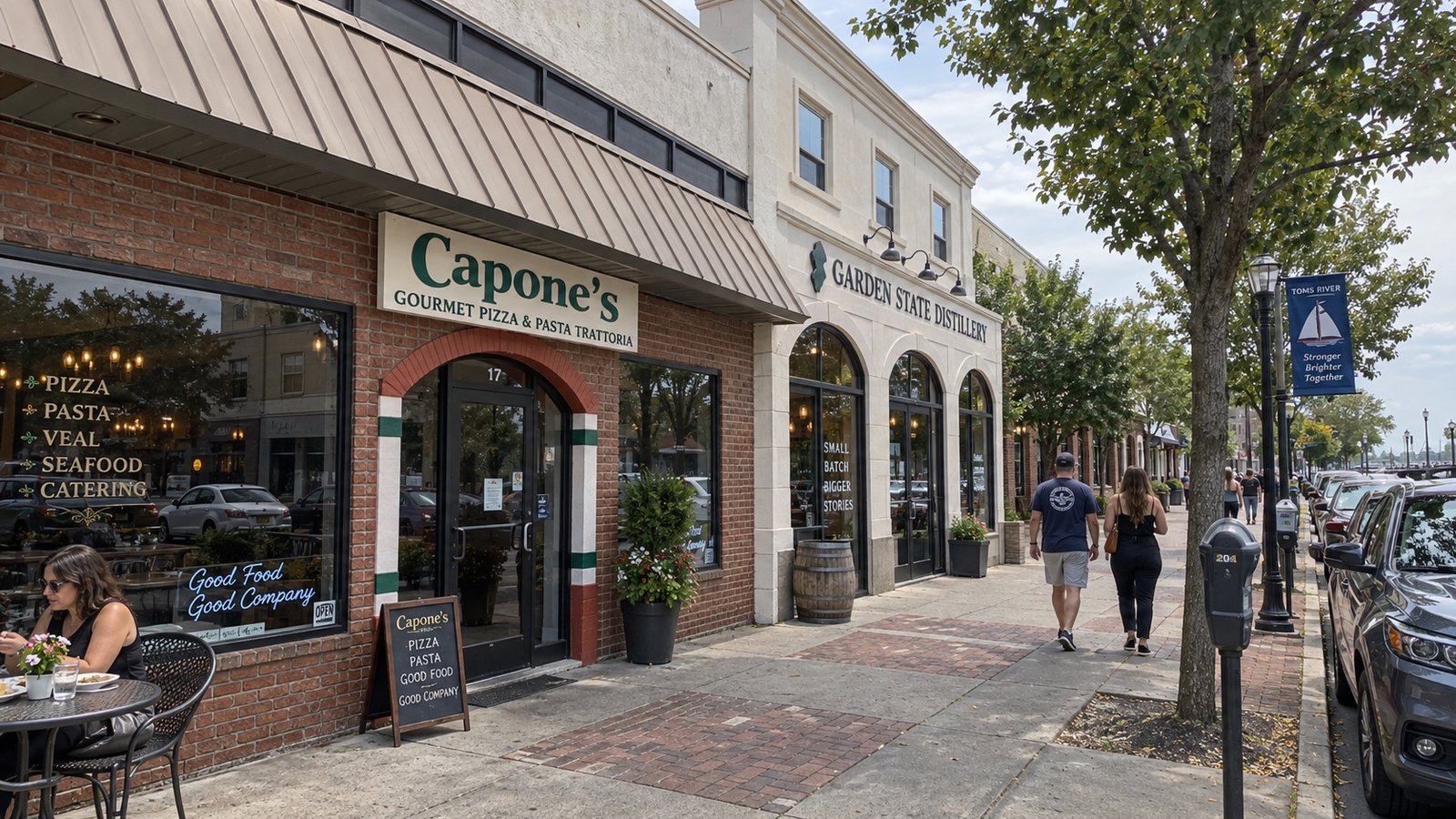
A small main-street storefront row with a few pedestrians and parked cars.
Try the everyday errands around a new address, not only the journey to work.

01 /

Start with the decision in front of you

Toms River asks three different questions of a newcomer, and this guide is organized around them. If you are still choosing where to live, start with the orientation and the neighborhood comparison, then read the housing section — this is an owner-majority township of single-family homes, and the differences that matter are driveway and garage space, flood zones near the water, and association rules in the planned communities. If you are moving with children, read the schools section early: Toms River Regional Schools assigns by home school and central registration, and kindergarten registration for the coming year opens months ahead. If the address is already decided, the second half of the guide walks through the practical setup — utilities, waste collection, the truck position, building access and the arrival sequence.

One caution before any comparison: Toms River is a township, and its boundaries do not follow the names people use. The school district also serves Beachwood, Pine Beach and South Toms River; mailing addresses and neighborhood names cross municipal lines. Verify the municipality of each address before applying any rule in this guide.

02 /

Understand Toms River before comparing addresses

Toms River is a township in Ocean County, not a city — procedures in this guide belong to Toms River Township. The township is the county's government center: the Ocean County administration building stands at 101 Hooper Avenue, Toms River. The township's own code still records the earlier name in its text — "the Township of Dover (now Toms River)" (Chapter 1, archived copy) — but the current official name is the Township of Toms River, and that is the name on every current procedure.

Geographically the township has three distinct parts. The mainland holds most of the population in suburban neighborhoods along corridors like Hooper Avenue and Fischer Boulevard. Downtown, along Main Street near the county offices, is a designated business improvement district with its own Downtown Toms River organization. And east across Barnegat Bay, the township includes a section of the barrier island — Ortley Beach, between Lavallette and Seaside Heights — plus Pelican Island, which the township's own beaches page and sanitation schedule treat as part of its service area. Surrounding communities — Beachwood, Pine Beach, South Toms River, Island Heights, Lavallette, Seaside Heights, Berkeley, Manchester, Brick, Lakewood — are separate municipalities with separate rules.

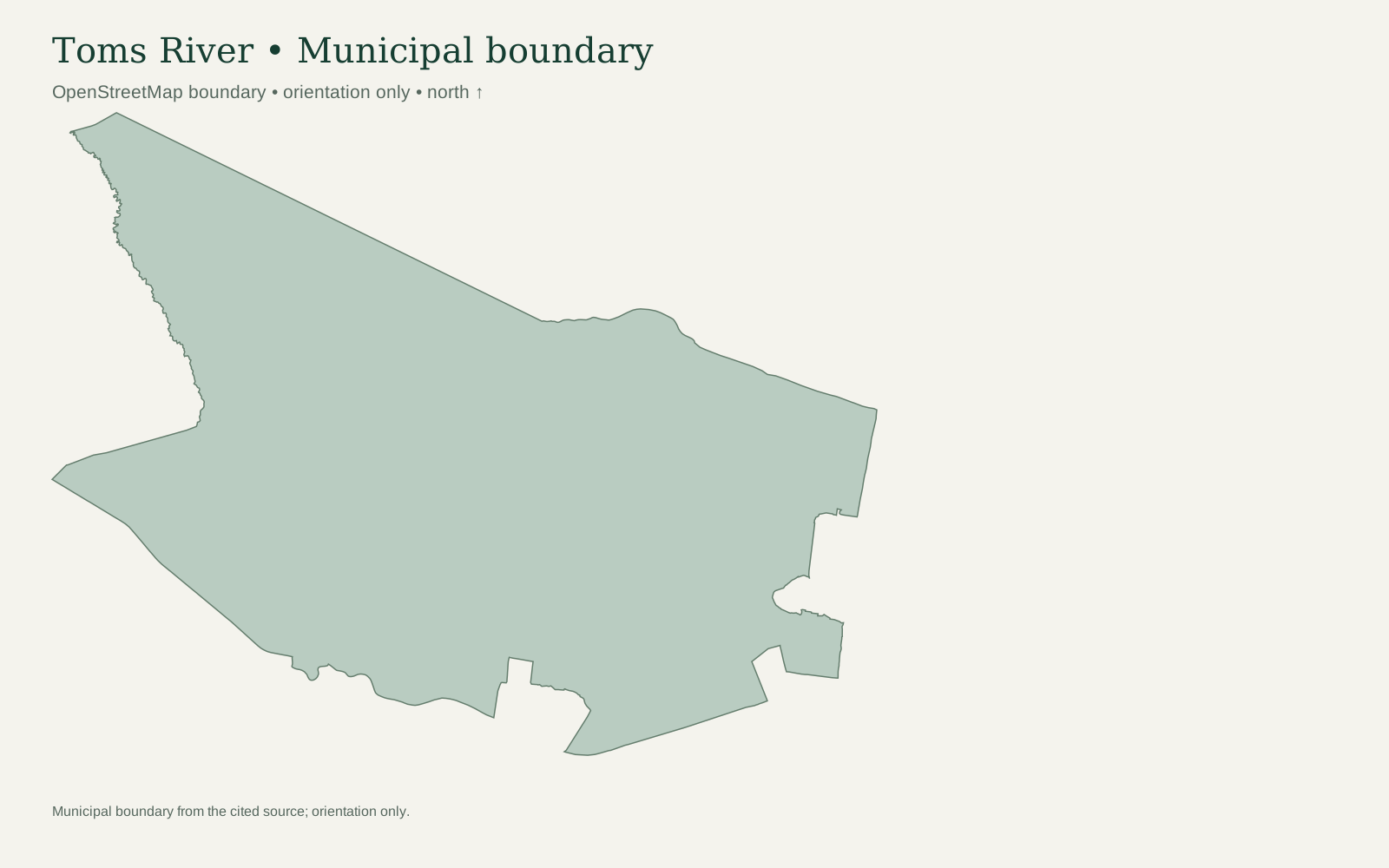
For a mover, the practical consequence is that "Toms River" describes a big, varied place: an address can be a mainland subdivision, a downtown apartment over a shop, an adult community, or a barrier-island beach house. The map below shows the municipal boundary; the sections that follow explain what changes from one kind of address to another.

Toms-River orientation map with numbered area key
Use the numbered key to locate the areas discussed below. Open full-size map.

03 /

Find the area that fits your routine

Toms River is one township with very different kinds of addresses — a downtown business district, mainland subdivisions, planned and adult communities, waterfront lagoons, and a barrier-island shore strip. The six modules below are starting points for inspection, not rankings: verify the municipality, the flood zone and the association rules for the specific address.

Downtown Toms River

The township's traditional center along Main Street: a designated business improvement district with shops, restaurants and events, next to the Ocean County government buildings on Hooper Avenue.

Downtown Toms River Business Improvement District ↗
Housing & setting
The most urban housing in the township — apartments and mixed-use buildings near Main Street rather than subdivisions. Expect managed buildings with written move-in rules.
Daily travel
The township's best transit position: NJ Transit bus 137 serves the township toward New York, and the county offices make this the local employment hub.
Before choosing
Confirm the building's moving rules and where a truck may stand on Main Street and side streets; downtown curb space is shared with shoppers and county workers.
Ortley Beach (Dover Beaches South)

The township's ocean beach community on the barrier island, between Lavallette and Seaside Heights: the township's beaches page describes a half-mile guarded beach between 3rd and Harding Avenues, with badges required in season.

Toms River Township Beaches ↗
Housing & setting
Shore houses on tight island streets, many used seasonally; ground-level contents and flood zones are real considerations here.
Daily travel
Reached over the bay from the mainland; summer weekend traffic is part of island life, and NJ Transit's rail and 137 bus both stay on the mainland.
Before choosing
Look up the flood zone on the township GIS before signing; confirm where a truck can stage on narrow summer streets; note that water service here is New Jersey American Water, not the mainland utility.

Pelican Island

A small barrier-island section of the township south of Ortley Beach, named in the township's sanitation schedule, which doubles its garbage collection in summer just like the rest of the island.

Sanitation Division: barrier-island summer schedule ↗
Housing & setting
Seasonal and year-round shore homes; the twice-weekly summer collection shows how sharply the population swings.
Daily travel
Island access depends on the same bay crossings as Ortley Beach; plan arrival and moving-day timing around summer shore traffic.
Before choosing
Same island checklist: flood zone lookup, truck staging plan for narrow streets, and the summer collection schedule for your first weeks.

Planned and adult communities

Much of the township's suburban stock sits in named planned developments — the township code keeps individual traffic articles for communities such as The Cedars at Dover, Friendly Village at Riverwood, Lake Ridge Homes and the Fairways at Bey Lea, many of them age-restricted or association-governed.

Township code Chapter 477: named community traffic articles (archived) ↗
Housing & setting
Single-family houses, townhouses and condominiums behind association rules; well-kept common areas with written standards for residents and vendors.
Daily travel
Car-based, on the township's western and southern corridors; check which roads inside the community are private.
Before choosing
Get the association's moving rules in writing — windows, truck position, certificate of insurance — before booking a date; private roads mean the association, not the township, answers staging questions.

Mainland neighborhoods

The suburban heart of the township: postwar single-family subdivisions along Hooper Avenue, Fischer Boulevard and the Route 9 corridor. Census data shows a township of homeowners — about 82% owner-occupied, with roughly 78% of all units detached single-family houses.

Toms River township profile, ACS 2024 5-year (Census Reporter) ↗
Housing & setting
Detached houses with driveways, garages, basements and yards; splits, ranches and colonials rather than rowhouses or towers.
Daily travel
Car-first; NJ Transit bus 137 is the main transit option, and school runs and errands follow the county-road corridors.
Before choosing
Measure driveway length and garage openings; ask who clears the sidewalk after snow (the owner or tenant owes it within 12 daylight hours); confirm your trash and recycling days by address.

Waterfront and lagoon neighborhoods

Homes along Barnegat Bay, the Toms River and the lagoon networks — the reason the township runs a full floodplain management program, participates in FEMA's Community Rating System and offers residents flood-zone determinations.

Toms River Township Floodplain Management ↗
Housing & setting
Waterfront houses with decks, docks and bulkheads; raised entries are common, and ground-level space decisions carry flood consequences.
Daily travel
Car-based, on bay-side streets that can flood in coastal storms; know your route off the water in a storm watch.
Before choosing
Check the flood zone and base flood elevation on the township GIS before signing; ask about flood insurance and the township's CRS discount; plan what furniture and storage stay above ground level.

04 /

Compare the whole home, not just the advertised payment

Toms River is an owner's township: 82.1% of occupied homes are owner-occupied and 17.9% rented (ACS 2024 5-year, via Census Reporter). The median gross rent is $1,726 a month and the median owner-occupied value $416,700 — medians describe the whole township at once, not the house in front of you, and shore-area prices diverge from mainland ones. Use the figures only to sanity-check a budget.

The stock explains the market. Of about 46,500 housing units, roughly 78% are detached single-family houses, and only about 2.6% of units were built before 1940 — this is a postwar suburb, not a prewar city. Rentals exist but are a minority: garden apartments, condominiums, downtown units and seasonal shore rentals. The township also has a large stock of planned and adult communities; its code dedicates individual traffic articles to developments such as The Cedars at Dover, Friendly Village at Riverwood, Lake Ridge Homes and the Fairways at Bey Lea (archived chapter list), which tells you how much of the housing sits behind association rules.

When comparing two homes, compare what the payment includes, the association or lease move-in rules, and the physical route for your furniture — driveway length, garage width, deck stairs, split-level half-flights. Near the water, add one more check: look up the flood zone on the township's interactive GIS before signing, because it affects insurance, storage decisions and what you keep at ground level.

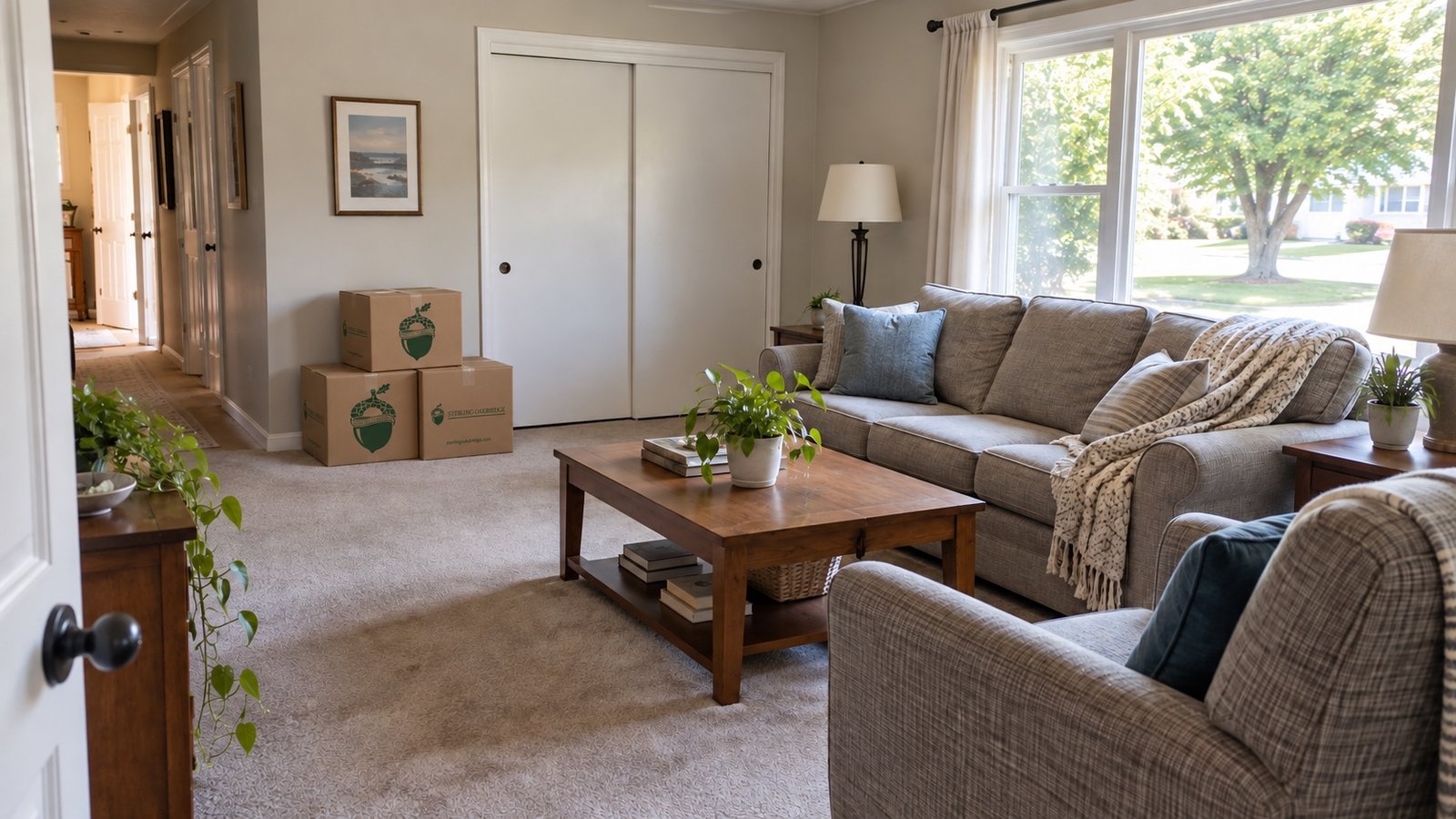
A furnished living room in a suburban house with sealed moving boxes stacked by the wall.
Compare usable rooms, garage and basement storage, and what the payment actually includes.

05 /

Test the complete daily journey

Toms River is a car-first township, and most households will stay that way: the housing is spread across suburban corridors, and there is no passenger rail station in the township. The transit that exists is real but thin. NJ Transit's bus 137, "Toms River – New York", links the township with New York City. The nearest rail is Bay Head station, in the borough just northeast of the township, at the southern end of the North Jersey Coast Line (schedule archived from NJ Transit): trains run between Bay Head and New York Penn Station, some requiring a change at Long Branch.

Driving is structured by road ownership, which also decides who answers a moving-truck question. The township's Road Division lists state highways Route 9, Route 37, Route 70 and Route 166 as maintained by the state (609-588-6212), and Routes 571 and 537, Hooper Avenue and Fischer Boulevard as Ocean County roads (732-929-2133); the other ~2,104 streets are the township's. Test the exact door-to-door routine from a candidate address — the commute, the grocery run, the school run — at the hours you would actually travel, including a summer Friday if you are considering the barrier island.

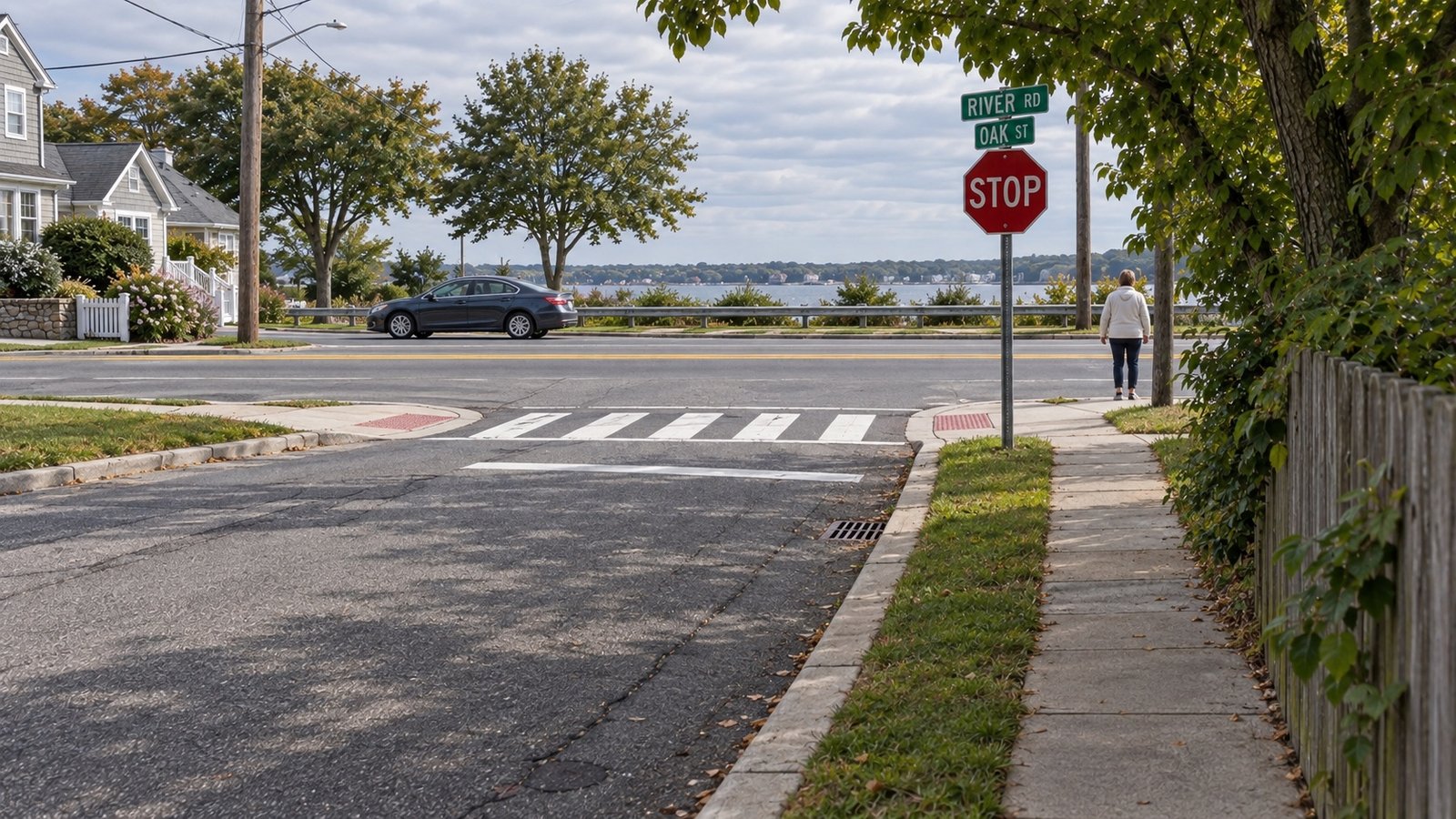
A suburban T-junction beside the water with a stop sign, pedestrian crossing and passing car.
Test the complete daily journey, including the walk at both ends.

06 /

Register through one central office

Toms River Regional Schools is a regional district: it serves children from Toms River, Beachwood, Pine Beach and South Toms River, with three high schools, three intermediate schools and a dozen elementary schools. Registration runs through one Central Registration office at 1245 Old Freehold Road (732-505-2600), and the district strongly encourages its online registration portal.

Assignment is address-based: the district's registration notices refer to "assigned home schools," and for 2026-2027 kindergarten it deferred all placement requests until mid-August, telling families to plan for the home school unless notified. It has also closed enrollment for babysitting- and daycare-address students at three elementaries — Hooper Avenue, Cedar Grove and East Dover — citing capacity. Two practical consequences: do not assume a preferred school, and register early.

For registration itself, gather documents before you start: an original photo ID for the registering parent, the child's original birth certificate with raised seal (kindergarten requires age 5 by October 1, "no exceptions"), and the residency proofs itemized in the district's checklist — four documents if you own, lease or rent in one of the four sending towns. Health forms are printed from the registration page and submitted to the school after registration. If you move within the district later, the address-change form is on the same page.

07 /

Assign an owner and a start date to each household service

Electricity is Jersey Central Power & Light — the township's own road page directs streetlight problems to JCP&L, and the utility's FirstEnergy page is the starting point for service requests. Natural gas is New Jersey Natural Gas, whose service territory covers Ocean County. Its start-service page asks you to submit the request at least 10 business days before your move-in date, notes a $15 account-opening charge, and warns that a security deposit may be required — first-time customers can waive it with a utility credit reference from the past year. Treat the 10-business-day lead as the binding constraint on your utility calendar.

Water and sewer split by location, and the township's Road Division publishes the contact list: Toms River Municipal Utilities Authority (732-240-3500) handles sewer; Veolia Water (732-349-0227) serves the mainland water system; and New Jersey American Water (1-800-987-5325) serves the barrier-island area. Confirm which water utility serves your exact address before opening an account — mainland and island differ.

For internet and cable, availability is address-specific; ask the seller, landlord or association which providers already serve the building, and book installation before the move rather than from an empty house.

08 /

Plan for weekly collection and the things you are leaving behind

Toms River Township collects garbage and recycling itself. Garbage is weekly on the mainland; the barrier island, including Pelican Island, gets twice-a-week collection from the week before Memorial Day to Labor Day. Recycling is every other week on eight area routes, and the address-based Recycle Coach lookup on the Public Works page tells you your day. Thirteen holidays shift the schedule, and containers follow rules the Sanitation Division lists: out by 6:30 a.m., in by 9 p.m., cans no larger than 35 gallons and no heavier than 50 pounds in non-automated areas, and recyclables never bagged.

The rule that surprises movers: the township allows one bulk collection per month, requested by phone at 732-255-1000, with furniture, mattresses and carpet (cut to four-foot rolls) set out by 6:30 a.m. the day after your normal collection — and it states plainly that it does not pick up move-outs or excessive volumes, directing larger amounts to private removal services. Metal appliances go on a separate metal list (ext. 8170), and refrigerators must have Freon removed by a licensed company first.

What you are leavingHow it goes out
Furniture, mattresses, carpetMonthly bulk pickup by phone request; carpet in four-foot tied rolls under 50 lbs
Appliances and metal itemsSeparate metal pickup list; Freon-certified sticker required on cooling appliances
Overflow recycling and small debrisRecycling Convenience Center, 1672 Church Road, Monday–Saturday 7:30 a.m.–3 p.m.; construction debris limited to two 35-gallon containers twice a month
Large renovation or cleanout loadsOcean County Landfill on Route 70 in Manchester Township, via resident, contractor or licensed hauler

Whatever the item, a curb pile on moving day is not a legal disposal route in Toms River — the Recycling Division and Sanitation pages are the operating manual for your first weeks.

09 /

Arrange a legal place for the moving truck

Toms River has no moving-truck permit program to apply for. We walked the official chain — the Municipal Clerk's permit forms, the Public Works pages, and the township code — and the honest answer is a decision path, not a form. Step one: use private property. Most township homes have driveways, and a truck on the driveway needs no street arrangement at all. Step two: if the truck must stage on the street, identify the road owner from the Road Division's own split — township streets (Road Division, 732-255-1000, or the police Traffic Safety Unit), county roads like Hooper Avenue and Fischer Boulevard (Ocean County Road Department, 732-929-2133), and state highways like Routes 9, 37, 70 and 166 (NJDOT, 609-588-6212). Call the owner of your street before moving day if staging is unavoidable.

Step three: respect the standing restrictions. The township code prohibits parking a commercial motor vehicle of four tons gross vehicle weight or more between 9 p.m. and 6 a.m. on streets listed in its Schedule V (§ 477-12, archived copy — the live code site blocks automated reads, so confirm the current schedule with the township). A moving truck that loads and leaves within the day avoids the question entirely; overnight street staging does not.

Two local adjustments. In planned and adult communities the roads may be private and the association is the road owner — get its written rules instead. On the barrier island in summer, streets are tighter and traffic heavier; a smaller vehicle, an early start and a confirmed driveway position matter more there than anywhere else in the township.

10 /

Inspect the full route through the property

For most Toms River homes, access is a driveway question: length, slope, overhanging trees, and the path from garage or front door to the truck position. Measure the large pieces against the actual route — garage doors are often the widest opening but not always the most direct. Waterfront and lagoon homes add deck stairs, bulkheads and raised entries; split-levels add half-flights with turns. Walk the route with a tape measure before moving day.

In the township's planned, condominium and adult communities, access is a paperwork question: many associations set moving windows, restrict where a truck may stand, or require a certificate of insurance from the mover. Ask the association or property manager for the written rules as soon as the date is set, and share them with us. If the home sits in a flood zone — check the township's GIS lookup — decide what lives at ground level before the move, not after.

Whichever type, confirm both ends together: where the truck stops, which door is used, every stair and landing between the truck and the room, and who unlocks what. A plan that works at the origin but not the destination is only half a plan.

11 /

Build a useful routine beyond the commute

Toms River's everyday geography follows its corridors and its water. Downtown Toms River, the designated business improvement district along Main Street, holds shops, restaurants and events near the county offices. Shopping clusters along Route 37 and Hooper Avenue. The township's park system runs from bayfront beaches to golf courses, and its recreation department publishes the facility list.

The shore is the township's signature amenity, and it runs on badges. The township's beaches page describes its ocean beach at Ortley Beach (Dover Beaches South), a half-mile between 3rd and Harding Avenues on the barrier island, plus Shelter Cove Beach on the mainland bayfront; guarded beaches end September 1, and seasonal badges or daily passes are required in season. Test the routine you will actually live — the grocery run, the pharmacy, the school route, a summer trip to the beach from the address you are considering — at the hours you would use it.

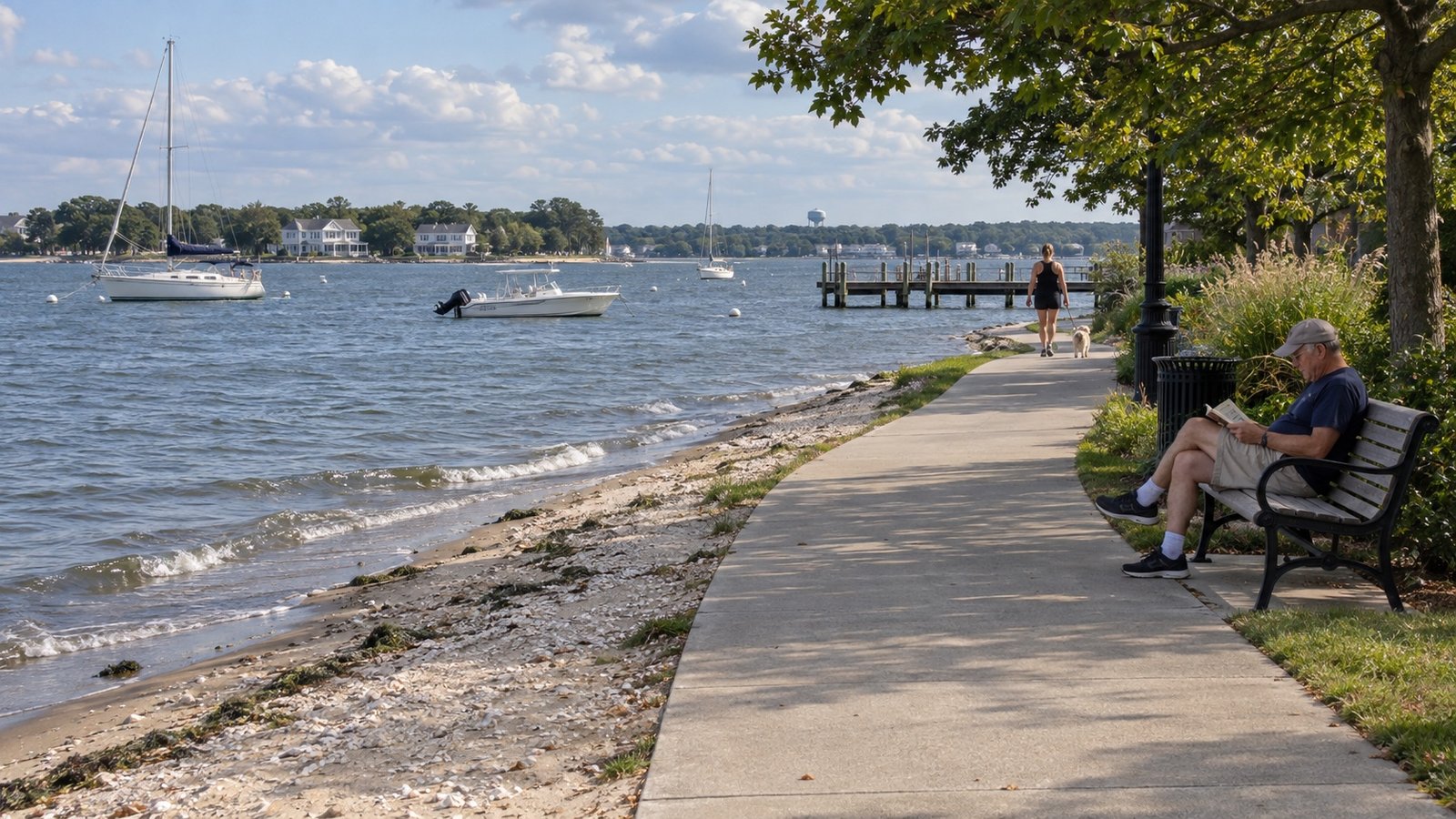
A bayfront promenade with benches, calm water and low buildings across the shore.
Check the outdoor routine around the address you actually choose.

12 /

Plan for the season in which you will live and move

Summer is the township's defining season. From the week before Memorial Day to Labor Day, the Sanitation Division doubles garbage collection on the barrier island and Pelican Island and moves island recycling to every Friday — municipal confirmation that the island population swells in season. Beach badges are checked at Ortley Beach and Shelter Cove, guarded beaches close after September 1, and shore traffic peaks on summer weekends. A July move to Ortley Beach is a different job from a November move to the mainland; book early and plan the truck position street by street.

Storm season overlaps the shore season. The township's Floodplain Management program exists because, in its words, "a coastal storm is always a possibility"; the township participates in FEMA's Community Rating System, maintains a floodplain ordinance, and offers residents flood-zone determinations and floodproofing advice. If your date falls in late summer or fall, watch forecasts in the final week and know your address's flood zone.

Winter's rule is snow. The Road Division asks residents to keep vehicles off township streets before snow accumulation so plows can work curb to curb, and warns that plows are not lifted for driveways — clearing your own driveway opening after the plow passes is the homeowner's job. Sidewalks abutting your property must be cleared within 12 hours of daylight after snowfall ends; fines start at $100 for a first offense (§ 450-4 and § 450-5, archived copy). If you rent, check the lease for who actually shovels.

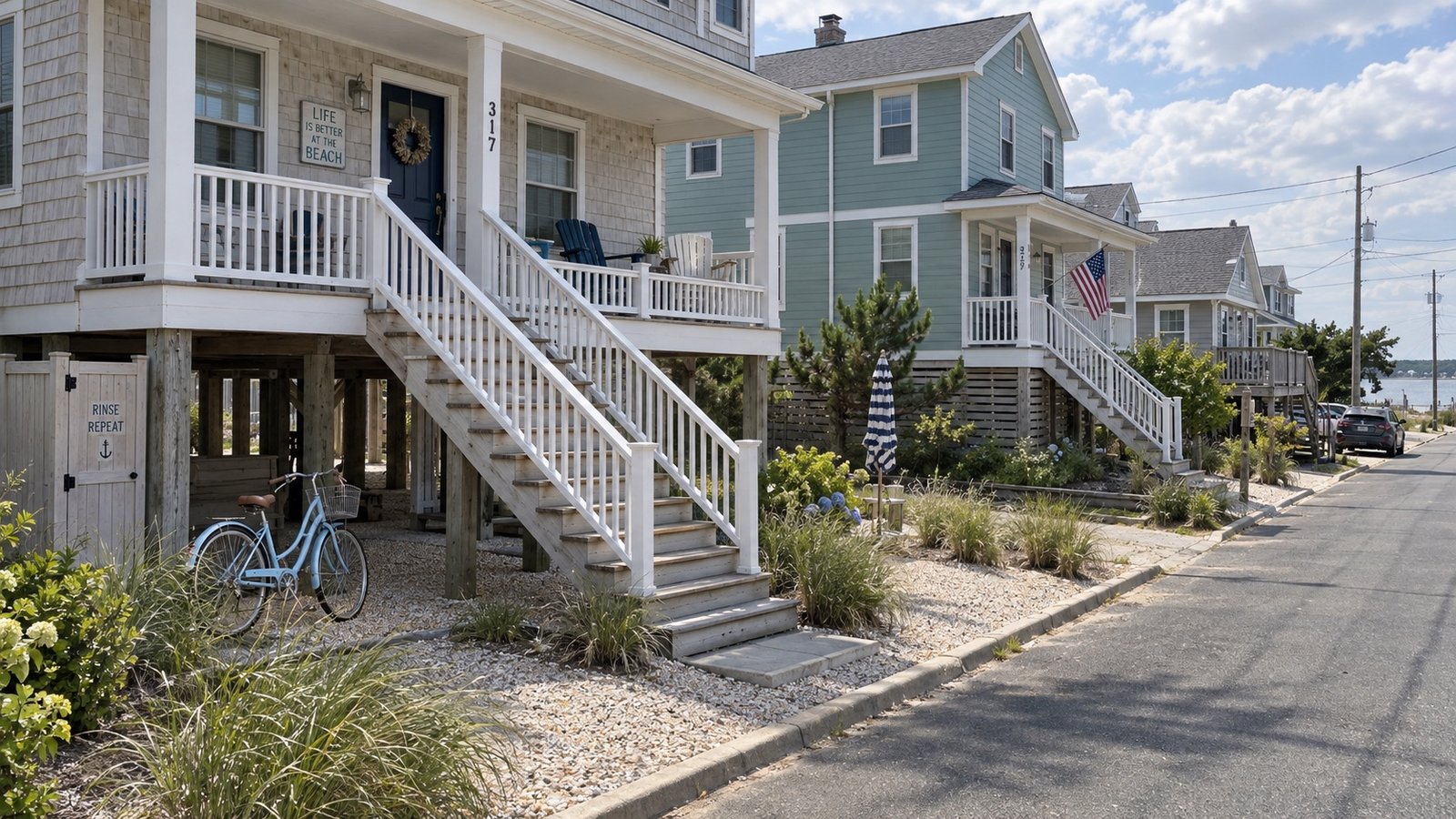
A barrier-island street of raised beach houses under a bright summer sky.
Summer shore dates need early booking and a street-by-street truck plan.

13 /

Turn the chosen home into an arrival plan

With the address decided, sequence the setup so nothing blocks the truck. Four to six weeks out: confirm the closing or lease date, start school registration if you have children — the district wants documents ready and kindergarten registration opens months ahead — and book the move itself. Two to three weeks out: submit the natural-gas request — New Jersey Natural Gas asks for at least 10 business days before move-in — open the electric account with JCP&L, confirm which water utility serves the address, and line up internet installation for arrival week. If you are leaving a home with unwanted furniture, request the monthly bulk pickup or a private removal now; move-out volumes are not collected.

At least a week out: confirm association or property rules at both ends, settle the truck position (driveway first; road owner if the street is unavoidable), and walk the carry route with a tape measure. In the final days: finish packing, set aside what travels with you, clear the driveway, and check the forecast — snow rules in winter, storm watch in hurricane season. In the first week after arrival: look up your collection days on Recycle Coach, test heat and hot water, note the nearest grocery and pharmacy, and — if you are near the water — confirm your flood zone on the township GIS and your beach badge options for next summer.

14 /

Questions before you arrive

Is Toms River a city or a township?

A township — the Township of Toms River in Ocean County, and that is the municipality whose procedures this guide uses. The township's code still records its earlier name, Dover Township, but current official naming is Toms River Township. Neighboring communities like Beachwood, Pine Beach and South Toms River are separate municipalities, though they share the regional school district.

Does my Toms River address assign my child's school?

Yes, by home school: Toms River Regional Schools assigns by address and registers everyone through Central Registration at 1245 Old Freehold Road. But placement requests can be deferred and some capacity limits apply — for 2026-2027 the district deferred all kindergarten placement requests until mid-August — so register early and do not assume a preferred school.

Do I need a car in Toms River?

Most households will want one. There is no passenger rail station in the township; NJ Transit bus 137 runs between Toms River and New York, and the nearest rail is Bay Head station on the North Jersey Coast Line, in the neighboring borough. Daily errands follow suburban corridors like Hooper Avenue and Route 37.

Who supplies my water and sewer service?

It depends on the address. The township's contact list gives sewer to the Toms River Municipal Utilities Authority (732-240-3500), mainland water to Veolia Water (732-349-0227), and barrier-island water to New Jersey American Water (1-800-987-5325). Confirm the exact address before opening accounts.

Can I leave unwanted furniture on the curb when I move out?

Only within the township's limits: one bulk collection per month, requested by phone, with items out by 6:30 a.m. the day after your normal collection. The township explicitly does not pick up move-outs or excessive volumes — plan a private removal service or Recycling Convenience Center trips for anything larger.

What is different about moving to the barrier island part of Toms River?

Ortley Beach and Pelican Island run on a summer rhythm — twice-weekly garbage in season, guarded badge beaches through September 1, and heavier traffic. Streets are tighter, flood zones matter more, and the water utility differs from the mainland. Plan the truck position and check the flood zone for the exact address.

How do I check whether a Toms River home is in a flood zone?

Use the township's interactive GIS, which includes flood-zone and base-flood-elevation layers, or ask the Engineering Division, which assists residents with flood-zone determinations and floodproofing options. The township participates in FEMA's Community Rating System, which provides flood-insurance discounts to residents.

Your next step

Bring the plan together

Use the Toms River moving page to prepare the inventory, access details and questions for your estimate.

Sources & useful local resources

Official procedures and local resources are linked beside the answers above. Reopen the relevant page when arranging a date: fees, schedules and application requirements can change.

Township geography & housing

Getting around

Schools & enrollment

Utilities

Trash, recycling & disposal

Truck staging & road ownership

Flood zones & seasonal rules

Beaches & recreation