New York / City relocation guide

Moving to Watertown

Watertown is a compact north-country city on the Black River, with pre-war blocks, its own bus system and serious snow. This guide helps you compare areas, plan the everyday basics and prepare the practical steps of arriving.

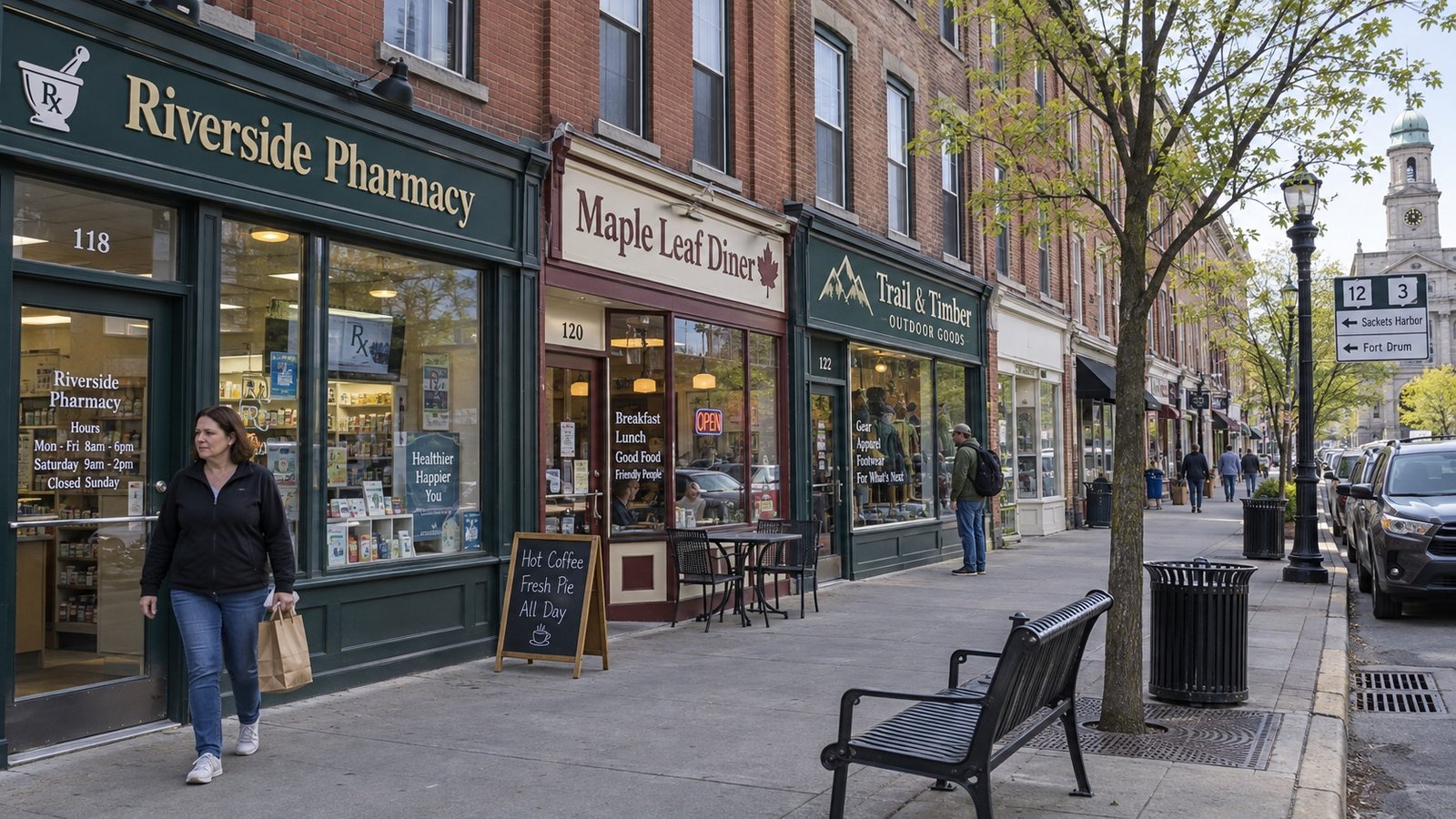
A small-city main street corner with older commercial buildings and distant pedestrians.
Try the everyday errands around a new address, not only the journey to work.

01 /

Start with the decision in front of you

Watertown asks three different questions of a newcomer, and this guide is organized around them. If you are still choosing where to live, start with the orientation and the neighborhood comparison, then read the housing section — Watertown's market is mostly older houses and small multi-family buildings, and the differences that matter are stairs, heat, parking and what the rent includes. If you are moving with children, go to the schools section for the registration mechanics. If the address is already decided, the second half of the guide walks through the practical setup — utilities, waste, the curb for the moving truck, building access and the arrival sequence.

One caution before any comparison: the City of Watertown is one municipality among several, and "Watertown" postal addresses reach into the surrounding towns. Fort Drum, the area's largest employer, is outside the city. Confirm the municipality before comparing procedures.

02 /

Understand Watertown before comparing addresses

Watertown is the Jefferson County seat and the north country's shopping and services center, sitting on the Black River where it falls toward Lake Ontario. The Public Square downtown is the reference point; the river's falls and the older mill and factory blocks edge it. The city is compact — most addresses are within a few minutes of the Square.

Two relationships matter for a newcomer. Fort Drum, the Army post, lies northeast of the city in Jefferson County — close enough to shape the rental market and the school districts, but a separate community with its own rules. And the city's own GIS and property search (maps and property lookup) is the tool for confirming whether a "Watertown" address is actually in the city.

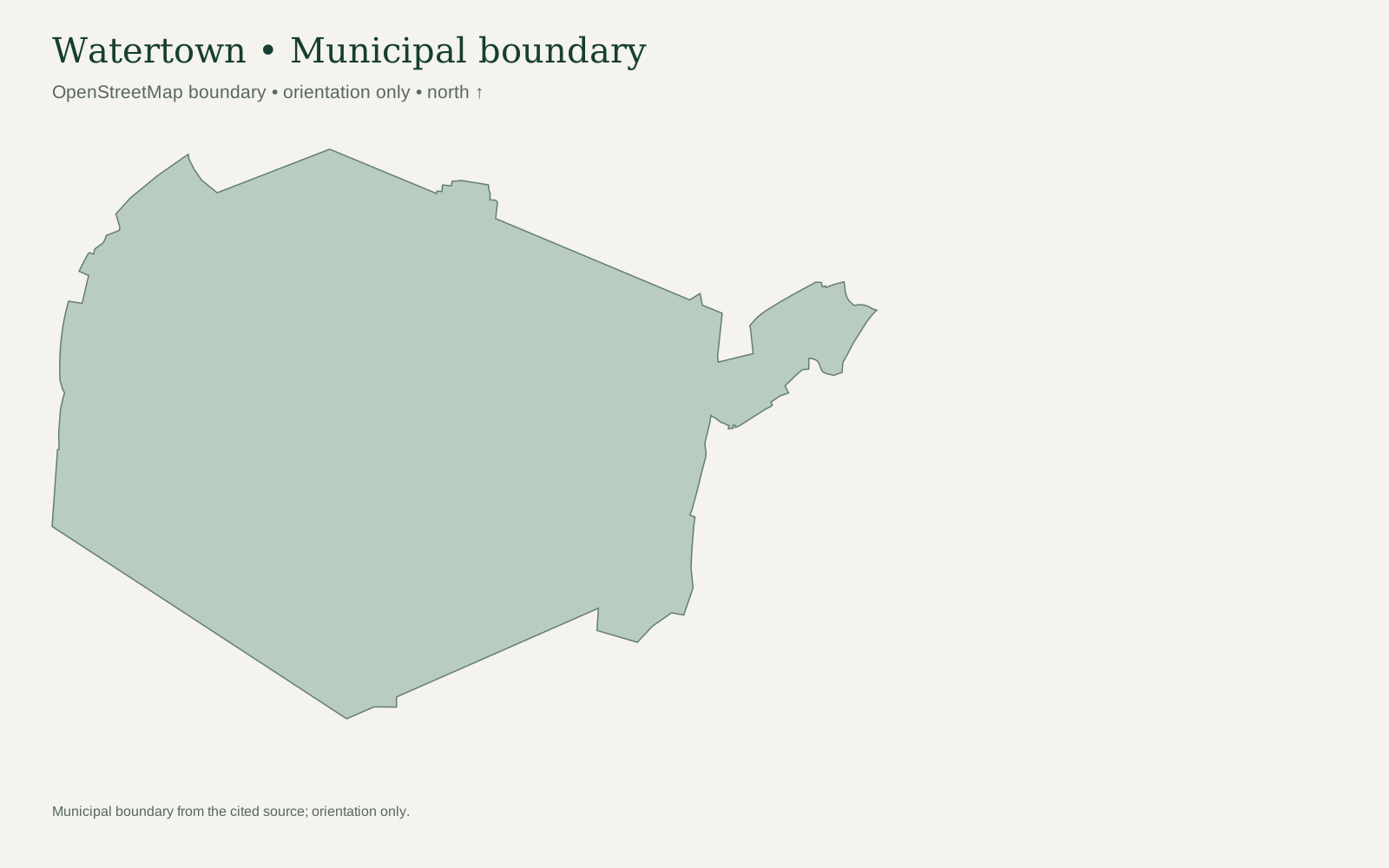
The map below shows the municipal boundary. Postal names, town lines and school geography draw different maps; verify each address against the map that matters for the decision at hand.

Watertown orientation map with numbered area key
Use the numbered key to locate the areas discussed below. Open full-size map.

03 /

Find the area that fits your routine

Watertown's documented areas are few enough to be honest about: the six modules below are what the record supports, chosen to contrast housing types and access patterns. They are starting points for inspection, not rankings — building conditions vary house by house.

Downtown & Public Square

The city's center: the Public Square Historic District (National Register) preserves the commercial blocks around the Square, where the city's shopping and civic life concentrate.

Public Square Historic District record (NPS) ↗
Housing & setting
Apartments over and behind the commercial blocks; expect managed entries and stairs rather than private driveways.
Daily travel
The walkable core; CitiBus routes converge here, and downtown parking is free in municipal lots.
Before choosing
Confirm the entry arrangement and where a truck can stand on the older blocks; agree any window rules with the property early.

Coffeen Street & the northeast

The northeast corridor grew around the railroad yards and Black River factories; the Taylor Flats nomination documents a 1907 eight-unit apartment building built there for middle-class tenants.

Taylor Flats nomination (NPS) ↗
Housing & setting
Older small apartment buildings and houses on a working corridor; check the specific building's entry and stairs.
Daily travel
Corridor buses toward downtown; test the actual stop and schedule for your routine.
Before choosing
Verify where a truck can stand along the corridor and how far the carry runs to the door.

Thompson Park area

The city's own hilltop park — Thompson Park, with its zoo and overlooks — anchors the residential area above downtown.

Thompson Park (City of Watertown) ↗
Housing & setting
Older houses on the streets around the park; porch-and-stairs access is the default.
Daily travel
A short ride from downtown; the park is the everyday outdoor reference point.
Before choosing
Hill streets and older construction: walk the carry route and check what the lease says about heat and snow clearing.

The north side

Residential blocks north of downtown, a mix of older doubles and singles from the city's growth decades.

Watertown housing data (Census Reporter) ↗
Housing & setting
Two-to-four-unit buildings and detached houses; about 28% of the city's homes sit in small multi-family buildings (ACS 2024 5-year).
Daily travel
Bus routes on the main corridors; downtown is close.
Before choosing
Measure the staircase and agree driveway use; check the collection day and tote or sticker choice early.

The east side

Residential streets east of the center, toward the city line and the town beyond.

City GIS and property search (City of Watertown) ↗
Housing & setting
A mix of older houses and post-war stock; typically easier driveway access than the center.
Daily travel
Car-oriented; check whether a CitiBus route actually serves your block.
Before choosing
Confirm the address is in the city — the town of the same name is a separate municipality — via the city's GIS and property search.

The west side

Residential blocks west of downtown toward the river crossings.

Planning and zoning (City of Watertown) ↗
Housing & setting
Older houses with porches and drives; condition varies house by house.
Daily travel
A short ride to downtown; the river bridges shape the daily pattern.
Before choosing
Pre-war construction varies widely; check windows, heat and stairways as carefully as the rooms.

04 /

Compare the whole home, not just the advertised payment

Watertown is a renter-leaning city: 59.1% of households rent their home (ACS 2024 5-year, via Census Reporter). The median gross rent is $967 a month and the median owner-occupied value $158,600 — medians describe the whole city at once, not the apartment in front of you; use them only to sanity-check a budget.

The stock explains the market. About 44% of units were built before 1940, about 43% are detached single-family houses, and about 28% sit in two-to-four-unit buildings. For a mover this means the differences that matter are physical: which floor, stairs or a driveway, how heat is supplied, and who clears the sidewalk after snow.

When comparing two homes, compare what the payment includes — heat, hot water, parking, snow clearing — the lease's move-in and move-out rules, and the condition of the access route: porch boards, stair rails, door widths. One city program is worth knowing: rental properties are registered through the city's online portal, so a registered rental has at least passed the city's front door — ask the landlord about it.

A furnished Watertown apartment with sealed branded moving cartons, personal belongings and a clear doorway.
Compare usable rooms, heat arrangements and what the rent actually includes.

05 /

Test the complete daily journey

Watertown is a car-first city, but it runs its own bus service: CitiBus covers the city with named routes at $1.50 a ride — children under 12 pay $0.50, under 6 free — with 10-ride cards at $10. No passenger rail serves the area. For flights, Watertown International Airport is outside the city, in the Hounsfield/Dexter area; its address is a mailing address, not the municipality.

Driving, the city is compact and the daily pattern runs through Public Square and the main corridors. Test the real door-to-door routine from a candidate address — the commute, the grocery run, the school run — at the hours you would actually travel, including a January morning.

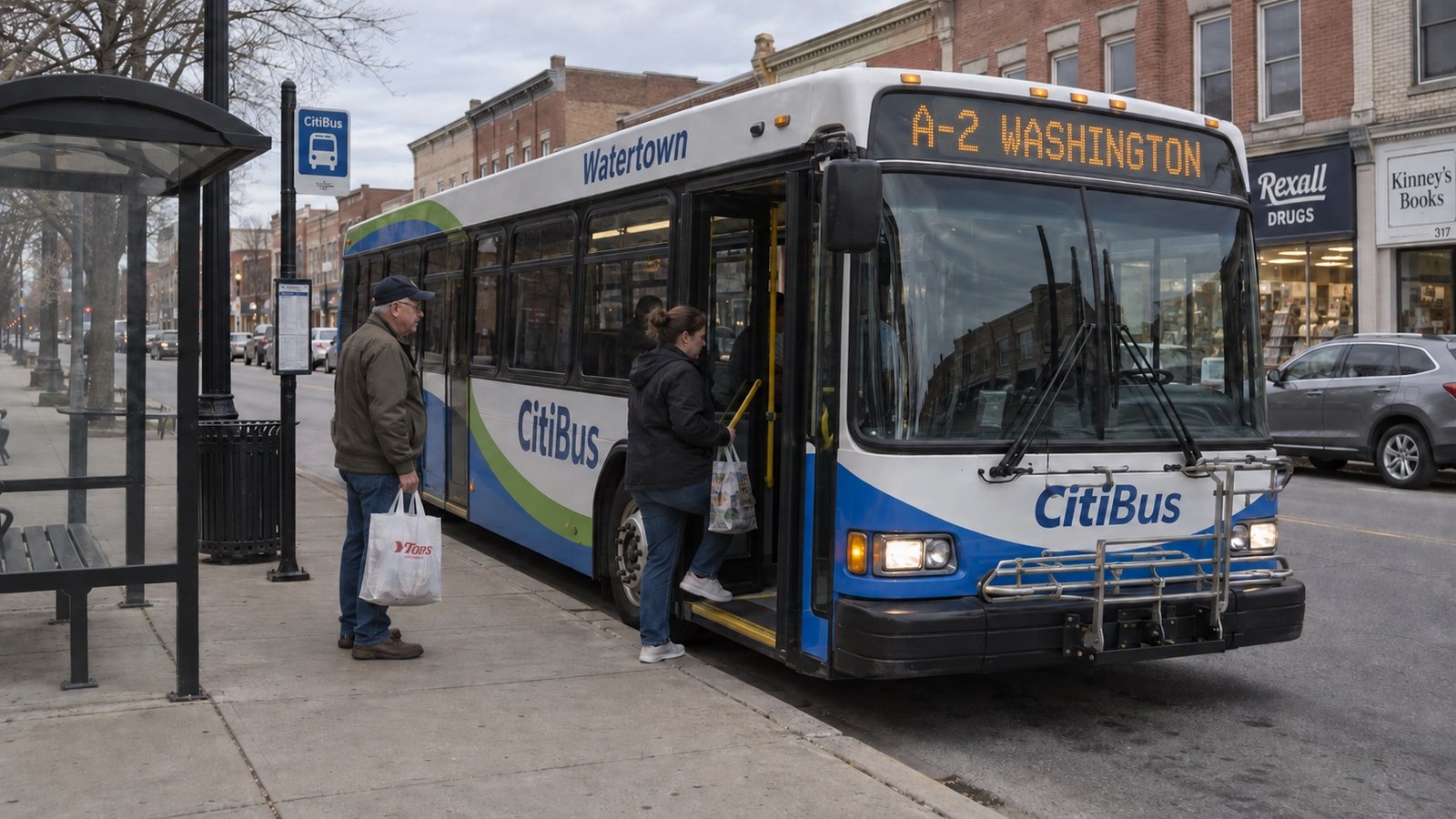
A small-city street with a local bus among older commercial buildings.
Test the complete daily journey, including the walk at both ends.

06 /

Register with the district directly

Watertown City School District serves the city. Registration runs through Central Registration (315-661-8338); the district's registration page lists the required documentation — health records, dental certificate, proofs of address — and accepts documents by mail, fax, email or by appointment. A bus-tracking parent app (FirstView) handles transportation updates.

Ask the district which school serves your address rather than assuming a neighborhood assignment from a listing. If you are arriving mid-year, contact the district before the move date so registration does not gate the first day of classes. Fort Drum-area families should note that addresses outside the city belong to other districts entirely.

07 /

Assign an owner and a start date to each household service

Electricity and natural gas are both National Grid territory (its upstate New York operation); start, stop or transfer service through its online account flow, submitted as soon as your date is fixed — no official lead time is published. Water and sewer belong to the city's Water Department, with the annual water quality report published at the city's water report page; whether a renter opens an account or the account rides with the property is a landlord question — confirm before the move.

For internet, check address-level availability before promising yourself a provider or a speed; in the older doubles, ask which provider already wires the building. An installation booked before the move is easier than one booked from an empty apartment.

08 /

Plan for routine collection and the things you are leaving behind

Watertown's trash service is pay-as-you-throw: households either rent a city refuse tote (the saved rate sheet shows a 32-gallon tote at $91 a quarter or $7 a week) or buy $5 blue refuse stickers for bags, per the Refuse & Recycling page. Letting tote service lapse costs a $50 re-delivery fee. Find your pickup day on the city's schedule page after arrival.

The rule that matters at a move: bulk items go out only through the Seasonal On-Demand Bulk Pickup — the 2026 season runs April 6 through October as weather permits, with a published list of acceptable items and prices; vehicles and similar items are excluded. Outside the season there is no municipal bulk route, so a fall-to-early-spring move needs a private hauler for anything left behind. A curb pile on moving day is not an option.

09 /

Arrange a legal place for the moving truck

Watertown publishes no moving-truck or street-occupancy permit. The decision path is simple and worth following in order. First, use the property: a driveway or private lot needs no arrangement with anyone. Second, if the truck must stage on the street, choose a legal position for the day — downtown, the city provides free municipal lots and free on-street parking, and the same calm applies on most residential blocks.

Third, if the position is unusual — a long carry across a sidewalk, a container, a trailer, or any need to hold or close street space — that runs through the Engineering Department, which publishes the street-closing policy and permit fee schedule. Call early, describe the position, and keep whatever they confirm with the moving papers. Share it with us so the crew's plan matches.

10 /

Inspect the full route through the building

Watertown's default housing type is the pre-war house or double: shared front halls, staircases with tight landings, sometimes a narrow driveway to a rear entrance. Measure the largest pieces against the actual route — width, turns, ceiling at the landing — and check porch boards and railings before anyone carries a sofa across them. Agree driveway use with the landlord and neighbors; many drives are shared or single-width.

In the larger buildings and managed properties, access means paperwork: elevator reservations, fixed moving windows and sometimes a certificate of insurance requested from the mover. Ask for the written moving rules at both ends as soon as the date is set.

Whichever type, walk both routes before the day: where the truck stops, which door is used, every stair and landing between the truck and the room, and who unlocks what. In winter add one more item — who clears snow and ice from the steps and walk before the crew arrives; make it an explicit assignment with the landlord rather than an assumption.

11 /

Build a useful routine beyond the commute

Watertown's everyday geography centers on Public Square: the surrounding blocks hold the shops and services, and the city's own Thompson Park sits on the hill above downtown as the shared backyard. The Black River's falls run through the city's history; the older mill and factory edges remain part of its fabric.

Test the routine you will actually live: the grocery run, the pharmacy, the school or daycare route, a late-evening trip home. Winter changes the calculation more here than in most cities — a January test drive is worth more than a July one.

A hilltop park with mature trees and a city view beyond.
Check the outdoor routine around the address you actually choose.

12 /

Plan for the season in which you will live and move

Winter defines Watertown's calendar. The snowfall record at the airport station (1991–2020, a partial record) averages roughly 110 inches a year, November through April, with December through February the core. Lake-effect bands off Lake Ontario can bury one part of the county while the next town stays clear — treat any December–March date as weather-dependent, watch the forecast in the final week, and keep a backup date in mind.

In a storm, the Department of Public Works works main streets and school routes first; residential side streets wait. The after-hours snow emergency line is 315-785-7842. The city's snow-season parking and sidewalk rules were not published in the pages we could read, so agree explicitly with the landlord who clears what — and where the household car goes while the truck works.

The other rhythm is the base: Fort Drum's rotation cycle brings waves of arrivals and departures to the area, and summer is the busiest household-moving season. End-of-month dates book out first then — our workload observation, not a city statistic.

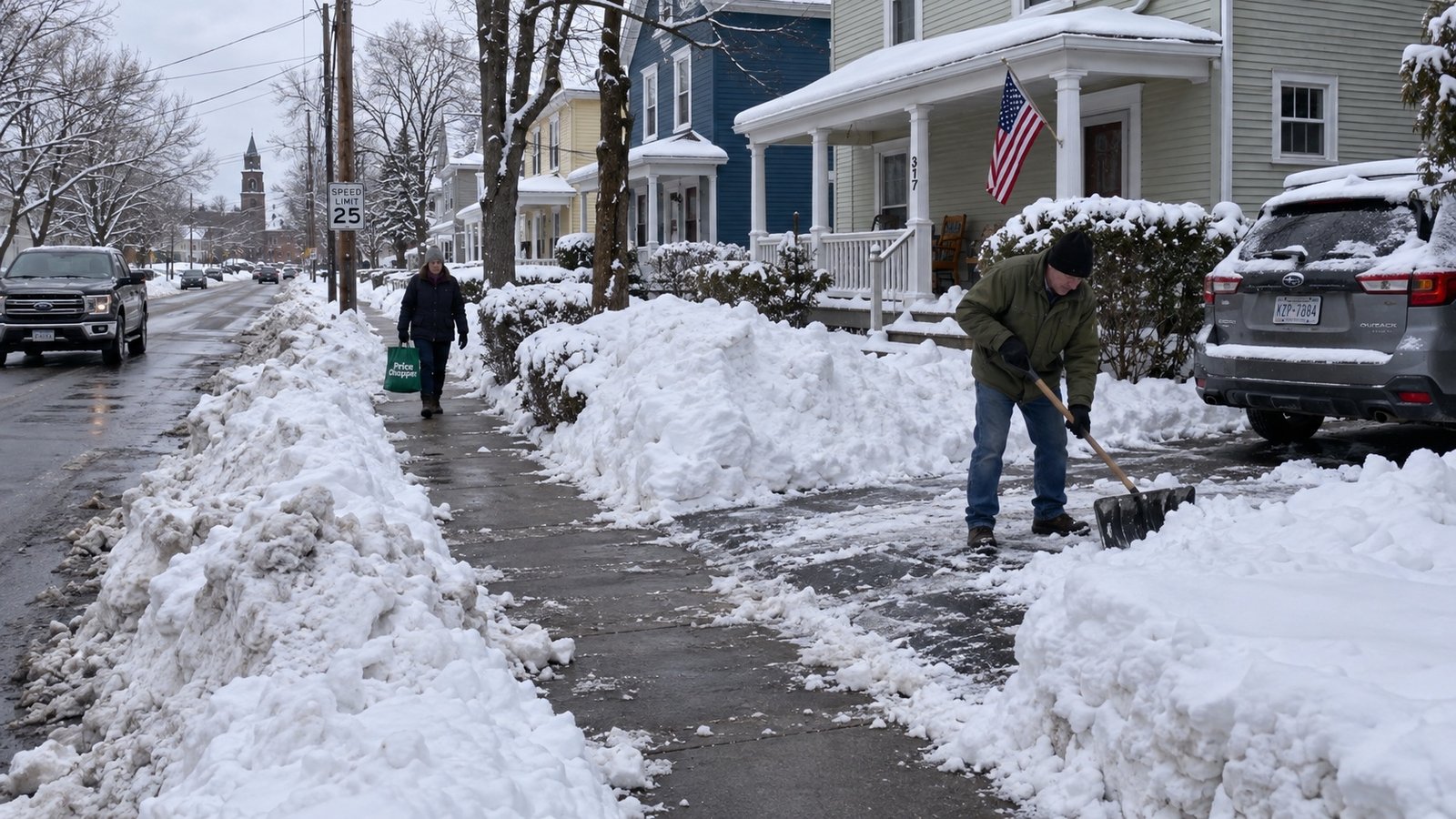
A residential street after heavy snow with deep plowed piles and cleared sidewalks.
Winter dates need a storm plan: north-country snow is measured in feet, not inches.

13 /

Turn the chosen home into an arrival plan

With the address decided, sequence the setup so nothing blocks the truck. Four to six weeks out: confirm the lease or closing date, start the school registration if you have children, and book the move itself. Two to three weeks out: submit the National Grid start request, confirm the water account arrangement with the landlord, line up internet installation, and plan disposal around the bulk season — remembering that between November and March there is no municipal bulk pickup at all.

In the final days: confirm the access plan at both ends, finish packing, set aside what travels with you, and in winter check the forecast twice. In the first week after arrival: find your pickup day on the city's schedule, choose between a tote and stickers, test heat and hot water, and note where the nearest municipal lot is if you will use downtown. If you are on a military rotation, keep your transportation office's paperwork with the moving papers.

14 /

Questions before you arrive

Is Fort Drum in Watertown?

No — the base is northeast of the city in Jefferson County. It shapes the area's rental market and moving seasons, but it is a separate community with its own rules. Addresses on post are not Watertown addresses.

Is the Watertown airport in the city?

No. Watertown International Airport sits outside the city, toward Dexter; the address is a mailing address, not the municipality.

Does my Watertown address assign my child's school?

Registration runs through Watertown City School District's Central Registration (315-661-8338), with documents accepted by mail, fax, email or appointment. Ask the district which school serves your address rather than assuming from a listing.

Do I need a car in Watertown?

Most households drive, but the city's own CitiBus runs named routes at $1.50 a ride, with 10-ride cards at $10. No passenger rail serves the area. Test the exact door-to-door routine from your address before deciding.

Can I leave unwanted furniture on the curb when I move out?

Only through the Seasonal On-Demand Bulk Pickup — April through October, item-priced from a published list. Outside the season there is no municipal bulk option; plan a private hauler. A curb pile is not an option.

How does trash billing work?

Pay-as-you-throw: either rent a city refuse tote (the saved rate sheet shows a 32-gallon tote at $91 a quarter or $7 a week) or buy $5 blue refuse stickers for bags. A $50 re-delivery fee applies if service lapses.

How much snow does Watertown actually get?

The airport station's 1991–2020 record (partial for some months) averages roughly 110 inches a year, November through April — one of the heaviest snow regimes in the eastern states. Lake-effect bands make it hyperlocal; December–March dates are weather-dependent.

Your next step

Bring the plan together

Use the Watertown moving page to prepare the inventory, access details and questions for your estimate.

Sources & useful local resources

Official procedures and local resources are linked beside the answers above. Reopen the relevant page when arranging a date: fees, schedules and application requirements can change.

City rules & services

Housing & neighborhoods

Getting around

Schools & enrollment

Utilities