Albany is the state capital: a compact, renter-majority city of brick rowhouses and government towers on the Hudson. This guide helps you compare areas, plan the everyday basics and prepare the practical steps of arriving.
Try the everyday errands around a new address, not only the journey to work.
01 /
Start with the decision in front of you
Albany asks three different questions of a newcomer, and this guide is organized around them. If you are still choosing where to live, start with the orientation and the neighborhood comparison, then read the housing section — Albany's market is mostly rentals in 19th-century rowhouses and small multi-family buildings, and the differences that matter are stairs, light, parking and what the rent includes. If you are moving with children, go to the schools section early: Albany registers students in person with a specific document list, and magnet and pre-K seats run on a spring lottery, not on your address. If the address is already decided, the second half of the guide walks through the practical setup — utilities, waste, the curb for the moving truck, building access and the arrival sequence.
One caution before any comparison: Albany's neighborhood names are everyday geography, not administrative units. Postal ZIP codes, the city GIS neighborhood layer, school registration and snow-emergency lot lists all draw different maps. Verify each address against the map that matters for the decision at hand.
If you are still deciding whether Albany itself is the right fit, read the orientation section with a map open: the city is the dense, walkable core of a four-city metro area, and many households compare an Albany rowhouse apartment against a suburb in Colonie or Bethlehem. Those are different municipalities with different school districts, trash programs and parking rules — nothing in this guide's municipal procedures applies across the line. What this guide can tell you is how the city itself works: its housing stock, its transit, its registration counters, its curb.
02 /
Understand Albany before comparing addresses
Albany is the capital of New York State and one of the oldest continuously settled cities in the country, sitting on the west bank of the Hudson River where I-87 meets I-90. State government is the anchor: the Capitol and the Empire State Plaza complex rise just east of the rowhouse neighborhoods, and the downtown economy follows the government's calendar. The city itself is compact — most residential addresses are within a few miles of downtown — and it borders Colonie, Guilderland, Bethlehem, Watervliet and, across the river, Rensselaer, all separate municipalities with separate rules. A "Capital Region" description and an Albany address are not the same thing; confirm the municipality before comparing procedures.
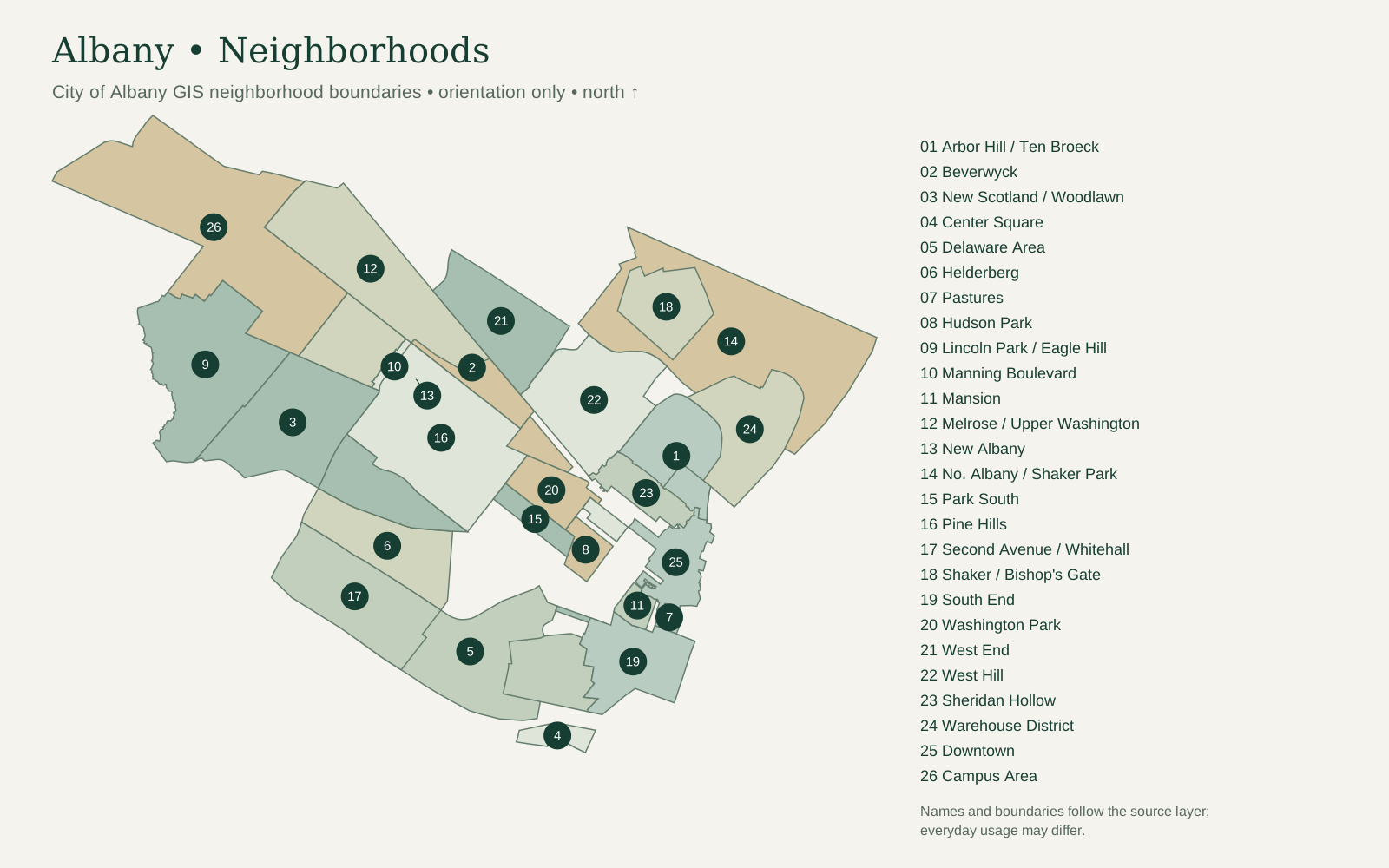
The city's own GIS service publishes a neighborhood boundary layer — neighborhood associations, plus informal designations for downtown, the campus area and the warehouse district — mapped below. These are not planning districts or service boundaries: areas without an active association appear as gaps, and everyday usage often differs from the association names. Postal ZIP codes cross these lines freely.
Three naming traps matter for movers. The Amtrak station called Albany–Rensselaer is in Rensselaer, across the Hudson. Albany International Airport is in the Town of Colonie despite its Albany postal address. And the colleges: the University at Albany's Uptown and Downtown campuses really are in the city, but Siena College is in Loudonville and Rensselaer Polytechnic Institute is in Troy — and the College of Saint Rose, long a Pine Hills institution, closed after the 2023-24 academic year. Addresses marketed as near a campus may sit in another town entirely, with another town's rules.
Working rhythms follow the government calendar. State offices cluster around the Empire State Plaza and the Capitol, so downtown fills on weekday mornings and empties after five; the blocks west of the plaza — Center Square, Hudson/Park, Washington Park — carry the evening and weekend life. The city's GIS layer names about three dozen areas, from Arbor Hill and the Mansion district in the older core to Pine Hills, Beverwyck and the New Scotland/Woodlawn area farther west, and the map below uses those boundaries. Treat them as orientation: a block's everyday name, its postal ZIP, its school registration and its snow-emergency lot are four different lookups.
Use the numbered key to locate the areas discussed below. Open full-size map.
03 /
Find the area that fits your routine
Albany's official GIS maps roughly three dozen neighborhood associations and informal designations; the nine below are the areas a household is most likely to compare, chosen for their verified housing character. They are starting points for inspection, not rankings — association boundaries are not planning districts, and building conditions vary house by house.
Downtown
Albany's historic commercial core on the site of the 17th-century Dutch settlement: the city's district documentation counts 160 buildings, mostly commercial, built mainly between 1880 and 1940 along State Street, Broadway and North Pearl. Residential life here means apartments in towers and office-to-residential conversions.
Expect managed buildings with elevators, set moving windows and certificate-of-insurance requirements. Compare what the rent includes and ask for the building's written moving rules before signing.
Daily travel
The strongest transit position in the city: the CDTA avenue corridors converge here, and route 22 links the Empire State Plaza to Troy via Watervliet seven days a week.
Before choosing
Confirm the loading arrangement and elevator reservation procedure early; downtown curb space is metered and enforced, so the no-parking sign request belongs in the lease conversation.
Capitol Hill & Lafayette Park
The government heart of the state: the Lafayette Park historic district holds the State Capitol, the Court of Appeals, the State Education Building and City Hall, plus 33 early-19th-century rowhouses on Elk and Columbia Streets — many now converted to offices.
Very little residential stock, and what exists is historic rowhouse fabric. Anyone renting here is beside the Capitol complex and should expect the building rules that come with it.
Daily travel
Immediately uphill from downtown; most addresses are a short walk from the Empire State Plaza and the downtown bus corridors.
Before choosing
Security and event closures around the government complex can reshape curb access on short notice — confirm the truck plan with both the city and the property.
Center Square & Hudson/Park
Albany's signature rowhouse neighborhoods between Washington Park and the Empire State Plaza: about 1,200 buildings, mostly two-to-four-story brick rowhouses built between 1845 and 1920, from working-class homes to detailed mansions. Lark Street is the mixed-use spine, with shops below and apartments above.
Rowhouse apartments over stacked floors, with stoops, narrow halls and tight stair turns; a few early apartment buildings and single-family houses mix in.
Daily travel
The Washington Avenue bus corridor borders the district to the north, and downtown is a short walk east through the government blocks.
Before choosing
Streets are narrow and often one-way, with little off-street parking — measure the stair route and arrange the curb early; several nearby avenues joined the residential permit zones in February 2026, so check your block.
Mansion
A dense 19th-century district just south of downtown, named for its proximity to the Executive Mansion: 475 buildings at the district's 1982 listing, mainly brick rowhouses built between 1840 and 1880, with storefronts along South Pearl Street and Madison Avenue.
Brick rowhouse flats in Italianate, Federal and Greek Revival stock; shared entries and stoops are the norm.
Daily travel
The New Scotland Avenue bus corridor borders the district, and downtown is walkable from the northern blocks.
Before choosing
Verify where a truck can stop on the narrower side streets, and ask the landlord about shared-hall rules before moving day.
Pastures
One of Albany's oldest residential areas, on the communal pastures of the Dutch city: the district's 112 buildings include early Federal-style rowhouses built largely between 1815 and 1855, alongside later churches, synagogues and newer Albany Housing Authority construction.
Small, early rowhouses with the access quirks of their era — high stoops, narrow halls, low thresholds; inspect the route from curb to apartment.
Daily travel
Immediately southeast of downtown — many addresses are a short walk or bus ride from the core via South Pearl Street.
Before choosing
Two-century-old buildings vary widely in condition; check windows, heat and stairways as carefully as the rooms.
South End
A large working-class district south of the Mansion area, built mostly as individually constructed two- and three-story brick rowhouses in Italianate and Greek Revival styles, with frame cottages mixed in; the Schuyler Mansion (1761) predates the grid. About a hundred of the district's buildings have been lost since its 1984 listing.
Rowhouse flats and small frame houses; South Pearl Street is the commercial spine with shops below apartments.
Daily travel
South Pearl Street buses and the Delaware Avenue corridor serve the wider south side; downtown is a short ride north.
Before choosing
Older individually built stock means house-by-house condition differences; confirm heat, stairs and where the truck can stand before booking.
Washington Park
The neighborhoods ringing the city's central park: the 1972 national-register nomination documents a predominantly residential 19th-century district of rowhouses facing and framing the park, built out as the city grew west from downtown.
Park-facing rowhouses and divided houses on the surrounding blocks; stoops, tall ceilings and period floor plans come with the address.
Daily travel
The Washington Avenue bus corridor runs along the park's north edge, and Center Square and downtown are walkable to the east.
Before choosing
Streets on the park's south side joined the residential permit zones in February 2026 — check whether your block is permit-only before planning where the household car and the truck will stand.
Pine Hills
A western streetcar suburb: the city's historic resources survey traces how farms and estates were subdivided from the late 19th century as trolley lines pushed west along Madison Avenue, with later growth along New Scotland Avenue. The stock mixes detached and two-family houses with apartment buildings.
More driveways and yards than the inner rowhouse districts, plus multi-unit houses near the college corridors; compare the specific building rather than the neighborhood average.
Daily travel
A genuine transit-rich area: the Washington Avenue (route 12, serving UAlbany), Western Avenue (route 10) and New Scotland Avenue (route 13) corridors all cross the district.
Before choosing
Student-linked rentals near the UAlbany Downtown Campus turn over around the academic calendar — ask about lease timing and who clears snow at multi-unit houses.
Warehouse District & North Broadway
The industrial corridor north of downtown along Broadway, grown from the Erie Canal and lumber-district era: the city's 2022 intensive survey documents stove, iron and brewing industries, and a national-register nomination for the Albany Industrial and Warehouse Historic District was in process in 2025.
Former industrial and warehouse buildings, some converting to residential and studio use; loft-style options come with their own access rules.
Daily travel
The Albany–Troy route 22 links the north side to the Empire State Plaza; downtown is a short ride south on Broadway.
Before choosing
Conversions vary: confirm freight-elevator access, loading space and truck approach near the rail corridor before committing to a date.
04 /
Compare the whole home, not just the advertised payment
Albany is a renter's city: 61.8% of households rent their home (ACS 2024 5-year, via Census Reporter). The median gross rent is $1,216 a month and the median owner-occupied value $234,700 — but medians describe the whole city at once, not the apartment in front of you, and listing sites' asking rents run above survey medians. Use them only to sanity-check a budget.
The stock explains the market. About 40% of Albany homes sit in two-to-four-unit buildings — the brick rowhouse and the divided Victorian are the signature forms — and half of all units were built before 1940. Downtown adds towers and office-to-apartment conversions; the western neighborhoods add detached houses and garden-style complexes. For a mover this means the differences that matter are physical: which floor, stoop or elevator, where a truck can stop, how heat is supplied and who clears the sidewalk. Bay windows and plaster medallions come with the charm; so do narrow staircases with landing turns.
When comparing two apartments, compare what the payment includes — heat, hot water, parking, snow clearing — the lease's move-in and move-out rules, and the condition of the access route: stoop treads, stair rails, door widths. Ask early who handles trash and bulky disposal; the city's collection program stops at buildings of four units, so larger buildings run through the landlord.
Stock varies by area in ways you can verify before a visit. The oldest core — Center Square, Hudson/Park, Mansion, Pastures, the South End — is brick rowhouse territory, mostly built between the 1810s and the 1920s. The western neighborhoods — Pine Hills, Beverwyck, Helderberg — developed later as streetcar suburbs, with detached and two-family houses alongside apartment buildings. Downtown and Capitol Hill add towers and office conversions. None of this assigns a condition to a specific building: two adjacent rowhouses can differ by a century of maintenance.
So inspect the physical unit, not the listing. Count the flights and measure the stair turns against your largest furniture. Ask how the unit is heated and what the rent covers — heat, hot water and snow removal change the real monthly cost. Look at the stoop treads, the hall lighting, the window condition. And ask the move-out question on day one: how does trash leave this building, and who arranges bulky disposal? In a city where collection stops at four-unit buildings, the answer differs block by block.
Compare usable rooms, light, storage and what the rent actually includes.
05 /
Test the complete daily journey
Albany's bus network is a genuine daily option in the core neighborhoods. CDTA runs local routes along the same avenues that define the neighborhoods — Central, Washington, Western, New Scotland, Delaware — many seven days a week, plus route 22 from the Empire State Plaza to Troy via Watervliet. The base cash fare is $1.50 (exact change; buses make no change), with the Navigator smart card and mobile ticketing for regular riders. Three BusPlus limited-stop lines cross the region: the Red Line down Central Avenue to Schenectady, the Blue Line up the Hudson corridor to Waterford, and the Purple Line along Washington and Western Avenues to Crossgates and UAlbany's Uptown Campus.
For rail, the region's Amtrak station is Albany–Rensselaer (ALB) — note the second name: the station is at 525 East Street in Rensselaer, across the Hudson, since downtown Albany's Union Station closed in 1968. Empire Service trains run to New York City, the Maple Leaf to Toronto, the Adirondack to Montreal, the Ethan Allen to Vermont and the Lake Shore Limited west; CDTA buses and the Flex+ on-demand service connect the station to downtown Albany.
For flights, Albany International Airport sits at the I-87/I-90 junction northwest of the city — in the Town of Colonie, whose planning board has long governed the airport area's land use, despite the "Albany, NY" postal address. If you keep a car, check whether your street falls in a residential permit zone before assuming you can park on it; the city expanded its permit system in February 2026.
Keeping a car changes the questions rather than eliminating them. Residential permit zones cover parts of the center-city streets and expanded in February 2026, so check whether your block is permit-only before assuming curb parking comes with the apartment. Winter adds the snow-emergency shuffle: when the city declares one, everyone re-parks on the even side for a day, then the odd side, and off-street lots open for the duration. Households that keep one car and use the bus for the downtown commute are common in the rowhouse neighborhoods — test both modes from the address you are considering, at the hours you would actually travel.
Test the complete daily journey, including the walk at both ends.
06 /
Register in person, with the document list ready
The City School District of Albany enrolls new K-12 students in person at the Harriet Gibbons Student Services Center, 75 Watervliet Avenue, weekdays 8:30 a.m. to 3:30 p.m. — there is no fully remote registration. The Central Registration Office answers questions at (518) 475-6125. New York Education Law requires district residency, so the document list is the heart of the visit:
Bring originals. Proof of the child's birth (birth certificate, baptismal certificate or passport), your photo ID, two proofs of your Albany address dated within 30 days — a lease, deed or mortgage statement, or a notarized affidavit from the district, plus a second document such as a utility or phone bill; note that water bills are not accepted — the child's immunization record, and custody papers where applicable. Arriving without the full set means a second trip.
Two programs run on their own calendar. Magnet schools and the pre-K 4 program place children through spring lotteries: for the 2026-27 year, applications submitted after April 2, 2026 missed the April 22 lottery and rolled into later lotteries and waitlists. Do not sign a lease counting on a specific magnet seat. Families arriving mid-year register through the same Central Registration office; ask which schools have seats at the moment you arrive rather than assuming the nearest building does.
Two practical notes complete the picture. Families registering in a language other than English can start with the district's Office of ENL and Refugee Services rather than the main counter. And timing matters more than parents expect: the lottery calendar runs in spring for the following fall, in-person registration takes an office visit with originals, and mid-year arrivals are placed where seats exist — so a household moving in July for September should call Central Registration before the lease is signed, not after the boxes arrive.
07 /
Assign an owner and a start date to each household service
Water and sewer belong to the Albany Water Department, a city utility with about 30,000 customers. Bills can be paid online, by mail or by phone (518-434-5300, weekdays 8:30 a.m. to 4:30 p.m.). The department does not publish a tenant-account policy, and in many multi-unit buildings the water account rides with the property — renters should confirm the arrangement with the landlord rather than assume they open an account, and buyers should ask their attorney how the final reading is handled at closing.
For internet, availability is address-specific and changes street by street in older neighborhoods; check the exact address with each wired provider before you sign a lease, and ask the landlord which provider already wires the building — an installation booked before the move is easier than one booked from an empty apartment.
Two Albany-specific questions belong on the utility list. First, heat: many pre-war buildings heat with gas-fired boilers or older systems, so ask at viewing who pays for heat and how it is delivered — a rent that excludes winter gas in a drafty 1890s rowhouse is a different number than it looks. Second, timing: utility appointments, internet installation and the moving date should interlock, with service starting the day you get keys and installation booked for arrival week rather than after it.
08 /
Plan for routine collection and the things you are leaving behind
Albany's Department of General Services collects trash and recycling weekly, but only for residential properties of four units or fewer — larger buildings use private haulers through the landlord. Set-out rules are strict: curbside after 4:30 p.m. the day before collection and before 12:01 a.m. on collection day, in heavy-duty bags or containers of 50 gallons or less with lids. The city's violation notices explain the common rejections: oversized barrels, overweight bags, trash in the recycling, uncovered mattresses. If you do not know your collection day, call DGS at (518) 427-7480.
What you are leaving
How it goes out
Furniture and other bulk items
Curbside in limited quantities — call DGS at (518) 427-7480 at least 24 hours before your collection day
Appliances and other white goods
Same 24-hour-ahead call; refrigerator and freezer doors must be removed (state law)
Mattress or box spring
Scheduled pickup via (518) 434-CITY; must be wrapped in plastic — free mattress bags at DGS, Neighborhood Services and City Hall
Paint, chemicals, electronics
Never curbside — the city runs free household hazardous waste and electronics drop-off events for residents
The mover's rule follows from this: a curb pile on moving day is not a legal disposal route in Albany. Mattresses must be scheduled and wrapped; furniture needs the call-ahead; anything else bulky needs a drop-off event or a private plan. Book disposal before the move-out date, not after.
The weekly rhythm rewards a first-week setup: learn your collection day, note the 4:30 p.m. set-out window, and keep containers at or under 50 gallons with lids. Recycling rides the same collection, and contaminated recycling carts are rejected, so keep trash out of the blue bin. If you are furnishing from scratch, time the old-furniture question to the move: the 24-hour-ahead bulk call and the wrapped-mattress pickup both need a working collection day at the address you are leaving.
09 /
Arrange a legal place for the moving truck
Albany runs moving-truck curb space through the police, not the parking authority. The instrument is the Emergency No Parking Sign: Albany Police Department's Traffic Engineering Division issues temporary no-parking signs to residents and businesses reserving on-street spaces when a driveway or lot cannot hold the load. The procedure, in order:
One: call (518) 434-5791 at least four business days before the first day you need the space — earlier in peak season, since invoices are mailed and payment is due on receipt. Two: describe the spot precisely and say whether the truck has a ramp or a lift, because both need extra length. Three: expect the published fees — $25 for one to three non-metered spaces, $50 for four to nine, $100 for ten or more, plus $15 per day for requests running three to thirty days; metered spaces are billed separately by the Albany Parking Authority after approval. Four: remember that approval is discretionary — APD may deny or modify any request — so confirm the signs are actually installed before the truck is scheduled around them. Five: on the day, if a vehicle is parked in your signed space, call the police non-emergency line at (518) 438-4000 rather than improvising a double-park.
Three adjacent rules round out the picture. If your plan involves a pod, a lift staged on the sidewalk or a dumpster, a Sidewalk Barricade Permit from Buildings & Regulatory Compliance must be approved first. A residential parking permit — the City Clerk program the city expanded in February 2026 — covers your household car on signed streets and does nothing for a moving truck. And a declared snow emergency overrides everything on-street, temporary signs included. If the building offers a driveway, lot or loading dock instead, use it — private loading beats a street reservation, but get the property's instructions in writing.
Strategy matters as much as the form. Match the reserved window to the building's elevator window at each end, and if the two ends need different days, plan a staged move rather than stretching one reservation. Prepare what you can before a short slot: boxes staged near the door, furniture disassembled, the path cleared. If the police deny or modify a request — or a storm cancels the plan — the fallback is private loading (a driveway, lot or dock) or a smaller shuttle vehicle from a legal position; decide which fallback you would use before the day, and put it in writing with your mover.
10 /
Inspect the full route through the building
In one Albany housing type, access means brick and wood: rowhouse stoops, shared front halls, staircases with tight landings, sometimes a narrow alley to a rear entrance. Measure the largest pieces against the actual route — width, turns, ceiling at the landing — and check stoop treads and railings before anyone carries a sofa up them. Agree on hallway and yard use with the landlord and neighbors; many rowhouse blocks share alleys and have no off-street parking at all.
In the other type, access means paperwork: downtown towers and larger complexes run moves through the property manager. Expect elevator reservations, fixed moving windows and a certificate of insurance requested from the mover; some buildings require protective padding in elevators and corridors, booked in advance. Ask for the written moving rules at both ends as soon as the date is set.
Whichever type, walk both routes before the day: where the truck stops, which door is used, every stair and elevator between the truck and the room, and who unlocks what. A plan that works at the origin but not the destination is only half a plan — confirm the two ends together, with time windows that overlap usefully.
Where the building allows a short window, preparation is the whole game: everything boxed and staged before the window opens, the crew briefed on the route, the elevator padded and reserved. Where two buildings both impose windows, confirm they overlap usefully — a loading window that closes before the destination's opens turns one move into two. And give each building the mover's certificate of insurance early enough for their review; a COI request made the week of the move is a common reason moves slip.
11 /
Build a useful routine beyond the commute
Albany's everyday geography rewards a look on foot. Washington Park is the city's shared backyard, ringed by the 19th-century rowhouse blocks documented in its national-register nomination. Between the park and the Empire State Plaza, Lark Street runs as the Center Square commercial spine — the city's district documentation describes its mixed-use buildings with shops below and apartments above. South Pearl Street plays the same role for the Mansion, Pastures and South End blocks, and Delaware and New Scotland Avenues for the neighborhoods along them.
The state complex itself is public space: the Empire State Plaza hosts a winter ice rink, a seasonal farmers market, the State Museum and the Corning Tower observation deck. Test the routine you will actually live: the grocery run, the pharmacy, the school or daycare route, a late-evening trip home. State government empties parts of downtown after five; the university calendar fills the western neighborhoods each fall. Visit a candidate address at the hours you would use it before deciding.
Each district leans on its own corridor: Lark Street for Center Square, South Pearl for the Mansion and South End blocks, Delaware Avenue for the south side, New Scotland Avenue for the hospital and Pine Hills blocks, Central Avenue for the north and west. The practical test is simple: from a candidate address, walk the grocery run, the pharmacy, the bus stop you would actually use, and the trip home after dark. The city reads differently at eight in the morning and eight at night — visit at both before you sign.
Check the outdoor routine around the address you actually choose.
12 /
Plan for the season in which you will live and move
Winter is Albany's scheduling season. The area's snow window runs roughly November through April — about 59 inches a year on the 1991–2020 normals for the Albany airport station, with December through March the core — and the city's response touches movers directly. Albany generally declares a snow emergency as the storm ends: normal parking rules are suspended citywide, and residents park on the even-numbered side of the street for the first 24 hours, the odd-numbered side for the second, so plows can clear the parking lanes. The snow hotline is (518) 476-SNOW (7669); sign up for Nixle or NY-Alert text alerts when you arrive.
During a declared emergency, the city opens off-street snow lots in every part of town — Bleecker Stadium, Lincoln Park, Ridgefield Park, Hackett Park and others — so households can move cars off the street. After the storm, the clock starts on sidewalks: the abutting property owner must clear them within 24 hours of the snowfall's end under City Code § 323-21, and corner lots must clear the path to the crosswalk. If you rent, check the lease for who actually shovels; the legal exposure sits with the owner, but the boots are often the tenant's.
The other calendar is academic: the University at Albany's Uptown and Downtown campuses sit inside the city, and student-linked leases turn over around late August and again in May. End-of-month dates at those times are the first to book out, our workload observation rather than a city statistic. If your dates are flexible, mid-month and mid-season dates give you more room.
Summer brings its own pattern. The academic calendar turns over the student-linked blocks around late August and May, and household leases across the city bunch at month ends. If your dates are flexible, mid-month and mid-season give you more room; if they are fixed to a turnover weekend, book earlier and confirm the curb request and elevator windows further ahead. None of this is a promise of price or availability — it is a reason to sequence the paperwork earlier in the busy windows.
Winter dates need a storm plan: snow emergencies change where anything may park.
13 /
Turn the chosen home into an arrival plan
With the address decided, sequence the setup so nothing blocks the truck. Four to six weeks out: confirm the lease or closing date, start the school conversation if you have children — in-person registration means gathering originals, so request records from the old school early — and book the move itself. Two to three weeks out: schedule National Grid start service for the week before the move, line up internet installation for arrival week, and plan disposal at the old address — bulk items need a call to DGS at least 24 hours before collection day, and mattresses need a scheduled, wrapped pickup.
At least a week out: confirm building rules and elevator windows at both ends, and call Traffic Engineering for the no-parking signs — the four-business-day minimum leaves no slack for mailed invoices, so earlier is safer. In the final days: confirm the signs are installed, finish packing, set aside what travels with you, and check the forecast and snow-emergency status if it is winter. In the first week after arrival: find your trash day with DGS, test heat and hot water, note the nearest grocery and pharmacy, sign up for Nixle alerts, and — in winter — identify the snow-emergency lot you would use and which side of your street is even-numbered. If you are buying rather than renting, add the water account question to the closing checklist.
In the first month, finish the administrative loop: update the address on licenses and registrations, confirm the trash and recycling days, set up the water arrangement if your lease puts it on you, register children for school if you have not, and save the numbers you will actually need — DGS at (518) 427-7480 for collection questions, (518) 434-CITY for city services, the snow line at (518) 476-SNOW (7669), and Traffic Engineering at (518) 434-5791 for any future curb reservation. The city runs on these counters; knowing them is most of settling in.
14 /
Questions before you arrive
Is the University at Albany actually in Albany?
Yes — both the Uptown Campus (1400 Washington Avenue) and the Downtown Campus are inside the city. But Siena College is in Loudonville, Rensselaer Polytechnic Institute is in Troy, and the College of Saint Rose closed after the 2023-24 academic year. Check the municipality of any address marketed as near a campus.
Does my Albany address assign my child's school?
K-12 registration is in person at the Harriet Gibbons Student Services Center, 75 Watervliet Avenue, with originals: proof of birth, your photo ID, two proofs of Albany address dated within 30 days (water bills are not accepted), immunization records and custody papers where applicable. Magnet and pre-K 4 seats are placed through a spring lottery — for 2026-27, applications after April 2, 2026 rolled to later lotteries and waitlists — so never sign a lease counting on a specific magnet.
Do I need a car in Albany?
Many households in the core manage without one: CDTA buses run the major avenues seven days a week at a $1.50 base fare, BusPlus lines link Albany to Schenectady and the Hudson corridor, and Amtrak's Albany–Rensselaer station connects to New York City, Vermont, Montreal and points west. Test the exact door-to-door routine from your address before deciding.
Who handles water and sewer accounts when I move in?
Water and sewer run through the Albany Water Department, a city utility. The department publishes no tenant-account policy, and in many multi-unit buildings the account rides with the property — renters should confirm with the landlord; owners and buyers should ask how the final reading is handled at closing. Customer service is (518) 434-5300.
Can I leave unwanted furniture on the curb when I move out?
Not without arranging it. Albany takes bulk items curbside in limited quantities only when you call the Department of General Services at (518) 427-7480 at least 24 hours before your collection day; mattresses need a scheduled pickup via (518) 434-CITY and must be wrapped in plastic. Plan disposal before moving day.
What happens to street parking during a snow emergency?
Albany generally declares a snow emergency as a storm ends. Normal parking rules are suspended citywide, and everyone parks on the even-numbered side of the street for the first 24 hours, then the odd-numbered side for the second 24 hours, so plows can clear the lanes. The city opens off-street snow lots, and the snow hotline is (518) 476-SNOW (7669).
Where are the airport and the train station?
Neither is in the city proper. Albany International Airport sits in the Town of Colonie at the I-87/I-90 junction northwest of the city, despite its Albany postal address. The Amtrak station, Albany–Rensselaer, is across the Hudson in Rensselaer; CDTA buses and the Flex+ on-demand service connect it to downtown Albany.
Official procedures and local resources are linked beside the answers above. Reopen the relevant page when arranging a date: fees, schedules and application requirements can change.