West Virginia / City relocation guide

Moving to Charleston

Moving to Charleston means fitting a home to the river valleys, hills and routes you will use every day. Downtown, the East End, the West Side, Kanawha City and hillside neighborhoods offer different building and access patterns. Confirm the municipality, test the address and connect school, utilities and lawful truck access before moving day.

Woman carrying a grocery bag along a brick bookshop and cafe block with pedestrians and traffic
Test the complete connection between the home and everyday destinations.

01 /

Begin with the address, the household and the handoff

Make the first decision at the scale of the actual home. Record its municipality, entrance, parking arrangement and the destinations the household must reach regularly. A neighborhood description can help narrow the search, but it cannot establish the school assignment, accessible route or vehicle space at a particular building.

Separate the decisions that depend on one another. You may need a lease or confirmed purchase before arranging some accounts, the exact address before checking school transportation, and an approved vehicle position before fixing the loading sequence. Keep the responsible contact and next action beside each item so an unanswered request does not look complete.

Build a short comparison using the same questions for each property: usable space, recurring housing costs, stairs and slopes, parking, daily travel, school arrangements and the timing of possession. Visit at the hour you would normally leave or return. If a service depends on a booking, test how you would arrange both directions and what happens when the schedule changes.

02 /

Read the river valleys and hills before comparing areas

This guide covers the City of Charleston in Kanawha County, West Virginia. It does not cover Charleston, South Carolina, Charles Town in West Virginia’s Eastern Panhandle or the separate City of South Charleston. Check the actual municipal boundary before applying Charleston’s parking, refuse or building procedures to an address.

The May 2024 comprehensive-plan revision describes distinct land-use and terrain patterns. Kanawha City has a traditional street grid and a long MacCorkle Avenue commercial corridor. South Hills and the northern hills have slopes and, in places, limited right-of-way and street connections. Across the city, rivers, interstates and bridges can make a short map distance a different daily journey.

The downtown plan uses the Kanawha River, Elk River, interstates and Morris Street to define its study area. That is a planning boundary, not a promise that every resident uses the same meaning of Downtown. Likewise, a neighborhood name does not specify a school zone, utility account or loading entrance.

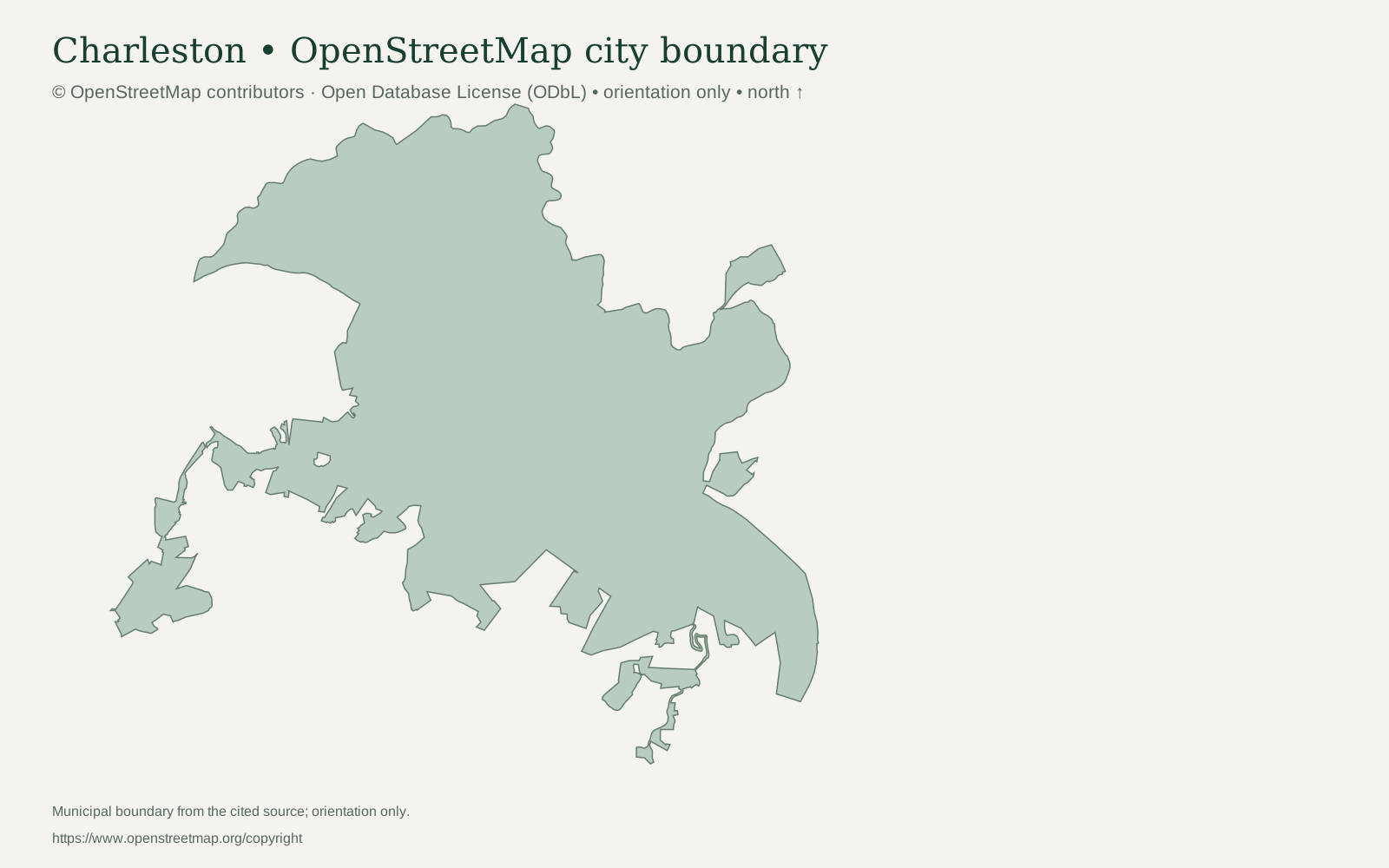
The orientation map uses one municipal boundary from OpenStreetMap, with Open Database License attribution. It shows the city outline, not school zones, flood status, truck routing or official neighborhood borders. Use the six area comparisons below to form questions for a visit; then check the exact property and route with the relevant owner.

Charleston West Virginia municipal boundary from OpenStreetMap, north upward, with contributor attribution
© OpenStreetMap contributors, ODbL. Municipal outline for orientation; not neighborhood, school, parcel or flood boundaries and not a truck route. Open full-size map.

03 /

Find the area that fits your routine

These six comparisons use the City’s planning profiles, checked against the May 2024 comprehensive-plan revision. The older area sheets describe enduring layout and terrain; their project proposals and historical statistics are not current service promises. Inspect the actual building and confirm today’s routes, school and permissions.

Downtown

The City’s downtown plan describes a river-bounded center with a street grid, historic commercial buildings, offices, retail and residential conversions. Its study boundary has a specific planning purpose; everyday usage of the name can be broader or narrower.

Downtown redevelopment plan: area and building patterns ↗
Housing & setting
Ask how the individual building receives furniture, whether an elevator is needed and where household waste is stored. A converted building can have a different service route from its public entrance.
Daily travel
Test the walk to the actual KRT stop and the return trip. Separate resident parking from the loading position used on moving day.
Before choosing
Confirm the loading door, reservation, stair or elevator capacity and any storefront activity sharing the route.

East End

City planning identifies an established neighborhood and historic-district setting around the Washington Street corridor, between Downtown and the Capitol area. The plan’s historic context helps describe the fabric; it does not establish the condition or available services of every block.

East End neighborhood planning profile ↗
Housing & setting
Inspect the porch, vestibule, stair landings and any shared entrance. Check whether the advertised unit includes off-street parking or a separate storage area.
Daily travel
Walk the actual connection to daily destinations and test crossings; proximity to a job center is not a measured commute from every address.
Before choosing
Verify entrance dimensions, meter-space needs and landlord permissions. Ask separately about any proposed exterior alteration.

West Side

The City describes a mix of traditional residential blocks and commercial corridors, with small-lot housing and historic-building reuse. River and highway crossings separate it from Downtown, so the chosen connection matters more than a straight-line distance.

West Side neighborhood planning profile ↗
Housing & setting
Check shared drives, upstairs access and the distance from the lawful vehicle position to the receiving entrance. Evaluate the condition of the actual home independently of area-wide planning observations.
Daily travel
Test the bridge crossing and the current fixed-route or KRTplus connection for the address, including the trip back.
Before choosing
Confirm which door is used for deliveries, where the truck can wait and whether neighbors share the access.

Kanawha City

The planning profile describes a traditional grid of residential streets alongside the long MacCorkle Avenue commercial corridor. That mix creates different conditions on a side street and at a commercial frontage; it should not be treated as one uniform housing type.

Kanawha City planning profile ↗
Housing & setting
Compare the home’s entrance, driveway and rear access. Establish which utility and refuse arrangements belong to the unit, particularly in a divided or shared property.
Daily travel
Try the crossing and daily trip to the relevant shop, workplace or transit pickup, rather than relying on the corridor’s length as evidence of convenient access.
Before choosing
Check driveway clearance, the pedestrian route and any separation from business loading.

South Hills and Corridor G

City planning describes residential hills, the Bridge Road business node and a separate regional retail corridor. Terrain, narrow rights-of-way and limited street connections affect parts of the area; a hilltop or hillside address needs its own route inspection.

South Hills and Corridor G planning profile ↗
Housing & setting
Measure driveway grade, steps and turning room. Ask who maintains retaining features and clears the private route, with photographs that show the entire approach.
Daily travel
Verify the current KRTplus zone and booking options where older fixed routes have changed. Test the actual drive or walk to everyday destinations.
Before choosing
Confirm vehicle access before assuming that a large driveway is usable for the moving truck.

North Charleston

The City’s profile distinguishes hilly, lower-density residential edges from flatter areas with residential and industrial uses. It is a Charleston neighborhood description, not North Charleston, South Carolina, and not the separate West Virginia municipality of South Charleston.

North Charleston, Edgewood and Oakridge planning profile ↗
Housing & setting
Inspect the lot, entrance and the usable position for a vehicle. Ask property-specific questions about drainage, storage and maintenance rather than treating a plan’s broad observations as an inspection.
Daily travel
Check the chosen road connection and current transit service for the address; the whole area does not share one stop or frequency.
Before choosing
Confirm the true municipal address, collection arrangement and room-by-room carrying route.

04 /

Compare the dwelling and recurring costs separately

The ACS 2024 five-year estimates, covering 2020–2024, describe Charleston city as a whole. Of an estimated 21,116 occupied homes, 63.3% were owner occupied and 36.7% renter occupied. The estimated median gross rent was $908 and median owner-occupied value $203,300. These are survey estimates for a past period, not today’s advertised rent, sale price or a budget quote for your home.

Citywide measureACS 2024 five-year estimateUse when comparing a home
Owner / renter share of occupied homes63.3% / 36.7%Market context; it does not show the current available inventory.
Median gross rent$908Ask which utilities and other recurring costs the offered rent includes.
Median owner-occupied value$203,300Compare current property-specific costs and condition independently.
Detached single-unit structures67.0% of all housing unitsInspect the driveway, steps and outdoor maintenance responsibilities.
Structures with two to four units12.3% of all housing unitsCheck shared entrances, stairs, meters and collection arrangements.
Homes built before 194025.5% of all housing unitsMeasure the receiving route and inspect the condition of the actual building.

The structure and age percentages use the estimated 25,544 total housing units, including vacant units, rather than the occupied-home denominator. An older construction date does not by itself establish poor condition, and a newer building does not guarantee a large elevator or unrestricted receiving hours. Ask questions that can be answered for the specific property.

For a rental, obtain the written division of utility bills, refuse charges, parking, snow clearance and minor maintenance. Identify who holds each account and whether there is a shared meter. Ask about deposits, permitted occupants and any move-in booking or contractor conditions without assuming the same terms apply across a neighborhood.

For a purchase, coordinate possession and utility changes with the closing contact. Inspect drainage, the basement or lower floor, retaining features and the driveway where relevant. Ask the appropriate property professional about records or specialist inspections needed for that home; a citywide housing table cannot answer them.

Measure the narrowest doorway, stair turn and landing with your largest pieces in mind. Check that the intended room can actually be reached. A generous floor plan is of limited use if the sofa cannot turn at the entrance or the only vehicle position creates a long uphill carry that was never included in the moving plan.

Partly packed child bedroom viewed through a doorway, with a desk, bookcase and branded linen carton
Compare the usable receiving route as well as the room and housing costs.

05 /

Check today’s KRT service and the return journey

Begin with KRT’s current route schedules and the stop serving the exact address. Check the direction, day of operation, last useful trip and any transfer. Do the same for the trip home. A route name on an older rental listing or neighborhood description is not evidence of the service running today.

The changes effective July 20, 2026 are especially relevant in the hills: fixed routes 11 Wertz, 16 South Park and 18 Fort Hill/Montrose, plus Route 10’s Northgate, Hillcrest and YMCA portion, were replaced by KRTplus service. Route 10 continues to City Park and Renaissance Village. Do not plan a commute from a timetable that still shows a discontinued segment.

KRTplus on-demand service uses six zones: West Charleston, East Charleston, South Hills, Southridge, Kanawha City and South Charleston. Ordinary trips must begin and end in the same zone. Confirm the pickup and destination rather than assuming a citywide door-to-door trip. The published service window is Monday through Saturday, 6 a.m. to 6 p.m.; there is no Sunday service.

Book through the KRTplus or Transit app, or call 304-343-7586. Advance requests can be made up to 14 days ahead, and availability still depends on the schedule. Include every passenger when booking; the operator says additional passengers cannot be added afterward. Be ready for the pickup and check the return booking before relying on the service for an appointment.

The current fare information lists a $1.50 standard single ride. KRTplus has a separate $12 airport point-of-interest fare. Account-based payment through the supported app or BlueCard offers caps of $3.50 per day and $50 per month; paper passes are excluded. Keep one supported payment method for the cap to accumulate. Ordinary cash payment is not the same account-based product.

KRTplus’s free connection to a fixed route within 60 minutes also depends on the stated Transit account or BlueCard method. Work out payment before the first transfer. The benefit is not established merely because two vehicles belong to the same system, and a fare cap cannot solve a missed last trip.

KRTplus Paratransit is a separate eligibility-based service. The May 2026 policy directs applicants to 304-343-0489 and requires a completed application for an eligibility decision. It describes service within three-quarters of a mile of fixed routes and ties availability to when those routes run; the system’s overall operating span does not mean every address has the same hours.

For paratransit, discuss the needed assistance, pickup location, companion and return trip with the dispatcher. The policy accepts reservations up to 14 days ahead and asks for next-day reservations by 4:30 p.m. the preceding day. Its published fare is $3 per ride, with a registered personal care attendant riding free. Confirm eligibility and the actual trip before building your first-week schedule around it.

Whether you drive, walk or use transit, test the bridge crossing, slope and final doorway as part of the journey. Plan a workable alternative for a late shift, an unavailable booked ride or a service interruption. The right comparison is the full trip at your usual hour, not the distance from the property to a line on a map.

White and blue bus at a sidewalk stop with pedestrians and a clear lane ahead
Check the current route or booked service, payment method and return trip.

06 /

Confirm the school before completing the annual packet

Use Kanawha County Schools’ current 2026–27 Back to School Hub as the starting point. The district has reorganized its website, and an older enrollment URL no longer opens. The hub connects families to school contacts, calendars, transportation and beginning-of-year forms; it is a better starting point than a saved search excerpt.

Open the district-linked Find My School / Find My Bus tool. The school tab takes an address and grade; the bus tab combines an address and school with trip options. Use the complete new address, then confirm the assignment, grade and intended start date with the school. A listing’s neighborhood name does not establish placement, and a bus search does not enroll a child.

Contact the receiving school before submitting the linked online packet if the student is new to KCS. Explain the move date, previous school, grade and whether the child already has a West Virginia student number. Ask for the current admission checklist, acceptable residency evidence, any custody documentation needed and the school’s process for obtaining previous records. Keep the contact’s name and any outstanding item on the move checklist.

The 2026–27 handbook discusses certified birth documentation, school records and health documentation. Give the school nurse the student’s circumstances and request the current requirements and assistance route. Physical and dental records, immunization documentation and an out-of-state transfer may require different follow-up; this guide does not replace that individual review or prescribe medical decisions.

The hub’s Beginning-of-the-Year Packet Launcher requests parent or guardian contact information, addresses, emergency contacts and a student table including name, date of birth, WVEIS number, school and grade. It explains that it sends separate student packets by email, using the supplied information. Having those fields ready helps, but completing the launcher should not be treated as confirmation of admission or school assignment.

After the school identifies the correct route, complete the required packet and check for the follow-up email for each student. The hub says paper copies can be requested from the school. Keep confirmation of the agreed start date, the person receiving any remaining documents and the plan for classroom, nursing or support needs. Avoid putting private student information into an ordinary moving-estimate message.

If the family is in temporary housing or cannot immediately obtain documents, contact the school and KCS Attendance and Social Services promptly. The handbook’s McKinney-Vento section describes enrollment help and district-liaison support. Explain the actual housing situation and ask how to begin; do not assume missing paperwork means the child must wait until every household task is finished.

Confirm the correct school calendar as well as the first attendance day. The hub distinguishes the traditional calendar from Piedmont’s year-round calendar. For transportation questions it lists 304-348-6616. Ask about the stop, pickup and return time, and the adult or tag arrangements that apply to the child rather than relying on another family’s experience.

The hub’s 2026–27 bus guidance requires tag scanning for Pre-K through grade 3 and explains grade-specific arrangements. It also states that a lost or forgotten tag does not deny a ride, although the app cannot confirm a boarding without the scan. Coordinate any individual transportation or accessibility needs directly with KCS before the first trip.

Third Base after-school care has a separate 2026–27 application for eligible K–5 KCS pupils at participating or feeder schools. Enrollment is annual, places depend on capacity and some sites have waitlists. Submission or receipt does not equal approval: obtain approval before attendance. Confirm the actual site, pickup responsibility and available start date so after-school care is ready when your work schedule begins.

07 /

Make separate arrangements for power, gas, water and sewer

Ask the owner which services are active, which are included in the rent and whose name belongs on each account. Record the exact unit and service address, possession date, account holder and any access appointment. Do not close an existing account early merely because the truck is booked; align the dates with the handoff of the property.

ServiceStarting pointBefore moving day
ElectricityAppalachian Power start / stop / transferConfirm address, account route, start date and any deposit or access requirement.
Natural gas, where suppliedMountaineer Gas by phoneHave the meter or address information and a date someone can provide access if service is off.
WaterWest Virginia American WaterRequest the correct residential start/stop and confirm the effective date.
SewerCharleston Sanitary BoardArrange separately and coordinate the final water reading when leaving.

Appalachian Power’s service page separates starting a new residential account, transferring within its territory and stopping service. The online route asks for the service and billing information needed to establish the account; a deposit may apply. If the old and new addresses overlap for packing or cleaning, explain the dates so both properties have the service they need.

Mountaineer Gas’s current application instructions direct new-service requests to 800-834-2070. Have the physical address or meter number, prior Mountaineer account if applicable, account-holder and contact details, mailing address and the date access can be provided if gas is off. The provider also asks for identity information; provide it directly through the provider’s process.

Distinguish activating service at an existing home from installing gas at new construction. The gas page asks for additional directions and contractor information where relevant. Ask whether the home needs an appointment, who must be present and which appliances or access points must be ready. A phone request alone is not proof that a technician visit has been completed.

West Virginia American Water’s new-customer page points residents to MyWater for start and stop service. Its customer booklet also explains residential activation, account management and alert preferences. If the portal does not load or the request needs help, use the current West Virginia contact page: 800-685-8660. Confirm the unit, requested date and any necessary meter access.

Do not assume a water request automatically finishes the sewer change. The Charleston Sanitary Board service instructions direct customers to 304-348-8136 with a daytime phone number, the address and the start or stop instructions. Confirm who holds and pays the account if the property is rented or uses shared billing.

When leaving, follow the Sanitary Board termination instructions too. They ask for the CSB account number and state that the account remains in the customer’s name until CSB receives the final meter reading from West Virginia American Water. Coordinate both providers and retain the effective dates and confirmations rather than treating the return of keys as automatic account closure.

Arrange internet and other optional services by the exact unit, installation availability and building permission. Keep a contact method available during the transition. At possession, record the condition and any accessible meter information with the property contact, test the services you are responsible for and report a mismatch through the provider’s normal channel.

08 /

Separate weekly collection from a moving cleanout

Confirm that the property receives Charleston City refuse service and ask the landlord how a shared building presents its waste. The Refuse and Recycling department is the current contact at 304-348-6831. Explain the exact address and whether you need the regular route, a cart, a large-item arrangement or instructions for material left over from the move.

The City’s recycling page says recycling is collected weekly on the same day as garbage and gives broad area routes Tuesday through Friday. Use the actual address to confirm the day and check current holiday notices. A 2025 holiday document still linked from the site is not a 2026 schedule.

Chapter 98 of the City Code places collection at the curb or within five feet of it; where there is no curb, within five feet of the traveled roadway’s edge. Set-out must not be earlier than 6 p.m. on the preceding day or after collection has passed. Standard containers must be removed from the curb by 10 p.m. on collection day. Agree who handles that task if the household is moving out before the pickup.

The live recycling instructions accept aluminum beverage cans, steel food cans, paper and cardboard, and plastics numbered 1 and 2. They exclude glass, plastics 3 through 7, plastic bags and foam. Keep food, liquid and nonaccepted packing materials out of the stream. A recycling symbol alone does not establish acceptance by Charleston’s program.

Keep paper and flattened cartons dry in a covered or waterproof collection arrangement. The current page accepts clearly marked containers during its Toter transition and specifies no more than 48 gallons and less than 40 pounds when full. The curbside FAQ explains that the City-issued cart’s serial number belongs to the address: do not take it to the new home or give it to a neighbor.

The code still contains clear-bag alternatives, while the current collection guidance emphasizes containers and excludes plastic bags from accepted materials. A covered, clearly marked container meets the practical direction without mixing loose bag film into recycling. Ask Refuse before using a different presentation method; keep the actual recyclable materials separate from packaging used to carry them.

For a sofa, mattress, box spring or other bulky item, contact Refuse before putting it outside. Identify each item, its size and condition, the quantity and the address’s service arrangement. Confirm whether a request is needed, the pickup day, allowed amount, any fee and whether the mattress or box spring needs wrapping. The current pages and code do not provide a complete mattress-specific booking and fee schedule, so an ordinary collection day is not sufficient confirmation.

Chapter 98 treats large items as bulky waste and allows special handling and charges; it also excludes renovation debris and certain other materials from standard collection. Do not treat a whole-house cleanout or contractor debris as an unlimited weekly load. If the City directs you to a private hauler or disposal facility, obtain its acceptance, vehicle restrictions, opening hours and charges before loading.

Plan disposal before the old lease or possession period ends. Keep a confirmed alternative if the pickup cannot occur in time, and ensure it includes both lawful disposal and access to the property. A donation inquiry is only useful once the recipient accepts that particular item. Leaving a mattress beside someone else’s dumpster or blocking a sidewalk does not complete the move-out obligation.

09 /

Match the street permission to the actual operation

Start with the City’s Traffic, Parking and Transportation department and a precise description of the setup. Provide the street, nearest address or meter numbers, dates, hours, vehicle length and the working area needed. Identify whether the operation uses existing parking, a loading zone, a travel lane or part of the sidewalk. Private driveway consent belongs to the property owner and does not authorize an obstruction of the public route.

NeedPublished processLimit to keep visible
Reserved metered parking for moving furnitureBagged-meter request through Parking OperationsPayment precedes bagging; short notice does not guarantee a clear space.
Active use of an existing loading zoneVehicle-specific loading-zone permitOrdinary use is up to 30 minutes; extended use needs separate consideration.
Street or sidewalk closureTPT temporary-closure application and traffic-control planAllow seven days for processing and approval; meter rental can also apply.

The current meter-request page links the August 2019 bagged-meter form. It asks for the applicant’s contact details, intended use, number of meters and days, street, zone, meter identifiers and the start and end dates and times. Where a meter number is unknown, the form allows a business address to identify the location. Moving furniture is one of the stated purposes.

The form lists $15 per space per day. It directs payment by check or money order to the City of Charleston through the City Collector, and says meters are bagged only after payment. Contact Parking Operations at 304-348-8158, 915 Quarrier Street, Suite 2, to confirm the current submission and payment arrangements and the exact spaces you need.

Requests with less than 24 hours’ notice cannot guarantee that vehicles will vacate. That is a warning about short notice, not a universal approval deadline. More than five days requires Parking Director approval, and a request involving an accessible meter may be rejected. Ask what to do if a vehicle remains and how to verify the reservation before dispatching the moving truck.

The temporary street and sidewalk closure application is separate. It asks for applicant and property contacts, the city block, description of the activity, dates and daily hours, work-zone length and width, lane-closure or detour details and an attached traffic-control plan. It says to allow seven days for permit processing and approval; the fee is a staff-completed field, not a universal amount published for every move.

The form provides TPT at 612 Washington Street East, Charleston, WV 25301, and tp&t@cityofcharleston.org as submission contacts. If metered parking is involved, it also directs the applicant to Parking Operations for meter rental. Ask which parts apply to the actual move and obtain the approved conditions. A separate excavation authorization mentioned on the form concerns digging or boring, not every household move.

The loading-zone permit application asks for business and vehicle details, registration, proof of insurance and $50 per vehicle. It states five to ten business days for processing and says current permits expire April 1. The permit belongs to the specified vehicle and plate; it is not a resident’s purchase of a reserved curb for an entire moving day.

Ordinary loading-zone use is active loading or unloading for up to 30 minutes. The Parking Director may approve extended use case by case. The permit does not authorize a blocked traffic lane, crosswalk or sidewalk. Ask the moving company to resolve the vehicle-permit question and use the bagging or closure route where the proposed operation calls for it.

Agree the vehicle position only after its permissions and the building’s receiving window are compatible. If the spot cannot be used, a different lawful position may change the carrying distance or require another review. Name the person who can approve the alternative and the time by which that decision must be made; cones, a paid ordinary meter or a pending application are not substitutes for the relevant approval.

10 /

Connect the curb approval to the building’s permission

Public-street permission ends at a different boundary from the landlord’s or association’s authority. You may have an approved curb position and still lack permission to use a driveway, service entrance or elevator. Obtain both sets of conditions and make them compatible with the planned sequence.

Trace the route from the proposed truck position to the final room. Include a vestibule, half-flight, courtyard, basement turn or second elevator if the route uses one. Measure the narrowest openings and the turning space for the largest pieces. Share photographs of the actual path, with doors and gates in the position they will have during the move.

Ask who can reserve and release the elevator, whether other occupants share it, how long the slot lasts and what happens if it is late or unavailable. Establish whether the building requires a certificate of insurance, specific protection, a union arrangement or another contractor condition. These are questions for that property, not claims about every Charleston building.

Identify the recipient and basis of each access payment or deposit, its due date and any return conditions. Keep receipts with the reservation. A fee paid to a building does not itself reserve a City street space, and a City approval does not authorize work beyond the building’s allowed hours.

When an access window is short, ask what may be prepared earlier: protected staging, elevator lining or packed cartons in an approved area. Keep corridors and exits usable. Plan the pickup and destination windows in travel order, allowing for the actual work between them. If one point slips, name who decides whether to continue, pause or use the agreed alternative.

11 /

Try the ordinary routes as well as the riverfront

The City’s parks and community-center directory identifies practical starting points around Charleston: Magic Island at the Elk and Kanawha confluence, Haddad Riverfront Park on Kanawha Boulevard East, East End Community Park on Dixie Street and community centers in Kanawha City and North Charleston. Check the current facility and program details for the activity you actually want to use.

For a home near the river, walk the complete route from the entrance to the public path or park. Check the crossing, slope and return route instead of assuming that a view means direct access. For a home on a hill, include the climb back and the place where a stroller, bicycle or mobility device will be stored.

Try the grocery, pharmacy, work and school trips at their usual hours. If the household will use a car, distinguish an assigned resident space from visitor parking and confirm the arrangement for a second vehicle. If a bus or booked ride is essential, identify the actual return option after an evening appointment.

Older couple and another walker on a riverside path with a railing and wooded hills
Walk the actual connection from the home to the park and back.

12 /

Arrange sidewalk clearance and inspect the private route

Charleston Code section 102-11 assigns snow and ice clearance duties to the specified occupants, people in charge of buildings and owners of unoccupied premises and unimproved lots on paved streets. It calls for snow removal within three hours after the fall, with overnight snowfall between 6 p.m. and 6 a.m. to be removed before 11 a.m. It also addresses ice and keeping gutters unobstructed.

Before moving in, agree with the landlord or property contact who carries out that work and who checks it when the household is away. Ask how the private driveway, porch, steps and landing are handled too. A cleared public roadway does not establish a usable carrying route all the way to the room.

In hillside areas, inspect the grade and the transition between the road, driveway and entrance. Check again after rain, snow removal or refreezing, especially where shade keeps a surface wet or icy. Send the mover a realistic view of the approach and raise a change in conditions before the vehicle reaches a position from which it is difficult to turn.

Keep cartons sheltered during wet weather and agree a dry staging area that preserves the passage through the building. If the approach becomes unusable or an active street restriction removes the agreed position, pause that part of the plan and contact the decision-maker. The alternative needs usable access, permission and agreed costs; a weather concern should not be hidden until unloading is already underway.

Cleared concrete walk and porch steps at a brick house with snow on the lawn
Assign sidewalk and private-route clearance before arrival.

13 /

Make a first-week plan and a usable fallback

Work backward from when you can actually receive the belongings. Write down the person releasing keys, the confirmed possession time, the building reservation and the legal vehicle position. The household’s preferred date is not a substitute for those confirmations. Update the mover when one of them changes.

Before pickupOn arrivalDuring the first week
Confirm possession, street and building permissions, services and inventory.Check the route, keys, utilities and room destinations.Finish school and account follow-ups, collection arrangements and condition records.
Keep documents, medication and essentials with the household.Keep shared corridors and exits open while unloading.Flatten and sort cartons without overfilling the covered cart.
Name the fallback decision-maker and deadline.Pause the affected step when an approval or safe route fails.Close the remaining tasks with their responsible contacts.

A useful Plan B states the trigger, decision time, responsible person and confirmed alternative. For example, if the seller cannot release the home by the agreed checkpoint, the authorized person must decide before the receiving window disappears. A revised date, approved alternative location or storage needs actual availability, access and agreed costs.

Plan for people as well as furniture. Keep essential belongings reachable, decide where the household can wait and preserve medication, childcare and pet arrangements. Identify who notifies the building, utility contact and moving company. State what confirmation is required to resume the original plan.

If the move is urgent, separate what can still be arranged from deadlines that cannot be compressed. Describe the remaining uncertainty openly. A submitted permit, a voicemail to a landlord or a tentative storage inquiry does not equal permission, keys or capacity.

When you are ready to discuss the work, use the Charleston estimate section with the inventory, access details and open questions. Keep the administrative checklist alongside the move plan so the shipment, household and receiving property are ready for the same handoff.

14 /

Questions before you arrive

Does the annual KCS packet confirm my child is enrolled?

The linked launcher collects household information and sends separate student packets. It asks for the school, grade and WVEIS number. A new family should first confirm the admission route, assignment and start date with the receiving school.

Can I still rely on an old South Park or Wertz bus schedule?

KRT replaced routes 11, 16 and 18 and part of Route 10 with KRTplus on July 20, 2026. Check the current service, zone, booking hours and return journey for the actual address.

Are water and sewer one move-in request?

Follow West Virginia American Water and Charleston Sanitary Board separately. When leaving, the CSB account remains in the customer’s name until the Board receives the final water-meter reading.

Can I leave a mattress out with ordinary trash?

Ask Refuse about the exact mattress, box spring and quantity before set-out. Confirm the request, day, preparation and any charge. The ordinary route and a general bulky-waste definition do not provide a complete mattress-specific pickup confirmation.

Is a loading-zone permit a whole-day curb reservation?

No. It is a vehicle-specific permit for active loading and unloading, normally up to 30 minutes. Extended use is considered separately; rented meter spaces and street or sidewalk closure approvals are different processes.

Can a reserved meter space authorize a sidewalk closure?

Meter bagging and closure review are separate. Describe the full working area to Traffic, Parking and Transportation and obtain the conditions for that actual setup before dispatching the truck.

What needs to be ready before the truck loads?

Confirm possession, keys, building access, the receiving window and a lawful vehicle position. Name the person who decides if one fails and prepare an actual alternative with access, capacity, costs and arrangements for the household.

Your next step

Bring the plan together

Use the Charleston moving page to prepare the inventory, access details and questions for your estimate.

Sources & useful local resources

Official procedures and local resources are linked beside the answers above. Reopen the relevant page when arranging a date: fees, schedules and application requirements can change.

Utilities

Housing

Schools

Waste and unpacking

Street access and seasonal preparation

Daily travel

City and neighborhood orientation