Delaware / City relocation guide

Moving to Dover

Dover combines a historic state-capital core, established residential streets and planned development areas. Compare actual homes and everyday journeys, then establish which municipality, school district and service arrangements apply to the chosen address.

Brick downtown buildings, shop windows and two pedestrians beside a crossing
Test everyday routes from the address you are considering.

01 /

Start with the address and the first week

Organize the move around three decisions: where you will live, when the property will be ready and how you will use it each day. A housing advertisement can identify a Dover address without confirming City limits, the resident school district or the provider responsible for each utility. Resolve those questions before combining them into a moving schedule.

For each serious housing option, keep the exact address, unit, possession terms and contact person together. Record your expected trip to work or study, the likely school-registration route, the utility arrangements and the building's loading rules. Comparing the same questions across homes is more useful than choosing a neighborhood from a broad reputation.

Separate the move itself from the tasks that follow. You need keys, usable access and essential services when you arrive. You may need school confirmation, a collection calendar and an internet appointment before the first working week. A later delivery should not block the entrance or prevent access to belongings already in the home.

Use the neighborhood comparisons as geographic starting points, then inspect the property. For inventory, packing and handling arrangements, continue to the Dover moving-services page. Keep unresolved questions visible until the responsible owner, school or public office answers them.

02 /

Dover city, the wider address area and local boundaries

This guide concerns Dover city in Kent County, Delaware. The municipal boundary, a postal address, a school attendance area and a utility service territory are different things. A business using Dover in its mailing address does not automatically put every nearby residence under the same municipal rules. Use the City GIS resources and the parcel address to establish the location before applying the procedures below.

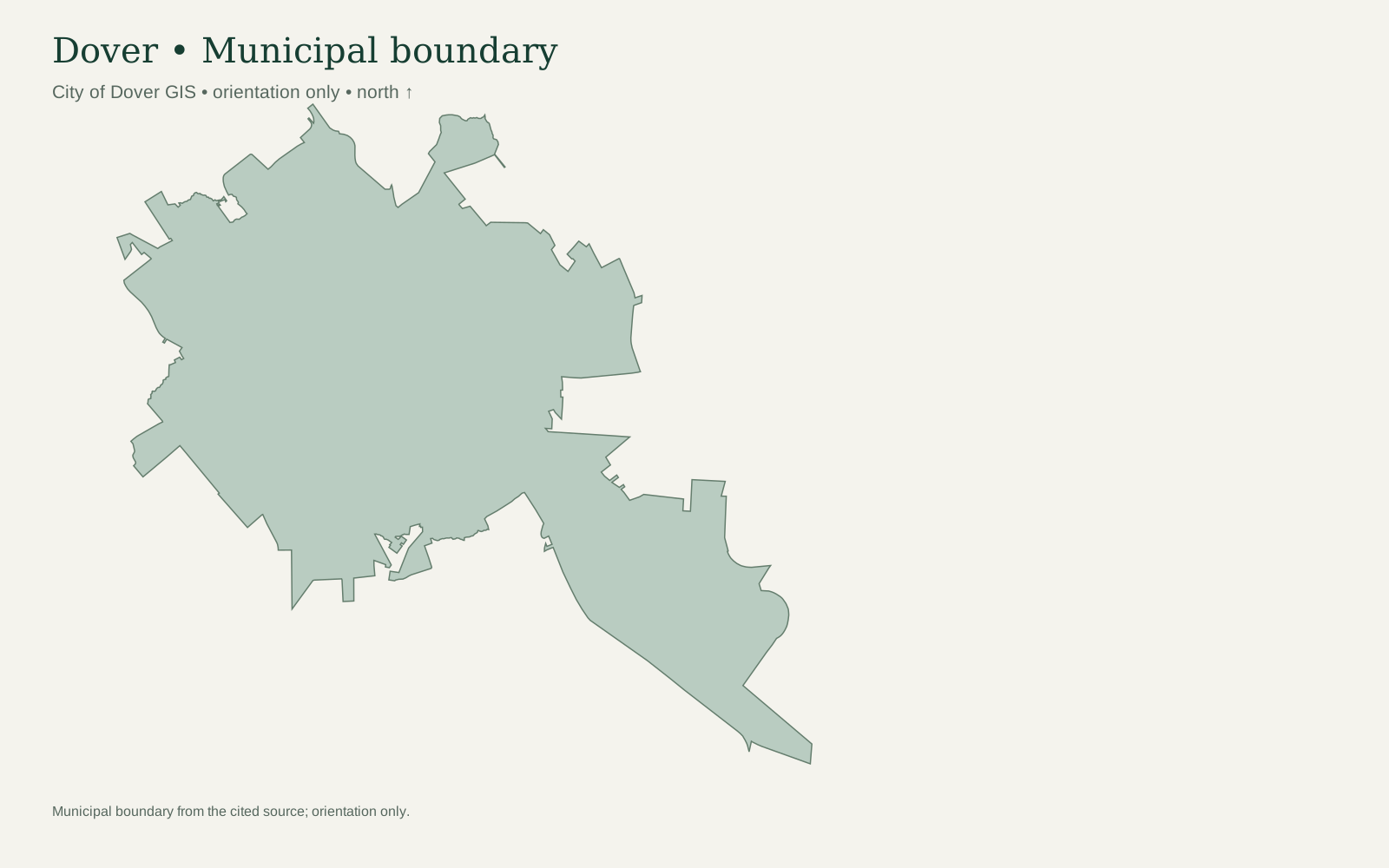
The map presents the boundary layer supplied through the City's parcel-and-zoning application, generalized for orientation. It is not a survey, a current annexation determination, a school-zone map or a route approved for a truck. The source includes historical planning attributes; confirm the jurisdiction of a boundary-edge property directly rather than resolving a close question from this small diagram.

The adopted comprehensive-plan collection helps distinguish the historic center, residential development areas and larger transport corridors. Its adoption date is January 13, 2020. Treat future projects in that plan as proposals or planning objectives until a current source confirms completion. A promised connection, new building or public facility should not be counted as an existing amenity when choosing a home.

The comparisons below include overlapping historic areas and a park-edge reference, not six exhaustive or mutually exclusive administrative neighborhoods. Loockerman Street's downtown setting overlaps parts of Victorian Dover; The Green describes a different historic focal point. An individual building can therefore be relevant to more than one description.

Distinguish university destinations and aviation facilities as well. Delaware State University appears in the City's planning context, but the destination for a particular class or flight-training program still needs its own address. Dover Air Force Base and a public airport have different access arrangements. Confirm the gate, terminal or campus entrance you actually need rather than routing every trip to a generic Dover pin.

Generalized Dover municipal boundary from the City parcel-and-zoning GIS application
City of Dover GIS boundary layer, generalized for orientation. Confirm current jurisdiction at boundary-edge properties; this is not a survey, school-zone or truck-route map. Open full-size map.

03 /

Find the area that fits your routine

These six comparisons use historic records, City planning documents and an official park location. They are starting points for inspecting actual homes, not rankings, school boundaries or promises of available housing. Historic districts can overlap the downtown area; the Silver Lake comparison uses a park as its geographic anchor.

The Green and the historic civic core

The federal preservation account identifies the square laid out in 1717 as the original commercial and residential heart of Dover. This is a historic focal point rather than a uniform housing development.

The Green: historic commercial and residential core ↗
Housing & setting
Inspect the particular building and its present use; a historic facade does not establish the internal layout or permission for alterations.
Daily travel
Try the actual walk to daily destinations and check the curb restrictions at the entrance.
Before choosing
Confirm the usable doorway, steps, exterior-work constraints and lawful loading position.

Victorian Dover

The 1978 National Register nomination describes nineteenth- and early-twentieth-century residential, commercial and industrial development north of the colonial town, including brick and frame buildings.

Victorian Dover Historic District nomination, 1978 ↗
Housing & setting
Older building forms vary by block and may have changed use. Check the present unit, stair turns and utilities rather than treating the historic inventory as a current listing.
Daily travel
Test the route to the specific DART stop and destinations; the district includes more than one type of street.
Before choosing
Check entrances, shared access, parking and any local historic designation separately.

Loockerman Street and the downtown redevelopment area

The 2024 district-renewal application documents downtown housing work and plans for commercial and mixed-use redevelopment around Loockerman Street and South Governors Avenue.

2024 Downtown Development District renewal application ↗
Housing & setting
Distinguish an occupied home from a proposed building or a project still being delivered. Published plans do not confirm current availability or amenities.
Daily travel
Walk the actual route to shops, services and transport, checking any works affecting the connection.
Before choosing
Confirm construction status, entrance arrangements, loading hours and what is included in the specific agreement.

Eden Hill Farm TND

The plan adopted in 2020 identifies a Traditional Neighborhood Design development combining residential, commercial, professional-office and open-space areas. It records completed townhouses and duplexes at that time.

Adopted comprehensive plan: Eden Hill Farm TND ↗
Housing & setting
Use the plan to understand the development concept, then verify the home, phase and shared facilities now offered.
Daily travel
Test the actual road and walking connections; a planned trail or connection is not proof of a completed route.
Before choosing
Request association rules, truck approval, parking allocation and written information on unfinished work.

Lincoln Park near Saulsbury Road

The February 2015 pedestrian plan identifies single-family residential lots east of Saulsbury Road as Lincoln Park and locates Saulsbury Park across the Gateway Boulevard intersection.

February 2015 Pedestrian Plan: Lincoln Park and Saulsbury Road ↗
Housing & setting
Compare the actual dwelling, front approach and parking arrangement. The dated plan supports the area identity, not a claim about every home today.
Daily travel
Inspect current crossings and the route to the park; the plan includes recommendations that must not be assumed completed.
Before choosing
Measure access and confirm the current crossing, collection point and school assignment for the address.

Homes near Silver Lake Park

The official park listing anchors this comparison at 300 Washington Street, with walking paths, play areas and lake access. It is a park-edge reference, not a mapped residential district.

Silver Lake Park: location and permitted recreation ↗
Housing & setting
Nearby homes need individual comparison; the park listing establishes no common dwelling type, ownership arrangement or access right.
Daily travel
Walk to a public entrance rather than assuming the nearest shoreline is an accessible route.
Before choosing
Check the actual approach, property responsibilities and recreation rules. The City prohibits swimming at the park.

04 /

Compare the home, its costs and its practical access

The ACS 2024 five-year profile for Dover city describes estimates covering 2020-2024, not current asking prices. Of an estimated 15,428 occupied homes, 46.9% were owner occupied and 53.1% renter occupied. Median gross rent was $1,344 and median owner-occupied home value was $258,900. Gross rent and a listing's advertised rent can cover different costs; ask what the actual monthly payment includes.

In the separate total-housing-unit measure, about 40.1% of units were detached single-family homes, 14.9% attached single-family homes and 40.1% in buildings containing two or more units. The remaining categories are outside those three groups. An estimated 5.9% of homes were built before 1940. These citywide figures do not describe every block or the condition, availability or cost of a specific dwelling.

Build a property-level budget from the lease or sale documents. Include separately metered services, any association charges, parking, internet, maintenance responsibilities and the initial costs needed to occupy the home. Ask which charges belong to the owner and which will be billed to you. A deposit or an estimated utility payment is not the same as a recurring rent increase.

Walk the entrance before committing the largest furniture. Check the front walk, steps, usable door width and the turn into the main room. For upper floors, inspect the staircase and landing together. In a managed building, ask for the written moving instructions, elevator availability and the actual place from which loading is allowed. A driveway shown in a listing may be shared or too short for the proposed vehicle.

For a historically designated property, ask the owner whether the proposed work affects an exterior feature and consult the City Historic District guidelines. National Register history and local approvals are separate questions. Do not assume that a door, railing or porch can be altered simply to accommodate furniture.

For newer housing, verify what has actually been delivered. The City's 2023 annual planning report documents residential construction in developments including Eden Hill Farm TND; that dated record is evidence of activity, not proof of today's inventory or completion of every phase. Inspect the unit, parking and shared areas covered by your agreement, and retain written answers about anything still under construction.

Two branded kraft cartons stacked beside a sofa and a bright window
Stage packed belongings clear of the route through the room.

05 /

Test DART journeys and the complete return trip

DART First State provides the public-bus network relevant to Dover. Its current route and schedule page separates Kent County routes from intercounty routes and links service notices. The live route feed includes local services such as 101 for Walker Road and Dover High School, 108 for East Dover and 109 for Dover Mall. A route name describes a service corridor; it does not prove that a stop is beside the home you are considering.

Use the exact date, direction and stop when checking a timetable. Read the return journey as carefully as the outward one, including the final service after work, study or an appointment. Weekday, weekend and holiday patterns can differ. If a journey requires a connection, allow time to walk between stops and identify what happens if the first bus arrives too late for the second.

The Route 301 timetable covers the Wilmington-Dover intercounty service. Check current alerts before relying on it and verify any onward connection independently. A convenient bus link to another city does not imply a direct train from your Dover neighborhood or a guaranteed connection to a booked departure.

The published DART fare table uses county-based zones. Its adult cash or DART Pass fare is $2 for one zone and $4 for two; cash requires exact change. Passes, reduced fares and paratransit have separate conditions. Check the fare for the complete trip and the identification needed for any concession. A free or reduced arrangement from another transit system does not carry over automatically.

Walk from the proposed home to the actual stop, including crossings, sidewalk continuity and the way back after dark. Repeat an essential driving journey at the time you expect to make it. Measure the full door-to-door routine, with parking and the walk to the entrance, rather than relying only on a map's driving estimate.

Delaware Airpark is a general aviation facility used for corporate, recreational and flight-training activity. It is not evidence of scheduled passenger flights from Dover. Check the airport code and terminal on any airline booking, then arrange the complete ground journey. A reference to DSU flight training likewise does not identify the entrance for a different university program.

Two people waiting on a sidewalk beside the open boarding door of a white and blue bus
Verify the actual stop, service date and return journey.

06 /

Establish the resident district, then complete enrollment

Begin with the exact residential address in the Delaware School Locator. Dover-area households may encounter Capital or Caesar Rodney district arrangements, and attendance assignments are more specific than the city name. Confirm the result with the receiving school, especially near a district boundary, in a new development or when the unit address has recently changed. A house near a school is not proof of assignment there.

Capital School District

The Capital enrollment page identifies the sequence: find the resident school, gather documents and submit the online or paper registration. It currently offers 2026-2027 online registration. Kindergarten ordinarily requires a child to be five on or before August 31 of that school year. Pre-K has its own eligibility and invitation process; the age threshold alone does not secure a place.

The listed documents include the child's birth certificate, parent or guardian photo ID, residence evidence such as a utility bill or legal landlord agreement, immunization records, a current physical, TB screening or test results, lead-test results and evidence of parenthood or guardianship. Custody or primary-placement documents may be relevant. For a transfer, prepare withdrawal papers, school reports or a transcript and any applicable IEP or 504 documentation.

Use the current enrollment page to reach the correct year's application and ask the school which forms apply to the child. Paper links can retain older year labels, so confirm the packet before completing it. Capital's current school list distinguishes early-childhood centers from other elementary grades; do not assume that kindergarten is delivered at every neighborhood elementary building.

Caesar Rodney School District

The Caesar Rodney enrollment page provides 2026-2027 preregistration, a locator and school-office contacts. Its linked document checklist calls for a birth certificate, residence proof, immunization records, a physical from within the last two years and parent or guardian photo identification. A mortgage statement or lease in the parent's or guardian's name is the primary residence evidence described; where neither is available, it lists an electric, gas or water bill. Ask the receiving school about the right evidence for a different living arrangement.

Include custody, IEP or 504 documents where applicable. Transfer students should provide withdrawal information and grades or report cards, with standardized test results if available. Keep copies accessible while boxes are in transit. Families registering for Charlton or the Kent County ILC are directed to contact the school for an intake appointment rather than treating ordinary preregistration as the whole process.

Resolve exceptions and obtain confirmation

Both districts identify support for students eligible under McKinney-Vento when a family is experiencing homelessness or a temporary living arrangement. Missing ordinary paperwork should not be treated as a reason to abandon registration; contact the district liaison about the appropriate process. Explain the actual living situation so the school can determine what applies.

School Choice is a separate process. Capital expressly directs families to register with their resident school before applying for choice. Do not assume that a requested school has accepted the child until you receive the relevant confirmation.

Caesar Rodney separately lists eligibility evidence for Dover Air Force Base schools, including qualifying military or DoDEA circumstances and housing documentation; contractors are listed as ineligible. An address near the base or a job connected to it is not enough to establish eligibility. Ask the school to evaluate the household's actual situation and documents.

After submitting, follow up with the school for receipt, outstanding documents, assignment and the starting date. Confirm transport, meal arrangements and any support plan separately. A portal confirmation shows a submission, not necessarily the end of enrollment. Keep the school contact and reference information in the first-week folder.

07 /

Open the correct accounts and close the old ones

Ask the owner which services are supplied directly to the unit, which meters belong to it and which costs are included in rent or association charges. Dover operates municipal utility services, but a Dover mailing address does not prove that every service at the property comes from the City. Verify the service address and the actual account holder before applying.

The City's Customer Services office is at Weyandt Hall, 5 East Reed Street, with telephone 302-736-7035. It posts weekday office hours of 8:30 a.m. to 5 p.m., with new service sign-ups and transfers required before 4:30 p.m. The call center also ends at 4:30 p.m. Check holiday closures and ask how the desired service date will be confirmed.

The residential application revised April 2026 requests applicant and service-address information, a copy of photo identification and a signed lease or sale agreement. It also states that online sign-up bills the full deposit in one installment. Prepare the current form and provide personal information only through the City's designated process. Ask Customer Services for the applicable deposit, any previous-balance issue and what must be completed before service can begin; the form does not establish one universal deposit for every household.

Distinguish application submission from active service. Confirm the accepted start or transfer date, whether anyone must provide meter access and how a problem will be handled if possession changes. Test the essential services when you obtain access to the property. A lit room during a viewing may still be served under the owner's account.

The City connection and disconnection guidance requires an explicit termination request. It describes a window from thirty days ahead to at least one business day's notice, with identification, the disconnection date and a forwarding address. Charges continue until the required request and final meter-reading process are completed. Ask for confirmation of the final date and account settlement; simply moving out or returning keys does not close the account.

Where the property uses natural gas, check the actual provider and meter. Chesapeake Utilities offers separate start, stop and transfer forms. Its start process distinguishes activating an existing gas-equipped property from installing a new connection. Give both addresses and dates for a transfer, and confirm access or appointment requirements with the provider. A requested date is not a service guarantee.

Book internet separately for the exact unit and usable installation date. Ask the landlord about permitted cable routes and equipment locations before an installer arrives. Keep old and new account references, confirmations and contact numbers together, with enough overlap to preserve the services you still need while leaving the former property.

08 /

Use the right collection week for cartons and bulky items

First establish whether the property receives City collection or uses a private arrangement through a landlord, association or business. The City's sanitation page provides address-based trash and recycling maps and the current collection calendar. Ask where the assigned containers belong, which day applies and whether the unit shares a collection point. A bin outside a building is not evidence that it is available to your household.

The currently linked residential guidelines, dated June 2019 direct residents to put bagged household trash in the City-provided 90-gallon cart, with nothing on top. Leave at least three feet from cars, mailboxes, fences and other obstructions, and orient the cart as shown. Set out by 7 a.m. on collection day, or after 7 p.m. the preceding evening. Arrange moving materials so they do not block cart access or the pedestrian route.

The recycling sheet includes paper, accepted containers, cartons, paperboard and corrugated cardboard. Items belong loose, empty, clean and dry in the recycling container. Keep plastic bags, foam, electronics, batteries and other excluded materials out of it. Separate packing film and protective foam while unpacking; a material's usefulness for moving does not make it acceptable in curbside recycling. Ask the collector how to handle cardboard that exceeds the available cart capacity.

Check the correct area in the 2026 recycling calendar, including holiday adjustments. The City's bulk schedule distinguishes household bulk from bulk yard material: household furniture, large appliances and rugs are collected on the week opposite recycling, while bulk yard material follows the recycling week. Do not infer the week from another street or from a neighbor's pile.

The Public Works FAQ says to contact 302-736-7025 in advance for a pile larger than four by eight by four feet. The linked guidelines also require bulk to be neatly arranged at the curb, clear of overhead power lines, buildings and fences. Ordinary collection does not include tires, hazardous material or construction and remodeling debris. The FAQ directs hazardous-waste questions to Delaware Solid Waste Authority rather than the household trash cart.

For a mattress or box spring, identify each item when asking Public Works or the actual collector to confirm acceptance, the correct week, required wrapping and any charge or quantity limit. The general furniture wording does not resolve all mattress preparation questions. Keep the items on private property until the applicable instructions and lawful setout time are clear; do not assume a separate free mattress entitlement.

Plan the disposal sequence before moving day. Donated items need an accepted recipient and pickup arrangement, while rejected or excess material needs another authorized route. Confirm whether packaging removal is included in your moving scope. Remove City carts from the street-side collection position by 8 p.m. on collection day, as the FAQ specifies, and keep exits usable during the unpacking period.

09 /

Follow the moving-van parking and obstruction decision path

Choose the intended loading position before deciding that the truck can use it. Photograph the curb, signs, nearby driveways and the path to the entrance. Record the address, side of the street, date, proposed hours, truck dimensions and space needed for any loading equipment. Private property permission and public street permission are separate questions.

1. Request the relevant parking exception

The City's parking-permit page specifically sends temporary requests for visitors or exceptions such as moving vans to Police. Temporary permits cannot exceed thirty days. This establishes a published route for the request; it does not publish a thirty-day advance notice rule, guarantee an empty space or establish that every truck can remain for the full period.

Use Dover Police non-emergency contact, 302-736-7111, to reach the unit handling the request. Explain whether the vehicle needs relief from a time limit, a designated loading position or more substantial control of the street. Ask whether the resident or moving company should apply and what form, vehicle details, fees and lead time apply. Obtain instructions for the actual move rather than relying on a general conversation about residential parking.

2. Establish who controls signs and enforcement

Ask whether the proposed space can be reserved, who may place any approved signs, when they must be posted and what record of existing parked vehicles is required. Clarify how a vehicle occupying the position should be reported and what enforcement is available. Do not assume that a permit automatically authorizes private cones, homemade signs, towing or blocking a neighbor's access.

Annual residential or business parking permits are a different scheme. The City says they expire July 15 and describes limits on the number of stickers; those stickers concern designated parking areas and time restrictions. They do not by themselves settle the moving truck's dimensions, loading equipment or entitlement to a particular space. Check the posted restrictions on the exact street even when the household already has a sticker.

3. Refer an obstruction to the responsible road authority

If the proposed operation affects a travel lane, sidewalk, ramp route or other public right-of-way, ask Police whether further authorization is needed from City Public Works or another road owner. Public Works can be reached at 302-736-7025. Explain the obstruction and duration explicitly; a parking exception is not permission to make pedestrians walk into traffic.

The published right-of-way maintenance and construction application covers a different type of work. It requests construction details and a traffic-maintenance case number, and requires written City Engineer permission for a street closure under that permit. Its twenty-four-hour pre-work contact and utility-location instructions are construction provisions, not a verified household moving application deadline. Ask which process actually applies before submitting a form intended for another activity.

4. Reconfirm the arrangement before arrival

Retain the approval, conditions, posting instructions and responsible contact. Confirm any building or private-drive permission as well, including a clear route and time window. Recheck temporary restrictions and weather close to the move, and make sure the moving contact has the authorized position.

If the space is occupied or no longer usable, contact the responsible office and review a lawful alternative. Measure the resulting carrying distance and identify any additional handling before agreeing to the change. A different curb, an extended stay or a blocked lane should not be improvised from the earlier permission. The moving-services page carries the corresponding information into the estimate and access plan.

10 /

Inspect the whole route inside and outside

View the home as a sequence of connected spaces: truck position, footpath, steps, landing, doorway, internal turn and destination room. The tightest connection can determine how an item must be prepared. Measure the usable opening with the door in its permitted position, and note any projecting handle, radiator, fixture or low ceiling that narrows the route.

For older buildings, compare the largest furniture with the stair turns as well as the front door. Ask about another authorized entrance before assuming a piece must be taken apart. Do not remove railings, doors or fixed features without the owner's agreement and any applicable approval. Photographs help explain the layout, but a wide-angle image is not a substitute for dimensions.

For an apartment, condominium or managed development, get the moving instructions from the person responsible for the property. Ask about permitted hours, access reservations, required insurance documentation, floor or wall protection and the approved truck location. Establish who supplies keys or gate access and who is available if the arrangement changes.

A shared loading point can be committed to another resident, delivery or maintenance task. Confirm the reservation against the actual date, and ask how long the vehicle can remain. Preserve access for neighbors and emergency services. A resident parking allocation does not necessarily give permission for a commercial truck to occupy the same space.

Tell the moving contact about long carries, uneven ground, exterior steps and difficult turns before the estimate is finalized. Identify which items need specialist preparation or another qualified service provider. Keep utility meters, exit doors and essential controls accessible while staging boxes. On the day, walk the route again with the receiving contact so a new obstruction is found before the first heavy item is carried.

11 /

Try the routines that will make the address work

Test ordinary errands from the home, not only the destinations that first attracted you to Dover. Identify where you will buy groceries, collect prescriptions, receive parcels and reach essential appointments. Check opening hours and the last transport option on the days you expect to use them. A place can be close on a map yet require a different crossing or entrance in practice.

The City park directory provides useful starting points for walks and recreation. Choose the actual park entrance and inspect the route from home, including the crossing back. A park nearby does not establish a continuous public path from every neighboring property or permission to cross private grounds.

For a household with children, an older relative or someone using mobility equipment, test the route with the relevant needs in mind. Check surfaces, resting opportunities and access to the destination. For pets, confirm property rules and the permitted use of the chosen outdoor space rather than assuming every lawn is open to them.

Keep a short first-week list: collection point, school contact, account confirmations, internet appointment and the building manager's details. Update addresses with the organizations you actually use, and arrange secure receipt of important deliveries. Do not leave private access codes visible in labels or shared moving instructions.

Two walkers following a paved park path beside a calm lake and autumn trees
Try the public entrance and the route from home.

12 /

Use the current snow rule and prepare the full approach

Dover changed its sidewalk snow provision in 2025. Under Ordinance 2025-05, adopted May 12, 2025, the owner, occupant or person controlling a property must keep the adjoining sidewalk clear of snow and ice once twenty-four hours have passed after snowfall ends. It must remain clear afterward. Older references to twelve hours of daylight describe the previous wording and should not set the plan for a new move.

Assign responsibility for clearing before the truck arrives. The public sidewalk, private front walk, stairs and landing all matter, even though they are not identical parts of the ordinance. An apparently cleared frontage may lead to icy or snow-covered steps. Check each segment and make the necessary arrangements with the owner or building manager.

For questions about the property obligation or current enforcement, use City Code Enforcement. Keep any official notice with the relevant dates. The move should be planned for usable access; waiting until a legal deadline is close does not make a carrying route suitable or establish that work can proceed.

At other times of year, inspect wet paving, leaves, drainage and the place where cartons will be staged. Keep packing materials out of public passage and storm drains. Reconfirm local restrictions when construction, events or weather alter the expected truck location. If the receiving property becomes unavailable, tell the moving contact before departure and agree the practical alternative, including any extra handling or storage that it requires.

Resident with a shovel beside a cleared sidewalk and snow-covered entrance steps
A clear public sidewalk does not confirm that the private steps are ready.

13 /

Prepare keys, essential belongings and an agreed Plan B

Confirm possession and the entry arrangement before dispatch. Have the receiving contact's number, working keys and any authorized gate instructions available. Verify that the approved loading position and building window match the plan. Keep the permission record accessible; it should not be inside a carton that cannot be reached until unloading is complete.

Carry documents, medicines, chargers, essential clothing and the first night's supplies separately. Include the school and utility reference information needed during the first working days. Set aside what belongs to the owner or previous occupant so it is not mixed into your delivery, and mark rooms or furniture positions in a way the receiving contact can explain.

Walk through the property on arrival, checking service readiness, the carrying path and the destination rooms. Explain fragile surfaces and the agreed placement of large items before cartons narrow the space. Keep children, pets and visitors out of the work route, and maintain access to doors and essential household controls.

If keys, a reservation or a public loading position fails, pause to resolve the specific problem. Contact the property owner or relevant authority and then review the change with the moving contact. A longer carry, another delivery day or storage can change the work involved; obtain the revised arrangement before treating it as part of the original plan.

After delivery, complete a room-by-room check while the receiving information is still fresh. Keep the inventory and service documents, identify anything needing follow-up and schedule collection of packaging using the property's actual rules. Avoid leaving excess cartons or unwanted furniture at the curb merely because the moving vehicle has departed.

For the first week, confirm school admission details, final utility dates at the old home, new account activation and the correct trash and recycling pattern. Close each task with a confirmation from the responsible party. The Dover estimate section explains what to send if inventory, services or access change before the move.

14 /

Questions before you arrive

Does a Dover mailing address establish City services?

No. Confirm the municipality, school assignment and service territory for the exact property. Postal names and public-service boundaries are not interchangeable.

Which school district should I contact?

Use the Delaware School Locator with the complete address and confirm with the receiving school. Capital and Caesar Rodney publish separate enrollment paths, and base-school eligibility has additional requirements.

What is the kindergarten age cutoff?

The district guidance ordinarily requires a child to be five on or before August 31 of the school year. Confirm the applicable enrollment year and any individual exception directly with the resident district.

Will the City utility account close when I move out?

No. The account holder must request termination, provide the required information and confirm the final meter-reading and billing process. Returning keys does not itself close the account.

When is household bulk collected?

The City describes household bulk on the week opposite recycling. Confirm the address calendar, pile limit and exclusions. Ask specifically about mattress acceptance, preparation and any charge before putting one outside.

Does a temporary moving-van permit guarantee an empty space?

The published duration limit does not establish a reserved-space guarantee. Confirm permission, any authorized posting and current enforcement instructions with Police, plus any separate obstruction approval.

How soon must snow be cleared from the sidewalk?

The ordinance adopted May 12, 2025 requires adjoining sidewalks to be clear within twenty-four hours after snowfall ends and to remain clear. Prepare the private walk and steps as well so the whole moving route is usable.

Your next step

Bring the plan together

Use the Dover moving page to prepare the inventory, access details and questions for your estimate.

Sources & useful local resources

Official procedures and local resources are linked beside the answers above. Reopen the relevant page when arranging a date: fees, schedules and application requirements can change.

Housing

Utilities

Truck space

Schools

Neighborhood context

Orientation

Weather

Waste

Everyday life

Transport