Connecticut / City relocation guide

Moving to Hartford

Hartford is a renter-majority city of triple-deckers, towers and choice-based schools. This guide helps you compare areas, plan the everyday basics and prepare the practical steps of arriving.

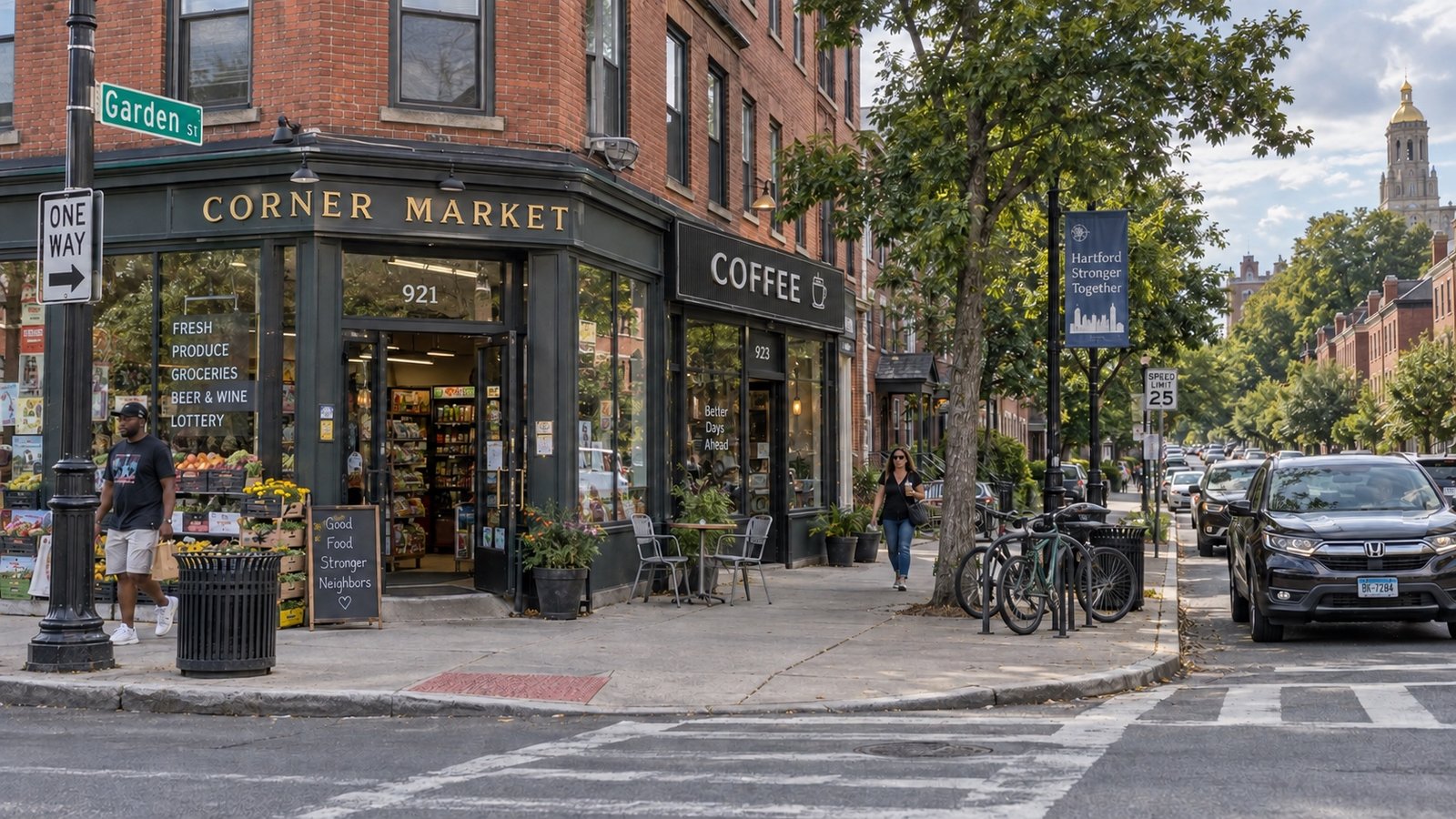
A corner store beside brick apartment buildings with bicycles and distant pedestrians.
Try the everyday errands around a new address, not only the journey to work.

01 /

Start with the decision in front of you

Hartford asks three different questions of a newcomer, and this guide is organized around them. If you are still choosing where to live, start with the orientation and the neighborhood comparison, then read the housing section — Hartford's market is mostly rentals in older multi-family buildings, and the differences that matter are stairs, light, parking and what the rent includes. If you are moving with children, go to the schools section early: Hartford runs a choice system with fixed application windows, not automatic assignment. If the address is already decided, the second half of the guide walks through the practical setup — utilities, waste, the curb for the moving truck, building access and the arrival sequence.

One caution before any comparison: Hartford is a city of 17 official districts, but everyday names, postal ZIP codes, revitalization-zone designations and school zones all draw different maps. Verify each address against the map that matters for the decision at hand.

02 /

Understand Hartford before comparing addresses

Hartford is the state capital and one of New England's oldest cities, sitting on the Connecticut River where I-91 meets I-84. The city itself is compact — most residential addresses are within a few miles of downtown — and it borders West Hartford, Bloomfield, Windsor, East Hartford, Wethersfield and Newington, all separate municipalities with separate rules. A "Hartford area" description and a Hartford address are not the same thing; confirm the municipality before comparing procedures.

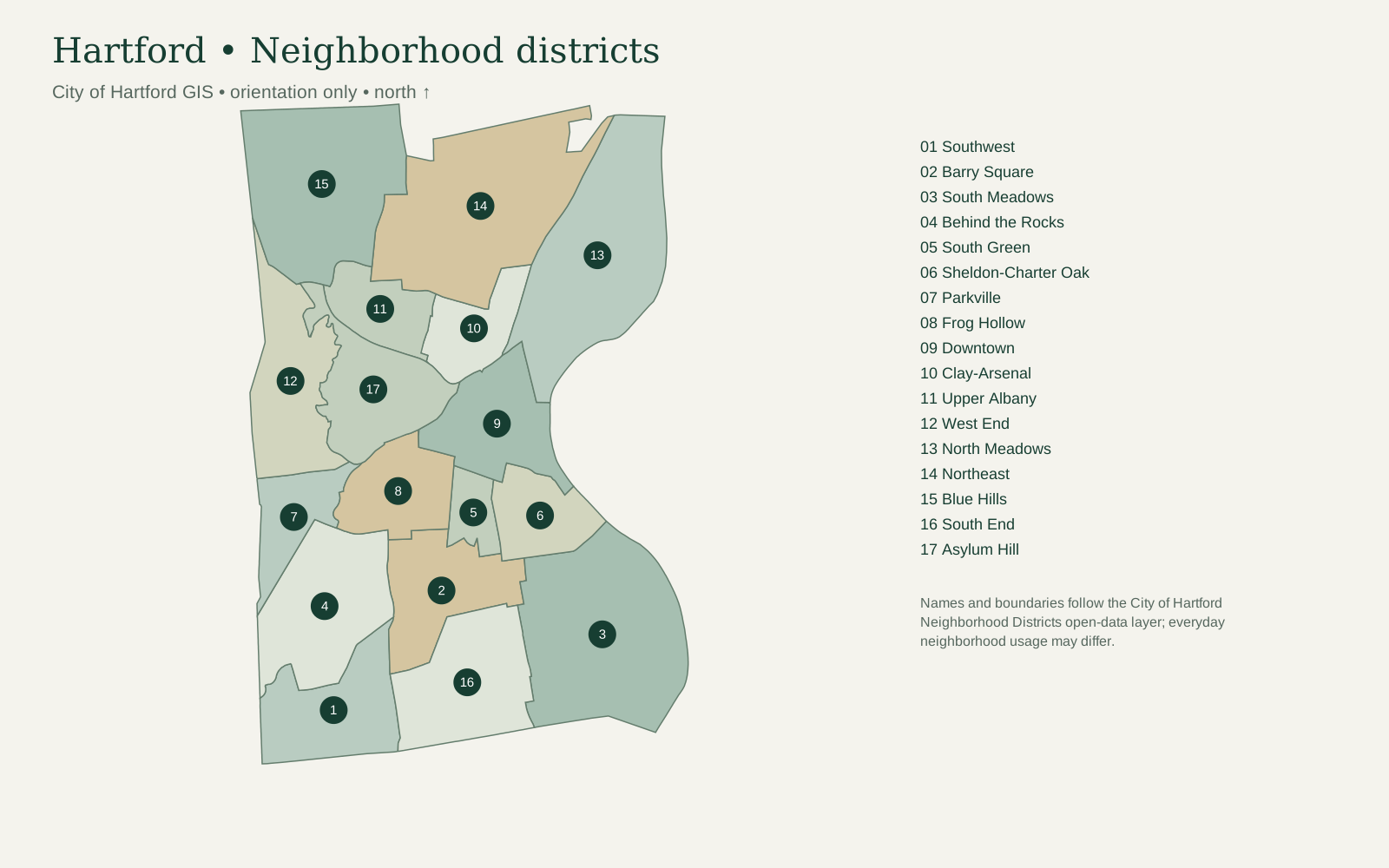
The city's own geography divides Hartford into 17 Neighborhood Districts, mapped below from the City's open-data layer. They are planning geography: postal ZIP codes cross them, and the city's Neighborhood Revitalization Zones — community bodies recognized by the city, some sharing a neighborhood's name with different boundaries — are a different overlay again. None of these lines assigns a school or guarantees a building condition.

One naming trap matters for movers: the University of Hartford is not in Hartford — its campus is in West Hartford. Two colleges really are in the city: Trinity College on Summit Street and UConn Hartford downtown on Prospect Street. Addresses marketed as "near UHart" may sit in another town entirely, with another town's rules.

Hartford orientation map with numbered area key
Use the numbered key to locate the areas discussed below. Open full-size map.

03 /

Find the area that fits your routine

Hartford has 17 official Neighborhood Districts; the eight below are the ones a household is most likely to compare, chosen for their verified housing character. They are starting points for inspection, not rankings — school placement follows the choice system described below, and building conditions vary house by house.

Downtown

Hartford's business and government core — state and city offices, the Convention Center and the Riverfront. Residential life here means apartments: towers and office-to-residential conversions rather than houses.

Neighborhood Districts — Open Data Hartford ↗
Housing & setting
Expect managed buildings with elevators, set moving windows and certificate-of-insurance requirements. Compare what the rent includes and ask for the building's written moving rules before signing.
Daily travel
The strongest transit position in the city: Union Station with CTrail and Amtrak trains, CTfastrak, local buses and the free weekday dash shuttle are all here.
Before choosing
Confirm the loading arrangement and elevator reservation procedure early; downtown curb space is metered and enforced, so the truck plan belongs in the lease conversation.

West End

Hartford's classic Victorian district: the West End South historic district records mostly single-family homes built between 1855 and 1925 in Queen Anne and Shingle styles, along side streets off Farmington Avenue.

West End South Historic District nomination (NPS) ↗
Housing & setting
Predominantly houses rather than apartments, with porches and driveways — and the maintenance questions that come with older construction.
Daily travel
Farmington Avenue buses serve the area and downtown is a short ride east; test the walk to the specific stop you would use.
Before choosing
Older single-family stock means checking porch stairs, narrow drives and basement access; confirm what the sale or lease says about snow clearing and repairs.

Asylum Hill

A mixed uphill district along Farmington and Asylum Avenues: 19th-century houses survive between 20th-century apartment buildings and major insurance employers. The Nook Farm area holds the Mark Twain and Harriet Beecher Stowe houses.

Nook Farm and Woodland Street District nomination (NPS) ↗
Housing & setting
Mostly apartments in older houses and mid-rise buildings; compare the specific building's entry, stairs and laundry rather than the avenue's reputation.
Daily travel
Well served by the Farmington and Asylum Avenue bus corridors, with a short ride downtown.
Before choosing
Verify parking before the move: parts of the hill fall in signed residential-permit streets — the Parking Authority lists Collins, Spring and Sumner — and a personal permit does not cover a moving truck.

Frog Hollow

A dense district south of downtown whose multi-family stock was built for factory households between 1890 and 1910; the national-register nomination calls it primarily multiple-family dwellings. Park Street is the commercial spine, and Trinity College sits at its southern edge.

Frog Hollow Historic District nomination (NPS) ↗
Housing & setting
Expect two-to-six-family houses and triple-deckers with shared entries; compare the staircase, the floor and the entry you will actually use.
Daily travel
Park Street buses reach downtown in minutes; walk the route you would use daily.
Before choosing
Verify where a truck can stop on the narrower side streets, and ask the landlord about shared-hall rules before moving day.

Upper Albany

The national-register nomination describes this district as almost exclusively large, two-family frame houses in Queen Anne and Colonial Revival styles, built as middle-class housing in the first two decades of the 1900s. Albany Avenue is the commercial artery.

Upper Albany Historic District nomination (NPS) ↗
Housing & setting
Two-family frame houses dominate, with scattered triple-deckers and brick apartment blocks; expect driveways and yards more often than in the inner districts.
Daily travel
Albany Avenue buses run toward downtown; check the specific stop and schedule for your routine.
Before choosing
Two-family houses often mean shared driveways and basement-storage questions — settle both in the lease.

Clay-Arsenal

One of Hartford's oldest residential areas, north of downtown. The Clay Hill historic district preserves brick two-to-six-family houses built from the Civil War era to World War I; the nomination counts about 221 contributing buildings.

Clay Hill Historic District nomination (NPS) ↗
Housing & setting
Older brick multi-family stock with the access quirks of its era — stoops, narrow halls, high thresholds; inspect the route from curb to apartment.
Daily travel
Main Street buses serve the district, and downtown is walkable from its southern blocks.
Before choosing
Pre-war masonry buildings vary widely in condition; check windows, heat and stairways as carefully as the rooms.

Parkville

A mixed industrial-residential district on the west side, where factories once anchored the blocks. The 2015 national-register nomination counts mostly two- and three-unit residences among its multi-family stock — Perfect Threes and triple-deckers built for factory households.

Parkville Historic District nomination (NPS) ↗
Housing & setting
Two- and three-family houses plus some larger apartment buildings; industrial conversions add loft-style options with their own access rules.
Daily travel
A genuine transit advantage: the CTfastrak guideway crosses the district — Parkville has its own station on the Hartford–New Britain line — and New Park Avenue buses run toward downtown.
Before choosing
Truck access near the I-84 corridor varies street by street; confirm the final approach and the curb before booking.

South Green

A small historic district just south of downtown: national-register documentation describes 19th-century homes ranging from Victorian mansions to modest brick double houses, plus early-20th-century six-family apartment blocks — almost universally masonry.

South Green Historic District documentation (NPS) ↗
Housing & setting
Brick doubles and small apartment buildings; entries are often shared, with stoops rather than driveways.
Daily travel
Immediately south of downtown — many addresses are a short bus ride or walk from the core.
Before choosing
Stoops and shared entries concentrate the carry; confirm where the truck may stand on these narrower streets.

04 /

Compare the whole home, not just the advertised payment

Hartford is a renter's city: 74.3% of households rent their home (ACS 2024 5-year, via Census Reporter). The median gross rent is $1,269 a month and the median owner-occupied value $228,600 — but medians describe the whole city at once, not the apartment in front of you, and listing sites' asking rents run above survey medians. Use them only to sanity-check a budget.

The stock explains the market. About one in three Hartford homes sits in a two-to-four-unit building — the triple-decker is the signature form — about 40% of units were built before 1940, and downtown adds towers and office-to-apartment conversions. For a mover this means the differences that matter are physical: which floor, stairs or elevator, where a truck can stop, how heat is supplied and who clears the sidewalk. Older radiators and bay windows come with the charm; so do narrow staircases with landing turns.

When comparing two apartments, compare what the payment includes — heat, hot water, parking, snow clearing — the lease's move-in and move-out rules, and the condition of the access route: porch boards, stair rails, door widths. Ask early who handles bulky disposal when you leave; Hartford's bulky pickup is appointment-based, and in buildings over six units trash service runs through the landlord, not the city.

A furnished living room with a bay window and sealed moving boxes stacked by the wall.
Compare usable rooms, light, storage and what the rent actually includes.

05 /

Test the complete daily journey

Hartford is one of the few mid-size American cities where a car-light household is realistic, at least in the core. CTtransit's Hartford Division runs local and express buses across 27 towns, many seven days a week; a local ride costs $1.75 for two hours, or $63 for a 31-day pass. The spine of the system is CTfastrak, a bus rapid transit line on a dedicated 9.1-mile guideway between Hartford and New Britain with 10 stations; its route 101 runs every 7–8 minutes at peak, every day of the year. CTfastrak is proof-of-payment — buy before you board.

Hartford Union Station anchors regional rail: the CTrail Hartford Line runs seven days a week between New Haven and Springfield, with a Metro-North connection at New Haven for New York City, and Amtrak's Hartford Line, Northeast Regional, Valley Flyer and Vermonter trains also stop there. Check the schedule page for your travel date — some trips are currently bus-substituted for construction. Downtown, the free dash shuttle loops every 15 minutes on weekdays between the Convention Center, the Riverfront and the arts district.

For flights, Bradley International Airport sits in Windsor Locks, about a 15-minute drive via I-91; the 30-Bradley Flyer bus connects the airport with Union Station and the Convention Center in about 30 minutes. Whichever mode you expect to use, test the real door-to-door journey from the specific address — the walk, the wait and the last connection included — at the hour you would actually travel.

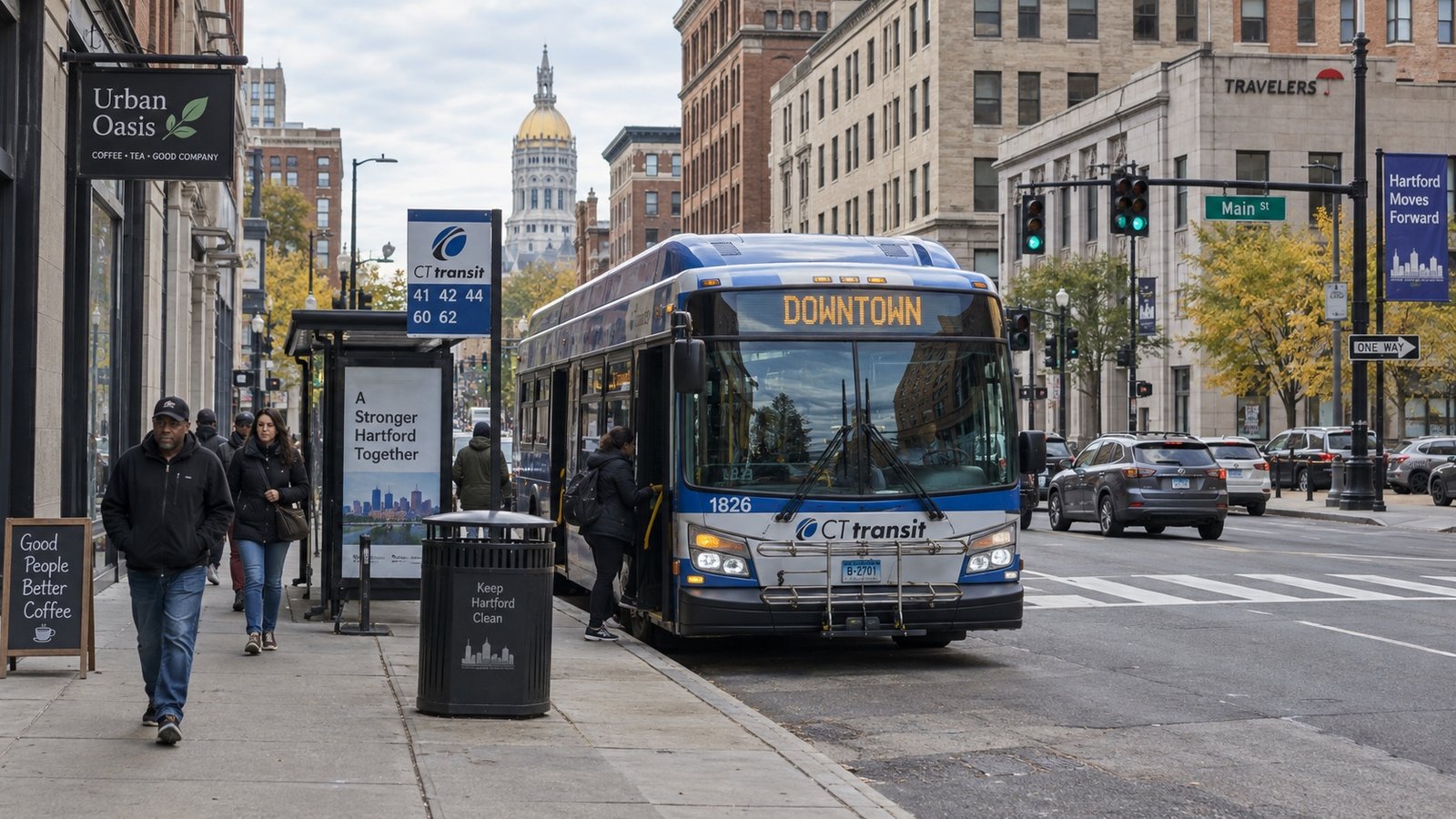
A downtown street with mid-rise office buildings and a city bus at a stop.
Test the complete daily journey, including the walk at both ends.

06 /

Treat school placement as an application, not an address

Hartford does not assign children to a neighborhood school by default. Hartford Public Schools is a choice district, and its enrollment page is explicit that there are two separate applications: the HPS District Choice Placement Process for district schools — Hartford residents only, with zone-based preferences, so look up your address's zone first — and the state's Regional School Choice Office application for magnet, Open Choice and technical schools. Do not sign a lease counting on a specific school.

TrackWho may applyWhat it covers
HPS District Choice Placement ProcessHartford residents onlyDistrict (non-magnet) schools, with zone-based preferences
RSCO application (chooseyourschool.org)Hartford and suburban residentsMagnet schools, Open Choice to suburban districts, technical high schools

The RSCO application runs on an annual cycle; for the 2027-28 school year it opens December 2, 2026. Placement is a ranked-choice protocol, not first-come: you may receive only one offer, there are more applicants than seats, and repeat applicants gain priority only by reusing the same account. Rank only schools you would accept.

Mid-year arrivals and new Hartford residents register directly: an online pre-registration, then in-person document verification with proofs of guardianship, the child's age and Hartford residency — including a notarized residency certification if you are staying with family or friends. Kindergarten requires age five by September 1, and new students need a recent physical and immunization record. District pages currently list two different walk-in addresses, so call 860-695-8876 before visiting. If a magnet offer arrives, registration happens at the magnet school itself. School years start in late August — August 25 in 2026 — so download the current-year calendar from the district.

07 /

Assign an owner and a start date to each household service

Electricity is Eversource — Hartford is in its electric territory, not its gas territory. Start, stop or transfer service through an Eversource.com online account; no official lead time is published, so submit the request as soon as your date is fixed. Natural gas is Connecticut Natural Gas: its moving page uses a secure online form and asks for a Social Security number or two valid IDs — have them ready before you start.

Water and sewer belong to the Metropolitan District Commission (860-278-7850), but the account normally rides with the property, not the person: sewer charges are largely recovered through property taxes, and unpaid water charges become a lien on the property. Renters usually confirm the arrangement with the landlord rather than opening accounts — MDC publishes no tenant-account policy, so ask. Owners selling or buying use the closing request, due at least 10 days before the property closing.

For internet, Frontier lists Hartford for fiber and Comcast's Xfinity also serves the city; availability is address-specific, so check the exact address before promising yourself a speed. In older triple-deckers, ask which provider already wires the building — an installation booked before the move is easier than one booked from an empty apartment.

08 /

Plan for routine collection and the things you are leaving behind

Hartford's Department of Public Works collects trash and recycling itself, but only for single-family homes and buildings of six units or less — larger buildings use private haulers through the landlord. Carts are city-issued, go out after 4 p.m. the night before or before 7 a.m. on collection day, and the city's lookup finds your day by address; 13 listed holidays shift the schedule, and recycling carts are inspected and rejected if contaminated.

The rule that surprises movers: bulky items are by appointment only. Call (860) 757-9983 or 311 well before a move-out — not the night before.

What you are leavingHow it goes out
Furniture and bulky itemsAppointment: max 5 items, 2 free collections per calendar year, $75 per extra collection
Self-hauled loads$10 permit for 4 loads at the transfer station, 180 Leibert Road
Mattress or box springFree at the transfer station with a green permit, or 2 of the 5 bulky items
TVs and electronicsBy appointment, or free at the transfer station with the green permit

Mattresses follow the state's stewardship program — manufacturers fund the recycling — and the Mattress Recycling Council explains Connecticut's options, including retailer take-back when a new mattress is delivered. Whatever the item, a curb pile on moving day is not a legal disposal route in Hartford.

09 /

Arrange a legal place for the moving truck

Hartford runs its curb through the Hartford Parking Authority. For a moving truck, the instrument is an on-street parking reservation: an online request naming the address, the date and the number of spaces, with a photo of the location. Three facts shape your planning. The price is quoted per request, based on location, duration and spaces — there is no public rate card. Payment must be made at least three days in advance. And approval is discretionary: requests are honored first-come, first-served if approved, and the Parking Authority may revise or cancel. Submit early, confirm the approval, and keep it with the moving papers.

Two adjacent rules round out the picture. A residential parking permit covers personal cars on specific signed streets — it does nothing for a moving truck. And everyday enforcement is real: double parking, blocked driveways, hydrant and bus-stop zones are ticket territory, and three unpaid citations get a vehicle towed. A truck left "just for an hour" in a bus lane or across a driveway is a gamble with someone else's moving day.

If the building offers a driveway, lot or loading dock instead, use it — private loading beats a street reservation, but get the property's instructions in writing. Either way, match the truck's window to the building's window, and remember the override: snow emergency bans cancel everything on-street, reservations included.

10 /

Inspect the full route through the building

On one Hartford housing type, access means wood: triple-decker porches, shared front halls, staircases with tight landings, sometimes a narrow driveway to a rear entrance. Measure the largest pieces against the actual route — width, turns, ceiling at the landing — and check porch boards and railings before anyone carries a sofa across them. Agree driveway use with the landlord and neighbors; many drives are shared or single-width.

On the other type, access means paperwork: downtown towers and larger complexes run moves through the property manager. Expect elevator reservations, fixed moving windows and a certificate of insurance requested from the mover; some buildings require protective padding in elevators and corridors, booked in advance. Ask for the written moving rules at both ends as soon as the date is set.

Whichever type, walk both routes before the day: where the truck stops, which door is used, every stair and elevator between the truck and the room, and who unlocks what. A plan that works at the origin but not the destination is only half a plan — confirm the two ends together, with time windows that overlap usefully.

11 /

Build a useful routine beyond the commute

Hartford's everyday geography rewards a look on foot. Downtown, the free dash shuttle links the Riverfront, the Convention Center and the arts district on weekdays, and the riverfront walks are the city's shared backyard. South of downtown, Coltsville National Historical Park preserves Samuel Colt's armory complex and its worker village, with Colt Park alongside. In Frog Hollow, Park Street is the commercial spine; across the city, each district leans on its own avenue — Albany, Franklin, Maple, Farmington — for groceries and errands.

Test the routine you will actually live: the grocery run, the pharmacy, the school or daycare route, a late-evening trip home. University calendars shape some blocks — UConn Hartford brings students downtown and Trinity College anchors the southern edge — while state government empties parts of downtown after five. Visit a candidate address at the hours you would use it before deciding.

A public park lawn with mature trees, curved paths and buildings above the tree line.
Check the outdoor routine around the address you actually choose.

12 /

Plan for the season in which you will live and move

Winter is Hartford's scheduling season. The area's snow window runs roughly October through April — about 51 inches a year on the 1991–2020 normals for the Bradley station, with December through March the core — and the city's response touches movers directly. When heavy snow is predicted, the mayor may declare a snow emergency parking ban: all on-street parking stops citywide, blue lights at 16 major intersections warn six hours ahead, and vehicles left out are ticketed — $100 at issuance, plus late fees — and towed. During bans, residents may move cars to designated city lots, parks and school lots; sign up for the city's alert system when you arrive.

After the snow, the clock starts on sidewalks: the abutting property owner must clear them within six hours after the snowfall ends, or by 9 a.m. after overnight snow, with fines of $99 a day. Plows may push snow back onto freshly cleared walks and driveways — a January reality at triple-decker curb cuts. If you rent, check the lease for who actually shovels; the legal exposure sits with the owner, but the boots are often the tenant's.

The other calendar is academic: UConn Hartford and Trinity College sit inside the city, and student-linked leases turn over around late August — UConn's fall semester began August 31 in 2026 — and again in May. End-of-month dates at those times are the first to book out, our workload observation rather than a city statistic. If your dates are flexible, mid-month and mid-season dates give you more room.

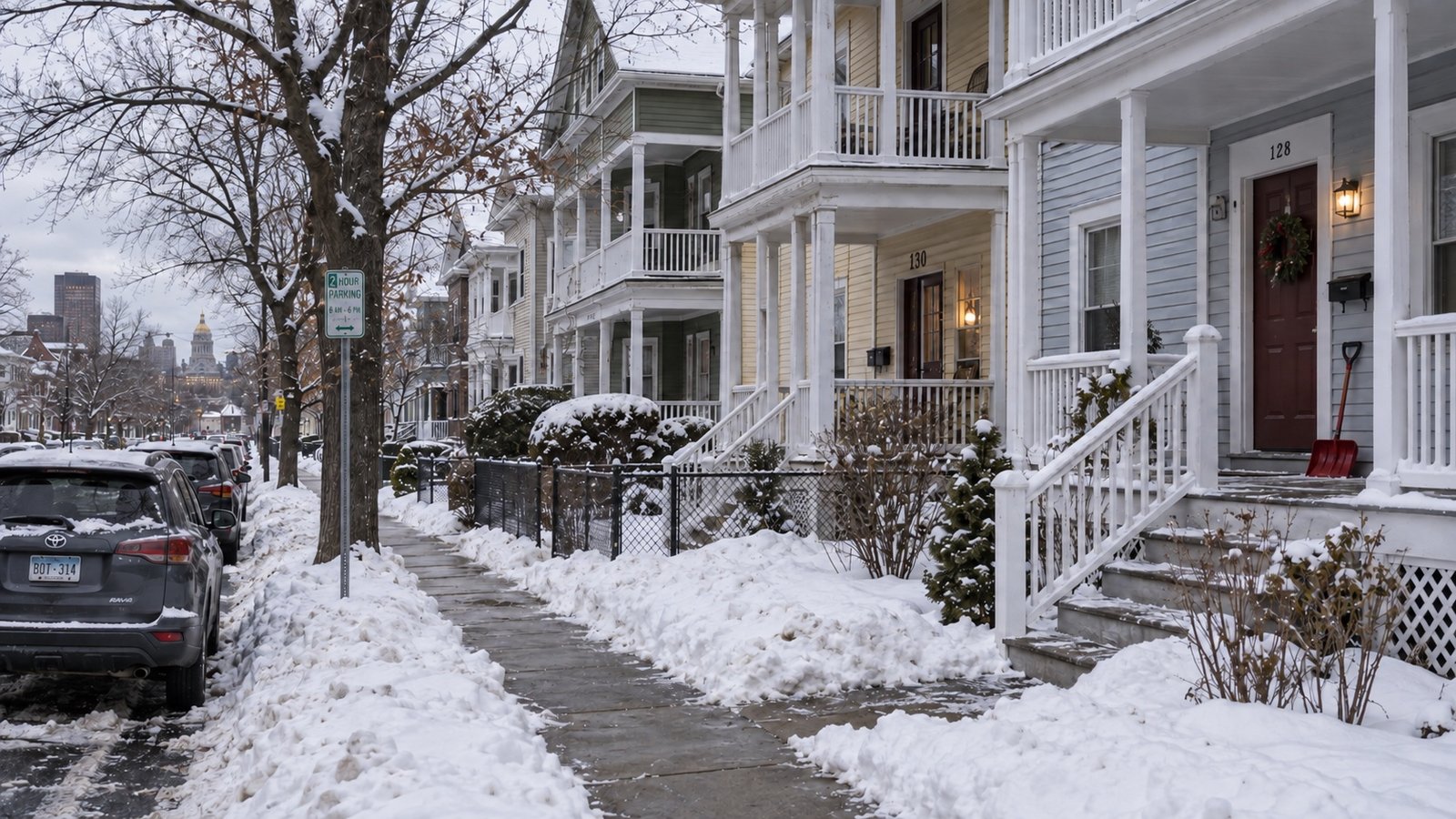
A residential street after snowfall with plowed snow along the curb and a cleared sidewalk.
Winter dates need a storm plan: parking bans change where anything may stand.

13 /

Turn the chosen home into an arrival plan

With the address decided, sequence the setup so nothing blocks the truck. Four to six weeks out: confirm the lease or closing date, start the school conversation if you have children, and book the move itself. Two to three weeks out: open the Eversource and gas requests, line up internet installation for arrival week, and book any bulky-waste appointment at the old address — remember the annual limit on free collections. At least a week out: confirm building rules and elevator windows at both ends, and submit the curb reservation request; its payment deadline is three days before the date, so an approved reservation must already exist by then.

In the final days: confirm the reservation approval, finish packing, set aside what travels with you, and check the forecast and the snow-ban status if it is winter. In the first week after arrival: find your trash day by address, test heat and hot water, and note the nearest grocery, pharmacy and — in winter — the blue-light intersection and the city lot you would use in a ban. If you are buying or selling rather than renting, add the water utility's closing request, due at least ten days before the property closing.

14 /

Questions before you arrive

Is the University of Hartford in Hartford?

No — despite the name, its campus is in West Hartford. Two colleges are actually in the city: Trinity College on Summit Street and UConn Hartford downtown on Prospect Street. Check the municipality of any address marketed as near a campus.

Does my Hartford address assign my child's school?

No. Hartford Public Schools is a choice district: district schools use the HPS District Choice Placement Process, and magnet, Open Choice and technical schools use the state's RSCO application with an annual window. Mid-year arrivals register directly with proofs of guardianship, age and Hartford residency.

Do I need a car in Hartford?

Many households manage without one in the core: CTtransit buses cover 27 towns, CTfastrak runs a dedicated rapid line to New Britain, the CTrail Hartford Line and Amtrak serve Union Station, and a free shuttle loops downtown on weekdays. Test the exact door-to-door routine from your address before deciding.

Who handles water and sewer accounts when I move in?

Water and sewer run through the Metropolitan District Commission, but the account normally rides with the property: sewer is largely paid through property taxes and unpaid water charges become a lien. Renters confirm the arrangement with the landlord; owners use MDC's closing request, due at least 10 days before a closing.

Can I leave unwanted furniture on the curb when I move out?

No. Hartford collects bulky items by appointment only — five items per appointment, two free collections per calendar year, $75 for each extra collection, or a $10 permit for four self-hauled transfer-station loads. Book weeks ahead of a move-out.

What happens to street parking during a snow emergency?

When the mayor declares a snow emergency parking ban, all on-street parking is prohibited citywide and vehicles left out are ticketed — $100 at issuance, plus late fees — and towed. Blue lights at 16 major intersections switch on six hours before the ban, and residents may move cars to designated city, park and school lots.

How far is the airport from Hartford?

Bradley International Airport is in Windsor Locks, about a 15-minute drive from downtown via I-91. The 30-Bradley Flyer bus links the airport with Union Station and the Convention Center in about 30 minutes.

Your next step

Bring the plan together

Use the Hartford moving page to prepare the inventory, access details and questions for your estimate.

Sources & useful local resources

Official procedures and local resources are linked beside the answers above. Reopen the relevant page when arranging a date: fees, schedules and application requirements can change.

Neighborhoods & housing

Getting around

Schools & enrollment

Utilities & internet

Trash, recycling & disposal

Truck access & parking

Snow & seasonal rules

Everyday & places