
Connecticut / City relocation guide

Moving to New Haven

New Haven is a renter-majority harbor city of older multi-family homes, two in-city universities and one of the Northeast's busiest rail stations. This guide helps you compare areas, plan the everyday basics and prepare the practical steps of arriving.

A neighborhood main street with small storefronts, apartments above, and a person walking with a bag.
Try the everyday errands around a new address, not only the journey to work.

01 /

Start with the decision in front of you

New Haven asks three different questions of a newcomer, and this guide is organized around them. If you are still choosing where to live, start with the orientation and the neighborhood comparison, then read the housing section — the market is mostly rentals in older multi-family buildings, and the differences that matter are stairs, light, parking and what the rent includes. If you are moving with children, go to the schools section early: enrollment runs through a central Office of School Choice & Enrollment, not automatic address assignment. If the address is already decided, the second half of the guide walks through the practical setup — utilities, waste, the curb for the moving truck, building access and the arrival sequence.

One caution before any comparison: the city's official neighborhood map, postal ZIP codes, school choice options and real-estate listings all draw different maps. Verify each address against the map that matters for the decision at hand — and verify the municipality, because several addresses marketed as "New Haven" sit in West Haven, East Haven or Hamden.

02 /

Understand New Haven before comparing addresses

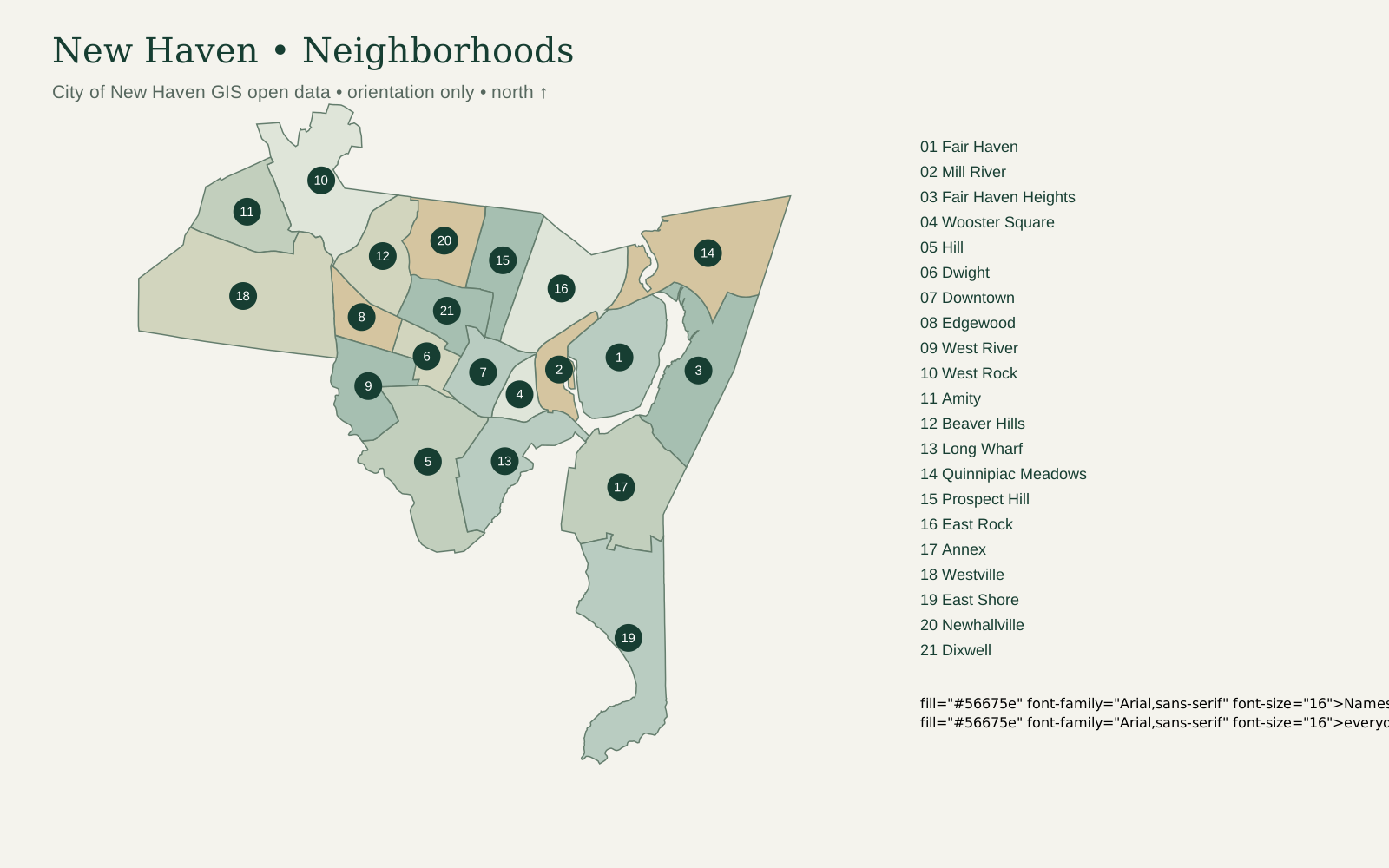
New Haven sits on the northern shore of Long Island Sound where I-95 meets I-91, a compact harbor city of 21 named neighborhoods in the city's own GIS layer, mapped below from that official geometry. The neighborhoods are planning geography: postal ZIP codes cross them, and none of these lines assigns a school or guarantees a building condition.

The city borders West Haven, East Haven, Hamden, Orange, Woodbridge and North Haven — all separate municipalities with separate rules, and the boundary care matters more here than in most cities. The naming trap: the University of New Haven is not in New Haven — its campus is at 300 Boston Post Road in West Haven. Two universities genuinely are in the city: Yale University, whose campus wraps the downtown, and Southern Connecticut State University at 501 Crescent Street. An address marketed as "near UNH" may sit in another town entirely, with another town's trash day, parking rules and school district.

New-Haven orientation map with numbered area key
Use the numbered key to locate the areas discussed below. Open full-size map.

03 /

Find the area that fits your routine

New Haven has 21 named neighborhoods in the city's own GIS layer, mapped above from that official geometry; the nine below are the ones a household is most likely to compare, chosen for their verified housing character. They are starting points for inspection, not rankings — school placement follows the choice process described below, and building conditions vary house by house.

Downtown

The business, institutional and cultural core around the New Haven Green, wrapped by the Yale campus. The Chapel Street Historic District nomination describes a mixed-use center of 102 late-19th- and early-20th-century commercial, residential and institutional buildings; living here means managed apartment buildings rather than houses.

Chapel Street Historic District nomination (NPS) ↗
Housing & setting
Expect elevators, set moving windows and certificate-of-insurance requirements. Compare what the rent includes and ask for the building's written moving rules before signing.
Daily travel
The strongest transit position in the state: Union Station (Metro-North to Grand Central, Shore Line East, Hartford Line, Amtrak) and State Street station, plus the CTtransit New Haven Division bus network.
Before choosing
Confirm the loading arrangement and elevator reservation procedure early; the downtown curb is metered and enforced Monday to Saturday until 9 p.m., so the meter-bag plan belongs in the lease conversation.

Wooster Square

A 19th-century residential square east of downtown: the national-register nomination records that the city bought the field in 1825, that the area was a fashionable residential district by the 1840s, and that Italian immigrant families later made it the city's signature Italian neighborhood.

Wooster Square Historic District nomination (NPS) ↗
Housing & setting
Expect 19th-century rowhouses and small multi-family buildings with stoops and shared entries; compare the staircase and the entry you will actually use.
Daily travel
Walkable to downtown; test the bus stop and route you would use daily on the Chapel and Grand Avenue corridors.
Before choosing
Narrow streets and stoops concentrate the carry; plan the meter-bag reservation for the truck before the date is fixed.

East Rock

The residential district below the traprock ridge the neighborhood is named for. The Upper State Street Historic District nomination describes one of the city's important neighborhood commercial centers, with 85 of its 91 major structures built between 1848 and 1945 — most of them first-generation buildings from 1865 to 1900.

Upper State Street Historic District nomination (NPS) ↗
Housing & setting
Older houses and small apartment buildings, many with porches and period floor plans; compare light, stairs and what the rent includes.
Daily travel
Served by the State Street corridor and within reach of the State Street rail station; walk the route to the stop you would use.
Before choosing
Porch stairs and shared entries are common; verify where a truck can stand on the narrower side streets before booking.

Dwight

A 20-block grid of modest 19th- and early-20th-century buildings just west of downtown; the Dwight Street Historic District nomination counts 629 buildings, bounded by Whalley Avenue on the north and the Yale campus on the east.

Dwight Street Historic District nomination (NPS) ↗
Housing & setting
Small multi-family stock with shared entries; apartments near the campus edge turn over with the academic calendar, so ask about lease timing.
Daily travel
Elm, Edgewood, Chapel and George Streets cross the grid toward downtown; most addresses are a short bus ride or walk from the core.
Before choosing
Confirm the curb position for the truck on the narrower grid streets, and ask the landlord about shared-hall rules before moving day.

Prospect Hill

The hillside district rising toward East Rock Park. The national-register nomination's property-by-property inventory records large two-and-a-half-story frame houses in Queen Anne, Shingle and Colonial Revival styles, built mostly around 1890–1910 along streets like Edgehill Road, Highland Street and St. Ronan Street.

Prospect Hill Historic District nomination (NPS) ↗
Housing & setting
Predominantly larger older houses, some divided into apartments; expect driveways more often than in the inner districts, plus the maintenance questions of older construction.
Daily travel
More car-oriented than the inner neighborhoods; test the bus and walking routes you would actually use before deciding.
Before choosing
Hill streets and long driveways lengthen the carry; confirm the truck position and the route from curb to door for the actual house.

Westville

A village-scale district on the city's west side. The Westville Village Historic District nomination describes a small, densely developed commercial area along two-tenths of a mile of Whalley Avenue that remains the commercial center of Westville.

Westville Village Historic District nomination (NPS) ↗
Housing & setting
A mix of village apartments and houses on the side streets around the Whalley Avenue spine; compare the specific building rather than the village's reputation.
Daily travel
Whalley Avenue is the corridor toward downtown; check the specific stop and schedule for your routine.
Before choosing
Village buildings are older and conversions vary; confirm whether the truck works better on Whalley or a side street for your address.

Beaver Hills

A planned early-20th-century residential subdivision the national-register nomination calls one of New Haven's most nearly intact of its kind: 276 major structures on a hill above the 130-acre Beaver Ponds Park, framed by Goffe Terrace, the Boulevard and Crescent Street.

Beaver Hills Historic District nomination (NPS) ↗
Housing & setting
Early-20th-century single-family houses with yards and garages; expect driveways, and expect older-house inspection questions.
Daily travel
Southern Connecticut State University sits on Crescent Street at the district's edge; test your bus or driving route from the specific address.
Before choosing
The district lies a half-mile south of the Hamden town line — confirm the municipality of any address near the edge before applying New Haven rules.

Fair Haven

The former maritime village on both banks of the Quinnipiac River. The Quinnipiac River Historic District nomination describes a largely residential community with buildings from 1780 to 1920, including houses and shops tied to the oystering industry that was the village's focus from the 1780s to the turn of the century.

Quinnipiac River Historic District nomination (NPS) ↗
Housing & setting
Older wood-frame multi-family stock dominates; compare the floor, the stairs and the entry rather than the listing photos.
Daily travel
Buses link the avenues to downtown; test the specific route you would use, including evenings.
Before choosing
Narrower streets near the river concentrate the carry; arrange the meter bag and confirm the truck's final approach before the date.

The Hill

The dense district on the peninsula south of downtown. The Howard Avenue Historic District nomination describes the avenue as the central spine of that peninsula, between the West River and the harbor, with 151 major structures on 32 acres.

Howard Avenue Historic District nomination (NPS) ↗
Housing & setting
Dense older multi-family houses with stoops and shared entries; inspect the route from curb to apartment, not just the rooms.
Daily travel
Howard and Union Avenues carry bus routes toward downtown; walk the stop-to-door path you would use daily.
Before choosing
Street space is tight; the meter-bag reservation and the truck's standing position need to be settled before moving day.

04 /

Compare the whole home, not just the advertised payment

New Haven is a renter's city: 71.6% of households rent their home (ACS 2024 5-year, via Census Reporter). The median gross rent is $1,488 a month and the median owner-occupied value $287,100 — but medians describe the whole city at once, not the apartment in front of you, and listing sites' asking rents run above survey medians. Use them only to sanity-check a budget.

The stock explains the market. Nearly two in five New Haven homes sit in a two-to-four-unit building, about 40% of units were built before 1940, and downtown adds towers and conversions around the Green. For a mover this means the differences that matter are physical: which floor, stairs or elevator, where a truck can stop, how heat is supplied and who clears the sidewalk. Older radiators and bay windows come with the charm; so do narrow staircases with landing turns.

When comparing two apartments, compare what the payment includes — heat, hot water, parking, snow clearing — the lease's move-in and move-out rules, and the condition of the access route: porch boards, stair rails, door widths. Ask early who handles bulky disposal when you leave; New Haven's bulky pickup is appointment-based, and whether your building is on city collection at all is a question for the landlord.

Two checks save the most regret. Heat: older New Haven buildings mix steam radiators, gas furnaces and electric heat, and gas is not available on every street — ask what fuels the heat and hot water and whose name the accounts sit in, because that decides which utility calls you make in the arrival week. And the approach: stand at the curb and walk the path a sofa would take — driveway or street, porch or lobby, stairs or elevator — because that path, more than the square footage, decides what moving day costs.

A furnished living room in an older apartment with tall windows and sealed moving boxes by the wall.
Compare usable rooms, light, storage and what the rent actually includes.

05 /

Test the complete daily journey

New Haven is one of the few Connecticut cities where a car-light household is realistic, at least near the core. CTtransit's New Haven Division runs local buses across Greater New Haven, many routes seven days a week, with connections toward Meriden, Waterbury, Wallingford and Milford; a local ride costs $1.75 for two hours, or $63 for a 31-day pass.

Union Station, opened in 1920 in the Long Wharf area, is the most-used passenger rail facility in Connecticut — 852,597 Amtrak passengers in fiscal 2025 alone: Metro-North's New Haven Line runs direct to Grand Central Terminal; CTrail Shore Line East runs seven days a week between New Haven and New London, also stopping at State Street station downtown; and the CTrail Hartford Line runs seven days a week between New Haven and Springfield. Amtrak's Acela, Northeast Regional, Valley Flyer and Vermonter stop at Union Station as well. Check schedules for your specific travel date before planning around any train — the Hartford Line schedule page currently notes some trips bus-substituted for construction.

For flights, Tweed New Haven Airport (HVN) sits three miles southeast of downtown and advertises more than 30 destinations. Whatever the map says, test the routine you will actually live — the walk to the stop, the transfer, the last trip home at night — from the exact address before deciding.

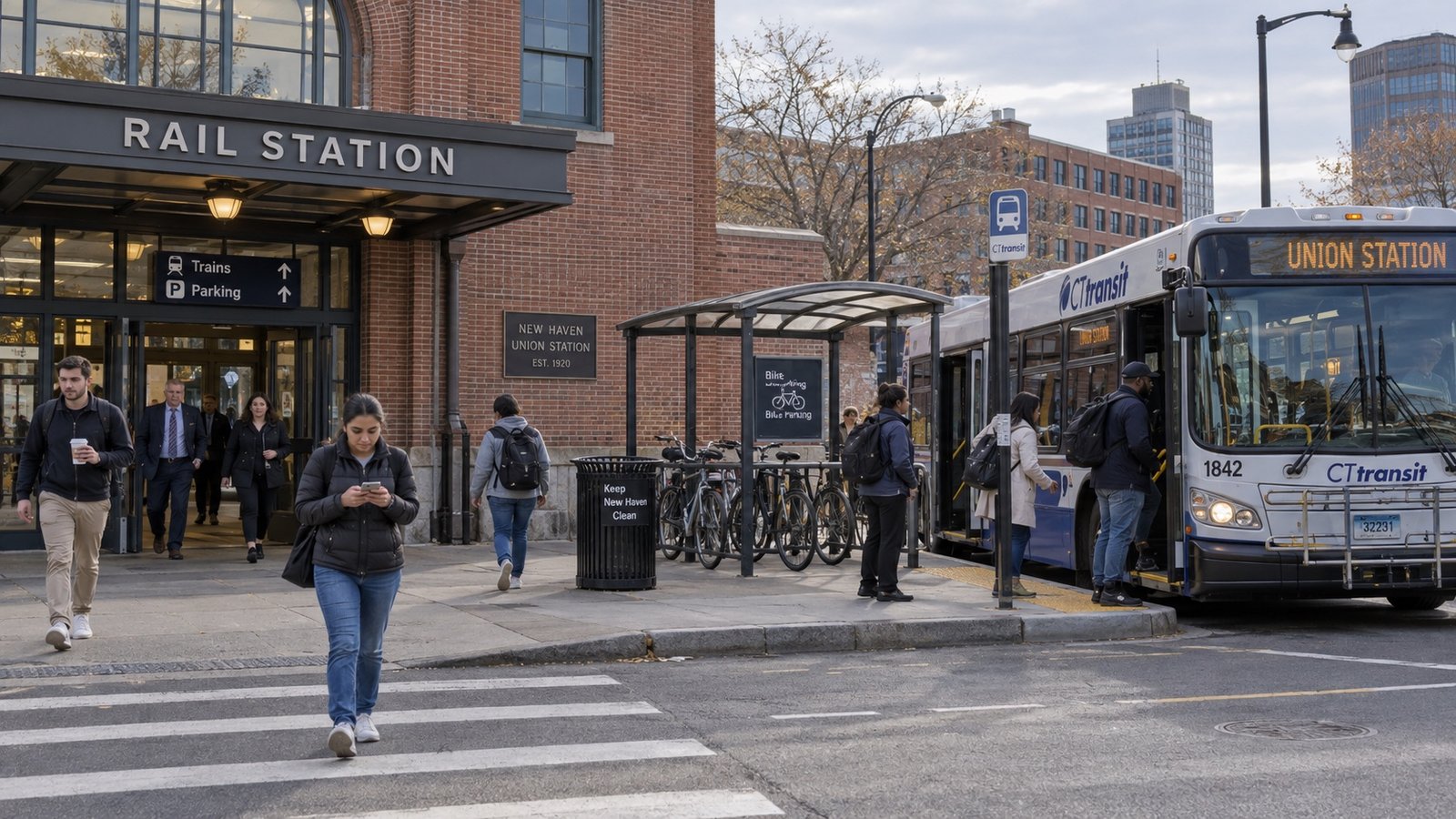
Commuters boarding a CTtransit bus beside a station entrance in a New Haven setting.
Test the complete daily journey, including the walk at both ends.

06 /

Treat school enrollment as an application, not an address

New Haven Public Schools routes enrollment through a central Office of School Choice & Enrollment, and the district's enrollment section separates online student registration from school choice and magnet placement — do not sign a lease counting on a specific school without confirming placement first. The district office is at 54 Meadow Street, (475) 220-1000.

The district's registration instructions describe an online process (PowerSchool) with documents uploaded per child. Have ready: a parent or guardian photo ID; the child's long-form birth certificate or passport; and proof of New Haven residency — a current mortgage statement or lease in the guardian's name, or one current utility bill (electric, gas, cable or water) from the last 30–60 days. Families without those documents may be asked for a residency affidavit; the Office of School Choice & Enrollment handles those cases at (475) 220-1430, in English or Spanish.

Two details matter for timing. Immunization and health records are not needed for registration itself but are required before the child starts school — arrange the pediatric records transfer before arrival week. And a child who leaves the district for a charter school or another district must register again on return; re-enrollment is not automatic. Application windows for choice and magnet placement change by year; confirm the current dates with the office rather than last year's calendar.

Registration and choice are separate tracks. The district's registration guide directs choice applicants to its magnet-schools portal, so a family that wants a magnet or choice placement handles that application in addition to the enrollment form — registering a child does not itself request a school placement. Newcomers who arrive mid-year register directly with the office rather than waiting for a choice window; keep the confirmation email the online system sends, since it is your proof the registration was actually submitted.

07 /

Assign an owner and a start date to each household service

Electricity is United Illuminating — New Haven is in UI's 17-town territory, not Eversource's. Start, stop or transfer service through UI's online moving pages; no official lead time is published, so submit the request as soon as your date is fixed. Natural gas is Southern Connecticut Gas, which lists New Haven in its service towns — but gas availability varies street by street, and SCG's own online tool checks a specific address. In older houses, confirm whether the home has gas at all before planning around it.

Water comes from the Regional Water Authority, headquartered at 90 Sargent Drive in New Haven and serving 15 South Central Connecticut municipalities; customer care is (203) 562-4020. Renters usually find the water account rides with the property — confirm the arrangement with the landlord rather than assuming you open an account.

For internet, Frontier lists New Haven for fiber and Comcast's Xfinity also serves the city; availability is address-specific, so check the exact address before promising yourself a speed. In older multi-family buildings, ask which provider already wires the building — an installation booked before the move is easier than one booked from an empty apartment.

08 /

Plan for routine collection and the things you are leaving behind

The city's Parks & Public Works department collects trash and recycling weekly: a brown 48-gallon toter for trash, a blue 96-gallon toter for recycling, placed curbside before collection and removed within 12 hours afterward. City holidays shift routes a day later, snow-covered toters are skipped until the next collection, and replacement toters come from Resident Services at (203) 946-7700. Whether a specific building is on city collection at all is worth confirming with the landlord — larger buildings may run private hauling.

The rule that surprises movers: bulky items are by appointment, scheduled in person at 34 Middletown Avenue, weekdays 7 a.m.–4 p.m. — call (203) 946-7700 before going. Homeowners of one-to-three-unit houses get two pickups per calendar year (first free, second $50); tenants pay $50 for each of two pickups, with proof of a current New Haven address required.

What you are leavingHow it goes out
Furniture and bulky itemsBulk appointment (in-person scheduling, 34 Middletown Ave) or transfer-station coupon
Self-hauled loadsTransfer station, 260 Middletown Ave, Mon–Sat 9 a.m.–12 p.m.; free resident coupons (7 items per visit) picked up at 34 Middletown Ave
TiresMaximum four per calendar year with a coupon
Mattress or box springState stewardship program — retailer take-back on delivery of a new one, or program drop-off via Bye Bye Mattress
Household hazardous wasteHazWaste Central at the Regional Water Authority, 90 Sargent Drive, Saturday mornings May–October

Whatever the item, a curb pile on moving day is not a legal disposal route in New Haven.

09 /

Arrange a legal place for the moving truck

New Haven's curb has two owners, and knowing which is which saves a wasted call. The New Haven Parking Authority runs the garages and surface lots. The street itself — meters, residential permits, enforcement — belongs to the city's Department of Transportation, Traffic & Parking (TTP), (203) 946-8075. Meter enforcement runs Monday through Saturday until 9 p.m.; after 5 p.m. metered spaces carry no time limit, but a moving truck still needs the meter paid or bagged.

For a moving truck, the instrument is a meter bag — the city hoods the metered spaces you reserve. TTP's permits, applications and fees page posts the current Meter Bag Application Form and Meter Bag Return Form. The return form fixes the terms: $20 per bag per day, charged six days a week with Sundays and holidays excluded; bags go back to 200 Orange Street, room G3, with the completed form, before 11 a.m., or charges continue. Checks are payable to City of New Haven TT&P.

Two gaps in the published material shape your planning: no official lead time for the application is stated, and the posting mechanics for no-parking signs are not described online. Treat the phone call to (203) 946-8075 as step one, submit early, and confirm the reservation before the truck is scheduled. A residential parking district permit is a separate program for personal cars on signed streets — it does nothing for a moving truck.

If the building offers a driveway, lot or loading dock instead, use it — private loading beats a street reservation, but get the property's instructions in writing. Either way, match the truck's window to the building's window, and remember the override: a declared snow parking ban clears the street, reservation or not.

10 /

Inspect the full route through the building

On one New Haven housing type, access means wood and stairs: two-to-four-family houses with shared front halls, staircases with tight landings, porch steps and, often, a narrow side driveway. Measure the largest pieces against the actual route — width, turns, ceiling at the landing — and check porch boards and railings before anyone carries a sofa across them. Agree driveway use with the landlord and neighbors; many drives are shared or single-width.

On the other type, access means paperwork: downtown towers and larger complexes run moves through the property manager. Expect elevator reservations, fixed moving windows and a certificate of insurance requested from the mover; some buildings require protective padding in elevators and corridors, booked in advance. Ask for the written moving rules at both ends as soon as the date is set.

Whichever type, walk both routes before the day: where the truck stops, which door is used, every stair and elevator between the truck and the room, and who unlocks what. A plan that works at the origin but not the destination is only half a plan — confirm the two ends together, with time windows that overlap usefully.

11 /

Build a useful routine beyond the commute

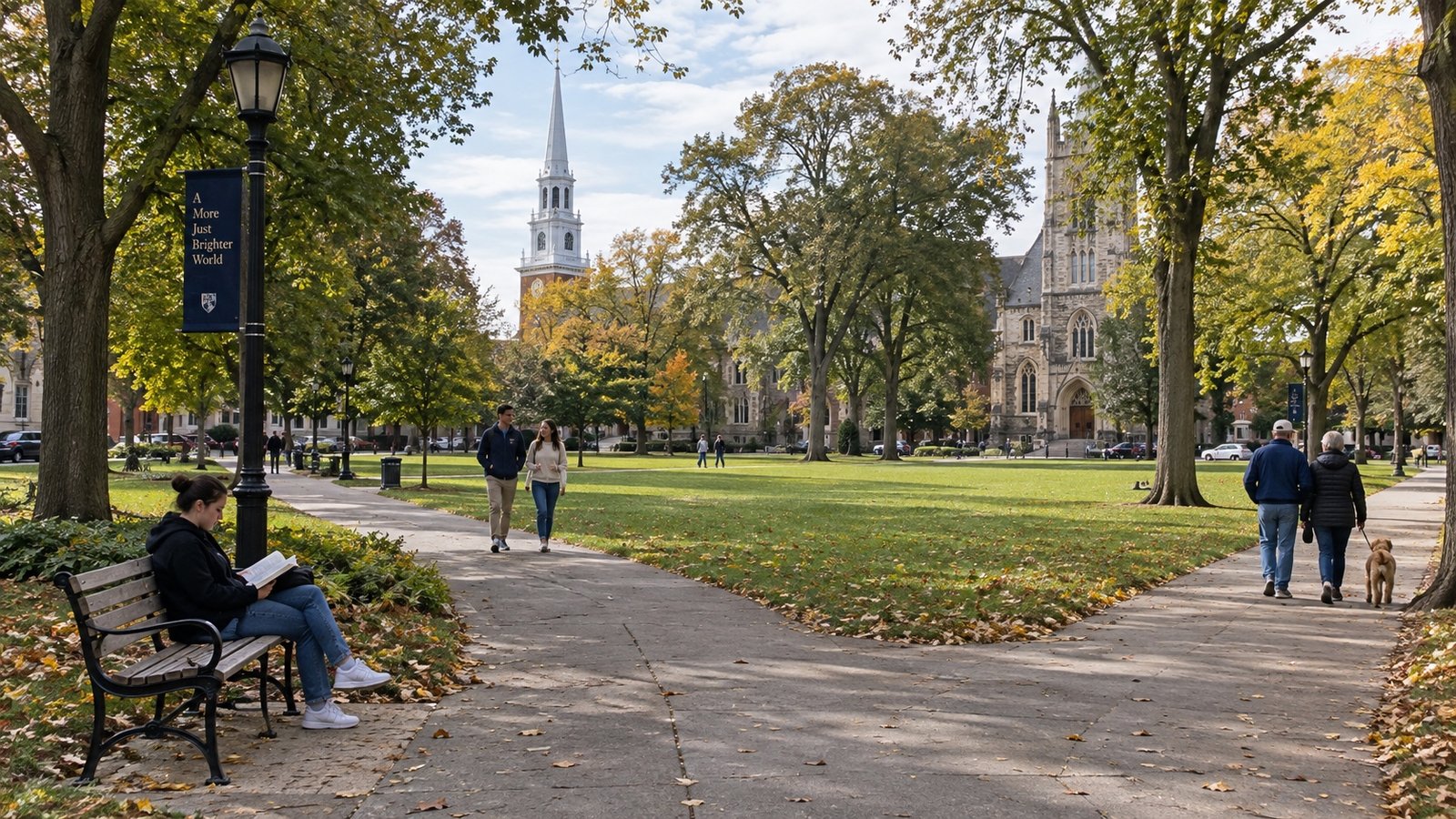
New Haven's everyday geography rewards a look on foot. The New Haven Green — a National Historic Landmark district bounded by Chapel, College, Elm and Church, with three churches raised between 1812 and 1816 — is the city's shared front yard and the reference point for downtown addresses. Wooster Square's park — a field the city bought in 1825, per the district nomination — anchors its neighborhood east of downtown, and each district leans on its own avenue — Whalley, Grand, Chapel, State — for groceries and errands.

Test the routine you will actually live: the grocery run, the pharmacy, the school or daycare route, a late-evening trip home. University calendars shape some blocks — Yale wraps the downtown and Southern Connecticut State anchors the Crescent Street edge of the city's west side — while downtown offices set a weekday rhythm around the Green. Visit a candidate address at the hours you would use it before deciding.

A public green with mature trees, walking paths and church facades along the far edge.
Check the outdoor routine around the address you actually choose.

12 /

Plan for the season in which you will live and move

Winter is New Haven's scheduling season. The city's snow-removal rules divide parking bans into zones: in the downtown area (Zone A) a ban prohibits parking on both sides; posted snow-emergency routes (Zone B) close; and in residential areas (Zone C) parking is allowed on the even side only, with no parking within 25 feet of intersections, hydrants or bus stops during any ban. Violations can be ticketed and towed. The city plows on a 24-hour schedule across 234 miles of roadway and posts updates through its alert system, the Emergency Operations Center at (203) 946-8221 and a snow line at (203) 946-7669; sign up for alerts when you arrive. If street space disappears, Parking Authority garages take cars overnight — all but two facilities allow it.

After the snow, the clock starts on sidewalks: they must be cleared within 24 hours of the storm's conclusion, and shoveling snow back into the street is prohibited. If you rent, check the lease for who actually shovels; the city's rule lands on the property, but the boots are often the tenant's. Storm weeks also touch collection days: snow-covered toters are left until the next pickup.

The other calendar is academic: Yale and Southern Connecticut State sit inside the city, and student-linked leases turn over around late August — Yale's residences opened to new students August 23 in 2026, with fall classes beginning September 2 — and again in May. End-of-month dates at those times are the first to book out, our workload observation rather than a city statistic. If your dates are flexible, mid-month and mid-season dates give you more room.

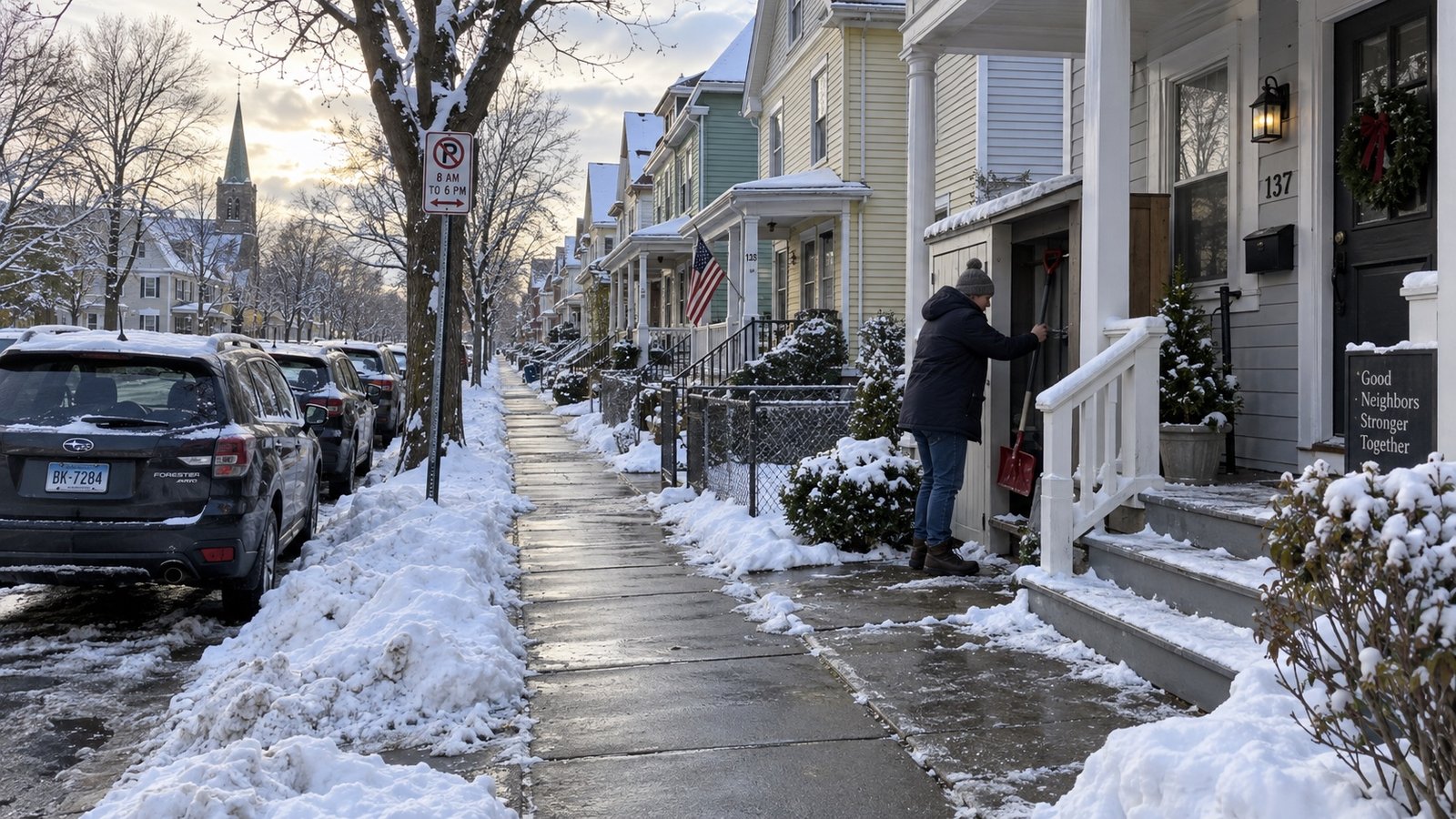
A residential street after snowfall with cars parked on one side and a cleared sidewalk.
Winter dates need a storm plan: zone parking bans change where anything may stand.

13 /

Turn the chosen home into an arrival plan

With the address decided, sequence the setup so nothing blocks the truck. Four to six weeks out: confirm the lease or closing date, start the school conversation if you have children, and book the move itself. Two to three weeks out: open the United Illuminating account request, check gas availability at the address with Southern Connecticut Gas, and line up internet installation for arrival week. If you are leaving a New Haven address, book the bulky-waste appointment or pick up transfer-station coupons now — both are scheduled or collected in person on Middletown Avenue.

At least two weeks out: confirm building rules and elevator windows at both ends, and call TTP at (203) 946-8075 about meter bags — the published forms give no lead time, so earlier is the only safe reading. In the final days: confirm the bags are placed and paid, finish packing, set aside what travels with you, and check the forecast and the snow line if it is winter. In the first week after arrival: find your trash day, test heat and hot water, and note the nearest grocery, pharmacy and — in winter — which side of your street is the even side. If children are starting school, their immunization and health records go to the school before the first day, not to the registration portal.

14 /

Questions before you arrive

Is the University of New Haven in New Haven?

No — despite the name, its campus is at 300 Boston Post Road in West Haven. Two universities are actually in the city: Yale University downtown and Southern Connecticut State University at 501 Crescent Street. Check the municipality of any address marketed as near a campus.

Does my New Haven address assign my child's school?

Not automatically. New Haven Public Schools enrolls through the central Office of School Choice & Enrollment with an online registration, and school choice and magnet placement run as a separate process. Registration needs a parent photo ID, the child's birth certificate or passport, and proof of residency; immunization records are due before the first day of school.

Do I need a car in New Haven?

Many households manage without one near the core: CTtransit New Haven Division buses run seven days a week on many routes, Union Station carries Metro-North to Grand Central, Shore Line East to New London and the Hartford Line to Springfield, and Tweed airport is three miles from downtown. Test the exact door-to-door routine from your address before deciding.

Who provides electricity, gas and water in New Haven?

Electricity is United Illuminating; natural gas is Southern Connecticut Gas, where the street has it (SCG checks availability by address); water is the Regional Water Authority. Renters usually find the water account rides with the property — confirm with the landlord.

How do I get rid of furniture I am not taking?

By appointment or coupon, never by curb pile. Bulk pickup is scheduled in person at 34 Middletown Avenue (call (203) 946-7700 first): homeowners of one-to-three-unit houses get two pickups a year, the second $50; tenants pay $50 each. Free transfer-station coupons cover self-hauled loads, seven items per visit, at 260 Middletown Avenue, Monday to Saturday 9 a.m. to noon.

What happens to street parking during a snow emergency?

New Haven declares parking bans by zone: downtown (Zone A) bans parking on both sides, posted snow-emergency routes (Zone B) close, and residential areas (Zone C) allow parking on the even side only. Violations can be ticketed and towed. Updates come through the city alert system and the snow line at (203) 946-7669.

How do I reserve street space for a moving truck?

Through the Transportation, Traffic & Parking department's meter-bag program: application and return forms are posted on the city's permits page, bags rent at $20 per bag per day (Sundays and holidays excluded), and bags go back to 200 Orange Street, room G3, with the form before 11 a.m. Call (203) 946-8075 early — no official lead time is published.

Your next step

Bring the plan together

Use the New Haven moving page to prepare the inventory, access details and questions for your estimate.

Sources & useful local resources

Official procedures and local resources are linked beside the answers above. Reopen the relevant page when arranging a date: fees, schedules and application requirements can change.

Neighborhoods & housing

Universities & geography

Getting around

Schools & enrollment

Utilities & internet

Trash, recycling & disposal

Truck access & parking

Snow & seasonal rules

Everyday & places