Rochester is a renter-majority city of pre-war doubles, lakefront weather and a school district built on zones and choice. This guide helps you compare areas, plan the everyday basics and prepare the practical steps of arriving.
Try the everyday errands around a new address, not only the journey to work.
01 /
Start with the decision in front of you
Rochester asks three different questions of a newcomer, and this guide is organized around them. If you are still choosing where to live, start with the orientation and the neighborhood comparison, then read the housing section — Rochester's market leans on older rentals in two-to-four-unit buildings, and the differences that matter are stairs, light, parking and what the rent includes. If you are moving with children, go to the schools section early: the city district registers every student centrally and runs an annual selection window across three zones, not automatic assignment, and the window's timing can shape when you move. If the address is already decided, the second half of the guide walks through the practical setup — utilities, waste, the curb for the moving truck, building access and the arrival sequence.
One caution before any comparison: everyday neighborhood names, postal ZIP codes, school zones and the city's quadrant service areas all draw different maps, and several well-known campuses carry Rochester mailing addresses while sitting in other towns. Verify each address against the map that matters for the decision at hand.
02 /
Understand Rochester before comparing addresses
Rochester sits on the south shore of Lake Ontario in Monroe County, and the Genesee River runs through the city — under the downtown bridges and over the High Falls — to meet the lake at the Port of Rochester, about nine miles north of downtown. The river, the lake and the Erie Canal are all treated as the city's waterfront in its Local Waterfront Revitalization Program, the official statement of land-use policy for those areas. The surrounding towns — Gates, Greece, Irondequoit, Brighton, Henrietta, Chili — are separate municipalities with separate rules, so a "Rochester area" description and a Rochester address are not the same thing; confirm the municipality before comparing procedures.
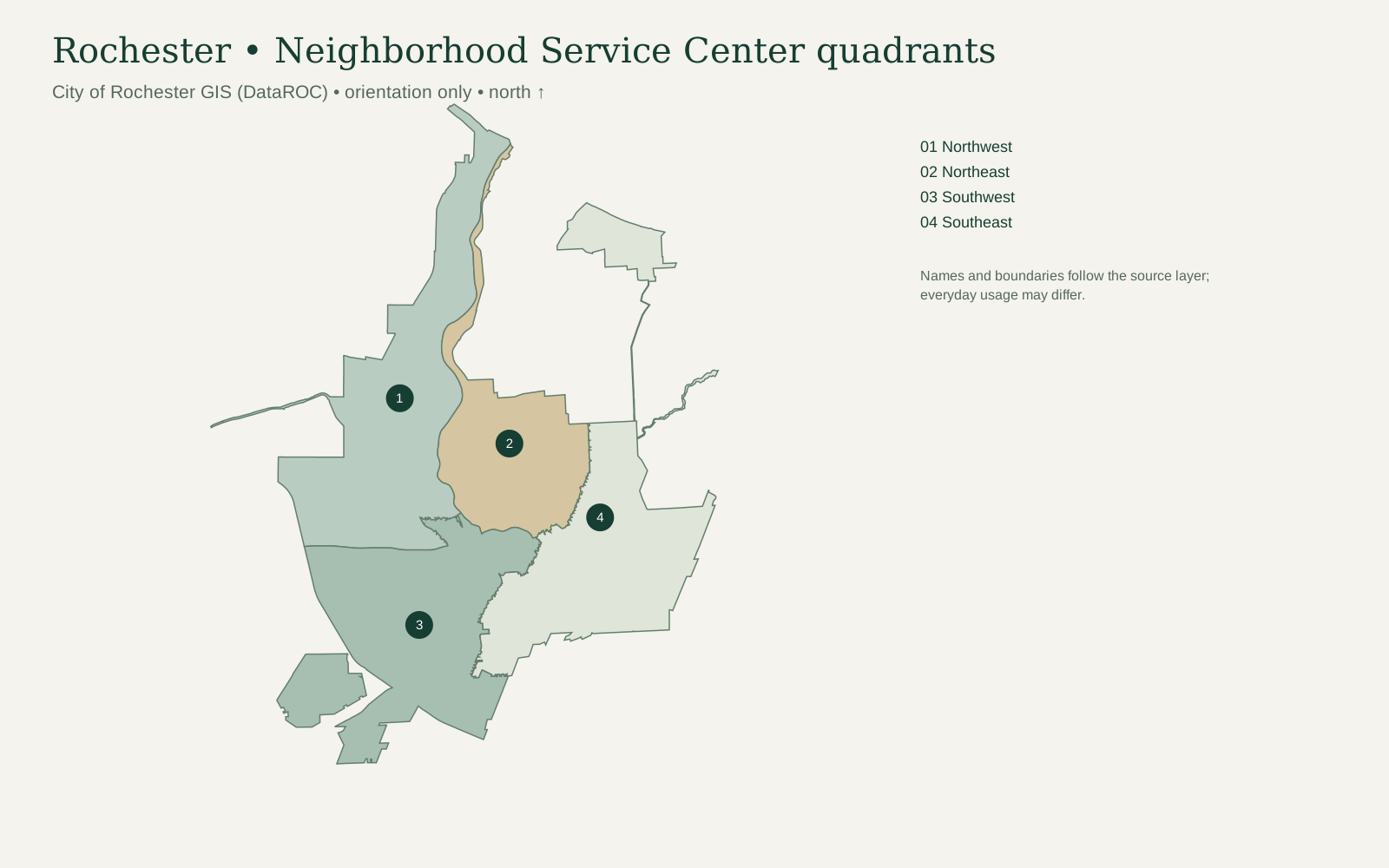
The city itself groups addresses into four Neighborhood Service Center quadrants — Northwest, Northeast, Southwest, Southeast — mapped below from the City's open-data layer. The quadrants are service geography: each has a Neighborhood Service Center that fields quality-of-life issues for its addresses. Everyday names like Park Avenue, the South Wedge, Beechwood or the 19th Ward have no official boundary map, and the city's nine local preservation districts — mapped in the open-data district layer — are a different overlay again, covering historic cores rather than whole neighborhoods. None of these lines assigns a school or guarantees a building's condition.
One naming trap matters for movers: several campuses carry Rochester mailing addresses without being in the city. Rochester Institute of Technology (One Lomb Memorial Drive, Rochester, NY 14623) is in Henrietta; Nazareth University and St. John Fisher University are in Pittsford. Two institutions really are in the city: the University of Rochester on the Genesee and the Eastman School of Music downtown on Gibbs Street. Addresses marketed as near a campus may sit in another town entirely, with another town's rules.
Size helps planning: Rochester is compact enough that most city addresses sit within a 20-minute drive of downtown in ordinary traffic, and the airport, the train station and the lakefront are all inside or immediately beside the city line. When a listing leans on "minutes to everything," test it at rush hour and in February.
Use the numbered key to locate the areas discussed below. Open full-size map.
03 /
Find the area that fits your routine
Rochester has no official boundary map for its everyday neighborhoods; the seven areas below are the ones a household is most likely to compare, chosen for their verified housing character. They are starting points for inspection, not rankings — school placement follows the zone and selection system described below, and building conditions vary house by house.
Corn Hill
The city's oldest residential area, just southwest of downtown: the local preservation district (designated 1977) records Erie Canal-era merchants, millers and craftspeople building here, with styles from worker's cottages and carriage houses to Greek Revival and Italianate mansions.
19th-century houses and small apartment buildings on tight lots; expect stoops, shared drives and the access quirks of very old construction. Exterior changes in the preservation district require Preservation Board review — owners should check before planning work.
Daily travel
Immediately southwest of downtown — many addresses are a short walk or bus ride from the core.
Before choosing
Daytime on-street parking on twelve Corn Hill street segments requires a resident, employee or visitor permit. Line up household permits before moving day; the truck itself follows the general city rules.
South Wedge
A southeast-quadrant neighborhood whose national-register district records two- to four-story commercial and residential buildings developed from the 1840s to the 1920s — a traditional urban village character in Italianate and Queen Anne styles.
Single- and two-family residences, some now divided into multiple apartments; expect porches, stairs and shared entries typical of pre-war stock.
Daily travel
South Avenue and South Clinton Avenue buses link the area to downtown; test the walk to the stop you would use.
Before choosing
19th-century side streets are narrow: confirm where the truck can stand and remember the city's 12-hour parking rule when staging.
East Avenue
The East Avenue corridor is one of the city's mapped local preservation districts — a broad residential avenue northeast of downtown whose older houses, side streets and apartment buildings are protected under the city's preservation ordinance.
Large older houses, some divided into apartments, plus purpose-built apartment buildings; compare the specific building's entry, stairs and parking rather than the avenue's reputation.
Daily travel
Buses on East Avenue and University Avenue run toward downtown; check the stop and schedule for your routine.
Before choosing
In a preservation district, exterior changes need review — and older buildings mean checking the carry route, the porch and the stairwell as carefully as the rooms.
19th Ward
A southwest-side streetcar neighborhood: the Inglewood & Thurston national-register district (period of significance 1921–1927) records single-family homes in Colonial Revival, Crafts, American Foursquare and Tudor Revival styles that grew with streetcar service on Genesee, Arnett and Thurston.
Mostly single-family houses with garages on modest lots, plus two-family homes nearer the arterials; porches and driveways are common.
Daily travel
Genesee Street and Thurston Road buses run toward downtown; check the stop nearest the address.
Before choosing
Driveways ease the carry, but many are narrow or shared — confirm the truck position on the residential side streets and the 12-hour parking rule.
Arvine Heights
A compact early-20th-century district on the edge of the 19th Ward: the national-register nomination (period of significance 1918–1957) counts 37 contributing primary buildings, all residences — single-family Bungalow/Craftsman and Tudor Revival homes, many with garages built at the same time as the house.
Detached single-family homes with driveways and garages; a later, more suburban pattern than the city's pre-war doubles.
Daily travel
A car-oriented edge of the ward; buses run on the nearby arterials — check the actual route and walk from the address.
Before choosing
Garages and driveways simplify staging, but these are short residential streets — confirm the truck position and carry path in advance.
Chili-West
A west-side streetcar neighborhood along Chili Avenue: the national-register district (period of significance 1874–1935) spans styles from Queen Anne, Stick and Eastlake to Colonial Revival, Tudor Revival, Prairie and Bungalow/Craftsman.
Single-family homes — several since converted to apartments — with garages behind; a mix of detached houses and small multi-units.
Daily travel
Chili Avenue buses head downtown; the avenue is the area's commercial spine.
Before choosing
Where homes were converted to apartments, expect shared entries and stairs; confirm which unit and which entrance the move uses.
Charlotte
The city's Lake Ontario waterfront district where the Genesee River meets the lake: the Port terminal and marina, Ontario Beach and Charlotte Pier, about nine miles north of downtown.
A lakeside neighborhood of older houses and cottages near the river mouth; check how summer beach traffic and winter lake weather affect the street you pick.
Daily travel
RTS route 22 (Lake) serves the Port, and the 16-mile Genesee Riverway Trail connects Charlotte to downtown along the river.
Before choosing
Distance from downtown lengthens every errand — test the drive or bus ride at the hours you would actually make it.
04 /
Compare the whole home, not just the advertised payment
Rochester is a renter's city: 61.9% of households rent their home (ACS 2024 5-year, via Census Reporter). The median gross rent is $1,081 a month and the median owner-occupied value $139,600 — but medians describe the whole city at once, not the apartment in front of you, and listing sites' asking rents run above survey medians. Use them only to sanity-check a budget.
The stock explains the market. About 44% of Rochester homes are detached single-family houses, about 26% sit in two-to-four-unit buildings — the double is the signature form, two stacked units behind one porch staircase — and about 54% of units were built before 1940. Downtown adds towers and office-to-apartment conversions. For a mover this means the differences that matter are physical: which floor, stairs or elevator, where a truck can stop, how heat is supplied and who clears the sidewalk. Wood porches and bay windows come with the charm; so do narrow staircases with landing turns and radiators that predate the lease.
When comparing two apartments, compare what the payment includes — heat, hot water, parking, snow clearing — the lease's move-in and move-out rules, and the condition of the access route: porch boards, stair rails, door widths. In a city where about one home in four sits in a two-to-four-unit building, ask whether utilities are metered per unit or split, and who is responsible for the shared hall and porch. Ask early how bulky disposal works when you leave: Rochester takes bulk items at the curb on the normal refuse day, but buildings of four or more units run through commercial collection arranged by the landlord, not the residential route.
One more Rochester-specific filter: preservation districts. Nine areas of the city are locally designated, and exterior changes there — windows, porches, demolition — require Preservation Board review before a permit issues. That does not change a lease, but it tells you something about the landlord's latitude for repairs and alterations, and it is worth checking whether a candidate address falls inside a district before you plan improvements.
Compare usable rooms, light, storage and what the rent actually includes.
05 /
Test the complete daily journey
The bus network is the Regional Transit Service, a state-established authority serving Monroe and seven neighboring counties. In the city, routes converge on the RTS Transit Center at 1372 East Main Street downtown, with entrances on St. Paul Street and North Clinton Avenue; route 22 (Lake) runs the length of Lake Avenue to the Port of Rochester on the lakefront. Plan trips, track buses and pay fares with the Transit app; current prices are posted on the RTS Fares & Passes page. Coverage is strongest on the main avenues — Lake, Genesee, Monroe, East and West Main, Chili — so test the exact door-to-door routine from a candidate address, including the walk to the stop, the wait and any transfer, at the hour you would actually travel.
Intercity rail is in the city: Louise M. Slaughter Station at 320 Central Avenue, just north of downtown, opened in 2017 and is served by Amtrak's Empire Service, Lake Shore Limited and Maple Leaf trains — toward New York City, Chicago and Toronto respectively. The station handled about 152,000 passengers in fiscal year 2025, so book popular weekend trains ahead rather than assuming seats.
For flights, Frederick Douglass Greater Rochester International Airport (1200 Brooks Avenue) sits on the city's southwest side, four miles from downtown off I-390's Brooks Avenue exit; the county-owned property straddles the Gates town line, and RTS buses are among the ground-transport options listed by the airport.
A car is common but not mandatory. Households near the core can run much of life on buses, the train and the bike-and-walk network along the river; households in the outer quadrants usually keep a car. What changes the calculation locally is winter: a car needs somewhere legal to go during plowing days and parking emergencies, so weigh a driveway or garage more heavily here than the mileage math alone suggests.
Test the complete daily journey, including the walk at both ends.
06 /
Treat school placement as registration plus a selection window
Every child entering the Rochester City School District registers with the central Office of Student Registration — 131 West Broad Street, Floor 1, Monday through Friday 8:00 a.m. to 3:30 p.m., 585-262-8241. Registration requires documents in five groups: proof of residency, proof of age, proof of guardianship with photo ID, health records and proof of immunization, and school records. Once registered, a student receives an ID number and the family completes enrollment online through PowerSchool, which requires a one-time account. Gather the documents before the office visit, especially if you arrive mid-year — a lease, a utility bill and the child's records from the previous school are the usual sticking points.
Placement is not a simple address lookup. The district is divided into three school zones — Northeast, Northwest and South — and the annual School Selection process lets families choose a citywide school or a school within their zone: learn about the options through school profiles and winter and spring open houses, rank the schools your child would actually attend, and apply by the selection deadline for the best chance of a placement you want. An online application can be started and saved while you explore the zone your address falls in. Do not sign a lease counting on a specific school.
Two adjacent notes: free Pre-K is available to city residents whose child turns three or four by December 1 — a separate enrollment line at 585-262-8140 with its own program locations — and the district's transportation FAQ works through RTS bus routes and passes, so older students commonly ride city buses rather than a yellow bus. If a long bus ride would shape your mornings, check the actual route from the candidate address before deciding.
Citywide schools accept children from any zone, which is why families compare across the map rather than only next door — but a citywide seat is a selection outcome, not an entitlement, and transportation follows the district's rules for the placement. Read the zone map with an actual address before assuming which list of schools you are choosing from.
07 /
Assign an owner and a start date to each household service
Electricity and natural gas both come from Rochester Gas and Electric: its site carries electric and natural-gas rates side by side and a Moving section with start and stop service requests. No official lead time is published, so submit the request as soon as your date is fixed rather than waiting for moving week, and keep the confirmation with your moving papers — the estimator and the landlord will both ask when power is live.
Water belongs to the Rochester Water Bureau, which has supplied the city from Hemlock and Canadice lakes, 28 miles south, since 1876, and wholesales water to the Monroe County Water Authority and several neighboring systems. For a city address, billing runs through 311; the bureau publishes no tenant-account policy, so renters should confirm with the landlord whether the account rides with the property before trying to open one themselves. Suburban addresses are a different picture — check the municipality. One utility-like charge surprises new owners: the residential refuse fee appears on the annual property tax bill ($399 for a one-unit property on the current schedule), so renters should confirm with the landlord how it is handled and buyers should ask how it was settled at closing.
For internet, Greenlight Networks lists Rochester among its fiber cities; availability is address-specific, so check the exact address and, in older doubles, ask which provider already wires the building — an installation booked before the move is easier than one booked from an empty apartment.
08 /
Plan for routine collection and the things you are leaving behind
The city collects refuse itself: weekly refuse and every-other-week recycling, with an address lookup for your day. Each residential unit gets a city-issued wheeled toter; extra refuse goes out beside it in cans or sturdy bags, and containers go to the curb by 6:30 a.m. on collection day and, under the rules FAQ, no earlier than the night before — then come back in within 24 hours. Eight listed holidays shift the week by one day. Buildings of four or more units are commercial customers, so ask the landlord how trash works before assuming the city route covers you.
The rule that makes Rochester movers' lives easier: bulk items go to the curb on your normal refuse day — household furniture, bedding and mattresses, and large appliances, with refrigerator doors removed and bundled wood no longer than four feet, eighteen inches across and sixty pounds. For a move-out's worth of material, the city's On Demand service schedules a special pickup; waste from a hired contractor is never collected, and the city will not take hazardous material at all. Whatever the item, setting it in front of someone else's property is illegal dumping, and scavenging from a set-out pile is prohibited — so time the clear-out to your own address and day, and put sensitive papers through a shredder rather than the curb.
The fees behind all this are on the property, not the person: the annual refuse charge appears on the tax bill by unit count, which is one reason landlords, not tenants, usually deal with the city on carts and missed collections. Report a broken or stolen toter through 311.
09 /
Arrange a legal place for the moving truck
Rochester's curb has no single reservation system; pick the instrument by street type. In metered areas, the Bureau of Parking bags meters at $20 per space per day through an online request form. The governing Meter Bagging Policy (December 2018) sets a 72-hour minimum notice, caps the charge at $400 per space per month, and lists approved uses — construction sites, bus or oversized vehicle parking, funerals, weddings and special events. A moving truck fits most naturally under oversized-vehicle parking; state the use plainly in the request's justification, give the number of meters and the duration, and treat approval as discretionary until confirmed in writing — a space left unoccupied for more than 48 hours can lose its bags. Meters run 8 a.m. to 6 p.m. on weekdays and are free evenings, weekends and listed holidays, which is worth knowing when you pick a moving day downtown.
On unmetered residential streets, the baseline rule is that no vehicle may park more than 12 hours on any city street — generous enough for a same-day load but not for staging overnight. If the truck or a container must occupy the street, sidewalk or curb lane longer, apply for a right-of-way permit: the barricade-or-obstruction category costs $50 a day or $360 a month on the 2025 fee schedule, and the DES Permit Office (City Hall Room 121-B, 585-428-6848, weekdays 9 a.m. to 4:30 p.m.) asks for early contact before scheduled work.
Winter rewrites the curb three ways. A plowing-day parking restriction puts alternate-side rules in force across residential areas — even-numbered side only until 7 p.m. on Tuesday, Thursday and Saturday; odd-numbered side on Sunday and until 7 p.m. Monday, Wednesday and Friday. A snow emergency prohibits parking on Snow Emergency Routes. A parking emergency prohibits parking on announced blocks of the city's 65 Parking Emergency Streets so they can be cleared curb to curb — with free parking offered at the Mortimer Street garage and free RTS shuttles to the affected streets. These are pre-automobile narrow streets, the same blocks where a moving truck has the least room; check both addresses against the emergency-street map if you move between November and April.
Two more local wrinkles. Corn Hill runs a daytime permit district on twelve street segments — residents buy $24 annual permits with two visitor passes, expiring each July 31 — which affects household cars and guests, not the truck. And if the building offers a driveway, lot or dock instead, use it: private loading with the property's instructions in writing beats any street arrangement, at any time of year.
10 /
Inspect the full route through the building
In one Rochester housing type, access means wood and stairs: pre-war doubles with shared front halls, porch steps, narrow staircases with tight landings, sometimes a narrow driveway to a rear entrance. Measure the largest pieces against the actual route — width, turns, ceiling at the landing — and check porch boards and railings before anyone carries a sofa across them. Agree driveway use with the landlord and neighbors; many drives are shared or single-width, and a truck that blocks a shared drive without warning starts the tenancy on the wrong foot.
In the other type, access means paperwork: downtown towers, loft conversions and larger complexes run moves through the property manager. Expect elevator reservations, fixed moving windows and a certificate of insurance requested from the mover; some buildings require protective padding in elevators and corridors, booked in advance. Ask for the written moving rules at both ends as soon as the date is set, and note which party — you, the mover or the building — provides the COI.
Whichever type, walk both routes before the day: where the truck stops, which door is used, every stair and elevator between the truck and the room, and who unlocks what. In winter, confirm who salts the steps and the walk. A plan that works at the origin but not the destination is only half a plan — confirm the two ends together, with time windows that overlap usefully.
11 /
Build a useful routine beyond the commute
Rochester's everyday anchors reward a look on foot. The city-run Public Market has operated on North Union Street in the northeast quadrant since 1905, open year-round — part grocery run, part community institution. The Genesee Riverway Trail runs 16 miles from Genesee Valley Park through the city to the lake, ending at the Port of Rochester — the marina, Ontario Beach and Charlotte Pier at the river's mouth, with the city listing swimming, fishing, festivals and outdoor movies among the draws. South of downtown, Highland Park carries the city's horticultural history: the preservation program describes it as Olmsted-designed and recalls the Ellwanger & Barry nursery business that once dominated the area. Downtown, the Eastman School of Music anchors the arts calendar around Gibbs Street.
Test the routine you will actually live: the grocery run, the pharmacy, the school or daycare route, a late-evening trip home, a November-morning walk to the bus. University calendars shape some blocks — the University of Rochester's campuses along the river and Eastman downtown — while lake weather shapes the northern neighborhoods, and the Public Market and the waterfront pull weekend traffic in their seasons. Visit a candidate address at the hours you would use it before deciding.
The city-run Public Market operates year-round — check the routine around the address you choose.
12 /
Plan for the season in which you will live and move
Winter is Rochester's scheduling season. The area's snow window runs roughly November through April — about 101 inches a year on the 1991–2020 normals for the airport station, with December through March the core — and the city's response touches movers directly through its three winter parking plans: alternate-side parking on plowing days, cleared Snow Emergency Routes during snow emergencies, and curb-to-curb clearing of 65 posted Parking Emergency Streets during parking emergencies, with free parking at the Mortimer Street garage and free RTS shuttles while the emergency lasts. Announcements go out through local media, so sign up for city alerts when you arrive, and if you rent on one of the narrow streets, make an alternative parking plan before the first emergency is declared.
Autumn has its own calendar: the city picks up loose leaves each November from its roughly 70,000 public trees, with an address lookup for your week — leaves piled for pickup can claim the curb space a truck would want, a small but real scheduling note for fall moves.
The other calendar is academic: the University of Rochester and the Eastman School of Music sit inside the city, and student-linked leases turn over around late August and again in May. End-of-month dates at those times are the first to book out, our workload observation rather than a city statistic. If your dates are flexible, mid-month and mid-season dates give you more room — and in any season, a midweek date avoids both the weekend meter-free downtown rush and the weekend lease-turnover crowd.
Winter dates need a storm plan: plowing-day and emergency rules change where anything may park.
13 /
Turn the chosen home into an arrival plan
With the address decided, sequence the setup so nothing blocks the truck. Four to six weeks out: confirm the lease or closing date, start the school conversation if you have children — registration first, selection window second — and book the move itself. Two to three weeks out: submit the RG&E start request, line up internet installation for arrival week, and look up the refuse day at the old address so disposal lands on a collection day; book the city's On Demand pickup if the volume needs it. At least a week out: confirm building rules and elevator windows at both ends, and file the curb arrangement — the meter-bagging request carries a 72-hour minimum notice, so an approved request must already exist by then, and a right-of-way obstruction permit needs its own lead time.
In the final days: confirm the bagging or permit approval, finish packing, set aside what travels with you, and check the forecast and the city's winter plans if it is snow season — a declared plowing day or parking emergency changes where anything may stand, including the truck. In the first week after arrival: find your refuse and recycling day — recycling runs every other week — test heat and hot water, note whether your block is a posted Parking Emergency Street, sign up for city alerts, and locate the nearest grocery and pharmacy. If you are buying rather than renting, add the water-billing conversation with 311 and confirm how the refuse fee on the tax bill was handled at closing.
14 /
Questions before you arrive
Is the Rochester Institute of Technology in Rochester?
Not in the city — despite its name and its Rochester, NY 14623 mailing address, the campus is in Henrietta. Nazareth University and St. John Fisher University are likewise in Pittsford with Rochester mailing addresses. The University of Rochester and the Eastman School of Music are actually in the city. Check the municipality of any address marketed as near a campus.
Does my Rochester address assign my child's school?
Not automatically. The district registers every student at the central Office of Student Registration, then places students through a selection process: three zones — Northeast, Northwest and South — with the option of a citywide school or an in-zone school, ranked and submitted by an annual deadline. Mid-year arrivals register directly with documents for residency, age, guardianship, immunization and school records.
Do I need a car in Rochester?
It depends on the address and routine. RTS buses cover the city and seven neighboring counties from the downtown Transit Center, route 22 (Lake) runs to the lakefront, Amtrak's station is in the city, and the airport is four miles from downtown. Many households still keep a car — test the complete door-to-door routine from your address at the hours you would travel before deciding.
Who provides electricity, gas and water?
Rochester Gas and Electric supplies both electricity and natural gas, with start and stop requests through its online Moving section. City water comes from the Rochester Water Bureau, supplied from Hemlock and Canadice lakes since 1876; billing runs through 311. Suburban towns are served differently — the city wholesales water to the Monroe County Water Authority — so check the municipality of your exact address.
Can I leave a mattress or furniture at the curb?
Yes — Rochester collects bulk items including furniture, mattresses and large appliances at the curb on your normal refuse day, set out no earlier than the night before and by 6:30 a.m. For a large move-out, book the city's On Demand special pickup. Never place items in front of another property; that is illegal dumping.
What happens to street parking in a snow or parking emergency?
During a plowing-day restriction, alternate-side rules apply across residential areas — even side until 7 p.m. Tuesday, Thursday and Saturday, odd side Sunday and until 7 p.m. Monday, Wednesday and Friday. A snow emergency bans parking on Snow Emergency Routes. A parking emergency bans parking on announced blocks of 65 posted narrow streets while they are cleared curb to curb, with free parking at the Mortimer Street garage and free RTS shuttles.
How far is the airport from Rochester?
Frederick Douglass Greater Rochester International Airport is four miles southwest of downtown, off I-390's Brooks Avenue exit, at 1200 Brooks Avenue on the city's southwest side. RTS buses are among the ground-transport options.
Official procedures and local resources are linked beside the answers above. Reopen the relevant page when arranging a date: fees, schedules and application requirements can change.