New York / City relocation guide

Moving to Southampton

Southampton Village and the surrounding Town of Southampton share a name, but an address can have different road, school and service arrangements. Use this guide to compare the setting, check the property and turn separate enrollment, utility and access decisions into a workable arrival plan.

Two adults walking past low brick and clapboard shopfronts on a village sidewalk
Test everyday journeys from the actual home and entrance.

01 /

Choose the decision that comes next

If you are comparing homes, start with the area comparisons and the housing checks. Keep the questions consistent across viewings: total monthly cost, condition, usable storage, parking, entry and the journeys the household will make. An attractive room does not settle whether a large piece of furniture can reach it.

For a household with children, use school enrollment while choosing the address. Establish the assigned school, the correct application route and the documents you can produce. School placement, transportation and childcare need their own confirmations; they do not follow automatically from signing a lease.

Once an address is chosen, organize service transfers, truck access and building permission. Give each task an owner and a date for a decision. Keep requested dates separate from confirmed appointments, and record who can resolve a problem on arrival day.

Keep a small arrival folder accessible throughout packing. Include the lease or closing instructions, service confirmations, school correspondence, the building contact and moving documents. Save useful phone numbers outside email. The first night needs working access, essential belongings and a usable room even if the rest of the home is still in boxes.

02 /

Start with the village boundary and the actual address

This guide centers on the incorporated Village of Southampton in Suffolk County, New York, on Long Island’s South Fork. The village history distinguishes the settlement’s origins from incorporation in 1894. The larger Town of Southampton includes other villages and hamlets. “Southampton” in a mailing address is not enough to choose the correct office.

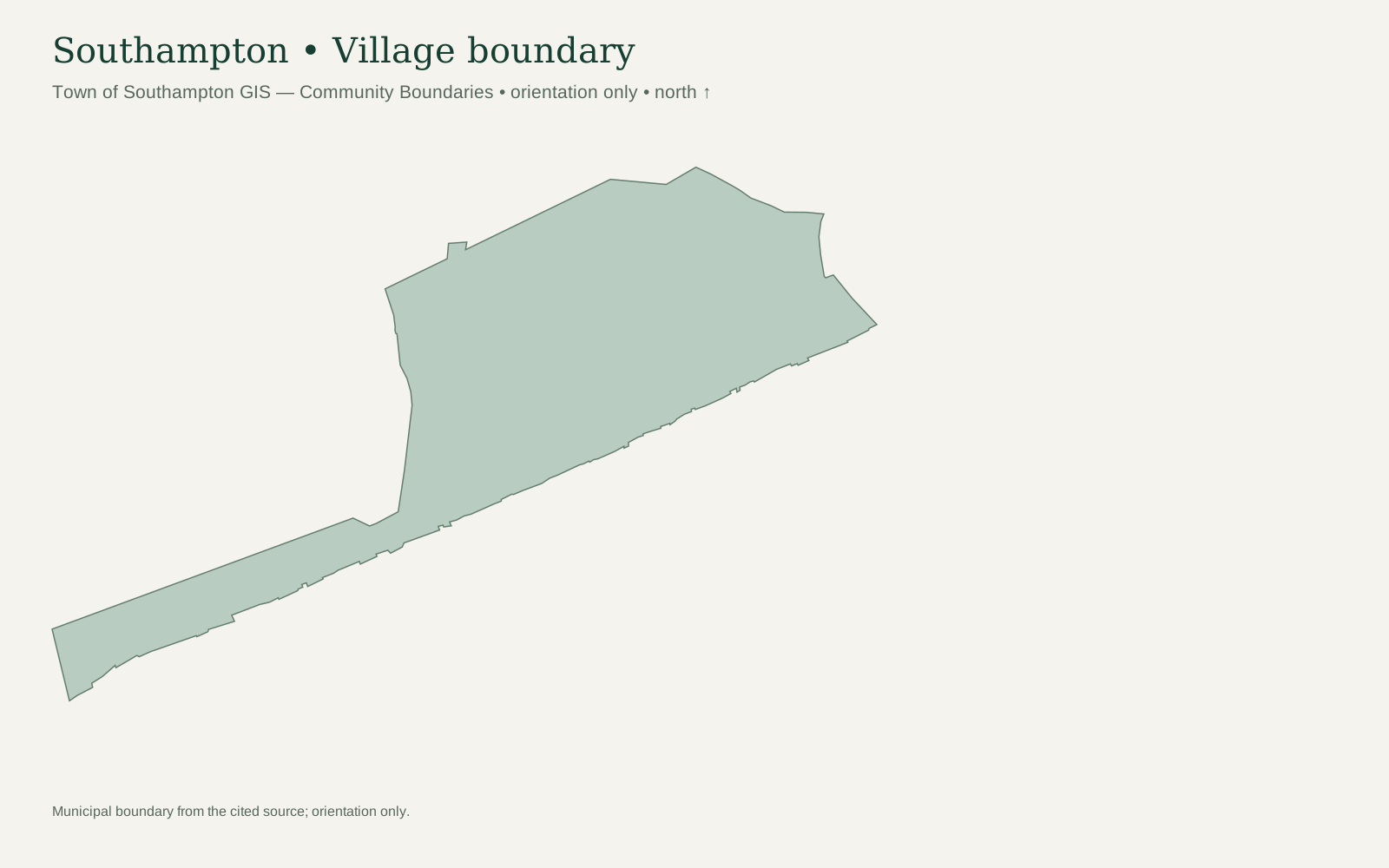
The orientation map uses the Town’s Community Boundaries GIS layer and shows the feature labeled Village of Southampton. It is a municipal outline for orientation, not a truck route, school-assignment map or set of neighborhood borders. Art Village, Water Mill, Bridgehampton and Hay Ground are nearby comparisons outside that village outline.

Record four things while considering a property: the municipality, the owner of the road used for delivery, the school district and the services connected to the building. Confirm them with the appropriate office or provider using the full street address. Those boundaries do not have to coincide.

The six area comparisons below draw on village planning and Town heritage reports. They describe documented setting and building history, with the source period made clear. They do not establish present vacancies, prices, a public right of entry or permission to alter a building. A heritage description is useful for deciding what to inspect; it does not replace a viewing.

Keep nearby institutions in the correct place. The village plan distinguishes the Stony Brook Southampton university campus in the Town from the village itself. A proposal in that plan, including redevelopment or sewer work, is not evidence that a project has since opened.

Outline of Southampton Village on Long Island, from the Town of Southampton community-boundary layer
Town of Southampton GIS: the incorporated village boundary, generalized for orientation. Nearby Town heritage areas extend beyond this outline. This is not a school-zone map, neighborhood boundary map, service area or truck route. Open full-size map.

03 /

Find the area that fits your routine

These six comparisons combine two village settings with four nearby Town heritage areas. The latter are outside Southampton Village and use their own address-specific road, school and service arrangements. Sources document local character in their stated periods; they do not describe current listings or six official municipal neighborhoods. Hay Ground overlaps parts of Water Mill and Bridgehampton rather than forming a separate municipality.

Village center / Main Street and Jobs Lane

The village plan adopted in 2022 and revised in 2023 describes a compact commercial center, with retail frontage on Main Street, Jobs Lane, Nugent Street, Jagger Lane and western Hampton Road. Proposed upper-floor housing and redevelopment in the plan are not treated as completed projects.

Comprehensive Plan: adopted 2022, revised January 2023 ↗
Housing & setting
For an actual home near shops, inspect its separate entrance, floor, stairs and delivery arrangement. The planning description does not establish available apartments or a lift.
Daily travel
Test the walk to the actual bus stop and the separate route to Southampton station. Confirm private parking rights.
Before choosing
Check the one-ton daytime loading rule, the receiving entrance and the building’s permitted hours.

Village historic residential settings

The village homeowner guide documents a large historic district and smaller Wickapogue Road, Beach Road and North Main Street districts. It describes older dwellings, summer houses and a range of late-Victorian and early-twentieth-century architecture. These places do not all share one building layout.

Village historic districts: homeowner guide ↗
Housing & setting
Measure the actual porch, door, stairs and route to the room. Ask the owner about any separate review before changing an exterior to accommodate access.
Daily travel
Try the particular route to shops, school or rail; a historic-district label does not establish a continuous sidewalk or short walk.
Before choosing
Verify the parcel’s designation and current rules with the village rather than treating the older pamphlet as a permit decision.

Art Village / Shinnecock Hills — Town

The Town’s 2012 report describes the late-nineteenth-century art-school enclave at the village’s western boundary: small Shingle Style cottages, wooded surroundings and narrow lanes. It records a distinct setting around Studio, Ochre and related lanes, outside the incorporated village.

Art Village heritage report, July 2012 ↗
Housing & setting
Compare the individual cottage or home, its gate and the tightest part of the route. Historic dimensions do not establish a modern truck turning area.
Daily travel
Check the actual road ownership and permitted vehicle approach from the regional route. Do not apply village-center parking instructions automatically.
Before choosing
Confirm lane access, property permission and a workable alternative truck position before committing to a delivery window.

Water Mill center — Town

The Town’s 2003 heritage material traces the hamlet center to the water-powered mill, windmill commons and Montauk Highway. It documents historic houses and a commercial center linked to those mills. This is a neighboring hamlet, not a part of Southampton Village.

Water Mill heritage report and designation, 2003 ↗
Housing & setting
Inspect the specific home and entrance; the historical inventory does not establish current occupancy, renovation condition or which services are included.
Daily travel
Test the exact Route 92 stop and both directions, along with any crossings between the home and the hamlet center.
Before choosing
Confirm school district, road authority and property access independently of the mailing address and heritage description.

Bridgehampton Main Street — Town

The 2009 Town report identifies a concentrated heritage stretch of Montauk Highway and a varied stock of houses, civic buildings and older commercial structures. Its Main Street setting is distinct from Southampton Village’s Main Street and uses a different local context.

Bridgehampton heritage report, January 2009 ↗
Housing & setting
For a nearby home, inspect its own driveway, stairs and relationship to commercial access. The report is a historic inventory rather than a current housing offer.
Daily travel
Compare the actual rail or Route 92 journey and the walk to the boarding point. Check service for the intended date.
Before choosing
Do not transfer Southampton Village’s Main Street loading rule to a same-named street here; establish the responsible authority.

Hay Ground — overlapping Town locality

The 2011 heritage report describes a locality overlapping Water Mill and Bridgehampton, centered on Montauk Highway and Hayground Road. Its triangular road pattern and documented farm history distinguish the setting; the name does not identify a separate municipality.

Hay Ground heritage report, May 2011 ↗
Housing & setting
Assess the individual building, driveway length, gate and storage needs. Agricultural history does not establish current land use, public access or available housing.
Daily travel
Test the actual connection to the hamlet center and transport stops rather than measuring from the locality name alone.
Before choosing
Confirm the address’s municipality, school district, service providers and delivery approach; avoid inventing a single Hay Ground boundary.

04 /

Compare the actual home, total cost and access

The ACS 2024 five-year housing estimates cover 2020–2024 and apply to Southampton Village, Census place 16000US3668462. They describe the whole village’s housing stock, not an individual hamlet, present listings or a quote for the property you are considering. Small local estimates also carry sampling uncertainty.

Village measureACS 2024 five-year estimateUse it for
Occupied homes1,648Understanding the tenure denominator
Owner / renter occupied83.9% / 16.1%Village-wide tenure context
Median gross rent$2,437 per monthHistorical paid-rent context, not an asking rent
All housing units3,857A different denominator from occupied homes
Single-unit detached / attached86.2% / 4.2%Broad structure mix
Built before 194018.0%A reason to inspect older-building access

The difference between total units and occupied homes is not a count of homes available to rent. Do not convert it into an availability claim. Compare actual leases or purchase documents, the period of occupancy they allow, deposits, recurring charges, included services and the costs you will arrange separately.

At a house, walk the route from the possible truck position through the driveway and gate to the rooms. Check porch steps, turning space and the narrowest door. Ask who maintains the drive and vegetation, whether a larger vehicle can enter and turn, and what route avoids landscaping or vulnerable surfaces. A wide frontage does not prove a usable turning area.

At an apartment or converted building, identify the unit’s own entrance and floor. Measure the stair turns and landings; verify any lift before depending on it. Establish parking rights, shared storage and the written delivery rules. A photograph of a furnished room does not show how those furnishings arrived.

For older or designated property, ask the owner which access preparations can be made and whether an alteration needs separate review. Keep ordinary furniture handling distinct from removing doors, changing an exterior or cutting vegetation. Confirm the building’s water, wastewater and heating arrangements from current property records rather than assuming one system across the village.

Two closed branded kraft cartons beside a blue-gray sofa in a bright living room
Keep a usable room and a clear path while unpacking.

05 /

Test the whole journey, including the last connection

Southampton LIRR station is on the Montauk Branch. MTA identifies an accessible station with a ramp and passenger-information systems, and a ticket machine against the station building’s west wall. Use TrainTime for the exact travel date, destination, transfers and return. A station nearby does not establish a frequent direct journey to a particular New York terminal.

The station page limits its waiting-room and ticket-office schedules to specified days between Memorial Day and Labor Day. Do not plan a year-round indoor wait around those seasonal hours. If assistance is needed, use the linked LIRR Care process and confirm the boarding arrangement before traveling.

Suffolk County Transit Route 92 connects East Hampton LIRR and Orient Point Ferry through Southampton, Bridgehampton, Sag Harbor, Hampton Bays and Riverhead. Its Southampton rail connection is described as a half-mile walk from North Sea Road at Bowden Square or Windmill Lane at White Street. Check the actual stop and direction; the rail platform and bus boarding point are not the same place.

The linked summer timetable is effective March 16–October 25, 2026. It lists a $2.25 regular fare and 25-cent transfers, with separate reduced-fare categories. Select the weekday, Saturday, Sunday or holiday schedule that applies. Later trips need the next effective timetable; a seasonal PDF should not be carried forward indefinitely.

Suffolk Transit On-Demand serves a defined Southampton zone and operates daily from 6 a.m. to 8 p.m. Book through its app or call 631-818-2982. Enter the actual origin and destination, then check the pickup point shown; it can require a short walk. Zone coverage and a confirmed ride matter more than a general “Southampton” label.

For a fixed-route-to-On-Demand transfer, the published instructions require buying the transfer when boarding the bus, booking from the eligible connection point and showing the ticket to the On-Demand driver. The operator recommends requesting the ride 10–20 minutes before it is needed. Treat that as booking guidance, not a guaranteed pickup time. Confirm fare and transfer handling for the reverse journey too.

Test the full routine from the home: getting to the stop, waiting, boarding, any connection and the return with bags or after an evening activity. Make a separate vehicle plan for the furniture shipment. Passenger travel and truck access have different restrictions, so a route that works for a family car is not automatically suitable for a moving truck.

Two adults beside the curb-facing passenger door of a white and navy bus
Check the boarding side, operating day, stop and return journey.

06 /

Confirm the district, submit the records and arrange the start

Begin with the full property address and the student’s grade. Southampton Village, a Southampton postal address and Southampton Union Free School District are different concepts. Ask the district to confirm responsibility before relying on a listing’s school description. For an address in another district, use that district’s own enrollment process.

The Southampton UFSD 2026–2027 registration page provides the complete new-student route. Submit the pre-registration form first. After approval, an email provides the PowerSchool account instructions. Complete all nine forms and upload the required records. The registrar reviews the file and contacts the family about missing information; finishing an initial online step does not by itself establish a first day of attendance.

Prepare a birth certificate or passport, parent or guardian identification, three proofs of address and the most recent physical and immunization records. The page expressly separates its Tuckahoe residency-document exception. Ask the registrar how that exception applies to the particular student rather than assuming every household with a neighboring address can omit records.

For an owner, the detailed proof guidance includes a deed, mortgage or tax bill plus two further acceptable documents. For tenants or shared housing, the page offers several ways to document residence, including landlord or other third-party statements. Its English guidance includes sworn or unsworn statements; do not assume every family must produce one particular notarized lease. If the situation does not fit the usual examples, contact registration before the desired start date.

The new-resident FAQ allows 30 days to supply residency proofs. Confirm how staff will handle your case and what is needed immediately; that statement should not be treated as a waiver of the rest of enrollment. A returning student’s family should contact the registrar for help restoring its PowerSchool parent account instead of creating a conflicting duplicate record.

The current Pre-K and kindergarten flyer states age four by December 1, 2026 for Pre-K and age five by that date for kindergarten. Children already attending the district’s Pre-K do not need to register again for kindergarten. The flyer gives the new district office as 300 Hampton Road and registration appointments at 631-591-4517, Monday–Friday, 7:30 a.m.–3:30 p.m.

Tuckahoe Common School District maintains its own registration forms, including student, parent or custodial affidavits and a housing questionnaire. A separate district’s form set is not interchangeable with Southampton’s nine-form PowerSchool process. Confirm the responsible office for the student’s grade and address before sending personal records.

After the file is accepted, confirm placement, start date, health-office follow-up, meals and transportation. The Southampton high-school transportation page lists Southampton Transportation at 631-591-4541 and separate Montauk Transportation contacts. Its high-school arrival and departure times do not establish a new child’s bus eligibility or stop. Ask about the specific route, pickup arrangements and any after-school return; childcare also needs its own confirmed place.

07 /

Coordinate accounts, possession and access for service visits

Ask the owner which utilities are individually metered, which are included in rent and who is responsible for each account. Identify the heating fuel and wastewater system from the actual property. The village’s planning history is not proof that a proposed sewer project serves a particular home today. Keep account changes distinct from installation, repair or a new connection.

For an existing SCWA-served home, the residential moving-in application distinguishes an owner occupant from a lease tenant. Prepare property and contact details, the requested service date and a permitted photo ID. The form instructs applicants to black out license or identification numbers before uploading. Send those records only through the provider’s official process.

The live form lists a $30 initiation fee, with a stated Stony Brook Water District exception, and a $50 residential tenant deposit with exceptions for certain managed districts. Confirm the applicable account terms before submitting. Its quarterly base charges continue on an open account even without consumption; moving belongings out is not the same as closing the account.

The SCWA moving-out form asks for the account number, name, forwarding address, closing date, telephone and email. It states five business days to complete the termination process and representative follow-up. Coordinate the final reading and the incoming resident’s start date so that possession, account responsibility and any physical service work fit together.

If the property is not already connected, use SCWA’s separate connection and availability process. Converting a private well or serving a new building requires more than transferring an existing account. A requested date does not establish water availability, connection cost or completed work. Arrange any required adult access and ask how the provider will confirm completion.

PSEG Long Island separates starting, stopping and transferring electricity. Its new residential application begins with identity, current address and contact details before the service-location stage. Keep the final confirmation rather than treating the first screen as an active account. Coordinate access if the provider requires a visit.

The PSEG residential stop form gives a minimum 72-hour notice for online requests and directs earlier requests to 800-490-0025. It asks for the service account, stop date and final-bill address. That published stop-service interval does not establish the earliest available start appointment. Keep the outgoing and incoming confirmations separately.

For a National Grid gas-served property, the Long Island service page asks for at least a week and describes five to seven days to arrange a physical visit. Its contact page also mentions 24 hours for start or stop requests. Begin with the longer planning window and confirm the actual appointment at 800-930-5003; the notices concern different possible steps and should not become a promised activation time.

The gas appointment checklist requires an adult aged at least eighteen throughout the visit and safe access to the relevant equipment. Agree that access with the owner and keep pets clear. Arrange internet installation, heating-fuel delivery or other address-specific services separately, with someone present who can resolve access problems.

08 /

Choose collection or self-hauling before unpacking

The Town recycling guide describes two household routes: arrange a private carter or bring material to the Town’s transfer stations. It states that the Town does not provide municipal curbside trash and recycling collection. Ask the landlord or owner what arrangement already serves the property, what the household pays for and where material must be kept.

A self-hauler uses designated Town green bags for non-recyclable household garbage. Recyclables go into their separate streams, not those bags. The guide says residents may be asked for proof of residency. Private-carter customers do not need the Town bags, but must arrange collection and special handling with the carter. Do not put moving debris beside a public receptacle or assume an unbooked curb pile will be collected.

The Town’s current green-bag and station page lists five large bags for $18.25 or five small bags for $10.25. It gives 8:30 a.m.–4 p.m. for ordinary green-bag and recycling access, with fee-based disposal ending at 3:30 p.m. North Sea and Hampton Bays are listed as open daily; Sag Harbor and Westhampton close on Wednesdays. Check holiday changes and whether the intended station accepts the particular material before loading a vehicle.

The 2026 fee schedule identifies North Sea at 1370 Majors Path and Hampton Bays at 30 Jackson Avenue. The prices below are disposal charges for the stated resident categories and facilities. They do not include transport from the home or authorize a private carter’s separate service.

MaterialFacility and published feeBefore taking it
Mattress or box springNorth Sea / Hampton Bays: $20 eachCount each mattress and foundation separately
Mixed residential bulkNorth Sea: $300 per ton, $15 minimumConfirm acceptance and the weighing process
Small bulk under 3 × 3 × 3 feetHampton Bays: $15 per cubic yardDescribe the item and dimensions
Large bulk over 3 × 3 × 3 feetHampton Bays: $30 per itemConfirm how staff classify the item
Appliance with refrigerantNorth Sea / Hampton Bays: $10 per itemKeep it separate from ordinary bulk

Keep corrugated cartons clean and dry, separate mixed paper and follow the station’s sorting instructions. The recycling guide identifies container plastics numbered 1 and 2; that is not permission to mix packing film, foam or every plastic object into container recycling. Ask attendants or the carter about uncertain material before combining it with the load.

The Town carter page maintains the permitted-service route. Its hauler application is a business requirement, not a registration form every resident must submit. Ask the chosen provider about collection days, container location, bulky items and mattress handling. Keep that agreement separate from a moving-company packing or unpacking scope.

Hazardous household products use the appropriate special collection process. The waste office, 631-283-5210, can confirm the current event, accepted material and facility rules. Assign disposal transport in advance so that rejected items do not remain at the old home after possession changes.

09 /

Follow the village loading procedure and the correct road authority

First identify whether the proposed truck position is in Southampton Village, a Town hamlet, a county or state road, or private property. Record the street segment, entrance, vehicle dimensions, load capacity, gross vehicle weight rating, dates and duration. Those vehicle measures are not interchangeable: the village’s central loading rule uses load capacity, while its truck-route provisions use GVWR.

Village Code §110-31 restricts vehicles with a load capacity greater than one ton from remaining stationary for loading, unloading or another purpose on Jobs Lane and the defined part of Main Street between 9 a.m. and 5 p.m., except as required by ordinary traffic conditions. The Main Street segment extends from Meeting House Lane and Jobs Lane to Nugent Street and Hampton Road.

Owners, occupants or tenants claiming that deliveries cannot reasonably be handled outside those hours or from a lawful nearby position may make a written application to the Village Clerk. The code provides for a Board hearing within ten days and a decision to grant or refuse the permit. It also describes a limited emergency-permit route. Neither provision guarantees approval, immediate processing or reserved curb space.

Contact the Village Clerk at 631-283-0247, extension 222. Ask for the current application, the supporting address and vehicle information, any charge and the hearing arrangements. The public exception-form route was behind a sign-in page when checked, so confirm which form actually applies to the proposed operation. Obtain the written decision before planning around an exception.

The truck-route provisions in §§110-16 and 110-16.1 concern vehicles over 10,000 pounds GVWR and describe directional routes using streets including Hill Street, Windmill Lane, North Sea Road, Nugent Street, Hampton Road and Main Street. They preserve exceptions for pickup or delivery of property along otherwise excluded streets. That local-delivery exception does not cancel the separate loading, parking or current traffic restrictions.

For ordinary loading elsewhere in the village, ask Village Police’s general-inquiry line, 631-283-0083, about the exact curb, hours, vehicle and carrying operation. Establish whether a reservation, exception, traffic control or other approval is needed. Confirm who installs any authorized signs, when they take effect and whom to call if the space remains occupied. No general household-moving fee, posting interval or approval deadline was established from the public chain.

The Village Highway Department is the road-maintenance contact at 631-283-2025. Ask about additional requirements if the plan affects a public lane, sidewalk or village property. Keep a lawful fallback position and its carrying distance, without blocking access or relying on privately placed cones.

Outside the village, the Town Highway permit index distinguishes road-opening work from temporary obstruction for moving a house, barn, shed or similar structure. “House moving” in that form means transporting the structure; it should not automatically be applied to household furniture. Describe the actual operation to Town Highway at 631-728-3600 and confirm the road owner.

For the approach from elsewhere on Long Island, NYSDOT’s parkway guidance restricts commercial vehicles on designated parkways. Give the mover the vehicle details and require a suitable truck route. Building access, a lawful approach and permission to stand at the destination are three separate parts of the plan.

10 /

Make building permission match the physical route

Obtain the property’s moving instructions from the owner or manager who can authorize access. Identify the entrance, floor, unit, usable hours and person opening the doors. At a shared building, ask how the move is coordinated with residents and other deliveries, and whether the service lift or corridor is actually available for the whole agreed window.

Measure the route from the truck position to the destination room. Include porch steps, narrow doors, stair turns, low ceilings and any separate storage area. An approved street position does not establish that a sofa fits inside, and a wide lobby does not settle the dimensions of the next door or landing. Send useful photographs and measurements to the estimator.

Ask about protective materials, a certificate of insurance, an attendant, contractor registration and any other building-specific condition. If a labor or union requirement is raised, request its written scope and the contact responsible for arranging it. These are questions for the particular property, not a claim that every Southampton building imposes the same conditions.

Record charges or deposits separately: amount, recipient, payment deadline, basis and return conditions. Clarify what belongs to the building and what belongs in the moving estimate. Obtain written permission for any preparation before a short moving window, such as delivery of packing materials, without assuming that furniture can be staged in a shared exit or hallway.

Make pickup and delivery windows work in sequence with travel and handling between them. They need not occur at the same time, but both must be achievable. Identify the person who can release the old home and the person who can receive the new one. If a lift fails or keys are delayed, know when to choose a revised window or confirmed storage before the vehicle is loaded.

Finally, inspect the route again just before the move. Remove loose obstructions, secure pets and keep residents informed through the appropriate manager. A previously approved route may change because of maintenance or another delivery. Have a decision-maker available to resolve changes before the crew begins carrying.

11 /

Build routines around the places you will actually use

Test ordinary journeys from the property before deciding that a village-center or hamlet address works for the household. Try the grocery trip with bags, the school or childcare handoff and the return from work. Compare the actual entrances, crossings, open hours and parking arrangements. A destination on the same map can still require a different route than expected.

Rogers Memorial Library’s card policy serves residents or property owners in the Southampton and Tuckahoe school districts and states a six-full-month residence or ownership requirement for the regular resident category. It asks for photo identification and, if necessary, separate proof of the physical address; a post-office box does not establish residency.

The policy offers a separate visitor or temporary-resident card for stays under six months, with photo identification, a current lease in the applicant’s name and a valid credit card under its stated conditions. A newly arriving household should ask staff which category fits its circumstances. The card page gives 91 Coopers Farm Road and 631-283-0774; owning property through an entity has additional documentation requirements.

For a walk, park visit or waterside outing, check the actual public entrance and current access conditions. Being near a pond or beach does not establish private access, parking entitlement or suitability for a particular activity. Keep the representative photographs separate from the address-specific checks you make in person.

Give the first week a small set of confirmed tasks: collect essential groceries, locate the agreed waste route, test the commute and complete any remaining school or utility appointment. Leave time between them. The household settles more easily when the entry, one sleeping area and basic services remain usable while the other rooms are still being unpacked.

Two adults walking on a paved path beside calm water, reeds and trees
Check the actual public entrance and current access conditions before planning a routine.

12 /

Check current traffic, snow conditions and the property route

The village’s September 2026 traffic notice prohibits left turns onto Hill Street from Halsey Neck Lane and Captains Neck Lane on weekdays, 3–7 p.m., September 14–October 30, 2026. The same notice identifies the Lee Avenue left-turn restriction as permanent, not merely part of that afternoon trial. Confirm current signs and directions for the actual move date.

The village parking code prohibits street parking or standing from 3:30–6 a.m. during the specified snowstorm conditions when at least one inch has accumulated, including its stated preceding-night condition. It separately restricts commercial-vehicle parking from 4–5 a.m. on streets so signed and commercial vehicles in public lots from midnight–7 a.m. Do not treat a daytime loading plan as authorization for overnight storage.

The current village alerts also mark the September 26, 2026 Hamptons Marathon as cancelled because of the storm. The linked document retains the earlier event traffic text with a cancellation mark. An older event route therefore should not be presented as an active closure. Recheck fresh notices close to departure.

At the property, arrange removal of wet leaves, snow or ice from the actual carrying route and verify lighting at gates and steps. Agree who makes the decision if access is unsafe or unavailable, when that decision is due and which revised window or confirmed storage arrangement can be used. A prepared fallback needs a receiving person and a restart condition as well as another date.

Resident holding a closed umbrella beside wet porch steps and a paved path
Inspect the approach again after rain and arrange clearing before delivery.

13 /

Turn separate confirmations into an arrival plan

Before loading, confirm possession of the destination, the usable entrance, the receiving person and essential services. Check the approved truck location and any required setup. Review the inventory with the mover and identify what stays behind. Keep documents, medicines, identification, chargers and first-night belongings with the household rather than at the back of the shipment.

Give the receiver a room plan and clear labels for major items. Keep children, pets and visitors away from the carrying route. A person authorized to approve placement or a scope change should remain reachable through delivery; a key holder who cannot make decisions may not be enough to resolve a problem.

Define Plan B before it is needed. Name the observable trigger, such as keys not released by a specific decision time or a failed lift inspection. Identify who decides, the lawful alternative window or actual storage reservation, and the people who must be notified. Account for additional handling, waiting and temporary accommodation, then specify what must be confirmed before delivery resumes.

At handover, check the inventory and record concerns while the relevant item can be inspected. Save the paperwork and service confirmations. Verify the next collection day, school start and remaining technician visits. Keep cartons and unwanted items within the agreed disposal plan, and leave the entry and essential rooms usable while the rest of the household settles in.

Use the Southampton moving page to bring the inventory, access information, packing choices and unresolved timing into the estimate discussion. The better the receiving conditions are defined, the easier it is to discuss the actual work and a practical fallback.

14 /

Questions before you arrive

Does a Southampton address mean Southampton Village rules apply?

No. Confirm the municipality, road owner, school district and connected utilities for the full address. The main procedure and housing statistics here concern the village; the nearby Town hamlets are explicitly identified as comparisons.

Can I use a daytime loading space on Main Street?

Check the vehicle’s load capacity and the exact street segment. The village has a separate daytime rule for central Main Street and Jobs Lane, with a written Clerk and Board exception process. A local-delivery truck-route exception is not itself a loading permit.

When can a child start at Southampton UFSD?

Confirm the district first, then complete pre-registration and the nine PowerSchool forms, provide the required records and obtain the school’s accepted start arrangement. The 2026–27 flyer uses December 1, 2026 age cutoffs: four for Pre-K and five for kindergarten.

Will the Town collect unpacking waste from the curb?

The published Town system uses private carters or resident self-hauling. Establish the property’s service and special-item handling. Green bags are for a self-hauler’s non-recyclable household trash; bulky items and mattresses have separate facility rules and charges.

Can I rely on the train and bus for everyday travel?

Test the complete outward and return journeys for the actual date. Southampton station is on the Montauk Branch, Route 92 has seasonal timetables, and On-Demand rides depend on the eligible zone and booking. Include the walk between the home, stop and platform.

What should be confirmed before the moving truck is loaded?

Confirm possession, the authorized entrance and curb, a reachable receiver and essential services. Keep the inventory, first-night belongings and paperwork accessible. If keys or access fail, use the agreed decision time and a confirmed alternative before committing to delivery.

Your next step

Bring the plan together

Use the Southampton moving page to prepare the inventory, access details and questions for your estimate.

Sources & useful local resources

Official procedures and local resources are linked beside the answers above. Reopen the relevant page when arranging a date: fees, schedules and application requirements can change.

Housing and geography

Truck access and parking

Schools and family

Transport and everyday life

Waste and recycling

Transport

Utilities

Weather and seasonal access