Massachusetts / City relocation guide

Moving to Springfield

A useful Springfield comparison starts with a particular home and the daily journeys you need. This guide connects neighborhood context with the practical work of enrolling, opening accounts, arranging truck space and settling into the property.

People walking along a broad sidewalk beside brick storefronts
Test the everyday journeys from the address you are considering.

01 /

Begin with the home and three everyday journeys

Choose a specific home to investigate, then test three journeys from it: work or study, food and other routine errands, and a regular personal destination such as a school or appointment. Use the hours when you will actually travel. Include the return trip, the walk from a stop or parking place, and a workable alternative if the usual arrangement fails.

Keep a short comparison sheet for each property. Record the full municipality and unit, possession date, monthly housing obligations, heating arrangement, parking rights and building access. Add the responsible contact for school assignment, utilities and any moving-truck permission. A useful comparison separates confirmed information from a landlord's estimate or a question still awaiting an answer.

Once you prefer a home, connect the administrative dates. School records may require review, a water closing form belongs in the transaction timetable, and a truck permit needs time for processing. None of those steps is completed merely because a moving date has been proposed. Keep copies of confirmations somewhere available from your phone while the rest of the household is packed.

02 /

Understand Springfield and its neighborhood map

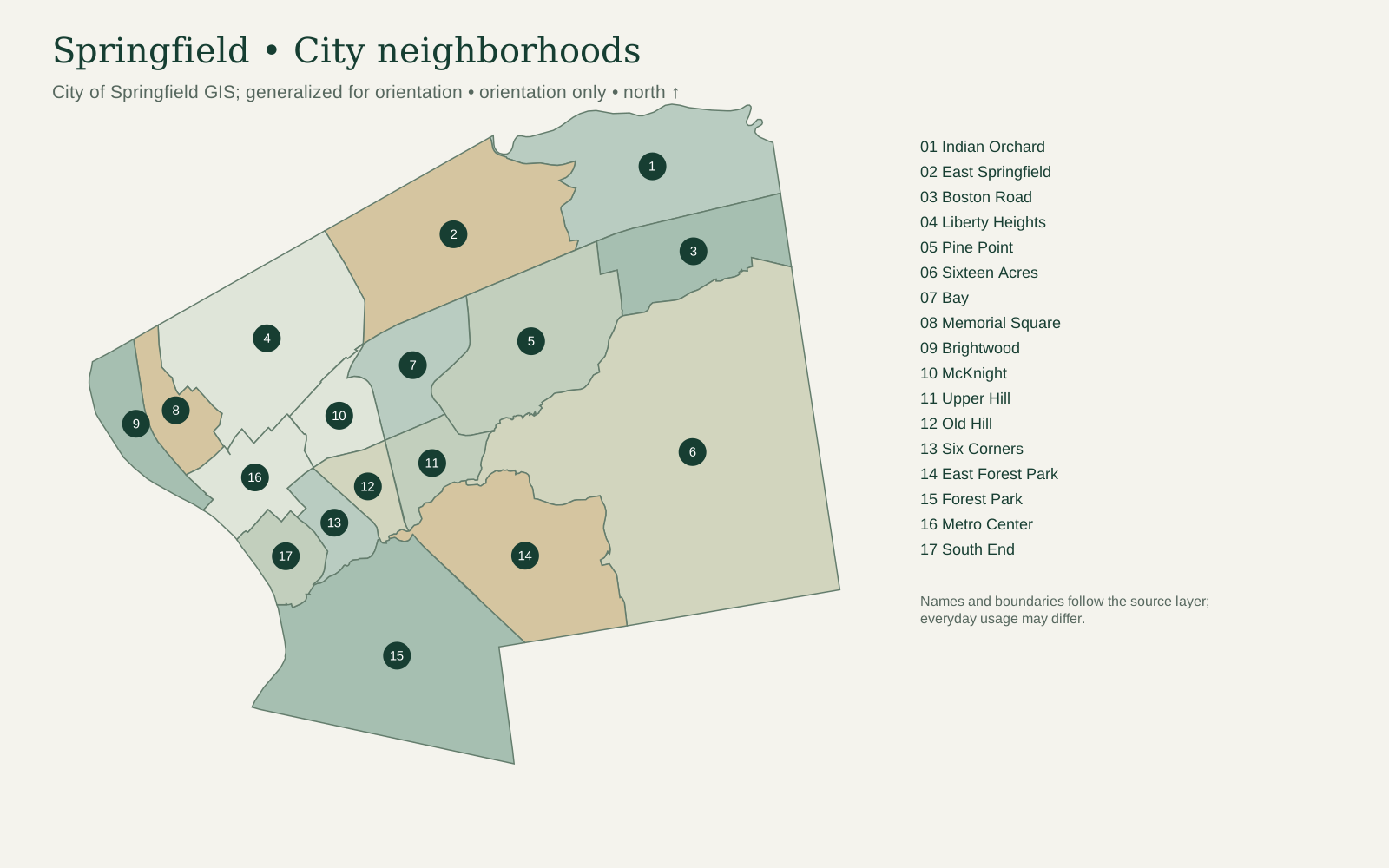
This guide concerns Springfield city in Massachusetts. The municipal GIS identifies 17 neighborhoods, shown on the orientation map. The six comparisons below draw on individual neighborhood investment plans; they do not rank every neighborhood or assign one housing character to an entire district. The map is generalized for orientation and does not establish property lines, school assignment or a legal truck route.

West Springfield is a separate municipality across the Connecticut River. Confirm the jurisdiction of the actual home instead of applying Springfield procedures to every address described as being in the Springfield area. Indian Orchard, by contrast, is one of Springfield's neighborhoods. Its distinct name and industrial history do not make it a separate municipality for the city procedures discussed here.

Springfield College lists its main address at 263 Alden Street in Springfield. Check the exact campus or residence when planning a student move. A reference to a western Massachusetts college does not establish that the building is inside the city or that a private apartment follows campus receiving rules.

Bradley International Airport is in Windsor Locks, Connecticut, outside Springfield and across the state line. Plan the ground connection separately from the flight. Compare the actual arrival time, luggage, vehicle arrangements and onward access to the home; a regional airport label does not provide a door-to-door travel guarantee.

Seventeen Springfield neighborhoods from official city GIS with numbered key
City of Springfield GIS neighborhoods, generalized for orientation. The six comparisons below cover a selection of these areas. This map does not establish parcel, school-assignment or truck-access boundaries. Open full-size map.

03 /

Find the area that fits your routine

These six comparisons use separate official neighborhood investment plans. The map shows all 17 city neighborhoods; local historic districts and school boundaries have different purposes. Compare the particular home and current journeys, and verify whether any planned improvement has actually been completed.

Forest Park

The 2025–2035 plan connects the neighborhood's residential growth to the establishment of Forest Park and the late nineteenth-century trolley network. It describes development around Sumner, Belmont and Fort Pleasant Avenues and the older homes of Forest Park Heights. This is historical context, not a uniform description of every present-day property.

Forest Park neighborhood investment plan ↗
Housing & setting
Compare the offered home's layout, heating, storage and actual upkeep. In a porch-front house, measure the exterior steps and landing as well as the internal staircase. Establish whether any shared spaces and off-street parking belong to the unit.
Daily travel
Test your route to the park entrance and the journeys beyond the neighborhood. Former trolley alignments explain development history; they do not establish current bus frequency. Use the current timetable and the stop that serves the address.
Before choosing
Check the curb arrangement on the exact block and the route between the vehicle and door. Agree who clears steps and the sidewalk in winter, and confirm any owner approval needed for changes to a protected exterior.

McKnight

The 2024–2034 plan describes a streetcar suburb with Victorian homes, landscaped triangles and terraces, and McKnight Glen. It distinguishes the local historic district from the broader National Register area; the names and boundaries are not interchangeable.

McKnight neighborhood investment plan ↗
Housing & setting
Inspect the actual dwelling and its entrances rather than inferring condition from the architecture. Ask about subdivision into units, shared halls, utility metering and storage rights. Measure turns that an exterior photograph cannot show.
Daily travel
Walk the route to the services and stops you expect to use, including the return journey. Tree-lined streets and historical development patterns do not establish how convenient a particular block is for your daily schedule.
Before choosing
If furniture access would require changing an exterior feature, have the owner check the property's actual designation and approvals first. Keep the loading arrangement separate from permission to enter or work on the building.

Metro Center

The 2025–2035 plan describes Springfield's central area with government and commercial buildings, apartments and mixed-use properties. Its discussion distinguishes existing land uses from proposals for additional pedestrian-oriented development. Proposed improvements should not be assumed complete.

Metro Center neighborhood investment plan ↗
Housing & setting
For an apartment, compare the floor, lift availability, sound and utility arrangements, and the rights attached to any parking or storage. Establish the precise receiving entrance rather than assuming a ground-floor business entrance serves the dwelling.
Daily travel
Test the complete route to Union Station or the relevant bus stop, then the service needed at your travel time. Include the walk from the final stop and the last useful return connection, not merely proximity on a map.
Before choosing
Obtain the building's delivery instructions and coordinate the public curb with DPW and the Parking Authority. Ask about permitted work hours, temporary restrictions, shared loading activity and the clearance of any proposed garage approach.

South End

The 2025–2035 plan identifies Main Street as the neighborhood's longstanding core. It records a mix of business and residential uses, including single- and two- or three-family homes and apartment buildings, with I-91 and the Columbus Avenues occupying a substantial corridor.

South End neighborhood investment plan ↗
Housing & setting
Compare the individual building's entrance, floor plan and current condition. Check which outdoor or basement areas are included, who maintains shared spaces and whether the dwelling's utility and parking arrangements suit your needs.
Daily travel
Walk the actual crossings between the property, errands and intended transit stops. Being near a roadway or a downtown destination does not settle the quality or duration of the route for your particular trip.
Before choosing
Check whether loading conflicts with a shop, shared driveway or another occupant's access. Ask DPW which street-occupancy conditions apply and agree a receiving contact who can keep the approved entrance available.

Indian Orchard

The 2025–2035 plan describes Indian Orchard's distinct development as a factory village within Springfield, shaped by mills and the Chicopee River. It records a street grid and worker housing associated with that industrial history. Indian Orchard remains a Springfield neighborhood.

Indian Orchard neighborhood investment plan ↗
Housing & setting
Assess the offered home and any conversion on its own terms. Establish usable rooms, shared access, heating and storage, and compare the route from the approved vehicle position to the unit. Historical building use does not establish current residential suitability.
Daily travel
Test trips from this part of the city to work, school and services. Use current routes and schedules for the actual address rather than assuming the downtown pattern applies. Check the return trip as carefully as the outbound one.
Before choosing
Identify the correct city street and entrance in the permit request. If access uses a rear lane or shared private area, obtain permission and confirm turning space before relying on that approach for a truck.

Old Hill

The 2024–2034 plan explains the neighborhood's development between the Armory and Watershops, with early residential streets around Walnut and Hickory. It describes current commercial activity along several corridors and a portion of the Springfield College campus extending into its southeastern corner.

Old Hill neighborhood investment plan ↗
Housing & setting
Inspect the precise property and its present layout, including stairways, storage and any shared entrance. A historical residential pattern is not a condition assessment. Confirm the landlord's or owner's responsibilities for utilities, refuse and external maintenance.
Daily travel
Use the exact destination on campus or elsewhere when testing a journey. The plan says Springfield College is primarily in Upper Hill, with part in Old Hill; proximity to the campus edge does not establish the distance to a particular building.
Before choosing
Confirm the truck approach and any shared loading arrangements with the property contact. For a campus residence, obtain that residence's receiving instructions; for a private rental, establish the building rules and municipal street procedure separately.

04 /

Compare the housing obligation and the physical home

The ACS 2024 five-year profile for Springfield city describes the 2020–2024 survey period. Approximately 50.4% of occupied homes were renter occupied and 49.6% owner occupied. Median gross rent was $1,144, and median value for owner-occupied homes was $245,000. These measures describe the surveyed housing stock; they are not current asking rents, sale quotations or a budget for the home you are considering.

Across all housing units, approximately 44.9% were single-unit detached, 5.2% single-unit attached and 48.6% in structures containing two or more units. About 36.7% were built before 1940. Those figures make the individual inspection especially useful: age and structure type do not establish a building's condition, insulation, heating cost or whether a large piece of furniture will fit.

For a rental, obtain a written breakdown of rent, utility responsibilities, deposits and other required payments. Ask what parking, storage, laundry and outdoor areas are included. Confirm who maintains shared halls and who arranges trash service, snow clearing and repairs. If a room, attic or basement appears in a viewing, establish whether it forms part of your tenancy before counting it as usable storage.

For a purchase, inspect the actual property and use the transaction's professional advice for condition and legal questions. Coordinate the water final reading and closing documentation through the closing participants. Possession and receipt of keys need to align with deliveries; a scheduled closing time does not guarantee that a truck can unload at that moment.

Measure entrances and turns before committing to moving large furniture. Include the porch, stairs and destination room, with particular attention to radiators, door swings and low ceilings. If you need dependable internet for work, check service at the exact unit and arrange any installation access. Record unresolved costs and permissions beside the advertised price so your comparison reflects the home you will actually use.

Two closed kraft cartons beside a sofa in a room with tall windows and a radiator
Check the room layout, storage and route for large belongings.

05 /

Check routes, fare notices and the trip home

Start with PVTA system and route maps, then consult the timetable and service notices for the specific trip. Compare the walk to the stop, crossings, connections and the last useful return journey. A route passing near a home does not establish frequent service at every hour or a direct connection to your destination.

PVTA's current bus fare page states that fixed-route buses are fare-free for FY27 and excludes premium B79 service. Its July 2026 continuation notice says the program continues until further notice, with funding approved into spring 2027. The fare page also retains ordinary fare tables, so use the current program notice and verify the rule for your service before buying a pass. Do not extend the bus announcement to every van or premium journey.

Springfield Union Station is at 55 Frank B. Murray Street and lists Amtrak, Hartford Line, PVTA and intercity coach contacts. Select the actual operator for ticketing, luggage and accessibility questions. The station's opening hours do not mean that a particular train or bus operates throughout those hours. Allow time for the transfer between the arriving service and your next departure.

If you drive, test where the vehicle can remain overnight as well as where you can stop briefly. Establish whether a leased parking space is assigned, shared or subject to a separate agreement. Check street signs and the walking route back to the entrance. A garage suitable for a personal car may have insufficient clearance for a moving truck, and a convenient passenger drop-off area may not accommodate a loading operation.

Try one ordinary weekday and, if it matters to your routine, a weekend journey before relying on a location. Include the practical details: carrying groceries, walking in darkness, reaching the correct platform and returning after an evening activity. Use those observations to compare properties without assuming that the neighborhood name alone determines transportation convenience.

Transit bus facing the same direction as curbside cars while a passenger boards from the sidewalk
Check current PVTA services; the transit scene is illustrative.

06 /

Enroll through Student Assignment Services

Use Springfield Public Schools' Pre-K to 12 enrollment page for the correct district and application path. The district allows an online enrollment application without first visiting Student Assignment Services. Prepare clear copies or photographs of the required records before starting, and use the exact residence and unit information that the district will review.

The current registration document list provides the detailed checklist and translations. Collect the child's age and school records, health documentation, the parent or guardian's identification and the accepted residence and occupancy evidence specified there. Do not substitute an old checklist from another Springfield school system. Where a required proof of residency cannot be provided, the enrollment page points to a residency affidavit; contact the district about the appropriate route for your circumstances rather than delaying without asking.

The currently linked checklist is revised October 2024. It requests a current immunization record and physical, a birth certificate (long form for new registrations), prior-school records for grades 1–12, and applicable guardianship or caregiver documents. It separates proof of residency from proof of occupancy dated within the past 60 days and from valid parent or guardian identification. If staying with someone, review its additional host-document requirements with Student Assignment Services.

The published process includes requesting prior-school records, nurse review of immunization records and, when a child has an IEP, review by the special education team for assignment. Uploading an application starts that work. It does not by itself confirm a school, first day, transportation arrangement or placement in a requested program. Keep the prior school's contact information and relevant records accessible during the move.

Kindergarten applicants must be five by September 1; first-grade applicants must be six by September 1. Preschool has a separate process for children aged three to five. Discuss the child's age, present enrollment, program needs and intended start with Student Assignment Services instead of treating a general age description as a guaranteed preschool seat.

Consult the boundary assignment viewer for address-based orientation, and obtain the district's final assignment. For children moving between elementary, middle and high school, review the relevant selection procedure. The 2026–2027 selection page describes a January 12–February 22 ballot period for current fifth- and eighth-grade students and a separate enrollment step for non-current students. Those dates have passed as of this guide's September check: a family arriving now should contact Student Assignment Services for the current entry or late-arrival path.

Student Assignment Services is at 91 School Street, with the main assistance number 413-787-6959. Ask about language assistance, missing documentation and any access needs before a visit. Before the first day, confirm the assigned school, start date, arrival and dismissal arrangements, transportation if applicable, and the contact for any remaining health or educational records.

07 /

Separate account changes from new connections

Eversource's service-area lists include Springfield for electricity and gas. Confirm the actual address, meter and services at the property; a community listing does not prove that every dwelling uses natural gas. Check the lease or purchase information for heating fuel, separately metered services and any utilities included in the housing payment.

The provider's start-service page requires an Eversource.com user ID for an online request. Select the correct Massachusetts location and arrange the effective date. Confirm whether the request is an account change at an active service or requires further work or access. Keep the confirmation and clarify responsibility during any gap between the previous occupant leaving and your possession date.

For water and sewer, the Commission's buying or selling procedure directs the real estate attorney to arrange the final reading and the seller's final bill. The buyer's attorney should submit the closing form at least five, but no more than ten, business days before closing. Put that task in the transaction schedule and confirm it with the responsible participant rather than treating it as an ordinary electricity-style online transfer.

The Commission's moving-account guidance says to update the mailing address through Customer Service at 413-452-1393. Tenants should establish with the owner which bills they are responsible for and how those charges are administered. Do not infer a right or duty to open a water account simply from the fact that you are moving into a rental unit.

A different Commission page covers new physical water and sewer connections, including plans, ownership information and contractor work. That construction process is not the routine checklist for every occupied-home move. If the property genuinely needs a new connection, have the owner establish the work and timing before relying on the home being ready for occupancy.

Check internet service at the unit rather than only the street. Ask whether equipment is already present, whether an appointment is needed and who can admit an installer. Keep a list of confirmed start and stop dates, meter or account references and the person responsible for each service. Avoid scheduling termination at the old home before agreed access, cleaning or other essential work is finished.

08 /

Arrange collection, cartons and unwanted furniture

First establish whether the property receives city service and pays the annual city trash fee, or uses a different arrangement. A landlord or manager should identify the actual collection point and the carts assigned to the dwelling. The city's trash collection page says carts stay at the property when an occupant moves. Do not take them to the new address or assume that every visible bin belongs to your unit.

Use the address and current calendar to confirm collection days and holiday changes. Prepare the cart before the published 6:30 a.m. collection time, and follow the current closed-lid requirement. Position containers on the tree belt rather than the roadway and keep the entrance and carrying path clear. Collection access needs to coexist with the moving truck rather than being blocked by it.

Springfield uses single-stream recycling. The city says overflow recyclables may go in a cardboard box beside the recycling barrel. Its accepted-material and placement guidance includes cardboard torn into smaller sections, calls for carts to be at least three feet apart and excludes plastic bags and Styrofoam containers or peanuts. Separate packing film and cushioning from the cartons; a moving box is not an all-purpose container for mixed packing waste.

Bulk pickup is available only to residents and properties paying the city's annual trash fee. The bulk collection instructions require an advance telephone appointment through 413-736-3111. Most listed bulk items need one $8 sticker per item. Since February 4, 2025, mattresses and box springs each need two stickers, totaling $16 per unit. A mattress and a box spring are two units, not one charge for a bed set.

Confirm the accepted item, appointment, preparation and placement before putting it outside. Ask specifically about the mattress or box spring you intend to discard and any protection or condition requirements. The posted price does not by itself book a pickup, and a sticker does not establish eligibility for a property served under another arrangement. Arrange an appropriate provider if city service does not apply.

For extra trash, the page specifies a $2 sticker for each plastic bag no larger than 32 gallons, with a limit of ten extra bags on a collection day and a call to schedule additional collection. Keep these bags separate from recycling. Decide what will leave the home before packing so that unwanted furniture, cartons and ordinary household waste each have an agreed destination and collection date.

09 /

Follow the street-occupancy application through to approval

Springfield explicitly includes moving and delivery trucks in its street occupancy permit category. Begin with the actual proposed operation: address and unit, the street segment, truck size, dates, loading duration and whether a ramp, liftgate or carrying activity affects the sidewalk or road. A private driveway arrangement may resolve some access questions, but any intended occupation of the public way still needs the appropriate review.

  1. Agree the responsible applicant. Coordinate the application with the mover and property contact. The city's manual says the entity occupying the public way obtains the permit; it gives the example that an owner cannot obtain one on behalf of a contractor working there. Ask DPW how that applies to the proposed household move.
  2. Confirm the approval chain. The web instructions begin with a Police Department Request to Conduct Event form and relevant Police, Fire, Health or other approvals. Although the wording refers to an event, it appears within the moving-truck occupancy procedure. Ask DPW and Police which forms and approvals they require for the particular loading arrangement.
  3. Submit the location and dates. The DPW application includes a Street Occupancy checkbox and requests the address, bounding side streets, work description, start and stop dates and applicant contact information. The form says to submit 72 hours in advance; the web instructions also allow 72 hours for processing. Leave additional time to resolve questions and obtain approvals.
  4. Provide the required insurance and traffic details. The city requires a liability certificate. Describe pedestrian passage, any travel-lane effect and the complete truck working space. Obtain the applicable instructions for barriers, signs and any police detail. Do not treat an ordinary moving truck as excavation and automatically add the separate trenching-license requirements.
  5. Confirm and pay the full fee. The web fee schedule and DPW contact page lists non-excavation at $25 per day. The linked 2017 occupancy manual also specifies a $75 application fee for daily occupancy. Because the presentations differ, obtain the current total and any additional charges directly for the application. The web procedure says fees are paid when requested and does not accept cash.
  6. Keep the authorization available. Confirm the approved hours, location and conditions before relying on the space. The manual calls for the occupancy permit card to be displayed where inspectors can see it, or carried when posting is not feasible. Clarify who posts any temporary restriction and when; an approved application is not permission to improvise signs or move another vehicle.

DPW Engineering and Traffic is at 70 Tapley Street; the listed Engineering number is 413-787-6210. The manual also addresses pedestrian continuity, road closures and police details at the permittee's expense when required. Ask specifically about allowed hours if the operation affects the Downtown or X business district, because the manual describes additional work-hour restrictions there. Do not turn its older general wording into an assumed approved household-moving schedule.

For a metered location, coordinate with the Parking Authority as well. Its on-street instructions explain that a parking session cannot be extended past a zone's time limit merely by paying again in the app. Paying a meter and receiving street-occupancy approval address different parts of the plan. Get any needed meter, posting and enforcement arrangement confirmed.

Before the day, recheck the exact curb for temporary restrictions, construction, waste collection and weather notices. If the approved space is unavailable, contact the responsible office and moving contact for the next step. Do not assume that double parking, blocking a driveway or occupying another part of the street is an equivalent alternative.

10 /

Check the entire delivery route before possession

Begin outside and follow the belongings all the way to their destination. Measure the narrowest opening, porch steps, landing, stair turn and hallway, then compare them with the largest items. Include the height available when furniture must be tilted. Photograph fixed obstructions and distinguish a measured opening from an estimate based on appearance.

For a multi-unit building, obtain the current move instructions from the person who manages common areas. Confirm whether an elevator must be reserved, which entrance may be used, any insurance documentation, permitted hours and arrangements for protecting floors. Ask who will unlock the receiving entrance and what happens if the move arrives after that person's availability.

In an older house, a second entrance may offer a different route, but establish permission and usable clearance before relying on it. Do not plan to remove a railing, alter an opening or carry through another unit without the owner's agreement and any applicable approvals. Historic character and present access are separate questions; a restored facade does not guarantee a workable route for every item.

Keep shared exits clear and identify a staging area that does not prevent another resident from entering or leaving. Record the responsibility for clearing private steps and maintaining lighting. If the route is unsuitable, discuss disassembly, an alternative route or specialist handling with the mover before the delivery is scheduled. The Springfield moving page explains the information needed for that review.

11 /

Test the services and places you will use regularly

Make a practical first-week list: food, a pharmacy, laundry if needed, a place to receive parcels, and the destinations important to your household. Check current hours and the route from the actual entrance. A business shown on an old neighborhood plan may have changed; use those plans for context and verify the service you intend to use today.

Visit a nearby park entrance and try the walk there, including crossings and the route home. The Forest Park neighborhood comparison refers to a real neighborhood and its park-related development, but living somewhere within that district does not establish a particular walking distance to a usable park entrance. Choose the facilities and routes that fit your needs rather than treating a boundary label as an amenity guarantee.

For appointments, study or shift work, test the relevant arrival and departure times. Confirm the exact destination building, parking or transit option and any visitor instructions. If you need accessibility accommodations, ask the service operator or property manager about the actual route and facilities. A general neighborhood description cannot settle access inside an individual building.

Establish how your building receives deliveries and handles missed parcels, maintenance requests and visitors. Introduce the correct unit designation into address records and check that essential contacts can reach you after the move. Resolve one routine at a time during the first week, keeping any remaining service appointments and administrative tasks on a single list.

Walkers on a paved park path and a person seated beneath autumn trees
Try the park entrance and route you expect to use regularly.

12 /

Prepare for snow rules and changing access

The city's severe weather parking restrictions apply once announced and until removed. They prohibit even-side parking from 7 p.m. to 7 a.m. and odd-side parking from 9 a.m. to 4 p.m. Existing prohibitions remain relevant, and designated red-and-white severe-weather signs can alter which side is available. Check the actual street and current announcement; do not treat the time periods as a general right to park anywhere during the gaps.

The snow and ice code generally requires clearing abutting sidewalks, hydrants and curb cuts within 24 hours after snowfall or ice ceases. For a parcel with one dwelling or rental unit, the duty is assigned to tenants or occupants; for multiple units or an unoccupied parcel, it falls to the owner or person responsible for the property. Establish the practical clearing arrangement before the first storm. The code also addresses making icy sidewalks passable and prohibits putting snow into streets.

The city's snow operations page describes an order of work from arterial routes to secondary streets and residential streets. That is not a promised clearing time for your block. Recheck the vehicle approach, street restrictions and private steps close to a winter move, and keep the receiving contact available if conditions change.

At other times, check the property's current condition after rain, falling leaves or nearby work. A clear sidewalk at a viewing does not ensure the same condition on arrival. For a campus-related move, use the actual residence's published check-in arrangements and calendar. No general claim about citywide moving demand is needed to plan around your own confirmed dates and access requirements.

Resident shoveling snow beside a cleared walk and porch steps
Assign clearing responsibilities and check access before the move.

13 /

Use a staged arrival checklist and a workable fallback

Before committing the date: confirm possession and keys, identify the receiving contact, inventory the belongings and survey both access routes. Establish the street-occupancy applicant and begin the local procedure. If a permit, elevator or building reservation is pending, keep that dependency visible rather than assuming it will be completed automatically.

Before the move: confirm utility dates, school application progress and any transaction-related water work. Arrange bulk collection for items that will not travel, and set aside the records, medication, chargers, basic food supplies and bedding needed immediately. Label cartons by destination and retain measurements and route photographs for unresolved access questions.

At arrival: verify that the planned entrance and loading space are available. Show the receiving layout, check essential services and keep the carrying path clear. Retain permits and service confirmations, complete the agreed delivery paperwork and walk the property for belongings that may have been placed in the wrong room or left outside the intended delivery area.

If the home is not ready: contact the moving and property contacts promptly. Agree any alternative receiving time, storage or extra handling and its terms before authorizing the change. A nearby curb, garage or vacant room is not automatically an approved substitute. Keep a personal overnight plan and essential belongings available while the revised arrangement is resolved.

During the first week: complete remaining school and service confirmations, verify the collection routine and test the journeys that shaped the housing decision. Record any property issue through the appropriate management channel. Return to the Springfield estimate preparation section if the move's remaining inventory, storage or delivery scope changes.

14 /

Questions before you arrive

Are Springfield and West Springfield the same municipality?

No. Verify the municipality for the actual address and street before applying a permit, collection or property procedure. Indian Orchard is a neighborhood within Springfield.

Are the housing figures current listings?

No. They are ACS 2024 five-year estimates covering the 2020–2024 survey period. Use the actual property information and current financial obligations to compare homes.

Are PVTA buses currently free?

The current fixed-route fare page announces fare-free travel for FY27, excluding premium B79 service. The continuation notice says funding extends into spring 2027 and service remains free until further notice; check the current rule for your trip.

Does submitting school enrollment confirm the assignment?

No. Records, immunizations and any program needs still require review. Confirm the assigned school, start date and transportation arrangements with Student Assignment Services.

What does city mattress pickup cost?

For eligible city-trash-fee properties, each mattress and each box spring needs two stickers totaling $16 per unit. An advance appointment is required; confirm preparation and placement before putting anything outside.

Can moving cartons go in recycling?

The city accepts cardboard in single-stream recycling and allows extra recyclables in a cardboard box beside the barrel. Reduce carton size and separate excluded plastic bags, film and foam rather than placing mixed packing waste in the recycling.

Can I use the city water new-connection process for a normal move?

That process concerns a physical water or sewer connection. For a property sale, coordinate the final reading and closing form through the transaction participants; for an existing account or rental, confirm the appropriate account and billing responsibilities.

Your next step

Bring the plan together

Use the Springfield moving page to prepare the inventory, access details and questions for your estimate.

Sources & useful local resources

Official procedures and local resources are linked beside the answers above. Reopen the relevant page when arranging a date: fees, schedules and application requirements can change.

Orientation

Housing

Weather

Neighborhood plans

Truck space

Transport

Utilities

Waste

Schools