New York / City relocation guide

Moving to Syracuse

Syracuse is a renter-majority city of two-flats, hills and serious snow, organized around its universities and hospitals. This guide helps you compare areas, plan the everyday basics and prepare the practical steps of arriving.

A neighborhood commercial corner with brick buildings and distant pedestrians.
Try the everyday errands around a new address, not only the journey to work.

01 /

Start with the decision in front of you

Syracuse asks three different questions of a newcomer, and this guide is organized around them. If you are still choosing where to live, start with the orientation and the neighborhood comparison, then read the housing section — Syracuse's market is mostly rentals in older houses and two-flats, and the differences that matter are stairs, heat, parking and what the rent includes. If you are moving with children, go to the schools section early: Syracuse runs a central registration with school-choice windows, not automatic assignment to every school. If the address is already decided, the second half of the guide walks through the practical setup — utilities, waste, the curb for the moving truck, building access and the arrival sequence.

One caution before any comparison: Syracuse is a city of 32 official neighborhoods, but everyday names, postal ZIP codes and school geography all draw different maps — and some famous "Syracuse" addresses, including Le Moyne College and the airport, are not in the city at all. Verify each address against the map that matters for the decision at hand.

02 /

Understand Syracuse before comparing addresses

Syracuse is the Onondaga County seat and the economic center of Central New York, sitting where I-81 meets the New York State Thruway (I-90). The city itself is compact — most residential addresses are within a few miles of downtown — and it is ringed by separate towns: DeWitt to the east, Salina and Geddes to the north and west, Camillus and Onondaga to the south. A "Syracuse area" description and a Syracuse address are not the same thing; municipal rules — trash, parking, permits — change at the town line, so confirm the municipality before comparing procedures.

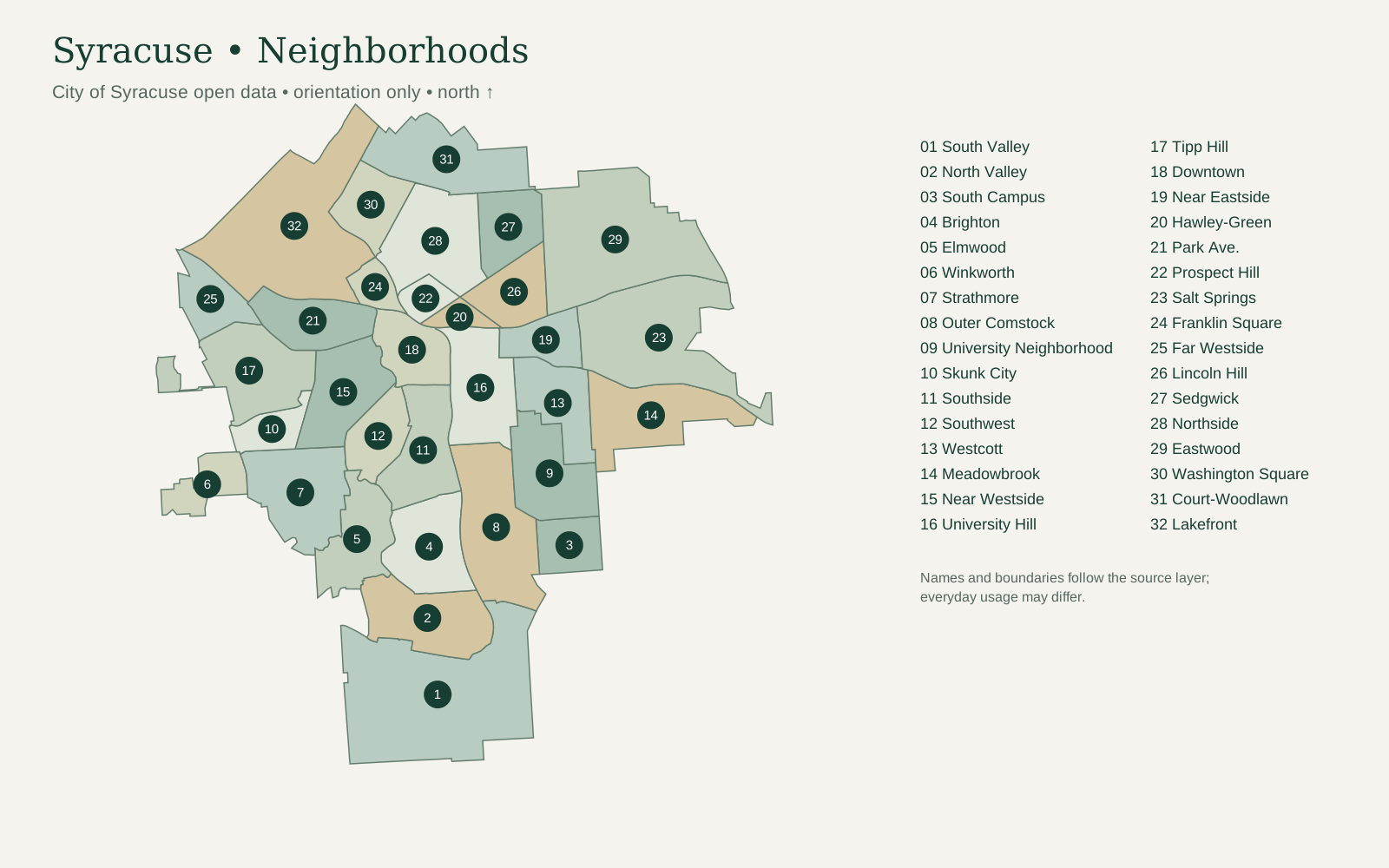
The city's own geography divides Syracuse into 32 official neighborhoods, mapped below from the City's open-data layer, maintained by the Department of Neighborhood and Business Development (the June 2026 revision shifted the Salt Springs boundary south to East Genesee Street). They are planning geography: postal ZIP codes cross them, and none of these lines assigns a school or guarantees a building condition.

Two naming traps matter for movers. Le Moyne College prints "1419 Salt Springs Road, Syracuse, NY 13214" as its mailing address, but the campus is in the Town of DeWitt — the city's own neighborhood layer stops south of Salt Springs Road. The institutions genuinely inside the city are on and around University Hill: Syracuse University (900 South Crouse Ave.), SUNY ESF (1 Forestry Drive, "alongside Syracuse University") and SUNY Upstate Medical University. Syracuse Hancock International Airport, despite the name, sits northeast of the city line in DeWitt. Addresses marketed as "near Le Moyne" or "by the airport" may follow another town's rules entirely.

Syracuse orientation map with numbered area key
Use the numbered key to locate the areas discussed below. Open full-size map.

03 /

Find the area that fits your routine

The City of Syracuse counts 32 neighborhoods in its official open-data layer; the nine modules below are the areas with verified documentation, chosen to contrast housing types and access patterns. They are starting points for inspection, not rankings — school enrollment has its own process, and building conditions vary house by house.

Downtown & Armory Square

The city's commercial core: the Hanover Square Historic District (listed 1976) preserves 19th-century commercial blocks in Federal, Second Empire and Romanesque styles, and the Downtown Committee describes Armory Square as a former warehouse district turned restaurant and retail quarter.

Hanover Square Historic District record (NPS) ↗
Housing & setting
Apartments and lofts over commercial floors; expect managed entries, elevator reservations and set moving windows rather than private driveways.
Daily travel
The Centro hub, the Intermodal Transportation Center and the walkable core are all here — the strongest car-light position in the city.
Before choosing
Confirm the loading arrangement and building window early; downtown curb space is metered and enforced.

University Hill

The university quarter: Syracuse University (its Comstock Tract buildings are a listed historic district, built 1887–1937), SUNY ESF and SUNY Upstate sit here — the city's employment and turnover engine.

Syracuse University–Comstock Tract record (NPS) ↗
Housing & setting
Student-oriented rentals around the campuses plus older houses; leases follow the academic calendar, and August availability is the pinch.
Daily travel
Walkable to campus; Centro routes converge below the hill.
Before choosing
Ask whether a rental runs on the academic year; confirm move windows against the university calendar and building rules.

Westcott

The Westcott-University Neighborhood Historic District — listed February 6, 2025 — documents the area's early-20th-century residential fabric, including Ward Wellington Ward designs, along the grid around Westcott Street.

NPS Weekly List, February 2025 (Westcott-University HD) ↗
Housing & setting
Older singles, doubles and small apartment buildings with porches and stairs; the classic near-campus rental stock.
Daily travel
Westcott Street is the commercial spine; buses on Euclid and Westmoreland connect toward downtown.
Before choosing
Measure porch stairs and narrow halls; ask the landlord about shared driveways and any district review for exterior work.

University Neighborhood

Between the Hill and Westcott: the Walnut Park Historic District (listed 1983) preserves Colonial Revival and late-19th-century residential blocks on Walnut Place and Walnut Avenue.

Walnut Park Historic District record (NPS) ↗
Housing & setting
Pre-war houses and small multi-family buildings; expect stairs and shared entries.
Daily travel
A walkable area east of downtown with bus service on the bordering avenues.
Before choosing
Check the entry and stair route of the specific building; older housing here varies house by house.

Strathmore

The Strathmore 'By the Park' Subdivision (listed 2006) is a planned early-20th-century community — Colonial Revival homes on curving streets near the park, with 1919 as its key development year.

Strathmore 'By the Park' record (NPS) ↗
Housing & setting
Predominantly single-family houses with yards and driveways — the easiest truck access in the city.
Daily travel
Car-oriented; buses on the bordering avenues; test the actual commute.
Before choosing
Confirm garage and driveway dimensions; planned-community details may carry association or district rules.

Meadowbrook (Scottholm)

The Scottholm Tract Historic District (listed 2012) documents the planned residential development along East Genesee Street, Scottholm Terrace and Meadowbrook Drive — community planning, architecture and landscape significance.

Scottholm Tract Historic District record (NPS) ↗
Housing & setting
Larger period single-family houses on landscaped lots; driveways are the norm.
Daily travel
East-side avenues carry the bus routes; check the stop you would actually use.
Before choosing
Long driveways and period construction mean measuring the carry route and checking what the sale or lease says about exterior changes.

Tipp Hill

The west-side neighborhood anchored by St. Patrick's Church complex (listed 2012, noted for architecture and social history) at North Lowell Avenue.

St. Patrick's Church Complex record (NPS) ↗
Housing & setting
Older two-flats and singles on a tight grid; porch-and-stairs access is the default.
Daily travel
Bus routes on the main avenues; a short ride to downtown.
Before choosing
Verify where a truck can stand on the narrower streets and agree driveway use ahead of the day.

Northside

The 19th-century commercial corridor along North Salina Street — the North Salina Street Historic District (listed 1985) preserves Greek Revival, Late Victorian and Federal blocks — with dense older housing behind it.

North Salina Street Historic District nomination (NPS) ↗
Housing & setting
Older multi-family and row stock; inspect stairs, entries and shared halls directly.
Daily travel
North Salina buses head downtown; the corridor is walkable for daily errands.
Before choosing
Confirm the legal curb position on the corridor and the entry arrangement of the specific building.

Hawley-Green

The Hawley-Green Street Historic District (listed 1979) preserves Stick, Eastlake, Italianate and Queen Anne houses from 1840–1900, just northeast of downtown.

Hawley-Green Street Historic District record (NPS) ↗
Housing & setting
Some of the city's oldest residential stock; character houses with the access quirks of their era.
Daily travel
Walkable to downtown; buses on the bordering streets.
Before choosing
Pre-1900 construction varies widely in condition; check windows, heat and stairways as carefully as the rooms.

04 /

Compare the whole home, not just the advertised payment

Syracuse is a renter's city: 58.4% of households rent their home (ACS 2024 5-year, via Census Reporter). The median gross rent is $1,039 a month and the median owner-occupied value $138,400 — among the lower figures in the series, but medians describe the whole city at once, not the apartment in front of you, and listing sites' asking rents run above survey medians. Use them only to sanity-check a budget.

The stock explains the market. About 41% of Syracuse homes are single detached houses and roughly 27% sit in two-to-four-unit buildings — the side-by-side or up-down two-flat is the signature rental form — while downtown adds loft conversions and University Hill adds larger apartment buildings. About 43% of units were built before 1940. For a mover this means the differences that matter are physical: which floor, stairs or elevator, the grade of the driveway, where a truck can stop, how heat is supplied and who clears the sidewalk. Wood porches and bay windows come with the charm; so do narrow staircases with landing turns.

When comparing two apartments, compare what the payment includes — heat, hot water, parking, snow clearing — the lease's move-in and move-out rules, and the condition of the access route: porch boards, stair rails, door widths. Syracuse requires certification and periodic inspection of rental and vacant properties through the Central Permit Office, so you can ask a landlord for the property's current status. Ask early who handles bulky disposal when you leave; the city's bulky collection is scheduled, not on-demand.

A furnished living room in an older apartment with sealed moving boxes by the wall.
Compare usable rooms, heat arrangements and what the rent actually includes.

05 /

Test the complete daily journey

The bus operator is Centro — the Central New York Regional Transportation Authority, the public provider for Onondaga, Oswego, Cayuga, Cortland and Oneida counties. City routes converge on the downtown Transit Hub on South Salina Street, and fares are among the lowest you will meet: a Greater Syracuse local ride costs $1.00 cash, with a $4.00 day pass, and tap-to-pay works at the farebox. A car-light household is realistic downtown and around University Hill; most outer neighborhoods assume a car, so test the door-to-door routine from the address you are considering.

Intercity travel runs through the William F. Walsh Regional Transportation Center at 1 Walsh Circle near Onondaga Lake's south shore, open since 1998: Amtrak's Empire Service, Lake Shore Limited and Maple Leaf stop there, alongside intercity buses and Centro connections. It is a bus or car ride from downtown, not a walk — plan the last leg.

Syracuse Hancock International Airport is northeast of the city, off I-81 in the Town of DeWitt, and is operated by the Syracuse Regional Airport Authority, with nonstop service to 27 destinations. Despite the mailing name, it is outside the city limits — which matters only if you are comparing addresses near it.

A downtown street with a city bus among older commercial buildings.
Test the complete daily journey, including the walk at both ends.

06 /

Register centrally, and mind the choice windows

Syracuse City School District enrollment runs through a single Student Registration Center: 1005 W. Fayette Street, 4th Floor, Syracuse, NY 13204; main line (315) 435-4545, appointments at (315) 435-6392, walk-ins accepted for registration, Monday–Friday 8:30 a.m.–4:00 p.m. There is an online registration portal, and the district offers a school locator tool to check which schools serve an address. A student residency questionnaire is among the standard forms, and McKinney-Vento rights apply for families in temporary housing.

The detail that changes planning: several programs are by application, with fixed windows, not by address alone. For the 2026–27 school year the district's published calendar runs like this:

ProgramApplication windowNotification
Grade 9 high school choice and transfersNovember 17, 2025 – January 2026Letters by April 30, 2026
Pre-K, K–8 and grade 10–11 choice/transfer, K–12 new and returning studentsFebruary 1 – April 1, 2026Letters by June 12, 2026

Choice programs include ELMS, the Montessori programs at Delaware and LeMoyne, Seymour Dual Language and Syracuse Latin. High school choice matters most at grade 9 — the district's high schools (Corcoran, Henninger, ITC, Nottingham, PSLA at Fowler, STEAM) admit through that window. A family arriving mid-year registers directly at the center; a family planning a fall arrival should treat the February window as a deadline and the November window as the high-school deadline. Do not sign a lease counting on a specific choice placement.

07 /

Assign an owner and a start date to each household service

Electricity and natural gas in Syracuse both run through National Grid's upstate New York territory. Start, stop or transfer service online through the utility's moving page; no official lead time is published, so submit the request as soon as your date is fixed.

Water is municipal: the Syracuse Water Department supplies city addresses from Skaneateles Lake, and its page is explicit that water bills are the responsibility of the property owner and are sent to the owner — renters normally confirm the arrangement through the lease rather than opening an account. The surrounding suburbs are mostly served by OCWA, the Onondaga County Water Authority, a separate system covering five counties; a move across the town line changes the water utility. The city also posts drinking-water notices, including 2024 lead-sampling notices for some homes — renters in pre-war buildings should ask what is known about the service line.

For internet, availability is address-specific; no carrier claims are made here. Ask the landlord or seller which provider already wires the building — an installation booked before the move is easier than one booked from an empty apartment.

08 /

Plan for routine collection and the things you are leaving behind

Syracuse's Department of Public Works collects trash and recycling in city-issued carts — the cart program went citywide in September 2023. Carts go out no earlier than 6:00 p.m. the day before collection and must be off the street by 7:00 p.m. on collection day; trash must be bagged with the lid closed, and no other containers are accepted. Improper set-out brings a violation notice and 24 hours to pull it back before a fine. The city publishes a collection-day map; learn your day in the first week.

The rule that surprises movers: bulky items go out only by scheduled collection. Call Cityline at (315) 448-2489 two days in advance; you get four bulk collections per calendar year, with limits of two cubic yards and 50 pounds per setout.

What you are leavingHow it goes out
Furniture and bulky itemsScheduled Cityline collection; 4 per calendar year, 2 cu. yd. / 50 lb per setout
Mattress or box springAccepted as a bulk item on a scheduled collection
Carpets and tiresBulk collection; up to 4 tires per calendar year
Excess bagged trash, electronics, hazardous wasteOCRRA county drop-off sites (Rock Cut Road, Ley Creek, Amboy)
Yard waste and construction debrisOnly on certain published days — check the city calendar

Whatever the item, a curb pile on moving day is not a legal disposal route in Syracuse — and a violation follows the property, which is why movers and landlords both care.

09 /

Arrange a legal place for the moving truck

Syracuse runs its curb through the Central Permit Office. For a moving truck, the instrument is a right-of-way permit covering parking or other activity in the city right-of-way — the permit menu includes metered-parking and street-parking occupancy, loading zones and oversized-vehicle permits. Three facts shape your planning, from the fee schedule effective April 1, 2025: street parking costs $18 per day per parking space, with a one-day minimum; Sundays and holidays are excluded; and all fees are due at the time of application, payable to the Commissioner of Finance.

Apply online through the city's application portal or in person at the Central Permit Office, One Park Place, 300 South State Street (entrance on East Onondaga Street), 315-448-4754, permits@syr.gov. The city publishes no processing lead time and no sign-posting procedure for reserved space, so apply early, confirm the permit was issued, and carry a copy on moving day. Agree inside the household who owns the application.

Enforcement is real: the Parking Violations Bureau gives you 20 days to pay or dispute a ticket, penalties accrue through 90 days, and three or more tickets in collections make a vehicle boot-eligible. A truck left "just for an hour" across a driveway or in a hydrant zone is a gamble with someone else's moving day. If the building offers a driveway, lot or loading dock instead, use it — private loading beats a street permit, but get the property's instructions in writing. Either way, match the truck's window to the building's window, and remember the winter overlay: signed odd/even restrictions still apply to a permitted truck.

10 /

Inspect the full route through the building

On one Syracuse housing type, access means wood and grade: two-flat porches, shared front halls, staircases with tight landings, and driveways that climb — the city's hills are part of the access question, especially from November to March. Measure the largest pieces against the actual route — width, turns, ceiling at the landing — and check porch boards and railings before anyone carries a sofa across them. Agree driveway use with the landlord and neighbors; many drives are shared or single-width.

On the other type, access means paperwork: downtown loft conversions and the larger buildings around University Hill run moves through the property manager. Expect elevator reservations, fixed moving windows and a certificate of insurance requested from the mover; some buildings require protective padding in elevators and corridors, booked in advance. Student-oriented buildings near the campuses add hard turnover dates tied to the academic calendar. Ask for the written moving rules at both ends as soon as the date is set. Syracuse also certifies and periodically inspects rental properties — a current certification is a reasonable thing to ask a landlord about.

Whichever type, walk both routes before the day: where the truck stops, which door is used, every stair and elevator between the truck and the room, and who unlocks what. A plan that works at the origin but not the destination is only half a plan — confirm the two ends together, with time windows that overlap usefully.

11 /

Build a useful routine beyond the commute

Syracuse's everyday geography rewards a look on foot. Downtown, the Downtown Committee's neighborhood map describes the core: Armory Square, a 19th-century warehouse district turned restaurant and retail blocks; Hanover Square, the city's oldest commercial district; and Clinton Square, which hosts festivals, the Downtown Farmers Market and winter ice skating. Each outer neighborhood leans on its own artery — Westcott Street, North Salina, James Street, South Geddes — for groceries and errands.

Test the routine you will actually live: the grocery run, the pharmacy, the school or daycare route, a late-evening trip home. University calendars shape whole blocks — the Hill fills in late August and empties in May — while downtown quiets after the workday. Winter is part of the everyday test too: visit a candidate address after a snowfall and see who shovels, where the plow piles land and how the hill feels underfoot. Visit a candidate address at the hours you would use it before deciding.

A neighborhood park with mature trees, paths and older houses beyond.
Check the outdoor routine around the address you actually choose.

12 /

Plan for the season in which you will live and move

Winter is Syracuse's defining season. Lake-effect snow off Lake Ontario makes this one of America's snowiest large cities — about 127 inches a year on the 1991–2020 normals for the Hancock airport station, with measurable snow essentially October through April and November through March the core (monthly means run from about 10 inches in November to roughly 34 in January). The city's response touches movers directly. Signed blocks carry odd/even parking restrictions: in parts of downtown they run November 1 through April 1, overnight between 10 p.m. and 6 a.m., and police ticket and tow cars that block plows on snow-priority streets. Plows clear primary and emergency routes first — more than 400 miles of city streets — so residential side streets are cleared last during a long storm.

After the snow, the clock starts on sidewalks: the owner, agent or occupant must clear abutting sidewalks by 6:00 p.m. the day after a snowfall, and pushing snow into the street is prohibited. The city supplements that with its own plowing of about 145 miles of well-used sidewalks when snowfall reaches three inches, but the legal duty stays with the property. If you rent, check the lease for who actually shovels.

The other calendar is academic: Syracuse University, SUNY ESF and SUNY Upstate sit inside the city, and student-linked leases turn over around late August — the university's fall 2026 Welcome weekend was August 22–23, with classes starting August 24 — and again in May. End-of-month dates at those times are the first to book out, our workload observation rather than a city statistic. If your dates are flexible, mid-month and mid-season dates give you more room.

A residential street after heavy snow with plowed piles and cleared sidewalks.
Winter dates need a storm plan: lake-effect snow can change the city's plans overnight.

13 /

Turn the chosen home into an arrival plan

With the address decided, sequence the setup so nothing blocks the truck. Four to six weeks out: confirm the lease or closing date, start the school conversation if you have children, and book the move itself. Two to three weeks out: open the National Grid requests, line up internet installation for arrival week, and schedule any bulky-waste collection at the old address — remember the four-per-year limit. At least a week out — earlier is safer, since no lead time is published: confirm building rules and elevator windows at both ends, and submit the right-of-way permit application for the truck.

In the final days: confirm the permit was issued, finish packing, set aside what travels with you, and check the forecast and the block's odd/even side if it is winter. In the first week after arrival: find your collection day on the city's map, learn the cart set-out windows, test heat and hot water, and note the nearest grocery and pharmacy. If you moved with school-age children, confirm registration at the Student Registration Center and ask about the school locator for your new address.

14 /

Questions before you arrive

Is Le Moyne College in Syracuse?

No — its mailing address reads Syracuse, NY 13214, but the campus is in the Town of DeWitt, outside the city. The campuses actually inside the city are Syracuse University, SUNY ESF and SUNY Upstate Medical University on and around University Hill. Check the municipality of any address marketed as near a campus.

Is Syracuse Hancock International Airport in the city?

No. The airport sits northeast of the city line in the Town of DeWitt, off I-81, and is operated by the Syracuse Regional Airport Authority with nonstop service to 27 destinations. The name is about the market it serves, not the municipal boundary.

Do I need a permit for a moving truck on a Syracuse street?

Plan on one. Street space for a truck runs through a right-of-way permit from the Central Permit Office — $18 per parking space per day under the fee schedule effective April 1, 2025, with a one-day minimum. Apply online or at One Park Place, 300 South State Street; the city publishes no lead time, so apply early. A property with a driveway or dock may not need it.

Does my Syracuse address assign my child's school?

Not entirely. All registration runs through the district's central Student Registration Center, and several programs — Montessori, dual language, Syracuse Latin, grade-9 high school choice — are by application with fixed windows (November for grade 9, February 1 to April 1 for most others, for 2026-27). Use the district's school locator for your address, and do not sign a lease counting on a choice placement.

Who provides water service in Syracuse?

City addresses are served by the Syracuse Water Department, supplied from Skaneateles Lake, and water bills legally ride with the property owner — renters usually confirm arrangements through the lease rather than opening accounts. The surrounding suburbs are mostly on OCWA, the Onondaga County Water Authority.

What are the winter parking rules?

Signed blocks carry odd/even restrictions; in parts of downtown they run November 1 through April 1, overnight between 10 p.m. and 6 a.m., and vehicles blocking plows on snow-priority streets are ticketed and towed. Sidewalks must be cleared by 6 p.m. the day after a snowfall — the duty sits with the property owner, agent or occupant.

Can I leave unwanted furniture on the curb when I move out?

No. Syracuse collects bulky items only by scheduled collection — call Cityline at (315) 448-2489 two days ahead, four collections per calendar year, two cubic yards and 50 pounds per setout. Mattresses count as bulk items. Book before moving day.

Your next step

Bring the plan together

Use the Syracuse moving page to prepare the inventory, access details and questions for your estimate.

Sources & useful local resources

Official procedures and local resources are linked beside the answers above. Reopen the relevant page when arranging a date: fees, schedules and application requirements can change.

Neighborhoods & housing

Universities & orientation

Getting around

Schools & enrollment

Utilities

Trash, recycling & disposal

Truck access & parking

Winter & seasons

Everyday & places