New York / City relocation guide

Moving to White Plains

White Plains is the Westchester county seat: a real downtown of towers and courts wrapped in single-family neighborhoods, on the Harlem Line into Manhattan. This guide helps you compare areas, plan the everyday basics and prepare the practical steps of arriving.

A quiet White Plains neighborhood street of single-family houses with driveways and mature trees.
The neighborhoods beyond downtown trade transit convenience for driveways and yards — walk the block at the hours you will live it.

01 /

Start with the decision in front of you

White Plains asks three different questions of a newcomer, and this guide is organized around them. If you are still choosing where to live, start with the orientation and the neighborhood comparison, then read the housing section — the city's market runs from downtown towers to 30,000-square-foot lots, and the differences that matter are building rules, stairs, parking and what the payment includes. If you are moving with children, go to the schools section early: White Plains does not assign elementary schools by address — it runs a Controlled Parents' Choice system with a January–February kindergarten window, so an address alone guarantees nothing. If the address is already decided, the second half of the guide walks through the practical setup — utilities, waste, the curb for the moving truck, building access and the arrival sequence.

One caution before any comparison: a White Plains mailing address and the City of White Plains are not always the same thing. ZIP codes 10601 through 10607 cross into Scarsdale, Harrison, North Castle and Greenburgh, and "North White Plains" is partly a hamlet in the Town of North Castle. Municipal rules — parking, waste, schools, permits — belong to the true municipality, so verify each address before applying anything in this guide.

02 /

Understand White Plains before comparing addresses

White Plains is the county seat of Westchester County and has been since 1757 — the city styles itself the "Birthplace of the State of New York" because the Provincial Congress adopted the Declaration of Independence here on July 9, 1776. It was chartered as a city in 1916, and today it pairs a genuine downtown — courts, county offices, corporate towers, a regional retail core — with quiet residential neighborhoods a mile from the train. The Metro-North Harlem Line ties it to Manhattan, and I-287 and the Hutchinson River and Bronx River parkways frame it for drivers.

It is a compact, substantially built-out city: you can cross it in ten minutes by car. It borders Scarsdale, Harrison, North Castle and Greenburgh, all separate municipalities with separate rules, and several White Plains ZIP codes spill across those lines. Westchester County Airport carries a White Plains mailing address but sits about five miles east of the city core, per the county.

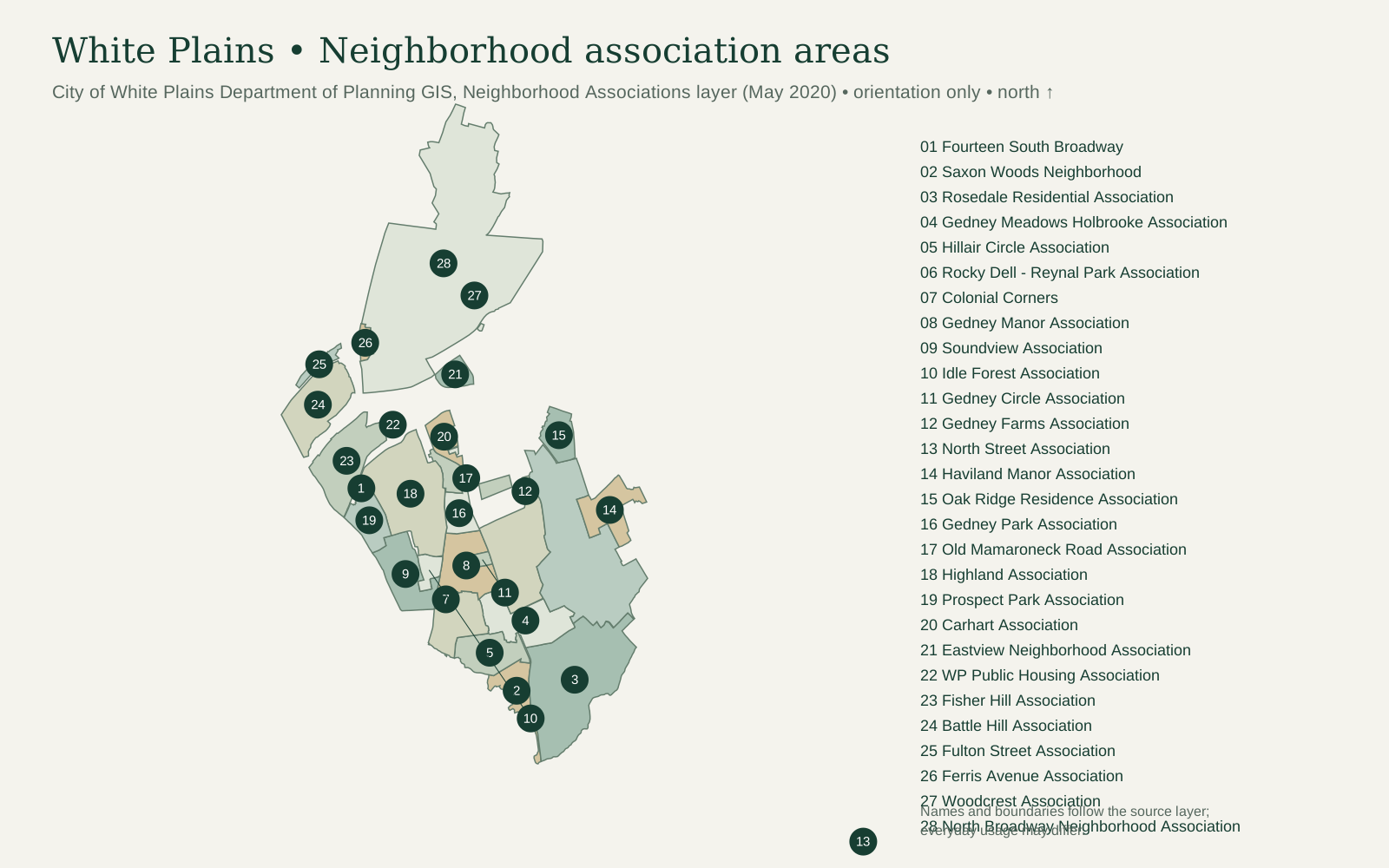
For orientation on the ground, the city's Planning Department maps 28 neighborhood association areas — Battle Hill, Fisher Hill, Gedney Farms, North Broadway, Soundview, Saxon Woods and the rest — shown on the map below. These are civic association geographies, not official districts: downtown and some blocks belong to no association, and no line on this map assigns a school or guarantees a building's condition. The 2024 One White Plains Comprehensive Plan is the city's own long-range account of how the downtown and the neighborhoods fit together.

White-Plains orientation map with numbered area key
Use the numbered key to locate the areas discussed below. Open full-size map.

03 /

Find the area that fits your routine

White Plains' Planning Department maps 28 neighborhood association areas; the seven below are the ones a household is most likely to compare, chosen for their verified character from city documents, the city GIS and National Register records. They are starting points for inspection, not rankings — elementary school placement follows the Controlled Parents' Choice system described below, and building conditions vary house by house.

Downtown

The county-seat core: courts, county and corporate offices, a regional retail district and the Harlem Line station. The comprehensive plan maps the densest residential zoning (RM-0.4/RM-0.35) in and around this Central Parking Area — residential life here means high-rise apartment, co-op and condo towers rather than houses.

One White Plains Comprehensive Plan (City of White Plains) ↗
Housing & setting
Expect managed buildings with service elevators, certificates of insurance and set moving windows. Compare what the rent or common charges include, and ask for the building's written moving rules before signing.
Daily travel
The strongest transit position in the county: White Plains station on the Harlem Line, the Bee-Line bus hub and the city's garages and metered streets are all here.
Before choosing
Confirm the elevator reservation and COI procedure with the managing agent early; downtown curb space is metered to 9 p.m. and street or sidewalk closures are banned from November 1 through New Year's Day.

Battle Hill

A residential hill southwest of downtown, named for the ground where much of the October 28, 1776 Battle of White Plains was fought. Streets slope off the ridge; the housing is mostly single- and two-family homes on small and mid-size lots.

History of White Plains (City of White Plains) ↗
Housing & setting
Older houses on hilly streets — expect steps to the door, short or steep driveways and pre-war staircases with tight turns.
Daily travel
A short bus ride or a manageable walk to downtown and the Harlem Line station from the lower streets; the climb home is real.
Before choosing
Check driveway slope and length against a 26-foot truck, and agree snow clearing in the lease or sale — hill streets punish an icy moving day.

North Broadway

The broad corridor running north from downtown was White Plains' estate row; the National Register-listed Mapleton, an 1867 Second Empire/Italianate mansion at 52 N. Broadway, survives from that era. Today the area mixes houses, schools and institutional properties along and off the avenue.

Mapleton National Register record (NPS) ↗
Housing & setting
Single-family houses on the side streets, with deeper lots as you move away from downtown; institutional neighbors include Pace's law school at 78 N. Broadway.
Daily travel
North Broadway is a straight run into downtown; North White Plains station serves the upper end of the corridor.
Before choosing
Confirm which station serves a given address — and remember that addresses past the city line may be North Castle, with another town's rules.

Fisher Hill

A rise of residential streets just north of downtown, one of the city's older house neighborhoods. The National Register-listed Percy Grainger Home and Studio (1893) stands at 7 Cromwell Place in the blocks between North Broadway and Fisher Avenue.

Percy Grainger Home and Studio National Register record (NPS) ↗
Housing & setting
Pre-war houses on hilly, walkable streets close to the core — porches, steps and short driveways are the norm.
Daily travel
Among the closest neighborhoods to White Plains station; many addresses are a realistic walk to the train.
Before choosing
Walk the actual carry from curb to door on the slope; verify where a truck may stand on the narrower streets before booking the date.

Soundview

An established house neighborhood southeast of downtown along Soundview Avenue, with some of the city's largest residential zoning — the comprehensive plan notes a portion of Soundview Avenue is zoned R1-30. The National Register-listed Soundview Manor (1920, Classical Revival, 283 Soundview Ave.) recalls its estate era.

Soundview Manor National Register record (NPS) ↗
Housing & setting
Single-family houses on generous lots, including some of the largest in the city; driveways and garages rather than street parking.
Daily travel
Car-oriented for most trips; downtown is a short drive, and Bee-Line routes serve the corridor toward the core.
Before choosing
Large lots still mean narrow shared drives on some streets — measure the approach; confirm what the sale says about drainage and slope on the hill blocks.

Gedney Farms

The city's southeastern corner toward the Scarsdale line — quiet single-family streets with the 1.5-mile Jack Harrington greenway walking from Gedney Way to the Scarsdale border. The city's own recycling yard at 87 Gedney Way carries the area's name.

Gedney Recycling Yard (City of White Plains DPW) ↗
Housing & setting
Single-family houses, many post-war, on mid-size lots; driveways and garages make for straightforward truck access on most streets.
Daily travel
Car-first for daily life; downtown and the Harlem Line station are a ten-minute drive.
Before choosing
The Gedney Recycling Yard nearby is a genuine move-in asset (recycling, electronics, free compost) — note its hours; check whether a street falls in White Plains or Scarsdale at the border blocks.

Saxon Woods

The southern edge of the city, organized around the county's 700-acre Saxon Woods Park — golf, the county's largest swimming pool and a hardwood trail system, at 1800 Mamaroneck Avenue. Residential streets ring the park toward the Scarsdale and Harrison lines.

Saxon Woods Park (Westchester County Parks) ↗
Housing & setting
Single-family houses on winding park-adjacent streets; larger lots and mature trees are the draw.
Daily travel
The most car-oriented corner of the city; plan on driving to the station and to downtown errands.
Before choosing
Park-border streets can be dark and narrow with limited shoulders — scope the truck approach in daylight; verify the municipal line, which weaves through this edge of the city.

04 /

Compare the whole home, not just the advertised payment

White Plains is a premium Westchester market split almost evenly between owners and renters: 51.0% owner-occupied, 49.0% renter, with a median gross rent of $2,269 a month and a median owner-occupied value of $620,800 (ACS 2024 5-year, via Census Reporter). Medians describe the whole city at once — not the apartment in front of you — and asking rents on listing sites run above survey medians; use them only to sanity-check a budget.

The stock explains the market. About 37% of units sit in buildings of 50 or more units — the downtown towers and garden-apartment complexes — about 28% are single detached houses, and roughly 30% of homes were built before 1940. The city's comprehensive plan describes the same range, "from apartments in high-rise buildings to single-family houses on large lots": R1-30 zoning east of North Street means 30,000-square-foot lots, while R2-2.5 transition blocks near downtown mean small-lot houses, and RM-0.4 districts around the core mean towers.

For a mover, the differences that matter are physical and administrative. In a co-op or condo tower, compare the managing agent's moving rules — certificate of insurance, elevator reservation, windows, fees — as carefully as the floor plan. In a house, compare the driveway slope and width, the stairs, and what the sale or lease says about snow clearing and repairs. When comparing two rentals, compare what the payment includes — heat, hot water, parking — and ask early who handles bulky disposal when you leave; the city's rules, below, apply to houses and small buildings, while large complexes run their own arrangements.

A furnished apartment living room with tall windows and sealed moving boxes stacked by the wall.
Compare usable rooms, building rules, parking and what the payment actually includes.

05 /

Test the complete daily journey

White Plains is one of the few Westchester cities where a car-light household is realistic, at least near the core. White Plains station on Metro-North's Harlem Line is the anchor: an accessible station with a staffed ticket office (daily, 6:10 a.m.–9:10 p.m.), six ticket machines, a waiting room open 6 a.m.–10 p.m. and nearly a thousand city metered parking spaces. Harlem Line trains run to and from Grand Central Terminal. Check the current timetable in the TrainTime app for your travel date — the MTA's web pages block automated reads, and this guide's station details come from the MTA's own page as archived in January 2025.

At the city's northern edge, North White Plains station is a second accessible Harlem Line stop, with parking lots operated by the city, the county, a private operator and the Town of North Castle — that last one a reminder that the municipal line runs right through this area, so check which town a "North White Plains" address actually sits in.

Bee-Line, Westchester County's bus system, is headquartered here and treats the city as its hub — the county says more than 65% of county residents live within walking distance of a route. Fares are $3.00 with one free transfer (as of January 4, 2026), with OMNY accepted and reduced fares for seniors and disabled riders. The MTA also lists Hudson Link cross-county buses and a guaranteed-ride program among the station's connections.

For flights, Westchester County Airport (HPN) is the county-owned airport about five miles east of downtown — close enough that many White Plains households treat it as their home airport, though its grounds are outside the city proper. Test the routine you will actually live: the walk to the platform, the bus timing at the hours you travel, the drive to I-287 at rush hour — before deciding.

A commuter rail platform with a train alongside and passengers walking toward the exit.
Test the complete daily journey from the address, including the walk to the platform at both ends.

06 /

Treat elementary placement as a choice application, not an address

The White Plains City School District runs five elementary schools (Church Street, George Washington, Mamaroneck Avenue, Post Road and Ridgeway), a two-campus middle school program (6th grade at Eastview, 7th–8th at Highlands), White Plains High School and the Rochambeau alternative high school. The fact that shapes everything else: your address does not assign your child's elementary school. Since 1988 the district has placed children through its Controlled Parents' Choice Program — the district's own manual is explicit that "a child's school assignment is not determined by where the child lives in White Plains, but rather by the rules of the program," weighing space, class size, parent preference, siblings, and language, special-education and socioeconomic factors. Do not sign a lease counting on a specific elementary school.

The timing matters as much as the rules. Each winter the district holds a formal kindergarten choice period — for the 2026-27 school year it ran January 12 to February 27, 2026, with tours at every elementary school in January. Families who register after the window still register; preferences are simply considered against what remains. The Family Information Center (914-422-2038) handles questions and placements.

Registration itself is online: the district's registration page opens an Infinite Campus application where you upload the child's birth certificate, each parent's photo ID, any custody order, proofs of residence, the most recent physical exam and vaccination record, and prior school records, plus supplementary forms (home language, housing, records request, medical and allergy history, income eligibility). After you submit, a Family Information Center staff member contacts you to complete registration. Mid-year arrivals use the same path. For transportation, the district buses K–5 students living more than half a mile from school and 6–12 students more than one mile. The district office is at 5 Homeside Lane (914-422-2000).

One higher-education footnote, because the name confuses people: Pace University's Elisabeth Haub School of Law is genuinely in White Plains at 78 N. Broadway — but SUNY Purchase and Manhattanville University, often lumped in, sit in the Town of Harrison (Purchase), a different municipality.

07 /

Assign an owner and a start date to each household service

Electricity and natural gas are both Con Edison — the company states its electric and gas service covers New York City and Westchester County, and White Plains is in that territory. Start, move or stop service through Con Edison's online service page: you will need the new address, the move-in date and a valid form of ID (without one, a deposit applies), and if the service is currently in the landlord's name it transfers to you automatically. No official lead time is published, so submit the request as soon as your date is fixed. Note that some White Plains houses still heat with oil — check what the property actually uses before assuming a gas account is needed.

Water and sewer are municipal: the city's DPW Bureau of Water & Wastewater (914-422-1220, 24-hour emergency 914-422-1333) supplies drinking water drawn from the New York City reservoir system at Kensico Reservoir by Westchester County Water District No. 1, per the city's 2025 water quality report. Water Billing (914-422-1207) handles accounts and conducts final meter readings — sellers and buyers should arrange the final reading before closing, and the Finance office publishes a water account change form. Renters should ask the landlord whether the account stays in the owner's name; practices vary by property.

For internet and cable TV, White Plains holds franchise agreements with two providers — Cablevision of Southern Westchester (Optimum) and Verizon. Availability and fiber tiers are address-specific, so check the exact address before promising yourself a speed, and in older multi-family buildings ask which provider already wires the building; an installation booked before the move is easier than one booked from an empty apartment.

08 /

Plan for routine collection and the things you are leaving behind

The city's Bureau of Sanitation collects household trash on an established schedule — most neighborhoods have two garbage days a week — plus weekly paper and co-mingled recycling (bottles, cans, jars, plastics 1–7, and cartons). Trash goes out in lidded metal or plastic cans of 75 pounds or less, never loose bags. Containers may be set at the curb from 6 p.m. the evening before collection until 8 a.m. on collection day, and containers left out beyond that window can draw a summons. Enter your address on the DPW page for your customized trash, recycling and brush calendar.

The rule that matters most to movers: bulky household items — furniture and other large non-metal pieces — go out at the curb on the second garbage day of your week, with crews spending at most ten minutes per stop. Metal items ("white goods" — boilers, refrigerators, stoves, bed frames, shelving) and TVs or computers are different: schedule a pickup by calling 914-422-1217 or through the free DPW At Your Service app, or drop them at the Gedney Recycling Yard. Mattresses must be wrapped in plastic and sealed with tape before sanitation will take them, on any route.

What you are leavingHow it goes out
Furniture, non-metal bulkCurb on the second garbage day of the week (10-minute limit per stop)
Mattress or box springSame bulk route, but only wrapped in plastic and taped
Appliances, scrap metal, TVs, computersAppointment via 914-422-1217 / DPW app, or drop at Gedney Recycling Yard
Renovation debris (doors, siding, tubs)Not collected — use a licensed private transfer station
Items the city cannot takeCounty H-MRF in Valhalla, by appointment

The Gedney Recycling Yard at 87 Gedney Way (Mon–Sat 8 a.m.–4:30 p.m., Sundays 8 a.m.–noon residents only) takes recycling, electronics and yard debris and gives residents free compost, mulch and topsoil — but it is explicitly not a dump and does not accept trash. For what the city cannot collect at all, Westchester County runs a household-material recovery facility in Valhalla by appointment through the H-MRF program. Whatever the item, a curb pile on moving day is not a legal disposal route in White Plains.

09 /

Arrange a legal place for the moving truck

White Plains has no moving-truck reservation form or parking-authority program, so the plan comes from the city's code and two offices. Work through this decision path in order.

1. Use private loading if it exists. A building's dock, lot or driveway beats any street arrangement. On residential property, a truck may stand only "temporarily for the purpose of and while actually engaged in loading or unloading" — that is code § 4-12-2; overnight staging on a residential property is not allowed.

2. If the truck stands at the curb to load or unload promptly, no permit is required. Code § 7-3-93 exempts loading and unloading across a sidewalk from a truck standing at the curb line, provided the work is prompt and lawful — the Commissioner of Public Works may set specified hours. This is the carve-out that makes most White Plains moves possible without paperwork. The catch is parking law while it stands: on-street meters require payment Monday through Saturday (9 a.m.–9 p.m. downtown, 9 a.m.–6 p.m. elsewhere), most spaces carry a one-hour limit enforced even when paid, and the Department of Parking enforces actively across its 8 garages, 23 lots and roughly 3,000 meters. Sundays and six holidays are free on-street — a genuine scheduling lever for downtown moves.

3. If the job needs street space reserved or occupied, apply for a street-obstruction permit. Reserving curb length, partially blocking a lane, operating a crane from city property, or staging a POD or dumpster on city land all require a permit from DPW Code Enforcement (914-422-1208, 255 Main St.) under § 7-3-86 — its office page lists exactly these cases. Apply on the commissioner's form with the property, the extent and the dates. Fees: minimum $150 in R1/R2 residential districts, $300 elsewhere, or 15% of the deposit if greater; a short-term permit of up to three days costs $30 for one day or $60 for two days at minimum; the deposit itself starts at $600 and doubles outside residential districts. Permits run up to 30 days. One seasonal override: no downtown street or sidewalk closures from November 1 through New Year's Day absent extenuating circumstances the Commissioner accepts.

4. Park the household's cars by the other rules. The truck and the cars are different problems. Residents can buy garage and lot permits from the Department of Parking — including a $75 annual evening-and-weekend garage permit for downtown — but no resident permit covers a moving truck, and none reserves street space for one. Match the truck's window to the building's elevator window, and keep the permit or the building's written loading instructions with the moving papers.

10 /

Inspect the full route through the building

In downtown White Plains and the larger complexes, access is administrative. Co-ops and condos delegate moves to the managing agent, and the packet is remarkably consistent across buildings: a certificate of insurance from the mover naming the building and its agents, a reserved service elevator with protective padding, fixed moving windows (often weekday-only, sometimes with a fee or deposit), and rules about where the truck may stand and which entrance the crew uses. Ask for the written moving rules at both ends as soon as the date is set — COIs and elevator bookings have lead times that cannot be fixed at the door, and a missed window can mean rebooking the whole day.

In the neighborhoods, access is physical. Houses on Battle Hill, Fisher Hill and the Soundview slopes can mean long or steep driveways, steps to the door and low turns on pre-war staircases; garden-apartment blocks add shared entries and long interior corridors. Measure the largest pieces against the actual route — width, turns, ceiling at the landing — check porch boards and railings before anyone carries a sofa across them, and agree driveway use with any neighbor or association that shares it.

Whichever type, walk both routes before the day: where the truck stands, which door is used, every stair, elevator and corridor between the truck and the room, and who unlocks what. Confirm the two ends together, with time windows that overlap usefully — a plan that works at the origin but not the destination is only half a plan. The moving page's access section explains how these details feed the estimate.

11 /

Build a useful routine beyond the commute

White Plains' everyday geography rewards a look on foot. Downtown works as the county's main street: the courts and county offices, the Mamaroneck Avenue and Main Street retail blocks, and the restaurants that fill after court and office hours. The White Plains Public Library anchors the cultural side at the edge of downtown, and the city runs more than twenty municipal parks, from Battle Hill Park to the 1.5-mile Jack Harrington greenway that walks from Gedney Way to the Scarsdale border.

The county adds the big open spaces. Saxon Woods Park, a 700-acre county park at 1800 Mamaroneck Avenue, holds the county's largest swimming pool, an 18-hole golf course and a hardwood trail system that links north to Twin Lakes and Maple Moor; Silver Lake Preserve and a stretch of the Bronx River Parkway Reservation sit inside the city too. The city's own largest green property is deliberately quiet: the 422-acre White Plains Reservoir water-supply lands at the northern edge, kept for the water system rather than recreation.

Test the routine you will actually live — the grocery run, the pharmacy, the school or daycare route, the walk home from the station after dark. Downtown empties and fills with the courts and offices; the neighborhoods keep their own hours. Visit a candidate address at the times you would use it before deciding.

A park path through mature hardwood trees with a distant walker and a glimpse of a golf green.
Saxon Woods Park and the city greenways are part of the weekly routine — check the outdoor life around the address you choose.

12 /

Plan for the season in which you will live and move

Winter is White Plains' scheduling season, and it is governed more by housekeeping rules than by bans. The airport station's record shows measurable snow roughly November through April — on the order of 30-plus inches a year on long-term average, with December through March the core (our computation from station data, not an official forecast). The city plows its own roads, and there is no citywide snow parking ban in the code. The rule that touches you directly is the sidewalk: code § 7-2-1 requires the owner or occupant to clear the abutting sidewalk within two hours after daytime snow stops in business districts and ten hours in residential ones — by 10 a.m. after overnight snow downtown, by noon elsewhere — with sand or abrasive if the ice will not lift. If you rent, check the lease for who actually shovels; the legal duty sits with the owner or occupant either way.

The other hard calendar rule is the holiday moratorium: from November 1 through New Year's Day, the city does not permit street and sidewalk closures in the downtown area during the holiday shopping season unless the Commissioner of Public Works grants an exception. A move that would need a crane, a closed lane or a POD placement downtown belongs outside that window, or in Code Enforcement's hands first.

The academic calendar is lighter here than in a college town, but it is real: the school district's kindergarten choice window runs January–February for the following school year — a family aiming at a September start should treat February 27 as a hard date — and Pace's law school at 78 N. Broadway adds a modest late-August turnover downtown. End-of-month dates at those times book out first; mid-month dates are usually easier to schedule. That is our own workload observation, not a city statistic.

A residential sidewalk after snowfall with a shoveled path, snowbanks along the curb and a parked car.
Winter dates need a shoveling plan: sidewalks must be cleared within two hours downtown and ten hours in the neighborhoods after snow stops.

13 /

Turn the chosen home into an arrival plan

With the address decided, sequence the setup so nothing blocks the truck. Four to six weeks out: confirm the lease or closing date, book the move itself, and start the school conversation if you have children — registration is online, and the kindergarten choice window has hard January–February dates. Two to three weeks out: open the Con Edison start-service request, line up internet installation for arrival week, ask the landlord or the water bureau how the water account transfers (buyers: arrange the final meter reading before closing), and plan disposal at the old address — the second-garbage-day bulk rule and the appointment routes for metal and electronics reward early scheduling.

At least a week out: collect the written moving rules from both buildings — certificate of insurance, elevator reservation, windows — and settle the truck's standing plan: legal curb position for prompt loading (no permit, but meter rules apply), a street-obstruction permit from Code Enforcement if space must be reserved or a POD staged, or the building's own dock or lot. Sunday moves dodge meter hours downtown. In the final days: confirm the building windows and any permit, finish packing, set aside what travels with you, and — in winter — check the forecast and the two-hour/ten-hour sidewalk-clearing duties at both addresses.

In the first week after arrival: look up your trash, recycling and brush days by address on the DPW page, test heat and hot water, buy any parking permits you need, and walk the everyday circuit — grocery, pharmacy, station — at the hours you will actually keep it. If a school-age child arrived mid-year, the Family Information Center (914-422-2038) is the office that completes the placement.

14 /

Questions before you arrive

Does my White Plains address assign my child's elementary school?

No. White Plains has placed elementary students through its Controlled Parents' Choice Program since 1988: assignments follow parent preferences and the program's balancing rules, not the street you live on. The formal kindergarten choice window runs January–February for the following school year; mid-year arrivals register online and are placed by the Family Information Center. Do not sign a lease counting on a specific school.

Do I need a permit to park a moving truck at my new home?

Not for prompt loading or unloading — code § 7-3-93 exempts a truck standing legally at the curb while goods move across the sidewalk. Meter and posted-limit rules still apply while it stands. If you need curb space reserved, a lane blocked, a crane, or a POD or dumpster on city land, apply to DPW Code Enforcement (914-422-1208) for a street-obstruction permit; fees start at $150 in residential districts, with $30–$60 short-term options.

Is Westchester County Airport in White Plains?

Not quite. HPN carries a White Plains mailing address, but the county describes it as about five miles east of the city. It is county-owned and close enough to function as the local airport; the same mailing-name caveat applies to some North White Plains addresses, which can sit in the Town of North Castle.

Do I need a car in White Plains?

Many households near the core manage without one: two Harlem Line stations serve the city, White Plains is the Bee-Line bus hub, and downtown errands are walkable. Single-family neighborhoods farther out are more car-oriented. Test the exact door-to-door routine from your address before deciding.

Can I leave unwanted furniture on the curb when I move out?

Yes, but only within the rules: bulky non-metal items go out on the second garbage day of your week (crews spend at most ten minutes per stop), mattresses only if wrapped in plastic and taped, and metal items, TVs and computers by appointment or at the Gedney Recycling Yard. Renovation debris is never collected — book the county's H-MRF or a private transfer station instead.

What are the snow rules I should know before a winter move?

There is no citywide snow parking ban in the code, but the sidewalk rule is strict: the owner or occupant must clear the abutting sidewalk within two hours after daytime snow stops in business districts and ten hours in residential ones (10 a.m. and noon respectively after overnight snow). Agree at both addresses who shovels, and remember the separate November 1–New Year's Day moratorium on downtown street and sidewalk closures.

Who provides electricity, gas, water and internet in White Plains?

Con Edison provides both electricity and natural gas across Westchester — start service online with your address, move-in date and ID. Water and sewer are municipal, run by the city's DPW water bureau with billing through the city. For internet and cable, the city has franchises with Optimum and Verizon; check availability at the exact address.

Your next step

Bring the plan together

Use the White Plains moving page to prepare the inventory, access details and questions for your estimate.

Sources & useful local resources

Official procedures and local resources are linked beside the answers above. Reopen the relevant page when arranging a date: fees, schedules and application requirements can change.

Neighborhoods & housing

Getting around

Schools & enrollment

Utilities & internet

Trash, recycling & disposal

Truck access & parking

Snow & seasonal rules

Everyday & places