
New York · Buffalo service planning
Long-distance moving from Buffalo NY
A long-distance move from Buffalo needs a workable pickup day and a receiving plan for the other end. Sterling Oakbridge provides direct and consolidated household moving throughout the United States and Canada, including longer routes that stay within New York. Tell us about the belongings, both properties and the dates you need to protect. We review the work before agreeing the applicable flat rate and delivery arrangement.
Make the pickup date possible before planning arrival
A lease ending is a firm constraint, but it does not reserve a truck position or open a shared porch. Start with the actual Buffalo address, the unit, the entrance and the proposed loading position. Describe which belongings will travel, which will stay and whether packing needs a separate preparation visit. If another person handles pickup, identify who can approve changes and who can answer questions about the inventory.
At delivery, distinguish the day keys become available from the day furniture can be received. A new job, travel booking or closing can create a gap between those dates. Tell us whether the receiver will be the household, a relative or another authorized person. The transport decision becomes clearer when both access plans and the dates are known together.
Arrange Buffalo street space with enough lead time
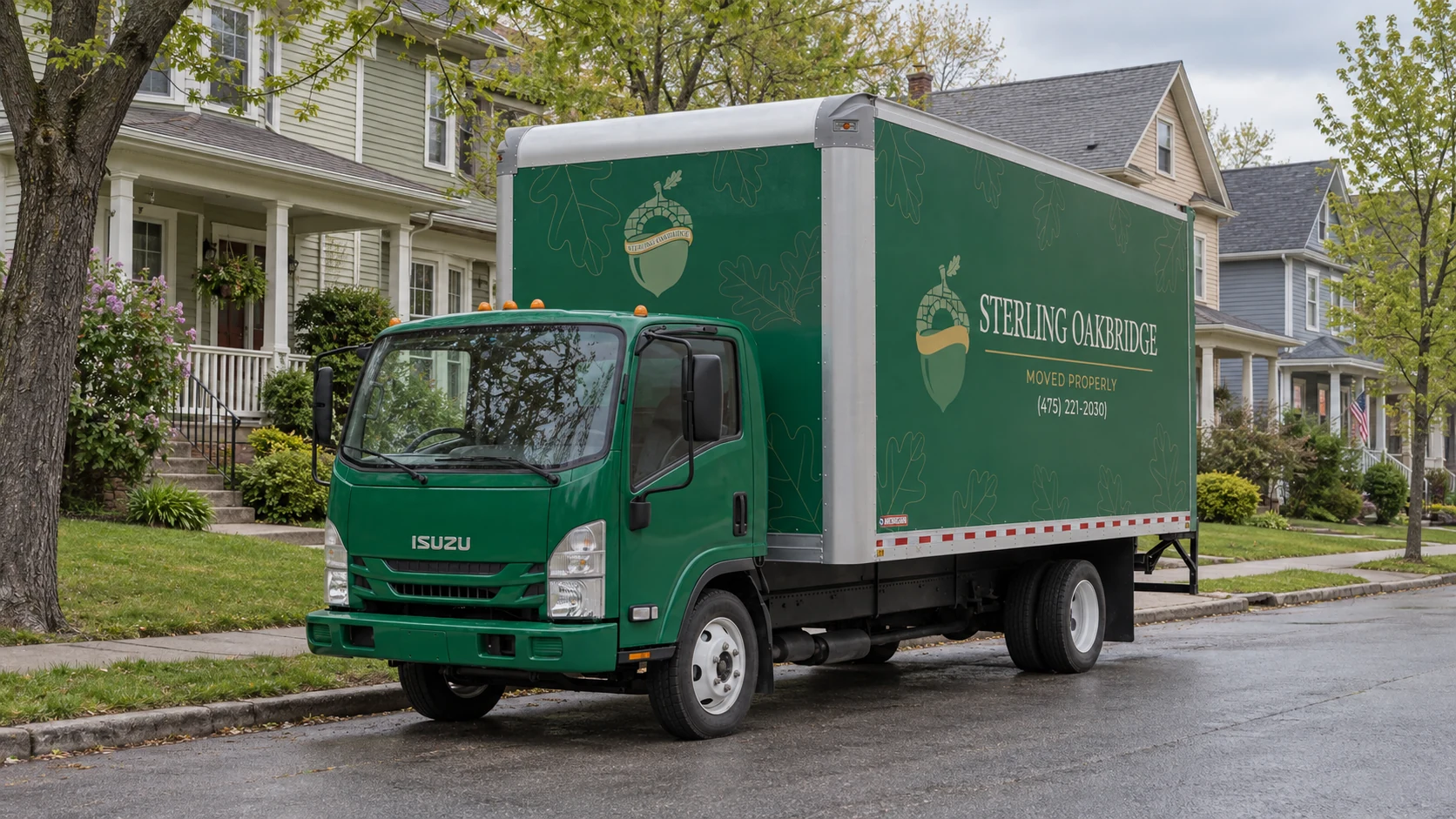
The City's Temporary No Standing Sign Request page directs work requiring temporary curb reservation to DPW, with signs requested through the relevant work permit. Describe the actual moving-truck use and ask which arrangement applies. Household parking permissions and a proposed truck loading position are different questions.
The published Street/Sidewalk Obstruction requirements call for information at least seven business days ahead, including liability insurance and a traffic-protection diagram. Confirm the current submission route, applicable charges and approval for your use. Assign the application, insurance information and property contact early. An approved position still needs sufficient space for the truck and carrying route.
Sterling can coordinate truck-permit arrangements, COIs and elevator scheduling within the agreed work. The authority or building provides the approval. If a private driveway or loading area is proposed, confirm permission, vehicle access and any effect on the sidewalk or other public space. The Buffalo guide's curb procedure connects these steps with the wider arrival plan.
Match the furniture to the actual Buffalo building
The Hamlin Park National Register nomination records two-story frame homes with open porches and a mix of single and two-family houses. That is useful context for asking about access, rather than a measurement of every Buffalo home. Photograph the porch, shared hall, front and rear stairs, landing turns and the door used for the move.
For an upper flat, identify which stairs are permitted and check the largest pieces against the complete route. A rear entrance may have different steps or a narrower door. Agree use of a shared driveway with the property and neighbors. For a managed apartment or conversion, collect written moving hours, elevator, floor-protection and insurance instructions. Ask the receiving property the same questions before relying on its address alone.
Winter preparation includes the carrying surface and the street arrangement. Confirm who clears the porch, steps and walk, and check current weather and City announcements for the booked date. If the route becomes unsafe or permitted access changes, contact us to review another position or date. A summer photograph does not establish a winter loading plan.
Decide how the shipment will travel
Direct moving provides a dedicated truck and the same moving crew at pickup and delivery. It can suit a substantial household shipment or a plan that needs closer coordination between the two properties. Confirm the delivery window and any agreed storage stage in writing. The survey and move-planning team has a separate role from the crew performing the move.
Consolidated moving combines compatible shipments within a shared transport arrangement. It can be useful for a smaller inventory when the household can accommodate a wider receiving window. Around 300–400 cubic feet is a helpful approximate shipment size to discuss, not a minimum or an automatic acceptance rule. The actual contents, dates and available arrangement need review.
Compare the receiving flexibility as well as the quote. If a building offers only a narrow appointment, send that rule before selecting transport. If a house is ready but the household will arrive later, identify an authorized receiver. If keys or access will not be available within the proposed window, discuss storage and staged delivery explicitly.
Use delivery windows to plan the household's travel
Every window below begins after pickup and loading are complete. Packing, furniture preparation and carrying work before loading are outside that delivery clock. The examples are planning references; actual truck routing, weather, border arrangements and property access still require review.
| Illustrative destination | Direct planning window | Consolidated window |
|---|---|---|
| Pittsburgh, Pennsylvania | 1–2 days | Up to 30 days |
| Wilmington, North Carolina | 2–3 days | Window agreed individually |
| Guelph, Ontario | 1–2 days | Up to 60 days |
| Portland, Oregon | 4–5 days | Window agreed individually |
Suitable nearby domestic consolidated routes can have up to 30 days. Florida can have up to 60 days, Canada up to 60 days, and California up to 90 days. Other distant destinations need an individually agreed window. Wilmington in this table is North Carolina, and Portland is Oregon: neither inherits Florida's or California's limit.
Canada remains a cross-border move even when the journey is short. A small nearby domestic direct shipment may sometimes allow same-day delivery when loading, distance and access fit, but it requires review. Same-day service is not automatically available, and next-day delivery is not guaranteed. Separate your travel booking from an unconfirmed furniture appointment.
Example 1: Buffalo to Pittsburgh for a new apartment
Imagine an adult moving from a second-floor Buffalo flat to a Pittsburgh-area apartment before starting a new job. The inventory includes a bed, a dining table, a sofa and packed books. This is an illustrative planning situation, not a completed customer job. The practical question is whether the origin staircase, pickup date and receiving appointment can support the selected move.
Check the sofa against the porch door and every turn on the stairs. Confirm which entrance the landlord permits and whether the driveway can be used during loading. At the apartment in Pennsylvania, obtain the actual building instructions and identify the receiver. An elevator reservation should cover carrying and placement; it is not simply a time for the truck to reach the street.
The illustrative direct window is 1–2 days after loading is complete. A suitable consolidated arrangement can have up to 30 days. If the first working day falls before the furniture arrives, keep the equipment and essentials needed for work with the traveler. A direct plan should still be reviewed against the building's actual appointment rather than treated as a guaranteed next-day service.
Decide which furniture needs disassembly and keep its hardware associated with the piece. Agree the rooms for placement and the basic reassembly required. Before pickup, make sure the final inventory includes the books and any items added after the initial list; have changes reviewed before the affected work begins.
Prepare removable legs before transport
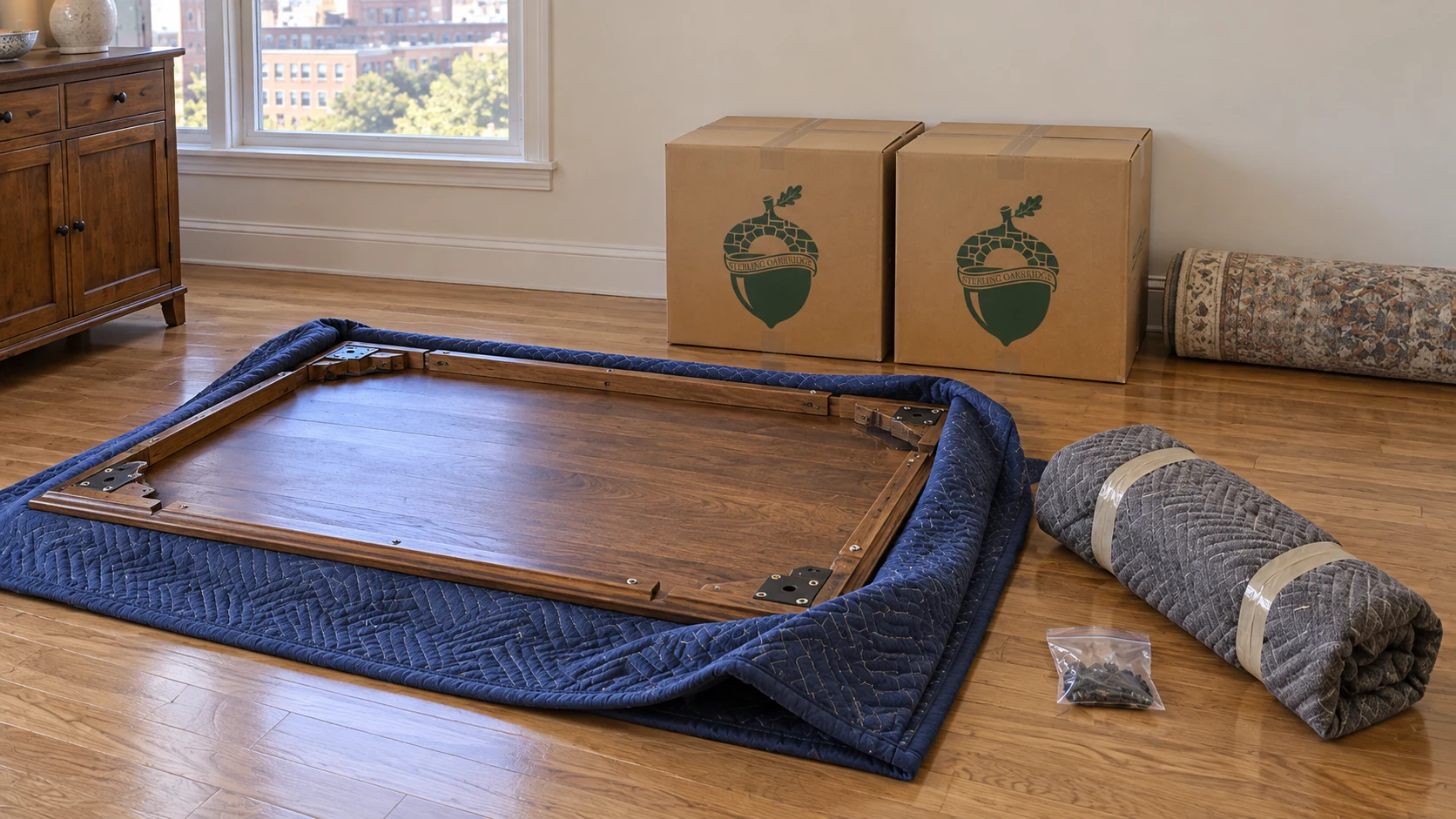
Safely detachable long table legs should be removed before carrying and transport, grouped in protected packaging and kept with the associated hardware. The tabletop needs its own fitted protection. Tell us about parts that cannot safely be removed, and about complex furniture requiring an individual method or quote. Do not assume that a long-legged table can pass the stairs in one piece simply because it fits its current room.
The photograph shows preparation in progress: the tabletop and protected leg bundle are separate, before loading. Basic furniture disassembly and reassembly belong in moving labor. Agree where the piece will be assembled at delivery, and keep packing or identification consistent so its hardware does not become an unrelated carton.
Example 2: Buffalo to Wilmington NC with a selected household group
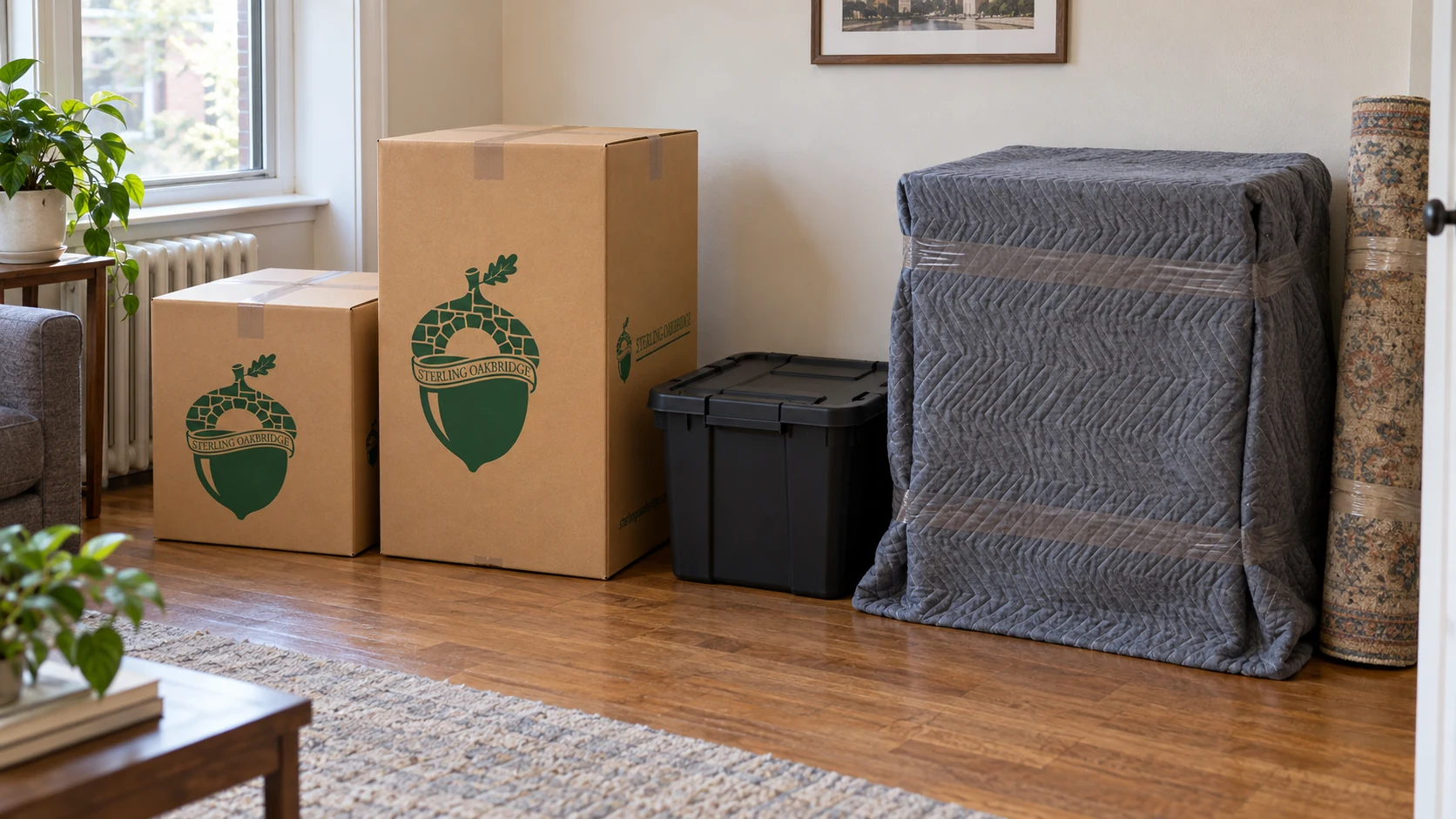
Consider a household sending a smaller selected group from Buffalo to Wilmington, North Carolina, while leaving other belongings with family. A protected chest, books, kitchen cartons and a few personal pieces will travel. The first task is to settle the list and distinguish those items from the belongings staying behind. A partial shipment can need packing and access preparation even when it will not fill a truck.
The illustrative direct window is 2–3 days after loading. A consolidated window for this destination is agreed individually; the Florida 60-day limit is not assigned to North Carolina. Explain when the home becomes available and how flexible the receiver can be. If the household travels sooner, plan what it needs without the shipped furniture during the receiving window.
Provide the actual Wilmington address and property instructions. A place in or around the city can be a house, managed apartment or another access arrangement; this example does not assume a gate, elevator or loading rule. Photograph the route to the intended rooms and identify who will unlock the property and accept the shipment.
At Buffalo pickup, keep the selected cartons and protected pieces grouped and identifiable. Decide who packs the kitchen contents and whether supplied cartons are needed. If more furniture is added after the estimate, update the list and have the change reviewed. A smaller shipment works best when its inventory and receiving responsibilities remain clear.
Example 3: Buffalo to Guelph with belongings following the traveler
Suppose a household member travels to Guelph before the furniture, while another authorized person remains in Buffalo for pickup. The Canadian destination is close enough to encourage informal timing assumptions, but the border and receiving documents still need a separate plan. Identify the traveler, the shipment contents and the person who can deal with questions while the goods are in transit.
Review the CBSA moving or returning guidance for the household member's actual circumstances. Accompanying belongings and goods arriving later must be identified appropriately; eligibility and restrictions depend on the person and goods. A moving shipment does not establish automatic duty-free treatment. Confirm the applicable records and who needs to be available before dispatch.
The illustrative direct window is 1–2 days after loading is complete. Canada's consolidated window can be up to 60 days, even for this relatively short road journey. It does not become the nearby domestic 30-day limit, and no fixed border-processing time is promised. Arrange travel essentials and an authorized receiver for the agreed window instead of assuming the furniture follows immediately after the traveler.
Before pickup, settle which possessions travel personally and which belong on the shipment inventory. At Guelph, confirm the actual building access, contact details and placement instructions. If the receiving address or shipment changes, raise it before the affected work so the transport, documents and property arrangements can be reviewed together.
Keep a separate plan for the first days
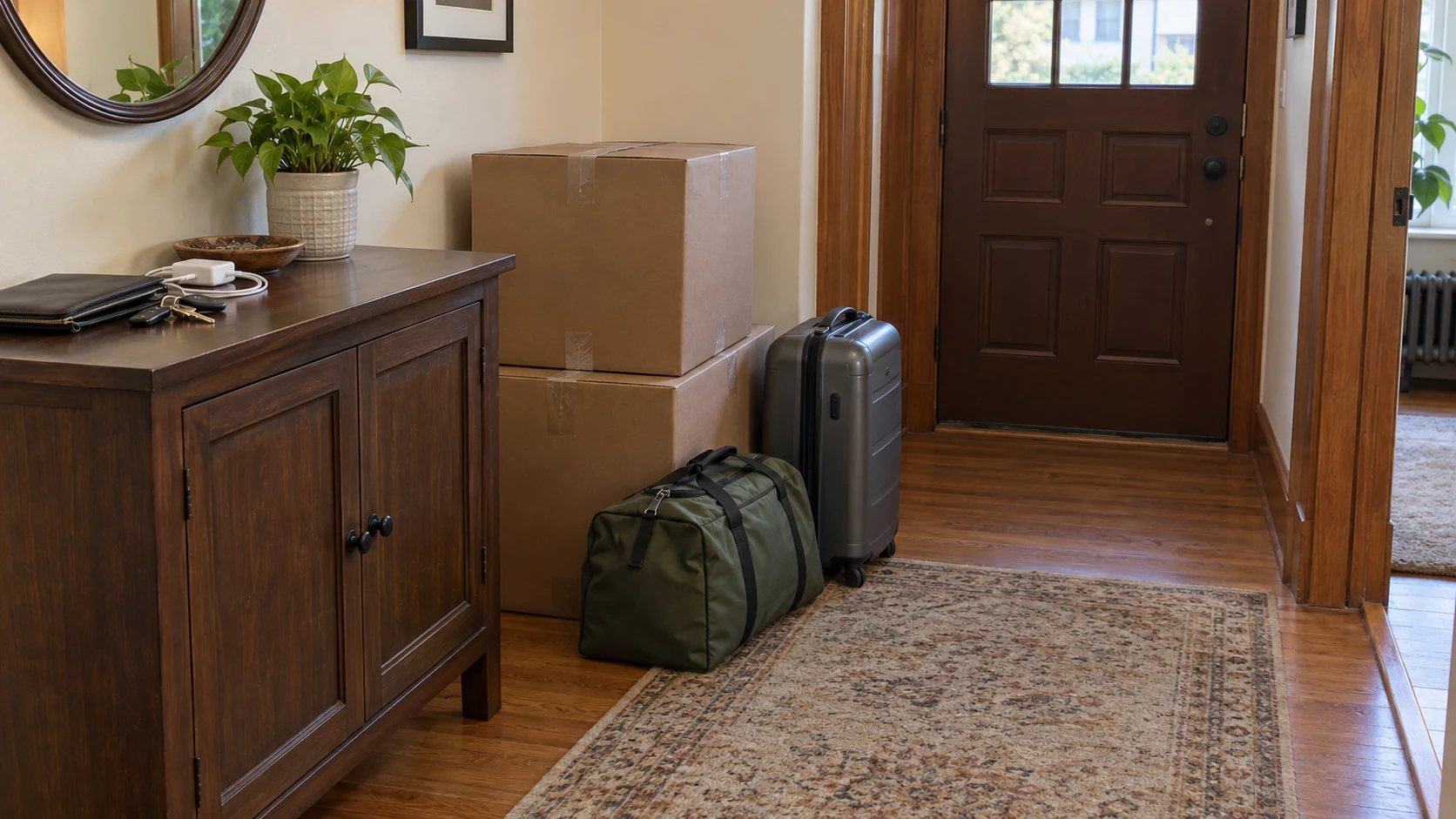
Keep keys, documents, medications, chargers, clothing and other immediate essentials outside the shipment. Add what the household needs for work, children or pets when relevant. For a wider consolidated window, consider temporary sleeping and everyday arrangements at the receiving address. A carton marked “open first” is still unavailable while that carton is in transit.
Store personal records in a closed folder and keep a reachable contact list for both ends. Public access photographs should show doors and stairs without exposing private paperwork. Group the bags traveling with you away from shipment cartons before loading, so neither the household nor the crew has to resolve the separation during the carry.
Example 4: Buffalo to Portland OR with room priorities
Imagine a family leaving Buffalo for a Portland-area home while one adult arrives early to make the house ready. The shipment includes the main furniture and packed household contents. Identify when the keys, utilities and permitted receiving access are available. A bedroom, working space and kitchen essentials may have different priorities even though the shipment is delivered as one reviewed move.
The illustrative direct window is 4–5 days after loading. Direct uses a dedicated truck and the same moving crew; confirm its actual plan for the reviewed route. A consolidated Oregon window is agreed individually. California's 90-day limit does not establish the timing for Portland, and a travel itinerary does not convert an illustrative window into an exact truck appointment.
Send receiving-access photographs before pickup, including the truck approach, entrance and route to the intended rooms. A driveway must be reachable and permitted for the vehicle; a bed's destination room must be reachable with the prepared components. Decide which furniture needs basic reassembly and identify complex work for individual assessment. Keep the hardware and component information with the correct piece.
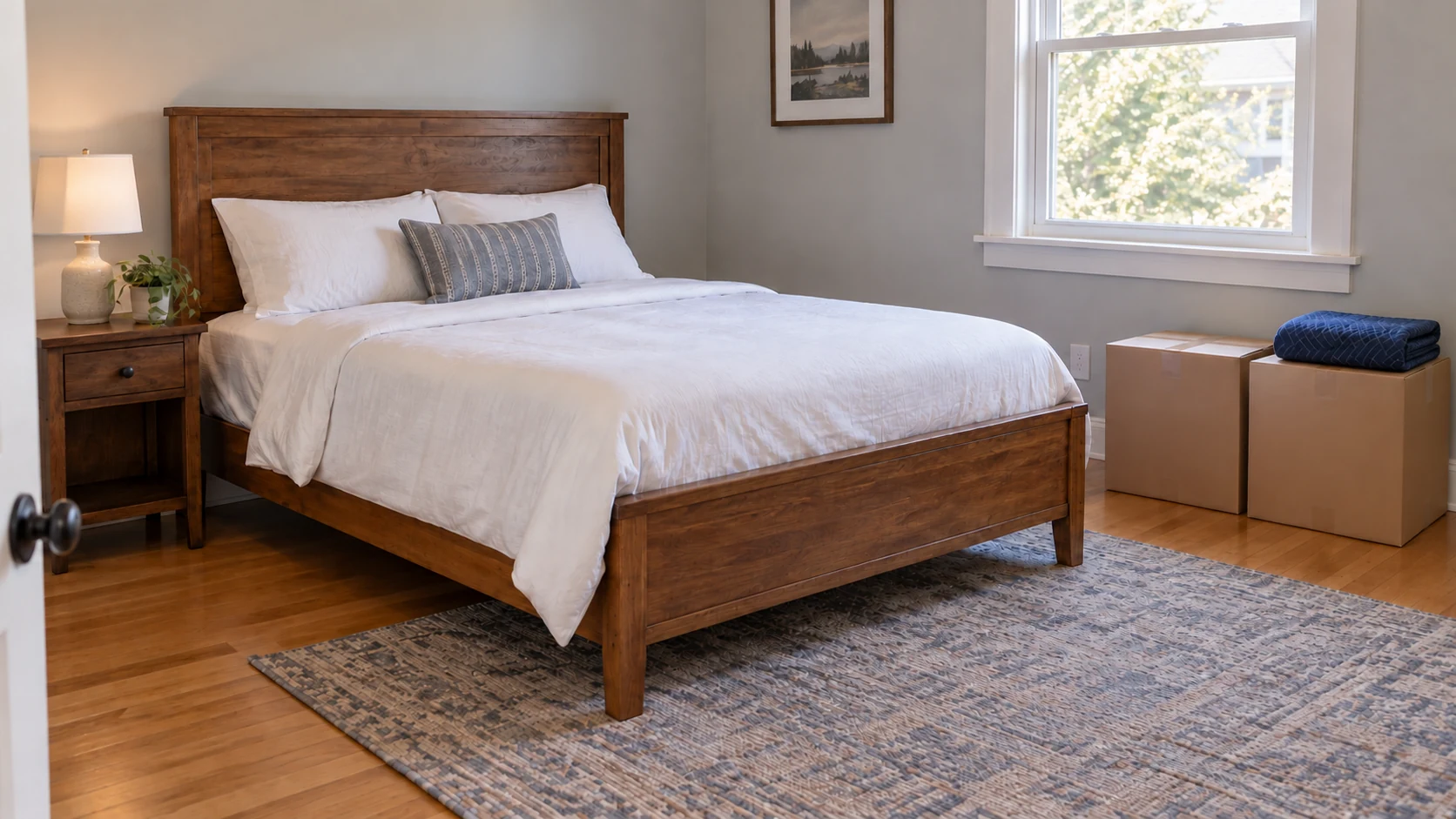
At delivery, the authorized receiver checks the inventory and condition, follows the agreed paperwork and confirms room placement. Once the bed is unwrapped and reassembled, the household can confirm the sleeping-room arrangement while the crew is present. Optional box unpacking and packaging removal should already be in the scope if they are wanted.
Keep the flat rate and service scope clear
For an agreed long-distance flat rate, travel or delivery taking longer does not raise the price while the shipment and agreed work stay the same. Added belongings, changed access, extra preparation, storage or another requested task can change the scope. Have changes reviewed and recorded before the affected work begins.
Basic blankets, shrink wrap and tape have no separate materials charge; supplied boxes are charged separately. Furniture unwrapping is part of delivery. Unpacking the contents of boxes is optional work charged for working time, and packaging or waste removal is charged separately. Complex furniture and specialist items need individual review and quotes. Tell us about a piano, safe, gym equipment or fragile collection early, including both carrying routes.
For an interstate household-goods move, review the applicable valuation and written documents before moving day. FMCSA's Protect Your Move resources help you check the carrier and understand that process. Valuation concerns mover liability and differs from a separate insurance policy. A route staying within New York or going to Canada needs its applicable terms reviewed instead of automatically using the same interstate paperwork.
Pickup around Buffalo and destinations to explore
We can review long-distance pickup in the City of Buffalo and nearby Erie County addresses. Allentown, Hamlin Park, Elmwood Bidwell and Bryant, University Heights and South Buffalo are useful City examples. Amherst, Cheektowaga, West Seneca, the Village of Depew and other neighboring municipalities have their own property and street arrangements; confirm the actual municipality rather than relying on a Buffalo postal address.
Explore long-distance destinations from Buffalo
These destinations illustrate a shipment from Buffalo, New York. Sterling serves routes throughout the United States and Canada. Confirm the actual pickup municipality, inventory, truck access and receiving dates; these examples do not rank bookings or establish appointments.
Northeast
- Buffalo, New York
- Syracuse, New York
- Boston, Massachusetts
- Philadelphia, Pennsylvania
- Washington, DC
- Baltimore, Maryland
- New York City, New York
- Pittsburgh, Pennsylvania
Southeast and Florida
- Charlotte, North Carolina
- Raleigh, North Carolina
- Atlanta, Georgia
- Jacksonville, Florida
- Tampa, Florida
- Miami, Florida
- Wilmington, North Carolina
Midwest and Texas
- Chicago, Illinois
- Dallas, Texas
- Houston, Texas
- Austin, Texas
Mountain West and Southwest
- Denver, Colorado
- Phoenix, Arizona
- Las Vegas, Nevada
- Salt Lake City, Utah
West Coast
- San Diego, California
- San Francisco, California
- Portland, Oregon
- Seattle, Washington
Canada
- Toronto, Ontario
- London, Ontario
- Montreal, Quebec
- Vancouver, British Columbia
- Guelph, Ontario
Give the planning team the information that changes the move
Send both addresses, a room-by-room inventory or clear item list, dates and alternatives, access photographs, packing responsibilities and special pieces. Identify the firm deadline for leaving, the date the new property can receive furniture and the authorized receiver. If you need storage between stages, describe that date gap at the beginning.
A small straightforward shipment may be reviewed from a list; more contents, full packing, difficult stairs or specialist work may need a video survey or visit. Our move-planning team recommends the review needed to define the work. You do not have to choose the survey method yourself. Use the Buffalo relocation guide for housing and arrival decisions and the city moving page for other services.
Long-distance moving questions
Where can you review pickup around Buffalo?
We can review long-distance pickup in the City of Buffalo and nearby Erie County addresses. Allentown, Hamlin Park, Elmwood Bidwell and Bryant, University Heights and South Buffalo are useful City examples. Amherst, Cheektowaga, West Seneca, the Village of Depew and other neighboring municipalities have their own property and street arrangements; confirm the actual municipality rather than relying on a Buffalo postal address.
How early should Buffalo curb-obstruction documents be prepared?
The City published Street/Sidewalk Obstruction requirements ask for information at least seven business days ahead, including liability insurance and a traffic-protection diagram. Confirm current submission details and approval for the actual moving-truck use. Agree who handles each document and which charges apply.
Does a private driveway remove every access requirement?
No. An approved private loading position may avoid a street-space reservation, but the vehicle approach, property permission, building rules and any affected public right-of-way still need review. Confirm the whole carrying route and how the space will remain available during loading.
What should I show you for an upper flat in a Buffalo double?
Photograph the permitted entrance, porch, shared hall, stairs, landing turns and truck position. Identify the unit and whether front or rear stairs are allowed. Show the largest furniture too. The actual building controls preparation; a neighborhood description does not establish its door widths.
Does direct long-distance delivery keep the same crew?
Yes. Direct uses a dedicated truck and the same moving crew at pickup and delivery. The survey and move-planning team has a separate role. Confirm the actual receiving window and any agreed storage stage in writing.
Can a smaller shipment use consolidated moving?
Consolidated moving can suit a smaller inventory and flexible receiving dates. Around 300–400 cubic feet is a useful approximate example, not a minimum. Send the actual pieces and cartons so volume, packing, access and the available arrangement can be reviewed.
When does the delivery clock start?
After pickup and loading are complete. Preparation and packing before loading are outside that clock. Illustrative windows help planning; confirm the actual route, property access and agreed delivery arrangement for your move.
Is next-day delivery to Pittsburgh guaranteed?
No. The Pittsburgh example gives a 1–2-day direct planning window after loading. A suitable small nearby domestic move may sometimes fit same-day delivery after review, but neither same-day nor next-day service is automatic. Confirm the actual receiving appointment.
Does Wilmington NC use the Florida consolidated limit?
No. Wilmington here is in North Carolina. Its consolidated window must be agreed for the actual shipment; Florida’s up-to-60-day limit does not automatically apply. The illustrative direct window for the Wilmington example is 2–3 days after loading.
Does a short Canadian route to Guelph use 30 days?
No. Canada keeps a consolidated window of up to 60 days even when the road distance is short. Confirm the applicable border records, goods arriving later and receiving plan. No fixed border-processing time or automatic duty-free eligibility is promised.
Does Portland OR use the California consolidated window?
No. Oregon needs an individually agreed consolidated window. The California limit of up to 90 days applies to California. Portland here is Oregon, with a separate illustrative direct planning window of 4–5 days after loading is complete.
Why are long table legs removed before transport?
Safely detachable long legs should come off before carrying and transport, with the protected bundle and associated hardware kept with the table. Fixed parts require their own assessment. Fully unwrapped furniture after delivery and reassembly may show installed legs; that is a different stage.
Can slower delivery change the agreed flat rate?
Travel or delivery taking longer does not raise the agreed long-distance flat rate while the shipment and service scope stay the same. Added belongings, changed access, extra packing, storage or another requested task can change scope and must be reviewed before the affected work.
What should travel with the household rather than the truck?
Keep documents, keys, medications, chargers, clothing and other immediate essentials outside the shipment. Include what children, pets or work need when relevant. For consolidated delivery, plan sleeping and everyday arrangements for the whole agreed receiving window.
Are boxes and basic protection charged separately?
Supplied boxes are charged separately. Basic moving blankets, shrink wrap and tape have no separate materials charge. Basic furniture disassembly and reassembly belong in moving labor, while complex furniture and specialist work are individually assessed and quoted.
Can you unpack boxes and remove packaging after delivery?
Furniture unwrapping is part of delivery. Unpacking box contents is optional work charged for working time, and packaging or waste removal is charged separately. Include the tasks you want in the reviewed move scope before the receiving day.
Can storage bridge a gap before the new home is ready?
Yes. Explain the date gap, shipment contents and anything you need to access during storage. Storage and staged delivery need an agreed plan. Do not assume the truck can wait until keys or permitted receiving access become available.
How should protection and moving documents be reviewed?
Discuss applicable valuation choices, cost, limits and the claims process before moving day. For interstate household goods, review the required written choices and carrier documents. Valuation concerns mover liability and differs from separate insurance; in-state and Canadian routes need their own applicable terms.
Do I have to choose a survey method before requesting an estimate?
No. Send the addresses, inventory, dates and alternatives, access photographs, packing responsibilities and special pieces. Identify firm commitments and the receiver. Our planning team recommends the appropriate list review, video survey or visit to define the work.