Pennsylvania / City relocation guide

Moving to Allentown

Choose an Allentown home with its building, daily journeys and first-week arrangements in view. Use the neighborhood comparisons and official procedures to prepare the address, accounts and receiving route.

Pedestrians beside a bakery and cafe on a mixed-use commercial street.
Try the errands and journeys that would form part of your ordinary week.

01 /

Start with the address and the first ordinary week

Begin with the property rather than a neighborhood label. Confirm its municipality, inspect the complete route into the home and list the school, work and household trips you will need after arrival. A convenient location on a regional map can still involve an awkward transfer, a difficult stair turn or an account that cannot simply be put in your name.

Keep one arrival record with the lease or closing information, contacts for the property, meter and account details, school records, delivery instructions and pending decisions. Separate confirmed arrangements from requests awaiting approval. The distinction matters when a truck position, utility start date or school placement controls another part of the week.

Use the comparisons below to choose places to inspect, then test the actual block. Walk from the proposed receiving position to the door, try the daily journey at the relevant time and ask who maintains the common route. A district-wide description cannot settle the details of an individual building.

02 /

Understand Allentown’s different planning areas

This guide concerns the City of Allentown in Lehigh County, Pennsylvania. Before using a city form, confirm the municipality of the parcel. Postal addresses, real-estate area names and service territories can describe different things. The landlord, sale documents and municipal mapping should agree about the property you are considering.

Allentown’s broad planning areas and its local historic districts operate at different scales. The compact downtown street grid contains a mixture of commercial, residential and institutional buildings. East Allentown has residential areas interwoven with commercial and industrial uses, particularly around its connecting corridors. The First and Sixth Wards have their own geography between the Lehigh River and Jordan Creek. These descriptions are useful for orientation, but they do not establish school assignment, parking entitlement or the condition of a particular home.

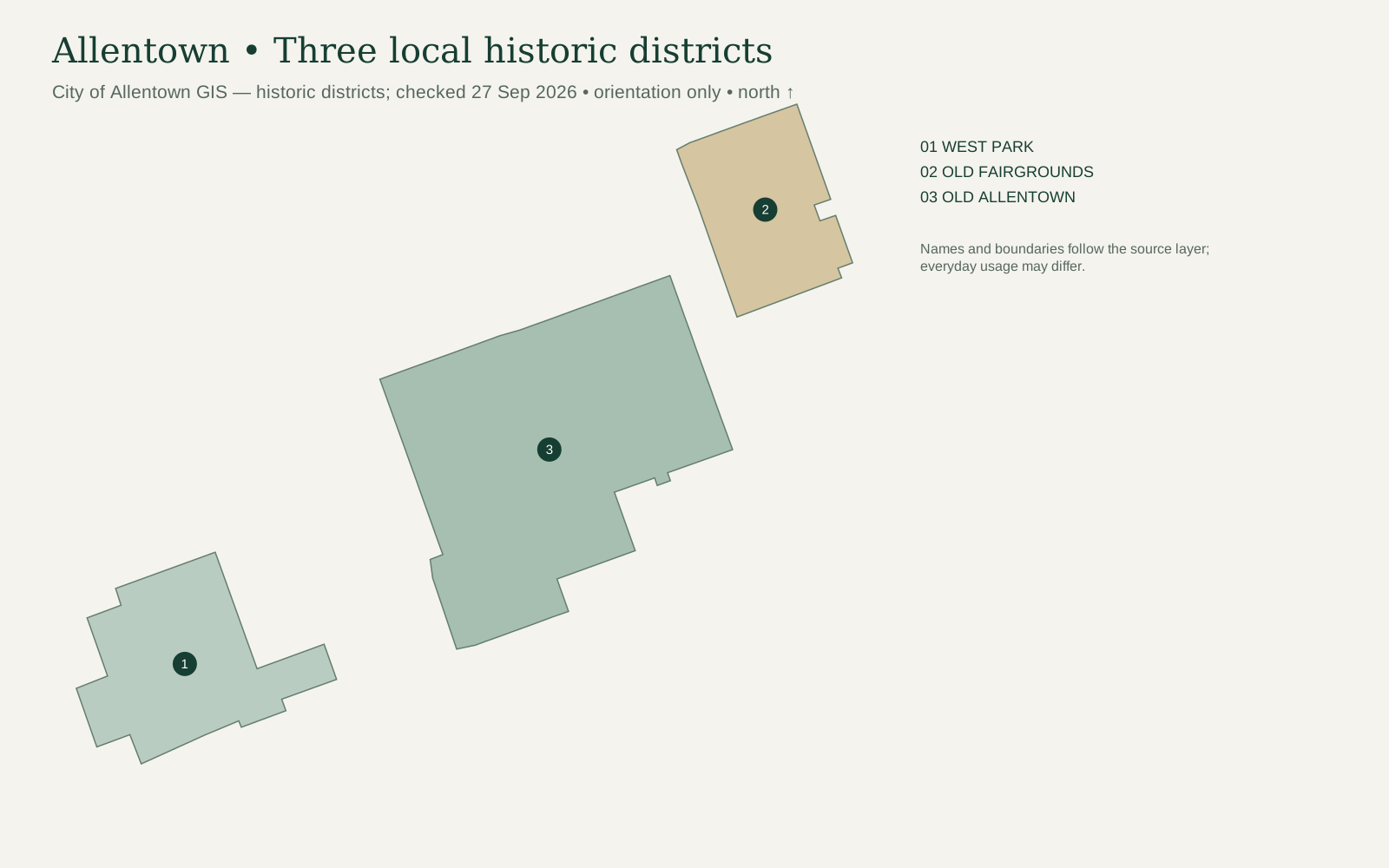
The City’s historic-preservation program identifies Old Allentown, Old Fairgrounds and West Park as three local historic districts. The accompanying official GIS layer supplies the three boundaries shown on this page. The map deliberately covers those districts only: other Allentown neighborhoods and the rest of the city lie beyond them.

Historic designation can matter if your plans include exterior alterations, replacing features or placing an obstruction in public space. Carrying furniture through an existing doorway and changing the building are different activities. Ask the City and owner about any alteration or temporary installation before assuming it belongs in an ordinary moving arrangement. Planning documents also contain proposals; a proposed corridor improvement or redevelopment is not proof that a facility is open today.

Three official local historic district polygons in Allentown: West Park, Old Fairgrounds and Old Allentown.
The map shows the three local historic districts in City GIS. It covers part of Allentown; it does not show every neighborhood, school attendance area or collection zone. Open full-size map.

03 /

Find the area that fits your routine

These six comparisons combine historic districts, a downtown area and broader planning areas. They are starting points for inspecting a property, not rankings, school boundaries or promises about individual buildings. The map shows only the three local historic districts.

Downtown and the Hamilton Street area

A compact street grid with a mixture of commercial, residential and institutional buildings is a defining physical pattern in the City’s downtown plan. Its redevelopment proposals should be distinguished from what is open today.

Downtown development plan ↗
Housing & setting
Inspect the actual apartment entrance, floor, lift and service route; shopfront frontage does not identify the residential receiving door.
Daily travel
Test the walk to your current bus platform and the return journey at the time you need.
Before choosing
Ask about building receiving hours, temporary signs and current Seventh/Hamilton work before setting delivery.

Old Allentown

The City’s first local historic district follows the older street grid and contains a dense concentration of nineteenth-century residential buildings. Brick rowhouses and varied historic details give the area a different receiving pattern from a home on a wide private drive.

City historic-preservation program ↗
Housing & setting
Measure the stoop, front hallway, stair turns and any rear gate rather than generalizing from the next house.
Daily travel
Walk the block-to-corridor route and check the current stop and service day.
Before choosing
Confirm the exact historic boundary, shared access and any approval needed for an exterior alteration or obstruction.

Old Fairgrounds

The former agricultural fairground was redeveloped largely between 1888 and 1910. The City’s guidelines identify attached rowhouses and semi-detached pairs as prevalent forms, with late-Victorian architectural influences.

Historic district design guidelines ↗
Housing & setting
Look for the actual relation between the front steps, shared wall, side passage and rear access; a twin is not automatically an easy side-entry move.
Daily travel
Try the walk to everyday shops and the bus route from the specific address.
Before choosing
Distinguish this historic district from the present fairgrounds farther west, and check legal curb space before delivery.

West Park and nearby residential blocks

The City’s parks survey describes an established neighborhood square with mature canopy trees, paths and a bandshell. The surrounding historic district has varied late-nineteenth- and early-twentieth-century housing, with front setbacks and porches described in the preservation guidelines.

Parks Plan 2025 — existing conditions ↗
Housing & setting
Inspect the porch steps, front-yard path and interior route; similar setbacks can conceal very different entrances.
Daily travel
Try the park approach and the daily journey from the particular block, including usable crossings.
Before choosing
Verify the district line, current park program and receiving arrangements; proposed park improvements are not promised facilities.

First and Sixth Wards

The 2023 neighborhood plan places its study area between the Lehigh River and Jordan Creek, roughly south of Sumner Street to their confluence. It describes the interwoven residential, industrial and commercial pattern created by the area’s history.

First and Sixth Wards neighborhood plan ↗
Housing & setting
Inspect the particular building and surrounding access rather than treating a former industrial structure as evidence of a current residential conversion.
Daily travel
Test the chosen crossing and corridor for the actual destination; a nearby river crossing does not establish a short daily trip.
Before choosing
Separate existing uses from redevelopment proposals, and confirm loading permissions at the address.

East Allentown

Vision 2030 describes residential neighborhoods interwoven with commercial and industrial areas, with Hanover Avenue and Union Boulevard connecting wider destinations. This is a broad planning area, not a single uniform housing district.

Allentown Vision 2030 ↗
Housing & setting
Compare the exact block, building form, parking and entrance rather than applying one access assumption across the east side.
Daily travel
Use today’s LANTA timetable to test corridor travel; the old plan’s proposed transit times are not current schedules.
Before choosing
Check the municipality, school assignment, crossing route and current development conditions at the parcel.

04 /

Compare the building as carefully as the price

The ACS 2024 five-year estimates for Allentown city cover 2020–2024. They describe the city’s housing stock, rather than current listings or prices for one neighborhood. The estimates put renter occupancy at 56.8% and owner occupancy at 43.2% of 46,374 occupied homes. Their approximate 90% margins of error are ±1.7 and ±1.6 percentage points respectively.

MeasureEstimateHow to use it
Median gross rent$1,317 ± $39 per monthA period estimate including applicable utility costs, not today’s advertised rent.
Median owner-occupied value$206,600 ± $6,302An owner-value estimate, not a current sale price or appraisal.
Detached single-unit structures25.9% ± 1.5 pointsPart of the citywide housing stock; inspect the actual drive and entrance.
Attached single-unit structures36.0% ± 1.9 pointsRowhouse access deserves specific measurement.
Units in two- to four-unit structures15.0% ± 1.7 pointsClarify shared doors, stairs and landlord responsibilities.
Built before 194037.9% ± 1.7 pointsAge invites inspection; it does not establish condition.

The structure and age shares use all 49,502 housing units, including vacant units, rather than the occupied-home denominator used for tenure. The margins are sampling uncertainty, not a range of offers you should expect to receive.

Inside a candidate home, measure the furniture route as well as the room. Record door clearances, stair landings, changes in ceiling height and any attic or cellar turn. Check where wardrobes and beds will stand without blocking a window, radiator or normal circulation. A rear entrance may help, but its alley, gate and yard need their own permission and measurements.

Compare the total obligations in the lease: electricity, gas or other heating fuel, water and sewer billing, parking, refuse, snow removal and any shared-area charges. Ask whether appliances belong to the property and who can authorize changes. Photograph existing damage at handover and record the meter or account information with the appropriate provider. For an apartment, obtain the manager’s written receiving rules before confirming delivery.

Budget separately for municipal sign orders, any approved container, building access arrangements and services in the moving estimate. None of those costs can be inferred from a citywide rent figure. If an advertised address turns out to lie outside the city, repeat the municipal and utility checks for its actual jurisdiction.

A resident gathering hanging clothes beside a closed Sterling Oakbridge wardrobe carton in an attic bedroom.
Check upper-floor headroom, storage and the furniture route before packing.

05 /

Test the current route and the return journey

LANTA operates the local bus network. The Allentown Transportation Center guide places the center at 110 North Sixth Street. Its boarding guide helps identify the platform, but the current route timetable determines when the trip runs. Check both ends of the journey, the transfer and the return service before relying on it for work or school.

The final changes effective June 15, 2026 revised a number of routes after public feedback. They are a better starting point than an earlier proposed schedule. Some changes affect weekdays, others Saturdays or Sundays; a route number by itself does not establish the same service on every day. Allow time for the walk to the stop and for a missed connection, then test the actual journey.

LANTA’s fare page displays a $2.50 cash single ride, a $2.50 three-hour pass and a $5 day pass. It also lists a $70 31-day product, while a separate monthly-cap paragraph still refers to $60. Confirm the fare product and payment method before budgeting for a month or loading value. The page also contains inconsistent reduced-fare descriptions, so check the current eligibility and amount directly. Cash onboard does not produce ordinary cash change, and transportation-center ticket windows no longer accept cash.

Operating hours depend on the route. The 2026 holiday information states that no LANtaBus, LANtaVan or LANtaFlex service runs on Thanksgiving, November 26, or Christmas, December 25, 2026. Plan another arrangement if a holiday falls within the move or first week. Other holidays may use Sunday-level service, which still needs checking against the particular route.

For a rider who needs an accessible shared ride, LANtaVan has registration and program requirements. ADA paratransit is one program, with disability-related eligibility and a trip area tied to the fixed routes; it is not an unrestricted citywide taxi. The application and eligibility manual says both trip ends must be within three-quarters of a mile of a corresponding fixed route and the trip must fall within its operating hours. Use the current applications page for submission choices: mail, an emailed PDF for LANtaVan, or the linked FindMyRide online route. The disability application instructions require a completed, signed application and proof of age, with questions about functional travel needs. An interview or assessment may be required. Confirm current eligibility and documentation with Paratransit Services at 610-432-3200 before relying on the service; an application is not an approved trip.

Once registered, the published reservation line is 610-253-8333, from 8 a.m. to 4:30 p.m. Trips can be arranged up to fourteen days ahead and by 4:30 p.m. the day before; same-day service is not available. Establish the first required trip before depending on it. LANtaFlex serves defined suburban zones and should not be assumed to cover an arbitrary Allentown home.

For intercity travel, Trans-Bridge’s stop list identifies its Allentown Transportation Center stop as 603 Linden Street, Platform C. Use the operator’s particular boarding instruction rather than treating the two street addresses for the transit-center area as two interchangeable pickup points. Its reservation rules tie the ticket to a run, date and time. Standard one-way changes must be made before departure; fees and commuter-pass rules differ. Confirm the run, boarding place and baggage allowance before arranging a connection with a delivery or key handover.

A passenger leaving a stopped city bus while another person waits on the sidewalk.
Check the actual boarding point, timetable and return service.

06 /

Complete registration and confirm the receiving school

Start with the exact address in the district school locator, then confirm assignment with Allentown School District. A neighborhood name, previous resident’s school or nearby building is not a placement decision. Tell the district the student’s grade, expected move date and any transfer or support needs.

The enrollment page explains the PowerSchool process: create or use a parent account, choose the applicable form, add or select the student and complete the required information. Use the 2026–2027 registration link for that school year. It opens a sign-in and account-creation page; an existing PowerSchool enrollment account can save work and return to an incomplete form. If the link or account does not work for you, call the enrollment contact at 484-765-4029 for help.

Prepare proof of birth, proof of residency, dated immunization information and the parent or guardian’s photo identification. The district lists alternatives for birth evidence, including a birth certificate, baptismal certificate, passport, hospital record, adoption certificate or notarized parent/guardian affidavit. Residency evidence can include a current utility or service bill, driver’s license, vehicle registration, deed, lease or notarized address statement, subject to verification. Ask which documents establish your particular situation; do not assume every family must produce the same two bills.

For the 2026–2027 kindergarten year, the district’s March 23, 2026 announcement states that children born on or before February 1, 2022 may enroll. The enrollment page expresses the same cutoff as turning five by February 1, 2027. Pre-kindergarten is a separate application with limited places and an age-four-before-September-1, 2026 condition. Submission alone does not establish a pre-K place.

Send previous school records and tell the receiving team about an IEP, a Section 504 plan, language support or a medical arrangement that needs continuity. Under the district’s health instructions, medication at school requires the relevant parent and prescriber authorization, with separate permission for eligible self-carried medication. Discuss the actual treatment and document timing with the school nurse. The enrollment page explicitly says the physical examination listed under kindergarten and first grade is not a condition of enrollment; the health page also has examination requirements by grade. Let the nurse reconcile what is due for your child.

If housing loss, temporary accommodation or sharing a home creates a document barrier, ask for the homeless education liaison rather than delaying registration until an ordinary lease appears. The 2026–2027 handbook, PDF pages 19 and 37, describes immediate enrollment and help obtaining records for eligible students experiencing homelessness. It gives 484-765-4037 as the route to a district liaison. Ask the team to assess the situation, school-of-origin options and transportation; do not make eligibility assumptions from a mailing address alone.

After submission, confirm that the record has been received, whether anything is missing, the assigned school and the first attendance day. Obtain the actual arrival, dismissal and transport instructions. The transportation page gives 484-765-4016 for district questions and 484-209-0898 for the STA terminal. Its detailed Act 372 section concerns charter and nonpublic pupils; do not apply those distance rules indiscriminately to every public-school student.

Activate the family communication tools and update emergency contacts. The attendance guidance asks families to know the bell and bus schedules, make a backup arrival plan and maintain current contact information. Automated attendance messages are not a monitored reply channel; contact the school’s attendance office when a response is needed. Complete these checks before the first morning, particularly when the household move occurs midyear.

07 /

Arrange the account handoff with each provider

Ask the owner which services supply the address, what the rent includes and which meters serve the unit. Electricity, natural gas, water and sewer do not necessarily share an account holder or service boundary. Record the requested start, the confirmed date and any appointment separately. A submitted request is not proof that a disconnected service is ready.

For Lehigh County Authority, use the start-and-stop instructions and identify whether the property belongs to the City of Allentown or a suburban division. For a sale, provide the settlement date, incoming party and forwarding information, with the realtor or title company completing missing details where necessary. LCA schedules the meter reading for settlement and lists a $15 new-customer fee on the first bill.

A rental change follows the landlord-and-tenant process. The owner and tenant complete the authorization to invoice together. The form remains valid for ninety days, and the owner remains responsible for the service even when bills are sent to the tenant. Outstanding balances must be resolved before the requested transfer can be completed. The form lists the City division at 610-437-7515 and suburban accounts at 610-398-1444.

LCA’s instructions say that a departing tenant’s remaining final balance goes to the owner, and final transfer bills must be paid by check, cash or money order rather than online or by phone. A $15 initiation charge applies when billing responsibility changes as described in the form. Discuss the timing with LCA and the landlord before assuming that your ordinary online payment or lease start date completes the handoff.

For a PPL-supplied property, the working start, stop or move page distinguishes opening your account from ending someone else’s. One customer cannot open or transfer an account for another person: the outgoing party stops its service and the incoming party starts its own. The new-service form begins with the service address and allows a requested date up to forty days ahead, followed by personal information and a summary. Check the confirmation and any outstanding action before relying on the date.

PPL publishes identification alternatives and a credit and deposit policy. A government-issued photo ID is one route; alternative identification may be accepted under the stated conditions. A deposit is conditional on the application and payment history, rather than a universal flat moving charge. Follow the provider’s secure instructions for sensitive documents and resolve any requested action directly with its staff.

Where UGI natural gas serves the property, its service-change instructions ask for seven working days to process a complete request. An inside meter requires an access appointment. The linked form begins by checking the ZIP code; the household should confirm the address, existing connection and required appointment before expecting heat or hot water. This is a routine account path, not an emergency reporting form.

Arrange internet installation with the actual supplier and building manager, including permission for equipment or a technician’s entry. At handover, keep meter photographs, confirmation numbers and final forwarding details. Test the services you need for the first night, and keep provider access clear of stacked furniture or cartons.

08 /

Plan cartons, bulky items and mattresses separately

Use the address-specific collection night rather than copying a neighbor’s arrangement across a boundary. Allentown’s curbside instructions call for setting material out between 5 p.m. and 10 p.m. on the collection night. Remove emptied containers and rejected material within twelve hours. Confirm where a shared building places its material and who provides the containers.

Regular trash is collected twice weekly. The published allowance is five bags of up to thirty gallons and forty pounds each, or two cans of up to thirty-two gallons and seventy pounds each. A household clearance can exceed that limit quickly. Arrange the excess before move-out rather than leaving a pile that the normal route cannot take.

On the second trash night of the week—Wednesday, Thursday or Friday, depending on the route—the allowance is one bulky item or forty pounds of construction material. The listed bulky examples include a matching mattress and box-spring set, which must be wrapped in plastic. Keep that requirement in the disposal plan before carrying the set outside. Confirm an unusual or multiple-item load with the Recycling Office at 610-437-8729.

Recycling is weekly and unlimited under the published curbside instructions, with material loose in the city-issued recycling bin. Do not bag it in plastic. Flatten and bundle large cardboard beside the bin. Separate packing film, bubble wrap and foam from the cardboard; their presence in a shipment does not make them curbside recyclables.

The recycling drop-off center is open around the clock to the general public and businesses for its accepted materials. It is not a household-junk drop-off: mattresses, sofas, wooden furniture, household trash and electronics appear among its exclusions. Refrigerant-containing appliances have a $20-per-item fee that must be prepaid at the Recycling and Solid Waste office before drop-off. Ask the office for an appropriate disposal route if your item does not qualify; do not substitute this site for an unconfirmed mattress destination.

Yard waste has a separate system. The 2026–2027 curbside calendar schedules it every other week, year-round, with holiday exceptions. Use brown paper lawn bags or suitable rigid containers no larger than thirty-two gallons with the required yard-waste sticker; branches for curbside collection have a four-inch-diameter and six-foot-length limit. Check the current address calendar rather than relying on older general seasonal descriptions.

The 2026 yard-waste drop-off site admits Allentown residents, excludes contractors and landscapers, and lists its regular season as April 1 through November 21, with Wednesday and Saturday hours. That site’s seasonal opening is different from year-round curbside collection. Confirm both eligibility and accepted material before hiring someone to haul yard debris there.

09 /

Follow the full curb and public-space procedure

Start by establishing the exact address, block face, vehicle length and working hours. Include any ramp, liftgate, container or protected pedestrian route in the description. A legally parked passenger car is a poor measure of the space a moving operation needs.

  1. Request the signs for the actual location. APA’s temporary no-parking instructions require a request three days ahead for metered locations and five days ahead for nonmetered locations. The page does not label those periods as business days. The signs must be posted twelve hours before enforcement at metered spaces and at least seventy-two hours before enforcement at nonmetered spaces.
  2. Complete the moving request. The public signage portal includes a MOVING reason, location and block, dates and times, number of signs and patron contact information. It calculates the amount after the relevant selections. Approval produces a payment email; payment finalizes the order. Retain the confirmation and leave the signs in their installed positions.
  3. Check the vehicle and operation. Code 615-60–62 addresses Class 5-and-above or over-11,000-pound vehicles. Delivery and service vehicles actually working nearby have an exception during 7 a.m.–8 p.m. Confirm how your operation fits, especially outside those hours or if the vehicle would remain unattended after the work.
  4. Preserve the other restrictions. The parking code still protects intersections, crosswalks, hydrants and sidewalks and restricts double parking. Detached trailers may not simply be left in the street. A temporary sign order does not turn a travel lane or blocked driveway into an authorized receiving area.
  5. Obtain separate public-space approval when needed. A container, staged obstruction or closure has its own permit and review questions. Resolve them before delivery and send the approved conditions to the person coordinating the move.

APA’s office is 610-841-9090; its dispatch number for a parking problem is 610-349-0400. If the reserved space is occupied, contact the authority instead of moving someone else’s car or shifting the signs. Agree a lawful alternative with the moving coordinator if enforcement or changed conditions affect the receiving position.

A residential parking permit is for an eligible resident vehicle in its designated zone. It does not guarantee a space or exempt street-cleaning, loading-zone and other restrictions; service and commercial vehicles are excluded. The online process requires matching documents and approval confirmation. It is not the booking method for a moving truck.

For a container or other obstruction, the temporary-obstruction code requires a use permit and describes plans, review and property-owner consent. Ask Engineering at 610-437-7596, extension 2260 to confirm the applicant and route for your proposal. The current linked application asks for the address, period, type of encroachment, supplier, owner and applicant, and routes the request through relevant City reviewers. It directs the form to Engineering by fax at 610-437-7614; confirm receipt and the current submission route with the office.

The linked fee sheet lists $35 per month for temporary dumpsters or pods under twenty cubic yards and $55 for dumpsters over twenty cubic yards. Its closure calculation uses area plus a base fee. Ask for the charge for your exact object and dimensions, including a pod at the size boundary; these are separate from APA signage costs. Obtain the approval, display instructions, removal date and any historic-district or traffic conditions. A form submission or payment alone does not establish every required approval.

10 /

Agree the complete route and who controls it

At a rowhouse, trace the path from the legal truck position across the sidewalk, up the stoop, through the door and around the first interior turn. Measure the narrowest point and the ceiling above each turn. Include the size of a large bed, wardrobe or sofa in the same record; an opening’s width alone does not answer whether an object can rotate through it.

For an upper-floor apartment, check whether the entrance and staircase are shared, when they can be used and how other residents retain access. Obtain the manager’s instructions for an elevator, receiving door or protection of common finishes. Confirm the individual authorized to unlock or approve the route on the day.

A rear alley may lead to a useful yard entrance, but it also raises separate questions about vehicle access, ownership, gates, refuse containers and turning space. Walk it from end to end. An open gate in a photograph is not permission to use that property, and a car entering an alley does not prove that the moving vehicle can.

If the proposed solution includes removing building components, using an exterior opening or placing equipment in public space, have that work and its permissions agreed separately. Share the full access record with the moving coordinator and resolve uncertain routes before a heavy piece reaches the doorway.

11 /

Try a complete day from the candidate home

Test the errands you will actually make: groceries, a pharmacy, school or childcare, work, a library or park, and the return home after dark. Walk the route and inspect its crossings rather than assuming a short straight-line distance is a useful trip. If you will use the bus, include the wait and connection at the time your schedule requires.

Downtown’s mixture of shops, homes and institutions can bring several purposes onto the same street, while other areas combine residential blocks with larger commercial or industrial corridors. Visit the specific address and see where its entrance, parking and daily destination sit in that pattern. A district description does not establish quietness, accessibility or the right fit for every household.

The West Park comparison draws on the City’s 2025 parks-plan survey, which describes mature trees, paths and a bandshell. Use such amenities as places to inspect, not as a guarantee of a particular event or improvement. Check the current program and the actual entrance or route you need.

Record two practical alternatives for the first week: another way to reach an essential destination and another time for an appointment if the household move runs late. Give the first days enough room for account checks, school confirmation and delivery rather than filling every hour with dependent commitments.

Neighbors talking on a park bench beside paths and mature trees.
Try a nearby park and the route to it as part of your daily routine.

12 /

Connect winter preparation with the real receiving date

Winter preparation starts with who is responsible for the path. City Code 545-3 requires owners, controllers or occupants of adjoining property to clear a sidewalk strip at least three feet wide within ten hours after snow, sleet or rain has ceased as reported by the National Weather Service at ABE. Clarify the division of work in a rental or shared building before a storm.

Keep the stoop, rail, landing and receiving route usable as well as the public sidewalk. Decide where removed snow can go without blocking the roadway or access. Ask Engineering about a constrained property rather than assuming the street is an available storage place for it. Inspect the route again close to delivery, since melting and refreezing can change the surface.

The City’s November 2025 emergency manual says a snow emergency takes effect four hours after declaration, with declarations between 7 a.m. and 11 p.m. Follow the actual announcement and posted restrictions for your block. Neighboring municipalities can make different declarations, and the usual parking arrangement may be unavailable during an emergency.

Use Snow Operations and the hotline at 610-437-7669 for current information. The City prioritizes roads and does not make a private entrance ready for a delivery. If the route cannot be used safely, contact the coordinator while an alternative is still possible.

Seasonal planning also includes active construction. Review current street-closure notices for the planned day; Center Square’s 2026 work can affect the Seventh and Hamilton approach. Keep the receiving contact and approved alternative accessible to the driver. Treat dated schedules as planning information that needs a final check, not a guarantee that a particular lane will be open.

A resident treating low front steps after snow beside a cleared sidewalk.
Assign winter sidewalk and entrance preparation before the receiving date.

13 /

Use a short sequence and preserve a workable alternative

Before possession, confirm the lease or closing, keys, receiving hours, school registration and utility requests. Arrange any sign order and public-space permit with enough time for posting and review. Identify who can make a decision if the curb position or building route changes.

At handover, photograph the property’s condition and relevant meters, verify the account confirmations and test essential services. Walk the delivery route once more and remove obstacles from private space. Check the current collection night before setting out any discarded material.

During delivery, have a person available who knows the room plan and can answer questions. Keep children and pets outside the active route. Separate immediate-use belongings from items that can remain packed, and keep important records with you.

After placement, confirm the first school day and transport, complete any provider follow-up and schedule the remaining waste or recycling. Update addresses and emergency contacts where required. A few deliberate checks are more useful than assuming every online request has completed itself.

If a closing, account, permit or receiving route remains unresolved, preserve an alternative date, approved location or agreed storage arrangement. Discuss the effect on the moving plan before the truck arrives. Use the Allentown moving page to bring the inventory, access details and outstanding questions into the estimate.

14 /

Questions before you arrive

Does an Allentown postal address mean City rules apply?

Confirm the actual municipality of the parcel. Postal descriptions, utility divisions and school boundaries are different systems; the property records and responsible agencies should settle each one.

Does the map show all Allentown neighborhoods?

No. It shows the three local historic districts from City GIS: West Park, Old Fairgrounds and Old Allentown. The comparisons also discuss areas beyond those boundaries.

Can I use a resident parking permit for the moving truck?

APA’s resident program does not reserve a space and excludes service and commercial vehicles. Request the proper temporary signs and check any separate public-space approval for the move.

How do I begin school enrollment for 2026–2027?

Use the district’s current-year PowerSchool registration link, prepare the listed documents and confirm assignment and the first day with the school. Contact enrollment at 484-765-4029 if you need help; housing instability can require a different support path.

Can the water bill simply move into a tenant’s name?

LCA uses a joint owner-and-tenant authorization and requires the relevant balances and conditions to be resolved. The owner remains responsible. Confirm the account division, timing and fee with LCA before assuming the transfer is complete.

Can I take a mattress to the recycling drop-off center?

No. The City lists mattresses among that center’s exclusions. The curbside bulk instructions allow a matching mattress and box-spring set, wrapped in plastic, on the correct second collection night within the stated limit. Ask the Recycling Office about other circumstances.

Can I assume a quoted LANTA monthly price covers my commute?

Check the current product, payment method, route days and return timetable. The fare page contains conflicting monthly-cap wording, and specific holidays have no service. Verify the plan before loading value or relying on it for the first week.

Your next step

Bring the plan together

Use the Allentown moving page to prepare the inventory, access details and questions for your estimate.

Sources & useful local resources

Official procedures and local resources are linked beside the answers above. Reopen the relevant page when arranging a date: fees, schedules and application requirements can change.

Place, housing and everyday life

Parking, access and seasonal preparation

School enrollment and transportation

Utilities and household accounts

Waste, recycling and disposal

Public transportation