Maine / City relocation guide

Moving to Bangor

Compare the actual home and daily routine before choosing a Bangor address. This guide connects six local settings with school registration, utility handoffs, disposal and the City decisions that affect arrival.

A woman crossing a wet downtown street toward the opposite curb, with brick shops, a waiting van and cafe seating.
Test the full walking connection between the home and daily destinations, including both ends of a crossing.

01 /

Make the home work for your ordinary week

Begin with the decisions that would change whether a property works for you. Establish the lease or closing terms, the rooms and storage you actually need, and the way you will reach work, school, care and groceries. A weekend visit to the waterfront tests a different routine from a weekday departure in rain.

Keep a short address file: the full street and unit, owner or manager, possession date, utilities included in the agreement, parking entitlement and school-registration contact. Separate what is promised in writing from something still to be checked. A reserved apartment parking space may not accommodate a commercial moving vehicle.

Compare areas and daily trips, then arrange school, utilities and access. Use the Bangor moving estimate page to define the moving scope.

02 /

Locate the home within Bangor, Maine

Bangor is the Maine city in Penobscot County, not another municipality with the same name. The Census place profile uses the City boundary for its housing estimates. A postal description or a trip across the urban area can include neighboring jurisdictions with different schools, waste arrangements and street rules.

The City publishes historic surveys for several central areas. They help explain building patterns, commercial frontages and changes in terrain, but their dates matter. A nineteenth-century house described in a survey is not a current condition report, and a historic commercial building is not automatically a lawful or available apartment.

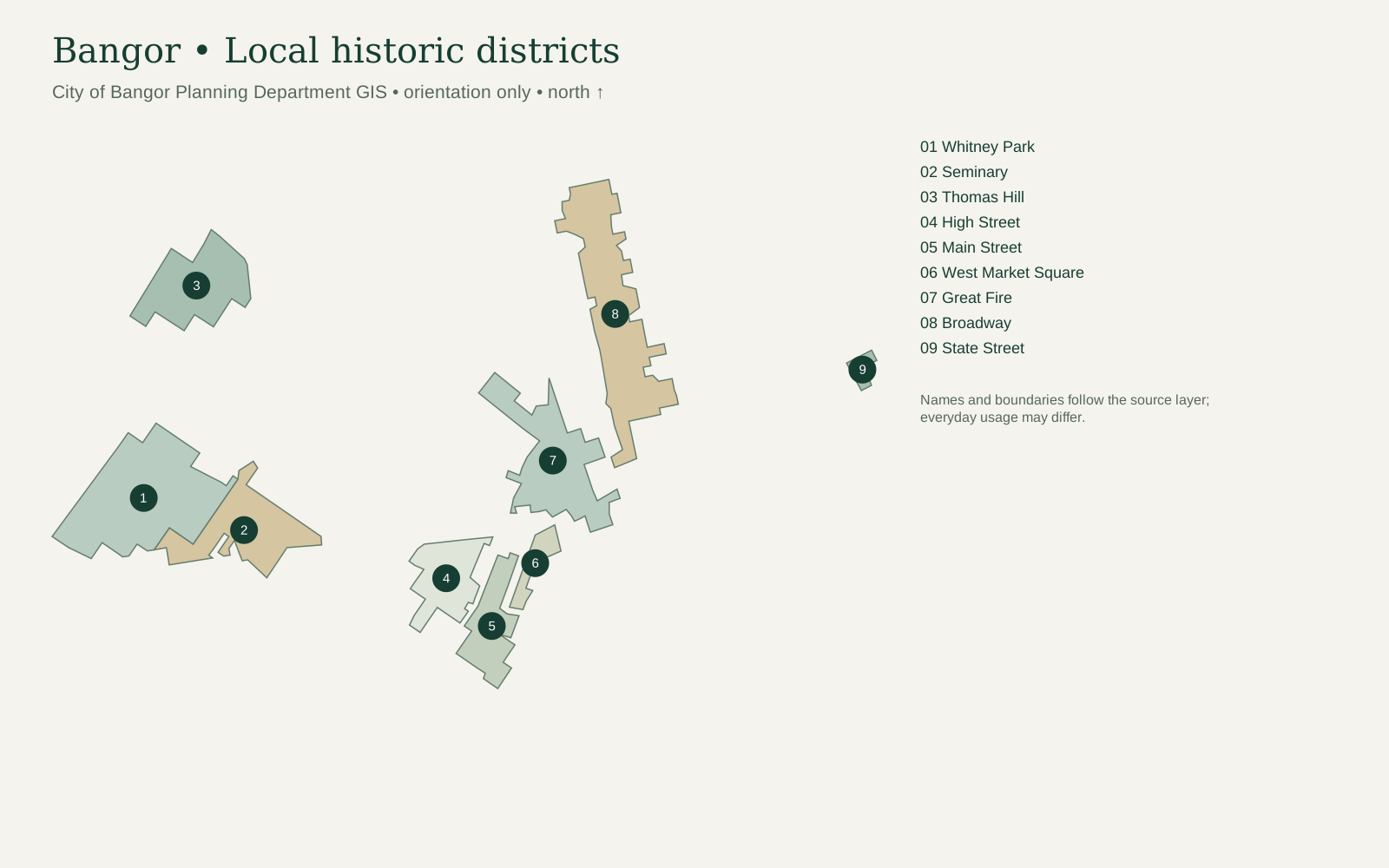
The map here uses the City GIS local historic district layer, credited to the City of Bangor Planning Department. It shows nine local districts, including small and disconnected areas. It is not a map of the entire City and does not show school assignments, parcel lines, flood zones or an approved truck route. The six area comparisons below are a separate selection of settings, not a key that divides the City into six administrative neighborhoods.

Keep National Register districts, local preservation districts and survey study areas separate. For example, the State Street survey covers a longer residential corridor than the small local State Street polygon. Capehart appears in the neighborhood comparisons but is outside this historic-district map. Ask the appropriate office about the actual parcel before proposing exterior changes or relying on a boundary.

Describe daily destinations by their specific entrance and municipality. The University of Maine destination in Orono is not a Bangor campus, while a regional bus may serve both cities. An address file with the exact unit, manager, receiving door and daily destinations is more useful than treating the whole Bangor area as one interchangeable location.

City of Bangor GIS map showing nine numbered local historic districts
City of Bangor Planning Department local historic district geometry. This map does not show the whole City, parcels, school assignments, flood zones or approved truck routes; the six written area comparisons are separate. Open full-size map.

03 /

Find the area that fits your routine

These six comparisons use distinct primary records to explain selected Bangor settings. Survey dates and boundaries differ, and they do not cover every part of the City. Current housing availability, condition, school placement and access need address-specific confirmation.

Broadway corridor

The 2021 survey describes a corridor of substantial older houses and distinguishes it from the denser vernacular building pattern on nearby Tree Streets.

Historic Survey Phase 1: Broadway and Tree Streets, 2021 ↗
Housing & setting
Compare the present unit layout, yard, stair arrangement and usable storage; the historic exterior does not show every conversion.
Daily travel
Walk the particular grade and crossing toward the daily destination or current bus stop.
Before choosing
Separate local and National Register boundaries, then confirm the actual driveway and entrance you may use.

West Market Square

The 2022 survey describes two compact downtown commercial blocks around Hammond, Broad, Main, Water and Merchants Plaza, close to the stream and waterfront.

Historic Survey Phase 2: West Market Square, 2022 ↗
Housing & setting
If comparing an apartment here, establish current residential use, a separate entrance and the rooms and storage included.
Daily travel
Test the path to the transit center and the destination, including the change from flatter downtown frontage to nearby slopes.
Before choosing
A shop frontage, service alley or customer parking area does not establish residential loading rights or a current vacancy.

Great Fire and downtown east

The 2024 survey describes historic commercial, civic and religious buildings around the central streets across Kenduskeag Stream, with rises along Center and Park.

Historic Survey Phase 3: Great Fire and Main Street, 2024 ↗
Housing & setting
Check the particular building use, floor, shared facilities and any internal stair or service elevator.
Daily travel
Include the actual hill, crossing and return route when comparing a central address.
Before choosing
The expanded National study area and the local historic polygon are different. Ask about current access and preservation review for the parcel.

State Street residential corridor

The 2025 survey distinguishes a western mixed-use section from larger residential parcels farther east near the hospital, including the Howard-to-Summit stretch.

Historic Survey Phase 4: State Street and Tree Streets, 2025 ↗
Housing & setting
Compare the current dwelling, setback, entrance and any division into units rather than assuming a large historic house has a simple layout.
Daily travel
Try the actual frontage and crossing at the times needed for work, school or care.
Before choosing
The survey corridor extends beyond the small local State Street district on the map. Confirm the block and property-specific permissions.

High Street

The Maine preservation record describes a curved hillside block near Main Street, with older houses and the early-twentieth-century Colonial Apartments.

High Street Historic District and Colonial Apartments ↗
Housing & setting
Inspect the actual apartment or house route, including landing depth, stair turns and any shared entrance.
Daily travel
Walk the slope and full connection to everyday destinations instead of relying on the short map distance.
Before choosing
The historic record does not establish a current unit vacancy, condition or parking entitlement. Measure and confirm the receiving route.

Capehart area

The 2015 watershed plan describes former air-base housing developed in 1958 and a residential street pattern connected to Capehart Brook drainage.

Capehart Brook Watershed-Based Management Plan, June 2015 ↗
Housing & setting
Compare the actual home, outdoor storage, driveway and relationship between the street and receiving door.
Daily travel
Use the current Route A service-change notice where relevant; shaded suspended trips are not extra departures.
Before choosing
The old watershed study is not a current parcel-risk assessment. Check the housing provider’s present waiting-list and application information separately.

04 /

Use citywide estimates, then inspect the particular home

The ACS 2024 five-year housing estimates cover 2020–2024 for Bangor city. They report 14,581 occupied housing units: approximately 47.2% owner occupied and 52.8% renter occupied. Median gross rent is $1,055, and the median value of owner-occupied homes is $219,600. These survey estimates are context, not September 2026 asking rents, listing prices or a prediction for a particular home.

The same dataset estimates 16,042 total housing units, including vacant units. About 39.4% are detached one-unit structures, and 41.1% were built before 1940. Those percentages use the all-unit denominator, unlike the occupied-unit tenure figures. The age of a building alone does not establish its condition, energy use, accessibility or renovation history.

Compare the full recurring cost. Ask what the agreement includes for heat, electricity, water, sewer, waste, parking and storage; identify the payer and billing arrangement for each. Confirm the heating fuel and actual provider rather than assuming that every Bangor address has a natural-gas connection. A quoted rent can cover a different combination of services from another property's advertised figure.

At an older house or converted building, inspect the actual unit boundaries and rooms. Check usable storage, ventilation, laundry access, stair turns and the route for the largest rigid furniture. Look beyond a generous room to the narrow opening that serves it. Record measurements and ask about alterations, shared facilities and the entrances you may use.

For a dwelling over a downtown business, separate residential access from shop access. Establish the authorized door, delivery hours, waste location and any shared loading arrangement. A customer parking space or service alley does not become a tenant's exclusive moving position. If an elevator is involved, confirm its size, reservation and the person who controls it.

The Capehart property page currently states that its waiting list is closed. The area comparison is therefore a description of its documented physical setting, not an offer of an immediately available home. Check current program and application information directly with the housing provider; older income tables or an exterior photograph do not establish eligibility or a vacancy.

Two closed Sterling Oakbridge book cartons stacked beside a low bookshelf, with an open carton of books in an attic study
Pack books in small cartons and keep the desk area and route to the stairs clear.

05 /

Check the current run, direction and return trip

Community Connector publishes route schedules, fares and service information for Bangor and nearby communities. Plan a complete trip from the home: the walk to the correct stop, direction of travel, any transfer, the destination entrance and the last usable return. A line on a regional map does not show every request-stop condition or the effect of a missed connection.

The April 2026 rider guide and system map explicitly says that Saturday service is temporarily suspended. Some older descriptions still refer to Monday–Saturday operation. Use the current route notice for the actual date and verify any restoration before depending on a weekend routine. Do not assume an evening or Sunday alternative exists because a weekday route reaches the destination.

For Capehart and the Route A area, the March 16, 2026 service-change sheet suspends the A1 trips. The remaining A2 departures from the transit center are shown at :45; the shaded A1 rows still printed at :15 are not additional operating trips. Check the latest notice before travel and ask how any stop marked R must be requested. A printed row alone is not proof that the run is active.

The schedule page also links the March 2026 Stillwater Route W timetable. For travel toward Orono or the University of Maine, the newer BBOE announcement gives the 2026–2027 academic-year service beginning August 31, 2026. An older 2025–2026 label elsewhere on the site should not be used to infer the current calendar. Confirm the academic dates, exact run and final return for the destination.

The fare page lists a $1.50 adult fare, a 75-cent half fare for eligible riders and free transfers. Cash requires the exact amount because drivers do not make change. Check the eligibility and identification required for a discount, free-fare arrangement or pass; a student pass and a participating institution's free-ride agreement are different products.

If the fixed route cannot meet a disability-related travel need, use the ADA paratransit process. It requires an application, an interview and a written eligibility decision. The published fare is $3 each way or $6 round trip, with service related to the fixed-route network and a three-quarter-mile service area. Call 207-992-4670 about eligibility, booking and the actual trip; a mobility device by itself does not establish automatic approval.

Explain the boarding surface, device and assistance needed. Confirm outbound and return arrangements, with an alternative if an appointment ends after service. The photo illustrates a setting, not an actual fleet vehicle or stop.

White bus with a blue lower stripe at a curbside stop, with passengers waiting beside the boarding door.
Check the actual stop, direction, departure and return service for the travel date.

06 /

Complete the receiving-school and travel handoffs

Begin with the full physical address, apartment number, grade and intended first attendance date. The Bangor School Department registration page directs new families to the receiving school; it says K–8 placement follows the physical address. Contact the district at 207-262-9125, 73 Harlow Street, if the correct school or next step is unclear. Do not choose a school solely because it appears closest on a map.

The current registration page links an attendance-area document revised in August 2012. That document is useful background, but should not be treated as a complete confirmation for 2026–2027. Ask the district to verify the address, grade, receiving building and appointment. This is especially important where a building or transport arrangement has changed.

For the ordinary resident process, prepare the child's original birth certificate, current health and immunization records, prior-school details and two proofs of residence. The residency form lists examples such as a Maine driver's license, dated utility receipt, real-estate tax bill, rental lease or excise-tax receipt. Confirm what the school will accept for the actual living arrangement and bring the current forms, rather than assuming an old example fits every family.

The student registration packet requests contact, previous-school, language, health and emergency information, as well as relevant learning-support details. Transfer report cards, transcripts or program records as appropriate, and identify any IEP, Section 504 plan, language services or other support requiring continuity. Discuss health documentation with the school nurse and applicable custody or guardianship documents with the registrar; the moving guide does not decide eligibility.

Arrange the receiving-school visit or counselor appointment during its available hours, submit the requested material securely and ask what still remains. Confirm the first attendance date, arrival entrance, dismissal arrangements and who to contact if records from the previous school are delayed. A form delivered to the office does not by itself establish the first day or transportation.

For entry to early grades, the registration page uses age four for pre-kindergarten and five for kindergarten by October 15. Pre-kindergarten has limited space and requires screening. The January 2026 information packet and registration page describe preparation and the summer screening process. For an arrival after that schedule, ask about the current place, screening opportunity and next step; neither the cutoff nor a submitted form guarantees an available seat.

If housing is unstable or the standard proofs are unavailable, contact the district's McKinney-Vento liaison promptly. The Maine Department of Education guidance explains immediate enrollment protections for eligible students even when ordinary records cannot be supplied immediately. Explain the situation directly to the school so it can assess the appropriate process; do not delay contacting the district while trying to complete a standard lease-based checklist.

Living outside Bangor is a separate question. The nonresident tuition page makes acceptance conditional on enrollment, class size and program availability, and places transportation responsibility with the parent or guardian. An inquiry about tuition is not admission, resident registration or a transport arrangement. Confirm any approval and cost before relying on that option.

Then settle the daily journey. The 2026–2027 bus page identifies John T. Cyr & Sons, 207-942-3354, and notes changes associated with Fairmount's relocation and bridge construction. It describes pickup times as approximate and asks for flexibility around the listed time. Confirm the correct stop, direction, receiving building and dismissal route for the child; do not infer them from an older school handbook or a familiar stop.

Keep the school documents, contact numbers and essentials out of the moving shipment until enrollment is settled. If the address, caregiver, arrival date or travel plan changes, inform the school and transport provider. An interim trip should be agreed before the first morning, with a clear contact if a bus or receiving location is uncertain.

07 /

Connect the right accounts to the actual handover

List each service at the address, whether it is already active, whether the unit has its own meter, and who pays under the lease or closing agreement. Separate the service location from a mailing address. A provider account change, a property closing and the ability to turn on a tap or appliance are related events, but one does not prove that all are complete.

Start with Bangor Water District start/stop instructions at 207-947-4516, extension 1, or its office at 614 State Street. A new application is required when responsibility changes, including landlord-to-tenant and tenant-to-landlord transitions. Existing-service applications can take several business days; arrange the effective date instead of assuming the previous account transfers automatically.

The application page separates residential, nonresidential and mixed properties. The residential form asks about the service and mailing addresses, owner or tenant status, landlord and contact information, as well as its other required account questions and signatures. Supply private information directly to the District. The form specifically tells applicants to call the office when water must be turned on, so online submission alone is not an activation appointment.

For departure, the start/stop page and linked Terms and Conditions require at least five business days' notice for the final reading. Responsibility continues until that reading. The shorter customer-rights overview still says three business days; use the fuller five-day instruction and confirm the actual appointment with the District. Coordinate a continuous account handover or any requested street shutoff, and make required meter or premises access available.

The linked terms list a $45 charge for an existing-service application during normal working hours, with different charges for after-hours or construction work. The pages differ on whether payment is taken with the application or on the first bill. Confirm the applicable amount and timing; this figure is not a complete utility bill, a construction quote or a guarantee of a same-day turn-on.

For a tenant, clarify the landlord's role, separate shutoff and meter arrangements. The District says City sewer bills are issued to property owners and that application information is shared for sewer setup. The lease may allocate costs differently from the provider's account responsibility. Record who closes the outgoing account, who opens the incoming one and what confirmation shows the reading and effective dates are settled.

For electricity, Versant Power explicitly lists Bangor in its service districts. Its start, stop or move page directs existing-service arrangements through 207-973-2000. Provide the exact location, requested dates and provider-required identification through its secure channel. New-construction planning has a different process; its construction timetable should not be presented as the deadline for an ordinary account transfer.

For a property using the former Bangor Natural Gas service, use Unitil. Its Bangor account-transition notice says the systems have been integrated and legacy Bangor account numbers are no longer accepted from June 1, 2026. Old payment profiles did not carry over. Check the current bill and account setup rather than relying on a saved old provider link.

Unitil's start/stop/move page distinguishes an existing customer's transfer or disconnection from a new customer's application for an existing property; new construction is separate again. Customer service is 1-888-301-7700. Confirm that the actual home has the service and identify the required date, meter access and any appointment. A regional gas network does not mean every Bangor property is connected.

For oil, propane, internet or other property-specific services, confirm the provider, equipment and account obligations with the owner. Obtain effective start and stop dates; update providers if possession changes.

08 /

Keep the cart, cardboard and bulky items on separate paths

Before packing day, ask which collection arrangement serves the actual property, its pickup day, and where the assigned cart belongs. Bangor's automated rubbish instructions describe City-coded 96-gallon carts and require setout by 6:30 a.m. Put acceptable material inside with the lid closed; items piled beside the cart are not part of the ordinary collection.

The City-supplied cart belongs with the address and should remain when you move. The page distinguishes an additional cart bought by a resident, which can move within Bangor after its serial number and address are updated with Public Works. Call 207-992-4500 about the applicable arrangement. Do not take a property's assigned cart simply because the outgoing resident used it.

The placement instructions call for a position within six feet of the curb, three feet of clearance around the container and fifteen feet of overhead clearance for the lifting equipment. Keep sidewalks usable and avoid vehicles or other obstacles. Coordinate the collection position with the moving truck so neither operation blocks the other; a cart's pickup day does not authorize a truck to occupy its frontage.

The trash page says accepted rubbish and recycling share the automated cart, with rubbish bagged and accepted recyclables loose. Break down cardboard so it does not jam the cart. Do not force a move's entire packaging volume into a container that cannot close, and do not assume that foam, film, electronics, lithium batteries or hazardous materials belong with ordinary household rubbish.

For clean household cardboard, the City's recycling page provides a separate resident drop-off at 530 Maine Avenue, 7 a.m. to sunset, seven days a week. Bring proof of Bangor residence, such as a utility or tax bill, and flatten the material. The site does not accept business or nonresident cardboard, food- or grease-contaminated boxes or mixed packing materials. Separate the streams before leaving the house.

Mattresses, box springs, sofas and other bulky items do not belong in the ordinary cart collection. The City bulky-waste page directs residents to Pine Tree Transfer Station, 358 Emerson Mill Road in Hampden, with 207-862-4200 for material and pricing questions. Loads are weighed and charges apply. Confirm current hours, the person and vehicle bringing the material, and the complete charge before traveling.

For a mattress or foundation, describe the number, dimensions and condition and ask about acceptance, preparation, separation and any item-specific fee. The City page does not establish a universal mattress price, and a general disposal rate does not necessarily settle the entire load. Secure and cover a self-hauled load as instructed by the facility; arrange a suitable separate service if you cannot deliver it.

The spring-cleanup notice is dated for the April 2026 event and covers specified materials such as branches and scrap metal. It is not a standing appointment for free furniture removal after a September move. A paid collection option must be arranged with its provider, and any donation requires the receiving organization's current acceptance.

Sort disposal before finalizing the inventory. Keep waiting material clear of doors, sidewalks and vehicle access.

09 /

Follow the full curb and public-space decision path

Start with the exact address and a sketch of the proposed operation. Include dates, hours, truck length and width, any ramp or liftgate, the requested spaces and the route to the door. Identify the owner of the parking surface and any public road, sidewalk or esplanade involved. Private-property permission does not settle public-space restrictions.

The City's parking page describes downtown time limits from fifteen minutes to four hours and ordinary permit-lot arrangements. These do not establish an exclusive moving reservation. The permit directory links the three-page Work Permit — Use of City Right-of-Way. It asks for a location sketch, proposed dates for no more than fourteen days, the sidewalk or street footprint, parking-space count and owner/contractor contacts.

The form directs questions to Code Enforcement, 73 Harlow Street, 207-992-4230. It includes review fields for Engineering, Public Works, Police, Code and Fire, plus the City Manager's signature. Its authority is section 257-4, construction occupancy. Ask Code Enforcement whether that form applies to the proposed household or business move and what process applies if it does not.

Coordinate the parking and traffic side with Bangor Police at 207-947-7382. Give the complete footprint and hours. Confirm the current application, fee, submission lead time, approval document, any official signs or meter treatment, who supplies and places them, and the response if a vehicle occupies the location. No universal moving fee or minimum notice was verified in the published chain; that is a reason to ask, not to assume no permission is needed.

The sidewalk code requires safe pedestrian passage for licensed construction occupancy and specifies a five-foot walkway in that context. It also directs the licensee to notify Police when metered spaces are involved. Do not independently apply those construction arrangements to a move or improvise a walkway in traffic. Explain the intended equipment and ask for the actual approved pedestrian plan.

Section 257-7, added in May 2026, separately prohibits storing materials so they occupy or obstruct a City sidewalk or esplanade. Keep cartons, furniture and equipment out of an unapproved public staging area. A short carry across a path and storing the shipment on it are different operations, and the entire plan must preserve access for other users.

The parking code, Article III gives the Police Chief or designee temporary traffic and parking-control powers. It protects marked restrictions, sidewalks, intersections, hydrants and driveways. Its narrow commercial double-parking provision allows up to fifteen minutes only on Main, Exchange, Harlow and Central Streets within the specified downtown area, with conditions including available loading space and eighteen feet of clearance. It is not a default method for a multi-hour household unload.

A different provision exempts household moving from the four-hour residential restriction for commercial vehicles over one ton in capacity. That exemption does not remove the other parking or obstruction rules, authorize continuous storage of a truck, or reserve the space. Confirm the proposed vehicle, exact position and hours rather than relying on one isolated exception.

Do not confuse the process with Engineering street-opening permit, which covers excavation and related utility work, or the City's special-event process. Fees, insurance provisions or deadlines for a different activity are not verified moving requirements. If the operation includes additional work, ask which separate permissions it triggers.

Winter sources disagree. The current City parking page says its May 2025 policy allows overnight on-street parking with the odd/even-day side arrangement, subject to snow orders. The codified section 291-42 still displays the older midnight-to-six winter restriction. Check the current City notice and obtain Police or Public Works confirmation for the actual date and street; this guide does not resolve that legal discrepancy by declaring either text repealed.

A City-wide snow-clearing order requires vehicles off the streets; a downtown-only order covers the management district. Follow temporary signs and live alerts. Listed emergency lots do not guarantee a large truck fits or may remain for a loading operation. Also check current works: the Cumberland Street project affects nearby downtown connections during its work periods, and dated notices should be checked again before travel.

Once the authority confirms the arrangement, connect it to the building's receiving window and keep the approval with the moving plan. Agree a decision time and a lawful alternative if access changes. A different authorized position, later window or confirmed storage stage needs its own permission, availability and costs before it becomes the fallback.

10 /

Trace one continuous route to the receiving room

Walk from the proposed vehicle position to the actual unit, then continue to the rooms receiving the largest pieces. Include the outdoor surface, steps, landing, threshold, door swing, hallway turn and any internal stair. Photograph the limiting parts with enough context to understand how they connect.

A house may have a side entrance that is easier than the front, but using it can involve a private yard, gate or shared drive. Obtain permission for the entire route. Do not remove a railing, alter a historic exterior or cross an adjoining parcel on the strength of a verbal suggestion from someone who cannot authorize it.

For an apartment or mixed-use building, identify the service door, elevator size, reservation window, protection requirements and who has keys. Ask whether deposits or other access charges apply and who receives them. Check that residential unloading can coexist with customers, deliveries and required exits; a shop's opening hours are not necessarily the building's moving hours.

Measure clear openings rather than nominal door sizes. Include stair landings and the space needed to turn a rigid piece. Discuss disassembly, protection and any item that still lacks a workable route with the mover before pickup. The moving-page access checklist helps connect those measurements to the estimate.

Agree who prepares the property, clears loose obstacles and deals with rain or snow on private surfaces. For a short reserved slot, agree what protected preparation may happen beforehand and keep carrying work inside the authorized time. Ask about COI, union or contractor conditions, the basis of any charges and who approves them. The person handing over keys should also know which rooms or entrances are unavailable. If a route changes, review the effect on carrying distance, equipment and the receiving window before work resumes.

11 /

Try the routine from the actual front door

Visit the candidate address at the time you expect to leave for work, school or an appointment. Include the stairs, outside walk, crossing and waiting time, then make the return journey. A pleasant downtown visit or a short map distance tests a different routine from bringing groceries uphill after the last suitable bus.

The Great Fire survey and State Street survey describe changes in terrain and building patterns across nearby central blocks. Use that context to choose what to inspect, rather than treating the descriptions as current access guarantees. Test the particular block, front door and destination entrance.

Keep the ordinary tasks concrete: where the household stores food and packages, how laundry works, where waste waits for collection, and whether a parked vehicle can be reached without crossing a neighbor's property. Confirm any shared spaces and permitted use with the owner. A representative photograph does not establish that a depicted facility is available to the address.

Woman loading a washing machine and a man folding a towel in a neighborhood laundromat.
Test the ordinary household errands and their connection to the candidate address.

12 /

Assign winter clearance and check the approach again

Look at the receiving route in its entirety: the truck position, grade, path, outside steps, landing and door. Agree who clears snow, treats slippery private surfaces and checks the route before the crew arrives. Ensure there is somewhere to put cleared snow without covering the walking route or the vehicle's intended access.

The City's snow-removal page describes a designated sidewalk network, with some alternate sections potentially remaining uncleared through multiple events. Do not assume every residential sidewalk or private approach receives the same service. A clear main road also does not establish that a shaded stair or shared rear entrance is ready.

Within the Downtown Parking Management District, section 257-2 places snow and ice duties on the responsible owner or occupant. It calls for removal within six hours after precipitation ends, or before 1 p.m. the next day if it ends after 6 p.m., and continued ice control and access. That is a district-specific rule, not a citywide deadline invented for every homeowner. Confirm who performs the work at the actual property.

Check current winter parking instructions and snow orders with the responsible City office, including the conflict described in the curb section. The heavy-load posting page also requires attention for a spring move: its March–May 2026 dates are historical by September, while actual posted signs and weather conditions matter to the route. Do not infer permission for a heavier vehicle from a passenger-car trip.

For a property near a stream or on a slope, use current parcel-specific information to investigate drainage and flood exposure with the appropriate professionals. The Capehart watershed plan and historic district map explain context; they do not classify the present risk or condition of a particular house. A representative winter image is not a clearance promise.

Resident spreading grit on a home’s front steps, with separate entrance paths and shallow snow.
Assign clearance and treatment of the private receiving route before arrival.

13 /

Turn the remaining uncertainties into a workable arrival plan

Before the final week, bring together the possession date, school outcome, utility start dates, waste arrangement and moving access. Each needs a named owner and a confirmation. An application receipt, a proposed curb space or a landlord's intention is not the same as a completed arrangement.

DecisionUseful confirmationIf unresolved
Keys and unit accessNamed person, time, usable entrance and receiving windowSet a decision time and an approved later window.
Truck positionAuthority, location, hours and any posting or access conditionsResolve a separate lawful alternative before arrival.
School and travelEnrollment outcome, first day and confirmed transportKeep contact with the school office and arrange the interim trip.
UtilitiesCorrect meter or account, effective dates and required appointmentsAsk the provider what remains and who supplies access.
Bulky disposalAccepted material, vehicle eligibility and current feeKeep the item out of an unapproved curb pile.

A useful fallback explains what triggers it, who decides and what happens next. If closing is delayed, establish where the household can wait and whether a storage or revised delivery stage is actually available. Agree access and costs before treating it as settled.

On arrival, walk the route again, identify items that stay and confirm the rooms for delivery. Keep children, pets and visitors away from the work area. Retain the inventory, provider confirmations and building contacts until the handoffs are complete, then update the appropriate accounts and district if the address or timing changes.

Use the Bangor moving estimate to describe the inventory, services and access that are confirmed, together with the decisions still open. That allows a change in the property or receiving plan to be addressed before it becomes a moving-day surprise.

14 /

Questions before you arrive

Are the housing figures current Bangor listing prices?

No. They are ACS 2024 five-year estimates covering 2020–2024 for the City. Compare current listings, included services and property-specific costs separately.

Does the map show every Bangor neighborhood?

No. It shows nine local historic districts from City GIS. The six written comparisons are a separate selection, and the map is not a school, parcel, flood or truck-route boundary.

Can I use the shaded A1 bus departures or assume Saturday service?

The Route A change suspends A1, and the April 2026 rider map says Saturday service is temporarily suspended. Check the current notice for the actual travel date before relying on an older description or shaded timetable row.

Can I use the old attendance map to finish school registration?

Confirm the exact address, grade and receiving building with the district. The linked map is dated 2012, and the current bus page identifies 2026–2027 changes. Enrollment, first attendance and transport each need confirmation.

Does Bangor Natural Gas still use its old account process?

Unitil says the accounts have been integrated and legacy account numbers are no longer accepted from June 1, 2026. Use the current Unitil process and confirm service at the actual property.

Can I put a mattress beside the City cart?

No. Mattresses and other bulky items are outside ordinary cart collection. Ask the transfer station or an arranged provider about acceptance, preparation, vehicle, hours and the complete fee.

What should I settle first when the moving date is close?

Confirm possession, keys and the usable receiving route, then resolve the lawful truck position and time-sensitive school and utility appointments. Give each open issue an owner, a decision time and a confirmed alternative.

Your next step

Bring the plan together

Use the Bangor moving page to prepare the inventory, access details and questions for your estimate.

Sources & useful local resources

Official procedures and local resources are linked beside the answers above. Reopen the relevant page when arranging a date: fees, schedules and application requirements can change.

Housing data

City rules, services and local context

Housing context

School registration and travel

Utility handoffs

Historic area comparisons