Pennsylvania / City relocation guide

Moving to Harrisburg

Start with the exact address and the life you need it to support. This guide explains Harrisburg’s housing context, six areas to compare, everyday journeys and the practical steps for setting up a household in Pennsylvania’s capital.

Adults walking across a paved downtown plaza beside benches, shops and an intersection.
Test ordinary weekday journeys and the public spaces near an address.

01 /

Start with the municipality and your ordinary week

A useful Harrisburg search begins with two questions: which municipality governs the property, and whether the address works for your everyday needs. Harrisburg is a city in Dauphin County, Pennsylvania. A Harrisburg postal address can extend beyond the city, so check the parcel or municipality before applying city parking, school or collection information. Do the same for any alternative property across a municipal boundary.

Choose a few repeat journeys to test: work, school or childcare, groceries, healthcare and an activity the household uses regularly. Visit at the time you would actually make the trip. A pleasant weekend walk does not show the weekday receiving restrictions, bus timetable or evening trip home. If one household member drives and another does not, evaluate both routines instead of treating one commute as the whole decision.

Use this guide to organize the questions, then obtain the address-specific answers from the responsible provider. Start school registration and service arrangements early enough to resolve missing information. Keep the moving inventory separate from the list of things to sell, donate or discard. Harrisburg’s weekly bulk-item limit makes that separation especially useful when clearing a home.

When an address is chosen, the Harrisburg moving estimate section explains which inventory, entrance and vehicle details to send. A property comparison becomes a workable relocation plan when the municipality, keys, household setup and receiving route all line up.

02 /

Understand the river, downtown and the Hill

Harrisburg’s development is closely connected to the Susquehanna River, while Paxton Creek also shapes the city’s floodplain decisions. The City’s preservation guide describes residential districts near the river and the expansion toward Allison Hill. These place names are useful orientation, but a broad neighborhood, a national historic district and a municipal preservation district are not interchangeable boundaries.

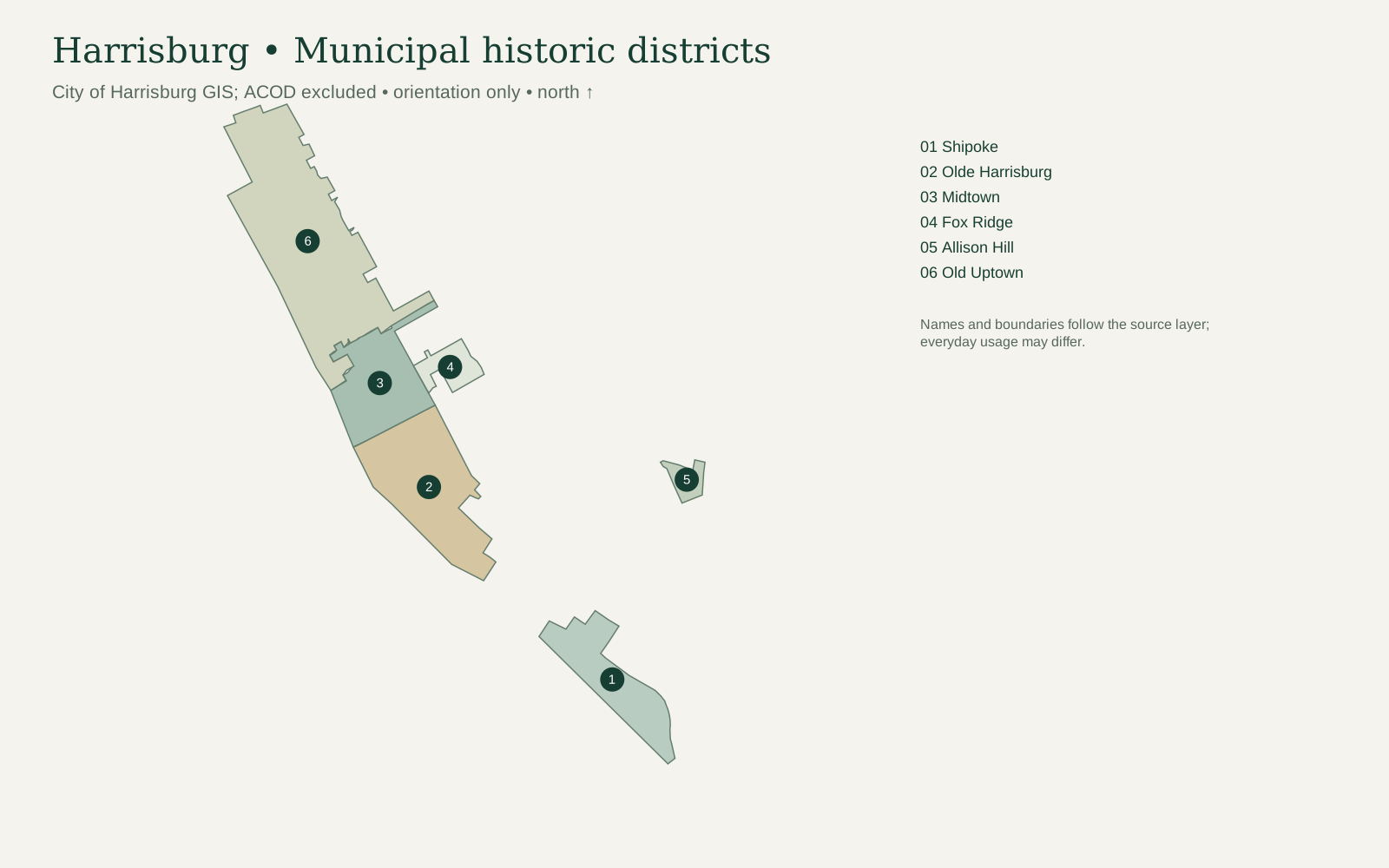
The map on this page shows six municipal historic districts from the City GIS layer. The separate Architectural Conservation Overlay District is excluded. The map is an orientation aid for preservation geography, not a complete division of every Harrisburg address. Bellevue Park and the broader Allison Hill area in the comparison below do not become municipal historic districts simply because they appear in the same guide. For a property question, use the City’s public zoning map and verify the result with Planning.

Downtown’s commercial blocks, Midtown’s older fabric, the river-edge setting of Shipoke and Bellevue Park’s landscaped street plan create different property questions. Look at the entrance, usable outside space, parking, room arrangement and the route to essential destinations. Avoid assuming that the broad area name guarantees a particular housing type, building condition or journey time.

A useful first visit covers the whole block in both directions. Find the actual receiving entrance, identify the way to the nearest crossing, and note whether a daily route depends on a particular service schedule. Then return with the questions that the initial view could not settle: district assignment, property responsibilities, loading arrangements and any address-specific flood information.

Six municipal historic districts in Harrisburg, Pennsylvania, from the City GIS.
City GIS outlines of the six municipal historic districts. The separate Architectural Conservation Overlay District is excluded. These are preservation boundaries, not a complete neighborhood map or school-attendance map; the comparison below also includes areas outside these outlines. Open full-size map.

03 /

Find the area that fits your routine

These six comparisons use named areas or historic districts with direct source support. They do not rank safety, school quality or investment prospects. Historical descriptions explain development and building form; inspect current properties and test the routes yourself. The City preservation guide distinguishes municipal districts from the broader neighborhoods around them.

Downtown commercial core

The National Register record identifies a commercial historic district around parts of Market and Third Streets, with Greek Revival and Italianate architecture among its recorded styles. Its historic boundary is a defined part of downtown, not every address described as Downtown Harrisburg.

Old Downtown Harrisburg Commercial Historic District — National Register metadata ↗
Housing & setting
If considering an apartment above a commercial floor, establish the actual entrance, shared route, sound conditions and receiving arrangement. Do not infer current residential availability from a historic commercial listing.
Daily travel
Test the actual bus stop and return journey alongside the walk to work or other destinations. Look at the route from the building door, not just the district’s central position.
Before choosing
Ask which spaces are private, which curb is operator-managed and whether delivery hours overlap the building’s other uses.

Midtown historic area

The National Register metadata describes the Midtown Harrisburg Historic District roughly between the Susquehanna, Forster, Verbeke and Third Streets, with Federal and late Victorian architecture. This is a specific historic area within the broader Midtown name.

Midtown Harrisburg Historic District — National Register metadata ↗
Housing & setting
Inspect the room layout, entrance steps and any conversion into multiple units. Older exterior character does not establish the internal condition, lease terms or practical furniture route.
Daily travel
Check the exact walk to Third Street services or another chosen route and test the return trip at the hours you need. Confirm where a bicycle or car may be kept.
Before choosing
Verify the parcel’s preservation status separately from the neighborhood label, then ask the owner about shared entrances and planned exterior changes.

Old Uptown

The National Register record for Old Uptown identifies Italianate, Queen Anne and Romanesque styles and periods of significance spanning the late nineteenth and early twentieth centuries. National and municipal preservation boundaries require their own address checks.

Old Uptown Harrisburg Historic District — National Register metadata ↗
Housing & setting
Compare the actual building and usable rooms, including stairs, doors, maintenance and any shared facilities. A stylistic label describes architecture rather than the size or quality of a particular home.
Daily travel
Walk the route to your chosen Third Street or other bus stop, and establish the service schedule that fits the household. Check everyday parking separately from moving-day space.
Before choosing
Request the property’s current responsibilities, confirm receiving access and resolve preservation questions before assuming an exterior alteration will be possible.

Shipoke

The City’s 2021 preservation guide places Shipoke south of downtown, between the Susquehanna River and an industrial corridor. It describes a historic district made up mainly of residential buildings, with some commercial property.

Historic District Design and Preservation Guidelines — 2021, pages 32–39 ↗
Housing & setting
Assess the exact home, storage level, entrance and mechanical systems. For a purchase or rental, obtain address-specific flood information rather than deciding from a broad riverfront description.
Daily travel
Try the actual walking route to downtown and your regular destinations, including the return after work. Check the block’s parking rules and the route to the receiving entrance.
Before choosing
Ask Planning for relevant property records, review the owner’s maintenance responsibilities and confirm a lawful truck arrangement for the selected block.

Allison Hill

The City’s July 2020 draft comprehensive plan describes Allison Hill as an area with townhouse and semi-detached residential buildings around commercial corridors, with an industrial legacy. This existing-form description is not a claim that the draft’s proposed projects have been completed.

July 2020 draft Comprehensive Plan — Allison Hill existing land use, page 37 ↗
Housing & setting
Compare the specific street, home layout, shared walls, entrances and usable outdoor space. The broader Allison Hill planning area is larger than the municipal historic district bearing that name.
Daily travel
Test a real trip along the Market, Derry or other corridor relevant to the address. Check crossings and timetable details rather than assuming all parts of the Hill connect equally to downtown.
Before choosing
Identify the actual municipality, parcel rules and building responsibilities. Inspect the route from the vehicle, especially where elevation changes or stairs affect the entry.

Bellevue Park

The Bellevue Park Association describes a landscaped residential plan with curving roads following the terrain, detached houses and reservations owned by the association. Its history connects the layout with Warren Manning and the neighborhood’s early twentieth-century development.

Bellevue Park history — street plan, houses and association-owned reservations ↗
Housing & setting
Compare the property’s room arrangement, drive and landscaping obligations, then review its applicable covenants and association documents. The landscaped setting does not remove the need for inspection.
Daily travel
Try the actual journey to work, school and shopping from the particular home. Check walking connections and the turning space of any private drive before assuming it solves vehicle access.
Before choosing
Confirm association requirements for proposed changes and the responsibility for shared landscape areas. The reservations are not ordinary City park property.

04 /

Read the housing numbers as context, then inspect the property

The ACS 2024 five-year estimates, covering 2020–2024, report 22,137 occupied housing units for Harrisburg city: about 63.4% renter-occupied and 36.6% owner-occupied. Estimated median gross rent is $1,062 per month, with a published margin of error of ±$35; median owner-occupied home value is $124,200, with a margin of error of ±$11,090. These are period estimates for the city, not current advertised rents or prices for a particular neighborhood.

Citywide measureACS 2024 five-year estimateQuestion for the property
One-unit attached housing43.1% of all housing unitsHow do stairs, party walls and entrances affect daily use?
One-unit detached housing14.0%What private access and exterior responsibilities come with the home?
Units in two-to-four-unit buildings14.4%Which doors, corridors and service areas are shared?
Housing built before 194043.2%What does an actual inspection show about the building?

The structure and age shares use 24,130 total housing units as their denominator, including vacant units; tenure uses occupied units. Sampling uncertainty applies to these estimates. An older date does not establish poor condition, and a recent renovation does not establish that every system or access route has changed.

Compare usable space rather than just the room count. Check whether the desk fits beside a radiator, whether the bed can turn at the stair landing and whether storage is dry and accessible. Open the doors and measure their clear widths. Ask about laundry, waste storage, heating, cooling, electrical service, maintenance reporting and which bills are included in the proposed arrangement.

For a rental, clarify who arranges utilities, how access is provided for maintenance and which spaces are private or shared. For a purchase, use the relevant professional inspection and property documents to resolve condition, title and boundary questions. If an exterior change is part of your plan, check preservation and association requirements before relying on that change. Keep flood classification and insurance questions tied to the parcel rather than to a neighborhood average.

A small home office with a desk, monitor, bookcase and two closed Sterling Oakbridge cartons.
Check working space, storage and the route for the desk and packed belongings.

05 /

Test the complete trip, including the return

rabbittransit’s Capital Region fixed-route network serves Harrisburg and surrounding parts of Dauphin and Cumberland counties. The route page gives a useful starting point: Route 1 connects Downtown, Market Street and Kline Village; Route 3 follows Third Street toward Uptown; Route 6/13 links the Sixth and Thirteenth Street corridors. These descriptions identify corridors, not a promise that every address has a convenient stop or the same service hours.

Open the current timetable for the specific day and direction. Check the walk to the outward stop, the crossing needed to reach it, the last practical return and any transfer. Some routes list weekday service, others also list Saturday service; do not infer Sunday service from a weekday map. Try the trip with the constraints you will actually have, including bags, an appointment time or a late shift.

The current Capital Region fare page lists a $2 regular fare and $1.80 rabbitPAY prepaid fare. Cash boarding requires exact change; passes and the app provide other options. Concessions and special programs have their own eligibility conditions. Check the current fare and transfer rules when planning a recurring trip, especially if several household members travel differently.

If you need an accessible or assisted trip, distinguish the fixed-route service from Shared Ride / Paratransit. Shared Ride requires an application and reservations, operates within program and county limits, and may combine passengers rather than running directly to one destination. The reservation instructions explain the booking details; obtain eligibility, the usable service window and the fare for your actual trip before treating it as a dependable daily arrangement.

Walking and cycling also need an address test. Find a usable crossing, inspect the surface and lighting of the route, and establish where a bicycle can be secured at each end. A short map distance can conceal an awkward junction or missing connection. If driving is part of the routine, distinguish the home’s ordinary parking from the temporary space required for a moving truck. Confirm both separately.

Commuter locking a bicycle parallel to the curb at a curbside rack, with an open walking route beside the shop fronts.
Test walking, cycle storage and the first and last part of your daily journey.

06 /

Use the Pennsylvania district’s current enrollment instructions

For an address within Harrisburg City School District, start with the district’s 2026–2027 Family and Student Handbook, registration on page 8. Confirm the district and school assignment for the exact home and the child’s grade before committing to a routine. A Harrisburg postal address or a nearby school building does not, on its own, determine enrollment or transportation.

The handbook directs families to begin online and links the Student Services Enrollment Center’s registration page, which provides English and Spanish entry links. Complete the appropriate registration process, then follow the center’s instructions for the appointment and document review. The center says staff will contact families about the submitted registration and anticipated start date. A form submission should not be treated as confirmation that all arrangements are finished.

Handbook requirementWhat to prepare
Evidence of the child’s birthA document accepted in the handbook, such as a birth certificate or passport
Immunization recordThe child’s current record for district review
ResidencyParent identification and the required supporting lease, mortgage statement or recent utility bill
Additional records when applicableSpecial education documents and custody or foster-care paperwork
Social Security cardThe handbook labels this optional

Use the current handbook’s exact document instructions when preparing your appointment; the utility-bill option specifies a bill from the past 30 days. If a document is missing or the housing arrangement is temporary, contact the enrollment center to explain the situation and obtain the appropriate path. Do not substitute an assumed document requirement or postpone asking because the household does not fit a standard lease arrangement.

The handbook lists Enroll@hbgsd.us and 717-703-4008 for enrollment questions. The Welcome Center gives the location as the Administration Building, 1010 North 7th Street, second floor, Harrisburg, PA 17102. Confirm the current appointment arrangements before travelling. For kindergarten, the handbook says the child must be five by September 1; verify the school-year application that applies to your move.

After registration, confirm the assigned building, start date, daily schedule and transportation eligibility. Arrange transfer of records with the previous school and tell the district about an address change. Discuss support needs, health paperwork and any existing education plan with the appropriate school staff. A virtual or blended option has its own process; the registration center directs interested families to raise that choice during enrollment.

Keep school documents and contact details with you during the move. Test the actual morning and afternoon journey, including the adult’s onward trip to work or childcare. The useful result is a confirmed plan for the child’s first day, not merely a list of schools near the new home.

07 /

Assign each account and keep the service dates together

Make a utility list for the particular property before choosing start and stop dates. Ask which services are individually metered, which are included in rent or another charge, and which provider serves the address. A mailing city does not establish service territory. Record the old and new address, unit number, responsible account holder, possession date and final billing address in one place.

Capital Region Water’s billing guidance directs account and contact changes to Customer Service at 888-510-0606, Monday through Friday, 8 a.m. to 4:30 p.m. It also explains that the deeded owner remains responsible for water and sewer charges, including where a tenant receives billing information. For a rental, ask the owner how water and sewer are handled and what changes the owner must authorize. Receiving a copy of a bill is not the same as becoming the property owner’s account substitute.

For an address served by PPL, the electric service-order guidance distinguishes starting, stopping and transferring service. If the address is not found online, PPL says a meter number can be used; a landlord may be able to supply it. Confirm the apartment or unit as well as the street address, and retain the order confirmation rather than assuming a request took effect.

UGI identifies Harrisburg within its Dauphin County natural-gas area, but availability still depends on the property. For an existing account or connection, use the start, cancel or transfer instructions; that page asks customers to allow seven working days for processing. Arrange the required date and any access appointment directly with the provider. A general service-transfer request is different from converting a building to gas or installing a new connection.

For internet and any building-managed service, confirm the usable provider and installation requirements at the exact unit. Ask whether equipment must be collected or returned, whether an existing connection is active, and whether the technician needs entry to a locked shared room. Keep account identifiers out of boxes and use the provider’s secure channel for private information.

Coordinate service dates with actual possession and agreed property responsibilities. Photograph final and initial meter readings where practical, save confirmations and check the first bills for the correct service address and dates. If dates move, revise the provider orders and building arrangements together. Electricity, water and an internet appointment do not automatically change because the moving date changed.

08 /

Plan collection, unpacking waste and unwanted furniture

The City’s Trash and Recycling instructions describe weekly residential service divided into five collection zones. Use the address lookup linked by Public Works to establish the actual day, and check the current holiday schedule. The instructions say citywide holidays delay remaining collections by one day. Put the provided containers at the appointed location the evening before collection; ask the owner or Public Works if the correct point is unclear.

For a household cleanout, the critical limit is one qualifying bulk item per week. The City gives furniture, a mattress, a bedspring and rolled carpet as examples. Large appliances are excluded from that allowance and carry a separate removal fee. Confirm preparation and collection for the exact item with Public Works at 717-412-4320 before placing it out. The page does not supply a universal mattress-bagging rule or a current fee for every appliance.

Do not put several unwanted pieces outside on the assumption that a move creates a special collection. The City warns that only one bulk item will be taken and that additional items can be subject to a fine. If you have more than the weekly allowance, plan donation, an appropriate hauler or another confirmed arrangement before the home must be empty. Do not mix property clearout work into the moving inventory without discussing it.

After unpacking, separate material by its actual disposal route. Harrisburg accepts specified plastics numbered 1, 2 and 5, along with the metal containers and paper categories on its current list. Flatten corrugated cartons, remove plastic packaging and bundle where practical. The City recommends holding cardboard until a later collection when rain would soak it. Food-stained, wax-coated and pizza boxes belong in the trash under the published instructions.

Glass bottles and jars use the City’s separate drop-off system; window glass, mirrors and drinking glasses are a different category. Plastic shopping bags and moving wrap should not be assumed suitable for the curbside recycling bin. The current page also excludes ordinary office and shredded paper from routine recycling and gives a contact route for larger quantities. Check the list for an unfamiliar material rather than relying only on a recycling symbol.

Electronics, construction debris and yard waste have separate routes. The City directs residents to the Dauphin County Recycling Center for specified household electronics and distinguishes construction material from household trash. Verify hours, eligibility and preparation before carrying a load. In a managed building, also ask how its bins, collection contract and storage area are organized; a citywide residential description does not authorize leaving items in a shared hall or beside any convenient dumpster.

09 /

Follow the parking and street-closure decision path

First identify where the vehicle would stand: a private drive or receiving court, an operator-managed metered space, another city curb, or an area that would require a lane or street closure. Write down the address, side of street, nearest cross streets, dates and hours, truck size and any extra working footprint. Include the ramp or lift if the planned operation uses one. A verbal description such as “outside the front door” is often too vague for the responsible office to assess.

For private space, ask the owner or manager whether it is available for the vehicle and the moving activity. Confirm clearances, turning room, permitted hours and how other occupants will retain access. A marked parking space can be large enough for a car while unsuitable for a truck and its handling route. Obtain the building’s instructions before treating the private option as settled.

The City’s Parking Enforcement page explains that the downtown operator manages its meter territory while City Parking Enforcement handles other areas. For Park Harrisburg / Metropolis questions, use the operator’s contact page and 717-234-2274; the listed office is 223 Walnut Street, Suite 1, with weekday hours of 9 a.m.–4 p.m. Municipal parking questions can start with 311 or parking@harrisburgpa.gov. Identify the exact block so that responsibility is resolved before discussing space.

Ask whether temporary reservation or meter arrangements are available for the proposed operation, which spaces are covered, how to apply, what notice and payment are needed, and who posts any authorized signs. The meter page lists ordinary paid-parking zones and times. It does not establish that paying for an ordinary space reserves the additional truck footprint or authorizes cones, a container or a closure. Obtain the specific arrangement and keep its conditions available on the day.

If the operation would close all or part of a street, use Traffic & Engineering and the Street Closure Request Form. The published form requires receipt at least three business days before the planned closure. It asks for the street and limits, dates and times, type and reason for closure, and contact information. A traffic-control plan must show the detour and control layout. The engineer reviews the location and can approve or disapprove the request; sending it is not the approval.

The form assigns responsibility for notifying property owners affected by the closure and for carrying out the physical closure under the applicable traffic-control requirements. It also says to notify City Parking Enforcement at 717-255-3141 and Metropolis at 717-234-2274 at least two days beforehand so temporary no-parking signs can be posted. Use the current form and obtain instructions appropriate to your operation; do not assume a contractor-oriented field or sample layout automatically fits a household move.

Once the plan is confirmed, give the mover the approval, block limits, times and contact route. Recheck posted street-cleaning or other restrictions and agree what happens if a vehicle occupies the approved area. Do not personally move or block another vehicle. If the arrangement cannot be obtained, consider an alternative legal receiving point with the owner, authority and mover; ask how its additional carrying distance affects the work.

10 /

Inspect the receiving route and the building’s own conditions

Start at the proposed vehicle position and follow the belongings’ route to their final rooms. Measure usable door openings, the narrowest hall, stair landings and turns. Check ceiling height where a long item must tilt and the space available with doors fully open. A listing photograph can conceal a tight turn or steps just beyond the entrance; visit or ask for photographs showing the whole sequence.

For a managed building, ask which entrance is authorized for moves and who releases it. Confirm any elevator reservation, size or load limit, protective covering, documentation, working hours and rule about temporary staging. Get the contact for the day itself. Do not assume that a person who can open the front door can also authorize the service entrance or receiving court.

Harrisburg’s historic preservation page explains review of certain exterior alterations visible from the public right-of-way. Ordinary moving activity and alterations to a historic exterior are different questions. If furniture access appears to require removal or modification of a door, railing or other feature, resolve ownership, specialist work and any approval before relying on that route. A mover’s inventory discussion does not grant permission to alter the building.

In Bellevue Park, the association’s description also identifies covenants and review of certain property changes. Read the documents for the particular property rather than assuming that every detached house is governed only by municipal requirements. Elsewhere, a condominium, lease or building management arrangement may impose its own conditions on common spaces.

Prepare the destination room plan before cartons arrive. Make space for larger pieces, keep a clear escape route and identify belongings that must remain accessible first. If access or the inventory changes, send the new information before moving day. The Harrisburg moving page explains the route details that belong with an estimate, including the relationship between the building entrance and the vehicle position.

11 /

Try the errands that make an address useful

Choose a small set of routine destinations and test them from the actual home. Carry groceries on the return journey, locate a pharmacy you can use, check an appointment route and find an indoor activity for poor weather. Record when the destination is open as well as how far away it is. A nearby shop or facility is useful only if its hours and access fit the household.

Harrisburg’s Parks & Recreation page identifies Riverfront Park along the Susquehanna, Reservoir Park at 100 Concert Drive, Italian Lake at Third and Division Streets, and City Island in the river. It also lists smaller neighborhood playgrounds. Use those destinations to compare actual entrances, crossings and the walk back, rather than treating a green area on a map as proof of an easy route.

Public and association-owned open spaces are not all governed alike. The Bellevue Park Association history describes its reservations and ponds as association property, not City parkland. For a home there, ask how access and property responsibilities work. For city facilities, consult the current park information for activities, reservations and any temporary restriction.

Try an ordinary weekday and a time when the household would be returning home. Look at lighting, crossings, the route with a stroller or mobility device, and the practical place to park a bicycle or car. These observations help you choose; they are not safety ratings or guarantees about future conditions. Keep a second workable option for an essential errand that depends on a narrow timetable.

Shoppers buying and choosing produce in a neighborhood grocery.
Try the grocery trip and the journey home with bags.

12 /

Check flood information and prepare for the actual weather

Harrisburg’s Floodplain page describes the city’s relationship with both the Susquehanna River and Paxton Creek. It lists address-oriented services including zoning verification letters identifying the property’s relation to the Special Flood Hazard Area, and elevation certificates or map-change records where available. Use those records and the appropriate professional advice when deciding how a property and its storage spaces fit your needs.

A broad statement about Shipoke, Allison Hill or distance from the river is not a parcel flood determination. Ask for the relevant property information and discuss insurance with the appropriate provider before relying on an assumption. A basement that looks dry during one viewing does not establish how it performs under other conditions. Consider where essential documents, equipment and stored belongings would be kept.

For the move itself, review the forecast and local notices close to the date. Arrange an unobstructed receiving route in wet, icy or snowy conditions, including the public approach and private entrance. Flat nonslip mats, adequate lighting and a clear landing should support the actual route; avoid placing protection where it catches a door or creates a trip point. Decide who will prepare the route and who checks it before work begins.

The City’s Public Works page covers street maintenance, sweeping and plowing. Check current posted restrictions and any changes affecting the intended vehicle position. This guide does not assign an unverified citywide snow-clearing deadline to every property. Confirm current obligations and the owner or tenant’s responsibility before the season, and keep a fallback date or receiving arrangement for conditions that make the planned operation impractical.

An open rowhouse vestibule with flat floor mats, a covered porch and rain outside.
Prepare a continuous receiving route for wet conditions.

13 /

Turn the preparation into a first-week plan

Keep a short list of unresolved items with the person responsible for each one. A pending school document, an unconfirmed service date and a parking question are different dependencies and may need different follow-up. Check them before the moving date, then revise the plan when a possession or appointment time changes.

StageActionUseful confirmation
Before committing to an addressVerify municipality, household journeys, property responsibilities and any flood informationAddress-specific records and direct answers from the responsible provider
Before moving dayComplete the receiving plan, service orders, enrollment steps and unwanted-item arrangementsApprovals, order dates, appointments and named contacts
At handoverCheck keys, unit identity, meters, access and the agreed condition recordDocuments and photographs kept with you
During the first weekConfirm collection day, school start, routine trips and account detailsA working household schedule and corrected first notices or bills

Pack an essentials bag for the period when the rest of the household is in transit. Include keys, documents, chargers, medication and what each household member needs that day. Keep provider and building contacts accessible even if internet installation is delayed. Share the destination room plan with the person receiving the belongings.

After unpacking, flatten cartons and follow the City’s current recycling and bulk instructions. Do not fill common corridors or assume that a large cleanout can wait at the curb. If an essential arrangement still has not been confirmed, contact its owner directly and use the fallback you prepared. The Harrisburg moving page connects the remaining inventory and access questions to your estimate.

14 /

Questions before you arrive

Does a Harrisburg mailing address mean I live in the City of Harrisburg?

No. Verify the property’s actual municipality before applying city parking, collection or planning procedures, and confirm the school district for the exact address. A postal city name is useful for mail but does not settle those boundaries.

What do the housing figures tell me about current rent?

The ACS 2024 five-year figures describe 2020–2024 conditions across Harrisburg city. The $1,062 median gross rent is a survey estimate with uncertainty, not a current asking rent, property quote or neighborhood forecast. Compare present listings and the full cost of the specific arrangement.

How do I start school enrollment?

Follow page 8 of the 2026–2027 district handbook and its linked registration center. Begin online, prepare the specified identity, residency, immunization and applicable records, then complete the district’s follow-up. Confirm assignment, start date and transportation separately.

Who handles water, electricity and gas?

Check the property’s actual providers and account responsibilities. Capital Region Water explains owner responsibility and account changes; PPL offers electric start, stop and transfer guidance; UGI provides natural-gas service requests. Confirm territory and dates for the exact unit.

Can I leave a mattress and several pieces of furniture for collection?

The City’s residential instructions allow one qualifying bulk item per week and list mattresses among the examples. Large appliances are separate. Confirm preparation for the item, then arrange another appropriate route if the household must clear more than the weekly allowance.

How do I arrange a place for the moving truck?

Identify whether the space is private, metered or another city curb, then contact its owner or responsible parking office. A lane or street closure has a separate City request process. Obtain the specific approval and conditions; ordinary meter payment does not confirm exclusive truck space.

Does the historic-district map show every neighborhood?

No. It shows six municipal preservation districts from City GIS. Broader neighborhood names, national historic districts, school zones and service territories are different geographies. Check the actual parcel or address in the relevant system before making a property decision.

Your next step

Bring the plan together

Use the Harrisburg moving page to prepare the inventory, access details and questions for your estimate.

Sources & useful local resources

Official procedures and local resources are linked beside the answers above. Reopen the relevant page when arranging a date: fees, schedules and application requirements can change.

Place, housing and everyday life

Parking, access and seasonal preparation

School enrollment and transportation

Utilities and household accounts

Waste, recycling and disposal

Public transportation