
Massachusetts · Quincy service planning
Long Distance Movers in Quincy, MA
Move from Quincy to a new home in the United States or Canada with a delivery plan that fits both properties. Direct service uses a dedicated truck and the same moving crew at pickup and delivery. Consolidated delivery can suit a smaller shipment when you can receive it within a wider agreed window. We review the inventory, packing, access and dates before agreeing the long-distance flat rate.

Begin with the home at each end
A long-distance move has two property deadlines: when everything must leave Quincy and when the new home can receive it. Start with those dates, then choose the delivery model. A signed lease, closing date or flight does not by itself establish that the elevator, loading position or recipient will be available for furniture delivery.
Send an inventory that includes the basement, attic, garage, balcony and separate storage unit, along with the rooms you use every day. Photographs or a video review help show the size and construction of furniture. Describe what you will pack, what the crew should pack and what will stay. Square footage gives context; the actual shipment and work determine the plan.
Quincy's housing includes detached homes, smaller multifamily buildings and larger managed apartments. An upper home near Wollaston may need a stair-turn review; a Quincy Center apartment may depend on a reserved elevator and service entrance. These are planning situations, not claims about every building in either area. The Quincy moving page covers the local carrying route, while the relocation guide helps compare neighborhoods and settling-in tasks.
We arrange long-distance pickups in the City of Quincy, Massachusetts, with the shipment, property access and dates agreed. Include the actual stairs and landings of an upper dwelling, a managed apartment's service entrance and elevator reservation, a detached home's driveway or porch, and any separate basement or storage route. North Quincy, Wollaston, Quincy Center and the coastal neighborhoods are local planning contexts, not promises that all properties share the same access. For a nearby address outside the City, send the complete address for review; a Quincy mailing name alone does not establish the loading arrangements.
Choose direct or consolidated delivery
Choose direct service when the reviewed shipment and receiving plan call for their own journey. The truck is dedicated to your move and the moving crew handles both pickup and delivery. This can be useful when you need a coordinated household arrival, have a substantial inventory or have limited receiving access. Confirm the actual pickup and receiving arrangement before relying on a date.
Choose consolidated delivery when a suitable smaller shipment and a broader receiving window work for you. Small shipments of roughly up to 300–400 cubic feet are a useful starting point for review, not a minimum order or an automatic eligibility cutoff. The receiving window must work for your circumstances; this model does not come with a promise of the same crew or free storage.
Delivery windows start after pickup and loading are complete. The examples below use reference driving routes between municipal points and our delivery policy to illustrate planning ranges. They do not certify a route for a particular truck, include live traffic or reserve a delivery appointment. The actual vehicle route, lawful travel schedule, property access and, for Canada, customs readiness still need review.
Swipe the table to compare both delivery options.
| Illustrative destination | Direct planning window | Consolidated window |
|---|---|---|
| Albany, New York | 1–2 days | Up to 30 days |
| Orlando, Florida | 2–3 days | Up to 60 days |
| Kingston, Ontario | 1–2 days | Up to 60 days |
| Sacramento, California | 5–6 days | Up to 90 days |
A suitable nearby domestic consolidation can have a window of up to 30 days. Florida and Canada have windows of up to 60 days; California has up to 90. Those are meaningful receiving periods, not descriptions of continuous driving. Other distant destinations need their own agreed window. Do not apply the California window to every western state or treat a short Canadian journey as a domestic delivery.
For a small nearby direct move, an early finish to loading and workable travel and receiving access may make same-day service possible. It is an arrangement to confirm, not a conclusion to draw from a map. Keep essential overnight items with you until the agreed delivery is complete.
Settle the Quincy loading position before moving day
Give us photographs from the possible truck position to the room containing the largest piece. Include the curb or driveway, entrance, stairs, landings, elevator, corridor turns and final doorway. Photograph the route in both directions when the return view reveals a step, door swing or narrow turn. An entrance can be wide enough while the route beyond it is not.
For a managed building, identify the person who books the elevator and opens the service entrance. Ask for the written move hours, elevator reservation, loading rules and any insurance-document requirements. Share those requirements before setting the work schedule. Explain whether the elevator will be shared and what happens if the preceding reservation runs late.
For a house or smaller multifamily property, include shared driveways, porch steps, basement exits and street-facing doors. A household's resident parking permit does not reserve space for a moving truck. Where a City-controlled street requires clarification, Quincy's Parking Division contact is 617-376-1407. Confirm any applicable permission and required notice for the actual position before setting the work schedule.
Road ownership matters as well as the address. DCR has a commercial vehicle access process for roads and areas it manages; it is not a rule for every Quincy street. A reference car route does not establish permission for the moving vehicle. Confirm the route and loading location without blocking a driveway, sidewalk, curb ramp or travel lane. If the initially proposed position is unusable, review a lawful alternative and any change to the carrying work before proceeding.
The four examples below are hypothetical planning situations. They describe decisions for a possible move, not completed customer jobs or currently available dates.
Example: Quincy to Albany, New York — fit the receiving window
Suppose you are leaving an upper Quincy apartment for a managed building in Albany. The landlord needs the old home empty on Friday, while the new building offers a receiving elevator on Saturday morning. Direct delivery may fit the household's need for a dedicated journey, provided loading, lawful travel and the receiving reservation can be coordinated.
Start by showing the Quincy stair turns and the largest furniture. Then confirm the Albany service entrance, elevator dimensions, reservation length and who will meet the crew. The illustrative direct range is 1–2 days after loading. It does not mean that any Friday pickup automatically reaches a particular Saturday appointment.
Keep a plan for a missed receiving slot: who can approve another reservation, where you can stay and which essentials you will have with you. If you are considering consolidation instead, the broader agreed window must be compatible with the building's ability to receive the shipment. Choosing a model with a window you cannot use is not a useful saving.
Prepare furniture and cartons for the whole journey
Agree the preparation before the crew arrives. Show removable shelves, long detachable legs, glass, stone, mirrors and pieces that have already been repaired. Identify the material and construction where you know them; a photograph of the outside may not reveal how a large piece comes apart. Specialist handling is quoted after reviewing the item, access and required operation.
Basic furniture disassembly and assembly use moving labor time without a separate basic assembly surcharge. That does not turn specialist work into the same operation. Prepare loose components as labeled sets, protect surfaces and identify the room where each piece will be used. A receiving crew should be able to match a protected part to the correct item without searching unmarked boxes.
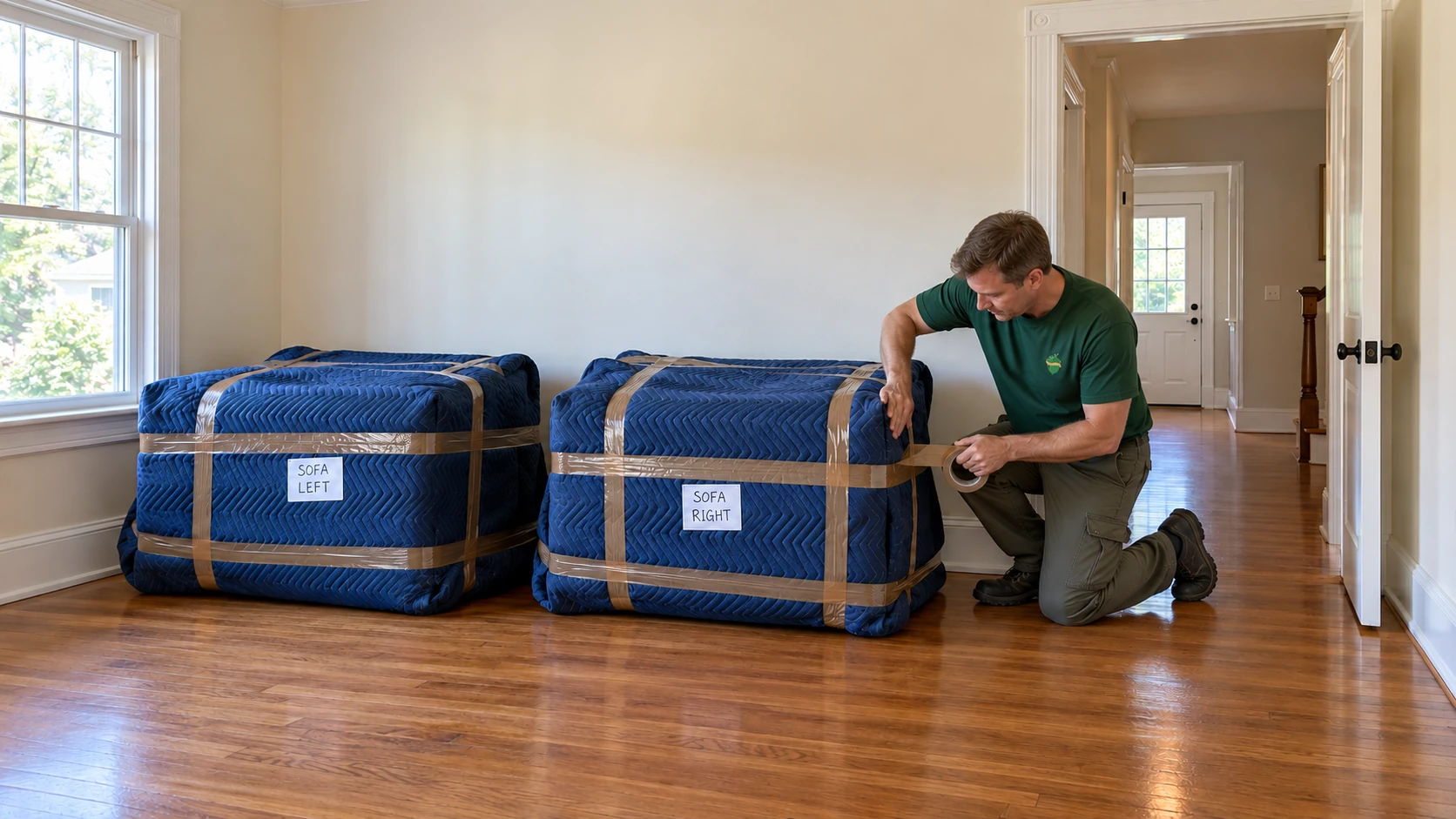
Packing is charged for working time. Company-supplied cartons are charged separately; moving blankets, shrink wrap and tape have no separate material charge. List the packing work in the estimate so that packing time, cartons, transportation and any specialist preparation can be understood together.
If you pack your own cartons, use containers appropriate to their contents, cushion and secure fragile pieces, and close each carton before moving day. Mark the destination room and useful contents without exposing sensitive information. Avoid making book cartons too heavy to handle safely. Show unusually heavy, fragile or valuable contents in advance rather than relying on the outside label to communicate the whole task.
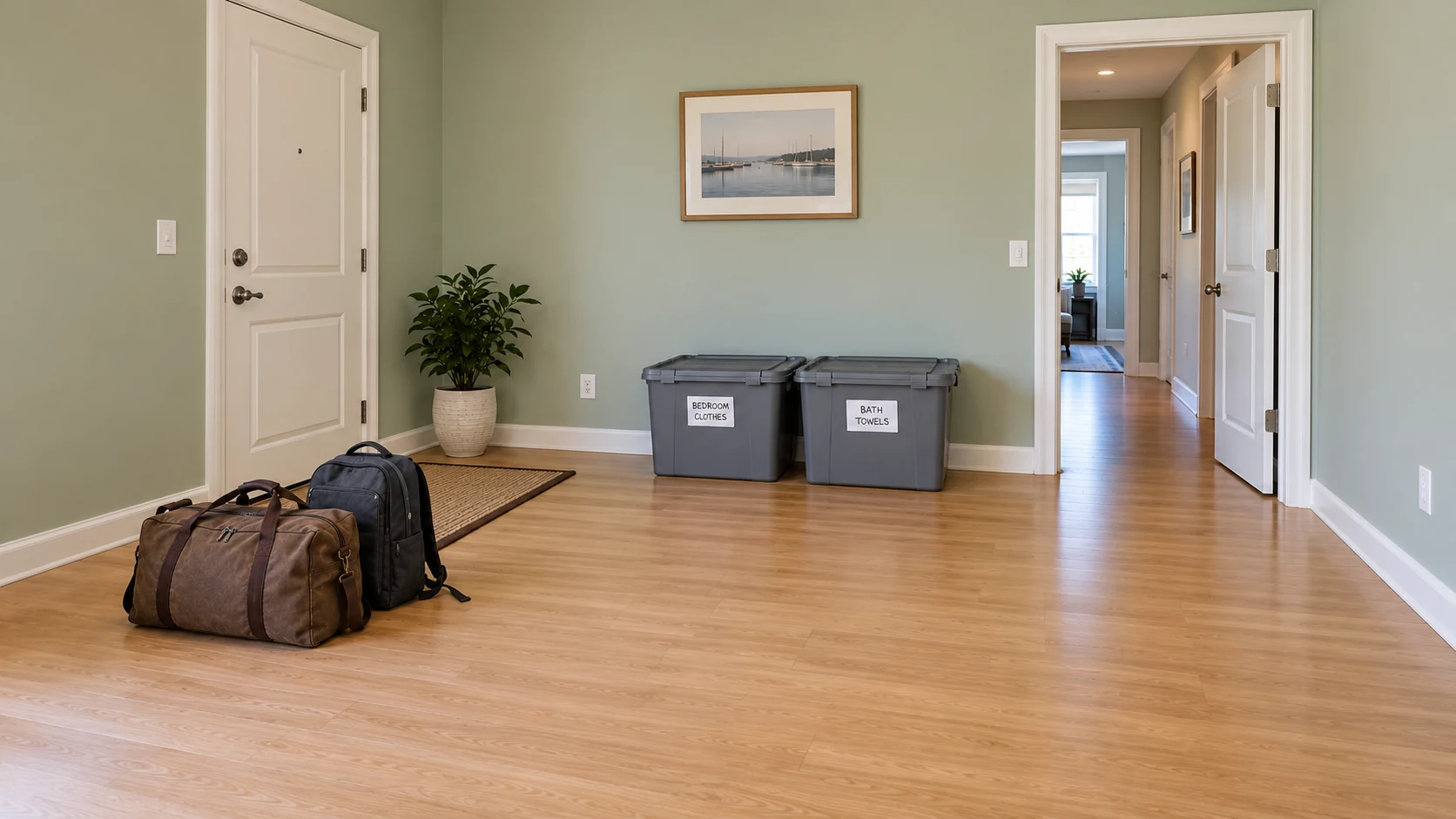
Separate items you will carry personally. Keep identity and travel documents, keys, necessary medicine, chargers and the first night's clothing accessible. Prepare children and pets to travel with you rather than arranging their needs around an unconfirmed truck arrival. Identify potentially hazardous contents, such as fuels and chemicals, before adding them to the shipment; do not hide them inside ordinary household cartons.
Example: Quincy to Orlando, Florida — bridge the gap between homes
Suppose your Quincy lease ends before you can take possession of the Orlando home. Decide where you will stay and what you need during the gap before choosing transportation. The first task is to distinguish a housing gap from a flexible furniture-receiving window: you may have somewhere to sleep while the delivery address is still unavailable.
For the illustrative reference route, direct delivery is a 2–3 day planning range after pickup and loading. A suitable small consolidated shipment can have an agreed window of up to 60 days. Neither option means a truck will wait until a delayed closing finishes. Discuss storage, handling and later delivery as separate agreed work if the shipment cannot be received.
Keep a compact personal supply for the interval: documents, work equipment you need daily, clothes and necessary medication. Confirm who can accept the shipment, how the receiving property is accessed and whether the planned room is usable. Compare the complete written arrangements, including any storage stages, rather than assuming that one delivery label includes them for free.
Keep a small shipment distinct and ready for pickup
Consolidation works best as a deliberate shipment choice. List the actual furniture and containers, show their dimensions and separate anything that will travel with you or remain behind. The approximate small-shipment volume guidance is not an instruction to remove necessary belongings or a guarantee that any load below it qualifies.
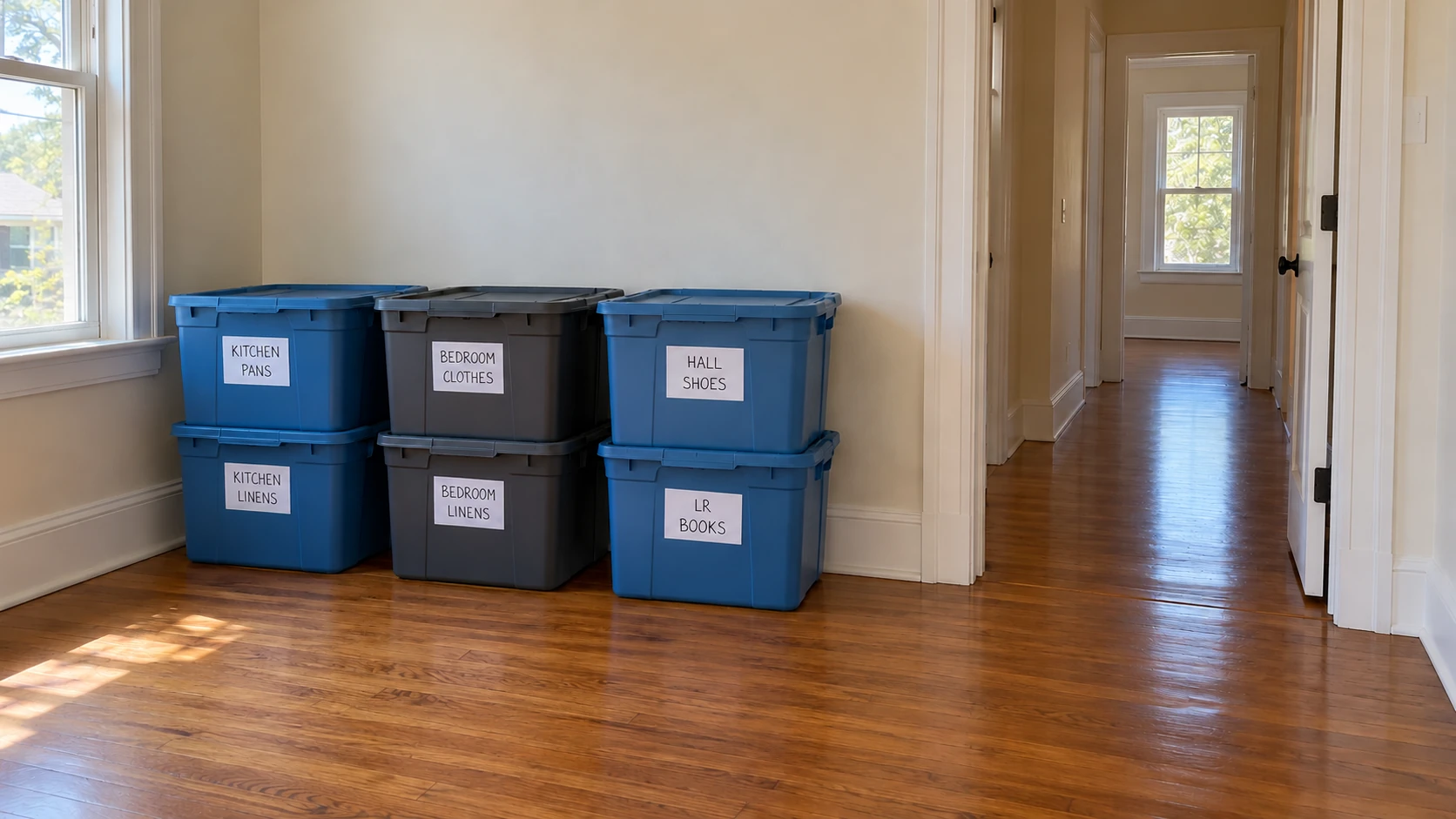
Room and contents labels help at both ends. Photograph the selected group before pickup and reconcile it with the shipment inventory. A few visible containers illustrate the grouping process; they do not establish the total volume of a household. Keep the personal travel group away from the items intended for loading.
Ask how you will arrange receiving within the agreed period and what notice and contact method will be used for your particular move. Do not assume live vehicle tracking or the direct-service crew arrangement applies to consolidation. If your new building allows only a very narrow appointment, resolve that conflict before choosing a wide delivery window.
Example: Quincy to Kingston, Ontario — prepare the importer's list
Suppose you are moving a selected household shipment to Kingston while carrying your first-week essentials yourself. A short-looking route does not remove the Canadian import steps. Establish your applicable entry category and keep the shipment inventory consistent with your customs list.
For people covered by CBSA's moving-or-returning guidance, prepare two copies of the belongings list, with values and identifying details where applicable. Separate accompanying goods from goods to follow and present the list at the first entry. Retain the completed BSF186 record for the later shipment. Eligibility and restricted items depend on the circumstances; a mover's inventory alone does not grant duty-free admission.
The reference direct range is 1–2 days after loading, subject to the actual route, customs readiness and receiving plan. A suitable consolidated shipment to Canada has an agreed window of up to 60 days. That Canadian window still applies when the road distance is relatively short. Carry the necessary records yourself and arrange any required importer participation before the goods are dispatched.
Read the written price and protection together
The agreed long-distance flat rate stays the same for the same shipment, access and services, even if travel or delivery takes longer. Adding furniture, packing or another stop changes the proposed work and needs a separately agreed written scope and price. Tell us about changes before loading so they can be reviewed while you still have meaningful choices.
Compare what each estimate includes: the actual inventory, preparation, carrying access at both ends, transportation, receiving work, cartons, valuation choice and any storage or special operation. A flat-rate description is not a substitute for the terms of the written estimate. For interstate work, check whether the document is binding or non-binding and which shipment and services it covers. Keep the bill of lading, the transportation contract and receipt, with your moving records.
For U.S. interstate household moves, valuation describes the carrier's liability. Compare Full Value Protection with Released Value before choosing. Released Value requires a written selection and limits responsibility to 60 cents per pound per article, rather than replacement cost. Read the written costs, deductibles and high-value declaration requirements.
At delivery, compare the items with the inventory and promptly record missing items or damage. Keep photographs and documents. Understand any release-of-liability language before signing. FMCSA's interstate guidance gives nine months after delivery to file a written loss or damage claim. State-only moves have their own rules.
If a move stays within Massachusetts, the DPU's intrastate household-goods guidance applies to tariff charges and the bill of lading. The general interstate flat-rate description on this page does not override those requirements.
Example: Quincy to Sacramento, California — plan the first usable room
Suppose you are moving a family household to Sacramento and can stay with relatives while the new home is prepared. Direct service offers the dedicated truck and same crew arrangement; the illustrative reference range is 5–6 days after loading. If a suitable small shipment and flexible receiving plan fit instead, California consolidation can have an agreed window of up to 90 days. That window is specific to California and must not be copied to every western destination.
Choose the first rooms you want usable and send a simple placement plan. Confirm the vehicle approach, doorway and turns before assuming that a large sofa, cabinet or bed will reach its intended room. Decide which furniture should be assembled and which carton contents you want unpacked. Furniture unwrapping is part of delivery; optional box unpacking is charged for working time, and packaging-waste removal is separate work.

Arrange a recipient who can identify the rooms and answer placement questions. Keep essential personal belongings with you through the agreed delivery period. If the home is still unavailable, review the alternative receiving or storage arrangements and their costs before the shipment reaches a closed door. A flexible personal stay helps only when there is also a workable plan for the goods.
Choose dates with a workable fallback
Start with the dates that are firm: the old property's handover, the new property's possession, travel and any school or work commitments. Then identify what can move. A middle-of-month date can be useful if it fits both leases; it is not a promise of lower prices or available company capacity. The same applies to summer and school-holiday preferences.
Before a winter Quincy pickup, agree who clears and treats the private steps and carrying route. If a City snow emergency is declared, check its actual parking instructions for the chosen date and address. Leave time to resolve a blocked loading position or unavailable elevator without treating an unsafe route as the only option. Planned roadwork information can help preparation, but it may not show an emergency change.
Keep two contacts available: the person releasing the Quincy property and the person receiving at the destination. Give both the shipment plan, agreed work and relevant building instructions. If a key, closing or reservation changes, communicate it before the next stage begins. The useful fallback is a specific authorized person, receiving option or separately arranged storage stage, rather than an expectation that the truck can solve the housing delay.
Explore long-distance destinations from Quincy
These destination examples organize household moves from Quincy to the United States and Canada. They are a planning directory, not a popularity ranking or a list of reserved routes. Review the shipment, both addresses, commercial vehicle access and receiving dates before choosing a delivery model.
Northeast and Mid-Atlantic
- Albany, New York
- Providence, Rhode Island
- Hartford, Connecticut
- New York City, New York
- Pittsburgh, Pennsylvania
Southeast and Florida
- Orlando, Florida
- Tampa, Florida
- Raleigh, North Carolina
- Richmond, Virginia
- Savannah, Georgia
Great Lakes and Midwest
- Chicago, Illinois
- Detroit, Michigan
- Columbus, Ohio
West Coast
- Sacramento, California
- Portland, Oregon
- Seattle, Washington
Mountain West and Southwest
- Denver, Colorado
- Phoenix, Arizona
Canada
- Kingston, Ontario
- Ottawa, Ontario
- Montréal, Quebec
Long-distance moving questions
Should I choose direct or consolidated delivery from Quincy?
Choose direct service when the shipment and receiving plan call for a dedicated truck and the same moving crew at pickup and delivery. Consolidation can suit a smaller shipment when a wider agreed receiving window works. Start with the inventory and the dates each property can actually release or receive the goods; a narrow elevator appointment may be incompatible with a broad delivery period.
When does the delivery window start?
It starts after pickup and loading are complete. Packing and loading happen before that clock starts. Tell us when the old property must be empty and when the new property can receive the shipment so those separate stages can be coordinated.
Can the long-distance price increase if the journey takes longer?
The agreed flat rate stays the same for the same reviewed shipment, access and services, even if travel or delivery takes longer. Additional furniture, another stop or newly requested packing changes the work. Those changes need a separately agreed written scope and price; report them before loading rather than expecting the original inventory to cover them.
Is there a minimum shipment size for consolidation?
The roughly 300–400 cubic foot small-shipment guidance is not a minimum order. Eligibility depends on the actual goods, route and agreed receiving window. Send the inventory and container dimensions so the shipment can be reviewed without guessing its volume from the number of rooms.
How broad are consolidated delivery windows?
A suitable nearby domestic route can have a window of up to 30 days. Florida and Canada can have up to 60 days, and California up to 90. Other distant destinations need their own agreed window. These periods start after pickup and loading; they do not promise a specific arrival day, free storage or the direct-service crew arrangement.
Can a nearby move arrive the same day?
It may be possible for a suitable small direct move when early loading, lawful travel, access and the recipient's availability can all be confirmed. Mileage alone does not establish that arrangement. The table's ordinary ranges are planning examples; confirm the actual schedule before booking an elevator or handing over keys.
Where do you arrange Quincy pickups?
We arrange long-distance pickups in the City of Quincy, Massachusetts, with the shipment, property access and dates agreed. Include the actual stairs and landings of an upper dwelling, a managed apartment's service entrance and elevator reservation, a detached home's driveway or porch, and any separate basement or storage route. North Quincy, Wollaston, Quincy Center and the coastal neighborhoods are local planning contexts, not promises that all properties share the same access. For a nearby address outside the City, send the complete address for review; a Quincy mailing name alone does not establish the loading arrangements.
Does my Quincy resident parking permit reserve a truck space?
No. A household resident permit does not establish a reserved moving-truck position. Identify the actual loading location and road owner, and clarify the applicable instructions. For City-controlled parking questions, the Quincy Parking Division contact is 617-376-1407. Keep driveways, sidewalks, curb ramps and travel lanes clear.
What should I send for a Quincy apartment with stairs or an elevator?
Send the inventory and photographs or video showing the full carrying route: loading position, building entrance, each stair turn or elevator opening, corridors and final doorway. Include written building move hours, the elevator reservation and any insurance-document requirements. Identify who can open the service entrance; a reservation is useful only when the actual route and recipient are available.
Can the truck follow my car's route near the Quincy shore?
A car route does not establish commercial vehicle access. Check the road owner and the actual vehicle route. DCR has a road-access and moving-permit process for areas it manages; that procedure does not apply to every Quincy street or guarantee approval for the proposed route.
Are packing and cartons included in one standard price?
Packing is charged for working time, while company-supplied cartons are charged separately. Moving blankets, shrink wrap and tape carry no separate material charge. Have the estimate identify the requested packing, cartons and any special preparation so the agreed long-distance scope is clear.
Will you disassemble and reassemble ordinary furniture?
Basic furniture disassembly and assembly are available using moving labor time without a separate basic assembly surcharge. Show the construction and access in advance. Complex, unusually heavy, fragile or specialist work needs its own review and quotation; the basic furniture terms do not automatically cover every operation.
What should travel with me instead of in the shipment?
Keep identity and travel documents, keys, necessary medication, chargers and the clothing and work items you need during the agreed receiving period. Separate that personal group from the shipment before loading. For Canada, carry the relevant import records yourself and arrange any required importer participation.
What paperwork matters for a move from Quincy to Canada?
For people covered by CBSA's moving-or-returning guidance, prepare two copies of the belongings list, separating accompanying goods from goods to follow. Declare it at the first entry and keep the completed BSF186 record for the later shipment. The applicable entry category, eligibility and restricted goods still need review; the mover's inventory alone does not establish duty-free admission.
Does a Canadian destination nearby use the 30-day domestic window?
No. Canada's consolidated window can be up to 60 days even when its road distance is relatively short. The border and receiving arrangements remain separate from the driving distance. Direct delivery has a route-specific plan subject to customs readiness and the recipient's availability.
What if I cannot receive the shipment because the closing is delayed?
Contact the move-planning team as soon as the receiving date changes. Review a workable alternative address or storage and later-delivery arrangement before the truck reaches an unavailable property. Storage, handling and later delivery must have their own agreed scope and charges; they are not automatically free parts of consolidation.
What is the difference between a binding and non-binding interstate estimate?
A binding estimate covers the described shipment and services at its stated price. A non-binding estimate is a forecast; final charges depend on actual shipment weight, services and the applicable tariff. Read the document's type and scope instead of relying on the words flat rate alone, and keep the estimate and bill of lading.
Does valuation mean every item is covered at replacement cost?
No. Full Value Protection provides repair, replacement or a cash settlement under its terms. Released Value instead limits responsibility to 60 cents per pound per article. Check the written costs, deductibles and high-value declaration requirements before choosing.
What should I do if an item arrives damaged or is missing?
Record loss or damage promptly, keep photographs and documents, and make a written claim through the carrier. FMCSA's interstate period is nine months after delivery; state-only rules differ.
Are box unpacking and packing-waste removal part of furniture delivery?
Furniture unwrapping is part of delivery. Removing contents from cartons is optional unpacking work charged for working time, and packaging-waste removal is charged separately. List the work you want at the receiving home so the crew and the written scope agree.
Do the California delivery windows apply to Seattle or another western city?
No. California's consolidated window can be up to 90 days; it is not a default for every western destination. Another distant route needs its own agreed window. Compare the actual destination, shipment and receiving plan before choosing between direct and consolidated delivery.
Does this flat-rate description apply to a move that stays in Massachusetts?
A move staying within Massachusetts needs the applicable DPU intrastate tariff and bill-of-lading requirements. The interstate flat-rate explanation does not override them. Identify both addresses first so the written estimate uses the correct route and regulatory framework.
How do I prepare the estimate request?
Send both complete addresses, the inventory, access photographs or video, requested packing and specialist work, and the dates that are firm. Include building move hours, elevator arrangements, separate storage and who can release and receive the property. Item lists, video review or an in-person survey may be used to clarify the work; square footage alone is not a fixed-price quotation.
Sources for the move decisions
- Quincy Parking Division: operations and contact supports the local parking contact; the particular loading position still needs its applicable instructions.
- Massachusetts DCR road-access and moving permits describes the procedure for DCR-managed access, not every street in Quincy.
- Moving within Massachusetts explains the intrastate tariff and bill-of-lading framework.
- FMCSA moving glossary explains estimates and transportation documents; liability and protection addresses interstate valuation and written claims.
- CBSA: moving or returning to Canada explains the applicable personal-effects lists and goods-to-follow process. Customs eligibility is specific to the importer.
The delivery examples use municipal reference points in Quincy and the four named destination cities, checked October 20, 2026, rather than home addresses. An address-specific truck route, customs clearance and a receiving appointment require their own review. Confirm the written arrangements for your actual move before making commitments based on a delivery example.