
Massachusetts · Somerville service planning
Long Distance Movers in Somerville, MA
Move from Somerville to a new home in the United States or Canada with a plan for the shipment and the people receiving it. Our direct service uses a dedicated truck and the same moving crew at pickup and delivery. Consolidated delivery can suit a smaller shipment with a wider agreed arrival window. We review both addresses, the inventory, packing and dates before agreeing the long-distance flat rate.

Start with the dates that each home can support
The first decision is whether the receiving home can accept the shipment when it arrives. A closing, lease start or flight establishes one part of your schedule. Keys, a reserved service elevator, an available loading position and a person who can open the home establish the delivery appointment. List those separately before choosing direct or consolidated service.
For the Somerville departure, write down the last day you can use the home, when packing can happen and whether the building restricts moving hours. At the destination, separate the earliest receiving date from any day you cannot receive. Tell us which arrangements are already confirmed and which are still provisional. A plan with two firm property deadlines may need different preparation from a small shipment going to a home that is available for several weeks.
Send a room-by-room inventory, including the attic, basement, porch, storage cage and anything at a separate address. Photos should show furniture as well as the route out: doorways, stair turns, landings and the distance from the entrance to the proposed truck position. Identify things that stay so they are excluded from both the shipment and the packing work.
For context on older shared homes, converted dwellings and managed apartments, the Somerville moving page covers local carrying access, while the relocation guide covers choosing a home and setting up everyday life. The pickup details below explain what to show for your particular property.
We arrange long-distance pickups in the City of Somerville, Massachusetts, with the shipment, access and dates agreed. Describe any shared stair and internal apartment level, a managed building's service entrance and elevator, and the route between the truck and the home. Davis, Union Square, East Somerville and Assembly are local planning contexts, not claims that every property has the same access. Include a separate basement or storage stop explicitly. For an address outside Somerville, send the full municipality and address for review; the mailing name alone does not establish truck permission or building access.
Choose direct or consolidated delivery
Direct service keeps the shipment on a dedicated truck, with the same moving crew at pickup and delivery. It is the practical starting point when you need that continuity or the shipment and receiving arrangements call for a direct journey. Give the planning team both properties' restrictions early. The people preparing your estimate have a separate role from the crew performing the move.
Consolidated delivery combines a suitable smaller shipment with a wider agreed receiving period. Approximately 300–400 cubic feet is guidance for the kind of small shipment to discuss, not a minimum shipment size or an automatic eligibility cutoff. An inventory review establishes what you have; a calendar review establishes whether the model will work for you. A household that can receive on only one afternoon should not choose a broad delivery period on the assumption that an exact afternoon can be selected later.
The two models have separate delivery terms. Dedicated truck and same crew are features of direct service; they are not promises for consolidated service. Consolidated service does not by itself promise free storage or a discount. Compare the actual written scope and receiving period, including any storage stage, rather than assuming that one label always means a lower total.
Delivery windows start after pickup and loading are complete. Packing days and a later storage release are separate stages that need their own dates. A suitable small nearby direct move may allow a specially reviewed same-day or next-day arrangement, but mileage alone does not establish one. Loading completion, lawful truck travel and a usable receiving slot must all fit.
Keep the written price tied to the agreed work
For a long-distance move quoted at a flat rate, the agreed shipment and service scope determine the price. The road journey or delivery taking longer does not by itself raise that agreed price. Added furniture, omitted inventory, extra packing or changed access can change the work; resolve known changes and any revised interstate written estimate before loading. The original estimate cannot be rewritten after loading begins; later additional services need their applicable agreement and charges before they are performed.
A useful estimate identifies what will travel, what the crew will pack, what you will pack, the pickup and delivery conditions and any separate storage or extra stop. Include a second basement entrance, a long carry, a building's service-lift requirement and furniture needing specialist handling in the initial review. A photograph of a furnished room is useful, but it may not show the contents of cupboards or everything stored elsewhere.
Separate the shipping model from the legal and pricing rules for the route. A move entirely within Massachusetts follows the applicable DPU tariff and moving-document requirements; the state guide explains that an estimate is not a fixed total. Do not treat the interstate flat-rate discussion as a replacement for those intrastate rules. For a move across state lines, obtain the required written estimate and complete the required survey unless you make the proper separate written survey waiver before loading. Retain that waiver with the bill of lading; waiving the survey does not waive the written estimate. Review the inventory, transportation documents and protection choice for that shipment.
Choose the requested work before comparing totals. Packing labor, cartons, optional box unpacking, removal, complex furniture work and storage should be identified where they apply. Two figures are not directly comparable if one includes crew packing and the other assumes all cartons will be ready when the truck arrives.
Reserve the Somerville loading position in time
A moving permit and a usable place to load solve different problems. The City's moving-van information sheet sets conditions for vans and qualifying unattached containers, including vehicle dimensions, legal spaces, passing clearance and permitted hours. It does not make every street suitable for every truck, and an ordinary resident parking permit does not reserve an empty curb for a moving crew. The sheet requires 12 feet of passing clearance and notes that some streets cannot accommodate oversized trucks. Send the vehicle length and actual curb-to-door route; a guest permit may address basic van parking, but reserving space still needs its own approved arrangement.
For a non-metered reservation, use the City's approved signs and the actual length of curb the vehicle needs. The City 311 guidance calls for buying temporary signs four days before the move, and approved signs must be posted at least 48 hours ahead. The posting policy also covers where signs go and reporting posting and removal to 311. Leave time for that process; arranging the move at the counter does not erase the advance posting requirement.
Metered spaces require their own arrangement. The moving sheet asks for at least 48 business hours' notice, and City staff handle the bags. Paying an ordinary parking meter or making a homemade cover does not replace that approval. The formal June 2026 regulations list a moving-van or container charge of $50 per day, $5 per sign, and separate meter charges of $35 per meter per day plus a $35 bag charge. The application and information sheet use different base-fee wording from that daily schedule. Ask the Parking Department at 617-666-3311 to confirm an itemized total for the vehicle, spaces and dates; do not multiply the form’s wording or add every possible fee to every move.
Moving permissions are generally limited to three days, and the City's moving information lists an 8 a.m.–8 p.m. window. Mail processing can require substantially more notice than an in-person purchase; the moving sheet describes a 15-business-day processing allowance after receipt and payment. Confirm the current collection or delivery method with the department. An existing loading zone is also time-limited: the regulations distinguish an ordinary 30-minute service zone from the 20-minute commercial delivery rule in Davis Square. Neither is a substitute for arranging a multi-hour move.
Keep the building manager's approval separate from the street permission. A permit does not reserve a lift, authorize use of private property or prove that a large item will turn on the stairs. For a declared snow emergency, Somerville's moving guidance prohibits moving-truck and container parking; temporary signs do not override the emergency. Build an alternative date into a winter move rather than treating the resident-car side-of-street rule as truck authorization.
Prepare the furniture and the whole exit route
Show us the furniture's construction before deciding that it will leave the home assembled. A narrow hall may require a different plan from a narrow front door. Include the full stair flight and the space at each turn, not just the opening at the top. A wardrobe or table that fits through one doorway may still be unable to turn onto a landing.
Basic furniture disassembly and reassembly use your moving labor time without a separate basic assembly fee. For a flat-rate move, include that work in the agreed scope. Complex furniture and specialist work receive individual quotes. Long, safely removable legs should be removed and grouped for transport; hardware and components need a clear association with the item. Tell us about wall attachment, unusual fasteners, prior repairs or anything that cannot safely be taken apart.
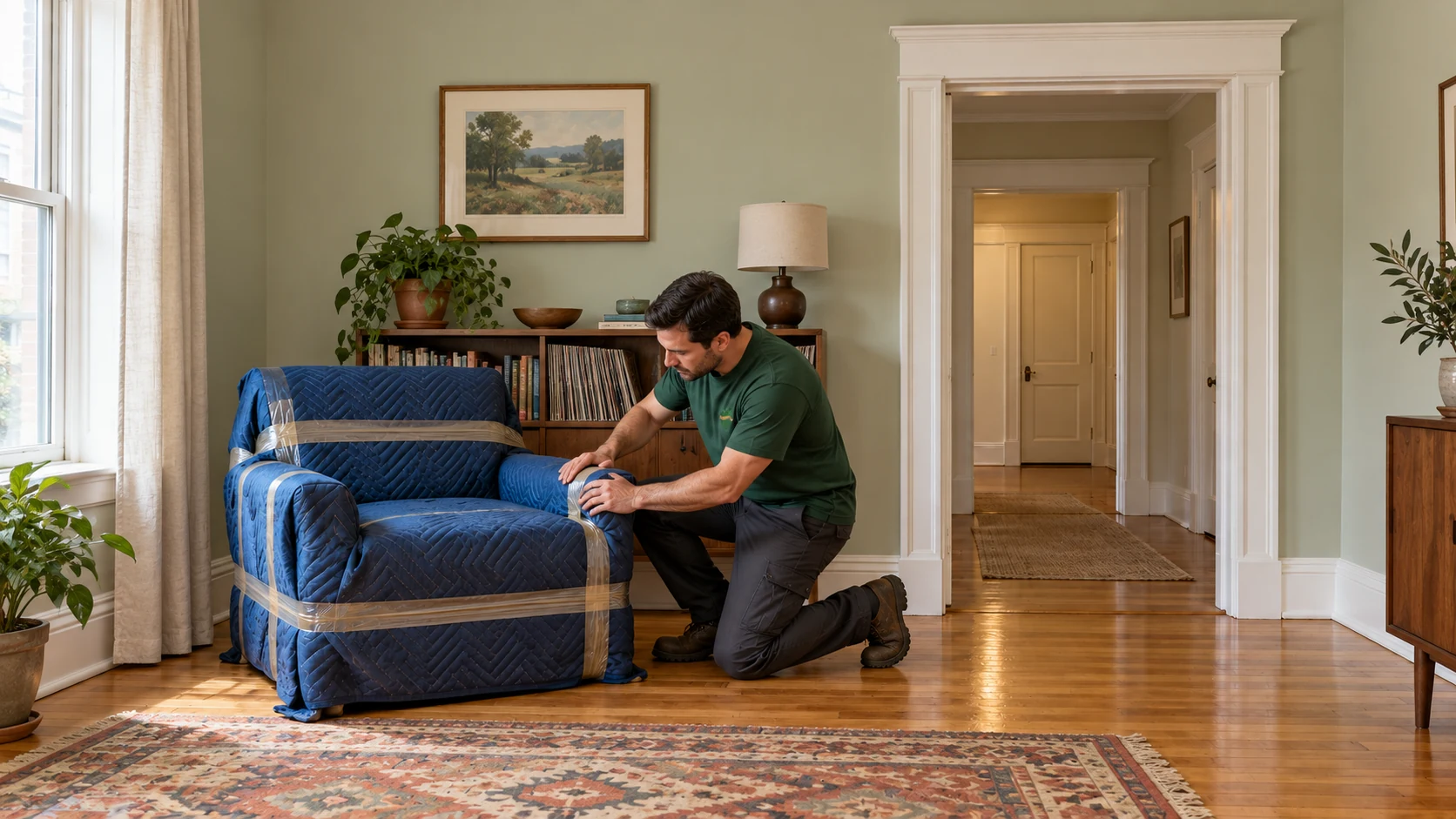
Moving blankets, shrink wrap and tape have no separate material charge; cartons are charged separately. Crew packing and the cartons it requires should be included in the scope you request. If you pack, finish the agreed cartons before loading, identify their rooms and contents, and distinguish fragile or high-value items for the review. Leave the hallway, exit and stairs usable while packing rather than filling the carrying route with finished boxes.
At the destination, identify the room for each large piece before unloading. A final position that blocks a door or prevents access to the remaining rooms is not useful placement. If the new home will need specialist assembly, reconnection or other follow-up work, arrange that responsibility and timing in advance. Crane work is outside our service scope.
Compare four delivery situations
The following examples are planning situations, not accounts of completed customer moves. They use city reference points to make the differences easier to compare. The road distances are public driving references checked on October 24, 2026; they do not certify a commercial vehicle route or a property's loading access. The exact truck journey, lawful travel schedule, customs readiness and receiving arrangements still need review for the order.
Swipe the table to compare both delivery options.
| Illustrative destination | Direct planning window | Consolidated window |
|---|---|---|
| Baltimore, Maryland | 1–2 days | Up to 30 days |
| Tampa, Florida | 2–3 days | Up to 60 days |
| Hamilton, Ontario | 1–2 days | Up to 60 days |
| Portland, Oregon | 5–6 days | Window agreed individually |
The direct ranges include planning allowance and start after pickup and loading finish. They are not delivery appointments. Consolidated maximum windows are different: a suitable nearby domestic route can be up to 30 days, Florida and Canada up to 60, and California up to 90. Other long routes need an individually agreed window. Canada keeps its Canadian window even when the reference distance is relatively short.
Example: Somerville to Baltimore, Maryland
Consider a household leaving an upper-floor Somerville apartment for a Baltimore home with furniture going to more than one level. The reference journey is about 399 road miles, with an illustrative direct window of 1–2 days after loading. The useful starting question is whether the receiving home and recipient can support that period, not whether an ordinary car journey could be completed in one sitting.
At pickup, show the common stair, any internal apartment stair and the curb-to-door route. At delivery, include the entrance steps and any basement turn for a sofa, cabinet or exercise equipment. A piece intended for the lower level should be assessed against that route before it is included in an agreed room-placement plan. Send the receiving property's street or building requirements as well as the Somerville permit arrangement.
Direct service keeps the truck and crew continuous. For a suitable small shipment, consolidation may instead allow up to 30 days after loading, provided the agreed receiving plan supports that period. If you must hand back Somerville keys on Friday but can receive only on Saturday afternoon, state both restrictions at the outset. Do not rely on the reference range to create an unconfirmed appointment.
Example: Somerville to Tampa, Florida
Suppose the destination is a managed Tampa apartment whose service elevator must be reserved. The reference journey is about 1,345 road miles and the illustrative direct window is 2–3 days after loading. Ask the building about its moving procedure before fixing travel around a delivery day. The elevator booking, loading entrance and person authorized to sign for the shipment need to work together.
A broad receiving window can be useful for a small shipment, but Florida consolidated delivery can be up to 60 days after loading. A one-day lift reservation cannot cover that entire period. Choose the model and agree how the actual building appointment will be arranged before committing to an arrival schedule. Do not assume storage is free if the home or lift is unavailable.
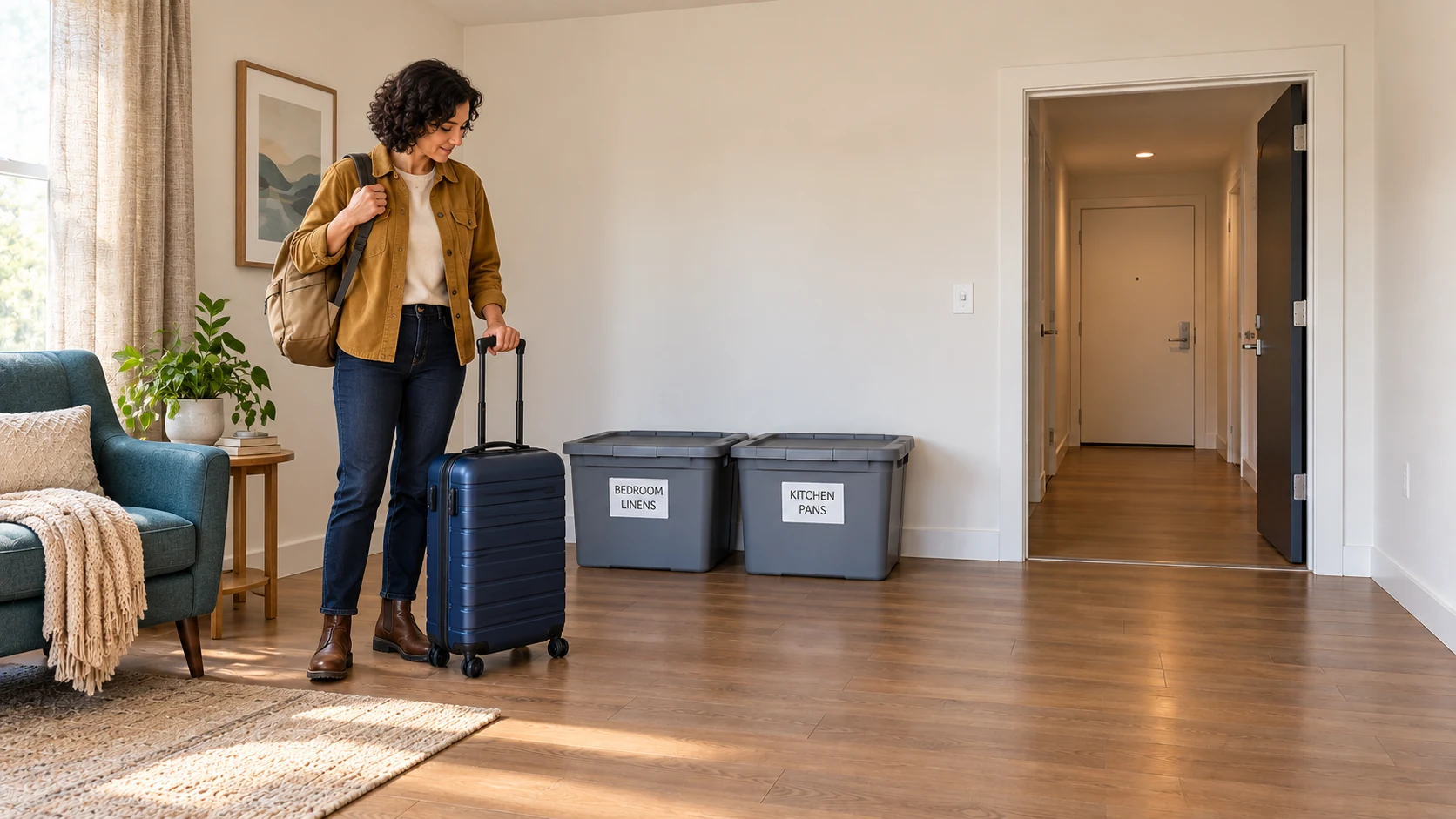
Travel with the things you will need before the household goods arrive: personal documents, regular medication, chargers, clothing and the items needed for children or pets. Keep those bags apart from the shipment during packing and final walkthrough. Decide whether the receiving home needs a separate first-night setup; furniture delivery, box unpacking and a household being ready for ordinary use are different stages.
Example: Somerville to Hamilton, Ontario
Consider a small apartment shipment to Hamilton whose owner will enter Canada before the goods. The reference road journey is about 515 miles; the illustrative direct range is 1–2 days after loading, subject to the border and receiving arrangements. Canadian consolidated delivery can be up to 60 days. The shorter distance does not turn it into the 30-day domestic category.
Prepare the customs information before pickup. CBSA's moving or returning guidance asks eligible settlers and returning residents for two copies of a personal-effects list, including values and identifying details where applicable. Separate goods accompanying you from goods to follow. Present the list at your first point of entry, even if none of the household shipment arrives with you, and retain the completed BSF186 receipt for the later goods.
Your mover's inventory helps identify the shipment, but it does not by itself establish duty-free entitlement or immigration eligibility. Entry category, ownership, possession and use requirements matter; restricted goods require their own review. Identify used mattresses, food, plants, firearms or other potentially restricted items before they are packed, using CBSA's actual rules for the item. Arrange the recipient, keys and access at the Hamilton property as carefully as the border paperwork. A customs delay is not a reason to leave the receiving plan unresolved.

Example: Somerville to Portland, Oregon
A household moving to Portland, Oregon, may need to coordinate a long journey with a closing and an unfinished receiving home. The reference journey is about 3,099 road miles and the illustrative direct range is 5–6 days after loading. This is Portland in Oregon, not Portland in Maine. A closing date that slips beyond the receiving period calls for a revised plan, rather than an assumption that a loaded vehicle can wait at no cost.
With direct service, the dedicated truck and same crew carry the shipment through to delivery. Before departure, agree who can authorize access if you travel separately and what happens if keys or essential building work are delayed. Any storage, later release and second delivery stage should have its scope and price in writing.
For a suitable consolidated shipment to Oregon, the delivery window is agreed individually. California's up-to-90-day category does not apply automatically to Oregon or other western states. Compare that particular receiving window with your temporary living arrangements and the belongings you can do without. If a table or bed will need reassembly, identify its construction, hardware and final room so the arrival plan includes usable placement rather than only an unloaded inventory.
Receive, inspect and set up the rooms
Give the receiving contact the room plan, shipment inventory and access instructions. That person should be able to identify where large furniture belongs and point out any condition issue as items arrive. Keep access to the remaining rooms open while unloading. Labeled cartons can go to their assigned rooms without filling the entrance or blocking furniture that still needs to pass.
Furniture is unwrapped as part of delivery. Box unpacking is optional work charged for time, and packaging or waste removal is charged separately. Tell us whether you want contents unpacked, cartons left for you, or an agreed removal stage. Do not assume that every container will be emptied or every piece of packaging taken away as part of transportation alone.
Review the inventory and delivery documents before the crew leaves. Note visible concerns, keep photographs and retain the paperwork. For interstate household goods, FMCSA describes a nine-month period after delivery for a written loss or damage claim; report concerns promptly instead of treating that deadline as a reason to wait. Read a delivery receipt carefully, especially language that would release the mover from liability. Your particular documents and the route's rules determine the applicable process.
Choose protection before pickup
For a US interstate household-goods move, Full Value Protection applies unless you choose Released Value through the required specific written statement. Under Full Value Protection, the mover is responsible for the replacement value of lost or damaged goods under the plan's terms. Released Value limits liability to 60 cents per pound per article, rather than the item's purchase or replacement price. A lightweight valuable object can therefore have very limited protection under that option. Have the selected level, cost, limits and claims process recorded before the move.
Valuation is the mover's level of liability; it is different from a separate insurance policy. Full Value Protection can also have written terms and limits for articles of extraordinary value. Identify artwork, jewelry and other high-value belongings in advance and request the actual written explanation. Do not assume that the general phrase “insured move” answers those questions or that the same rules apply to an intrastate or Canadian move.
Read the estimate and transportation contract along with the inventory and any storage instructions. Keep your copies available throughout pickup, travel and delivery. Tell us about changes in writing so the receiving team is working from the same shipment and room plan that you agreed.
Explore long-distance destinations from Somerville
These examples organize household destinations in the United States and Canada. They are a planning directory, not a popularity ranking or a list of reserved routes. Choose the shipment and receiving model against both properties and the actual commercial vehicle journey.
Northeast and Mid-Atlantic
- Baltimore, Maryland
- New Haven, Connecticut
- Philadelphia, Pennsylvania
- Buffalo, New York
Southeast and Florida
- Tampa, Florida
- Jacksonville, Florida
- Norfolk, Virginia
- Wilmington, North Carolina
- Atlanta, Georgia
Great Lakes and Midwest
- Milwaukee, Wisconsin
- Minneapolis, Minnesota
- Cleveland, Ohio
West Coast
- Portland, Oregon
- San Diego, California
- Seattle, Washington
Mountain West
- Boise, Idaho
- Salt Lake City, Utah
Canada
- Hamilton, Ontario
- Quebec City, Quebec
- London, Ontario
- Ottawa, Ontario
Start your request with the full pickup and delivery addresses, a room-by-room inventory, access photos, the dates that are fixed and the work you want us to perform. Include special-value items, packing help, extra stops and any gap between homes. We can then compare direct or consolidated delivery against the actual shipment and prepare the written estimate for that scope.
For related work, see packing and unpacking, moving and storage and the long-distance service overview.
Sources for access, documents and cross-border preparation
- Somerville moving-van and container information: vehicle, notice, timing and processing conditions.
- Somerville permit application and sign-posting policy and June 2026 Traffic Commission regulations: applicable signs, meters, charges and loading-zone rules.
- Somerville 311 temporary-sign guidance and snow-emergency information: advance sign purchase and emergency restrictions.
- Massachusetts DPU moving guide: estimates, tariffs and documents for moves wholly within Massachusetts.
- FMCSA liability and protection: interstate valuation options and claims guidance.
- CBSA moving or returning to Canada: personal-effects lists, goods to follow and import qualifications.
Long-distance moving questions
Should I choose direct or consolidated delivery from Somerville?
Choose direct when the shipment and receiving plan call for a dedicated truck and the same moving crew at pickup and delivery. Consolidation can suit a smaller shipment when you can receive within a wider agreed period. Compare the actual inventory and both properties' dates: a one-afternoon elevator appointment may be incompatible with a broad delivery window.
Does the same crew deliver my belongings?
The same moving crew handles pickup and delivery with our direct service, using a dedicated truck. That is not a promise for consolidated delivery. The team preparing the estimate has a separate role from the moving crew.
Is 300–400 cubic feet a minimum for consolidated moving?
No. It is approximate guidance for the kind of small shipment to discuss, not a minimum or an automatic eligibility limit. Send the actual furniture and carton inventory and your receiving availability so the shipment and delivery model can be reviewed together.
When does the delivery window start?
It starts after pickup and loading are complete. Advance packing and any separate storage stage need their own dates. The illustrative table is a planning reference rather than a confirmed appointment; the order needs an agreed receiving plan for the actual truck journey and property access.
Can you guarantee same-day delivery to a nearby destination?
A suitable small nearby direct move may allow a separately reviewed same-day arrangement, but it cannot be inferred from mileage. Loading must finish early enough for lawful truck travel and an available receiving slot. Give us both properties' restrictions before relying on a same-day or next-day plan.
Will a slower journey increase the agreed flat rate?
The journey or delivery taking longer does not by itself increase the agreed long-distance flat rate for the same shipment and service scope. Added belongings, extra packing or changed access and delivery requirements can change the work. Resolve known changes and any revised interstate written estimate before loading. The original estimate cannot be rewritten after loading begins; later additional services need their applicable agreement and charges before they are performed.
What information do you need for a written estimate?
Send both full addresses, a room-by-room inventory, access photos, fixed dates and the work you want. Include attic or basement contents, separate storage, extra stops, high-value items and who will pack. Show stairs, turns, entrances and the proposed truck position; a room's square footage alone does not describe the shipment or carrying route. For an interstate household shipment, obtain the required written estimate and complete the required survey or proper separate written survey waiver before loading. Retain the waiver with the bill of lading; it does not waive the written estimate.
Does a Somerville resident permit reserve parking for the moving truck?
No. A resident permit does not reserve an empty loading position. Somerville has specific conditions for moving vans and containers, approved temporary signs and separate meter arrangements. Have the Parking Department review the actual vehicle length, location and dates, and keep the building's private access approval separate.
How early should I arrange Somerville moving signs?
The City 311 guidance calls for purchasing temporary signs four days before the move, and approved signs must be posted at least 48 hours ahead. The posting policy also covers sign placement and reporting to 311. Metered spaces need at least 48 business hours' notice under the moving information sheet. Mail processing needs more lead time; the sheet describes a 15-business-day processing allowance after receipt and payment.
What are the City's moving-permit and meter charges?
The June 2026 regulations list $50 per day for a moving van or container, $5 per sign, and separate meter charges of $35 per meter per day plus a $35 bag charge. The application and information sheet use different base-fee wording from the daily schedule. Ask the Parking Department at 617-666-3311 to confirm an itemized total for the actual vehicle, spaces and dates. These are City charges, not a moving-company price, and every line does not automatically apply to every reservation.
Can an existing loading zone cover the whole move?
Do not rely on it for a multi-hour move. The Somerville regulations distinguish an ordinary 30-minute service zone from the 20-minute commercial delivery rule in Davis Square. Arrange the loading position that the actual move needs rather than treating a short delivery zone as a moving reservation.
Can a winter move proceed under temporary signs during a snow emergency?
Somerville's moving guidance prohibits moving-truck and container parking during a declared snow emergency, and temporary signs do not override that restriction. Agree an alternative date or plan if an emergency affects the move. The resident-car side-of-street rule does not authorize a moving truck.
What should I show for an upper-floor Somerville apartment?
Show the common stairs and any internal apartment levels, the full turns and landings, doorways and the route between the entrance and truck. Include large furniture's dimensions and construction. A piece fitting through the front door does not establish that it can turn on the stair, and a street permit does not authorize private building access.
Are packing materials and furniture assembly included?
Moving blankets, shrink wrap and tape have no separate material charge. Cartons are charged separately, and packing labor belongs in the requested scope. Basic furniture disassembly and reassembly use your moving labor time without a separate basic assembly fee. For a flat-rate move, include that work in the agreed scope. Complex furniture and specialist work receive individual quotes; crane work is outside our service scope.
How should I pack if I am doing the cartons myself?
Finish the agreed cartons before loading, identify their rooms and contents, and keep the carrying route clear. Separate the things that stay and the bags traveling with you. Tell us about fragile or high-value items and anything requiring special preparation. Show all cupboards, storage and loose contents in the inventory review so unfinished packing does not become an unplanned moving-day task.
What should travel with me instead of on the truck?
Keep the personal documents, regular medication, chargers, clothing and other immediate essentials you need during travel and the receiving period. Add the items required for children or pets. Put those bags in a clearly separate group during the final walkthrough so they are not loaded with the household shipment.
How long can consolidated delivery to Florida or Canada take?
The agreed consolidated window can be up to 60 days after pickup and loading are complete for Florida or Canada. Canada retains that category even for a shorter reference journey such as Hamilton. Make sure the household can manage and receive throughout the agreed period; an isolated elevator booking is not enough.
Does California's consolidated window apply to Portland, Oregon?
No. California's up-to-90-day consolidated category does not automatically extend to Oregon, Washington or other western states. A suitable consolidated shipment to Portland, Oregon, needs its own agreed receiving window. The direct example in the table is a separate illustrative model, not an Oregon consolidated commitment.
What documents should I prepare for household goods going to Canada?
CBSA's moving or returning guidance asks eligible settlers and returning residents for two copies of a personal-effects list with values and identifying details where applicable, divided into accompanying goods and goods to follow. Present it at your first point of entry even if the shipment comes later, and retain the completed BSF186 receipt. Eligibility, ownership and use conditions and restricted-goods rules still apply; the mover's inventory alone does not establish duty-free entitlement.
What happens if my new home is not ready to receive the shipment?
Arrange the receiving and any storage stages before choosing the delivery model. Identify the earliest receiving date, unavailable dates, keys, recipient and building appointment. If those change, contact the planning team for a revised written arrangement. Do not assume that a loaded truck can wait, that storage is free or that a later delivery stage is included without agreement.
Does delivery include unpacking every box and removing the packaging?
Furniture is unwrapped as part of delivery. Unpacking box contents is optional work charged for time, while packaging and waste removal are charged separately. State whether you want room placement only, contents unpacking or an agreed removal stage so the work is included in the plan.
What protection applies to an interstate household-goods move?
Full Value Protection applies unless you select Released Value through the required specific written statement. Under Full Value Protection, the mover is responsible for the replacement value of lost or damaged goods under the plan's terms. Released Value limits liability to 60 cents per pound per article rather than the item's replacement price. Review the actual cost, limits, high-value declarations and claims process in writing. Valuation is the mover's liability, different from separate insurance, and interstate rules should not be transferred automatically to an intrastate or Canadian move.
What should I do if something arrives damaged?
Note the concern during delivery, take photographs and keep the inventory and moving documents. Report it promptly and follow the written claims procedure. FMCSA describes nine months after delivery for a written loss or damage claim on an interstate household-goods shipment; do not wait simply because that period exists. Read any receipt language about releasing the mover from liability before signing.
Are the four route examples completed Sterling customer moves?
No. They are conditional planning examples using different shipment and receiving situations. The city-to-city driving references help illustrate the two delivery models; they do not certify truck access, promise an appointment or describe a completed job. The actual order needs its own inventory, vehicle route and property review.
Does the same flat-rate rule apply to a move entirely within Massachusetts?
A move wholly within Massachusetts follows the applicable DPU tariff and moving-document rules. The state guide explains that an estimate is not a fixed total; hourly rates, packing and other services determine the final charge under those terms, with travel-time treatment also relevant. Obtain the written estimate and read the bill of lading supplied before loading. Do not substitute the interstate flat-rate discussion for the rules governing that intrastate move.