
New Jersey · Morristown service planning
Long Distance Movers in Morristown, NJ
Sterling Oakbridge plans long-distance household moves from Morristown, New Jersey, throughout the United States and Canada. Choose direct delivery for a dedicated truck and the same crew at pickup and delivery, or consider consolidation for a suitable smaller shipment with a broader agreed receiving window. We review the inventory, both properties and requested services before quoting. Eligible interstate shipments can use an agreed flat rate; the written estimate uses the terms applicable to your actual route.

Connect the Morristown departure with the receiving address
A move is ready when the belongings can leave the first property and enter the second under an agreed plan. A signed lease, a short driving distance or a resident parking permit does not establish that complete sequence. Identify the person who releases the Morristown property, the person who can receive at the destination and the deadline for deciding whether the arrangement can proceed.
Morristown town includes detached homes, small multifamily buildings and larger apartment properties. For an upstairs apartment, follow the route through the common entrance and any turn or transfer. At a house, include the basement, attic and detached garage if their contents are moving. A lower-level door can still lead to exterior steps or a rising path before the truck. Send the whole route, rather than a photograph of the doorway alone.
Use the full street address and municipality. Morristown town, Morris Township and other addresses using a Morristown postal label do not necessarily share the same street authority. Our Morristown moving page covers local access planning; the relocation guide helps with homes, household routines and settling in.
Choose direct or consolidated delivery
Direct delivery assigns a dedicated truck and the same crew at pickup and delivery. It suits a household that needs its shipment planned as one journey, with the receiving arrangement reviewed around that move. The ordinary examples below include travel margin. A same-day or next-day arrangement may be possible for a suitable move, but needs its own accepted loading, travel and receiving sequence.
Consolidated delivery can suit a smaller inventory when the household can accept a broader window. Approximately 300–400 cubic feet is guidance for smaller shipments, not a minimum volume or an automatic eligibility rule. Send the actual pieces, cartons and preparation needs. The direct model’s dedicated-truck and same-crew terms do not automatically apply to consolidation.
For an eligible shorter domestic route, the consolidated maximum can be up to 30 days. Florida and Canada have up to 60 days; California has up to 90. Other distant destinations need an individually agreed window. The Canadian category applies even when that destination is closer than a domestic example. Neither consolidation nor an extended window creates free storage or an assumed discount.
Delivery windows begin after pickup and loading are complete. Packing, the full carrying route, furniture preparation and any wait for usable loading access happen first. The household’s lease deadline and the receiving building’s daily work period need separate attention.
Swipe the table to compare both delivery options.
| Illustrative destination | Direct planning window | Consolidated window |
|---|---|---|
| New York City, New York | 1–2 days | Up to 30 days |
| Raleigh, North Carolina | 1–2 days | Up to 30 days |
| Montreal, Quebec | 1–2 days | Up to 60 days |
| San Diego, California | 4–5 days | Up to 90 days |
These are illustrative delivery windows, not booked appointments or approval of a particular truck route. The road references use general municipal points, not the two properties. Vehicle restrictions, loading locations, border arrangements and receiving access still have to fit the actual shipment.
Keep the written price tied to the agreed work
The agreed long-distance flat rate does not rise simply because driving or delivery takes longer for the same reviewed inventory, access and services. Report additional furniture, another flight of stairs, a different entrance, more packing or requested storage before loading so the required revised estimate can be prepared and agreed before the shipment is loaded. Later changes need the applicable written scope and price before the affected work begins.
Describe what is moving and what stays. Include furniture dimensions, the contents of storage rooms and any items at another stop. Identify who packs each group, which cartons are needed, whether unpacking is requested and what materials should be removed afterward. Packing and optional unpacking or putting contents away are charged for working time; company-supplied cartons separately. Basic moving blankets, shrink wrap and tape have no separate basic-material charge. Furniture unwrapping is part of delivery; packaging and waste removal are charged separately. Basic disassembly and reassembly have no separate basic assembly fee; storage and specialist work need their own agreed scope and quote.
If both addresses are within New Jersey, use the applicable in-state process. The Division of Consumer Affairs requires an on-site or virtual survey, a completed written estimate and the consumer brochure. A list and still photographs can start planning; they do not replace that survey, including for a small household shipment. The state FAQ distinguishes a binding estimate from a probable-cost estimate and describes the Order for Service provided at least 24 hours before the scheduled move. Review the applicable operator, tariff, documents and timetable. For an interstate household shipment, complete the required survey unless you make the proper separate written survey waiver before loading. Keep that waiver with the bill of lading; it does not waive the written estimate.
Example: Morristown to New York City with a narrow receiving period
Suppose an upstairs Morristown household is moving to a New York City apartment. The shipment includes a bookcase, a dining table, a sofa and packed cartons. The destination contact offers one afternoon work period, but the keys will be released by a different person that morning. A relatively short journey does not make those arrangements connect automatically.
First, the Morristown inventory and survey must include the entire shared stair, its turns and the route to the accepted truck position. At the destination, management identifies the receiving entrance, every lift or transfer, the work period and its certificate-of-insurance requirements. If a building operator or other personnel are required, establish who provides and authorizes them and whether their service is separate from the moving scope.
The coordinator can then connect the expected completion of loading with the reviewed journey and the receiving period. The ordinary direct illustration is 1–2 days after loading. A same-day plan needs a separately accepted schedule; it is not a consequence of the destination name or reference distance.
Set a decision time before dispatch and before any alternative slot expires. If the keys or approved entrance are unavailable, choose a confirmed later slot, another reviewed method, or available storage and redelivery with the receiver, dates, access and charges agreed. A message asking management for an exception does not reserve the exception. Resume the affected stage when the property controller confirms access and the coordinator accepts the revised sequence.
Example: a selected Morristown shipment to Raleigh
Suppose a household will live with relatives in Raleigh before its permanent home is ready. It is sending a compact dining set, a chair, a mattress and selected cartons; the rest stays in a separately identified Morristown garage. Consolidation may fit the smaller shipment if the household can accept the agreed receiving window and the relatives can actually receive and hold the selected belongings.
Mark the garage contents that stay before the inventory is finalized. A walkthrough should distinguish them from the cartons that leave. Agree how the mattress and dining set will be protected, whether the table’s construction permits removal of its long legs, and how the matching leg and hardware set will remain identified. Selected packing can be included without treating every room as part of the shipment.
The ordinary Raleigh direct illustration is 1–2 days after completed loading; a suitable shorter domestic consolidated arrangement can have up to 30 days. Neither establishes a particular arrival afternoon. The receiving household needs the dimensions and placement plan, usable access and an authorized person for the actual period.
Decide whether the mattress, work materials or other daily items can be unavailable for that window. If not, revise the shipment model or the interim household plan before accepting consolidation. Accommodation, a borrowed bed or another storage location must be a real arrangement with the responsible person’s agreement, rather than an assumption that an early delivery will solve it.

Example: Morristown to Montreal with goods arriving later
Suppose a household moves to Montreal before its furniture follows. Its Morristown apartment and off-site storage inventory must be combined without losing the distinction between what travels with the household and what the mover transports. The person handling the Canadian entry needs the documents accessible before the shipment leaves.
The Canada Border Services Agency explains the personal-effects process for eligible settlers and former residents. Prepare two copies of the goods list, separating accompanying belongings from goods to follow, with values and identifying details. Account for the goods at the household’s first Canadian entry, even when none accompany you. Keep the resulting personal-effects record available for the later shipment, with later goods on the original goods-to-follow list. Eligibility, ownership conditions and restricted goods need their own review; a Montreal address alone does not establish tax-free entry.
Match that list to the moving inventory. Resolve missing pieces, a change of recipient or an additional pickup before they become conflicting instructions. Tell the coordinator who handles the import process, which documents are ready and who can receive at the Montreal property. Customs readiness and the building’s access period are separate requirements.
The ordinary direct illustration is 1–2 days after completed loading, subject to the actual accepted journey and import arrangements. A suitable Canadian consolidated shipment can have up to 60 days. The short reference distance does not substitute the domestic 30-day maximum. Plan the household’s accommodation, medication, clothing and work needs for the agreed model; do not leave the needed documents inside the moving load.
Prepare furniture for the complete route
Furniture preparation should follow the piece’s construction and the carrying route. Empty ordinary drawers and normally retain them secured in the complete protected piece. Identify removable shelves and matching parts. For safely removable long table or desk legs, protect the body first while keeping joints accessible, turn it upside down onto stable padding and remove the complete matched set. Wrap the removed legs together last and retain matching hardware. Integral supports require an appropriate construction-specific method. Send the largest dimensions and photographs of restrictive turns before deciding the method.
For a completed room-preparation stage, loose books and household belongings should be packed, the rug rolled where it is moving, and the selected furniture properly protected. Keep the path clear for the next movement. Protection is removed when the item is stably placed at the receiving property; a photograph of a wrapped piece does not prove it can negotiate the next stair or fit through the destination door.
Packing, unpacking and furniture work should be listed in the agreed scope. If a particularly valuable, delicate or unusual piece needs specialist handling, identify it during the review. Ordinary household service does not establish a specialist method or a particular insurance cover for every object.

Example: a larger Morristown household move to San Diego
Suppose a detached-home household is sending most of its furniture and cartons to San Diego. The inventory includes an attic room and a detached garage. The receiving home will be accessible only after the household collects the keys, and the driveway has not yet been reviewed for the proposed vehicle. Direct delivery gives this shipment a dedicated truck and the same crew at both ends, with the journey and receiving plan agreed for that load.
Before loading, finish the whole-home inventory, including the upper room, garage and any items that need a separate preparation method. Confirm the route out of each space. A photograph of a broad driveway does not establish permission, turning clearance or a safe loading position for the actual truck. The coordinator needs the proposed approach and carry at both addresses.
The ordinary direct San Diego illustration is 4–5 days after pickup and loading are complete. California’s consolidated maximum is up to 90 days for a suitable shipment under that model. That maximum belongs to California; it is not a rule for every western state. Choose the model around the household’s real need for its belongings and the accepted receiving arrangement.
Set the key handover and receiving decision deadline before dispatch. If the destination cannot accept the planned delivery, confirm an available later period or another authorized method. Before relying on storage, confirm a facility that can actually accept the shipment: capacity, receiving hours, protection, handling, price, payer and onward-delivery date. Arrange accommodation and essentials for people and pets separately. If no destination can accept the load, revise departure. Resume when possession, the authorized receiver and the complete route are ready, with changed work and charges agreed in writing. A longer journey under the unchanged agreed scope does not itself change the flat rate; a newly requested storage or redelivery stage needs its own written agreement.
Make the truck position and building window usable
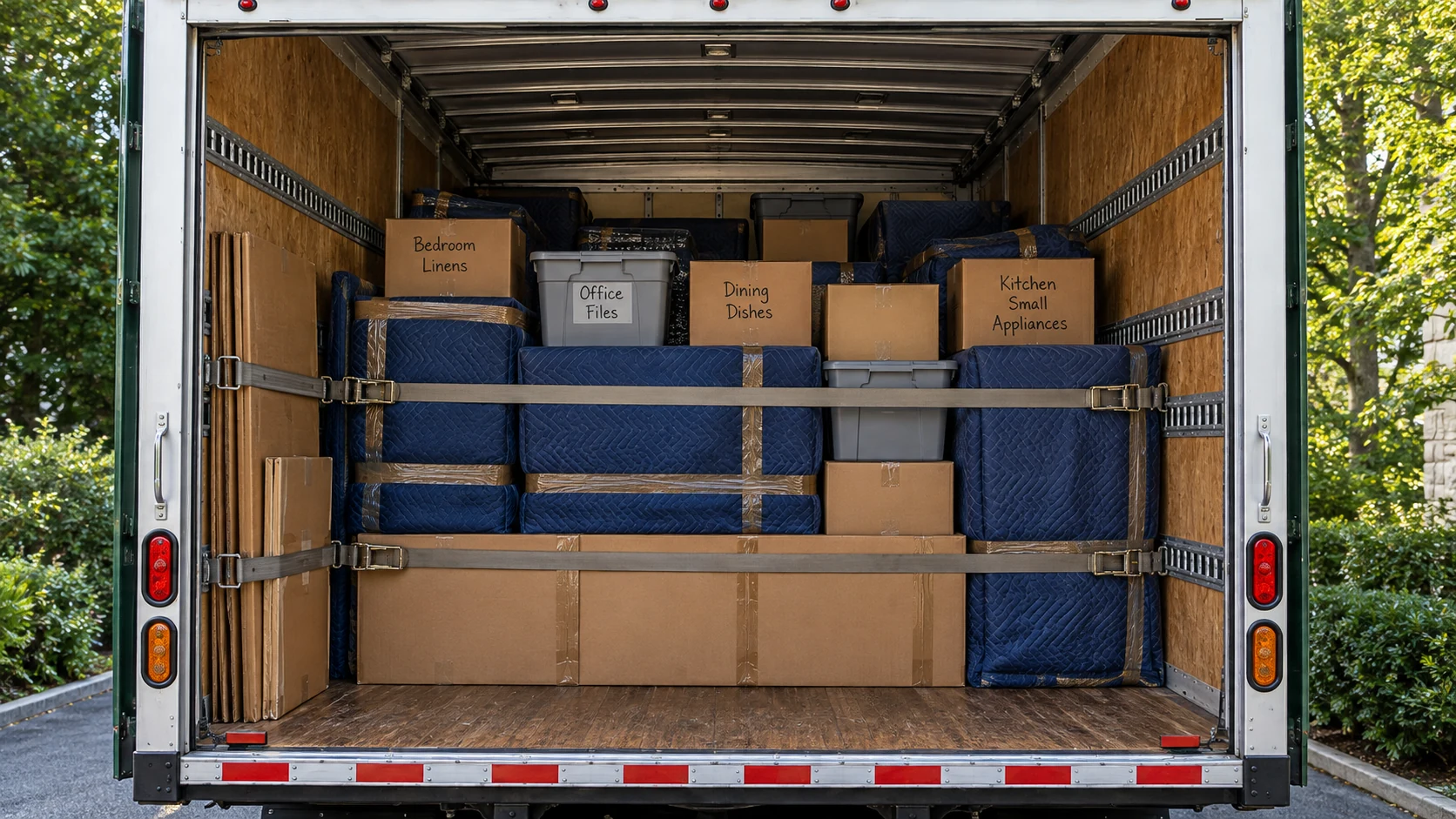
Plan the actual Morristown loading position and duration separately from household parking. The Town’s vehicle code has distinct commercial-vehicle parking, resident-permit, truck-route and weight-restricted-street provisions. Ordinance O21-2026 changes the weight basis for the specified parking provision to manufacturer gross vehicle weight rating. The separate truck-route section uses its own actual gross vehicle weight wording. An empty truck should not be assumed outside the parking category, and a route exception does not reserve the curb.
Section 7-16 includes a general commercial-vehicle two-hour rule during 6 a.m.–9 p.m. and a residential overnight restriction with an active-service exception, including a moving van. The permit-area service/delivery exception in Section 7-17.3 has its own marking and purpose conditions; it does not silently override every other rule. Active moving work is different from leaving a truck unattended overnight. Review the actual vehicle, location, date and complete work period with the relevant authority and coordinator.
At an apartment property, connect the accepted truck position to the approved entrance, every lift or transfer and the final room. Management supplies the COI wording, submission contact, deadline and booking conditions. If a lift operator or other building role is required, identify who provides and authorizes that person. Agree an alternative while it is still available if the full operation cannot fit the permitted period.
Snow restrictions, temporary signs or an unavailable bay can change the curb arrangement. Do not dispatch on an unresolved assumption. A different entrance or longer carry may affect the method and scope, so establish the access, people, equipment, inventory and any changed charge before proceeding. The person opening the property must remain reachable after the first contact has left.
Keep essentials available and receive the shipment deliberately
Keep keys, identification, medication, chargers, clothing and the documents needed for travel or Canadian entry with the household. Include work and school items needed before delivery. Separate these bags during the inventory check so they cannot be loaded by mistake. A first-night carton inside an inaccessible truck or stored shipment cannot supply the household while it waits.
For a real receiving period, identify an authorized person who can admit the crew, check the inventory and direct placement. Confirm room access and any agreed furniture assembly or unpacking. If the person changes, pass the name and instructions to the coordinator before arrival. Receiving in a garage or temporary room needs the property controller’s approval and a suitable protection and placement plan; it is not equivalent to completed delivery into the intended rooms.
For an interstate household move, FMCSA’s valuation guidance distinguishes the mover-liability options from separate insurance. A building COI has another purpose. Full Value Protection applies unless Released Value is selected through the required written choice. Released Value limits liability to 60 cents per pound per article rather than replacement cost. Disclose high-value items and review cost, deductible, limits and claims terms before loading; a building COI does not replace these arrangements.
Finish what stays behind before the key handover
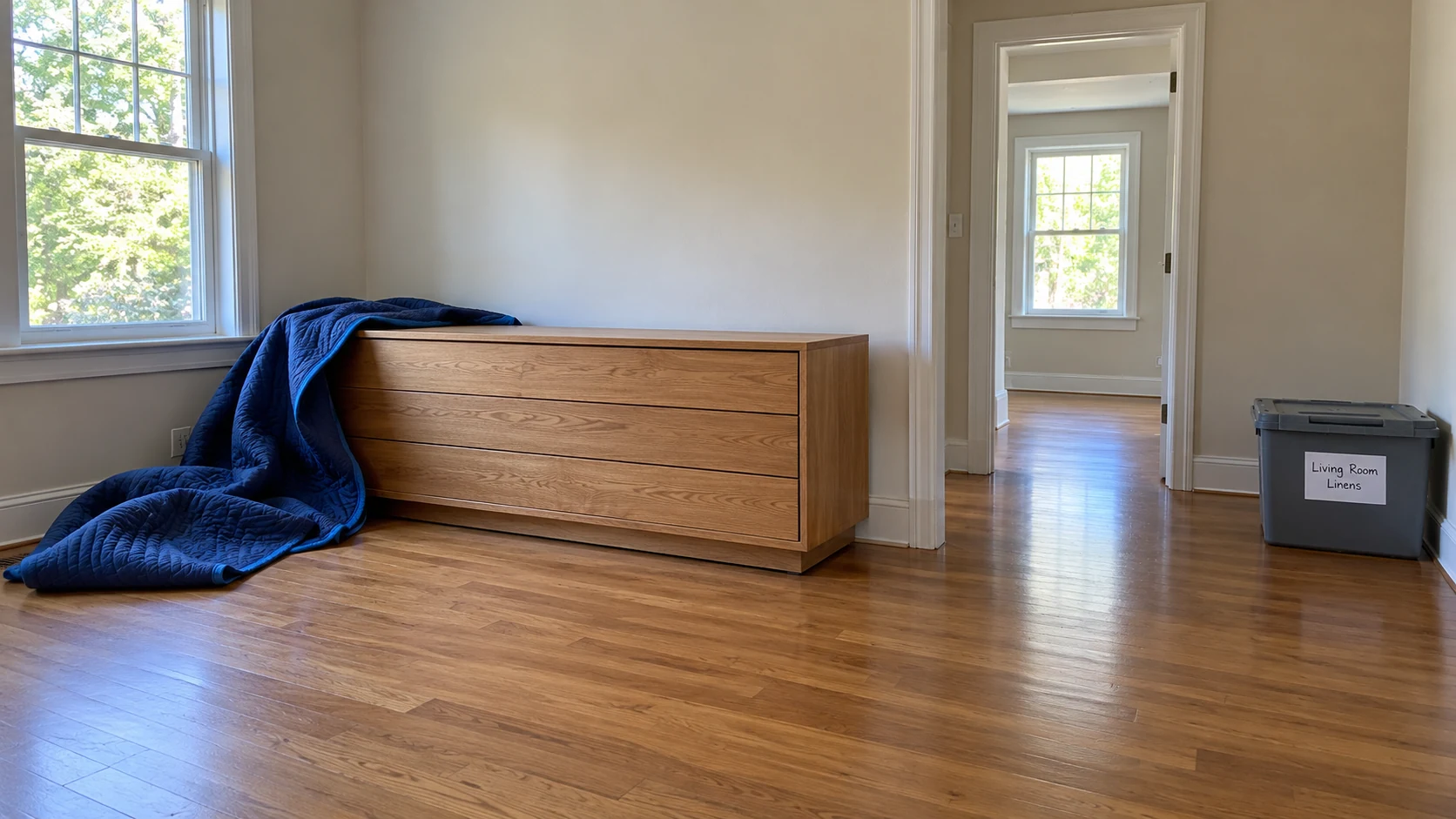
Decide what is moving, staying, being donated or being collected before the final inventory. Morristown’s collection information and 2026 zone calendars separate ordinary collection from small quantities of nonmetal household bulk. North and South have different schedules. Metal, contractor debris and other excluded materials need the appropriate separate route; moving out does not make every discarded item eligible for the curb.
If a collection cannot happen before the property must be clear, arrange an accepted alternative in advance. Any company removal needs its destination, work and charge included in the scope. The Town recycling center’s resident and business eligibility has material and use conditions; it does not mean every contractor load is accepted. Keep donation, removal and the moving inventory distinct so an item is not accidentally loaded or left behind.
The date also needs to fit the household: lease end, school arrangements, a summer trip or a mid-month key exchange may change what can happen before departure. Share those firm dates when requesting the estimate. A seasonal or calendar preference does not establish company availability or a lower price.
We arrange long-distance pickups in Morristown town, New Jersey, with the inventory and access agreed for the actual property. Include upstairs, lower-level, attic and detached-garage contents that are moving, together with every part of the route to the truck. For an address in Morris Township or elsewhere in Morris County, send the full municipality and street address for review. A Morristown postal label does not establish the street authority, a reserved truck position or the receiving building’s rules.
Explore long-distance destinations from Morristown
These examples organize destinations for a household move from Morristown. We serve destinations throughout the United States and Canada. Review both properties, the inventory and receiving dates before choosing the delivery model.
Northeast
- Boston, Massachusetts
- Buffalo, New York
- Philadelphia, Pennsylvania
- Washington, DC
- Baltimore, Maryland
- New York City, New York
Southeast and Florida
- Charlotte, North Carolina
- Raleigh, North Carolina
- Miami, Florida
- Orlando, Florida
- Tampa, Florida
Great Lakes and Midwest
- Chicago, Illinois
- Cleveland, Ohio
- Columbus, Ohio
Pacific states
- Seattle, Washington
- Spokane, Washington
- Portland, Oregon
- San Francisco, California
- Los Angeles, California
- San Diego, California
Mountain West and Southwest
- Denver, Colorado
- Phoenix, Arizona
- Las Vegas, Nevada
- Salt Lake City, Utah
Canada
- Québec City, Quebec
- Vancouver, British Columbia
- Toronto, Ontario
- Ottawa, Ontario
- Montreal, Quebec
- Kingston, Ontario
Long-distance moving questions
Which delivery model suits a Morristown household move?
Choose direct delivery for a dedicated truck and the same crew at pickup and delivery, with the journey reviewed for that shipment. Consolidation can suit a smaller inventory if the household can accept a broader agreed receiving window. Compare the actual belongings, both carrying routes and firm dates. A short building work period still needs a separately accepted receiving arrangement.
When does the delivery window start?
After pickup and loading are complete. Packing, furniture preparation, the Morristown carry and any wait for usable loading access happen first. Ordinary direct illustrations are New York City 1–2 days, Raleigh 1–2 days, Montreal 1–2 days and San Diego 4–5 days. They are planning ranges, not appointments, customs guarantees or certified routes for a particular truck.
Can my New York City move be delivered the same day?
It may be possible for a suitable shipment with completed loading early enough, a reviewed journey and usable receiving access. It is not automatic because the cities are relatively close. Connect the Morristown carrying route with the destination keys, building personnel, accepted entrance and work period before agreeing that schedule. The ordinary direct illustration remains 1–2 days after completed loading.
Is 300–400 cubic feet a minimum for consolidation?
No. It is approximate guidance for smaller shipments, not a minimum or an automatic qualification. Send the actual pieces, cartons and requested preparation. A smaller shipment still needs usable access, someone authorized to receive it and an agreed window. Decide how the household will manage without those belongings before choosing the model.
What consolidated window applies to Raleigh, Montreal or San Diego?
A suitable shorter domestic route, illustrated by Raleigh here, can have up to 30 days. Canada, including Montreal, has up to 60 days. California, including San Diego, has up to 90 days. Florida also has up to 60 days; other distant destinations need their own window. Confirm the applicable arrangement in writing. Do not assume free storage, a discount or the direct model’s same crew.
Does Montreal use the shorter domestic window because it is nearby?
No. Montreal is in Quebec, Canada, so the Canadian consolidated maximum is up to 60 days. A relatively short reference road distance does not substitute the domestic up-to-30-day category. The ordinary direct illustration is 1–2 days after loading, with the actual import arrangements and receiving access separately accepted.
Does California’s 90-day window apply to all western destinations?
No. The up-to-90-day consolidated maximum belongs to California, including the San Diego example. Other distant destinations need their applicable individually agreed window; Canada has its own up-to-60-day category. The direct San Diego illustration is 4–5 days after completed loading. A reference range does not book the receiving date.
Will a longer journey increase the agreed long-distance flat rate?
No. Travel or delivery taking longer does not itself increase the agreed flat rate for the reviewed inventory, access and services. Report additional items, changed access, more packing, storage or another stage before loading so the required revised estimate can be agreed before the shipment is loaded. Later changes need the applicable written scope and price before the affected work begins.
What changes if both addresses are within New Jersey?
Use the applicable New Jersey intrastate process: an on-site or virtual survey, a completed tariff-based written estimate and the consumer notice. An item list and still photographs can start planning but do not replace the survey. The state FAQ distinguishes a binding estimate from a probable-cost estimate and describes the Order for Service provided at least 24 hours before the scheduled move. Review the applicable operator, documents and timetable; interstate terms do not automatically govern an entirely New Jersey move.
What Canadian documents should remain accessible when goods follow me?
Establish the applicable import process and responsible person before pickup. Prepare the required inventory in two copies, separating accompanying belongings from goods to follow. Account for the goods at the household’s first Canadian entry, even when none accompany you, and keep the resulting personal-effects record for the later shipment. Confirm eligibility, restrictions, clearance responsibilities and receiving access. The moving inventory or Canadian address alone does not establish an exemption.
Can you pack selected rooms and unpack after delivery?
Yes, when included in the agreed scope. Identify what you will pack, what the crew should prepare and the unpacking result you want. Packing and optional unpacking or putting contents away are charged for working time; company-supplied cartons separately. Moving blankets, shrink wrap and tape have no separate basic-material charge. Furniture unwrapping is part of delivery; packaging and waste removal are charged separately. Basic disassembly and reassembly have no separate basic assembly fee; specialist work needs its own review and quote.
Must all furniture drawers and legs be removed?
No. Empty ordinary drawers and normally keep them installed and secured within the protected whole piece. For safely removable long table or desk legs, protect the body first while keeping joints accessible, turn it upside down onto stable padding and remove the complete matched set. Wrap the removed legs together last and retain matching hardware. Integral supports and construction or access exceptions need an appropriate reviewed method.
Does a Morristown resident parking permit reserve the moving space?
No. Household parking permission does not reserve a moving position or establish the commercial vehicle’s complete working window. Morristown’s parking, permit-area service and truck-route rules have distinct conditions. Supply the actual vehicle, frontage, date, hours and carrying route to the coordinator and relevant authority. Agree a usable alternative and any changed scope before dispatch if the first arrangement is unavailable.
Is an empty truck outside Morristown’s weight-based parking rule?
Do not assume that. Ordinance O21-2026 changes the specified parking provision to manufacturer gross vehicle weight rating. The separate truck-route section has its own actual gross vehicle weight wording and exceptions. Review the relevant vehicle documents and provisions for the proposed operation. A route exception is not a curb reservation or approval of every vehicle dimension.
Can a moving van remain on a residential street overnight?
Active moving service and unattended overnight staging are different. Section 7-16 has a residential overnight restriction with an exception for a vehicle actively performing the specified service, including a moving van. Other parking and stopping rules still matter. Confirm the actual period and lawful position; do not turn the active-service exception into permission to leave the vehicle unattended overnight.
What if a lower-level exit or shared stair is the only route?
Review the entire route to the accepted truck position. A lower-level doorway can lead to exterior steps or a rising path; a shared stair can include restrictive turns. Supply photographs, useful measurements and every transfer or lift. The coordinator must accept the preparation, people and equipment needed. A different route or longer carry needs review before it becomes an unexpected change on moving day.
Who arranges the COI, lift operator or other building personnel?
Management should provide the exact certificate wording, submission contact, deadline and booking conditions. Forward those requirements to the coordinator. If an operator or another building role is required, management must identify who provides and authorizes that person. The coordinator then reviews the complete sequence and any separately charged building service; those roles are not automatically included in the moving crew’s scope.
What happens if keys or receiving access are delayed?
Contact the authorized property contact and coordinator by the agreed decision deadline. Confirm an available later slot or another authorized method. Before using storage, confirm an accepting facility, capacity, receiving hours, protection, handling, price, payer and onward-delivery date. Arrange accommodation and essentials for people and pets separately. If no destination can accept the shipment, revise departure; resume when possession, the authorized receiver and the route are ready, with changed work and charges agreed in writing.
Which belongings should travel with the household?
Keep identification, keys, medication, chargers, clothing, needed Canadian documents and work or school items required before delivery. Keep the receiving instructions and decision-maker’s contact available. Separate those bags during the inventory check. Essentials packed inside an inaccessible truck or stored shipment cannot support the household while it waits.
Can unwanted furniture simply be left for Morristown collection?
Only use the appropriate accepted collection route. The Town’s 2026 zone calendars allow small quantities of nonmetal household bulk on the applicable schedule; North and South differ. Metal, contractor debris and other excluded material need separate handling. If collection cannot meet the key handover, arrange an accepted alternative. Any company removal needs its destination, work and charge in the scope.
Is valuation the same as insurance or a building COI?
No. Interstate household-goods valuation is the mover’s liability arrangement. Full Value Protection applies unless Released Value is selected through the required written choice; Released Value limits liability to 60 cents per pound per article rather than replacement cost. Separate insurance and a building COI have different purposes. Disclose high-value items and review cost, deductible, limits and claims terms before loading.
Where can long-distance pickup be arranged around Morristown?
We arrange long-distance pickups in Morristown town, New Jersey, with the inventory and access agreed for the actual property. Include upstairs, lower-level, attic and detached-garage contents that are moving, together with every part of the route to the truck. For an address in Morris Township or elsewhere in Morris County, send the full municipality and street address for review. A Morristown postal label does not establish the street authority, a reserved truck position or the receiving building’s rules.
What should I send for a useful estimate?
Send both street addresses, the item list, useful photographs, largest furniture dimensions and firm dates. Include complete carrying routes, proposed truck positions, stairs, lifts, work periods and receiving contacts. Identify requested packing, cartons, unpacking, storage, specialist work and exclusions. Complete the survey required for the route. An interstate survey waiver must be a proper separate written agreement before loading, retained with the bill of lading; it does not waive the written estimate. New Jersey intrastate moves use their applicable survey, tariff-based estimate, consumer notice and Order for Service.