
New Jersey · Short Hills service planning
Junk Removal & Disposal in Short Hills, NJ
A replacement piece can need space before it arrives. A smaller home may already have the shelving you need. A treadmill that has sat unused for years can add substantial handling and shipment capacity to a move without adding value at the destination. Sterling Oakbridge provides agreed junk removal and disposal planning in Short Hills, with stand-alone visits and moving-day add-ons. Review the outgoing inventory, carrying work, local requirements and accepting route before the property's clear-by date.
Decide what the next home actually needs
Disposal can help save money when it avoids work the household would otherwise pay for twice. A bulky unused item might need preparation, carrying, shipment space, storage and another removal after delivery. Removing it locally can avoid those stages, but the removal itself still has a cost. Compare complete estimates for the actual item and route. Age alone is not a reason to discard valuable, useful or sentimental belongings.
Short Hills is part of Millburn Township in Essex County. Municipal sanitation, recycling and Town Yard instructions come from the Township; a Short Hills postal address does not create a separate bulk collection system. The home may have a long private drive, a narrow older doorway, stone surfaces or a garage far from the vehicle. Describe the actual access and property instructions rather than assuming every local home presents the same job.
Begin with three lists: keep, committed recipient and remove. A person who might want a bookcase has not yet cleared it from the house. Record a collection date for an agreed sale or gift and identify what happens if that arrangement fails before your deadline. A public drop-off can be useful when the material, residency, vehicle and carrying conditions fit. Private carrying and receiving arrangements need review when those conditions or the household's timing do not fit.
For a long-distance move, assess the receiving use before allocating capacity. An unused exercise machine can be costly to handle even when it stands in an accessible garage. A sound machine you intend to use may be worth moving; one nobody will use should not travel simply because it was once expensive. Compare the revised shipment scope with local removal and any necessary replacement. Removing an item does not automatically reduce an already agreed flat rate.
Include more than a photograph of the unwanted piece
Send dimensions, quantity, condition, the room and floor, access photographs and the clear-by date. Show the route from the item's present position to legal vehicle access: turns, stairs, thresholds, service elevators, shared doors and long approaches. Tell us who authorizes entry and whether a building or house manager requires a booking window, certificate of insurance or particular protection. An item photograph cannot establish all the carrying work on its own.
Name the materials and parts. A mattress is different from a bed's headboard or metal rails. A refrigerator needs a different receiving plan from a small portable appliance. A powered gym machine is different from a folding chair. Describe fixed connections, safely detachable sections, batteries, liquids, upholstery and unusual weight. Disclose pests, mold, unknown contents or contamination before the estimate; they are not routine additions to an agreed household group.
- Furniture removal. Sofas, armchairs, dressers, tables and bookcases. Identify each piece, its dimensions, the carrying route and whether a recipient or removal has been agreed.
- Mattress disposal. Used mattresses and box springs after a bed replacement or downsizing. Give the size, quantity and condition; disclose pest concerns and confirm covering instructions and an accepting destination.
- Appliance removal. Refrigerators, freezers, washing machines, dryers and microwaves. Give the model and utility preparation. Refrigerant appliances need a suitable receiving chain; appliance removal does not include utility disconnection or installation unless separately confirmed.
- E-waste and electronics. Televisions, monitors, computers and associated covered equipment. Confirm the exact device and approved electronics route. An appliance and a covered electronic device can follow different disposal programs.
- Gym equipment. Treadmills, exercise bikes, weight benches and loose weights. Identify weight, stairs, dismantling, screens and embedded batteries before choosing the carrying and receiving plan.
- Outdoor items. Worn patio furniture, loose play equipment and unwanted garden equipment. Describe fuel, batteries, anchoring and any dismantling. A fixed shed or play structure needs a separate review of permissions and work.
- Yard waste. Branches, brush, leaves and trimmings remaining after a small clearance. Review material, quantity, bundling and the local green-waste route. Soil, stumps, fuel and equipment are different loads; garden work itself is not included automatically.
- Light construction debris. Small quantities of loose drywall offcuts or other identified remnants from a minor repair. Send photographs, material types and quantity for acceptance review. Confirm the receiving route and charges; demolition, unknown or contaminated materials need a different plan.
- Used packaging and floor protection. Flattened cartons, packing paper, plastic film and clean protective sheeting. Separate materials and identify contamination or attached debris. Agree the staged quantity and separately charged collection.
The categories organize a request, rather than promising that all items can travel in one waste load. Recyclable paper, metal furniture, electronics and hazardous products can need separate receivers. Tell us what is actually present, and keep useful household belongings out of the removal group. Do not empty an unidentified container into a trash bag or assume every appliance can be disconnected as part of ordinary carrying.
Example 1: replacing a worn ottoman on Hobart Avenue
Imagine a household on Hobart Avenue replacing a worn round ottoman in its living room. The new piece is due before the family can take the old one to an appropriate receiver. The old upholstery has become tired, nobody has committed to taking it and the room has no useful place for both pieces. Leaving the unwanted ottoman beside the routine refuse container would not provide an authorized bulky collection.
This is a straightforward clearance with a definite purpose: free the receiving space before delivery. Compare retailer take-back, a confirmed recipient and an eligible Town Yard trip with a stand-alone removal. A municipal drop-off does not include carrying the piece from the living room, and its vehicle rules can matter. A household that cannot safely handle the route needs that labor planned rather than treating the drop-off address as a complete service.
The access survey follows the piece toward the private side exit, including the threshold and landing. Agree floor and doorway protection for the actual house. Empty the top and identify the ottoman's integral low base so it is not mistaken for a table with detachable long legs. The illustration shows one manageable piece on an outward route; actual dimensions, grip, weight and steps determine the appropriate team, rather than the photograph fixing a universal crew size.
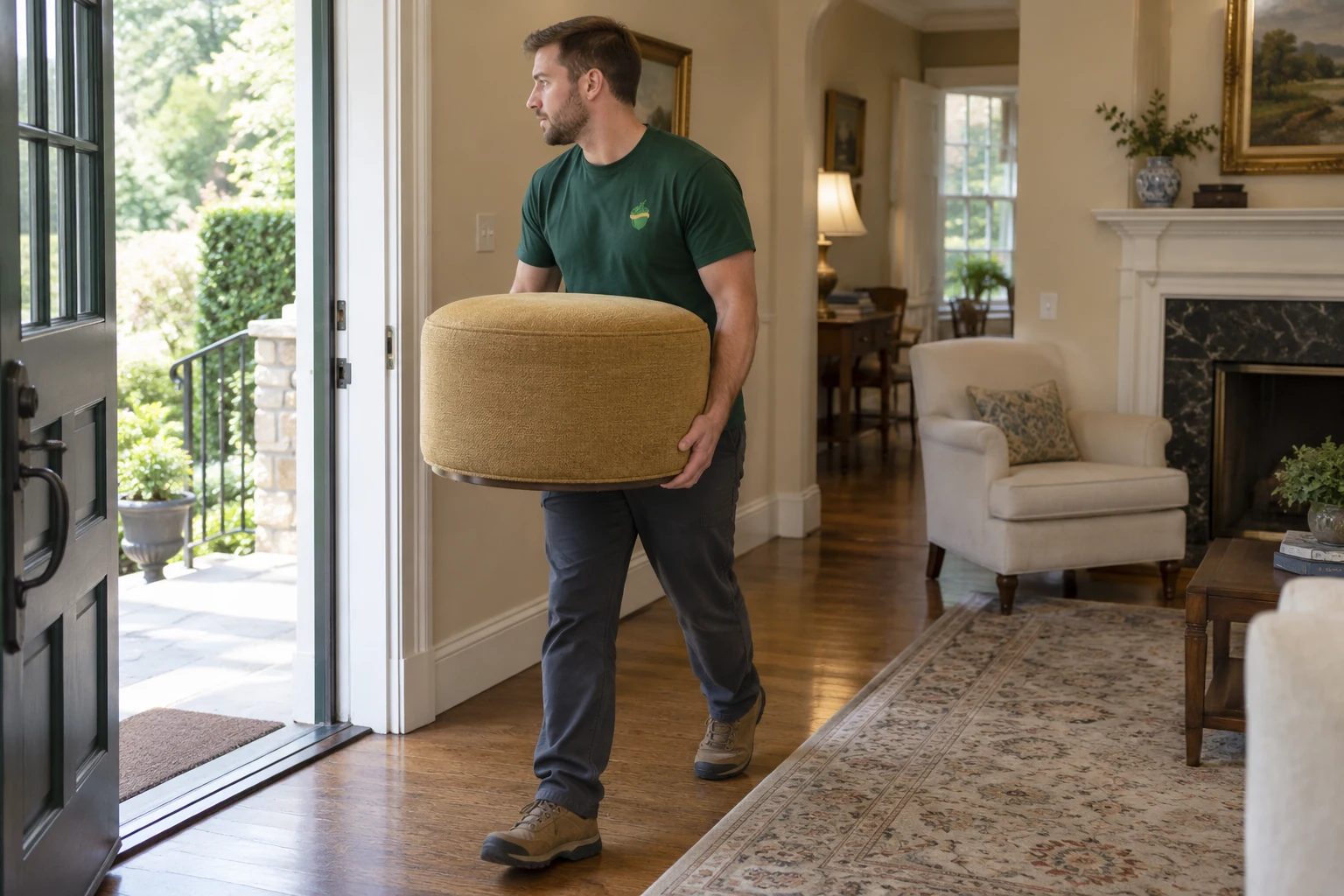
The result is the agreed empty space, with the old piece collected and received through a suitable route. Keep the replacement provider's delivery and the removal provider's responsibilities clear. A small item can still require its own dispatch and receiving work when the dates demand it. Compare that complete cost with the alternatives and confirm the removal inventory before booking, including any additional piece the household wants taken at the same visit.
Example 2: surplus bookcases before a smaller home on Hartshorn Drive
Consider parents on Hartshorn Drive moving locally to a smaller apartment after their children have established households of their own. The next home has built-in shelving for the books they are keeping. Two low freestanding wooden bookcases from the current study therefore have no receiving place. They are not family heirlooms, no recipient has committed to collecting them and the parents do not want to store them without a future use.
Keep the books, retained armchair and selected furniture separate. Empty the outgoing shelves before the visit and photograph the complete bookcases, including their backs, bases and any loose shelves. The instruction is to remove those two named pieces, not everything in the study. A broader room clearance could otherwise include belongings that should remain or be packed. Use the written inventory to distinguish reserved gifts, retained items and pieces authorized for disposal.
The illustration shows a resident reviewing the empty shelves on private property. It is a decision stage, not a completed packing or public set-out scene. A bookcase that looks small in a room may still be awkward at the exit because of its depth, fixed base or narrow turn. Review the route, fastening and safe dismantling if needed. Do not assume it must be stored simply because it could potentially be useful to somebody one day.

A moving-day add-on may suit this household when the team is already there and the removal work, capacity and receiving are agreed. It can avoid a second dispatch, while additional labor and material charges remain part of the estimate. An earlier stand-alone visit may be more useful if the study needs to be clear for packing, property work or handover before the main move. Choose the schedule that meets the actual clear-by date.
The economic decision is about a real receiving use. Shipping the extra shelves to the new apartment, paying to store them and eventually arranging another removal would repeat the same unresolved task. Storage is a useful option when a piece has a defined future place or temporary receiving delay. In this example the parents have already chosen built-in shelving and do not need the extra units, so the inventory should reflect that decision before loading begins.
Example 3: an unused treadmill before a White Oak Ridge Road move
Imagine a White Oak Ridge Road household leaving for Tampa, Florida after ten years in the same home. An older electric treadmill and a rolled exercise mat remain in the garage, although the family no longer uses either. The machine was once part of a home fitness routine, then became something to move around whenever the garage was reorganized. The move is a practical moment to decide whether it has any receiving use.
Do not make the decision from purchase price alone. Establish condition, whether a committed recipient wants it and whether the family expects to use it at the next home. Keep a useful machine if the benefit justifies the route. If it has no future use, compare local removal with packing, safe dismantling, lifting, shipment capacity and handling after delivery. Buying a replacement is relevant only if the household actually intends to replace it.
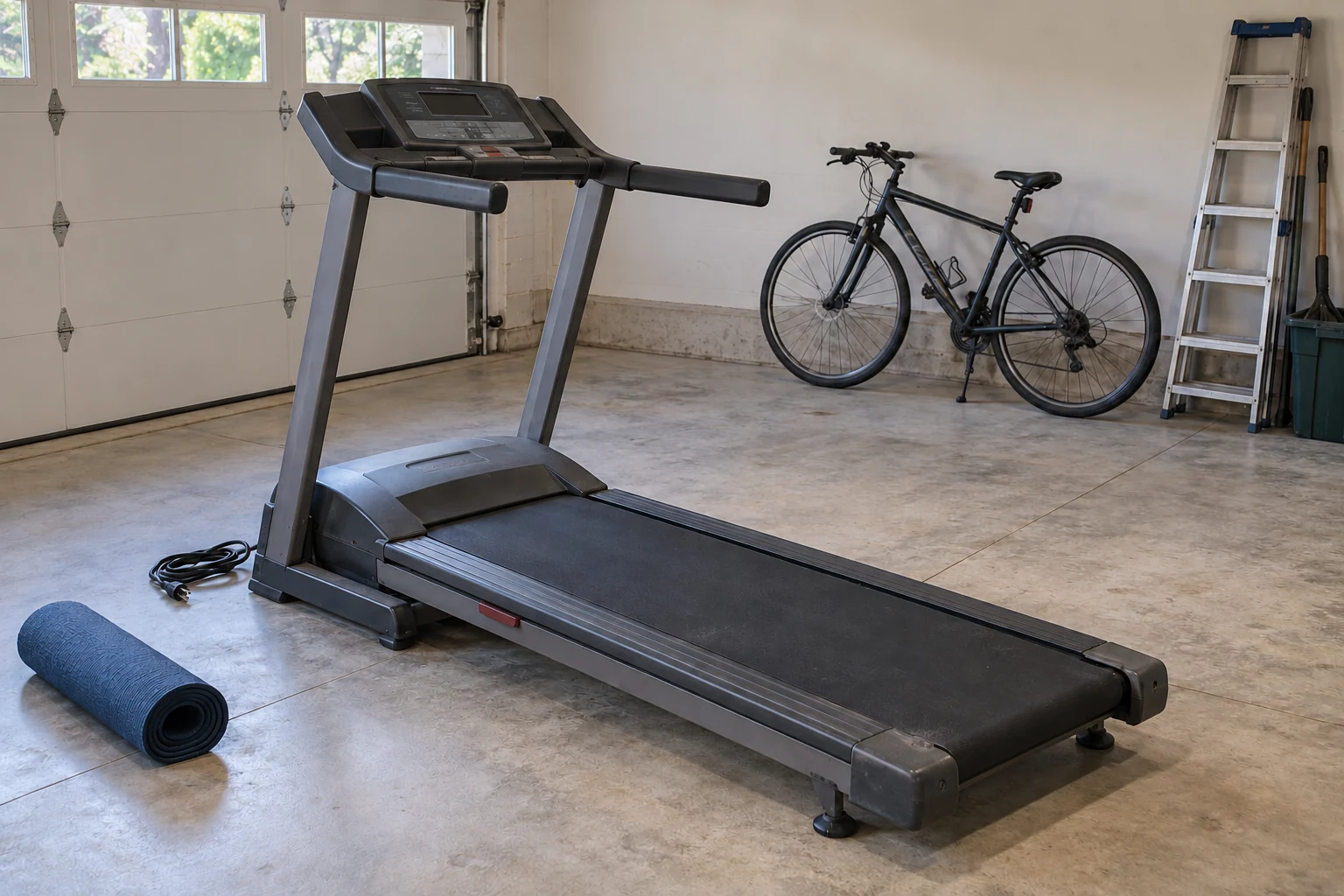
The illustration is a private condition review: the treadmill is unplugged, its deck lowered, its console unlit and the retained bicycle separate. It does not show the machine ready for transport. Send the model, dimensions, weight if known, photographs of the route and any manual information that helps identify safe sections. Include electronic components, detachable parts and any batteries. Do not dismantle unfamiliar powered equipment just to make an estimate photograph easier.
Review this group with the long-distance moving plan before final shipment pricing. An unused heavy machine can affect both capacity and labor over a long route. An earlier removal can free garage access before packing, while an agreed add-on can work when appropriate space and receiving are available. The long route makes the comparison valuable; it does not make every old machine uneconomic to move or establish a universal rate per cubic foot.
The receiver also matters. A metal frame with electronics is not automatically a plain metal appliance, and an unplugged treadmill is not simply a television. Identify the complete machine and the intended receiving route before the visit. Gas, solvents, automotive fluids and other garage products remain separate; the selected illustration includes none of those products in the removal group. A household gym clearance does not authorize a mixed hazardous-material load.
A wider range of clearance situations
The same process can help after inheritance, a household separation, a renovation, a business closure or a tenancy change. The needed result may be an empty room, a usable garage or a property ready for handover. Those purposes do not make every item's ownership or every material's receiving arrangement identical. Use the broader situations below to build a clear request and identify the parts that need separate review.
View 21 removal situations and what to check
Swipe the table sideways to read all columns.
| Situation | What needs to change | What to agree first |
|---|---|---|
| A furniture replacement | A worn armchair, sofa, dresser or old table makes way for a new purchase. The old piece needs to leave before the new room layout can work. | Agree removal versus retailer haul-away, access, recipient acceptance and the delivery deadline. |
| A television or monitor upgrade | A broken or unwanted screen remains after the replacement arrives. The old device needs an approved recycling route and space needs to be cleared. | Identify the model and an accepting electronics program; ordinary trash is not the route. |
| A local move to a smaller home | Parents choose a smaller home after the children leave; spare furniture no longer fits. Avoid carrying and storing pieces that have no role in the receiving home. | Use the new floor plan, a keep list, a removal list and a separately reviewed quote. |
| A household separates | People move to different homes and a shared surplus remains. Unallocated items should have a destination before the rooms are cleared. | Confirm the authorized owner and each person's keep/remove instructions. |
| A temporary family stay ends | A relative returns home and the spare bed, chair or temporary setup is no longer needed. Clear a useful room instead of keeping furniture without a future use. | Verify ownership and which pieces are being returned, retained or removed. |
| Accumulation before a move | After seven to ten years, forgotten garage, attic or basement belongings reappear. Avoid packing and transporting contents that would be discarded after delivery. | Sort early, photograph the group and distinguish ordinary items from special materials. |
| A long-distance keep-or-replace decision | Bulky low-value furniture competes for space with useful, valuable or sentimental possessions. Removing unwanted bulk can avoid shipment, handling and storage costs. | Compare two actual moving quotes with removal and destination replacement costs; no automatic per-cube discount. |
| An estate's remaining contents | After retained and sold pieces leave, ordinary unwanted furniture remains. The property needs to be cleared for its next agreed use. | Identify the authorized representative and preserve items awaiting sale, collection or family decisions. |
| Rental turnover or a possession deadline | A property must be handed over after tenancy, including situations involving lawful eviction processes. Ordinary unwanted contents may prevent the agreed handover. | Confirm lawful possession and authority over the items; removal is not eviction enforcement or legal advice. |
| An office lease ends | Old desks, chairs or shelving are no longer needed in the new office. Release the old premises without moving a surplus into the new workspace. | Separate business waste, IT/data decisions, landlord instructions and the commercial receiving route. |
| A business changes its space | Unused shop fixtures, storage furniture or equipment need to leave. Make the leased space usable for its next purpose. | Confirm the actual equipment, utilities and materials; resident-only programs do not serve business loads. |
| Outdoor items at a home sale | Patio furniture or children's outdoor items are not wanted at the next home. Clear agreed contents before move-out and property handover. | Confirm the sale agreement, ownership, anchoring, item size and ordinary material acceptance. |
| An unwanted shed or play structure | A shed or fixed children's play structure is no longer useful. It may need a separate dismantling and collection plan rather than transport to the new home. | Review foundations, utilities, dismantling, permissions and receiving material limits; structural demolition is not automatically part of ordinary collection. |
| Broken outdoor equipment | An old mower, grill or other outdoor equipment has stopped being useful. Avoid taking a repair or disposal problem to the new property. | Identify fuel, oil, propane and batteries separately; arrange the applicable material route. |
| A broken household appliance | A washer, refrigerator, freezer or other appliance is being replaced. The old appliance takes up receiving or working space. | Review utilities, access and model; refrigerant-containing appliances need an appropriate processor. |
| Unused or broken gym equipment | A treadmill, exercise bike or weight system is not going to the new home. Avoid a difficult carry and shipment for equipment with no planned use. | Identify weight, dismantling, stairs, electronics and any battery before quoting. |
| Packaging after unpacking | Used flattened cartons, paper and plastic wrapping fill the available space. Restore useful rooms and clear the agreed collection area. | Group used flats in large open boxes near a clear exit; separate material types and agree the collection date. |
| Protective materials after renovation | Clean floor-protection paper or plastic film remains after work ends. The finished space needs to be made usable again. | Identify contamination, wet paint or attached debris; protective packaging is not automatically construction or hazardous waste service. |
| A mattress or box spring replacement | An old bed surface remains after replacing a mattress or changing bed size. Clear the receiving room without carrying an unwanted bulky piece to another home. | Confirm size, condition, covering instructions, local collection eligibility and accepting destination. |
| A prepared yard-waste pile | Identified branches, brush, leaves or trimmings remain after a small clearance. Clear agreed outdoor space before a handover or after work is finished. | Confirm quantity, bundle/container rules and actual green-waste acceptance; tree work, soil and stumps are separate. |
| Light debris after a minor repair | A small photographed quantity of identified drywall offcuts or repair remnants remains. Clear the completed room without mixing construction material into ordinary household pickup. | Review the material, quantity, carrying route, charges and accepting destination; unknown or contaminated material needs a different plan. |
For an estate, record what has been sold, reserved or selected by family before authorizing the remainder. For a business, separate confidential records and data-bearing equipment from ordinary furniture. For a tenant move-out, establish who can authorize removal and access. Loose repair remnants, outdoor structures, heavy gym equipment and unknown containers should be named rather than hidden inside “everything left over.” A clear list helps the correct items leave and the correct belongings stay.
Compare stand-alone and moving-day estimates
A stand-alone visit has its own dispatch, reviewed carrying work and receiving arrangements. It can clear a room before replacement delivery, create space for packing or meet a handover date that precedes the main move. Include the whole known group, the site and the deadline so the estimate reflects the task. Adding a treadmill after quoting an ottoman changes weight, handling and potentially the receiving route.
An add-on coordinates agreed removal with the main moving visit. It may avoid repeated travel because the team and vehicle are already at the property. It still needs appropriate capacity, extra handling time and a receiver available for the actual materials. It may require another trip. An available corner of a moving vehicle does not settle waste classification or access to a resident-only facility; those questions need their own arrangement.
Compare written estimates for the same group and deadline. Review dispatch, carrying, necessary dismantling, transport, receiving charges and any further trip. Identify specialist handling or utility work that is outside the ordinary agreed scope. The saving comes from avoidable work in the revised plan, rather than a promised fixed discount. A confirmed recipient or suitable municipal option can also be useful when it genuinely meets the household's carrying and scheduling needs.
Millburn's bulky-waste option and Town Yard access
Millburn's current Sanitation instructions say items outside a trash or recycling receptacle cannot be left at the curb for ordinary collection. Residents can verify eligible Type 13 bulky items with DPW for Town Yard drop-off. The municipal bulk contractor collects at DPW; that is not a curb pickup appointment for every home. Do not copy Rumson's Wednesday appointments into a Short Hills clearance plan.
The Town Yard instructions require proof of residency and list many household groups, including furniture, bedding, small appliances and electronics. White goods use Tuesday appointments, with refrigerator/freezer preparation to confirm; gas grills are excluded from that pickup. The Yard's published hours are weekdays 8:30 a.m.–2:30 p.m. and Saturday 8 a.m.–noon. Department office hours are a different schedule.
The revised 2026 guide adds important vehicle and load restrictions: no box trucks or trailers, no commercial vehicles of vegetative waste and a maximum of two drop-off loads weekly. Resident eligibility does not automatically admit Sterling's vehicle. An agreed private waste route must use a receiver and transport arrangement that accept the actual load. A household should verify its own material and vehicle before relying on a drop-off trip.
Millburn's Chapter 14 code also distinguishes Township-contracted residential collection, private commercial/institutional hauling and multifamily arrangements. Do not treat a private bulky clearance as permission to replace routine residential sanitation or take recyclables already set out for the Township. Review the local scope and accepting arrangement for the actual job. State transport documentation and municipal collection rules answer different questions.
Recycling, repair material and seasonal yard work
For clean suitable paper and cardboard, use the actual Millburn recycling programme. Recyclables are separated, clean and dry; plastic bags do not belong in single-stream collection. The Yard's separate white, clean, dry polystyrene programme excludes packing peanuts and food containers. Film, dirty protective covering and foam should be identified individually instead of assumed recyclable because they protected a floor or purchase.
The 2026 guide and code differ on an evening instruction: the guide mentions after 5 p.m., while Chapter 14 states no earlier than 6 p.m. for curb materials. Use the code's later window and confirm current address-specific instructions; don't turn the discrepancy into permission to place a bulky pile at the curb. The code sets container requirements and removal timing as well. Keeping public access and drains clear remains part of the collection plan. Chapter 14.
Construction and demolition debris are excluded from Township collection. Chapter 14 requires an approved Class B recycling arrangement for the relevant materials, regardless of whether the occupant is a homeowner, tenant or business. Describe wood, wallboard, tile, metal and any suspected contamination before agreeing light repair-remnant removal. A small amount does not create another city's one-can exemption. Demolition, masonry, soil and large contractor loads need separate scope and receiver review.
Vegetation has its own limits and seasons. The current DPW HTML page ends regular vegetative collection October 15, while the revised 2026 guide says October 31. Confirm the actual route/calendar when booking rather than assuming either date guarantees collection. Branch preparation, quantity and contractor access also differ from furniture. Leaf collection follows designated zone dates and separates municipal from county roads; the three illustrative street names do not establish an individual property's full collection schedule.
As checked October 10, 2026, the published holiday exceptions do not list Columbus Day as a general garbage suspension. Check the current address calendar and alerts before booking rather than copying Newark's dated resumption instructions. A property handover, a recycling day and a white-goods appointment are separate dates. Choose the removal format only after the schedule can achieve the space needed.
Electronics, hazardous products and business contents
The Township electronics list includes computers, televisions, audio/video equipment, phones, printers and scanners, subject to the applicable Yard conditions. Exact small appliances should be checked against their own material route. A powered exercise machine needs the receiver's review of the whole unit and electronics; a general e-waste list is not blanket approval for every gym machine. Protect personal data before handing over data-bearing equipment, and keep it identified separately from ordinary furniture.
Essex County's electronics event programme is another specific resident option, with its own date, proof and material exclusions. It is not the same as daily Township Yard access, and it does not accept every portable appliance. The HHW programme handles specified hazardous household products under separate conditions. Confirm the next actual event; a prior collection date is not an upcoming opportunity.
Fuels, oils, solvents, pesticides, cylinders, batteries, lamps and unknown chemicals need separate identification and arrangements. Do not place them with the pictured ottoman, bookcases or treadmill. The owner-confirmed NJ waste documentation supports agreed ordinary removal; it does not establish every hazardous transport permission or erase resident-event restrictions. Keep containers intact and disclose damaged, leaking or unidentified material before deciding the route.
Commercial contents require an appropriate hauler and receiver, with the property's local collection and reporting obligations considered. Office furniture, confidential records, electronics and repair debris should be described as separate groups. Essex County's hauler information distinguishes material routes; confirm classification and facility acceptance for the actual load. Do not treat the household Town Yard or resident event as a free destination for an arbitrary commercial truck.
Make the authorized list and clear-by date explicit
Keep reserved sales and family-selected pieces outside the removal group. Empty the selected furniture when appropriate, contain agreed hardware and photograph condition. Describe the route and who will meet the team. For powered or fixed items, identify disconnection and safe dismantling rather than assuming ordinary carrying includes those operations. The crew needs a list that distinguishes retained contents from the pieces authorized to leave.
For an add-on, reconcile that list with the shipment inventory before loading. For a stand-alone visit, specify the date and the space that must be free. Use packing services for useful belongings that will travel and storage for a real receiving delay or future use. Removal resolves the pieces you have deliberately selected to leave, with appropriate local and material arrangements.
Short Hills junk removal and disposal questions
Can disposal save money before a Short Hills move?
It can avoid preparation, carrying, shipment capacity, storage and later disposal for items with no receiving use. Compare removal and necessary replacement with the actual revised moving work. Removing an item does not automatically lower an agreed flat rate.
Does Millburn collect ordinary bulky furniture at the curb?
The current sanitation instructions direct eligible household bulky items outside ordinary receptacles to Town Yard drop-off, with acceptance to verify. The bulk contractor collects at DPW. This is different from routine residential sanitation and scheduled white-goods collection.
Can Sterling’s truck use the resident Town Yard?
Resident eligibility does not automatically admit a company vehicle. The current 2026 guide prohibits box trucks and trailers and lists further load and vehicle conditions. Review private hauling and accepting arrangements for the actual load rather than assuming the Yard is the default receiver.
What should I send for a single replacement-piece removal?
Provide the piece, condition, dimensions, floor, route photographs and replacement deadline. Identify thresholds, steps and legal vehicle access. Compare a confirmed recipient, seller take-back or eligible resident trip with the carrying work and date you need.
Is a moving-day add-on cheaper than a stand-alone visit?
It may avoid another dispatch when the team and vehicle are already at the home. Extra carrying, suitable capacity, receiving charges and another trip still affect the total. Compare written estimates for the same list and deadline; removal is not automatically free.
Should surplus bookcases be stored when downsizing?
Storage is useful when there is a real future use. If the next apartment has built-in shelving and nobody has committed to collecting the extra units, compare removal with repeated handling, storage and eventual clearance. Keep retained books and furniture separate.
Should an old treadmill travel on a long-distance move?
Assess future use, condition, value, dimensions and handling needs. Compare the actual shipment scope with local removal and any necessary replacement. An unplugged machine still needs safe handling and appropriate electronics/material receiving; the photograph is a condition review, not completed transport preparation.
Can mattresses and box springs be included?
Identify size, quantity, condition, access and any contamination. The Township lists bedding among Town Yard material options, subject to actual access and preparation. Confirm the covering and receiving conditions for the chosen route rather than importing another municipality’s mattress rule.
What about appliances, televisions and electronics?
Identify the exact unit and route. White goods have a separate municipal appointment programme, while the Township electronics list names particular devices. A powered gym machine is not automatically a plain metal appliance or covered electronic device. Utility disconnection and installation are separate operations to agree.
Can used packing materials be recycled?
Suitable paper and cardboard follow the actual local programme. Separate them from plastic film, food, dirty covering and foam. Millburn’s separate polystyrene route accepts selected white clean dry material, excluding packing peanuts and food containers; single-stream collection has different conditions.
Can light construction or yard material be added?
Describe material, origin and quantity. Township collection excludes construction/demolition debris and the code requires appropriate approved Class B arrangements. Vegetation has separate preparation and seasonal rules; the current HTML and 2026 guide differ on the season end date, so confirm the actual calendar.
Can an estate or office be cleared?
Discuss the authorized list, ownership, access and deadline. Preserve sold or family-selected estate pieces and separate confidential records and data-bearing office devices. A business needs an appropriate commercial receiving plan and cannot assume resident-only facilities accept its load.
What needs separate hazardous-material review?
Identify fuels, oils, solvents, cylinders, batteries, lamps, pesticides and unknown containers separately. Ordinary NJ waste documentation does not establish every hazardous permission. Check actual product acceptance and resident-event conditions before deciding the route.