
New York · Binghamton service planning
Fine Art & Antique Movers in Binghamton, NY
A glazed print above a Court Street shop, a marble-top heirloom and a bronze sculpture raise different packing and delivery questions. Sterling Oakbridge plans fine art and antique moving in Binghamton around the object's condition, both carrying routes, accurate value and the person receiving it.
The useful question is which protection the object needs. A framed print behind glass, an unglazed oil painting, a bronze sculpture and a fragile antique mirror have different contact points, weights and risks. We can review protective packing, custom soft crates and wooden crating, with the materials, handling, delivery and any storage included in a written scope. Tell us about insurance requirements before the packing method is chosen.
Art, antiques and heirlooms we can review
Most of this work is for private owners: one treasured piece, several objects going to family members, or artwork moving with a household. A modest purchase and a valuable original both deserve a considered plan. Monetary value affects insurance and documentation; personal significance tells us why you want the item handled carefully even when it has little resale value.
The inventory can include framed prints, paintings on canvas or rigid supports, works on paper, photographs, decorative frames and mirrors. Sculpture may be made from bronze or another metal, marble, limestone, other stone, ceramic, wood or mixed materials. Antique furniture can include writing desks, cabinets, tables and chairs with aged joints, carved details or delicate finishes. Describe the actual construction and condition rather than relying on the label “antique.”
We can also review individual collections or deliveries for art sellers, galleries, designers and furniture showrooms with decorative artwork. Give us the owner, receiving contact and intended use of the goods. Commercial stock, exhibition pieces and privately owned household artwork can need different insurance arrangements. For institutional work, send the lender's handling, documentation and crating specifications so they can be reviewed with the proposed job.
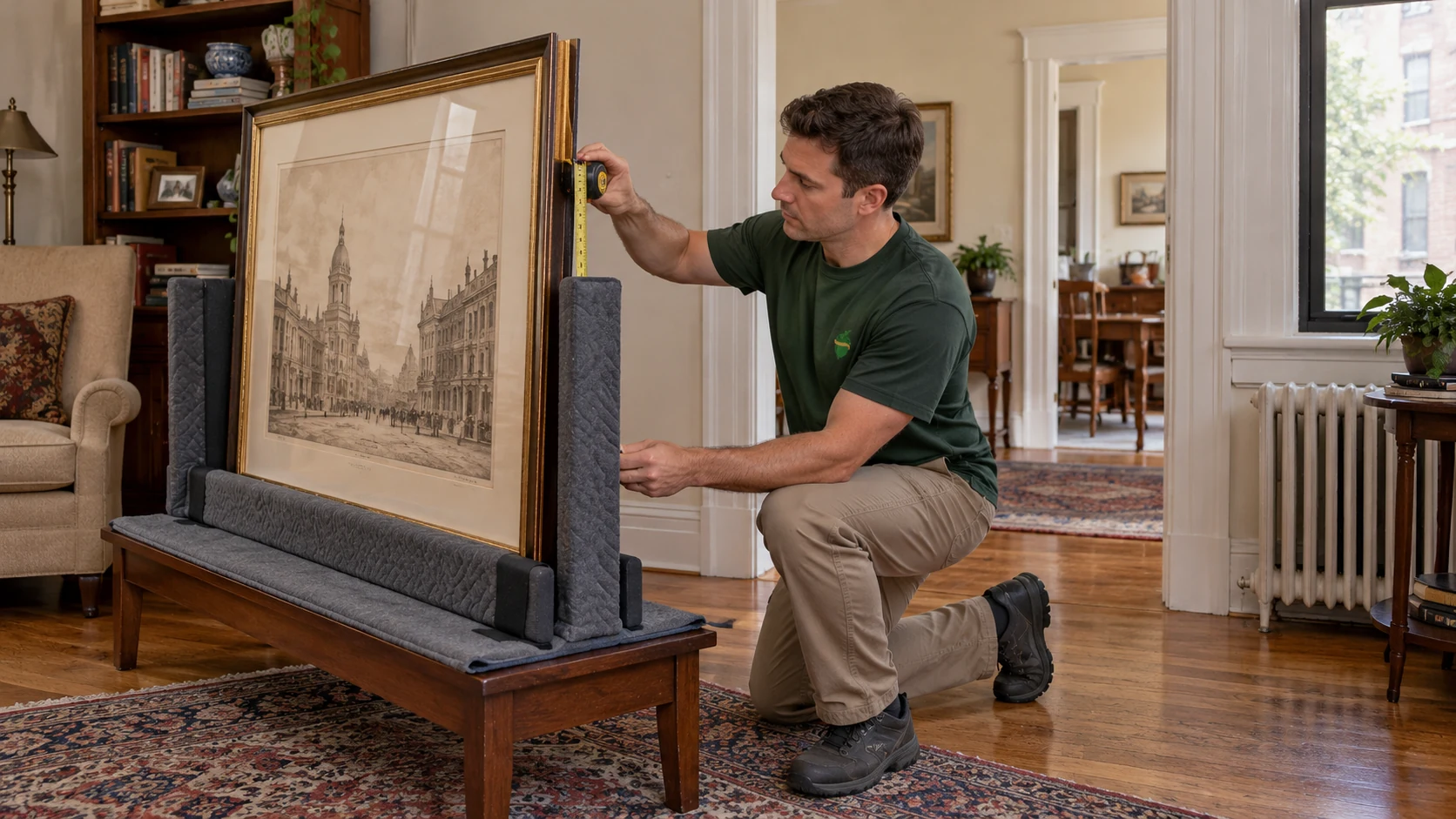
Start with condition, dimensions and the carrying route
Send front, back and detail photographs before booking. Include the outside frame measurements, glazing, medium, approximate weight if known, detachable parts, existing cracks, repairs and any sensitive surface. Photograph the narrowest doorway, the stair turn and the route from the room to the loading position at both addresses. The packed dimensions can be substantially larger than the piece itself.
For a painting, identify whether it is behind glass, varnished, newly painted, heavily textured or showing loose paint. A strong-looking frame may have fragile ornament. For a cabinet, tell us about loose joints, glass doors, removable shelves and hardware. For a sculpture, identify the base and any projections that cannot carry weight. The packing plan needs reliable support points as well as a protective exterior.
Record the condition before wrapping and compare it at delivery. Agree any requested written or photographic documentation in the estimate; an ordinary moving inventory is different from a formal conservation condition report. If paint is lifting, a frame is separating or an old repair cannot tolerate handling, a conservator or suitable repair specialist may need to assess the object first. Packing cannot stabilize every existing defect.
From picture corners to a custom soft crate
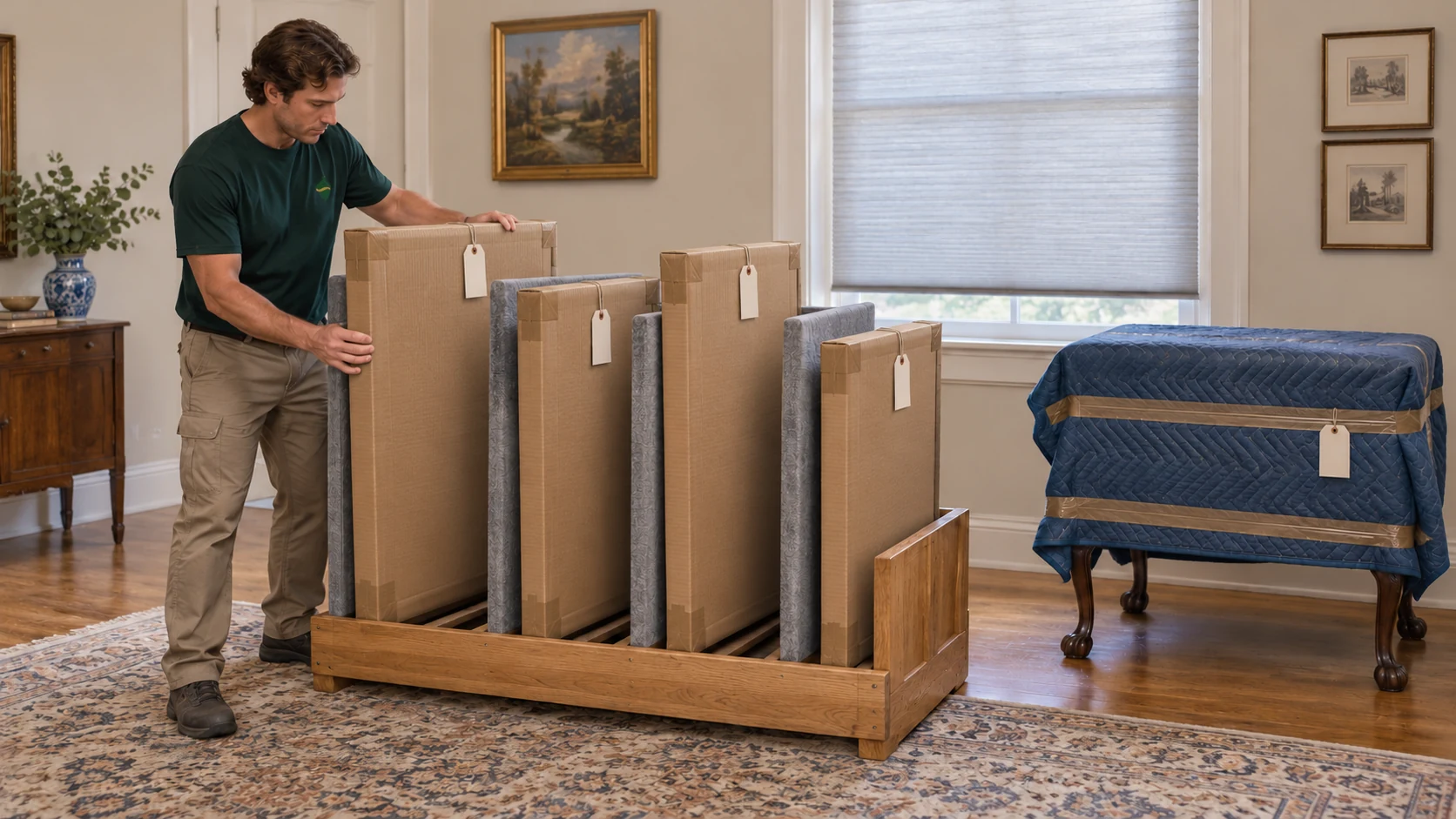
For an appropriate framed piece, protection can begin with paper and cardboard. Clean paper moving blankets provide a substantial multilayer wrapping, while rigid panels protect the package from contact during the carry and journey. The wrapping must be supported by the frame or suitable spacers so it cannot press on the picture surface. The lower-cost option still has to suit the object, route and agreed protection terms.
Four adjustable picture or mirror corners
Corrugated picture corners, also called mirror corners or corner protectors, are folded cardboard pockets placed over the four corners of a suitably protected frame. Their sections can be moved closer together or farther apart to fit different dimensions. They help protect the corners and can form part of a proper picture or mirror carton system.
Four corners by themselves do not provide the same front, back and edge protection as a complete carton or custom enclosure. A small inexpensive glazed print on a controlled local move may need a different solution from a large, heavy mirror, an ornate frame or an exposed painting. Size adjustment is useful; it does not give a particular corner set unlimited capacity.
A fitted double-wall cardboard soft crate
A soft crate is a custom protective enclosure made to fit the piece. In the method we can review, the prepared object is wrapped in a paper blanket and surrounded with double-wall corrugated cardboard: front and back panels, protected edges and overlapping sections secured to the packaging. Suitable heavy-duty wardrobe or china-carton board can supply the panels. The board must be clean, sound and appropriate for the job.
Double-wall cardboard has two corrugated layers and offers a more substantial enclosure than basic corner sleeves. A quilted moving blanket can provide an additional protective layer for an appropriate glazed frame or mirror, provided its bulk and pressure do not create a new risk. The fit should keep the object from shifting without squeezing a fragile surface. Packing tape belongs on the exterior materials, not on the frame, paint or antique finish.
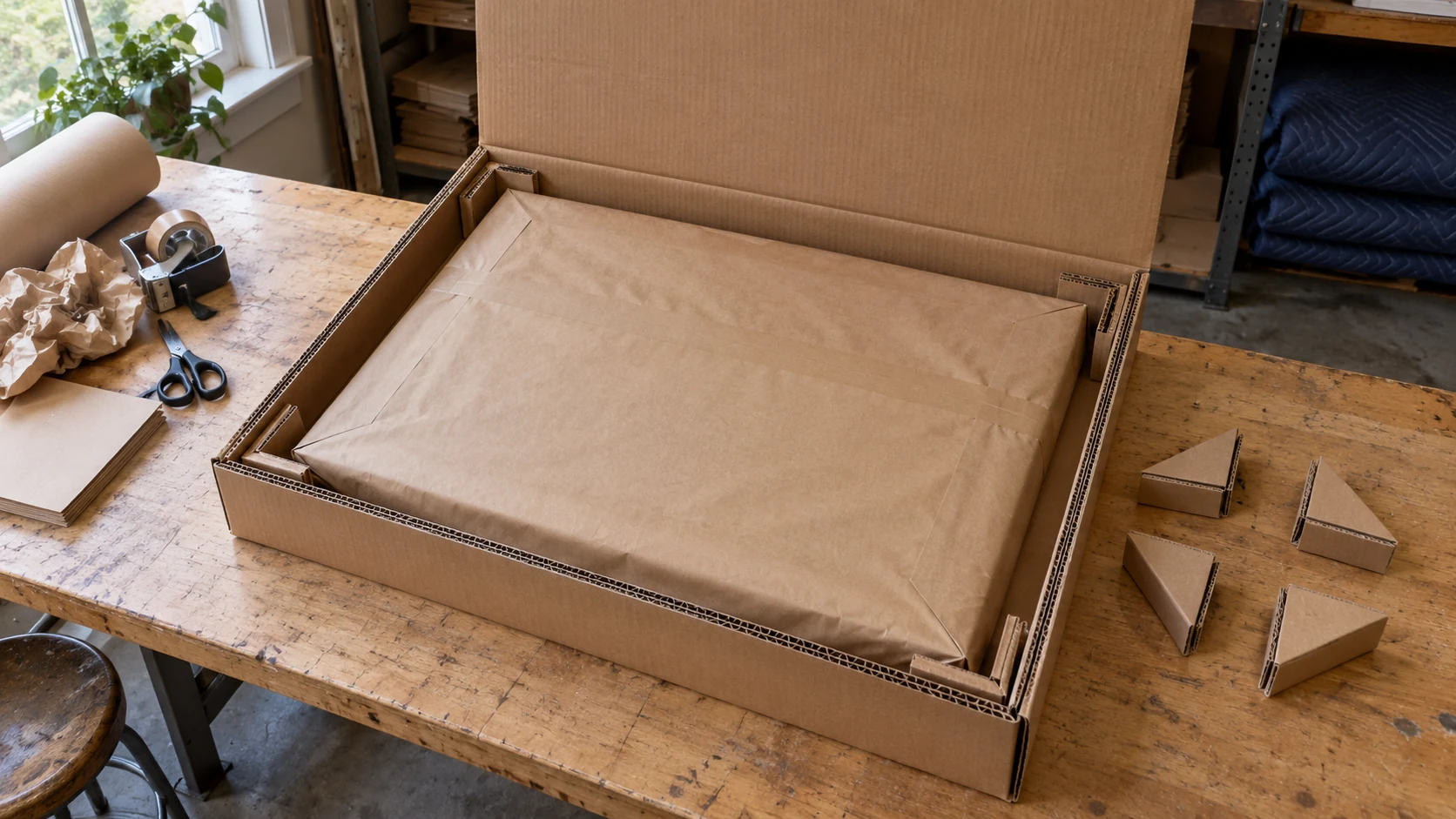
A soft crate can be useful for a suitable object and controlled move, but it is not a wooden crate. It is also not automatically an insurer-approved container. If additional insurance is selected, we check the policy's packing requirements first; a handmade enclosure from cut-down cartons may fail those requirements even when it offers useful physical protection.
For the rest of a household, our full packing and unpacking service covers the broader preparation plan. Here the material choice stays specific to the artwork or antique.
What may touch a painting, and what must stay away
Paper, cardboard and paper blankets are practical parts of many packing systems, but a painted surface needs its own contact decision. Glassine is a smooth paper used in some art applications; it is not a universal safe wrapping for oil or acrylic paint. An uncured coating, a tacky varnish or an unstable surface can react badly to pressure or direct contact.
Specialty names you may encounter include Dartek, a nylon film used in conservation packaging, and silicone release paper or silicone-coated polyester film. Their suitability depends on the artwork and intended use. They are different from ordinary stretch wrap and do not make it safe to press wrapping against every painting. A conservator's or artist's instructions matter for an unfamiliar or sensitive surface. Conservation guidance on contact materials.
Where contact must be prevented, a handling-travel-storage frame or another appropriate stand-off system keeps the cover clear of the painted surface. The Canadian Conservation Institute explains this approach in its painting-wrapping guidance. An unframed canvas may need that preparation before it can be wrapped and enclosed.
Bubble wrap is not the direct-contact layer for fine art. Pressure and environmental conditions can leave impressions or cause material to adhere. For an appropriate inexpensive poster or already isolated package, bubble cushioning may be considered outside the protective inner layers. It should not touch an exposed picture surface or become a substitute for a suitable enclosure. Long storage makes the compatibility question more important, because a material stays in place much longer than during a short carry.
Wooden crating and what “museum-quality” should mean
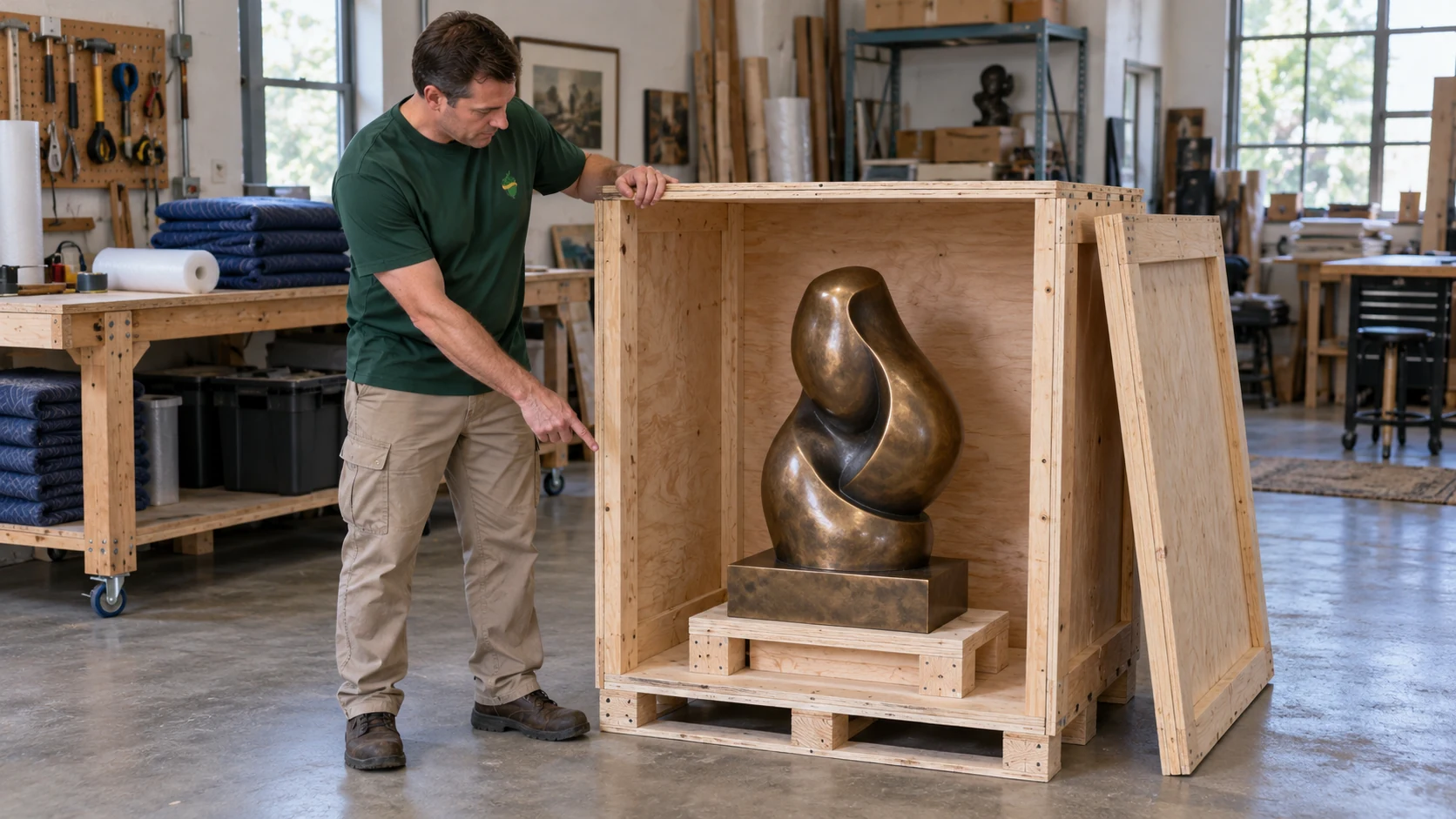
Wooden crating adds a rigid structure around an object and its protective packing. Its value comes from both the shell and the internal support. A box that lets the object move, puts pressure on a fragile projection or cannot support its loaded weight has not solved the problem simply by being made of wood.
Open-frame or T-frame protection
An open timber framework, sometimes described in moving work as a T-frame crate, can reinforce a suitably protected object with boards around its perimeter and protective panels inside. Terminology varies, so ask what the proposed structure actually covers. An open frame is a lighter, limited enclosure; it does not provide the same all-around protection as a fully enclosed plywood crate and should not be assumed to meet an insurer's wooden-crate requirement.
A fully enclosed custom plywood crate
A plywood crate encloses the protected piece and uses suitable internal blocking, cushioning and restraints. The design accounts for the object, packed dimensions, weight, loading method and handling at delivery. Larger or heavier objects may need thicker plywood, stronger battens, a reinforced base and a planned way to lift the loaded crate.
Plywood thickness alone is not a capacity rating. A half-inch panel, for example, tells you little about the strength of the base, joints or supports. We review the construction as a whole rather than publish one thickness as suitable for every painting, stone object and antique cabinet. The crate also has to fit through the agreed route or be built and opened at suitable points in the process.
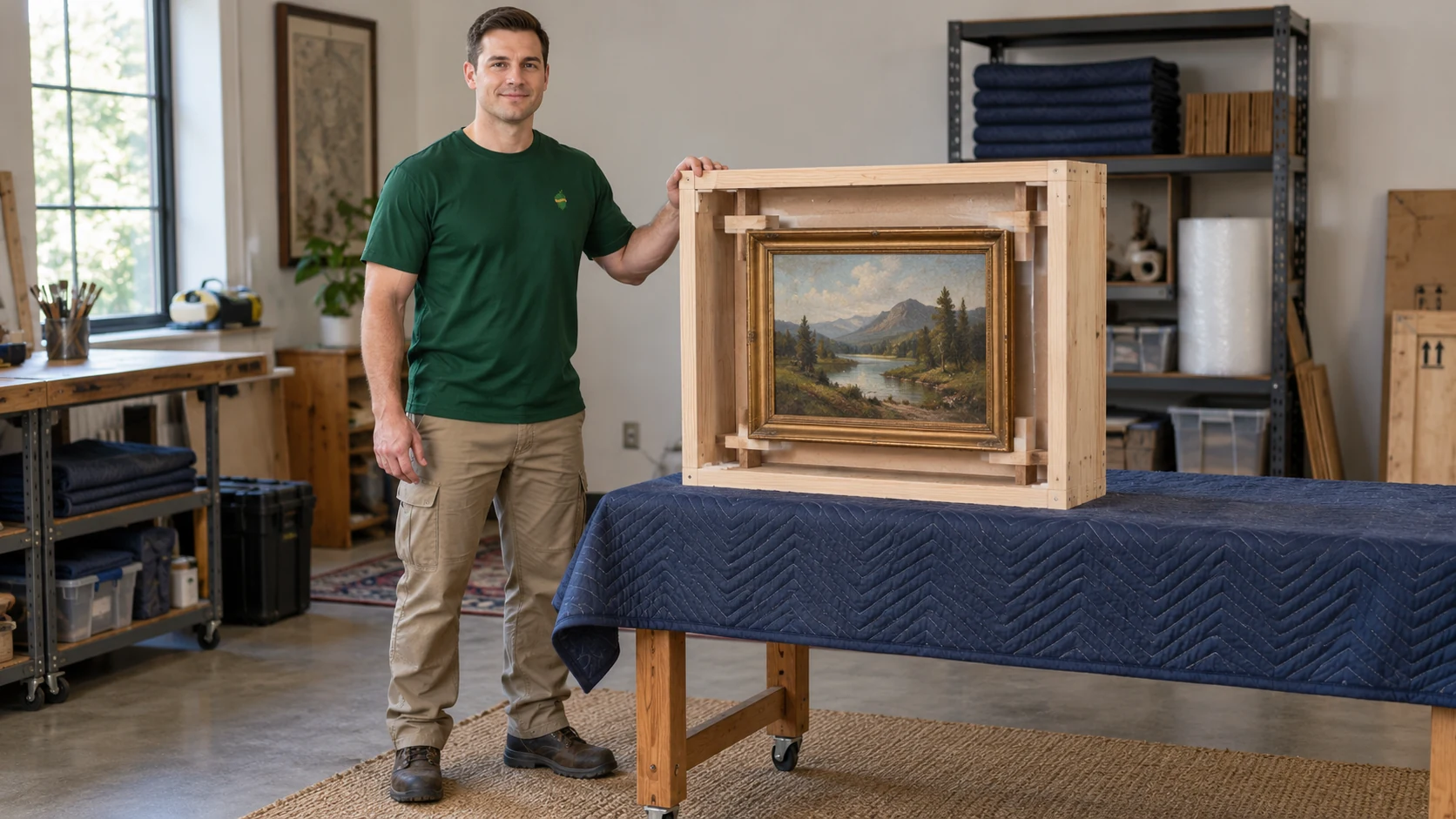
Museum-quality crating specified for the piece
“Museum-quality” is a useful way to describe a more carefully specified crate, but the phrase should lead to concrete requirements. Depending on the object and journey, these can include compatible lining, designed cushioning and secure support, thermal insulation, a well-sealed enclosure, reusable construction and clear opening instructions. A lender or institution may supply its own specifications.
Paper and cardboard can be important layers, while selected conservation-compatible foam can be appropriate inside a designed crate. Material choice follows the support and cushioning task. The strongest-looking shell is not automatically the best shock protection. CCI's artwork packaging bulletin explains why design must follow the object and transport hazards. Ask us to price the required features rather than rely on the label alone.
Overseas crating: heat-treated wood and ISPM 15
If the piece will enter an international shipping chain, tell us the destination before the crate is designed. The relevant term is ISPM 15-compliant wood packaging, often using properly treated and marked timber. Heat treatment is one approved route; “treated” is not a general claim that any wood has been made suitable for export.
There is an important distinction: manufactured plywood is generally exempt from the wood-packaging treatment requirement. Solid-wood framing, battens, skids or dunnage can still be regulated even when the crate walls are plywood. The destination's rules, construction and certification must be checked together. USDA APHIS wood-packaging requirements, export treatment and marking.
Discuss export packing and the handoff to the international carrier as an individual scope. Ask for a separate written plan for overseas freight, customs clearance, destination handling and insurance, including who will perform each stage.
Antique furniture, mirrors and fragile details
An antique desk may need clean quilted moving blankets with separate protection around its legs and corners. An especially delicate or valuable piece may need a soft crate after appropriate wrapping, or a custom wooden crate. The decision follows the actual finish, joints, ornament, size, route and insurance terms.
Empty furniture and identify removable shelves, doors, drawers, leaves, keys and hardware before the carry. Keep the parts labeled with the correct piece. Disassembly should be reviewed against the construction and condition; an old glued joint is not the same as a modern removable table leg. Do not lift furniture by a decorative rail or assume that fragile legs can tolerate the original furniture's weight during every maneuver.
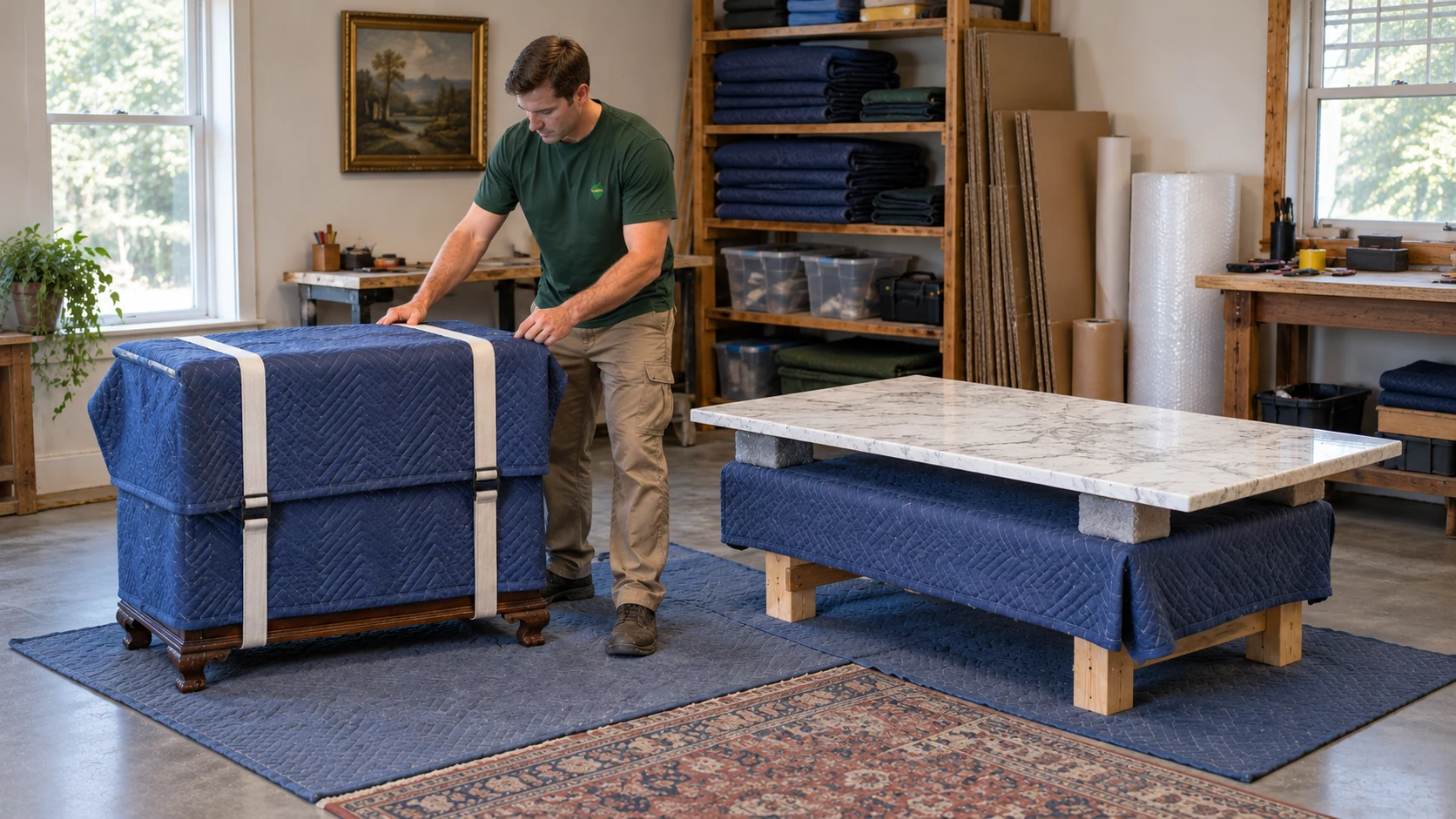
Antique mirrors combine glazing, weight and a frame that may have fragile ornament. Corner protection is only part of the plan. Review the full enclosure, orientation and receiving route, including whether the mirror can be safely carried and where it will be opened. Hanging or mounting after delivery is a separately agreed task with its own hardware and wall requirements.
Stone, bronze and outdoor sculpture
Weight and fragility can exist together. A marble or limestone object can chip or fracture; a bronze sculpture may have a robust base but delicate projections. The packing design needs to support the appropriate structural areas, keep the object stable and avoid using ornament or protruding sections as handles. Ask for a weight estimate and photographs of the base, connections and underside.
Wrapping, a custom cradle and a reinforced crate can be combined where appropriate. The load must be supported and restrained for handling and travel; a heavy object should not simply sit loose inside a strong-looking box. Separate removable parts and identify their relationship to the main object. A preliminary fit check happens before the final protection and restraints are completed.
Outdoor artwork adds questions about attachment and extraction. It may be bolted to a base, set into a foundation or partly buried. Photograph those connections and establish who will release the piece. Excavation, disconnection, a forklift, a crane or specialist rigging can be separate paid work, with equipment access and suitable support needed at both pickup and placement.
Tell us about gates, ground conditions, gradients, trees, overhead obstructions and the destination base before an equipment visit is planned. Agree the qualified specialist and responsibilities for release, lifting and reinstallation. A moving crew's arrival does not by itself include excavation or a crane, and the receiving site must be ready for the same object's weight and mounting needs.
Insurance, declared value and the $5,000 and $10,000 thresholds
Careful packing and financial protection answer different questions. Sterling Oakbridge works with MovingInsurance.com for customers reviewing separate moving insurance. Decide which items and stages you want covered before packing begins, and read the terms of the exact policy you select. A household policy should not be assumed to cover gallery stock or goods for exhibition.
Understand 60 cents per pound per article
Released Value is a limited mover-liability option, not insurance based on an artwork's price. At $0.60 per pound per article, a 10-pound piece would have a $6 liability limit under that option, subject to the applicable terms. It would not become a $1,000 insured item because its purchase price was $1,000.
For interstate household-goods moves, Full Value Protection applies unless you select Released Value through the required written waiver. Local and other shipments need their applicable terms checked separately. Have the applicable liability selection and limits recorded in your moving documents. FMCSA liability and protection guidance.
Include the premium in the total budget
As a planning allowance, additional insurance for a valuable piece can be roughly 3–6% of its declared value in the kinds of projects we review. This is a budgeting example, not a published insurer tariff or a guaranteed quote. On a $10,000 item, that allowance is $300–$600 for the premium alone; it excludes crating, moving, storage and any specialist visits. The actual premium depends on the selected policy, deductible, destination and other underwriting terms.
Crating can be a condition of coverage
In the Full Service All Risk terms reviewed for this page, a delicate or fragile item valued $5,000–$9,999 must be professionally packed in a solid wooden crate at the residence. For $10,000 or more, a solid wooden crate and approved third-party uncrating are required. We plan the approved third-party involvement at pickup and delivery before agreeing the job. The exact carrier, policy and written approval control the requirements; a soft crate or open timber frame is not an automatic substitute. MovingInsurance.com Full Service All Risk terms.
The same reviewed terms distinguish proper professional packing from cut-down cartons and moving pads. That matters even below the wooden-crate threshold. Choose the policy and have the proposed packing approved together; do not buy coverage on the assumption that a particular handmade soft crate will qualify.
Higher declared value can therefore add more than a larger premium. It may add crate construction, a specialist appointment before pickup, approved opening at the destination and coordination with the delivery window. Use an accurate, supportable value, with a receipt or appraisal where required. Lowering the declaration merely to avoid a threshold can leave the piece underinsured. Sentimental value explains the need for care but is not the same as insurable replacement value.
Estate purchases, designer receiving and renovation storage
For an estate sale or auction purchase, the agreed item must be paid for and released. You arrange the purchase and seller's collection appointment, then provide the real pickup address, lot or item list, release documents, access and contact person. Packing and crating need to fit that appointment. Use the furniture delivery plan to review buyer and seller handoffs; this art plan adds the object-specific protection.
A designer project may need artwork received before the room is ready. Agree the receiving address, arrival notice, inventory, inspection or photographs, exception reporting, storage and final release. The seller's damage-reporting deadlines still matter. Incoming artwork and furniture can share a project plan while keeping the packing and condition requirements for each object. Ask for the receiving, inspection, holding and final-delivery scope as part of your artwork estimate.
During renovation, artwork should leave a space before dust, water, vibration or an unsuitable temporary environment becomes a risk. Arrange the outward move and the return together, including when the contractor will release the receiving room. The in-home moving plan helps review clearance and return within the property. Art leaving the property needs separately agreed suitable holding conditions.
Climate-controlled storage needs both temperature and humidity review
For sensitive artwork and antique furniture, discuss climate-controlled storage that manages the conditions the objects need. An ordinary drive-up unit exposed to outdoor temperature and humidity swings is unsuitable for this kind of inventory. Being indoors or labeled “climate-controlled” is not enough to establish appropriate humidity control, monitoring or a particular lender's requirements.
Confirm the facility, environmental arrangements, access, duration and later delivery before the objects leave home. Keep pieces protected, identified and suitably supported; avoid unplanned opening or retrieval. If a cold crate enters a warm room, opening may need to wait for appropriate acclimatization rather than expose the contents immediately to condensation. The object and travel conditions determine the receiving instructions. CCI guidance on paintings and environmental change.
Storage adds unloading, holding, reloading and redelivery as well as the space charge. Discuss whether insurance continues through the specific facility and period; coverage suitable for transit does not automatically cover every self-storage arrangement. A temperature-sensitive work may also need specific transport conditions, which must be confirmed separately from the warehouse conditions.
Four Binghamton situations, with different decisions
Example 1: a glazed print leaving an apartment over a Court Street shop
Imagine an owner moving a glazed lithograph from an apartment over a Court Street shop. The print cost about $1,000, but the owner also cares about the frame and the memory attached to it. Record the glass, frame joints, hanging fittings and the turn from the shared landing before choosing a complete picture carton or fitted soft crate.
The City's off-street parking and loading code treats parking and loading as different facilities and includes exceptions for existing downtown buildings. Do not infer that this older shop has a dedicated loading bay or that a visitor space is available for the carry. Ask the property contact to identify the actual permitted entrance and vehicle position. A packing choice that fits the bare picture can still fail at the landing once protection increases its dimensions.
Example 2: a marble-top chest bought from a private Broome County estate
Consider a buyer arranging delivery of a marble-top chest from a private estate elsewhere in Broome County to a Binghamton home. The buyer settles payment, release authority, pickup appointment and the actual property address. A sale listing or organizer's office address cannot replace that location.
Have the top, cabinet, joints and repairs reviewed separately. Confirm whether a qualified person should remove the top, how it will be supported, and which parts must travel as one assembly. A quilt blanket around a sound cabinet does not answer the brittle stone's support needs. The Phelps Mansion's account of its period interiors describes marble and historic woodwork on Court Street; it is local heritage context, with no connection to this imagined purchase or a Sterling commission. Include opening, reassembly and final placement in the estimate.
Example 3: artwork and an antique desk held during a West Side renovation
Imagine a West Side homeowner clearing several paintings and an antique desk while a contractor works on the room. A designer also expects two purchased works to arrive during that interval. Prepare separate lists for the owner's existing pieces and the new shipments, with condition photographs, expected dates and a contact authorized to inspect each arrival.
Agree suitable temperature and humidity conditions, item identification, access during holding and the trigger for return. A drive-up unit selected for convenience cannot establish those conditions. Include preparation, pickup, receiving, unloading, holding, reloading and return in the comparison. Report visible shipment problems within the seller's actual deadline. If the designer is sending gallery inventory or commercial stock, confirm the applicable coverage rather than assuming a residential household form will cover it. Our in-home moving plan explains room clearance; off-site art holding needs its own written scope.
Example 4: a high-value bronze sent from Binghamton to Cleveland
Consider a private owner sending a bronze sculpture with documented replacement value of $14,000 from Binghamton to a Cleveland residence. A projecting arm and a small-looking base change the support plan. Send the actual weight, base dimensions, projection details and photographs of the full route at both addresses.
Before booking transport, confirm the insurer's accepted wooden-crate specification and approved third-party responsibilities for packing and destination opening. The crate must support the load at appropriate points while leaving clearance around fragile projections. Do not reduce the stated value to simplify the booking. Our long-distance moving plan supplies journey context; the sculpture's condition, policy terms, destination appointment and final support govern the object-specific handoff.
What the estimate should include
The useful comparison is the complete cost to have the piece safely received in the agreed place. A short drive with complex packing and access can involve more work than a longer trip with a straightforward protected item. Identify the packing tier, materials and handling stages before comparing prices.
Ask the written estimate to distinguish packing labor and supplies, crate construction where required, carrying and transport, storage handling and duration, approved specialist visits, uncrating and final placement. Add hanging, mounting, excavation, rigging, equipment hire or packaging removal only when agreed. Company-supplied cartons are charged separately; specialist crating is individually quoted. Do not assume that routine use of moving blankets makes a custom crate free.
Local work is generally estimated by staffing and time under the applicable moving terms. A time estimate is not a guaranteed completion cap. For an agreed long-distance flat-rate shipment, the price follows the confirmed inventory, access and services; changes need a revised written scope. Extra insurance has its own premium, terms and deductible.
You can avoid unnecessary paid stages by settling the receiving room, release permissions and appropriate packing before pickup. Reusing a suitable crate may be worth discussing if its condition, fit and insurer approval still work for the new journey. Never remove needed support or choose an inaccurate declared value simply to reduce the apparent total.
Send the details for an art and antique moving estimate
Send an item list with photographs, measurements, known weights and condition; the actual origin and destination; photographs of access; your dates; and whether the move involves a seller, storage, a designer or outdoor attachment. Include any appraisal, lender instructions or proposed insurance policy so we can check requirements before quoting the packing.
Tell us the result you want at delivery: protected transport to a receiving room, approved uncrating, placement, or a separately agreed mounting task. Those details let the plan cover the piece from its present position through the final handoff.
Fine art and antique moving questions
Can you move one painting or an inexpensive framed print?
Yes, we can review a single piece as well as a collection. Send its dimensions, glazing, condition and the carrying routes. A modest purchase or family keepsake can still need careful packing; price alone does not select the method.
What is the difference between picture corners and a soft crate?
Picture or mirror corners are folded protectors at the four corners of a suitable frame, usually as part of a complete carton system. A custom soft crate adds fitted double-wall cardboard panels and edge protection around the prepared piece. Neither is automatically equivalent to a wooden crate or approved by an insurer.
Do all artworks need a wooden crate?
The object, condition, route and protection terms determine the packing. Some suitable framed works can use a proper picture carton or reviewed soft crate. Fragility, size, handling conditions or an insurance policy can require a wooden crate even on a short local move.
Can bubble wrap touch a painting?
We do not use bubble wrap directly against an exposed fine-art surface. An appropriate package may use outer cushioning after suitable isolation, with the surface kept clear. Pressure, temperature and time can leave impressions or cause materials to adhere.
Is glassine the right material for an oil painting?
It is not a universal safe contact material. The paint, varnish, condition and curing state matter. Dartek film, silicone release materials or a stand-off travel frame may be considered for the specific work; sensitive or unstable surfaces need specialist guidance.
What does museum-quality crating include?
Ask for the actual specification: compatible lining, suitable internal support and cushioning, any needed thermal insulation, a well-sealed shell, reusable construction and safe opening instructions. The term alone does not establish a certification or guarantee that one crate suits every object.
Is a T-frame the same as a fully enclosed wooden crate?
No. An open timber or T-frame structure can reinforce a protected object, but it has different limits from an enclosed plywood crate. The proposed construction and insurer approval must be checked; the name is not enough to establish coverage.
Does overseas crating require heat-treated plywood?
Manufactured plywood is generally exempt from ISPM 15 wood-packaging treatment requirements. Solid-wood battens, skids, framing or dunnage may still need approved treatment and marking. The destination and complete crate construction must be checked before an international handoff.
Can you move antique mirrors and furniture?
We can review mirrors, desks, cabinets, tables and other agreed antique pieces. Send detail photographs of glazing, joints, ornament and repairs. The method can involve quilted protection, a fitted enclosure or wooden crating; fragile construction may need specialist assessment first.
Can you transport marble, limestone or bronze sculptures?
Send the material, dimensions, weight where known, base details and access photographs for review. Weight-bearing supports, restraints and the loading method must suit the specific object. A strong crate does not make fragile projections safe to lift or strap.
What if an outdoor statue is fixed or partly buried?
Identify the attachment and who will release it. Excavation, disconnection, specialist rigging, a forklift or a crane can be separate paid work. Equipment access, ground conditions and the destination support must be reviewed before scheduling.
Is my artwork automatically insured for its purchase price?
No. Review the mover-liability selection and any separate policy before packing. Released Value at 60 cents per pound per article is a limited liability option. For interstate household-goods moves, Full Value Protection applies unless the required written waiver selects Released Value.
How much should I budget for additional insurance?
A rough planning allowance for the valuable-piece projects we review is 3–6% of declared value. It is not a guaranteed MovingInsurance.com tariff. Obtain a quote for the exact item, destination, policy and deductible, and budget separately for packing, crating, transport and specialists.
What changes when the item is worth $5,000 or $10,000?
The reviewed Full Service All Risk terms require a solid wooden crate for a delicate or fragile item at $5,000–$9,999. At $10,000 or higher they require wooden crating and approved third-party uncrating. We plan approved specialist involvement at both ends against the selected policy before booking.
Will a handmade soft crate satisfy additional-insurance requirements?
Do not assume it will. The reviewed policy excludes cut-down cartons and moving pads as substitutes for required professional packing. Have the actual container and packing method accepted for your selected policy before work begins, including for items below the wooden-crate threshold.
Can I declare a lower value to avoid third-party crating?
Use an accurate, supportable replacement value. Underdeclaring can reduce compensation or leave the piece underinsured. Compare the complete protection, premium and specialist costs instead of choosing a value solely to avoid a packing requirement.
Can you collect artwork bought at an estate sale?
We can review pickup of paid, released and agreed items. You arrange the seller's collection appointment and provide the true pickup address, invoice or item details, release authorization, contact and access information. Packing must fit the collection window.
Can artwork be received or stored during a renovation?
Yes, we can review receiving, suitable holding and later delivery as one project. Agree the actual receiving address, documentation, storage conditions and release instructions. Sensitive art and antique furniture need appropriate climate-controlled conditions, with temperature and humidity arrangements checked.
Is an outdoor drive-up storage unit suitable for art and antiques?
Ordinary drive-up storage exposed to outdoor temperature and humidity swings is unsuitable for sensitive artwork and antique furniture. Confirm an appropriate facility and the actual environmental arrangements. Insurance for transit does not automatically cover every self-storage facility or duration.
Do you hang artwork and remove the crate after delivery?
Agree the final tasks before booking. Approved uncrating, final placement, wall hanging or mounting, and packaging removal can have separate requirements and charges. Insurance may also specify who must open a high-value crate; do not assume the recipient can open it without affecting the terms.
Can you collect an antique bought elsewhere in Broome County and deliver it to Binghamton?
We can review collection and delivery once the buyer supplies the actual item location, seller release, appointment, dimensions, condition and receiving address. Identify the physical municipality at both ends. Review stone tops, loose ornaments, access and the complete packing, opening and placement scope before booking.