
Pennsylvania · Pittsburgh service planning
Long-distance moving from Pittsburgh PA
A Pittsburgh departure needs a plan for the hill outside the door as well as the distance ahead. A porch above street level, a narrow landing or a managed loading window can determine how pickup works. Sterling Oakbridge plans direct and consolidated household shipments from Pittsburgh and reviewed nearby addresses throughout the United States and Canada. Send both addresses, your inventory, dates and access details so we can agree the appropriate delivery model and written flat price.
Begin with the actual address and carrying route
Pittsburgh is in Allegheny County. Its mailing name also appears on addresses in other municipalities, so establish the actual jurisdiction before using the City’s permit or collection procedures. A nearby borough address and a City neighborhood are different planning cases. The Pittsburgh moving page and relocation guide connect property access with the local setup work.
For a house or rowhouse, record the path from the proposed truck position to the room, including outdoor steps, porch, entrance width, stair turns and intermediate landings. A ground-floor address can still have a substantial uphill carry. For an apartment, ask which entrance and elevator can be used, whether a reservation is required and who grants access. Send the property’s actual written instructions; building type alone does not establish a certificate-of-insurance requirement or a moving charge.
The truck position must work physically and administratively. A driveway can be steep, shared, too narrow or difficult to leave. A street position needs enough usable length and a safe route from the vehicle to the entrance. Discuss any proposed ramp, sidewalk crossing or carrying distance rather than assuming the nearest visible space will be available. Review the destination with the same care, including the receiving contact and room placement.
Choose direct or consolidated delivery around the receiving plan
Direct delivery uses a dedicated truck for your shipment and the same crew for the agreed pickup and delivery. It can suit a household that needs a defined travel plan and has receiving access ready. The actual truck arrangement depends on the reviewed inventory and property access. A substantial mixed household load and a smaller dedicated job need different loading plans; no single volume describes every direct shipment.
Consolidated delivery shares a planned transport schedule. A smaller inventory around 300–400 cubic feet is one useful example, not a minimum or automatic qualification. This model needs enough receiving flexibility for the agreed window. Identify who can receive the shipment, how the property grants access and whether any separate storage stage is needed. Do not treat a wide transport window as an already reserved elevator appointment.
Crossing a state line does not decide the model by itself. A nearby West Virginia address may call for a different plan from a full household moving across Pennsylvania or to the West Coast. Send the real origin, destination, inventory and dates; we review the scope rather than assign it from the mailing name.
Keep the flat price tied to the agreed scope
The agreed long-distance flat price holds for unchanged inventory, access and services, including when the journey or delivery takes longer. Extra inventory, a different carrying route, an added storage stage or optional unpacking changes the work. Those changes are reviewed and agreed separately in writing.
Record packing responsibilities before pickup: which rooms you finish, which items Sterling prepares and any separate preparation appointment. Basic blanket protection, wrapping and tape have no separate surcharge; cartons are separate. Basic working furniture disassembly and reassembly also have no separate surcharge. Complex construction, sensitive materials or specialist work need individual review.
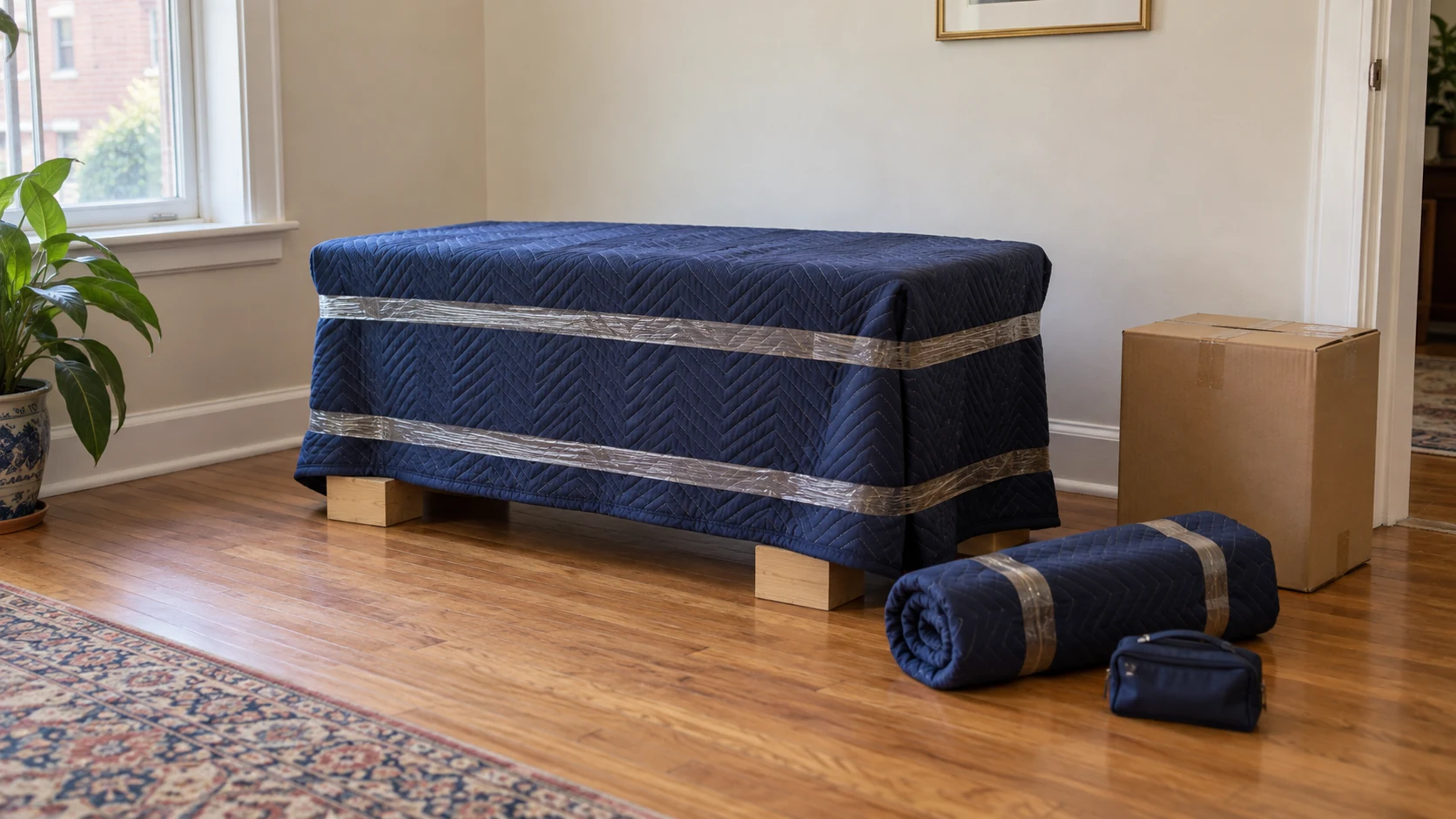
Safely detachable long table and desk legs are normally removed before transport. The body is protected first, then joints are accessed and removed legs are protected as an associated common set with the hardware kept together. Integral supports and pieces that cannot be safely dismantled are assessed individually. Agree the preparation with the crew; an access photograph helps identify the piece and its joints without asking the household to handle a heavy item itself.
The preparation photograph below shows a single protected body and its associated leg bundle. It does not represent a completed house or a finished truck load. At delivery, furniture protection is removed, agreed basic reassembly is completed and placement is checked. Emptying cartons, putting their contents away and taking away carton packaging are separate tasks with time in the scope.
Arrange Pittsburgh street space early
The City’s Moving Permit information sheet covers temporarily obstructing one or more on-street parking spaces for moving activity. The published moving-truck fee is $50 per truck for a maximum two-day period. A container has a separate fee and duration. If both properties are in the City, the sheet calls for a separate permit for each address. Confirm the actual application category, invoice, metered-space charges and approved terms rather than turning one listed fee into an assumed total.
The timing has several stages. The sheet asks applicants to allow one week for approval or denial after all required information has been verified complete and received. A notice within three business days relates to an incomplete application; it is not an approval deadline. The current DOMI applicant guidance gives a general recommendation to begin three to four weeks before work. Assign the application, required information, payment and sign posting while there is time to respond to a question.
The holder must post issued temporary No Parking signs at least 48 hours before the reserved period. The posting policy requires visible signs within the approved area and no more than 50 feet apart. Follow its mounting instructions and save timestamped photographs after posting. Keep the approved dates, times and area available. If another vehicle occupies the zone, contact the local police for the stated enforcement process; an issued permit does not guarantee an empty truck position.
The PPA residential permit program is separate from reserving a moving position. Do not assume that all trucks are exempt or prohibited. DOMI directs applicants reserving metered space to contact PPA separately. Private property needs its own permission and physical review, including whether the loading activity affects public travel. Nearby municipalities have their own procedures.
Delivery windows begin after pickup and loading finish
The table illustrates transport planning after loading is complete. Earlier packing, sign posting and property reservations do not start that clock. Actual addresses, the commercial vehicle route, conditions and receiving availability still need review before dates are agreed. These reference examples do not certify a truck route or reserve a delivery appointment.
| Illustrative destination | Direct planning window | Consolidated window |
|---|---|---|
| Wheeling, West Virginia | 1–2 days | Up to 30 days |
| Greenville, South Carolina | 1–2 days | Up to 30 days |
| Guelph, Ontario | 1–2 days | Up to 60 days |
| Seattle, Washington | 4–5 days | Window agreed individually |
A suitable close direct job may sometimes fit same-day or next-day arrangements after pickup and receiving access are reviewed. The Wheeling table entry keeps a broader illustrative window. For consolidated delivery, the close domestic examples use up to 30 days; Canada and Florida use up to 60 days, and California up to 90 days. Seattle is in Washington and requires its own agreed window. The Canada rule applies to Guelph even though it is closer than several domestic destinations.
Example 1: Pittsburgh to Wheeling, West Virginia
Consider a smaller apartment inventory leaving a City address with porch steps and arriving at a Wheeling rental with a ground-level entrance. This is a hypothetical planning example, not a completed customer job. The first question is whether the proposed truck position leaves a clear carrying route to the porch. Photograph the steps, narrowest doorway and stair turn, and identify the pieces that need disassembly before being carried out.
The receiving address needs a confirmed key holder and a usable standing area. A ground-level entrance does not establish driveway permission or vehicle clearance. Ask whether another tenant shares the approach, where furniture can be placed and whether the household must leave by a particular time. Review both addresses before arranging City permit work at the Pittsburgh origin; Pittsburgh’s rules do not apply automatically in Wheeling.
The illustrative direct window is 1–2 days after pickup and loading finish. A smaller close direct job may sometimes support same-day or next-day arrangements when the inventory, actual truck route and receiving schedule fit. Agree that arrangement explicitly rather than making it an expectation from distance alone. Consolidated delivery has an illustrative window of up to 30 days, subject to route and inventory review.
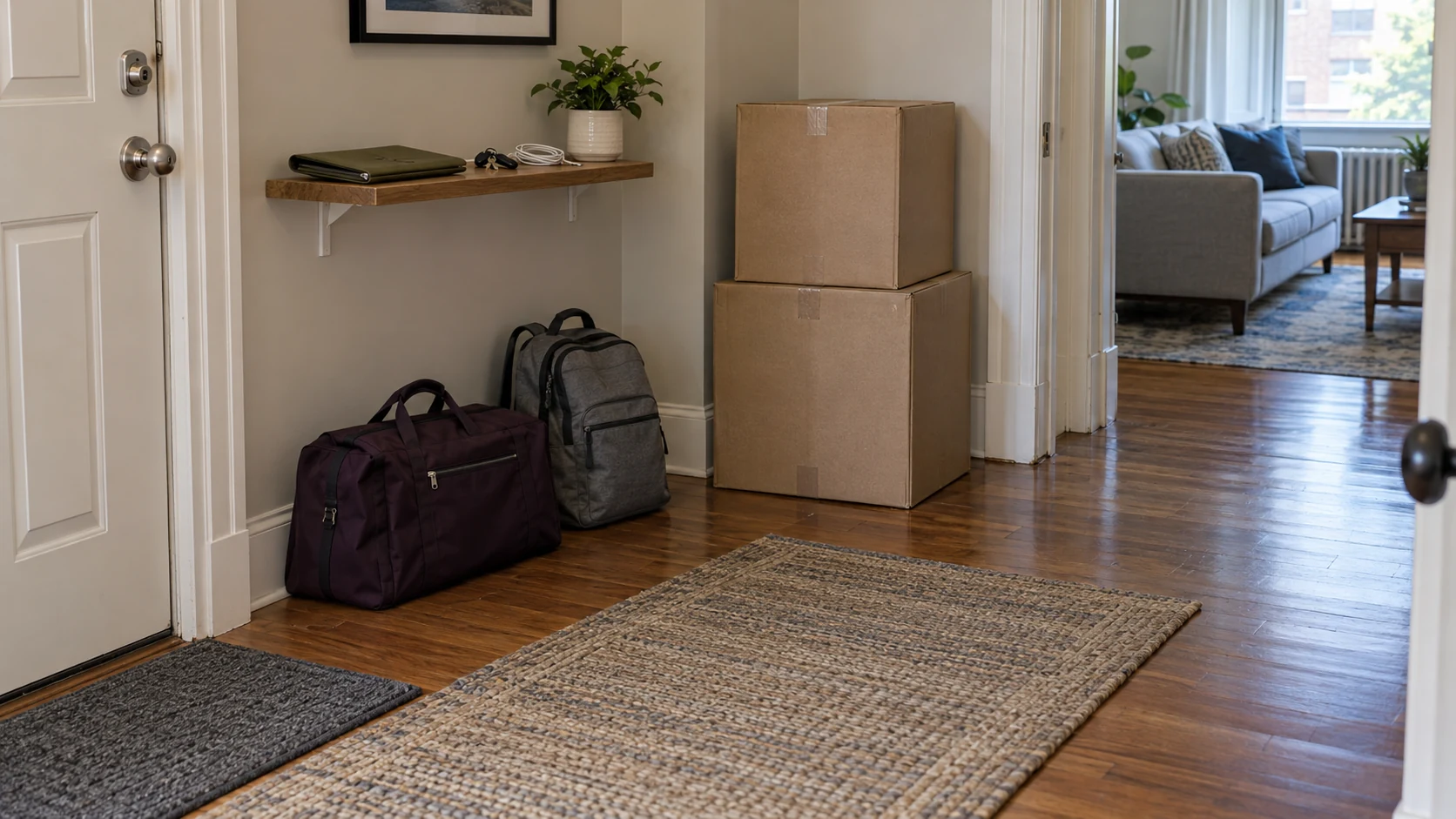
Separate the household’s travel supplies from the shipment. Keys, documents, chargers, medications and the first-night bag should remain available to the household. If a firm rental handover makes a broader receiving window impractical, discuss direct delivery and actual availability before selecting consolidated delivery. The agreed flat price remains unchanged for unchanged scope if travel takes longer; a newly added stair carry or item is a scope change to review in writing.
Example 2: Pittsburgh to Greenville, South Carolina
Imagine a house departure with a dining set, dresser bodies, cartons and garage contents, followed by delivery to a Greenville house after closing. Start with a room-by-room list and a separate garage list. Identify what is moving, what the household will carry personally and what needs a disposal plan. A garage can conceal extra inventory that changes truck space and preparation time if it is first discussed during loading.
The origin survey includes the grade, driveway dimensions, porch and path through the house. Plan protection and safely detachable furniture parts before the carrying window. The receiving survey needs more than a closing date: identify when keys will actually be available, who receives the truck and how it can stand without blocking a shared approach. Check whether the largest protected body fits through the chosen doorway after appropriate disassembly.
Direct delivery uses a dedicated truck and the same crew, with an illustrative 1–2-day travel window after pickup and loading finish. The Greenville consolidated example uses up to 30 days. South Carolina is not Florida, so the Florida window should not be applied simply because the destination is south of Pittsburgh. Compare the actual receiving flexibility with the reviewed schedule.
If the closing or occupancy dates do not align, request a separately agreed storage stage before the estimate is finalized. Identify what must remain accessible and how the eventual delivery is arranged. No storage entitlement follows automatically from a consolidated window. Carton unpacking and putting kitchen contents away also need their own scope; furniture placement and basic reassembly do not establish a full household unpacking service.
Example 3: Pittsburgh to Guelph, Ontario
Consider a smaller apartment shipment containing sealed household cartons, a customer tote and a modest furniture group. The household can travel independently and has flexibility to receive it in Guelph. The City’s contact page identifies Guelph, Ontario; confirm the actual receiving municipality and property rather than using a broader regional label.
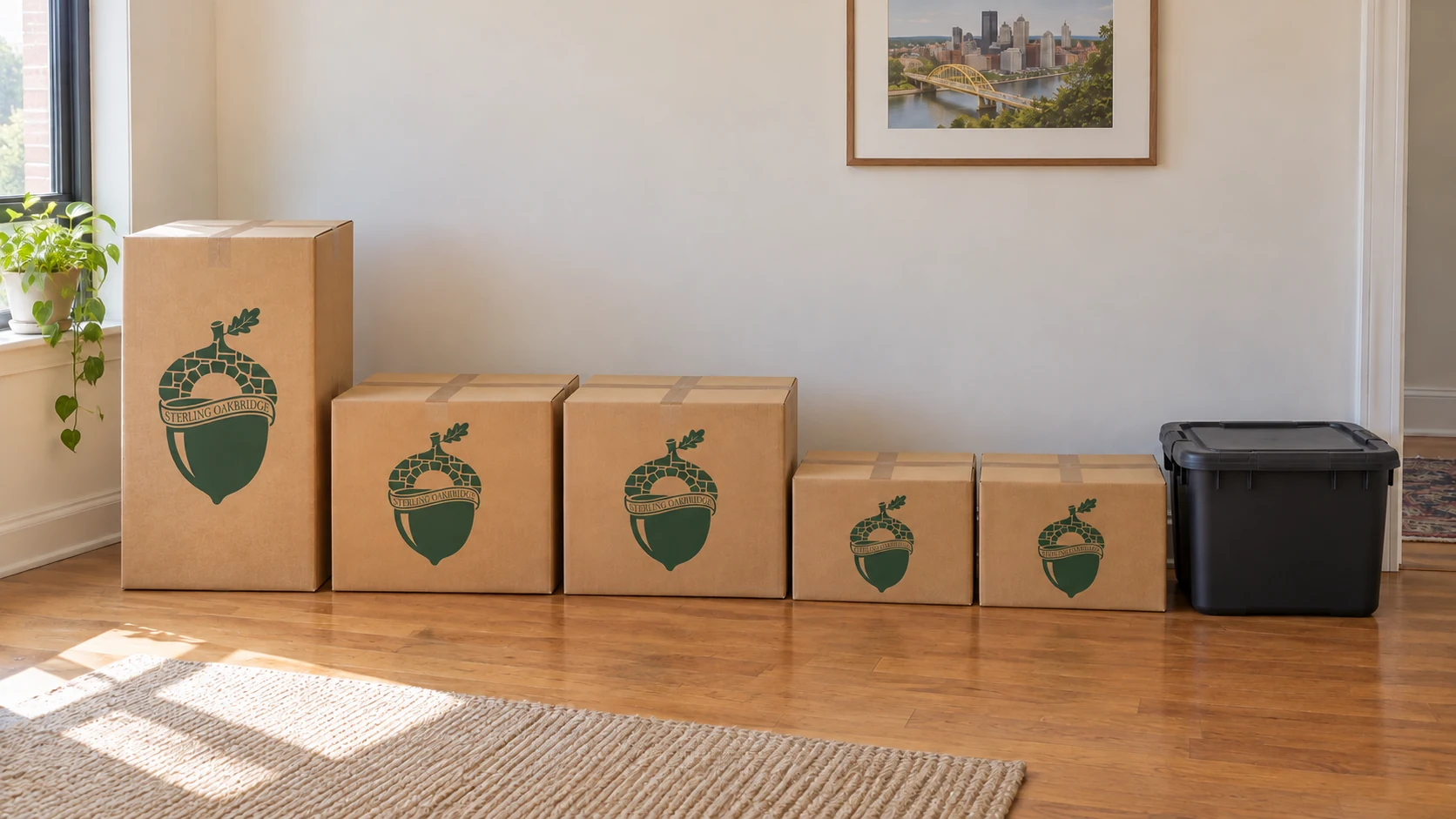
Record the inventory and packing assignments first. Around 300–400 cubic feet can be a useful smaller consolidated example, but it is not a minimum and does not qualify every shipment. Carton types should match their contents, and loose personal documents should remain separate from the goods. The photograph illustrates a small pickup group, not an entire apartment inventory or a substantially filled direct truck.
Review both properties’ entrances, any loading reservation, elevator requirement and the authorized person receiving the goods. A flexible transport window still needs an actual plan for gaining entry on delivery. If the household is traveling ahead, keep contact details current and establish how the receiving appointment is confirmed. Decide what travels personally rather than burying travel documents and first-night supplies in the shipment.
The illustrative direct window is 1–2 days after pickup and loading finish; a reviewed direct move uses a dedicated truck and the same crew. The consolidated Canadian window is up to 60 days, despite the relatively close route. Confirm relevant shipment and personal documents, inventory restrictions, household travel dates and border planning before booking. Document review and border processing can affect the plan; the service illustration does not establish universal customs clearance or admission of every item.
Example 4: Pittsburgh to Seattle, Washington
Imagine a household leaving a managed Pittsburgh apartment for a Seattle receiving apartment. Its inventory includes a desk with detachable long legs, upholstered pieces and packed cartons. The origin’s written rules determine whether a loading appointment, elevator booking, corridor protection or insurance documentation is required. Do not assume that every managed building uses the same rules or that a reservation transfers to the receiving property.
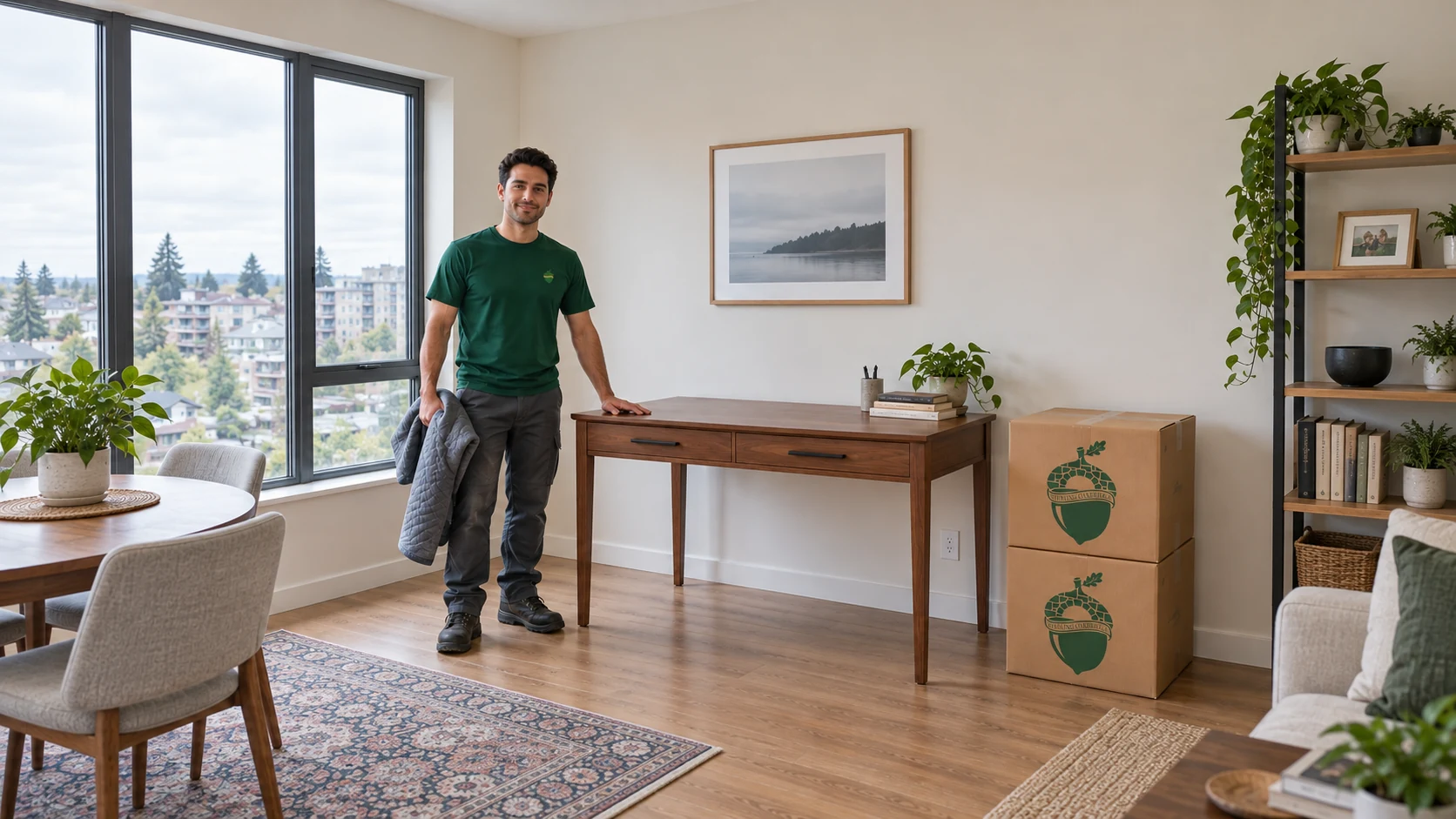
Review the largest protected bodies against each property’s actual elevator and doorway dimensions. Safely detachable long desk legs are removed for transport and kept protected together with their hardware; the body has its own continuous protection. The receiving photograph shows a later moment: protection removed, four ordinary legs reattached and placement completed. Bare installed legs in that finished scene do not describe the transport preparation.
The illustrative direct window is 4–5 days after pickup and loading finish, with a dedicated truck and the same crew for the agreed pickup and delivery. The household should have a receiving contact, keys and an agreed way to obtain property access. Discuss any hard deadline before scheduling personal travel or a one-time elevator slot. The table is a planning illustration, not a promise that either property will be available on a particular day.
Seattle consolidated delivery needs an individually agreed window. Washington does not inherit California’s up-to-90-day policy simply because both are on the West Coast. Review inventory, route and receiving flexibility before choosing it. If delivery takes longer with inventory, access and services unchanged, the agreed flat price holds. Extra storage, new inventory or changed access is separate work to agree in writing.
Clear the winter route and settle what stays behind
For a winter departure, agree who clears and treats the sidewalk, stoop, steps and entrance at both properties. Pittsburgh Code §419.03 requires the responsible tenant, occupant or owner to clear paved sidewalks within 24 hours after snow or sleet falls or freezing rain or ice accumulates. This is different from the City’s street snow-service advice, which asks residents to wait 24 hours after snowfall ends before requesting an untreated street be plowed. Check the actual street and carrying route before pickup and review any needed schedule adjustment.
Unwanted furniture needs a separate plan. The City’s Bulk Pick Up page allows eligible residential collection of up to two listed items each week with regular refuse service. Set-out is between 6pm the evening before and 6am on collection day. Its instruction is to leave items whole, without disassembly or bags. Check the actual item, property eligibility, collection day and excluded materials; extra quantities require a different arrangement.
That disposal instruction is distinct from preparing furniture that is being transported. Agree disposal separately from the standard move, and keep items intended for collection away from the shipment inventory. Storage, carton unpacking and packaging removal also need explicit arrangements. A clear inventory and receiving plan make the written estimate useful and reduce last-minute uncertainty at both ends.
We can review long-distance pickup in Pittsburgh and nearby Allegheny County addresses, including Dormont and Wilkinsburg boroughs. A Pittsburgh mailing name does not establish City jurisdiction. Confirm the actual municipality, property, entrance, truck position, inventory and dates before applying City of Pittsburgh procedures. Nearby boroughs retain their own rules.
Explore long-distance destinations from Pittsburgh
These destinations illustrate household shipments from Pittsburgh, Pennsylvania, within Sterling’s reviewed United States and Canada coverage. Compare actual addresses, inventory, truck access and receiving dates. A listing does not reserve a delivery appointment or rank bookings.
Northeast and nearby interstate examples
- Wheeling, West Virginia
- Philadelphia, Pennsylvania
- Harrisburg, Pennsylvania
- New York City, New York
- Buffalo, New York
- Boston, Massachusetts
- Baltimore, Maryland
- Washington, DC
Southeast and Florida
- Greenville, South Carolina
- Charleston, South Carolina
- Charlotte, North Carolina
- Raleigh, North Carolina
- Richmond, Virginia
- Atlanta, Georgia
- Jacksonville, Florida
- Tampa, Florida
- Miami, Florida
Midwest and Texas
- Columbus, Ohio
- Cleveland, Ohio
- Chicago, Illinois
- Detroit, Michigan
- Dallas, Texas
- Houston, Texas
Mountain West and Southwest
- Denver, Colorado
- Salt Lake City, Utah
- Phoenix, Arizona
- Las Vegas, Nevada
West Coast
- Seattle, Washington
- Portland, Oregon
- San Francisco, California
- San Diego, California
Canada
- Guelph, Ontario
- Toronto, Ontario
- Ottawa, Ontario
- Montreal, Quebec
- Vancouver, British Columbia
Long-distance moving questions
Where can I arrange long-distance pickup around Pittsburgh?
We can review long-distance pickup in Pittsburgh and nearby Allegheny County addresses, including Dormont and Wilkinsburg boroughs. A Pittsburgh mailing name does not establish City jurisdiction. Confirm the actual municipality, property, entrance, truck position, inventory and dates before applying City of Pittsburgh procedures. Nearby boroughs retain their own rules.
Does long-distance always mean crossing a state line?
No. Send the actual addresses, inventory, dates and access details. A longer move within Pennsylvania may need a long-distance plan, while a nearby interstate address does not automatically determine the delivery model. We review the appropriate scope before agreeing the job.
What does direct delivery include?
Direct delivery uses a dedicated truck for your shipment and the same crew for the agreed pickup and delivery. Review the actual inventory, truck arrangement and receiving person before choosing it. The travel window starts after pickup and loading finish; packing and property access reservations are separate stages.
When might a small shipment use consolidated delivery?
When its inventory, route and receiving flexibility fit the reviewed schedule. Around 300–400 cubic feet is a useful smaller-shipment illustration, not a minimum or automatic qualification. Consolidated delivery shares a planned transport schedule; agree receiving availability and any separately needed storage before choosing it.
When do the delivery windows begin?
After pickup and loading are complete. These illustrations use direct windows of Wheeling 1–2 days, Greenville 1–2 days, Guelph 1–2 days and Seattle 4–5 days. An earlier packing appointment or property reservation does not start that travel clock. Agree actual dates after reviewing both properties and the truck route.
What are the consolidated windows for these examples?
Wheeling and Greenville use up to 30 days, Guelph in Canada up to 60 days, and Seattle an individually agreed window after pickup and loading finish. Florida uses up to 60 days and California up to 90 days under the reviewed policy. Do not apply California’s window to every western state.
Could a smaller Pittsburgh–Wheeling direct move arrive sooner?
A suitable close direct job may sometimes fit same-day or next-day arrangements after review of inventory, pickup completion, the actual truck route and receiving availability. The illustrative 1–2-day entry does not promise that faster arrangement. Confirm the schedule before reserving property access.
Does a journey delay increase the agreed flat price?
No. For unchanged inventory, access and services, the agreed long-distance flat price holds when travel or delivery takes longer. Added inventory, changed access, storage or other extra work changes the scope and is reviewed and agreed separately in writing.
When does Pittsburgh require a Moving Permit?
The City’s information sheet describes a Moving Permit for temporarily obstructing one or more on-street parking spaces for moving activity. The published moving-truck fee is $50 per truck for a maximum two-day period. Confirm the complete application, actual position, current charges and permit terms with DOMI. Different municipalities and private loading arrangements require their own review.
How early should I apply for the City permit?
Apply early. The moving information sheet asks applicants to allow one week for approval or denial after all required information has been verified complete and received. Notice within three business days applies to an incomplete application; it is not an approval promise. Allow additional time for issuance and the required 48-hour advance sign posting. DOMI’s general right-of-way guidance recommends starting three to four weeks before work.
What should I do with the temporary No Parking signs?
The holder posts issued signs at least 48 hours before the reserved period, visible from the road and no more than 50 feet apart, within the approved area. Follow the City’s permitted mounting instructions and save timestamped photographs after posting. If another vehicle occupies the zone, contact the local police for the stated enforcement process; the permit does not guarantee an empty space.
Are a residential permit and moving-truck reservation the same?
No. The Pittsburgh Parking Authority’s residential program is separate and does not reserve a moving position. Review the actual vehicle and signs rather than assuming a categorical truck exemption or ban. DOMI’s guidance directs applicants reserving metered space to contact PPA separately; meter charges and the application invoice need confirmation.
How should I describe hills, outdoor steps and building access?
Send the route from the proposed truck position to the final room: surface and grade, outdoor steps, landings, porch, doorway, hallway turns, stairs or elevator and carrying distance. Ask the actual property which reservations, corridor protection, insurance documents or charges it requires. A neighborhood name does not settle those requirements.
What changes when snow or ice affects the carrying route?
Arrange a clear, treated route at both properties and check current street conditions. Pittsburgh Code §419.03 assigns the responsible tenant, occupant or owner sidewalk clearance within 24 hours after snow or sleet falls or freezing rain or ice accumulates. The separate street-service advice asks residents to wait 24 hours after snowfall ends before requesting an untreated street be plowed; these are different rules.
Are long table and desk legs left on for transport?
Safely detachable long legs are normally removed before transport. Protect the body first, then access the joints and keep removed legs protected together with their hardware. Integral supports or pieces that cannot be safely dismantled need individual review. Basic working disassembly and reassembly have no separate surcharge; complex construction is reviewed.
Are materials and basic reassembly included?
Basic blanket protection, wrapping and tape have no separate surcharge; cartons are separate. Basic working furniture disassembly and reassembly also have no separate surcharge. Identify any complex or specialist piece and agree who packs the loose contents before pickup.
Does furniture delivery include unpacking every carton?
Furniture protection is removed during delivery and agreed basic reassembly and placement are completed. Carton unpacking, putting contents away and removing carton packaging are separate tasks with time in the scope. Say which rooms and cartons need that work before the estimate is finalized.
Can Sterling plan a shipment to Guelph, Ontario?
Yes. Canada is within reviewed household coverage, and Guelph, Ontario is one illustration. Confirm the inventory, relevant shipment and personal documents, household travel plans, dates and authorized receiving contact before booking. Document review and border processing can affect the plan; no universal customs clearance or admission of every item is assumed.
Can I leave unwanted furniture for Pittsburgh collection?
Eligible City residential collection accepts up to two listed bulk items per week on the regular refuse day, set out between 6pm the evening before and 6am on collection day. The Bulk Pick Up page directs residents to leave items whole, without disassembly or bags. Eligibility, excluded items and excess quantities need separate review. That disposal instruction is distinct from preparing furniture you are transporting; disposal and storage are separately agreed moving tasks.