
Connecticut · Stamford service planning
Long-distance moving from Stamford CT
Sterling Oakbridge plans direct and consolidated household moves from Stamford throughout the United States and Canada. Start with the inventory, the two addresses, the pickup date and who can receive the shipment. A downtown apartment with a property reservation, a Glenbrook stair carry and a North Stamford driveway require different preparation even when they share the same destination.

Build the departure and receiving plan together
A long-distance move has two property schedules and a transport stage between them. The household may need to return keys at pickup, start a job elsewhere or wait for a closing before delivery. Identify those dates separately. A lease ending Friday does not establish a receiving appointment on Saturday, and a room being available does not automatically mean a truck can unload there.
For each address, send the unit, floor, entrance, stairs or elevator, proposed truck position and distance from that position to the door. Include the property contact and any written instructions. Where the carry turns through a shared hall or landing, identify the large pieces that have to pass through it. For a house, inspect driveway width, slope, surface, overhead clearance and turning room. Confirm access for the actual vehicle rather than relying on a photograph of the front door.
Ask a managed property whether it requires a freight or passenger elevator booking, corridor protection, a certificate of insurance, loading hours or a particular entrance. Those rules come from the property. A downtown address, condo label or citywide housing statistic does not establish every building's requirements. Put the approved property window and proposed truck window into the same plan before finalizing the job.
For wider Stamford housing and arrival questions, use the moving-to-Stamford guide. The Stamford moving page covers the wider range of household and business work. This page focuses on the shipment leaving the origin, its delivery model and what must be ready to receive it.
Choose direct or consolidated delivery for the actual shipment
Direct delivery uses a dedicated truck for your shipment and the same crew for the agreed pickup and delivery. It can fit a household that needs a tighter receiving plan, has a substantial furniture inventory or wants the dedicated journey reviewed around both properties. The inventory and access determine the truck and loading arrangement; a household description by itself does not reserve a vehicle or a date.
Consolidated delivery can suit a smaller shipment whose receiving dates accommodate a shared transport schedule. A group around 300–400 cubic feet is a useful example, not a minimum or automatic qualification. List the actual furniture and carton count, describe fragile or awkward pieces and identify any dates when the receiver will be away. Do not choose a shared window and then make an incompatible fixed building appointment at the destination.
For unchanged inventory, access and services, the agreed long-distance flat price holds even when travel or delivery takes longer. Changes in scope are reviewed and agreed separately in writing. An added storage stage, a different entrance or extra inventory is a scope question; ordinary journey delay does not become a new moving charge. Share changes while the plan can still be adjusted.
The cases below are hypothetical planning examples. They describe distinct inventories, access questions and receiving constraints; they are not reports of actual customer jobs or measured booking patterns. The photographs are representative illustrations of their stated stages.
Example 1: Glenbrook apartment to Williamsport, Pennsylvania
Imagine a one-bedroom Glenbrook apartment whose household is taking a sofa, a compact desk, a dresser, sealed cartons and a few customer totes. The inventory might be suitable for a smaller consolidated shipment, but the household first needs an actual volume review. A room count does not tell us how much furniture is going, and the compact desk still needs its detachable long legs prepared for transport.
At pickup, the apartment has a shared entrance and a turning stair landing. Identify the floor, usable door and landing dimensions, and the agreed truck position. Ask the owner or manager about shared-hall use and permitted loading hours. If the proposed truck or ramp would obstruct public travel, review the Stamford Street Use requirements; the presence of a household parking permit does not settle that question.
The Williamsport receiving home has an available ground-floor room, but the person with the keys works away from the address on weekdays. Identify an authorized receiver and the days when the room and entrance can actually be used. Review the truck approach and local parking arrangement at that address separately; Stamford approval does not extend to the destination.
For this illustrative route, direct delivery is planned around 1–2 days after pickup and loading finish. A consolidated plan may use up to 30 days. If the household needs the desk immediately for work, decide whether direct delivery better fits that requirement or arrange a separate temporary work setup. The shorter example is still a reviewed journey, not an automatic same-day appointment.
The estimate records the inventory, both carrying routes, packing responsibility and receiving availability. If the household later adds a basement storage room or requests carton unpacking, review those additions in writing. Keeping the original scope unchanged preserves the agreed price even if the journey takes longer.
Protect furniture and keep its parts associated
Protect the furniture body before accessing the joints and removing safely detachable long legs. Keep the removed parts protected together with their hardware so the receiving crew can identify the matching piece. Long table or desk legs normally come off before transport; otherwise the leverage on a joint and the carrying route can make the piece difficult to handle safely.
Integral supports and furniture that cannot be safely dismantled need individual review. Vulnerable short feet and corners remain inside the main furniture protection. Quilted moving blankets are draped material around a real object; tape secures the protection rather than touching exposed furniture surfaces. A protected body with a separate parts group represents preparation. A fully unwrapped desk with installed legs at the destination represents completed reassembly.
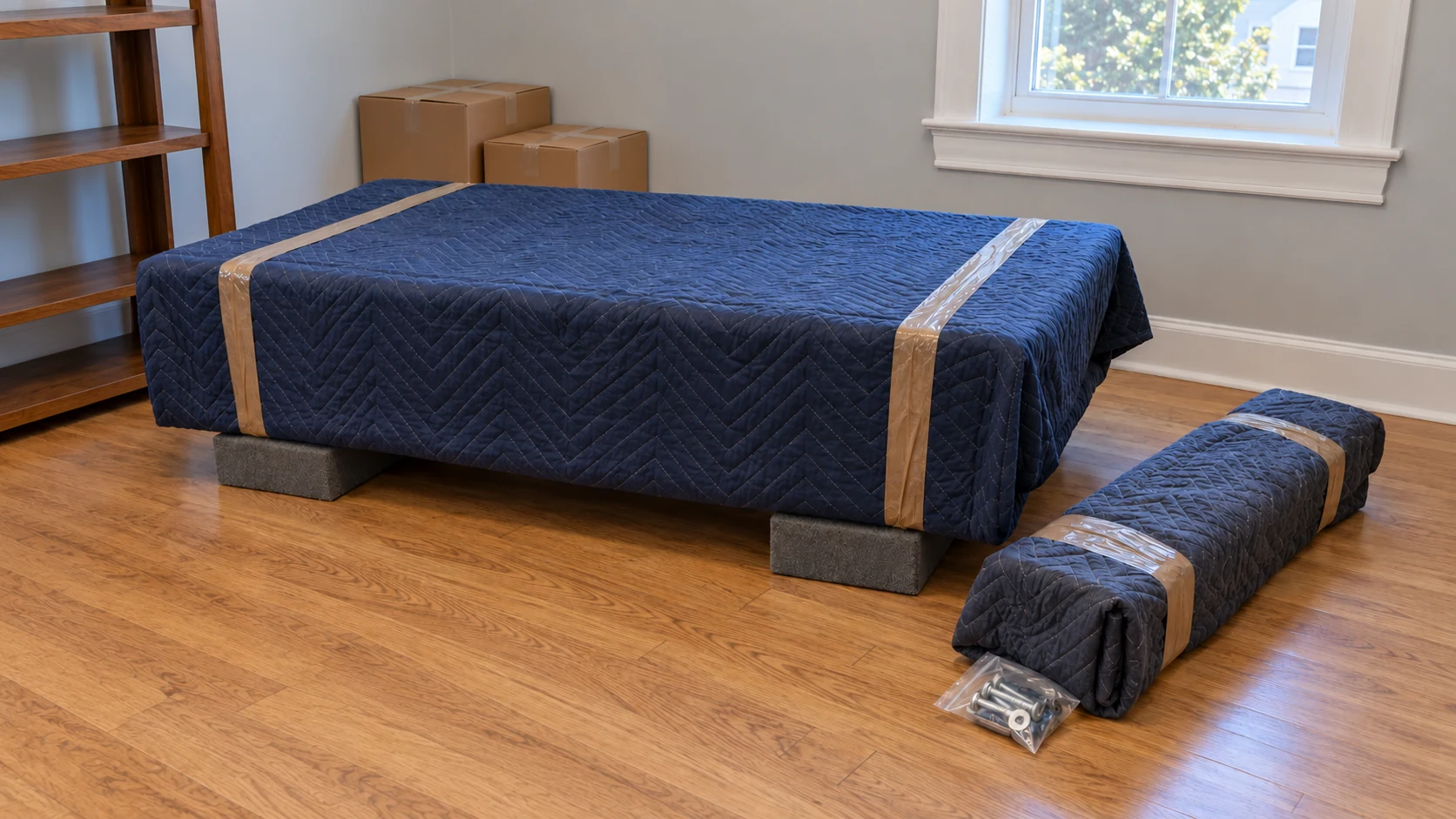
Basic blanket protection, wrapping and tape have no separate surcharge. Cartons are separate. Basic working furniture assembly and disassembly also have no separate surcharge; complex, delicate or specialist construction needs review. Tell us about the piece and the desired scope rather than assuming a special procedure from a room photograph.
Decide who will pack loose contents and by when. Identify drawers, shelves, books, kitchen items and fragile pieces as actual tasks. Keep the carrying route clear as packing finishes. If only a selected piece needs preparation, identify that limited scope; preparing one desk does not mean the entire home is ready for loading.
Example 2: downtown Stamford apartment to Jacksonville, Florida
Consider a two-bedroom downtown apartment moving a mixed household inventory to Jacksonville: protected sofa sections, bedroom furniture, a dining table with removable legs, cartons of books and kitchen contents, lidded totes and an awkward chair. This example uses direct delivery because the household wants the dedicated journey and receiving plan reviewed together. The truck size and load arrangement follow the actual inventory.
The Stamford property provides written instructions for an elevator reservation and an approved loading position. Collect the exact hours, entrance and any insurance wording, then match those instructions to the packing and pickup plan. If metered street spaces are involved, assign someone to review the City's meter-rental process and its relationship to any Street Use approval. The form is a request; confirm the actual approved arrangement.
The furniture should be prepared before the carrying appointment. Safely detachable long legs come off with their parts protected and associated. A completed substantial direct load has mixed supported pieces arranged from the front of the body, appropriate restraints and a stable final row. It should not be illustrated as a sparse row of identical cartons or a wrapped tall-legged table standing unsupported in an otherwise empty truck.
At Jacksonville, the receiver confirms the property entrance, truck position and available rooms. Identify stairs, elevator requirements or a driveway restriction at that exact address rather than assuming every Florida home has the same access. If the family travels ahead, confirm who will hold the keys and receive the shipment if the family is delayed.
The illustrative direct window is 2–3 days after pickup and loading finish. A reviewed smaller consolidated Florida shipment may use up to 60 days. Those windows describe different delivery models; choosing the direct example does not turn the consolidated window into a fixed arrival date. The agreed price remains the same for unchanged scope when travel or delivery takes longer.
Keep the household's travel essentials outside the load
Set aside keys, personal documents, daily medicines, chargers, essential clothing and first-night needs before loading begins. Decide which items travel with the household and keep that group apart from the shipment. If children, pets or work commitments determine the household's journey, make the first-night plan around their needs rather than the truck's expected arrival.
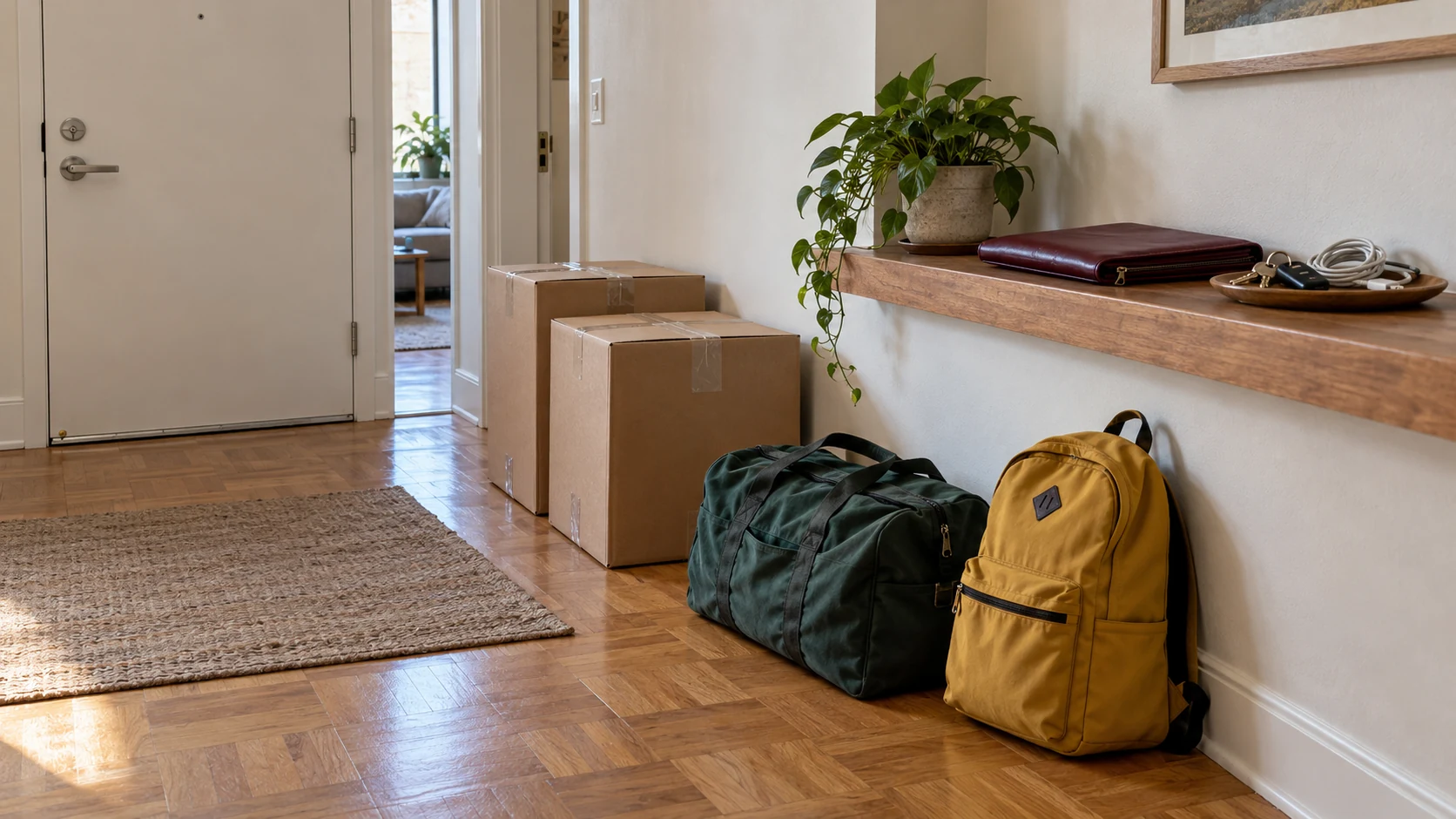
The receiving person should have access instructions and a working contact number. Arrange keys without putting readable private information on exposed cartons. A household travel bag or document folio should not disappear into the last packed room just because it sits near shipment cartons. If the home will be empty before delivery, identify what the receiver needs to open the entrance, protect the route and direct placement.
Example 3: Springdale household shipment to Moncton, New Brunswick
Imagine a Springdale household relocating to Moncton with a compact dining set, bedroom furniture, books, clothing cartons, protected fragile pieces and customer totes. List the actual items, identify anything that needs separate review and decide whether the household wants a direct journey or can receive within a consolidated Canada window. Canada is within Sterling's reviewed coverage; the destination still introduces a document and receiving plan.
The pickup house has porch steps and a shared driveway. Agree driveway use with the relevant occupants and describe the full route to the rooms. Identify how the actual truck will approach the property. A household car route through the Merritt Parkway is unsuitable for a box truck; Connecticut also prohibits box trucks on the Wilbur Cross and Milford parkways. Review a commercial approach and local clearances independently of the rail or car commute.
For this example, the receiving address is in the City of Moncton, New Brunswick. A nearby Dieppe or Riverview address would have a different municipality and property arrangement. Confirm the destination street, entrance, available room, truck position and authorized receiver. Do not use a broad area name to infer local loading permission.
Before booking, identify the shipment documents, personal documents and border questions relevant to the actual move. Check who will travel, what must remain with the household and whether any contents need additional review. Do not assume that every item is admissible, that one document list fits every household or that customs processing has a guaranteed duration. A receiver's building reservation must leave room for the agreed transport and document plan.
The direct illustration uses 2–3 days after pickup and loading finish. Consolidated Canada delivery may use up to 60 days, including for a relatively close destination. The actual route, access, border processing and receiving dates are reviewed before agreeing the schedule. If the receiving property is not ready, discuss a separate storage stage rather than silently adding it to the original scope.
Arrange Stamford street space and property access early
Stamford's Engineering guidance requires a Street Use arrangement when the proposed truck, ramp or container obstructs public travel on a street or sidewalk. The department FAQ calls for a description, a plan showing location, extent and staging, appropriate traffic controls, required insurance, applicable fee and an approved schedule. Identify the applicant, proposed footprint and dates before treating a loading position as available.
The City's linked fee schedule classifies charges by construction-cost category and closure type. Its conditional entries should not be presented as a universal moving-truck tariff. Ask Engineering to identify the applicable category and current fee for the proposed use. A certificate of insurance is a document to arrange for the actual requirement; a sample certificate does not prove company coverage or approve a particular loading plan.
For metered spaces, the Parking Meter Rental Application is a separate Cashiering & Permitting process. Its posted terms request 24-hour notice and completed forms brought to the department. Confirm the requested meters, dates, applicable time coverage and any required Street Use copy. Keep the approval and property instructions together; sending a form is not proof that the requested space is reserved.
The digital residential parking program has license-plate and zone-specific rules. A household permit does not reserve truck loading space. Ask the City how its requirements apply to the actual vehicle and loading arrangement. For a private driveway, lot or dock, confirm the property's permission, usable geometry and whether a ramp or carry would still obstruct public travel.
In winter, check snow restrictions for the actual date and street. A declared snow emergency prohibits parking on signed snow-emergency routes. Listed narrow streets separately use alternate-side parking above two inches of snow, even without a declaration. Clear and treat the actual carrying route; the City requires sidewalk snow and ice clearance within 12 hours after snowfall ends or by 10 a.m. after overnight snow. Municipal garage advice does not establish truck clearance or loading permission.
Illustrative delivery windows from Stamford
| Illustrative destination | Direct planning window | Consolidated window |
|---|---|---|
| Williamsport, Pennsylvania | 1–2 days | Up to 30 days |
| Jacksonville, Florida | 2–3 days | Up to 60 days |
| Moncton, New Brunswick | 2–3 days | Up to 60 days |
| Portland, Oregon | 5–6 days | Window agreed individually |
These windows start after pickup and loading are complete. They describe reviewed planning examples, not reserved appointments. An earlier packing day, building reservation or household departure date is a separate part of the schedule. Confirm the final truck route and both properties' availability before using a window to book receiving access.
Nearby domestic consolidated shipments may use up to 30 days, Florida and Canada up to 60 days, and California up to 90 days. Other farther destinations have individually agreed windows. Portland is in Oregon; its consolidated example does not inherit the California window. A smaller close direct job may sometimes fit same-day or next-day arrangements after review, but that possibility does not replace the windows agreed for these cases.
Example 4: North Stamford house to Portland, Oregon
Consider a North Stamford house sending a substantial furniture inventory to Portland: bedroom pieces, a desk, sofa sections, cartons of books and household contents, protected fragile pieces and customer totes. The household chooses direct delivery for the dedicated shipment and asks to review packing and furniture preparation around the departure date. The home size alone does not establish how much inventory is moving.
The pickup driveway is long and slopes before reaching the garage. Describe its surface, width, overhead clearance and turning area, and confirm permission where it is shared. Review whether the selected truck can use the proposed standing area. If it cannot, identify a different carrying or shuttle arrangement in the estimate rather than discovering the change when the truck arrives. Photograph the complete approach and route, not only the front steps.
The Portland receiving address is an apartment with a scheduled building entrance and an available workroom. The receiver confirms the actual property instructions, permissible truck position and placement plan. Identify which furniture must be reassembled and which cartons will remain sealed. If an office desk is needed for the first working morning, decide how to bridge the household's arrival and the agreed delivery window.
The direct illustration is 5–6 days after pickup and loading finish. A consolidated Oregon window is agreed individually. The 90-day California example is not a rule for all western states. Review the receiving contact's availability for the agreed period and how any change will be communicated.
At delivery, remove furniture protection and complete the agreed basic reassembly and placement. Carton unpacking, putting away contents and removing carton packaging are separate tasks with time in the scope. If a receiving room or building appointment changes after booking, review the effect on access and any separate storage or handling stage in writing. For unchanged scope, a longer journey does not change the agreed flat price.
Prepare a smaller consolidated pickup as its own shipment
A smaller group can combine sealed cartons, a customer tote and protected furniture. Record the pieces as a distinct inventory and identify what is staying in the home or travelling with the household. Match cartons and cushioning to the actual contents, close and seal packed cartons before loading, and avoid placing unsupported heavy pieces over fragile items.

This illustration shows a smaller pickup group. A completed substantial direct load is a different stage and has a mixed supported load filling the selected body appropriately, with contact restraints and organized secured supplies. Neither model is determined by a carton brand or a single photograph. The estimate and actual inventory establish the work and delivery schedule.
If the household needs some items immediately, identify them before choosing consolidated delivery. Keep travel essentials separate, nominate the receiver and state the days when access is unavailable. Any storage, special handling or unpacking request belongs in the agreed scope rather than being inferred from the presence of cartons.
Receive, unwrap and finish the agreed placement
Confirm the receiving person, keys, entrance and route to each room before the delivery period. Keep the floor and doors clear, agree where the large pieces belong and share any property reservation changes. Furniture protection is removed at delivery; basic working reassembly follows the placement plan. Long legs that were removed for transport can be installed on the now unwrapped receiving furniture.
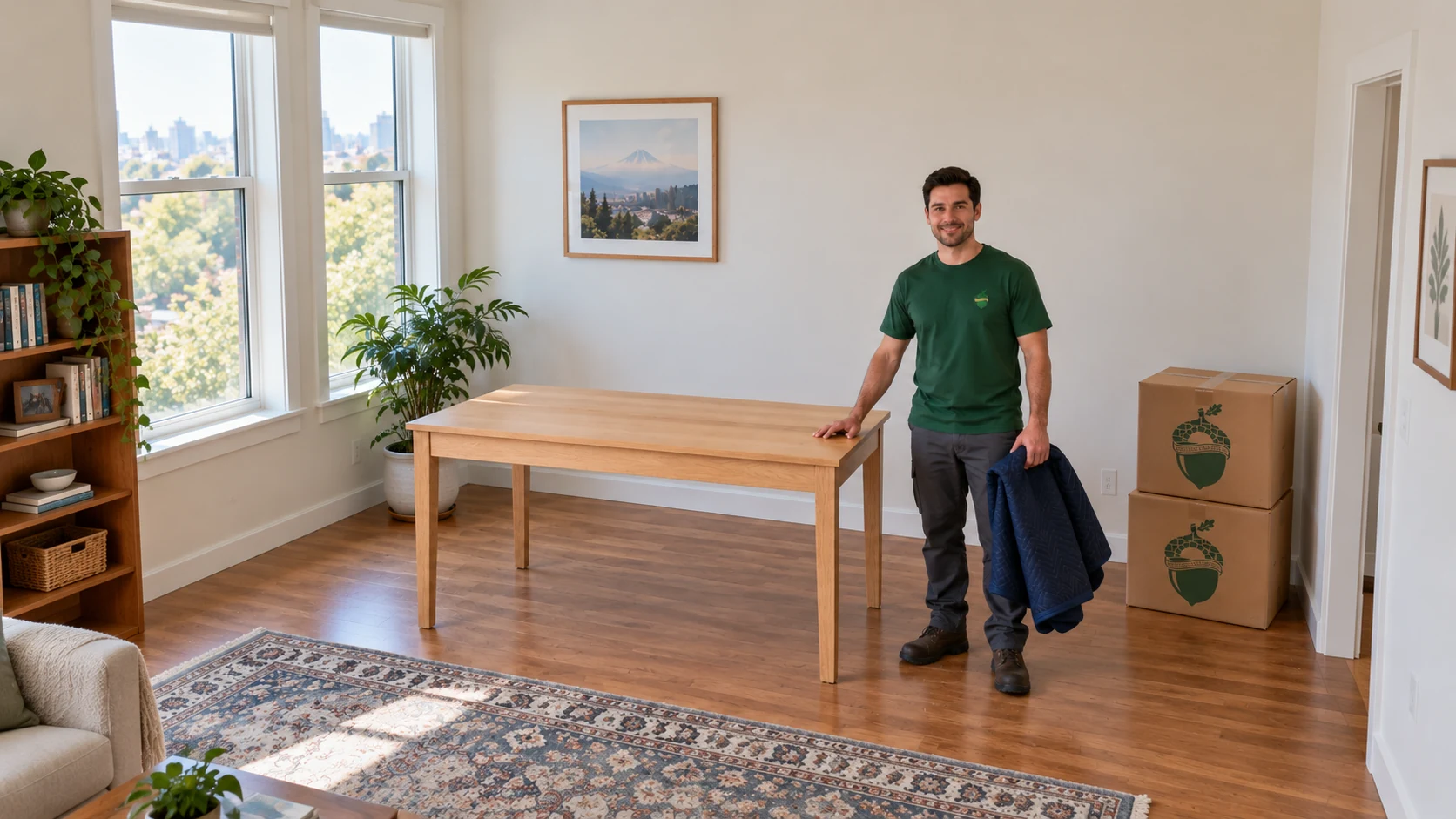
A completed furniture-placement stage does not include automatically emptying every carton. Ask for carton unpacking, putting contents away or removing that packaging separately if needed. For belongings already delivered that later need to move between rooms or floors, the existing in-home and in-building service in Stamford provides a separate scope to review.
Plan unwanted furniture before pickup. The City's resident dump guidance has vehicle, material and weight conditions. A resident allowance does not establish free disposal for a commercial moving truck. Check the correct site and charges for the actual item, or request separate disposal work in the estimate.
Review the pickup area and destination
We can review long-distance pickup in the City of Stamford and nearby Western Connecticut addresses. Greenwich and Darien are separate towns; Norwalk is a separate city. Confirm the municipality, property, entrance, truck position and dates for the actual address. The planning region is a current Census county-equivalent grouping, not the office that issues a Stamford street permit.
Explore long-distance destinations from Stamford
These destinations illustrate household shipments from Stamford, Connecticut. Sterling serves routes throughout the United States and Canada. The list does not rank bookings or reserve dates. Review the inventory, commercial truck approach, property access and receiving availability.
Northeast
- Williamsport, Pennsylvania
- New York City, New York
- Buffalo, New York
- Syracuse, New York
- Boston, Massachusetts
- Philadelphia, Pennsylvania
- Baltimore, Maryland
- Washington, DC
Southeast and Florida
- Charlotte, North Carolina
- Raleigh, North Carolina
- Charleston, South Carolina
- Atlanta, Georgia
- Jacksonville, Florida
- Tampa, Florida
- Miami, Florida
- Naples, Florida
Midwest and Texas
- Chicago, Illinois
- Dallas, Texas
- Houston, Texas
- Austin, Texas
Mountain West and Southwest
- Denver, Colorado
- Phoenix, Arizona
- Salt Lake City, Utah
- Las Vegas, Nevada
- Albuquerque, New Mexico
West Coast
- Portland, Oregon
- Seattle, Washington
- San Francisco, California
- San Jose, California
Canada
- Moncton, New Brunswick
- Toronto, Ontario
- Montreal, Quebec
- Québec, Quebec
- Vancouver, British Columbia
Long-distance moving questions
Where can I arrange long-distance pickup around Stamford?
We can review long-distance pickup in the City of Stamford and nearby Western Connecticut addresses. Greenwich and Darien are separate towns; Norwalk is a separate city. Confirm the municipality, property, entrance, truck position and dates for the actual address. The planning region is a current Census county-equivalent grouping, not the office that issues a Stamford street permit.
Can a move farther within Connecticut be long-distance?
Yes. Crossing a state line is not the only consideration. Send the actual addresses, inventory, dates and access details so we can review the shipment and appropriate delivery model. A move to another Connecticut city can require a long-distance plan; a nearby interstate address does not by itself determine that plan.
What is different about direct delivery?
Direct delivery uses a truck dedicated to your shipment and the same crew for the agreed pickup and delivery. Review the inventory, both property schedules and the receiving person before choosing it. Delivery planning starts after pickup and loading finish; the travel window does not include an earlier packing or elevator appointment.
Can a smaller Stamford shipment use consolidated delivery?
Yes, subject to review of the inventory, route and dates. A group around 300–400 cubic feet is one useful example of a smaller shipment, not a minimum or an automatic qualification. Consolidated shipments share a planned transport schedule, so the receiving window differs from a dedicated direct move.
When do the delivery windows start?
After pickup and loading are complete. Packing, an elevator reservation or the start of a loading appointment is not the beginning of the travel window. The illustrative direct windows here are Williamsport 1–2 days, Jacksonville 2–3 days, Moncton 2–3 days and Portland 5–6 days. Review the actual truck route, addresses and receiving availability before agreeing dates.
What consolidated windows apply to these examples?
The Williamsport example uses up to 30 days; the Jacksonville and Moncton examples use up to 60 days after pickup and loading finish. The Portland, Oregon window is agreed individually. California shipments may use up to 90 days; that does not give every western destination the same window. No table entry is a reserved appointment.
Does a longer journey increase the agreed price?
No. For unchanged inventory, access and services, the agreed long-distance flat price holds when travel or delivery takes longer. An added item, changed entrance, storage stage or other scope change is reviewed and agreed separately in writing. Share a change as soon as it is known.
Do I need a Stamford Street Use permit?
If the proposed truck, ramp or container obstructs public travel on a street or sidewalk, ask Stamford Engineering about the Street Use application. Its requirements include a description, site and staging plan, appropriate traffic controls, required insurance, applicable fee and approved schedule. Confirm the arrangement for the actual position; no universal moving-truck permit or flat municipal fee is assumed.
How does meter rental work in Stamford?
Cashiering & Permitting has a separate Parking Meter Rental Application. The posted form requests 24-hour notice and completed forms brought to the department; it lists $20 per meter per day for Monday–Saturday, 7 a.m.–7 p.m., or $25 per meter per day for 24-hour coverage seven days a week. A Street Use permit copy may also be required. Confirm the meters, dates and approval; the form alone does not establish a reserved space.
Will a residential parking permit reserve the truck space?
No. The digital residential program uses license plates and zone-specific rules; a household permit does not reserve a truck loading position. Ask the City how parking and any obstruction requirements apply to the proposed vehicle and loading arrangement. Meter rental and Street Use approval are separate questions.
Can the moving truck use the Merritt Parkway?
No. Connecticut prohibits box trucks, tractor-trailers and trailers on the Merritt, Wilbur Cross and Milford parkways, along with vehicles exceeding the published dimensions. Review the commercial approach and final entrance separately from a household car route. A passenger-car map or station commute does not confirm a suitable truck route.
Does every downtown building require a certificate of insurance?
Ask the particular property. A managed building may require a certificate of insurance, elevator booking, corridor protection or a loading appointment, but neighborhood and housing statistics do not establish those requirements. Send the written property instructions and contact details for both ends before the estimate is finalized.
What changes if snow falls before pickup?
Inspect the actual curb and carrying route and check current restrictions. A declared snow emergency prohibits parking on signed routes; listed narrow streets use alternate-side rules above two inches even without a declaration. Stamford requires sidewalk snow and ice clearance within 12 hours after snowfall ends or by 10 a.m. after overnight snow. Arrange safe access and review any necessary schedule change.
Are detachable table and desk legs left on for transport?
Safely detachable long legs are normally removed before transport. Protect the furniture body first, then access the joints and remove and group the protected parts with their hardware. Integral supports or pieces that cannot be safely dismantled need individual review. Basic working assembly and disassembly have no separate surcharge; complex work is reviewed.
Are packing materials and basic reassembly included?
Basic blanket protection, wrapping and tape are included without a separate surcharge. Cartons are separate. Basic working furniture assembly and disassembly also have no separate surcharge; identify complex, fragile or specialist pieces for review. Agree which loose contents you pack and which you want us to pack before pickup.
Will you unwrap furniture and empty every carton at delivery?
Furniture protection is removed during delivery and basic reassembly follows the agreed placement plan. Emptying cartons, putting away contents and removing that carton packaging are separate services and need time in the scope. Identify those tasks early if you need the home set up beyond furniture placement.
Can a Canada move be planned from Stamford?
Yes. Sterling reviews household moves into Canada, including the illustrative Moncton, New Brunswick case. Confirm the inventory, relevant shipment and personal documents, travel plans, dates and authorized receiving contact before booking. Border processing and document review can affect the plan; do not assume universal customs clearance, tax treatment or admission of every item.
Can belongings wait in storage between the two homes?
Ask about a separately agreed storage stage when the pickup and receiving dates do not align. Confirm the inventory, handling, access and later delivery schedule in writing. A receiving room being unavailable does not automatically include storage in the original price or turn a direct window into a fixed appointment.
Is resident dump access included for unwanted furniture?
No. Disposal is separate from a standard household moving scope. Stamford resident permits and allowances have vehicle, material and weight conditions; they do not establish free disposal for a commercial moving truck. Confirm the actual item, site and charges before hauling, or ask us to review a separate disposal scope during the estimate.
Request an estimate for the actual Stamford move
Send the origin and destination, inventory, desired pickup dates, receiving availability and access details for both properties. Identify the packing responsibility, furniture that needs preparation, fragile or specialist pieces and any separate storage, disposal or unpacking stage. Include the written property instructions and proposed truck arrangements so the estimate can describe the actual scope and delivery model.