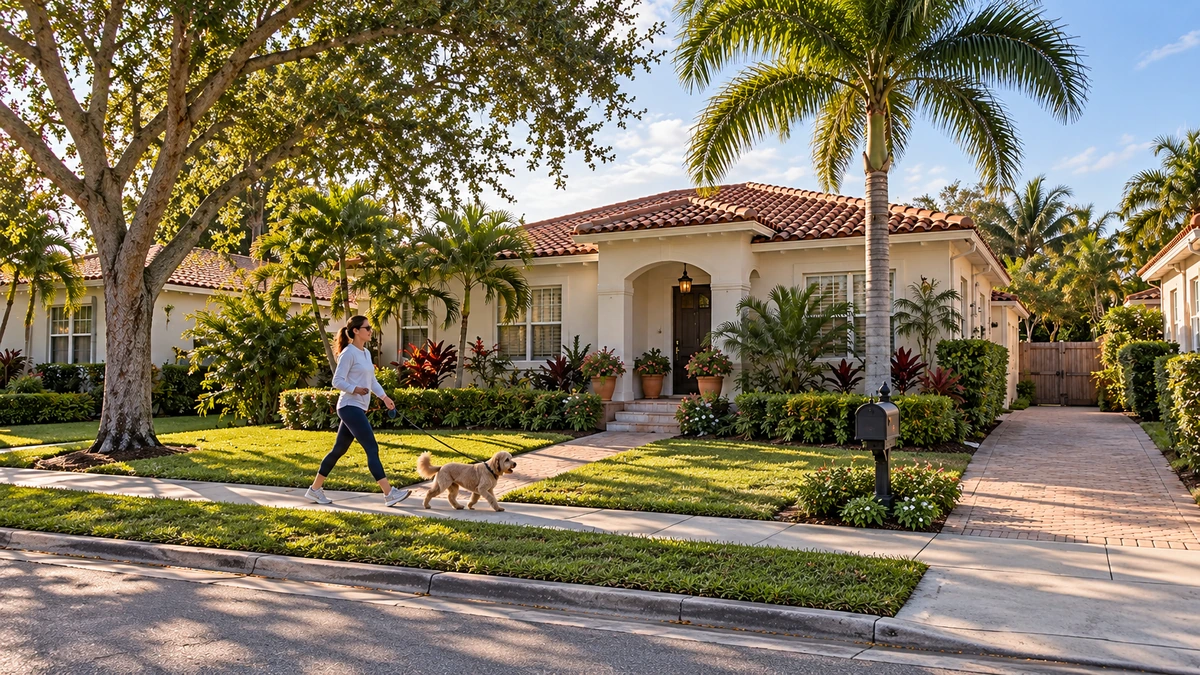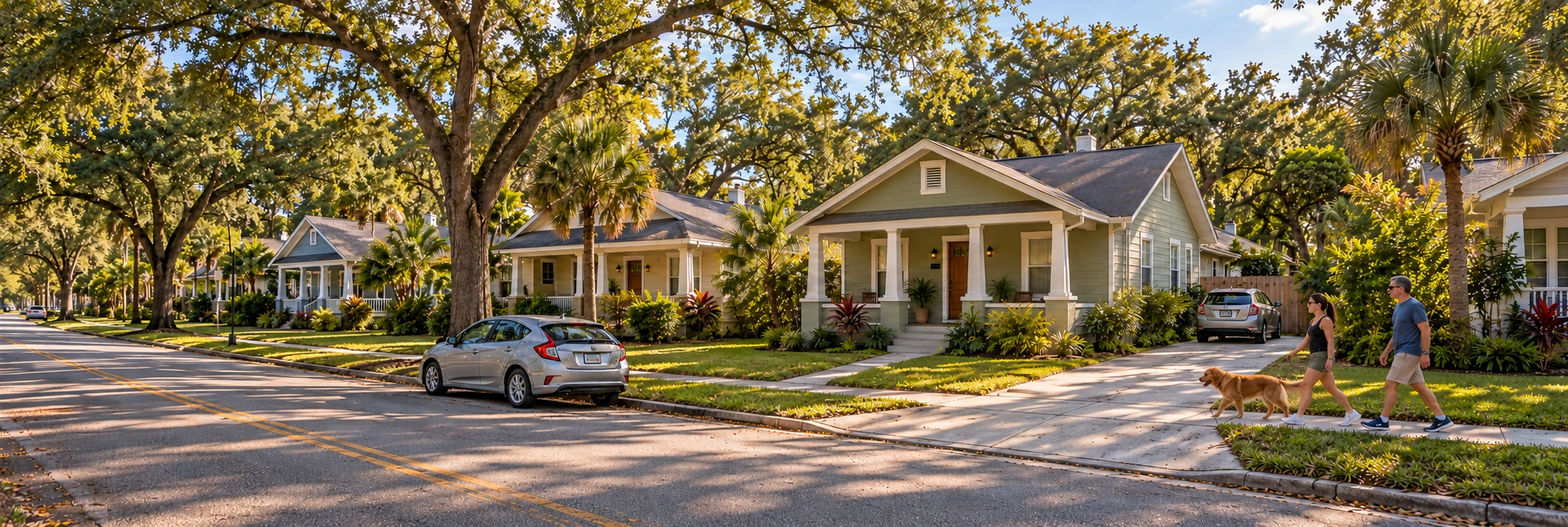
Two neighbors walk their dog along the sidewalk beside Florida bungalow homes, parallel to the curb; parked cars and a separate connected driveway remain visible.

State moving guide

Moving to Florida: A Practical Guide

Find your part of Florida, compare moving costs and plan a smoother arrival. Explore twelve cities, understand your delivery options and prepare for a household move to or from the Sunshine State.

Florida planning

Find your place in Florida

A waterfront apartment in Miami, a neighborhood near Orlando’s lakes or a home in the Panhandle offers a different version of Florida life. If you are still choosing where to live, start with the map and city profiles below. Compare the inland cities with both coasts, then narrow your search to the neighborhoods that suit your daily routine.

Already know where you are going? Use this guide to work through the move itself: what affects the price, how direct and consolidated delivery differ, what to pack and how to prepare your new home. You will also find Florida weather considerations, mover checks and a first-week checklist. Sterling Oakbridge can help plan an interstate household move to or from Florida.
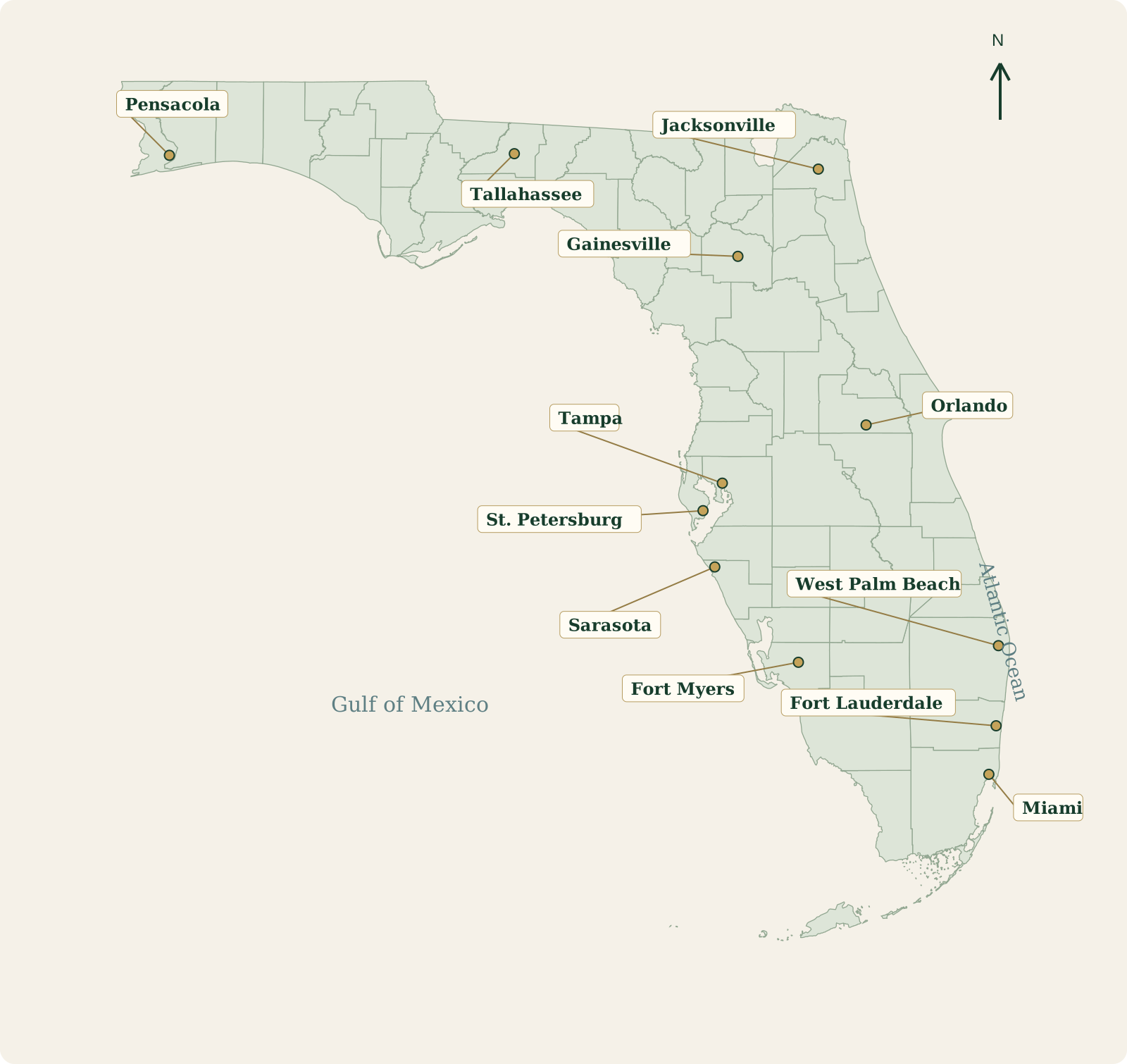

Map locating twelve featured Florida cities across the Panhandle, inland Florida, the Gulf coast and the Atlantic coast.
Explore twelve Florida cities across the Panhandle, inland Florida and both coasts. Compare the city profiles below to narrow your search.

Florida planning

Which part of Florida fits your move?

The Panhandle and North Florida. Pensacola anchors the western Panhandle; Tallahassee is the inland capital, and Gainesville is home to the University of Florida. Jacksonville brings the St. Johns River and the Atlantic side into the picture. These places offer different starting points for a search beyond South Florida’s coastal cities.


Central Florida and Tampa Bay. Orlando is the inland choice in this group, with city neighborhoods as well as the wider region’s theme parks. Tampa and St. Petersburg sit on different sides of Tampa Bay: compare their downtowns, waterfronts and surrounding neighborhoods rather than treating the whole area as one destination.

The southwest coast. Sarasota combines an arts-focused downtown with nearby Gulf islands. Farther south, Fort Myers centers on the Caloosahatchee River and its River District. Look separately at mainland neighborhoods and island communities when choosing a home.

The southeast coast. West Palm Beach, Fort Lauderdale and Miami share an Atlantic-coast setting but have distinct downtowns and local character. A Miami high-rise, Fort Lauderdale canal neighborhood and West Palm Beach home can mean very different daily journeys. Compare the area around the home with the places you expect to visit most often.

Service network

Explore Florida’s cities

From the Panhandle to South Florida, these twelve cities offer different settings for your next home. Start with the places that interest you, then compare their neighborhoods and the surrounding area.

Palm-lined waterfront promenade with walking residents, blue bay water and a dense Miami-style high-rise skyline.FL

Miami

Biscayne Bay, the Brickell skyline and a lively urban waterfront give Miami a distinctly metropolitan feel. Explore its city neighborhoods if you want to compare high-rise living with a more residential setting.

Explore Miami moving →
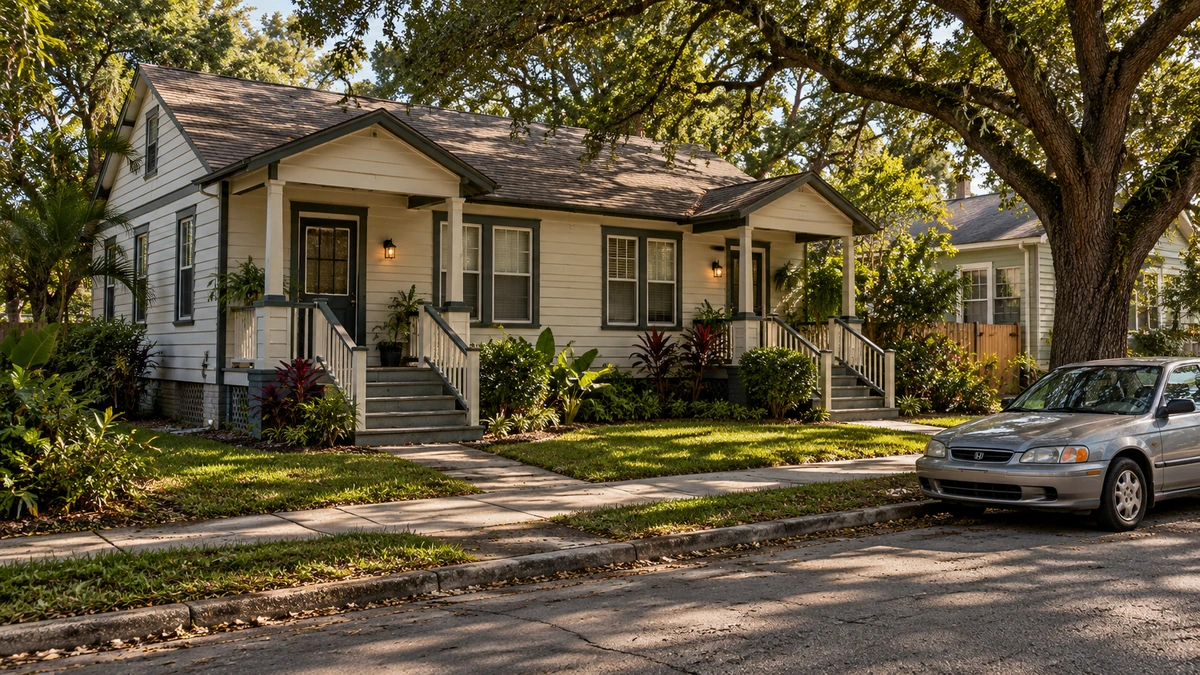
A wood-sided Tampa duplex has two separate porches and short front stairs beneath mature shade trees.FL

Tampa

Tampa brings together the Riverwalk, historic Ybor City and neighborhoods with older homes. Its mix of waterfront downtown and established residential streets offers several ways to make a home on the Tampa Bay side.

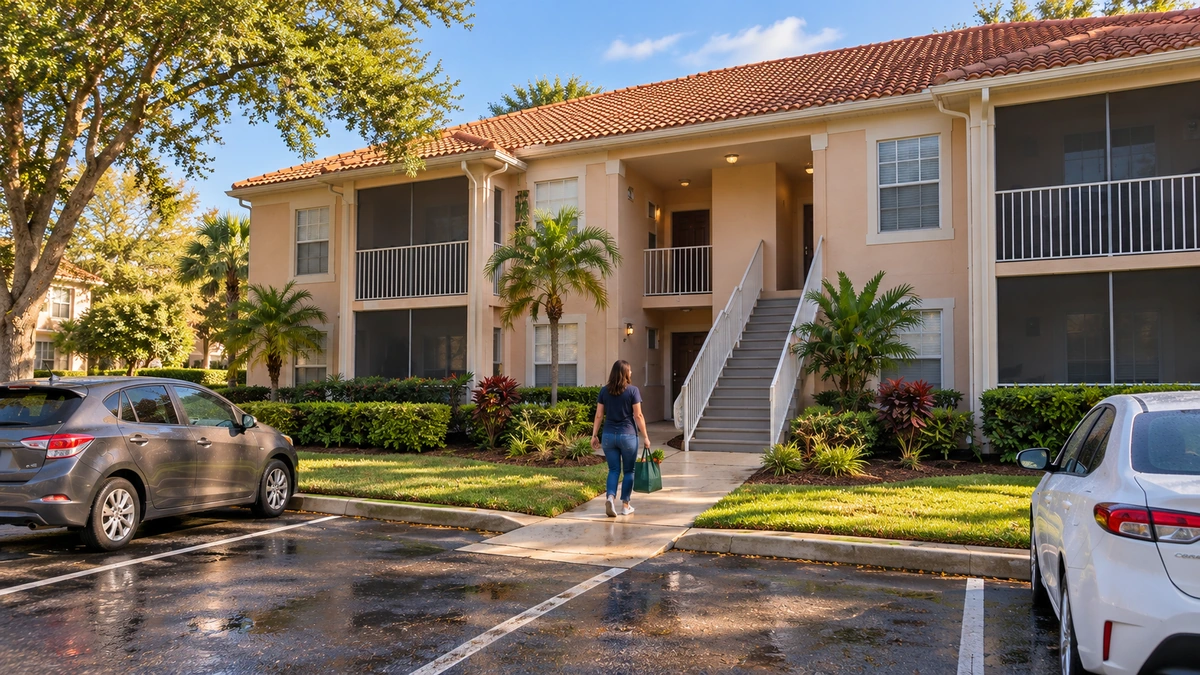
A resident with groceries approaches the complete outside stair of an Orlando garden condominium from its parking court.FL

Orlando

Look beyond the theme parks to Orlando’s lakes and city neighborhoods, from Thornton Park to Audubon Park. This inland destination is worth exploring if your Florida search starts with everyday city life rather than a coastal address.

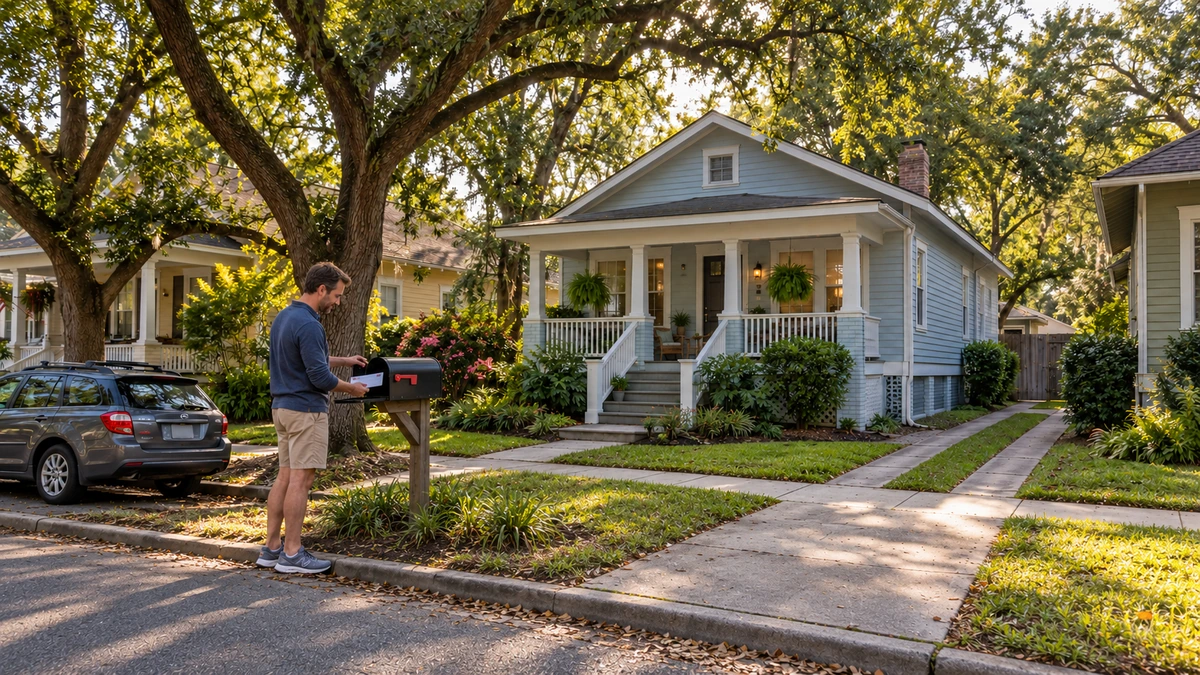
A resident retrieves an envelope from a curbside mailbox outside a raised blue Jacksonville bungalow, with a station wagon in the side drive.FL

Jacksonville

The St. Johns River shapes Jacksonville’s city setting, with Atlantic beaches in the wider area. Compare the riverfront, established neighborhoods and coastal communities to find the part of Northeast Florida that fits your routine.

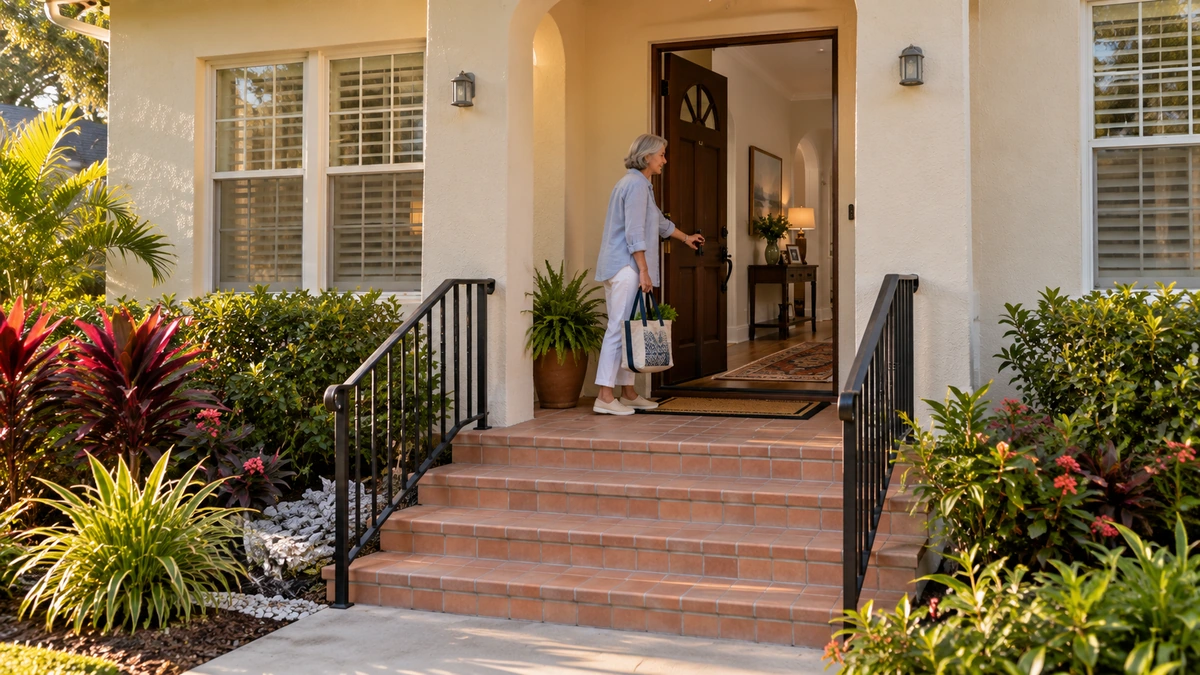
A woman with a reusable bag opens a wood front door from the landing of an arched St. Petersburg entrance.FL

St. Petersburg

Waterfront parks, the St. Pete Pier and an active arts scene distinguish St. Petersburg. Explore the downtown bayfront alongside its residential neighborhoods when comparing homes on the Pinellas side of Tampa Bay.

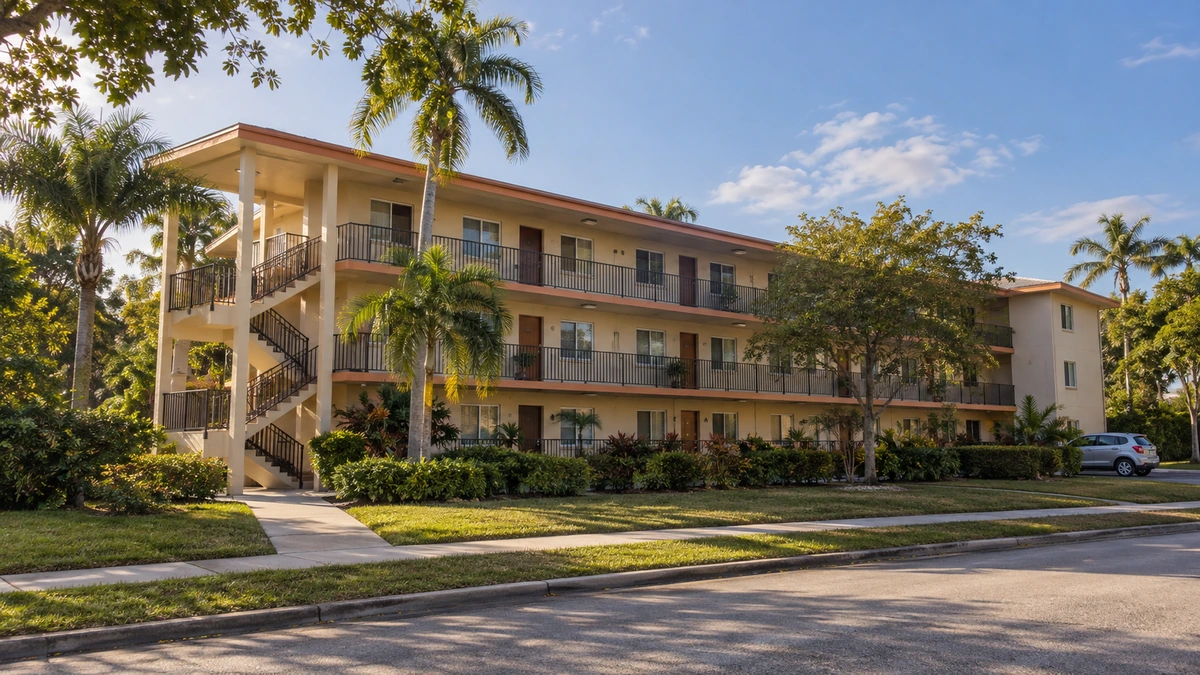
A Fort Lauderdale low-rise apartment building has outside access galleries, a complete end staircase and a car parked clear of the approach.FL

Fort Lauderdale

Canals, the Riverwalk and Las Olas Boulevard give Fort Lauderdale a waterfront character of its own. Compare downtown, canal-side neighborhoods and the Atlantic beachfront before deciding which setting suits your life.

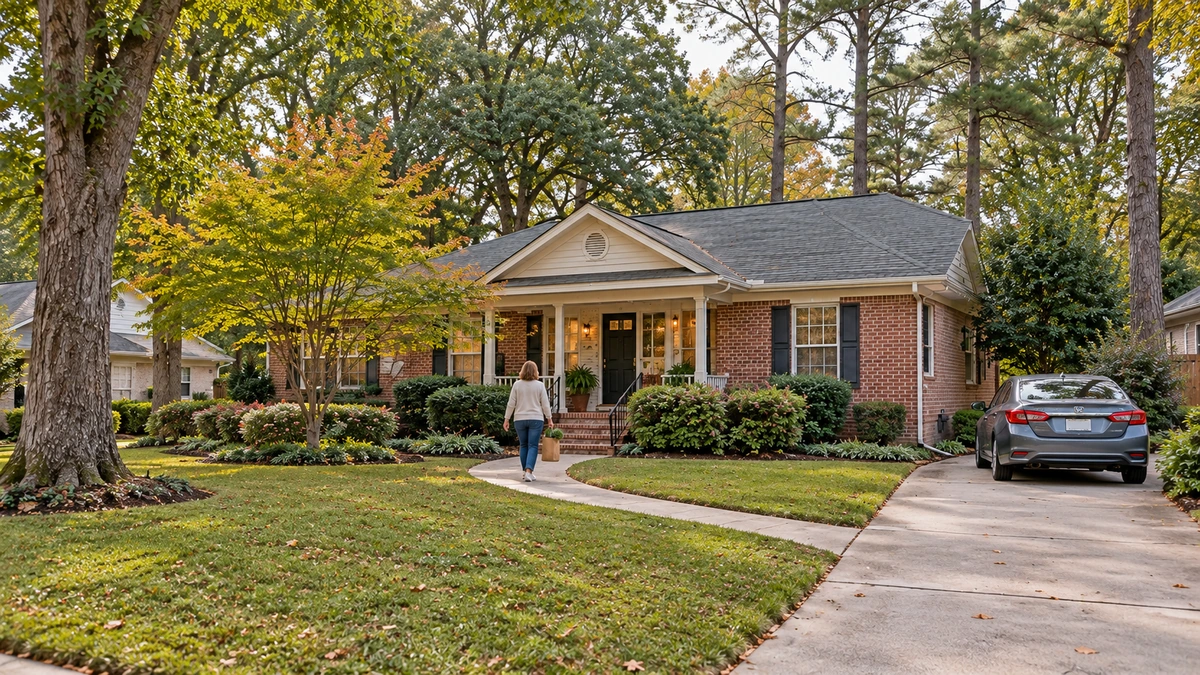
A resident carries a grocery bag along the curved approach to a brick Tallahassee ranch, with a sedan parked on the drive.FL

Tallahassee

Florida’s capital combines university life, rolling hills and extensive parks and trails. Tallahassee offers a different North Florida setting for a move centered on work, study or life beyond the coastal cities.

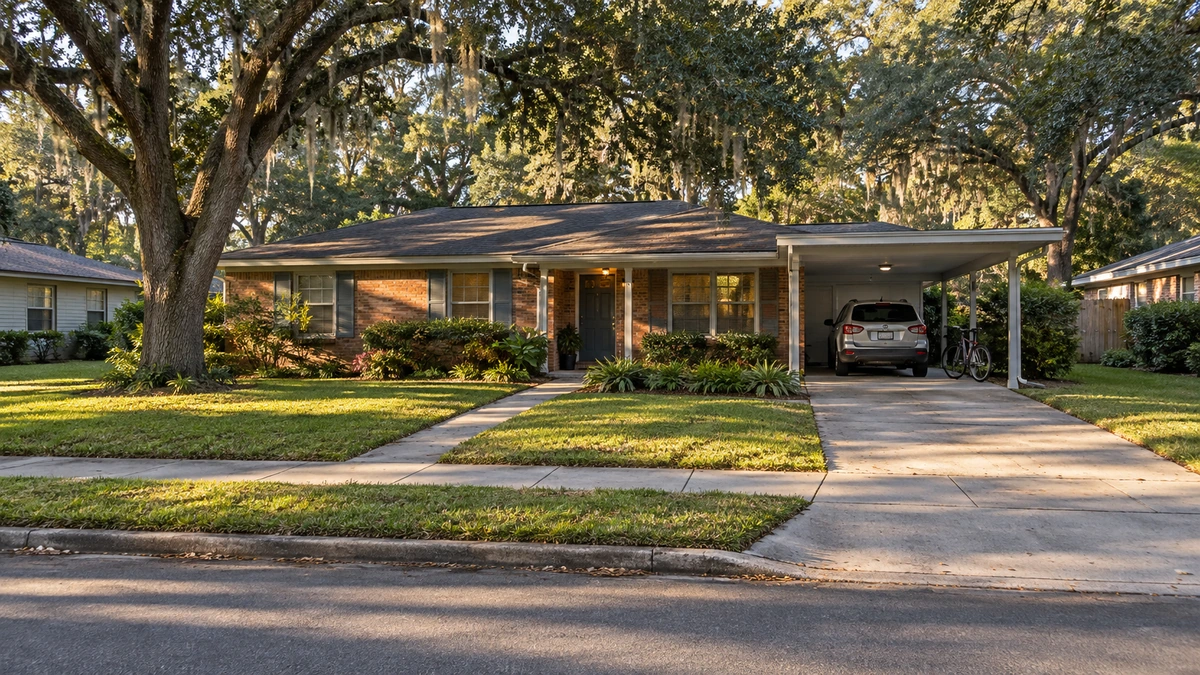
A Gainesville brick ranch has a covered entrance, a separate front walk and a carport containing a family vehicle and bicycle.FL

Gainesville

Home to the University of Florida, Gainesville pairs a college-city atmosphere with parks, gardens and nearby springs. Consider this inland North Florida destination if campus life, culture and outdoor time belong in your plans.

A woman reads a book behind the continuous white railing of a raised Pensacola cottage porch beside its open main stair.FL

Pensacola

Pensacola brings a historic city setting to the western Panhandle, with Gulf beaches nearby. Compare life in town with the separate beach communities when exploring this corner of Northwest Florida.

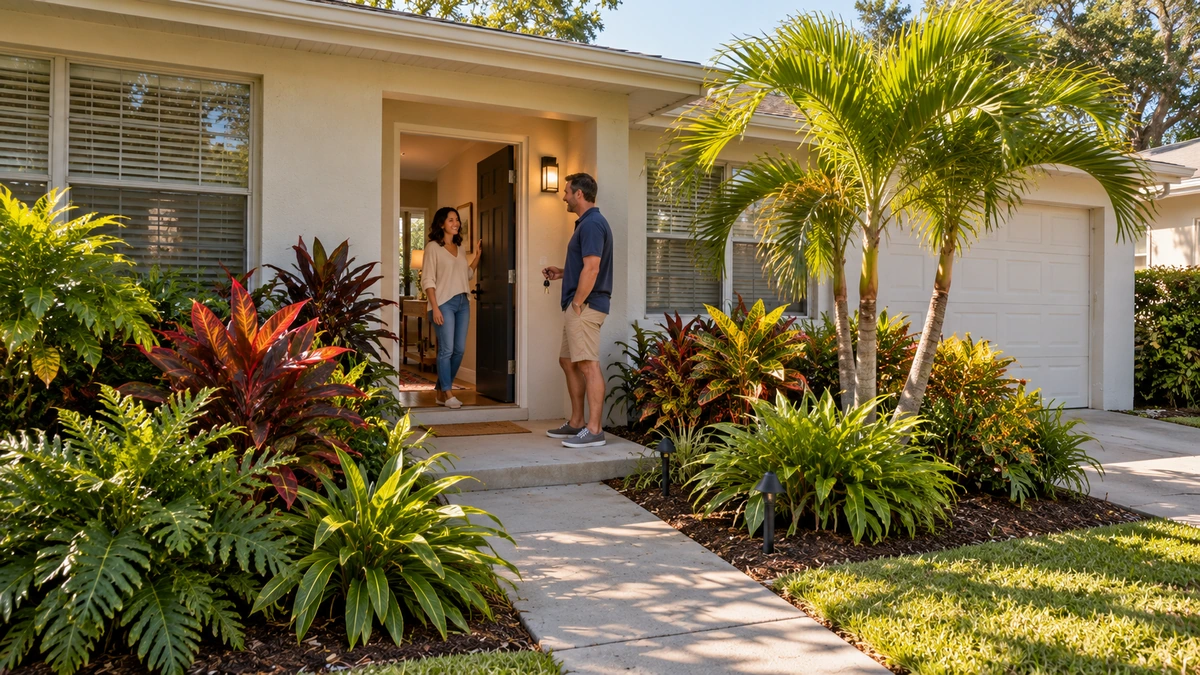
Two residents speak across an open recessed doorway of a low Sarasota stucco home, with the front walk beside the garage.FL

Sarasota

Museums, theater and a lively arts scene meet a southwest-coast setting in Sarasota. Explore its downtown and residential neighborhoods, with the beaches and natural areas of nearby Gulf islands within the wider area.

A Fort Myers stucco ranch has a screened front entrance, a narrow front path and a separate garage driveway.FL

Fort Myers

Fort Myers has a riverfront identity along the Caloosahatchee, with a downtown River District and established mainland neighborhoods. It is a useful starting point for comparing Southwest Florida city life with nearby island communities.

A resident walks a small dog along the sidewalk in front of a modest Spanish-style West Palm Beach house and its closed side gate.FL

West Palm Beach

West Palm Beach combines a waterfront downtown with districts such as Clematis Street and Northwood Village. Explore the mainland city’s cultural life and neighborhoods, with Palm Beach and the Atlantic shore across the water.

Florida planning

Moving within Florida or between states?

A move from Tampa to Orlando is usually a move within Florida. A move from New York to Miami, or from Jacksonville to Georgia, is an interstate move. The difference matters because the mover checks, paperwork and protection for your belongings follow different rules.

Staying within Florida? Check the mover’s registration through Florida’s consumer agency, FDACS, and get a written estimate and contract before work begins. Moving between states? Use FMCSA’s interstate moving guide to check the mover and understand your documents and protection choices. Sterling Oakbridge’s Florida service described here is for interstate household moves.

If the move includes storage, tell the mover where your belongings will ultimately go. If the destination changes, have the new address, work and price confirmed before the move continues. The FAQ below covers less common routes, including journeys between Florida homes that pass through another state.

More places to explore

Keep exploring Florida communities

Looking beyond the featured cities? These communities offer more starting points for your Florida home search.

Ask about your Florida move →

Florida planning

Can the truck reach your home?

A moving truck needs more room than a car. Before moving day, show your coordinator the road, driveway, gate and place where the truck could stop. Mention low branches, tight turns, soft ground and any vehicle-size restrictions. This helps the team choose a workable approach before arriving at your door.

Parking and carrying are two separate parts of the job. The truck may fit in the driveway while your furniture still has a long walk, steps or a narrow side gate ahead. A short video from the street to the front door is often more useful than a close-up of the house. For an apartment, continue through the shared entrance to the elevator or stairs and your unit.

Ask the owner or building manager about private access. For loading on a public street, check with the authority responsible for that street. If the preferred spot cannot be used, agree on an alternative with the coordinator and ask whether it changes the carrying distance, work or price. Keep household cars, contractors and other deliveries clear of the agreed space on moving day.

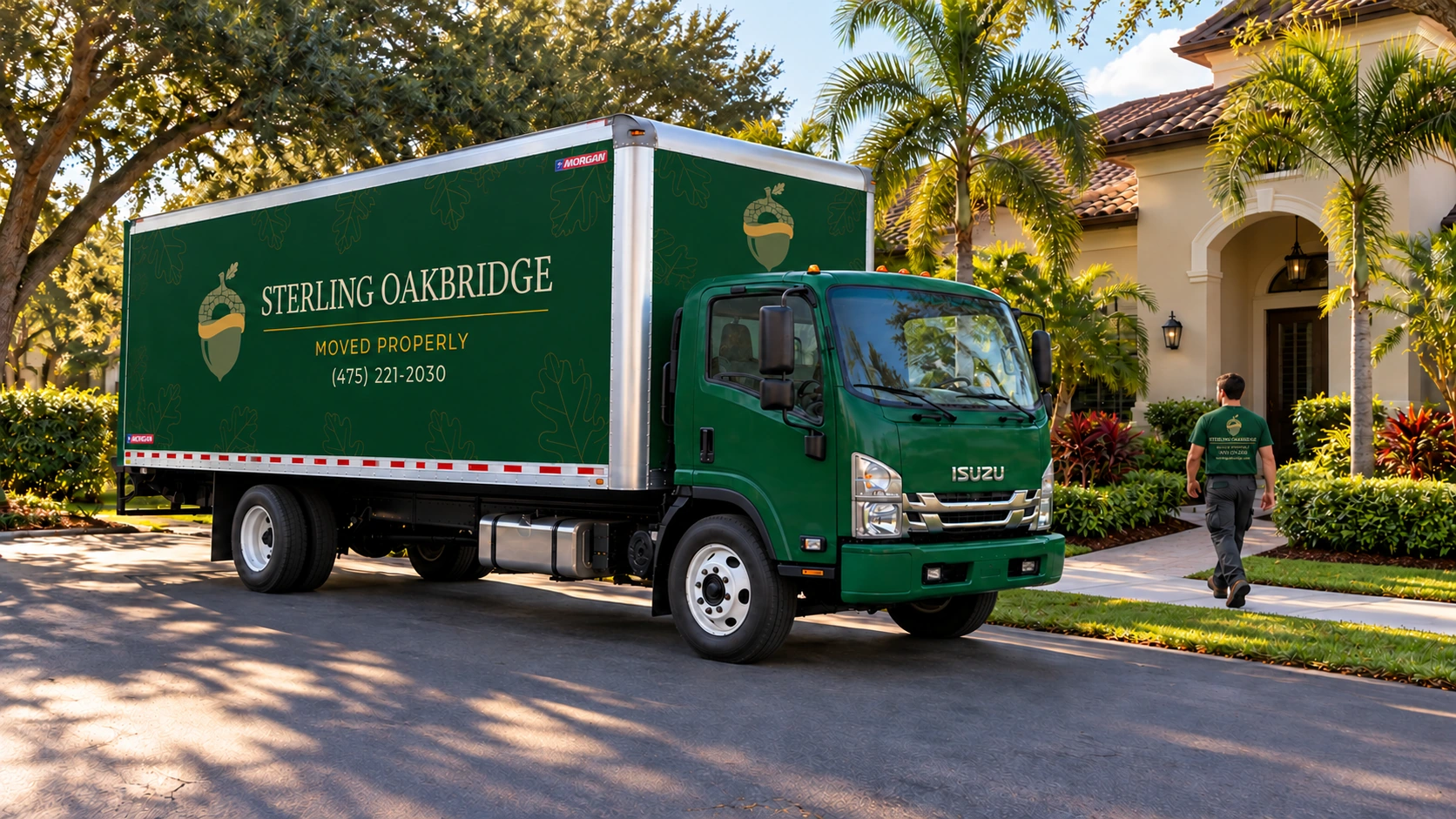
A Sterling Oakbridge mover walks toward a Florida home on the separate path beside a green rigid moving truck.
A Sterling Oakbridge mover walks from the parked truck to the front door.

The moving process

Your move, step by step

  1. 1

    Tell us about your move

    Share the addresses, belongings, dates and help you need, including large furniture or extra stops.

  2. 2

    Check both homes

    Show parking, entrances and stairs; get building instructions and any elevator appointment.

  3. 3

    Review your estimate

    Check the listed work, delivery option, price, payment and protection terms before booking.

  4. 4

    Pack and get ready

    Finish your agreed packing, keep essentials with you and clear the route for collection.

  5. 5

    Receive and settle in

    Have someone ready to receive, direct room placement and check the inventory and condition of your goods.

Ready when you are

Ready to discuss your move?Tell us where you are moving, what is coming with you and the dates you have in mind.

Florida planning

What to look for in a Florida moving estimate

For a move within Florida, the registered mover must provide a written estimate and contract before work begins. You, the mover and any involved broker must sign or electronically acknowledge and date them. Keep a copy you can open on moving day.

The paperwork should identify the companies and contacts, pickup and delivery addresses, planned dates and any place your belongings will be stored. Costs should be itemized, including packing, extra handling, storage and any broker’s fees. Compare estimates using the same belongings and requested services so an omitted stair or packing job does not become a surprise later.

Payment methods must be stated clearly. Florida law requires the mover to accept at least two of three categories: cash-type payments, a qualifying personal check, and credit cards. The cash-type category includes cash, cashier’s checks, money orders and traveler’s checks; a personal check must show your or your representative’s name and address. Ask which methods the mover accepts before booking. Read loss-or-damage terms separately; a price estimate does not explain the protection for your belongings.

County guides

Explore the area around your new home

These six counties include several of the featured cities. Use the local communities below as starting points for a closer home search.

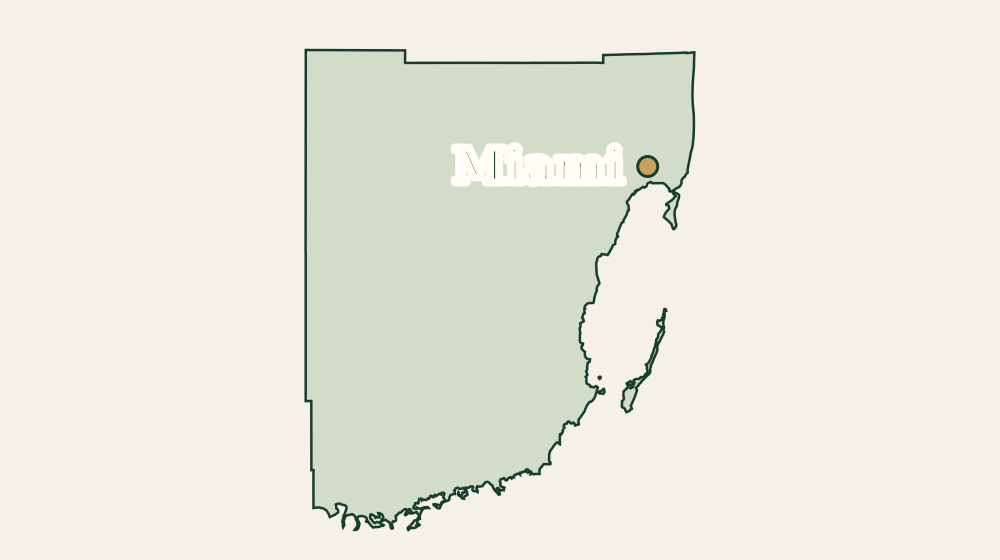
Map of Miami-Dade County with Miami labeled beside its marker
South FloridaPop. 2,774,841 · 2024

Miami-Dade County

Compare the neighborhood around your Miami-area home, its building type and everyday journeys. For a condominium, ask about its moving appointment before choosing delivery.

Key communities

Miami · Coral Gables · Doral

Check a Florida moving company →
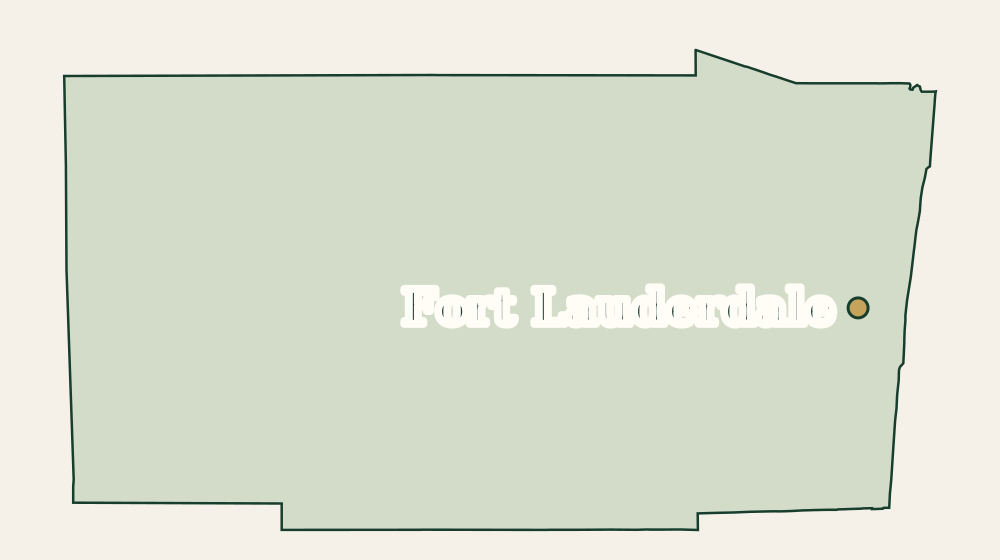
Map of Broward County with Fort Lauderdale labeled beside its marker
South FloridaPop. 1,981,888 · 2024

Broward County

Compare Fort Lauderdale-area neighborhoods, apartments and houses. Find out how movers reach the unit and whether management requires an appointment.

Key communities

Fort Lauderdale · Hollywood · Pompano Beach

Check a Florida moving company →
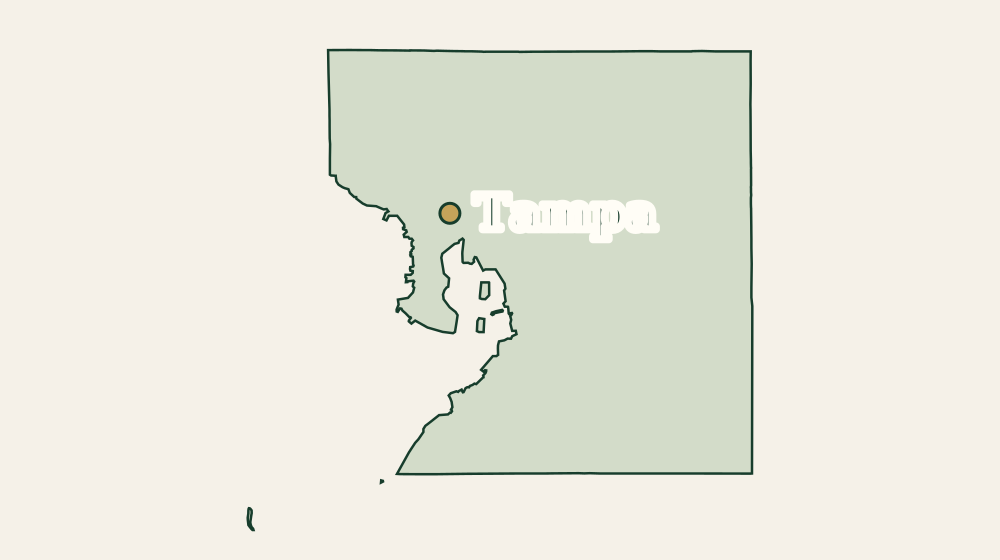
Map of Hillsborough County with Tampa labeled beside its marker
Tampa BayPop. 1,560,449 · 2024

Hillsborough County

Explore Tampa-area communities and the type of home you want. Older porch houses, apartments and newer developments can have different moving needs.

Key communities

Tampa · Plant City · Temple Terrace

Check a Florida moving company →
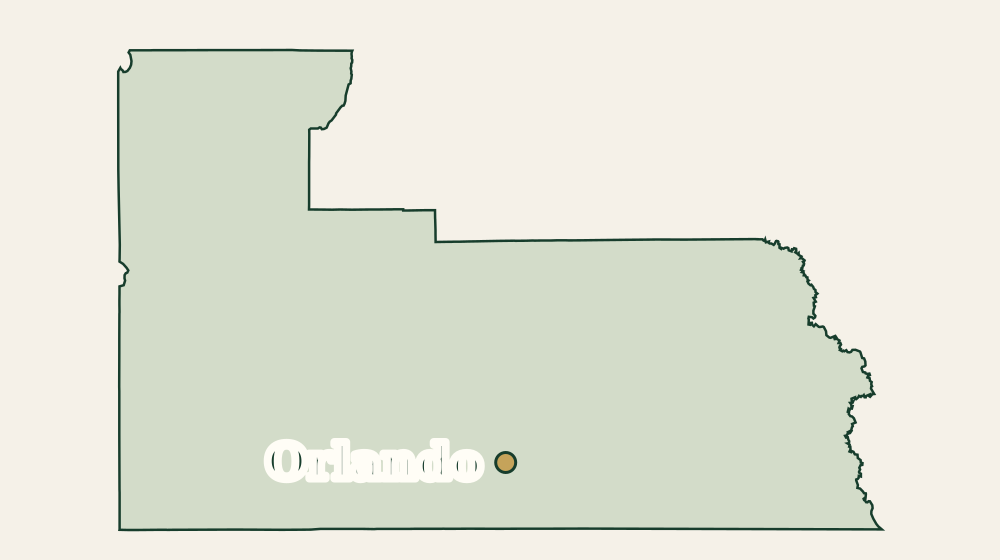
Map of Orange County with Orlando labeled beside its marker
Central FloridaPop. 1,511,568 · 2024

Orange County

Compare Orlando-area neighborhoods with your work and daily routine. Ask about shared entrances, stairs and elevator arrangements for the home you choose.

Key communities

Orlando · Winter Park · Apopka

Check a Florida moving company →
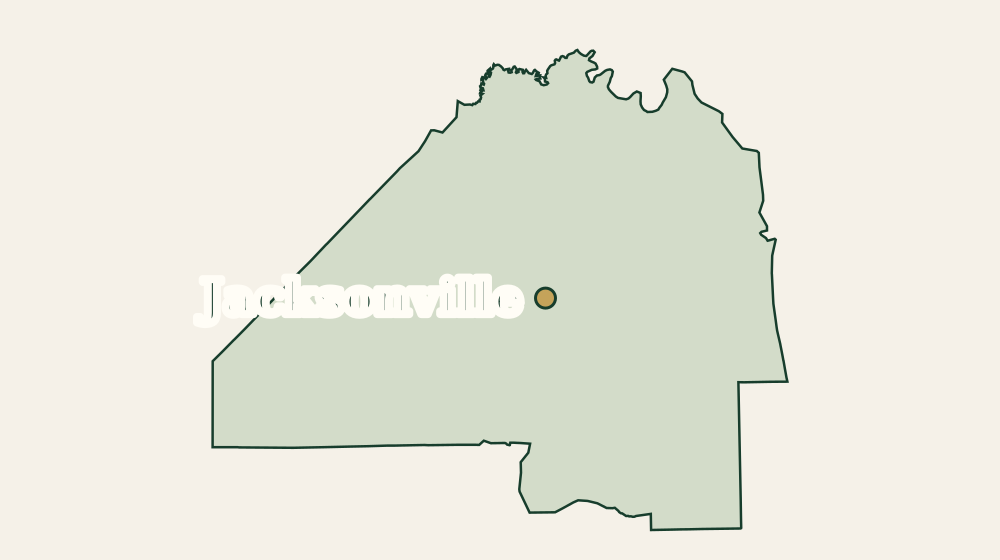
Map of Duval County with Jacksonville labeled beside its marker
Northeast FloridaPop. 1,062,593 · 2024

Duval County

Look at the area around your Jacksonville home as well as its rooms. Show the team the driveway, porch steps and furniture route before moving day.

Key communities

Jacksonville · Atlantic Beach · Neptune Beach

Check a Florida moving company →
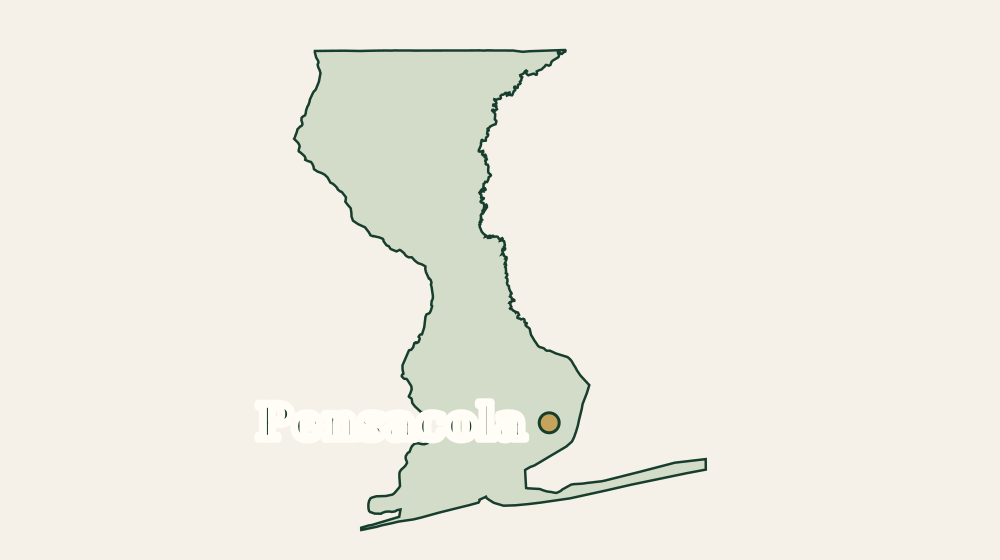
Map of Escambia County with Pensacola labeled beside its marker
Western PanhandlePop. 336,358 · 2024

Escambia County

Include a raised porch, complete stair and any narrow side approach in the receiving review.

Key communities

Pensacola · Century

Check a Florida moving company →

Population estimates: April 1, 2024, Florida EDR/BEBR. They are separate from the 2024 ACS housing estimates. Read the county and municipality source.

All 67 Florida counties

Florida planning

Will your furniture fit through the new home?

Measure the largest pieces against the narrowest parts of their route: door openings, porch steps, hallway turns, stairs and elevator doors. Include handles, railings and low ceilings. A room can be large enough for a sofa even when the sofa cannot get through the entrance.

Florida homes can add a second set of obstacles: a screened entry, a raised porch, a side gate or an outside apartment stair. Show the full route at both homes, including garages and detached spaces with items to move. For a condominium, ask management about the service entrance, elevator reservation, working hours and required insurance documents.

Send furniture dimensions and photographs early if a piece looks difficult. The team can assess ordinary disassembly, another permitted entrance or separately quoted specialist work. Keep instructions and hardware together, and leave the intended floor space clear at delivery so the piece can be placed and unwrapped.

Florida planning

Check the mover before you book

For a move within Florida, look up the mover in the FDACS Business License Lookup. Match its legal or trade name and contact details to your estimate. If a broker arranged the move, find out which registered moving company will collect and transport your belongings. A broker arranges work; the mover prepares the moving estimate and performs the move.

Ask what happens if an item is lost or damaged, how a claim is filed and which limits apply. Registration and vehicle insurance do not mean every belonging will be replaced at full value. Florida has its own rules for liability limits and valuation choices, including written disclosures before work starts. The law also permits movers operating two vehicles or fewer to use a bond or certificate of deposit in place of specified insurance coverage; read the actual provider’s documents.

Keep the estimate, contract, inventory, condition photographs and payment record. Raise an unclear charge with the mover in writing and keep the reply. FDACS provides a complaint process for Florida household moves. For an interstate move, use the federal consumer resources and documents described next.

Who does what

A little coordination before moving day

You, the moving team and your building contacts each handle a different part of getting the move ready.

01 Moving checklist

You and your household

Tell us what is moving, choose services and protection terms, keep essentials with you and arrange someone to receive.

02 Moving checklist

Your moving team

Review the belongings and access, provide the moving documents, and carry out the transport and work you have agreed to.

03 Moving checklist

Your building and street contacts

Management confirms shared entrances and elevator bookings. The responsible street authority handles public loading permissions. Share their instructions with the team.

Florida planning

Protect your belongings on an interstate move

Before loading, read the written estimate, inventory and transport documents. They should describe your belongings, both addresses, packing, furniture preparation, extra stops and any storage you need. Use FMCSA’s consumer resources to check the interstate mover and learn about your rights.

For interstate household goods, Full Value Protection applies unless you select Released Value through the required written waiver. Read how each option handles loss or damage before choosing. A separate insurance policy is a different product. Tell the mover about unusually valuable items and any required declarations; keep identifying photographs and condition notes.

Sterling Oakbridge’s agreed long-distance flat rate covers the listed belongings and services. A longer journey alone does not change that price. Added furniture, another stop, extra packing or changed access may change the work and require a written price agreement. At delivery, check the inventory and condition of your goods, note concerns and keep the mover’s claim instructions.

Florida planning

Plan for Florida heat, rain and hurricane season

Florida’s Atlantic hurricane season runs from June 1 through November 30. As your moving date approaches, follow current weather, road conditions and instructions for the counties at both homes. If an evacuation order applies, put your household’s safety first and contact the coordinator about the move.

Before arriving, look up the new home in Florida’s Know Your Zone resources and make an evacuation plan. Keep identification, medicines, essential supplies and travel arrangements with you. Evacuation zones and flood zones answer different questions: use the relevant official address-based map for each.

For ordinary rain, tell the team about exposed paths and any covered space available near the entrance. If weather closes a road or building, agree where the goods can safely remain, how you will be contacted and when delivery can resume. Confirm any changed storage, handling or price before the extra work begins.

A woman slides a screened living-room window closed while rain falls outside.
A resident closes a living-room window as rain falls outside.

Florida planning

Arrange a place for the moving truck

A clear loading space saves avoidable carrying and last-minute decisions. Give the coordinator the proposed truck position, distance to the door and any gate, slope or turning restriction. For a condominium, ask management which loading area and service entrance movers must use.

Permission comes from the property owner or manager on private land, and the responsible street authority for public curb space. Ask about the actual date and vehicle, then share the instructions with the coordinator. Leave pedestrian routes and building entrances clear. If the space is unavailable, agree on a backup and any extra carrying or handling cost before the truck sets out.

FL511 reports road incidents, construction and closures; FDOT lists truck restrictions on designated roads. The moving team also needs to check the truck’s route and final approach. Turnpike tolls vary by trip, axle count and payment method, so ask how they are included in your quote.

Moving routes

Where are you moving?

A move within Florida, across a nearby border or farther away calls for different planning. Start with the journey that matches yours.

Within Florida

Moving within Florida

For most moves staying within Florida, start with a registered mover and the state’s written estimate requirements. Sterling Oakbridge’s service covered here is interstate moving.

Compare the same work

Include the same belongings, packing, stairs, extra stops and storage in each estimate.

Check the mover

Use FDACS to check the company that will perform the move, including any broker’s role.

Prepare the homes

Arrange loading space and building appointments before moving day.

Florida moving checklist from FDACS →

Across a nearby state line

Florida to Georgia or Alabama

A nearby state line still makes the move interstate. Plan loading and delivery as well as the road journey.

Share the journey

Give both addresses, stops and packing needs so the quote covers the whole move.

Agree the dates

Discuss pickup and delivery; a short route does not guarantee a same-day appointment.

Get ready to receive

Confirm destination parking, entrances and someone available to meet the team.

Plan a neighboring-state move →

Longer U.S. route or Canada

A longer move or a move to Canada

Compare direct and consolidated delivery using your belongings and how soon you need them. Canada also requires entry and customs preparation.

Choose a delivery option

Direct uses a dedicated truck and the same crew. Suitable smaller shipments may use consolidation.

Plan the waiting time

Consolidation to Florida or Canada can allow up to 60 days after pickup and loading are complete. Other destinations have their own terms.

Match your new home

Tell us about a fixed building appointment or a closing delay before choosing delivery.

Compare delivery options →

Direct service uses a dedicated truck and the same pickup and delivery crew. Suitable smaller consolidated shipments use a wider agreed window; confirm the model in writing.

Florida planning

Decide what you want help packing

You can pack your own contents, ask for help with selected rooms or include more packing in the move. Identify books, kitchenware, framed pieces and delicate collections separately so the crew can plan the right time and materials. Packing labor and supplied cartons are separate charges; blankets, wrap and tape carry no extra material charge under Sterling Oakbridge’s terms.

Use small suitable cartons for heavy books, support fragile contents and label boxes with the destination room. Keep documents, medicines, chargers and first-night supplies with you. For unusually valuable or delicate items, send photographs, dimensions and condition details early; some work needs a separate specialist quote.

Ask before including houseplants from another state. FDACS has inspection-document requirements or a stated alternative where the origin state does not offer inspections, and citrus plants and parts have separate restrictions. Identify the species and origin, then confirm both entry eligibility and the mover’s acceptance. If your packing needs grow, tell the coordinator before moving day so the extra time and cartons can be priced.

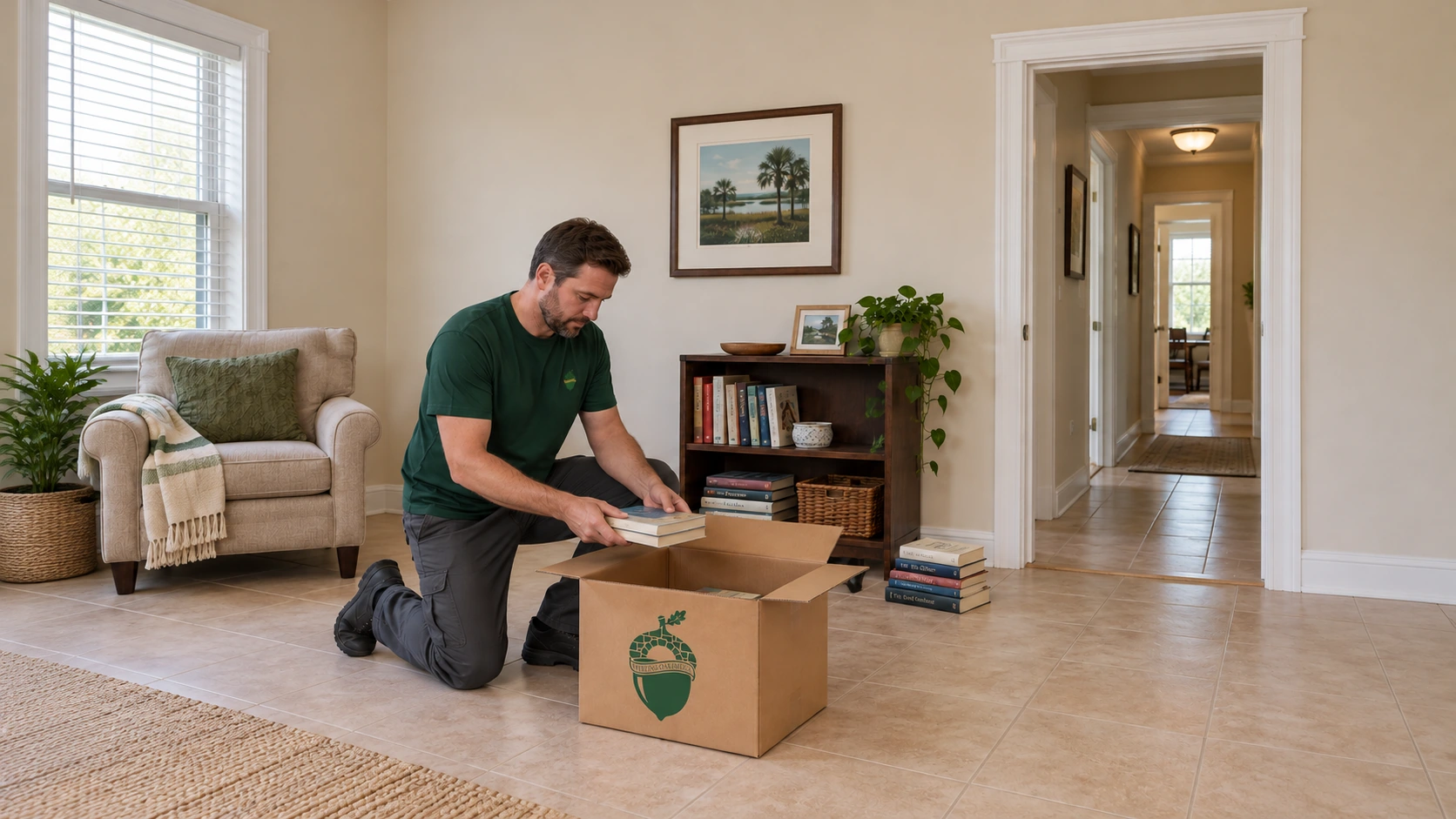
A kneeling Sterling Oakbridge mover places two thin books into a small floor-supported carton in a furnished home.
A mover packs books into a small box.

Florida planning

Get large furniture ready for the move

Send photographs and dimensions of large or awkward furniture before collection. Include joints, detachable parts and the tightest doors or turns at both homes. Tell the coordinator if a piece is built in, already dismantled or missing instructions or hardware.

Basic disassembly and reassembly use moving labor time, with no separate basic assembly surcharge under Sterling Oakbridge’s terms. Electrical, plumbing, structural work and specialist installation need a separate assessment. The team needs to know the actual item before deciding how to prepare it.

Empty furniture as agreed, keep matching hardware and instructions together, and clear its route. At delivery, leave the intended position open. Furniture unwrapping is included with delivery; emptying and placing carton contents is optional unpacking charged for working time. Ask for that help in advance if you need it.

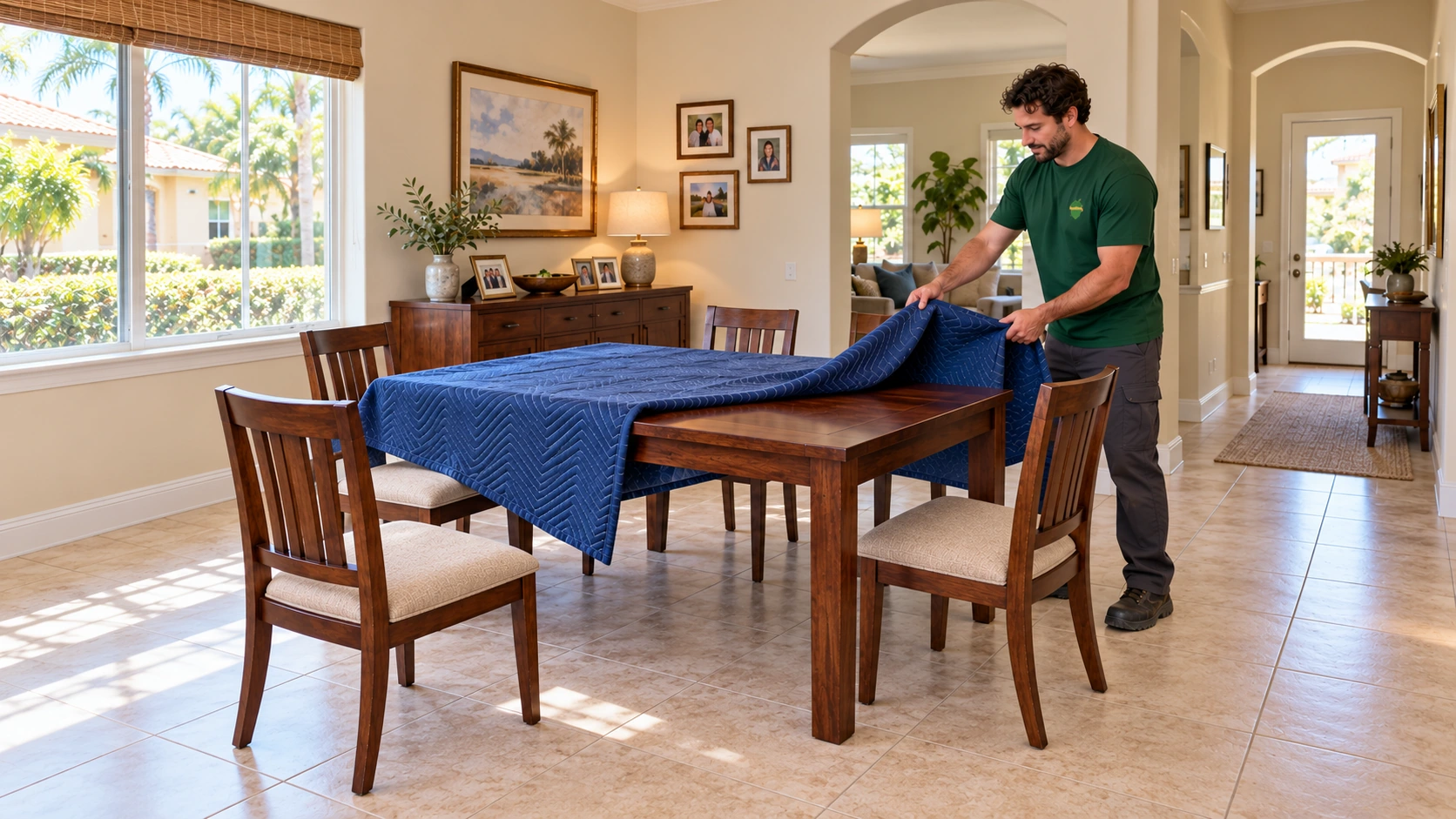
A Sterling Oakbridge mover lifts a loose blue blanket from a wooden dining table beside four matching chairs in a furnished Florida home.
A mover removes a protective blanket from a dining table after delivery.

Florida planning

What Florida’s housing mix means for your move

Florida offers more than one kind of home. The 2024 ACS five-year estimates put detached houses at 54.7% of the state’s 10,256,470 housing units. Apartments, condominiums and other structures account for the rest. An apartment move may require shared-building arrangements; a house may involve porch steps, a screened entry or a longer driveway.

The same release estimates 8,752,810 occupied homes: 5,918,647 owner occupied (67.6%) and 2,834,163 renter occupied (32.4%). It also counts 199,988 housing units built in 1939 or earlier, or 1.9% of all units. The planning-data table below keeps the figures and their sources together.

These numbers describe statewide housing, not current prices or the layout of a particular home. When comparing properties, look at the entrance, stairs, elevator and furniture route as well as the rooms themselves. Older homes and renovations deserve a look at the actual openings rather than an assumption based on age.

Florida planning

Do migration figures help you choose a Florida city?

State migration figures give broad context, but they cannot choose a neighborhood for you. The 2024 ACS one-year table reports that 2.5% of Florida residents aged one or older lived in another U.S. state a year earlier. That is a share of residents now in Florida; it does not subtract people who left the state or count moving-company shipments.

The figure also does not explain why people moved, which cities suit your budget or when a moving company has space. For your home search, compare neighborhoods with your work, school, transport and everyday needs. For the move itself, use your belongings, dates and the two properties to choose the delivery arrangement.

The housing figures elsewhere use a separate 2024 five-year ACS release. Keep those dates and different groups in mind when comparing statistics. View the Census mobility table.

Florida planning

Moving between Florida, Georgia and Alabama

A move across the Georgia or Alabama border is still interstate, even when the homes are close. Include loading, travel and unloading when discussing dates. A Panhandle move and a journey from South Florida can have very different travel needs.

Prepare the destination as carefully as the Florida home: building hours, elevator booking, truck parking and someone available to receive. Use the actual road route for planning rather than straight-line mileage or a car’s estimated journey time.

For goods entering Florida, check any regulated contents before packing. FDACS describes agricultural inspection requirements for specified trucks, trailers and cargo vans, including rental vehicles, and separate plant-entry rules. Tell the coordinator about plants or other restricted items. An extra stop, changed address or storage need should be included in the written moving plan.

Florida planning

Choose pickup and delivery dates that work for you

Start with the dates you cannot change: the end of your lease, the day you receive the new keys, school or work commitments and any building delivery appointment. Then tell the coordinator where you have flexibility. A confirmed pickup and a delivery appointment are separate arrangements.

Direct service uses a dedicated truck and the same crew at pickup and delivery. Suitable smaller consolidated shipments have a wider window: for a Florida destination, up to 60 days after pickup and loading are complete. If you need a narrow condominium slot, raise it before choosing a delivery option. Keep essentials with you while waiting for the shipment.

A closing delay, weather interruption or building change can affect the plan. Agree who will receive the goods if you are travelling and what happens if the new home is not ready. Early planning helps resolve those issues; a particular weekday or season does not guarantee availability or a lower price.

Florida planning

Direct or consolidated delivery: which fits your move?

Direct delivery uses a dedicated truck and the same moving crew at pickup and delivery. It is worth discussing when your household needs the journey and arrival planned closely together. The team still needs to confirm the route and dates before agreeing to an appointment.

Consolidated delivery is an option for suitable smaller shipments when you can accept a broader delivery window. Roughly 300–400 cubic feet is a useful small-shipment guide, not a minimum or an automatic cutoff. For goods going to Florida, the window can be up to 60 days after pickup and loading are complete. Ask for the terms for your shipment before booking.

Choose the option that fits how you will live while waiting. Keep medicines, documents and work essentials with you, and make sure someone can receive the goods within the agreed window. Consolidation does not automatically include a discount, free storage or the same crew at both ends. Compare prices for the same inventory and services; added work needs a written agreement.

Common moving situations

How the plan changes with your needs

These examples show how delivery dates, a closing delay or a border crossing can shape a moving plan.

A fixed delivery slot at a Miami condominium

Your old home must be empty on a set day, but the new building only accepts movers by appointment.

What to do. Give the coordinator the building’s instructions and delivery slot before choosing direct or consolidated service.

Why it helps. You can choose an arrival arrangement that fits the building and know whom to contact if the appointment changes.

A few pieces for an already furnished Florida home

You can live comfortably while a smaller furniture shipment is on the way.

What to do. Ask whether the inventory suits consolidation and whether you can receive within its window, up to 60 days for a Florida destination after loading is complete.

Why it helps. You keep essentials with you and understand the timing and charges before booking.

Your closing date moves back

You are ready to leave, but cannot yet get the keys to the new home.

What to do. Contact the coordinator before dispatch to agree on rescheduling or an available storage option, including its price and later delivery.

Why it helps. Your belongings have a planned destination while you wait for possession.

You arrive in Canada before your furniture

Your household and belongings will cross the border at different times.

What to do. Prepare CBSA’s inventories and declare goods to follow at your first entry. Agree who will handle the later shipment’s paperwork.

Why it helps. The later furniture shipment has the documents and receiving contact it needs.

Florida planning

Moving between Florida and Canada

Plan customs paperwork alongside the transport. For a move to Canada, CBSA asks eligible settlers and returning residents for a detailed inventory in two copies, separating goods travelling with you from goods arriving later. Declare the goods-to-follow list at your first entry and keep the resulting paperwork for the later shipment.

Duty treatment depends on your circumstances and the goods’ ownership and use. Ask CBSA about restricted or uncertain items before packing. Suitable consolidated shipments destined for Canada can have a delivery window of up to 60 days after pickup and loading are complete; your personal-entry paperwork may be needed earlier.

For household goods entering the United States after you, CBP identifies Form 3299 and a detailed inventory. List the contents specifically rather than writing only “household effects,” and check restrictions such as food. Agree who supplies documents, handles clearance and receives the goods. If the itinerary also needs an ocean, air or other separate stage, confirm the provider, packaging, handoff and availability before booking.

Florida planning

What affects your moving price?

Your quote starts with what you are moving, where it is going and the work you want included. Give each mover the same inventory, addresses, dates, packing needs and extra stops. Mention large pieces, stairs, a long walk from the truck and building restrictions so you can compare like-for-like prices.

With Sterling Oakbridge, packing labor and supplied cartons are separate charges. Blankets, wrap and tape carry no extra material charge. Basic furniture disassembly and reassembly use moving labor time without a separate basic assembly surcharge. Storage, specialist work and optional carton unpacking should be described and priced where requested.

The agreed long-distance flat rate covers the listed goods and services. A longer journey alone does not change it. Added items, another stop, a new address or changed handling can change the work, so have any price revision confirmed in writing before it is done. Read payment and loss-or-damage terms alongside the price. For moves wholly within Florida, use the state estimate requirements rather than assuming interstate terms apply.

Florida planning

A practical moving timeline

Start with the home and date decisions. List your belongings, decide what packing help you need and find out when you can enter the new home. FDACS suggests allowing two to six weeks to plan a move within Florida; complex moves or uncertain possession dates may need earlier attention. Ask about availability rather than assuming a date is held.

Before booking, resolve the important details. Check the mover, compare written estimates, choose delivery and protection terms, and get building instructions. Book any required elevator or loading appointment. If the new home is uncertain, discuss storage and later delivery before collection.

Before pickup, finish your agreed packing. Label rooms consistently, keep essentials with you and send any inventory or access changes to the coordinator. Reconfirm keys, property contacts, parking, weather and road conditions. At delivery, direct room placement, check the inventory and condition of your goods, and keep the paperwork for any follow-up.

Florida planning

Make delivery day easier

Have the keys, permission to enter and someone available to receive the move. If you will not be there, agree who can sign the delivery record and direct furniture placement. For a condominium, confirm the service entrance, elevator booking, working hours and required documents with management.

Clear the route to each room and choose the main furniture positions before the truck arrives. Use the same room names on cartons and in your instructions. Furniture is unwrapped as part of delivery; emptying cartons and putting their contents away is optional unpacking charged for working time.

Tell the coordinator about renovations, a blocked entrance or a changed building appointment before dispatch. If you cannot yet use the home, agree on rescheduling or a separately priced storage option. Keep medicines, identification and other essentials with you so a delayed delivery does not leave them inaccessible.

Florida planning

If your new home is not ready

Tell the coordinator as soon as a closing or handover looks uncertain. A move may need rescheduling or a storage stage before final delivery. Check availability and cost before the truck proceeds; a consolidated delivery window does not automatically include free storage or access to a storage unit.

Agree where the goods will be held, who is responsible for them, which inventory and condition record applies, and whether you can retrieve anything. Keep items you need daily with you. For a Florida-only move using third-party self-storage, review the required facility agreement in your name; interstate goods keep their own moving terms even if the storage address is in Florida.

Plan the second delivery too: who can authorize release, how much notice is needed, where the goods will go and what handling or delivery charges apply. Set a time to confirm whether the home is ready. If the date slips again, update the providers before the agreed storage period ends and get the revised arrangement in writing.

Florida planning

Settle into your first week in Florida

Keep a small arrival kit with medicines, identification, chargers, clothes, toiletries and work or school essentials. Make the first bed and bathroom usable without unpacking every carton. Confirm utilities, keys and your landlord’s or building manager’s contact details before arrival.

If you are establishing Florida residency, FLHSMV sets separate deadlines: a new resident who will drive needs a Florida driver license within 30 days, while applicable vehicle, vessel or mobile-home title and registration have a 10-day requirement. Vehicle registration also involves Florida-authorized insurance. Read the agency’s new-resident checklist for your documents and situation; an out-of-state financed vehicle may need extra coordination.

Keep your moving paperwork while you settle in, report delivery concerns through the mover’s process and arrange any agreed follow-up work. Look up emergency information for your actual county and address, including your household’s evacuation plan.

A resident puts folded bed linen on a made bed beside an overnight bag on a luggage stand, leaving the hallway route open.
Setting out bedding beside an overnight bag for the first night.

Florida planning

Ready to plan your Florida move?

For an estimate, send both addresses, a list of belongings, your preferred dates and the help you need. Include packing, large furniture, extra pickups, unpacking or storage. Add photographs and dimensions for awkward items and tell us about stairs, elevators and truck parking.

Before booking, check that the written plan includes the goods and work you discussed, pickup and delivery terms, protection choices, payment methods and a receiving contact. Direct and consolidated delivery offer different timing; choose one that fits your home and household.

Keep a simple backup for a delayed closing, unavailable elevator or weather interruption. Know whom to contact and which alternative you have agreed to. Keep the final estimate, inventory and any changes together so you can refer to them at pickup and delivery.

Verified data

Florida planning data

Planning factEstimateVintageSource
Total housing units10,256,4702024 ACS 5-yearU.S. Census Bureau
Detached single-unit homes5,608,274 · 54.7% of housing units2024 ACS 5-yearU.S. Census Bureau
Homes built in 1939 or earlier199,988 · 1.9% of housing units2024 ACS 5-yearU.S. Census Bureau
Owner-occupied housing5,918,647 · 67.6% of occupied units2024 ACS 5-yearU.S. Census Bureau
Renter-occupied housing2,834,163 · 32.4% of occupied units2024 ACS 5-yearU.S. Census Bureau
Residents age1+ who lived in another U.S. state one year earlier2.5% · not net migration or shipments2024 ACS 1-yearU.S. Census Bureau

Planning answers

Florida moving questions

Straightforward answers about prices, packing, delivery and getting settled.

Ask about your move
What should I send for a Florida interstate moving quote?

Send both addresses, a list of belongings, preferred dates and the packing or other help you need. Mention stairs, elevator bookings, truck parking, extra stops and large furniture; photographs and dimensions help with awkward pieces. If the new home is not ready, say so early so storage or later delivery can be included in the estimate.

Can Sterling Oakbridge help with a move to or from Florida?

Sterling Oakbridge can help plan an interstate household move involving Florida, including packing and furniture preparation where agreed. Start with your destination, belongings and preferred dates to discuss the work you need. If both homes are within Florida, check the specific service request and the actual operator before booking; this guide’s city profiles are a starting point for exploring places to live.

Does my Florida move count as interstate?

A move between Florida and another state is interstate, even across a nearby border. Most moves staying within Florida use state rules. Tell the mover about the complete route and any storage: a route between Florida homes that crosses another state, or a stop during an interstate move, needs the correct classification. Use FDACS for Florida-only mover checks and FMCSA for interstate resources.

How can I check a mover for a move wholly within Florida?

Search the FDACS Business License Lookup and match the mover’s name and contact details to the estimate. If a broker arranged the move, identify the registered mover that will do the work. Read the written estimate, contract, itemized charges, payment methods and loss-or-damage terms before booking.

What must a Florida-only estimate and contract cover?

It must identify the mover and any broker, customer and contacts, pickup and delivery addresses, proposed dates, any holding location, itemized services and total costs, including broker fees. Payment methods must be disclosed. The registered mover provides it before work, and you, the mover and an involved broker sign or electronically acknowledge and date it. Keep a copy and agree changes in writing.

Is loss-or-damage protection the same for every move?

No. Florida-only moves have state rules and written protection choices. A mover may limit liability to as little as 60 cents per pound per item, which can be much less than replacement cost. Interstate household goods have Full Value Protection unless you select Released Value through the required written waiver. Read the actual terms, exclusions and claim procedure, and declare unusually valuable items as required.

What is the difference between direct and consolidated delivery to Florida?

Direct delivery uses a dedicated truck and the same crew at pickup and delivery. Consolidation suits eligible smaller shipments with a broader delivery window. Around 300–400 cubic feet is a size guide, not a fixed cutoff. For a Florida destination, consolidation can take up to 60 days after pickup and loading are complete. It does not automatically include a discount, free storage or the same crew.

When does the Florida consolidated delivery window start?

After pickup and loading are complete. For a Florida destination, the consolidated window can be up to 60 days from that point. Tell the coordinator before booking if a condominium requires a narrow appointment or you will be unavailable. Confirm the shipment’s terms and keep daily essentials with you while waiting.

Does a longer long-distance journey change my flat rate?

No: a longer journey alone does not change the agreed long-distance flat rate for the same belongings and services. Added goods, another stop, extra packing, a new address or different handling may change the work. Have the additional work and any price revision agreed in writing before it is done.

What should I check before delivery to a Florida condominium?

Ask management about the service entrance, loading area, elevator reservation, permitted hours and insurance documents. Share those instructions and any firm appointment with the coordinator before booking delivery. Show the route to your unit, including stairs or tight turns, and agree on a backup if the appointment changes.

Who handles permission for a moving truck’s loading position in Florida?

The property owner or manager handles private loading areas; the authority responsible for the street handles public curb space. Ask about the date and truck, share the instructions with the coordinator and agree on a backup. A spot that is physically empty may still have loading restrictions.

Where can I check Florida road conditions?

Use FL511 for reported incidents, construction, closures and travel conditions, and FDOT for truck restrictions on designated roads. The team must also check the actual truck route and final approach. Turnpike tolls depend on the trip, axle count and payment method; ask how they are included in the quote.

How should hurricane season affect a Florida moving plan?

Follow current weather and local instructions as the date approaches. The Atlantic season runs June 1–November 30. Know your new home’s evacuation information, keep essentials with you and put household safety first if an order applies. Contact the coordinator about any delay, storage or revised delivery before the move resumes.

Is an evacuation zone the same as a flood zone?

No. Evacuation zones guide emergency action, while flood zones describe a different type of risk and are used for matters such as flood insurance. Check the relevant official maps for your address and follow current county evacuation orders. One map cannot answer both questions.

Can I bring my houseplants into Florida with the shipment?

Some houseplants may be eligible, but entry rules depend on the species and origin. FDACS describes inspection documentation and an alternative where the origin state does not offer inspection; citrus plants and parts have separate restrictions. Identify your plants with FDACS before packing and confirm the mover will accept them.

What is included when I request professional packing?

The crew packs the contents you have included in the moving plan, whether selected items or more rooms. Packing labor and supplied cartons are separate charges. Blankets, wrap and tape carry no extra material charge under company terms. Tell the coordinator about delicate pieces or additional rooms early, and keep medicines, documents and essentials with you.

Are furniture preparation and carton unpacking the same service?

No. Basic furniture disassembly and reassembly use moving labor time without a separate basic assembly surcharge. Furniture unwrapping is part of delivery. Emptying cartons and putting their contents away is optional unpacking charged for working time. Specialist installation, electrical, plumbing and structural work need a separate assessment.

What if my Florida home is not ready to receive the shipment?

Contact the coordinator before dispatch to discuss rescheduling or an available storage option. Agree on the provider, location, responsibility for the goods, access, price and later delivery. Keep essentials with you. A delayed closing or a broad consolidated window does not automatically include free storage.

How should I prepare for a household move between Florida and Canada?

Prepare the transport and customs paperwork together. For eligible settlers and returning residents, CBSA asks for detailed inventories separating goods with you from goods arriving later; declare goods to follow at first entry and keep the paperwork. Duty treatment depends on your circumstances. Suitable consolidation to Canada can allow up to 60 days after pickup and loading are complete; confirm clearance and receiving arrangements.

Can my belongings arrive in the U.S. after I do?

Yes, but the later shipment needs its own clearance paperwork. CBP identifies Form 3299 and a detailed inventory for household goods arriving separately from their owner. Describe the contents specifically, check restricted items and duty eligibility, and agree who provides documents, handles clearance and receives the goods. Your own arrival does not automatically clear the later shipment.

What can the Florida Census figures tell me about my move?

They show the state’s mix of housing and broad mobility patterns. For example, detached homes account for 54.7% of Florida housing units in the 2024 ACS five-year estimates. The separate one-year mobility table counts residents who previously lived in another state; it is not net migration or a measure of moving-company demand. Use neighborhood and property details for your own choice.

What does the Florida city map show?

The map locates the twelve cities featured in this guide, from Pensacola in the Panhandle to Miami in South Florida. Use it to see which cities are inland, on the Gulf side or along the Atlantic coast, then compare their profiles below. The county guides later in the article provide a closer look at six of those areas.

When do new Florida residents need a driver license and vehicle registration?

FLHSMV gives a 30-day driver-license deadline for a new resident who will drive, and a separate 10-day requirement for applicable vehicle, vessel or mobile-home title and registration. Florida-authorized insurance matters for vehicle registration. Follow the agency’s new-resident checklist for your residency triggers, documents and transaction; financed out-of-state vehicles can need extra steps.

How far ahead should I start planning a Florida move?

Start once you know the homes, belongings and dates that matter. FDACS suggests two to six weeks for planning a move within Florida. Ask earlier if you have a fixed building slot, substantial packing or an uncertain closing. Availability must be confirmed, and interstate delivery timing depends on the option you choose.

Primary sources

Sources for the decisions in this guide

Official resources for planning a Florida move. Housing and geographic figures retain their stated dates; follow current agency guidance for your own move.

Moving documents and consumer protection

3 sources
  • FDACS: moving within FloridaFlorida Department of Agriculture and Consumer Services

    Consumer preparation, written estimates and actual operator checks for Florida-only moves.

  • Florida Statutes, Chapter 507 (2026)Florida Legislature

    Florida-only scope, mover and broker duties, written estimates and contracts, valuation and holding requirements.

  • FMCSA consumer rightsFederal Motor Carrier Safety Administration

    Interstate consumer documents and liability protection. The retained full official reading was checked October 20, 2026.

Weather and emergency planning

5 sources

Roads, restrictions and tolls

3 sources
  • FDOT truck lane restrictionsFlorida Department of Transportation

    Restrictions on designated highway sections; not certification of every truck route.

  • FL511 frequently asked questionsFL511 · Florida Department of Transportation

    Coverage and limits of current traffic, incident, closure and weather information.

  • Florida Turnpike tollsFlorida’s Turnpike Enterprise

    Trip, axle and payment factors; no unverified dollar toll is quoted here.

Arrival, plants and border documents

4 sources
  • FLHSMV: new residentsFlorida Highway Safety and Motor Vehicles

    Separate residency-related driver-license and title/registration deadlines and document requirements.

  • FDACS plant regulationsFlorida Department of Agriculture and Consumer Services

    Homeowner plant entry documentation, citrus restrictions and item-specific questions.

  • CBSA: moving or returning to CanadaCanada Border Services Agency

    Eligibility, detailed inventories, accompanying goods and goods to follow. Page marked modified May 18, 2018; read October 21, 2026.

  • CBP: sending household effectsU.S. Customs and Border Protection

    Article 000001051, published February 12, 2026: unaccompanied effects, Form 3299 and detailed inventory.

Local housing and historic context

5 sources

Geography and housing statistics

6 sources

Photographs are original illustrations. Follow the official resources below for moving requirements, weather, arrival documents and the dated housing figures used in this guide.

Let’s plan your move

Tell us about your Florida move.

Tell us where you are moving, what you are taking and your preferred dates. Add any packing, furniture preparation, unpacking or storage help you need.

A Sterling Oakbridge move coordinator in the planning office