New Albany is a city northeast of Columbus spanning Franklin and Licking counties. The saved ACS 2024 five-year city profile estimates about 10,900 residents. This guide helps you compare an address, set up the practical basics and prepare the move itself; the postal name alone does not establish school or utility eligibility.
Check the destinations and walks your household will actually use.
01 /
Start with the decision in front of you
Three reading routes through this guide, depending on where you stand. If you are still choosing an address, read orientation, the area comparison and housing first — compare the actual journey, property, lot and any association or landlord rules. If you have children, go next to schools — confirm the school district for the address before planning around a campus. If you already hold keys or a closing date, go to arrival and work backwards: utilities, any association or landlord move rules, and the truck plan.
When the address is settled and the move itself needs planning — dates, inventory, access and the estimate — the New Albany moving page is the working document.
02 /
Understand New Albany before comparing addresses
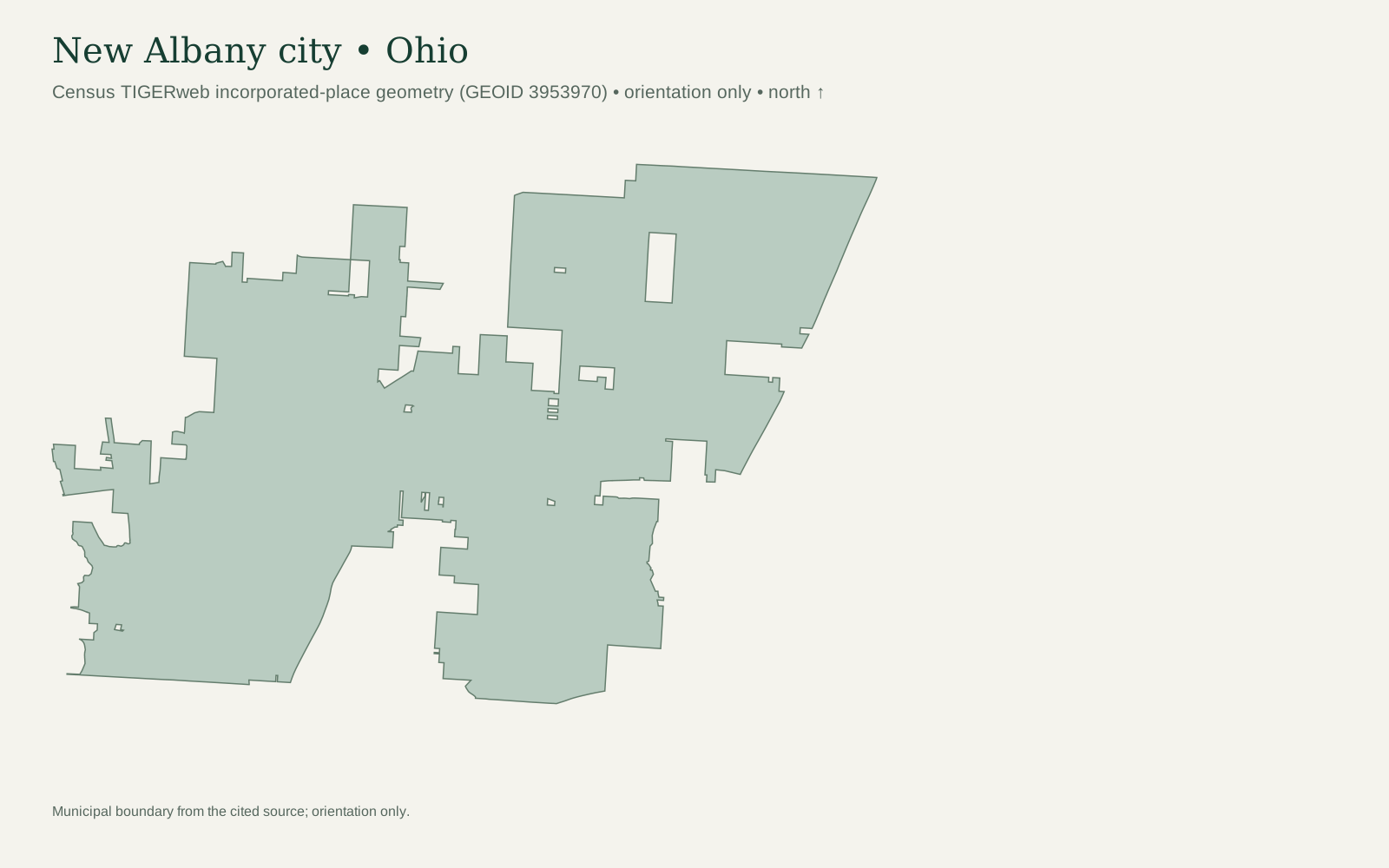
New Albany is a city spanning northeast Franklin County and Licking County — a planned community organized around its village center, its school campus and its business park. The City of New Albany owns the procedures: Village Hall at 99 West Main Street (614-855-3913) and Public Service at 7800 Bevelhymer Road (614-855-0076). The statistics describe an affluent owner market: 88.7% (±1.9 percentage points) of occupied housing units are owner-occupied, 92.4% (±1.9 points) of all housing units are single-unit, median owner-occupied value is $772,100 (±$41,816) and median household income is $238,250 (±$25,457), from the saved ACS 2024 five-year profile. These are survey estimates for the city, not current asking prices, house dimensions or moving-company demand.
Daily life organizes around the village center, the trail network and the school campus, check the trips your household actually needs. Confirm city jurisdiction, county records, school district and service connections separately for the complete address.
Census TIGERweb incorporated-place geometry for orientation; municipal procedures belong to the City of New Albany. Not school assignments or approved truck routes. Open full-size map.
03 /
Address and service checks
Use these five modules to investigate an address and its daily needs. They describe contacts and checks, not residential neighborhood profiles or attendance boundaries.
The village center side
The civic and errand core: Village Hall at 99 West Main Street, the shops on the green, and the community events calendar.
Verify the actual connections and records; a city directory does not establish service to a parcel.
Daily travel
Not a place but the accounts to start before closing week.
Before choosing
Review curb-to-home water-line and private sewer-lateral condition and maintenance responsibility.
04 /
Compare the whole property, not just the price
Citywide tenure and structure estimates provide context, not a street-by-street building description (ACS 2024 five-year, via Census Reporter). The building and its association decide the move logistics as much as the price — a deep lot with a wide drive is a different job from a townhome court.
The due-diligence list follows the type. In houses: the roof and systems' ages, the basement finish, and the utility split — the city owns the water mains but contracts the City of Columbus for water service (the homeowner maintains the service line from curb to house), and sanitary sewer is the city's, treated at Columbus plants. In HOA neighborhoods: the written rules on trucks, move windows and protection — get them before booking anything.
Compare the total monthly commitment: rent or mortgage, property taxes, insurance, utilities and any association or community-authority assessments. A renter checks included services, deposit terms, condition photos and key handover; a buyer checks inspection and repair records, drainage and previous alterations. Ask Community Development about approvals for planned work; the city says roofs, decks, fences and patios require plan review and a permit. Confirm current requirements for your project before arranging it.
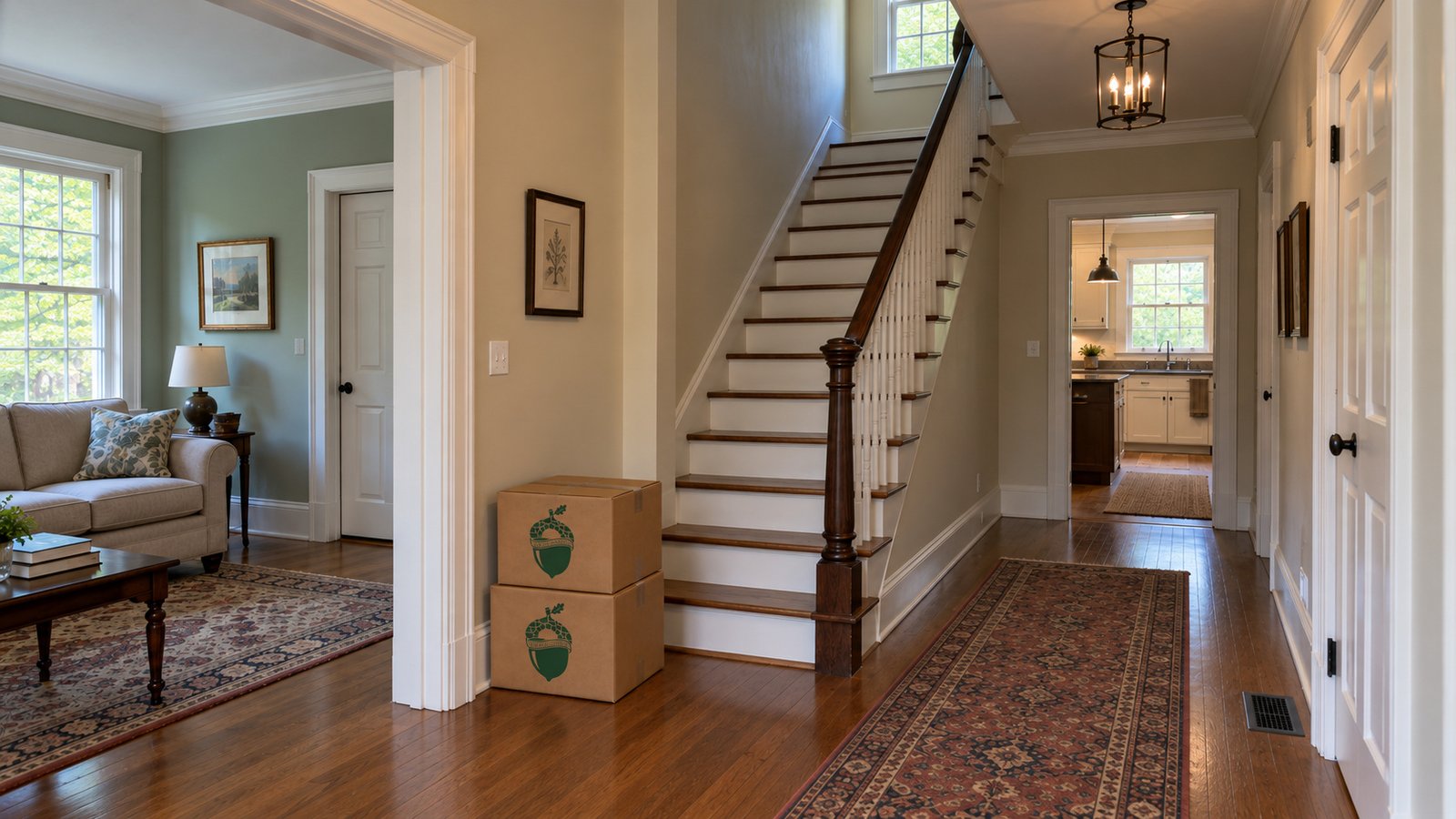
Check stair turns, door swings and furniture routes in the home you choose.
05 /
The Columbus commute — test yours anyway
The saved ACS 2024 five-year mean travel time is 22.1 minutes (±1.4), for workers aged 16 and over who did not work at home. It is not a time from your home to Columbus or a named employer.
The practical test: drive your real route at your real hours, in the season you will actually keep. For a non-driving commute, COTA SmartRide New Albany connects the Park & Ride and business park with Lines 35 and 45. The service page describes different weekday/weekend patterns and links schedules; confirm both directions, the transfer, the walk to the stop and your employer's shuttle destination. This is not an all-address door-to-door service.
If anyone works from home, verify service at the address. The city lists New Albany Net, but its economic-development guidance describes a network available to businesses. That does not establish residential eligibility: check the exact address and unit with providers, including installation dates, upload capacity and a backup connection.
Test the actual trip at your working hours and check both directions.
06 /
Five schools on one campus
New Albany-Plain Local lists five schools on a single campus, per the federal Common Core of Data (2023-24, via the CCD directory): Early Learning Center (PK–K), Primary School (1–3), Intermediate School (4–6), Middle School (7–8) and High School (9–12) ; the saved directory is historical and does not assign a new address.
Confirm the school district, assigned building, grade and bus arrangements for the full address with the district before relying on this campus. A New Albany postal address is not proof of NAPLS residency. The current enrollment instructions distinguish new, returning and sibling applicants. Prepare supporting documents before opening the application: incomplete applications are deleted after 14 days. Renters may enroll only on or after the lease begins; buyers or builders must follow the district's contract and 90-day documentation requirements. The district explicitly warns against starting too early. Returning families contact the registrar to reactivate their account.
The current first-step guidance says kindergarten placement depends on residency and distinguishes half-day and limited tuition-based all-day places. Ask separately about preschool capacity and any waitlist. Preparation can begin before application eligibility; do not defer school contact until after the move.
07 /
Water, sewer and address-specific internet
The utility split is unusual and worth reading once: the city owns the water mains but contracts the City of Columbus to provide water service and maintain them (billing and quality through Columbus, 614-645-8276); the service line from curb to house is the homeowner's. Sanitary sewer is the city's network, treated at Columbus plants, with city crews inspecting public lines by camera; private sewer laterals remain the homeowner's inspection responsibility. And internet: The city lists New Albany Net, but its economic-development guidance describes a network available to businesses. That does not establish residential eligibility: check the exact address and unit with providers, including installation dates, upload capacity and a backup connection. The city's utilities page lists utility contacts, including AEP or The Energy Cooperative for electric and Columbia Gas for gas.
Trash runs on the Thursday Rumpke route, billed directly by the hauler — see waste.
For the actual property, confirm the connections, meter readings, start/stop dates, deposits and which accounts the landlord or association retains. The directory does not assign an electric or gas provider to every parcel. Review water-service and private sewer-lateral records before buying; know the city's reporting contact if a backup occurs. Do not obstruct manholes or maintenance easements when arranging storage or landscaping.
08 /
Thursday, before 7 a.m., with the bundle rules
Use the city's current collection guidance. Thursday is the normal Rumpke collection day; set out before 7 a.m. and check holiday or weather changes. Rumpke bills residents directly. Household trash quantity is not limited, but material rules still apply: boards, fencing, paneling and carpeting need four-foot-by-four-foot lengths tied in 18-inch bundles of no more than 50 pounds. Wrap mattresses and upholstered furniture in plastic. Refrigerant appliances need certified CFC removal before collection; arrange this with Rumpke (1-800-828-8171). Commercial and contractor waste is excluded.
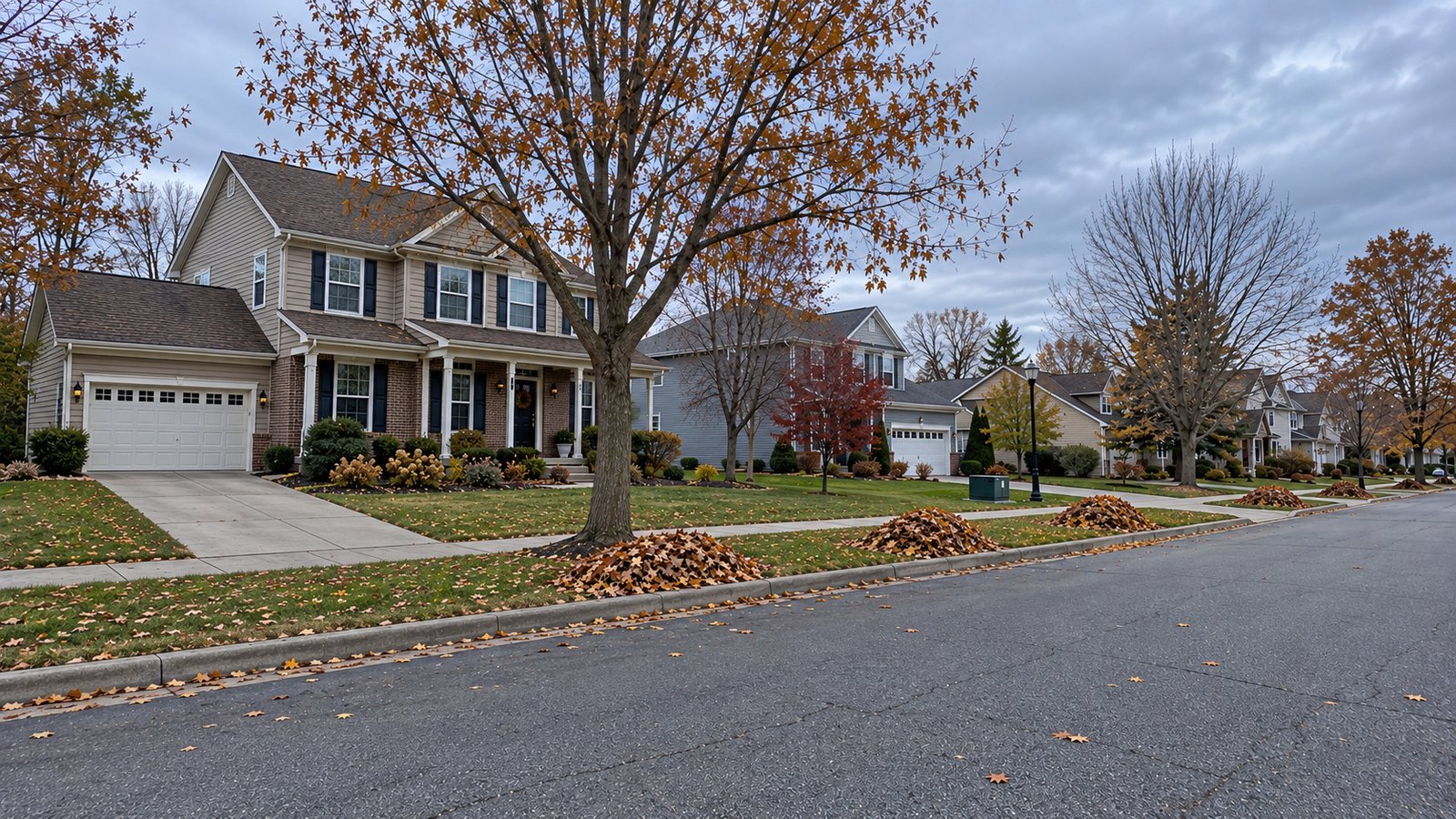
Yard waste needs paper yard-waste bags or a can marked for it; avoid plastic bags. The separate leaf program uses a zone schedule and excludes private streets and business-park areas. Check your street in its live progress map; keep piles behind the curb, out of drains and clear of parked vehicles. The city waste page gives special-disposal contacts and seasonal programs: confirm dates, eligibility and material acceptance before travelling to an event. Separate donation, recycling, ordinary refuse and excluded items before packing the keep list.
09 /
The driveway, and the association's window
Review a private standing position with the property owner and mover for clearance, slope, surface capacity and maneuvering room. Association or landlord consent does not authorize use of a public street. For a proposed curb occupation or obstruction, ask Public Service (614-855-0076; permits@newalbanyohio.org) which approval applies. The city publishes right-of-way procedures and requires special hauling permits for vehicles or equipment exceeding state weight, height or width limits; these are not blanket parking permissions.
One local note: Thursday collection and any leaf-zone work need room at the curb. Plan the move and set-out together. The moving page's parking section turns this into the day-of plan.
10 /
Walk the full route before moving day
Access planning means reading the whole actual route, where present: the entry, the center stair's turns, the second-floor landing, the basement stair, the garage-to-house door. Measure the largest pieces against the real route, and photograph the stairs and the driveway for the estimate.
Outside, protect the entry's flooring and watch steep or curved driveways for the truck's clearance. In HOA communities and rentals, the written rules come before the day.
11 /
A village center, a trail network, a school campus
Explore the resources that fit your routine: the village center's shops and Village Hall, the paved trail network, the school campus on the north side, and the community's events calendar. Check opening hours, accessibility and the whole trip from your chosen address; a place on the map does not establish a short walk.
The routine to test before you buy is the weekly loop at two hours: the morning version (school run, the commute) and the evening one (the trails, the village center). A planned community runs on its shared spaces — the trails and the green are how you join it.
Before arrival, identify a grocery and pharmacy, arrange prescription and medical-record continuity, and confirm appointment availability with the providers you choose. Check library and community-program registration or booking requirements rather than assuming access. A household without a driver should test the return trip as carefully as the outward one.
Try the everyday walking routes from the address you are considering.
12 /
The school calendar, the leaf season, the storm dates
New Albany's calendar has three beats. The school-year turn: check the actual school dates when requesting a move and hold a backup. The leaf season: fall puts the curb to work for the city's collection — check the current zone map and exclusions, and keep piles out of the street. And the storm dates: winter weather can affect travel and access; the city's snow program handles the streets, and residents and businesses clear their walkways; agree responsibility for the private receiving route before the truck arrives.
The steady discipline wins here: book the date early, hold a backup, and plan the cleanout across the Thursdays. The moving page converts the calendar into a date-and-backup plan.
Check the current collection zone and keep piles and parked vehicles clear of the route.
13 /
Turn the closing date into an arrival plan
Work backwards from the day you get keys. Two weeks out: start the water account with Columbus and confirm the city sewer setup, confirm the address's gas, electric and internet providers and installation dates, get any association or landlord move rules in writing, and book the move through the New Albany moving page. One week out: confirm the truck plan and the backup date, set up the Rumpke account for the Thursday route, separate disposal by material and confirm any excluded items, and set aside what travels with you. In the first days after arrival: register the car and update voter registration, learn the Thursday rhythm, and — with children — complete the already-planned school process at the eligible time.
Keep a Plan B for the failures that matter here: a storm date (the backup moving day, agreed in advance) and a slipped closing (which items go to storage, which travel with you). The guide's sections hold the details; the moving page holds the estimate.
Match the plan to your reason for moving: a renter records condition and account responsibility; a buyer checks assessment and repair records; a family coordinates school eligibility and transport; a remote worker books internet and a backup; a business assigns an IT contact and confirms building access and operating priorities. Keep account confirmations, meter readings, condition photos and any loading approval together after arrival.
14 /
Questions before you arrive
What kind of community is New Albany?
New Albany is a city northeast of Columbus in both Franklin and Licking counties, distinct from New Albany, Indiana. Village Hall: 99 West Main Street (614-855-3913). Census GEOID 3953970 identifies the city, not the ZIP or the entire counties.
How long is the commute from New Albany?
The saved ACS 2024 five-year mean is 22.1 minutes (±1.4) for workers 16 and over who did not work at home. It does not predict your route. Test your hours and return trip; check COTA Lines 35/45 and SmartRide if relevant.
Where do New Albany children go to school?
Confirm the district, grade, building and bus arrangements for the exact address. NAPLS has five listed schools on its campus, but postal New Albany is not an enrollment guarantee. Prepare documents first; follow lease-start or purchase/building-contract timing and the current enrollment steps. Incomplete applications are deleted after 14 days.
How does trash work in New Albany?
Thursday is the normal Rumpke collection day; set out before 7 a.m. and check holiday or weather changes. Rumpke bills residents directly. Household trash quantity is not limited, but material rules still apply: boards, fencing, paneling and carpeting need four-foot-by-four-foot lengths tied in 18-inch bundles of no more than 50 pounds. Wrap mattresses and upholstered furniture in plastic. Refrigerant appliances need certified CFC removal before collection; arrange this with Rumpke (1-800-828-8171). Commercial and contractor waste is excluded. Check holidays, yard-waste containers and the separate leaf-zone schedule.
Who provides water, sewer and internet?
Columbus handles water billing under the city's contract; homeowners maintain the curb-to-home water line. Public sewer reaches Columbus treatment; private sewer laterals need owner review. Confirm accounts and actual electric, gas and internet service for the address. The city lists New Albany Net, but its economic-development guidance describes a network available to businesses. That does not establish residential eligibility: check the exact address and unit with providers, including installation dates, upload capacity and a backup connection.
What should I know about HOA rules for moving day?
If the property has an association, ask for written truck, timing and protection rules. Also confirm landlord/building requirements. Association consent does not authorize a public street position; check the proposed arrangement with the city separately.
How do I arrange the moving estimate?
Use the New Albany moving page to request an estimate: both addresses, dates plus an alternative, a room-by-room inventory (basement, garage, office and gym included), the HOA's rules, and photos of the entry and the driveway. The more concrete the request, the more accurate the plan and price.
Continue planning
The other side of your move
Explore the local guide or plan the moving services for this location.
Official procedures and local resources are linked beside the answers above. Reopen the relevant page when arranging a date: fees, schedules and application requirements can change.