
An adult carrying a grocery bag walks along a sidewalk beside brick bungalows and autumn trees.

State moving guide

Moving to Illinois: A Practical Guide

Find your part of Illinois, compare moving arrangements and prepare a smoother arrival. Explore Chicago, the suburbs and cities farther south, then build a plan for your belongings, both homes and delivery.

Illinois planning

Find your place in Illinois

A Chicago apartment, an Aurora house and a home near Carbondale put you in different parts of Illinois life. Begin with the twelve city profiles if you are still deciding where to settle. Use the map to place each city, then compare the particular neighborhoods, daily journeys and kind of home you want. A place that suits a weekend visit may need a closer look for everyday living.

If your next address is already chosen, start with the work ahead: what is moving, who will pack, how the crew can reach each home and when someone can receive the goods. The practical chapters explain Illinois mover checks, interstate documents, delivery options, weather, furniture preparation and a gap between homes.

Sterling Oakbridge reviews interstate household moves involving Illinois. Tell us about both ends of the journey to discuss the actual route and work. The city portraits and county guides help you explore the state; they do not promise a local Illinois office or establish that every Illinois-only move can be undertaken.
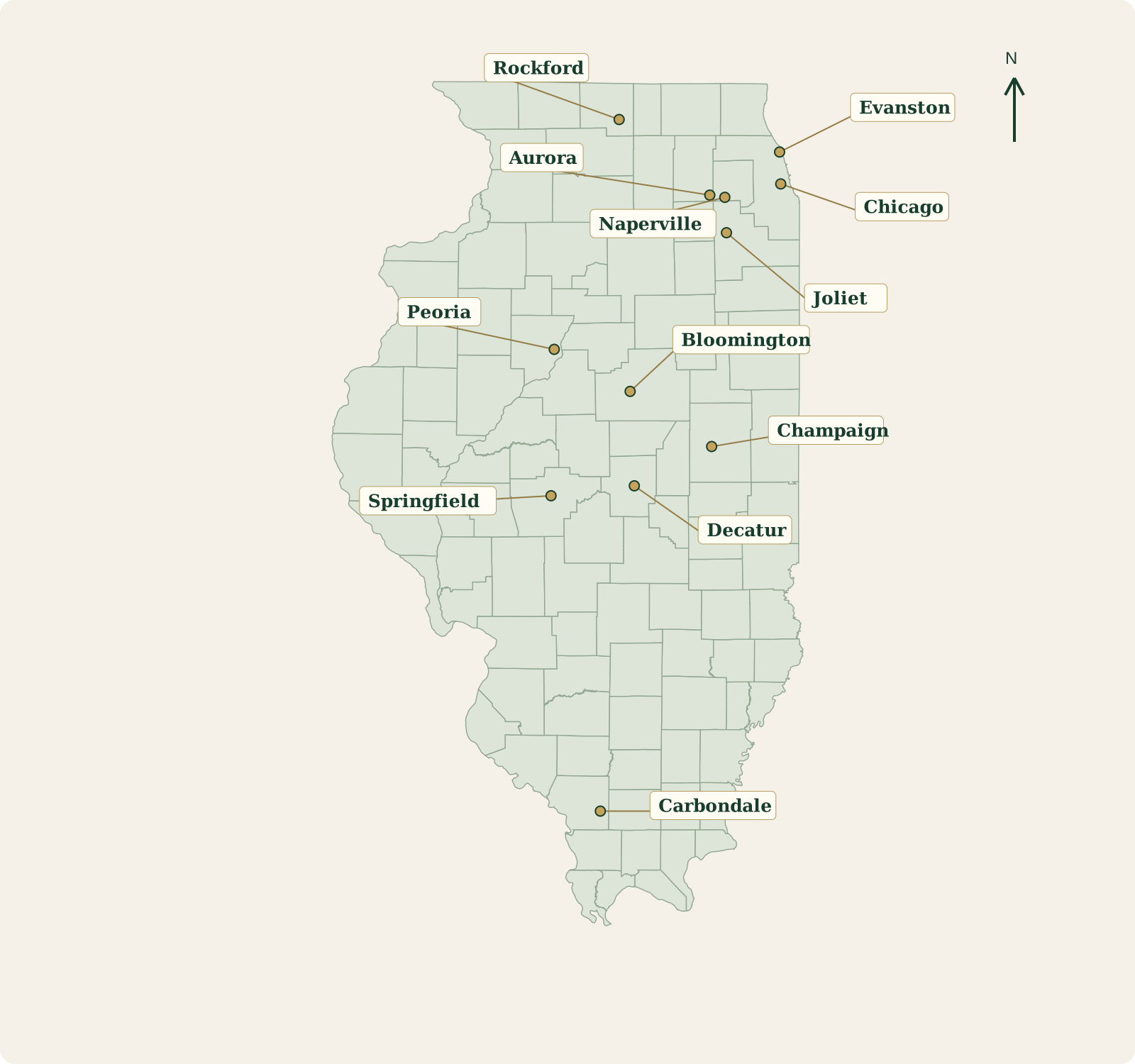

Illinois cities and regions
Explore twelve Illinois cities, from Chicago and the surrounding communities through central Illinois to Carbondale. Compare their profiles below to narrow your home search.

Illinois planning

Which part of Illinois fits your everyday life?

Chicago and the surrounding communities. Chicago offers distinct neighborhoods, lakefront settings and many forms of urban housing. Evanston has its own business districts and Lake Michigan shoreline. Aurora, Naperville and Joliet are separate cities with their own centers, rather than interchangeable labels for a Chicago address. Compare the journey from a candidate home to work, school and the places you use regularly.

Northern Illinois. Rockford is a useful starting point for exploring the north-central part of the state. Its gardens, parks and city neighborhoods offer a different setting from the Chicago lakefront. Look at the actual neighborhood and your travel needs before deciding that one northern Illinois city can substitute for another.

Central Illinois. Springfield, Peoria, Bloomington, Champaign and Decatur give you several city settings to explore. State-capital life, riverfront districts, university-related activity and established residential streets are different reasons to look more closely. Bloomington and Normal, like Champaign and Urbana, are separate municipalities even when discussed together as a regional destination.

Southern Illinois. Carbondale provides a southern reference in this guide, with a university and access to the wider southern Illinois landscape. Twelve profiles cannot represent every part of the state. Use the additional community names and official local resources to extend your search, then visit the particular area and property before committing.

City portraits

Explore Illinois’s cities

Explore twelve different city settings before looking more closely at a neighborhood and home. These portraits introduce places; a city link appears only where a corresponding guide is already published.

Residents walk beside Lake Michigan with a dense Chicago skyline beyond the waterfront.IL

Chicago

Explore a city of distinct neighborhoods, lakefront spaces and busy commercial streets. Chicago offers apartment towers, smaller multi-unit buildings and bungalow districts, so the daily setting changes considerably from one neighborhood to another. Compare the specific block, your regular journey and the home itself rather than choosing from the downtown skyline alone.

A resident walks beside a river railing while another reads on a bench, with brick city buildings across the water.IL

Aurora

The Fox River and an active downtown give Aurora its own center west of Chicago. Theatre, local shops and river-related recreation provide starting points for exploring the city and the wider Aurora area. Compare the actual residential neighborhood with the places you will use regularly; an Aurora postal address or regional label does not describe every part of that journey.

Two adults walk beside a landscaped river with downtown storefronts, viewed from the opposite bank.IL

Naperville

Downtown shops and the Riverwalk offer an inviting place to begin a Naperville visit. Paths beside the DuPage River, public spaces and nearby residential areas give you several settings to explore. Consider how far a candidate home is from the particular destinations that matter to you, rather than assuming that every Naperville address shares the downtown experience.

A resident waters a flower bed beside a complete older porch house and a neighboring limestone home.IL

Joliet

Joliet combines a downtown beside the Des Plaines River with established residential districts. Its historic buildings include locally distinctive limestone construction and a range of older house styles. Explore the central streets and surrounding neighborhoods as different places to live, then look closely at the property and everyday route that fit your household.

A wood-sided porch house stands behind a planted yard and clear front steps on a tree-lined street.IL

Rockford

Rockford offers a north-central Illinois city setting with gardens, parks and residential neighborhoods to explore. Begin with the parts of the city connected to your work, family or regular activities, then compare nearby blocks and homes. A regional visitor attraction can introduce the area, but it does not describe the daily life around every Rockford address.

An adult with a tote walks past brick shopfronts on a tree-lined city sidewalk.IL

Springfield

Illinois’s capital brings government, Lincoln history and Route 66 connections into one city. The historic visitor sites are one way to begin exploring; residential neighborhoods offer a separate view of everyday Springfield. Compare the home and its surroundings with your regular destinations before choosing which part of the city suits you.

Two adults talk at a small riverside table while a walker follows a broad waterfront path.IL

Peoria

Peoria’s Illinois River setting and riverfront give the city a recognizable starting point. Look beyond a waterfront visit to compare established neighborhoods, nearby amenities and the home you would actually use. Your journey between those places matters more than a general impression of the city’s central attractions.

One adult sits at a sidewalk cafe table while another stands nearby holding a coffee cup.IL

Champaign

Champaign belongs to a wider university-area setting shared with neighboring Urbana, while retaining its own city identity. Local food, cultural activity and parks offer useful ways to explore. Compare a downtown apartment, an established residential street and locations farther from the center against the daily trips and household schedule you expect.

A complete two-story porch house and brick neighboring home stand on a shaded residential street with a child-size bicycle by the steps.IL

Bloomington

Bloomington and neighboring Normal are distinct communities commonly explored together. Their central Illinois setting includes historic areas, campuses and Route 66 connections. Start with the particular neighborhood and regular destinations you need; a regional name can help you search, but it does not replace choosing a home in the right municipality and location.

An older adult walks along a shaded sidewalk beside a complete timber porch house and a vintage brick apartment building.IL

Evanston

Evanston combines Lake Michigan access, neighborhood business districts and a varied residential environment along Chicago’s northern edge. Tree-lined streets, older homes and apartment buildings provide different living settings. Explore the lakefront and commercial centers, then compare the actual home with the routes you will use day to day.

Residents walk past low-rise brick shopfronts on a city street with ordinary curbside parking.IL

Decatur

Decatur offers a central Illinois city setting with a historic downtown and established neighborhoods. Merchant Street is one starting point for exploring the city’s older commercial character. Look at the particular neighborhood, household needs and daily travel rather than expecting the downtown area to represent every residential address.

Resident raking autumn leaves beside a southern Illinois bungalowIL

Carbondale

Carbondale introduces southern Illinois through a university city and the surrounding regional landscape. Its neighborhoods, local businesses and community spaces offer a different starting point from northern Illinois. Compare the home’s location with the trips you expect to make, including any campus-related or regional travel, before deciding which setting fits.

Illinois planning

Within Illinois or across a state line?

Chicago to Springfield is an Illinois-only move. Chicago to a Wisconsin address is an interstate move even if the journey is shorter. The shipment's actual origin and destination, including a storage stage, matter more than the phrase “long distance.” A city or metropolitan-area name alone does not settle which process applies.

For an Illinois-only household move, start with the Illinois Commerce Commission's mover resources. The ICC licenses Illinois intrastate household-goods movers and explains the applicable charges and documents. Interstate mover and broker checks belong with FMCSA. Ask which legal business is arranging the move and which carrier will transport your goods.

Give the complete pickup and final delivery addresses when seeking a proposal. If the destination changes after booking, tell the coordinator before loading and obtain the revised arrangements in writing. This guide's Sterling Oakbridge service is interstate household planning; availability and the proper operator for work remaining entirely inside Illinois require separate confirmation.

More places to explore

Keep exploring Illinois communities

Looking beyond the featured cities? These communities offer more starting points for your Illinois home search.

Ask about your Illinois move →

Illinois planning

Show the whole route from the truck to your room

Photograph the stopping place, sidewalk or driveway, entrance and interior route in sequence. Include the parts that disappear in a front-of-house photograph: a narrow side passage, basement steps, a rear gate, a sloping walk or the turn before an upstairs landing. Give the carrying distance and say whether the crew must share the path with other residents.

A Chicago building's alley is not automatically an authorized loading area. A suburban driveway is not automatically large or strong enough for the proposed truck. For a rural property, show the approach from the public road, soft shoulders, overhead branches, gates and room to turn. Obtain the property owner's instructions for a shared or private lane.

The moving team can then review the actual vehicle and handling route. If a smaller-vehicle transfer, longer carry or different stopping place is needed, have the arrangement and price explained before moving day. Keep private access codes in the agreed private communication channel. A useful access video follows a continuous journey; it does not need to show family documents, alarm details or unrelated private rooms.

Mover supporting a closed compact book carton on a level bungalow approach
A mover supports a closed book carton along a clear, level approach.

The moving process

Your move, step by step

  1. 1

    Tell us about your move

    Share the addresses, belongings, dates and help you want, including large pieces and extra stops.

  2. 2

    Check both homes

    Show parking, entrances and stairs; get building instructions and any elevator appointment.

  3. 3

    Review your estimate

    Check the work, delivery option, price, payment and protection terms before booking.

  4. 4

    Pack and get ready

    Finish the agreed packing, keep essentials with you and clear the collection route.

  5. 5

    Receive and settle in

    Have someone ready, direct room placement and check the inventory and condition.

Ready when you are

Ready to discuss your move?Tell us where you are moving, what is coming with you and the dates you have in mind.

Illinois planning

Understand an Illinois-only moving estimate

Obtain a signed written estimate before the move begins. Show or describe everything being moved, including basement, garage and storage contents, and confirm the inventory in writing. The ICC's 2026 consumer guide explains that an Illinois intrastate estimate is not a binding final price: actual services and the applicable tariff determine the bill.

The guide distinguishes hourly charging for moves under 50 miles or entirely within the listed Chicago-area counties—Cook, DuPage, Kane, Kendall, Lake, McHenry and Will—from weight-and-distance charging for longer moves outside that group. It also describes a limited rate exemption outside Cook County for a move beginning and ending in the same incorporated community and nearby surrounding area. Licensing still applies. Ask the mover which rule and filed tariff cover your exact journey; do not infer the basis from mileage alone.

Compare the crew, vehicle, time basis, packing, access, valuation and any additional stage on the same terms. Ask how changes will be recorded and which payment arrangements apply. Keep the estimate and the agreed item list together. These Illinois-only rules are separate from the written interstate proposal discussed elsewhere in this guide.

County guides

Explore the area around your new home

These six counties include several of the featured cities. Use the local communities below as starting points for a closer home search.

Cook County with Chicago marked
Chicago regionPop. 5,182,090 · 2024

Cook County

Explore Chicago neighborhoods and neighboring communities with their own city identities. Compare the particular home and daily journeys, including any shared-building access.

Key communities

Chicago · Evanston · Oak Park

Check mover credentials →
DuPage County with Wheaton marked
Western suburbsPop. 930,024 · 2024

DuPage County

Explore separate suburban centers and established residential areas west of Chicago. City and county boundaries differ; check the actual address and community rather than assigning every suburb to one county.

Key communities

Wheaton · Downers Grove · Elmhurst

Check mover credentials →
Will County with Joliet marked
Southwestern Chicago regionPop. 701,462 · 2024

Will County

Compare Joliet and surrounding communities, from older city neighborhoods to lower-density residential areas. Review the particular home, road approach and regular travel.

Key communities

Joliet · New Lenox · Lockport

Check mover credentials →
Winnebago County with Rockford marked
Northern IllinoisPop. 283,292 · 2024

Winnebago County

Begin with the Rockford area, then compare nearby communities and the daily setting around a candidate property. The county outline gives geographic context rather than a service boundary.

Key communities

Rockford · Loves Park · Rockton

Check mover credentials →
Sangamon County with Springfield marked
Central IllinoisPop. 194,947 · 2024

Sangamon County

Explore the state-capital area and nearby communities as different places to live. Check the actual home, interior route and everyday destinations when narrowing your search.

Key communities

Springfield · Chatham · Rochester

Check mover credentials →
Jackson County with Carbondale marked
Southern IllinoisPop. 53,064 · 2024

Jackson County

Compare the university-city setting with other southern Illinois communities and surrounding landscapes. Review the final road approach and property readiness for the actual shipment.

Key communities

Carbondale · Murphysboro · De Soto

Check mover credentials →

County population: 2024 ACS five-year estimates, U.S. Census Bureau. These are period estimates, not a count of people moving or available homes. Read the source.

All 102 Illinois counties

Illinois planning

Check the home behind the listing photographs

A home's floor plan can change the moving work more than its bedroom count. An older raised bungalow may involve front steps and a narrow interior turn. A two-flat can have a shared entrance or a separate upper-floor route. A newer apartment can have a larger elevator but a tightly controlled moving appointment. Check the actual property rather than applying one assumption to every home in the city.

Measure large furniture against the narrowest part of its full route. Record the clear doorway, stair landing, elevator opening and the space to turn after entering. Include feet, handles and other projections in the furniture measurement. A doorway that is wider than one edge of a sofa does not guarantee that the whole sofa can turn into the room.

For a managed building, request the service entrance, elevator dimensions, loading arrangements, permitted hours and required insurance-document instructions. Tell the coordinator about freshly finished floors or rooms that are not ready. Decide where the largest pieces will go before cartons occupy the circulation space. If a piece cannot fit safely, resolve disassembly, another position or another destination in advance.

Illinois planning

Check the Illinois mover and the written terms

Look up the operating business through the ICC's household-goods mover page. Match its business name and license information to the estimate and bill of lading. A truck, website or inexpensive verbal offer does not replace the license check. Ask who is responsible if a second company participates in the work.

Read the charging basis and the selected protection for loss or damage. A building's certificate of insurance is a different document from the terms that value your belongings. Put unusually valuable items on the required written record and ask how the carrier handles them before packing or loading. Keep jewelry, essential papers and medicines with you rather than inside the shipment.

The ICC guide also explains delivery payment, written claims and dispute assistance. A delivery notation is not itself a complete written claim. Record an issue promptly, retain the relevant goods and packaging for the claim process, and follow the applicable written deadline. Use the current ICC guidance for an Illinois-only move; do not apply that deadline automatically to an interstate shipment.

Who does what

A little coordination before moving day

You, the moving team and your building contacts each handle a different part of getting the move ready.

01 Moving checklist

Your household

Keep the inventory current, obtain property instructions and make packing and placement choices.

02 Moving checklist

Your moving team

Review the shipment and access, explain the proposed work and delivery terms, and identify the coordinating contact.

03 Moving checklist

Your building and receiver

Confirm entry and appointments, keep the route available and have someone ready to receive and check the goods.

Illinois planning

Know your interstate documents before loading

Check the carrier and any broker through FMCSA's Protect Your Move resources. Match the operating name and USDOT information to the company named in your paperwork. If you booked through a broker, establish which carrier will collect the shipment, whose estimate applies and who handles delivery questions.

Review the estimate, bill of lading, inventory, payment terms and protection choice. They should describe the belongings, addresses and services you actually discussed, including packing, extra pickups, storage and receiving help. Read changed paperwork before signing and keep your own accessible copies. An estimate based on an incomplete list is a poor comparison with a fully reviewed household proposal.

Federal interstate protection choices include Full Value Protection and a written election of Released Value, which generally limits liability to 60 cents per pound per article. These are not interchangeable with separate insurance. Ask how high-value articles, owner-packed cartons, storage and specialist operations are treated. If an item is lost or damaged, use the carrier's written claim process as well as recording the issue at delivery.

Illinois planning

Prepare for the weather at both homes

Before a winter move, arrange snow and ice clearance from the authorized stopping place to the door, including exterior steps. Keep that route clear after a fresh snowfall. Ask the building when a service entrance will be opened and where wet footwear or protective materials can be managed without blocking other residents.

During warmer months, allow for heat, heavy rain and severe-weather interruptions. Keep water, medications, weather alerts and essential documents with your household. Identify a safe shelter at each address. Loading should not continue through a dangerous warning simply to protect an appointment; contact the coordinator and the building if the plan needs to change.

Check Illinois road conditions and local forecasts close to the move. Conditions in Rockford, Chicago and southern Illinois can differ, and the receiving state has its own weather. Ready Illinois flood guidance advises avoiding flooded roads. Tell the moving team if the approach, storage site or home is affected, and obtain an alternative receiving plan rather than attempting to use an unsafe route.

Mover smoothing a protective floor runner inside a snowy-day entrance
A mover smooths the floor runner before furniture enters the house.

Illinois planning

Arrange a lawful place for the truck to work

Ask the property manager or local authority which space can be used for loading, when it is available and whether a reservation or other permission is needed. Building approval and permission to occupy a public street are different matters. Obtain the instructions before setting the crew's sequence; a passenger parking space may be too short or otherwise unsuitable.

For Chicago and surrounding suburbs, record any alley dimensions, overhead structures, street restrictions and the route to the service entrance. Elsewhere, include bridges, posted roads, narrow village streets and the final driveway. The Illinois Department of Transportation's truck resources distinguish state roads from roads controlled by local authorities. The carrier must review the relevant vehicle and jurisdiction; a car-navigation route is not a truck-access clearance.

If the reserved space is blocked, contact the coordinator and building representative. Do not instruct the driver to obstruct a hydrant, access ramp, intersection or traffic lane. A different stopping place can change the carry, handling plan and work time. Agree how the proposed alternative will be handled before proceeding, especially if the destination has a fixed closing time.

Moving routes

Where are you moving?

Begin with the actual origin, destination and any storage stage. The state boundary determines the moving process; the inventory and receiving schedule determine which arrangement is useful.

Within Illinois

Staying in the state?

An Illinois-only shipment follows the state mover and tariff process. Confirm the proper operator separately.

Example

A Chicago apartment to a Springfield home.

Before booking

Check the ICC license, written estimate, charging basis and selected protection.

Read Illinois moving guidance →

A neighboring state

A nearby border crossing

Wisconsin, Iowa, Missouri, Kentucky and Indiana are interstate destinations from an Illinois origin.

Both properties

Show access, appointments and any extra stop rather than relying on a metropolitan-area label.

Delivery

Agree the shipment model, actual receiving window and person meeting the truck.

Explore interstate moving →

Farther away

Cross-country or Canada

Compare the full household plan with the dates and border arrangements that apply.

Direct or consolidated

Dedicated direct delivery or an eligible smaller shipment within a wider written window.

Canada

Coordinate the person entering, the goods lists and the later receiving arrangements.

Discuss the longer journey →

Direct service uses a dedicated truck and the same pickup and delivery crew. Suitable smaller consolidated shipments use a wider agreed window; confirm the model in writing.

Illinois planning

Choose the packing help that saves you useful work

Start with the rooms or objects you cannot comfortably prepare yourself. You may want help with the kitchen and breakables while packing clothing and books on your own, or ask for a more complete packing plan. Show the actual contents so that materials, working time and the required stage can be reviewed together.

Use appropriately sized cartons, cushion fragile contents and close each carton properly. Keep heavy contents in manageable containers. Mark the destination room and a practical contents description on ordinary household cartons. Separate keys, documents, medicines, chargers and first-night supplies before packing begins. Ask about plants, liquids, aerosols, batteries and other restricted materials instead of assuming everything may travel on the truck.

Tell the coordinator about artwork, a piano, a safe, exercise equipment or unusual furniture before move day. The object, dimensions, construction and complete access route determine the required operation and individual quote. For agreed Sterling work, packing uses working time and supplied boxes are charged separately. Basic moving blankets, shrink wrap and tape have no separate material charge; specialist preparation must be included in the reviewed scope.

Mover folding packing paper around a lamp base on a protected dining table
A mover folds protective paper around an unplugged lamp base.

Illinois planning

Prepare furniture for the journey and the next room

Send photographs of large pieces, their construction and the proposed route. Include anything attached to a wall, electrically connected, unusually heavy or previously repaired. Discuss suitable disassembly before the crew arrives; do not assume a tall wardrobe or sectional can be safely separated without seeing how it is built.

Basic disassembly and reassembly for agreed Sterling moving work uses moving labor time without a separate basic assembly surcharge. More complex work is individually reviewed. Establish who disconnects an appliance, removes a wall attachment or prepares an item needing a specialist. A transport booking does not automatically include every installation task at the destination.

Keep hardware with its identified piece in a secure, agreed location. Clear drawers or shelves as instructed and photograph existing condition. At delivery, decide the room position before removing protection. Furniture unwrapping is part of delivery; emptying cartons and organizing their contents are different work. Tell the team if floors, paint or a room are not ready so that the agreed placement can be reconsidered before the furniture enters.

Mover lifting a loose blue moving blanket from an upholstered armchair
A mover lifts the loose blanket from an armchair resting on the floor.

Illinois planning

What Illinois housing figures can tell you

Statewide data can help you ask better housing questions, but it cannot choose a neighborhood for you. The 2024 ACS five-year estimates count 5,457,452 housing units in Illinois. About 58.2% are detached single-unit homes, and about 20.2% were built in 1939 or earlier. An older home can offer a very different entrance and interior route from a recently built apartment.

The same release counts 5,036,449 occupied homes, with about 67.1% owner-occupied and 32.9% renter-occupied. Those percentages use occupied homes as the denominator. They do not describe all housing units, and they should not be read as the likelihood that a particular address is available, accessible or affordable.

Use the dated planning-data table below to see the original Census tables. After narrowing the geography, compare the actual property, its total household costs and the journeys you expect to make. A statewide housing mix is useful background for a home search; a stair measurement, building appointment and reviewed inventory are the evidence needed for the move itself.

Illinois planning

Use migration data without turning it into a recommendation

The 2024 ACS one-year geographic-mobility estimate places 1.6% of Illinois residents aged one and older in another U.S. state one year earlier. It describes the previous residence of people counted in that survey population. It is not the net balance of arrivals and departures, a number of households buying moving services or a prediction for your move.

People choose Illinois addresses for different reasons: work, education, family, housing or a change in daily life. A university-area apartment search and a household buying a house near relatives have different constraints. Begin with your reason, the people who need to travel regularly and the type of home that meets your needs.

Then compare a small number of actual alternatives. Visit the neighborhood at useful times, investigate the home and verify the matters that would change your decision. Regional names and an appealing city center can help you begin; neither replaces an address-level review. Keep the cost of moving, temporary accommodation and a possible gap between homes separate from the ongoing cost of living there.

Illinois planning

A nearby state line still changes the moving process

Illinois borders Wisconsin, Iowa, Missouri, Kentucky and Indiana. An Illinois address can be close to a home in another state, but the household shipment is still interstate. Chicago-area destinations also need attention to the particular municipality: an Indiana or Wisconsin suburb is not an Illinois intrastate destination merely because it belongs to the wider metropolitan area.

Give the actual addresses and tell the coordinator whether there is a storage stop or extra collection. Compare the written work, protection, payment and receiving terms for that journey. Do not transfer an Illinois-only hourly assumption or ICC claims deadline into an interstate arrangement without checking the applicable documents.

The border can be the easy part while the final approach is difficult. A country lane, restricted bridge, service elevator or narrow apartment stair still needs review. If the proposal depends on an appointment, confirm the person opening the property and the hours available. Use the appropriate published state guide where one exists; an unbuilt destination page should not be treated as a confirmed local service.

Illinois planning

Build a schedule around the dates that are truly fixed

List the dates you cannot change: the last day at the old home, the new home's handover, a booked building appointment and the day a receiver can be present. Mark the dates that are still provisional. A property closing date is not the same thing as possession of keys and a ready unloading route.

Share those constraints with the moving team before selecting the delivery arrangement. Building access, lawful vehicle travel, weather and the reviewed work all affect the plan. A larger packing requirement or an additional pickup can change the collection sequence even when the distance stays the same.

For Sterling direct delivery, agree the shipment's actual estimated travel and receiving window; the travel-stage count starts after pickup and loading are complete. Consolidated delivery suits an eligible smaller shipment only when its wider written window works for the household. Neither a city pair nor a short map distance by itself promises same-day or next-day delivery. Keep a practical household plan for the period before the goods arrive.

Illinois planning

Choose direct or consolidated delivery for your household

Direct service uses a dedicated truck and the same moving crew at pickup and delivery under Sterling's confirmed arrangement. It is a useful option to discuss for a full household or a receiving plan with limited flexibility. Show the entire shipment, including items in another room, garage or storage unit, so that the proposal covers the work you actually need.

Consolidation can suit an eligible smaller shipment when you can receive it within a wider agreed delivery window. Compare the belongings, collection readiness, protection, payment and receiving arrangements rather than deciding from a low headline price. A small shipment may still contain a large piece that needs a careful access review.

Ask what happens if the destination is not ready and how an update will reach the receiving person. Prepare essentials and temporary arrangements for the window you accept. A dedicated vehicle and a consolidated route have different planning uses; neither removes the need for lawful travel, weather decisions and a workable final approach. Have the selected delivery model named in the written proposal.

Common moving situations

How the plan changes with your needs

These are planning examples, not accounts of customer jobs. Each shows a decision to settle before collection.

An Evanston apartment with a small shipment

You have a few furniture pieces and cartons for an out-of-state home, with flexibility about receiving.

What to do. List every item, show the apartment route and compare a suitable consolidated proposal with the receiver’s available dates.

Why it helps. You can judge whether the wider window fits before accepting the smaller-shipment arrangement.

A full household leaving Springfield

Furniture, basement contents and a kitchen need preparation for a cross-country move.

What to do. Include every inventory group and selected packing task in a direct-shipment proposal; identify anything needing specialist preparation.

Why it helps. The price comparison covers the actual household and the work you want, rather than bedrooms alone.

A Chicago building with a service appointment

The building permits loading only through an agreed entrance during a reserved period.

What to do. Get the loading location, elevator dimensions, access documents and start/finish times before confirming the collection sequence.

Why it helps. The team can review whether the work fits the appointment and resolve restrictions in advance.

A new home near Carbondale is not ready

Your pickup date is approaching while possession of the destination has been delayed.

What to do. Arrange an actual storage receiver, intake and release terms, selected protection and a later delivery; carry essentials with you.

Why it helps. The shipment has a usable destination even if the property’s handover changes.

Illinois planning

Plan Canada and any additional transport stages early

A household move between Illinois and Canada needs the shipment plan and border preparation to work together. Confirm the person entering Canada, their status, the goods travelling with them and any goods arriving later. Canada Border Services Agency guidance explains the personal-effects process; the documents depend on the person's circumstances.

Prepare the required goods lists and ask how the transporting carrier will receive the completed customs instructions before collection. Keep identity, immigration and essential household records with you. Discuss regulated or unusual contents separately, including vehicles, plants, food and other restricted items. A moving appointment is not approval to import a particular object.

Alaska, Hawaii or another destination involving additional carriers, water transport or an overseas handoff needs a separately reviewed arrangement. Establish who handles each stage, which documents and protection apply, where goods are received and how the next operator releases them. Do not assume that a mainland truck proposal includes every later stage. Resolve those questions before the shipment leaves the first home.

Illinois planning

Get a price for the same belongings and work

For an interstate Sterling proposal, start with a complete inventory and the work you want included. The agreed flat rate stays the same for the same shipment and service scope; taking longer in travel or delivery does not by itself change that agreed price. Added belongings, new stops, additional packing or changed access need a revised written scope and price.

Separate the items that make proposals difficult to compare: packing labor, supplied boxes, specialist preparation, storage intake and release, optional carton unpacking and waste removal. Basic furniture preparation, moving blankets, shrink wrap and tape follow the company's stated terms; unusual pieces need their own review. Ask about the required payment timing and method before booking.

An apartment's room count or a house's square footage is only a starting point. A basement workshop, a full book collection, a shared service elevator or a long walk can change the work substantially. Send photographs or arrange the appropriate inventory, video or in-person review. A usable estimate tells you what will be done and what information would require it to change.

Illinois planning

Turn the move into a sequence you can follow

While choosing and booking. Confirm addresses, property dates and the working inventory. Obtain mover and broker information, compare the actual proposal, select protection and establish who receives questions. Ask the building about access before accepting a schedule that depends on its appointment.

Before packing finishes. Decide what travels, what stays and what needs another arrangement. Separate essential documents and medicines, identify specialist items and show the coordinator anything added since the review. Label cartons by room and useful contents; keep hardware with its identified piece according to the agreed plan.

Before collection. Reconfirm entry, authorized parking, elevator access, contacts and weather-related preparation. Finish the work you agreed to do yourself. Walk the route, clear loose obstacles and keep children and pets away from the working area without making the home inaccessible to their needs.

At collection and delivery. Use the agreed inventory and condition records, keep your paperwork and remain available through the named contact. Have a receiver ready, direct large furniture before cartons fill the rooms, record any issue and retain the claim instructions. Keep a separate essentials bag for the time between those two appointments.

Illinois planning

Make the destination ready before the truck arrives

Confirm keys, power, lighting and the correct entrance. Ask the receiving person to check the actual loading place, elevator reservation and route to the unit before delivery day. A person meeting the truck needs authority to open the property, direct placement and review the inventory; a door code alone does not replace that role.

Choose rooms and positions for the largest pieces first. Mark the room names consistently with carton labels and protect a clear path through the home. Tell the coordinator about unfinished flooring, wet paint, construction materials or a room that cannot receive furniture. If the agreed conditions change, review the alternative before unloading begins.

At delivery, compare the shipment to the inventory and inspect accessible condition while the crew is present. Note a specific loss or damage on the relevant documents and keep your copies. A delivery note helps record what was observed; use the separate written claim procedure if needed. Ask how to report an issue discovered while opening a carton and keep the packaging that may be relevant.

Illinois planning

If the two homes do not line up, plan both storage stages

Arrange storage before collection if the new property may be unavailable when the shipment is ready. Agree where the goods will go, who receives them, how intake is recorded and what later delivery will require. Storage charges are only part of the comparison: handling into and out of storage, transport, access and selected protection also matter.

Keep the items you will need during the gap outside the stored shipment. A carton positioned somewhere in a full storage load is not necessarily available on demand. Ask whether access is possible, how it is arranged and what it costs. If a few items must arrive earlier than the rest, price and organize that stage explicitly.

Storage protection can differ from transit protection, especially when arrangements change into a longer-term warehouse contract. Read the receiving and release terms for the actual facility. When the new home is ready, reconfirm its address, entry, vehicle access and receiver rather than treating the original tentative date as automatic dispatch approval. The moving-between-homes guide explains the decisions in more detail.

Illinois planning

Settle the essentials before opening every carton

Prepare a usable bedroom, bathroom and a small kitchen area first. Keep bedding, toiletries, clothing, medicine, chargers and basic utensils accessible. Check that the home has working lights, required keys and a clear path to its exits. A fully unpacked living room is less urgent than a safe place to sleep and the items your household needs each day.

Open and inspect belongings in a manageable order, retaining packing materials relevant to any problem. Keep the inventory, receipts and carrier contact together. Record a missing or damaged article specifically and follow the written claims instructions; do not assume a verbal conversation completes the process or that all cartons must be unpacked before you can report an issue.

If you drive, start the new-resident paperwork early. The Illinois Secretary of State says a new resident may use a valid home-state or home-country driving license for 90 days. Applying for Illinois title and registration has a separate 30-day deadline after establishing residence when the vehicle is properly registered elsewhere. Check the current document checklist and appointment instructions for your circumstances; do not wait for the household shipment to arrive.

Use the current municipal and state resources for utilities, recycling, resident registration and other address-related tasks. Requirements vary with the household and municipality. Learn the immediate neighborhood on ordinary journeys: the walk to the nearest shop, your regular transit stop or the route to a school or workplace. Those details turn a broad Illinois destination into your own daily routine.

Resident setting folded bedding on a bed beside an open overnight bag
A resident sets out clean bedding beside an open overnight bag.

Illinois planning

Bring the decisions together before moving day

Your final check should answer five practical questions: which belongings travel, what preparation is included, how the crew reaches both homes, which delivery arrangement you accepted and who can receive the shipment. Keep the current written proposal and the answers together so that a later change is easy to identify.

Confirm the selected packing, furniture preparation, storage and optional unpacking work. Give the coordinator updated photographs or an item list if you have bought furniture, cleared a room or changed the destination. Tell the building if the planned vehicle, appointment or service entrance has changed. Obtain the revised arrangements before the crew is committed to an unusable route.

Use the Illinois-only resources for a move staying within the state and the interstate documents for a shipment crossing its boundary. For Sterling's Illinois interstate planning, send both addresses, the inventory, dates, access details and any unusual objects. The team can then review the actual request and explain the proposed work, price and delivery terms. You can ask for an estimate while keeping decisions about a particular property or service stage explicit.

Verified data

Illinois planning data

Planning factEstimateVintageSource
Total housing units5,457,4522024 ACS 5-yearU.S. Census Bureau
Detached single-unit homes3,178,371 · 58.2% of housing units2024 ACS 5-yearU.S. Census Bureau
Homes built in 1939 or earlier1,104,684 · 20.2% of housing units2024 ACS 5-yearU.S. Census Bureau
Owner-occupied homes3,378,910 · 67.1% of occupied homes2024 ACS 5-yearU.S. Census Bureau
Renter-occupied homes1,657,539 · 32.9% of occupied homes2024 ACS 5-yearU.S. Census Bureau
Residents age 1+ from another U.S. state one year earlier1.6% · not net migration or shipments2024 ACS 1-yearU.S. Census Bureau

Planning answers

Illinois moving questions

Straightforward answers about prices, packing, delivery and getting settled.

Ask about your move
Where should I begin if I am still choosing an Illinois city?

Start with the region that fits your work, household and regular travel, then compare the twelve city profiles. Chicago and its surrounding communities, north-central Illinois, central cities and Carbondale offer different starting points. Narrow the search to particular neighborhoods and properties. Visit the places you would use every day and compare the actual home, ongoing costs and journey before deciding.

Can Sterling Oakbridge help with a move involving Illinois?

Sterling Oakbridge reviews interstate household moves to or from Illinois. Send both addresses, your inventory, dates, property access and the preparation or storage help you need. The team can review the route and proposed work. This guide does not establish a local Illinois office or promise Illinois-only moving service; work staying entirely within the state requires separate operator and availability confirmation.

Is a short move to a Wisconsin or Indiana suburb interstate?

Yes. A shipment from an Illinois home to a home in another state is interstate even when both are discussed as part of the wider Chicago region. Give the exact addresses and any storage stop. Use the interstate mover checks and written terms for that journey; do not decide from the city pair, mileage or metropolitan-area name alone.

How do I check an Illinois-only household mover?

Use the Illinois Commerce Commission household-goods resources to find the licensed operating carrier, then match its name and license information to your estimate and bill of lading. Ask which carrier will perform the move if another company arranged it. Read the charging basis, protection, payment and claims terms before booking. A company offering an attractive price still needs the authority for the actual Illinois-only work.

Does an Illinois intrastate estimate guarantee the final bill?

The ICC consumer guide explains that an Illinois intrastate estimate is not a binding final price; the actual work and applicable tariff determine the charges. Obtain a signed written estimate before work starts and include all belongings, access and services. Ask which charging rule applies to your exact trip and how changes are recorded. The company’s agreed interstate flat-rate policy is a separate arrangement.

Are Illinois-only moves always billed by the hour?

No. The ICC guide distinguishes short moves and moves within seven specified Chicago-area counties from longer weight-and-distance moves outside that group, and describes a limited local rate exemption outside Cook County. Licensing still applies in a rate-exempt area. Have the carrier identify the charging basis and relevant tariff for your addresses rather than assuming an hourly rate from the word local.

How much will my interstate Illinois move cost?

You need a proposal for the actual inventory and work rather than a statewide average. Send both addresses, furniture and carton contents, access, packing choices and any storage or specialist items. Compare proposals on the same scope. For Sterling’s agreed interstate flat rate, the price stays the same for the same shipment and services; additions and changed requirements need a revised written scope and price.

What is the difference between direct and consolidated delivery?

Sterling direct delivery uses a dedicated truck and the same moving crew at pickup and drop-off. Consolidation is available for suitable smaller shipments within a wider agreed delivery window. Compare each option against your belongings and the dates someone can receive them. Have the selected model and receiving window written into the proposal; neither model automatically promises a particular arrival day.

When does the quoted travel-stage timing begin?

For Sterling’s long-distance planning, the travel-stage count begins after pickup and loading are complete. Packing or collecting the household is a separate stage to allow for in your schedule. Confirm the actual estimated delivery window and receiving arrangements for the reviewed route. A map distance alone does not establish same-day or next-day availability, especially with a building appointment or weather disruption.

What information is useful for an estimate?

Send a current inventory, photographs or a suitable video, both addresses, floor levels, stairs or elevator details, the authorized truck stopping place and any carrying distance. Include extra pickups, garage or basement contents and the work you want the crew to do. Flag a piano, artwork, safe or unusual furniture early. The planning team can then decide whether further video or in-person review is needed.

How do I prepare for a Chicago apartment move?

Get the building’s service entrance, authorized loading location, elevator dimensions, permitted moving hours and required insurance-document instructions. Reserve the appointment as directed and show the coordinator the full route to the unit. Include stairs or narrow turns beyond the elevator. Reconfirm the person opening the building and avoid assuming that an alley or an available curb space is approved for loading.

Will a driveway mean the moving truck can park at the house?

Not necessarily. Show the driveway’s width, slope, surface, overhead clearance, connection to the public road and space to turn. The team must review the actual vehicle and any local restrictions. If a different stopping place or smaller-vehicle transfer is necessary, agree the handling arrangement and price beforehand. Keep gate access and shared-lane permissions organized with the property owner.

What should I do before an Illinois winter move?

Arrange snow and ice clearance over the entire working route, including steps and the authorized stopping place. Keep the route clear after new snowfall and confirm building entry and lighting. Check local forecasts and Illinois road conditions near the appointment, along with the weather at the receiving address. If safe access is lost, contact the coordinator and review the schedule or receiving plan.

Can I pack part of the home myself?

Yes, discuss which contents you will prepare and which rooms or objects need packing help. Finish your agreed work before collection and use secure, properly closed cartons with room and contents labels. Separate essentials before packing starts. For agreed Sterling work, packing is charged for working time and supplied boxes are separate; show fragile or unusual contents so the right preparation can be included.

Are blankets, boxes and furniture preparation charged the same way?

No. For agreed Sterling moving work, basic moving blankets, shrink wrap and tape have no separate material charge; supplied boxes are charged separately. Basic furniture disassembly and reassembly uses moving labor time without a separate basic assembly surcharge. Specialist items need individual review. Ask the written proposal to identify the packing, boxes and unusual preparation you actually want.

Does delivery include unpacking all my boxes?

Furniture unwrapping is part of delivery. Removing contents from cartons is optional work charged for working time, and packaging or waste removal is separately charged. Say whether you want large furniture placed and unwrapped, selected cartons emptied or more extensive unpacking help. Agree the tasks and suitable room readiness before delivery so the crew and household share the same expectation.

What should I do about furniture that may not fit?

Measure the piece, including projections, against the complete route: entrance, elevator opening, hallway turn, stair landing and room door. Send photographs from more than one angle and ask about suitable disassembly. Decide on another room, another destination or leaving the item if necessary. A wide front door alone does not show that a large piece can turn through the rest of the home.

How do I choose protection for an interstate shipment?

Ask for the written Full Value Protection and Released Value terms, including any required election, charges and treatment of high-value or owner-packed items. Released Value generally limits carrier liability to 60 cents per pound per article. Separate insurance is different. Read how the selected protection applies to transport, storage and specialist stages before choosing, and retain the inventory and condition records.

What if my Illinois destination is not ready?

Tell the coordinator before collection and arrange an actual receiving or storage plan. Confirm intake, later release and delivery, access to stored belongings and the protection applying during the gap. Keep medicines, documents and day-to-day essentials with you. A delayed handover should not leave a loaded truck without an authorized place to deliver; later delivery needs a fresh readiness check.

Who needs to be present when the goods arrive?

You or an authorized receiving person should be available to open the property, direct room placement, compare the inventory and record condition. Confirm the service entrance, truck space, building appointment and a working contact number in advance. Give the person the current plan and authority needed for decisions. A key left nearby or a door code alone does not provide the full receiving role.

What should I do if something is missing or damaged?

Record the specific issue on the relevant delivery documents, keep your copies and contact the carrier promptly. Retain packaging and the item for the applicable claim procedure. Use the separate written claim process and deadline; a delivery notation or a phone call may not complete it. Illinois-only ICC procedures and federal interstate procedures differ, so follow the documents for the actual shipment.

Can a move from Illinois to Canada be arranged?

Sterling’s long-distance scope includes Canada, subject to the actual shipment and route review. Coordinate the person entering, their customs circumstances, accompanying goods and goods arriving later. Prepare the required goods lists and give the carrier the agreed clearance instructions before dispatch. Ask separately about regulated contents or vehicles. Confirm the receiving plan and selected protection across the relevant stages.

Do the city cards prove there is a local crew in each city?

No. They introduce Illinois communities and help you compare places to live. A city link appears only when a corresponding published city page exists. For your move, the planning team still needs both addresses, inventory, dates and access to confirm the route, available work and price. A photograph or a geographic reference does not establish a branch office or blanket local availability.

What should stay with my household for the first few days?

Keep identity and moving documents, keys, medicines, essential clothing, chargers, toiletries and bedding accessible outside the shipment. Add supplies for children or pets and the items you will need before the accepted delivery window ends. Have the inventory and coordinator contact available to the receiver. Prepare a usable sleeping space and bathroom before trying to unpack every room.

Primary sources

Sources for the decisions in this guide

Official resources for choosing a community in Illinois and preparing the move. Figures retain their stated dates; follow current agency guidance for your own circumstances.

Moving documents and consumer protection

3 sources

Weather and emergency planning

3 sources

Roads, truck restrictions and local access

2 sources

Arrival and receiving preparation

4 sources

Cities, neighborhoods and housing context

12 sources

Geography and dated housing statistics

7 sources

Photographs are original representative illustrations, not customer jobs or identified addresses.

Let’s plan your move

Tell us about your Illinois move.

Tell us where you are moving, what you are taking and your preferred dates. Add any packing, furniture preparation, unpacking or storage help you need.

A Sterling Oakbridge move coordinator in the planning office