
Pennsylvania · Scranton service planning
Long-distance movers in Scranton PA
A long-distance move from Scranton needs a workable pickup route and a receiving plan that survives the journey. A porch entrance, upstairs apartment, metered block or private court can each change the sequence. Sterling Oakbridge reviews the actual inventory, buildings and dates before agreeing direct or consolidated household delivery within the United States and Canada.
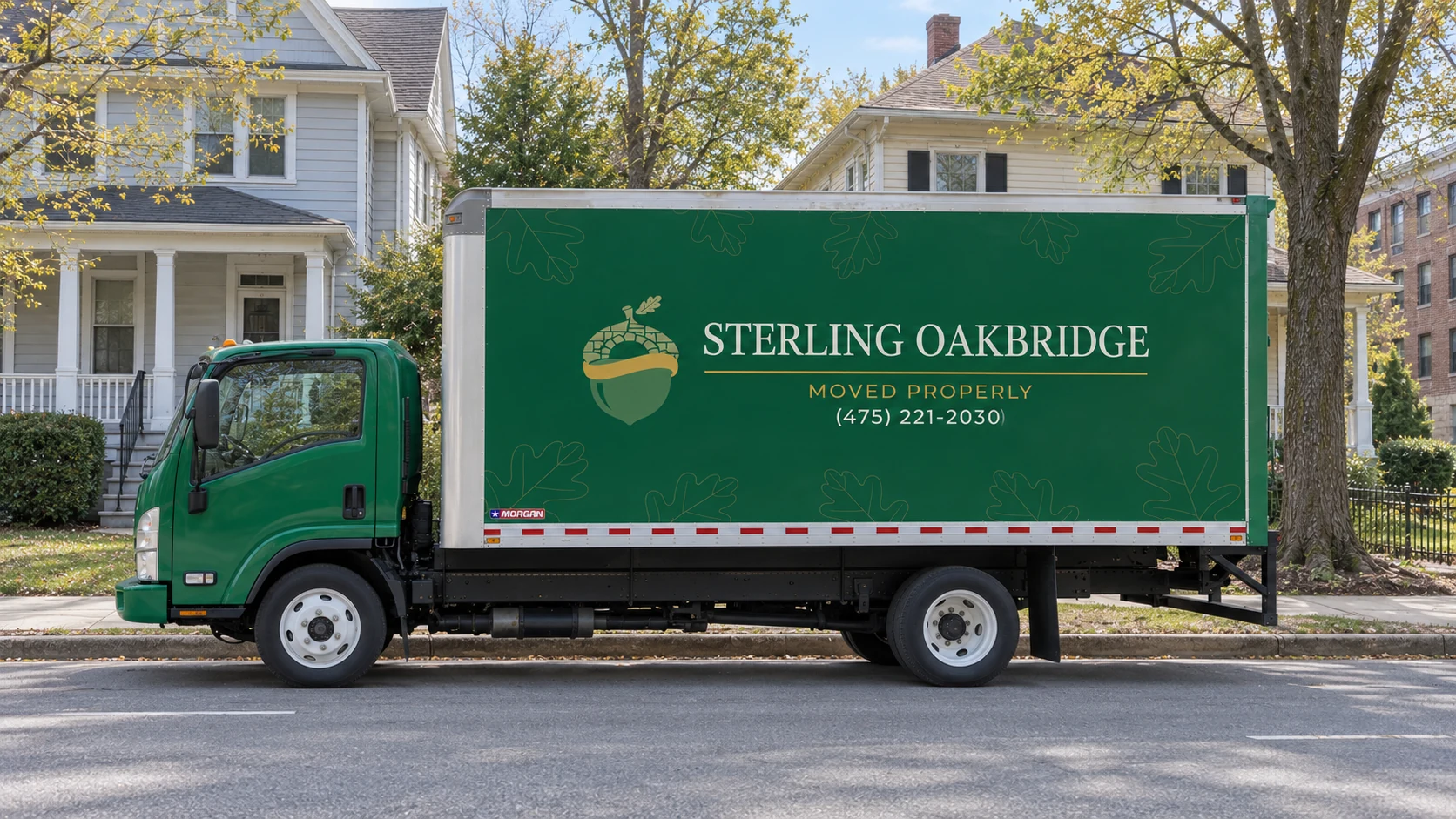
Connect the Scranton property with the receiving address
Start with the building entrance you will actually use. A narrow porch stair may lead to a broader main door, while an apartment above ground level may have a second turn beyond the landing. Photograph the whole route and measure the tight points before choosing a vehicle position or dismantling a large piece. An address and a room count alone do not describe that work.
The local Scranton moving page and relocation guide explain access, parking, utilities and household preparation. For the long-distance order, connect those local decisions to the receiving property: possession, key handoff, permitted work hours, usable stairs or elevator, and someone authorized to direct placement. A delivery date is useful only when the building and household can receive the agreed inventory.
We can review long-distance pickup in Scranton and nearby Lackawanna County addresses, including Dunmore and Clarks Summit boroughs. These are separate municipalities. Confirm the actual property, jurisdiction, entrance, inventory, truck position and dates before applying Scranton City procedures; a Scranton mailing address alone does not establish City jurisdiction.
Scranton is a City in Lackawanna County. Dunmore and Clarks Summit are separate boroughs in the same county, with their own property and street arrangements. Confirm the actual municipality before applying a City permit or snow-clearing rule. Nearby pickup examples describe reviewed service scope; they do not establish an office, warehouse or identical procedure at every mailing address.
Choose direct or consolidated around the actual shipment
Direct delivery provides a dedicated truck for your shipment and the same crew for the agreed pickup and delivery. It is useful when the household needs a coordinated receiving plan, a larger shipment or a comparatively firm arrival. Review the complete furniture and carton inventory, including basement, attic, porch and garage items that are going. Vehicle size and the work sequence follow that inventory and the actual approach.
Consolidated delivery is particularly useful for a smaller shipment with flexibility at the receiving end. Around 300–400 cubic feet or less is an illustrative smaller-shipment range, not a minimum or a substitute for reviewing the pieces. Describe the sofa, dresser, bed components, cartons and customer totes individually. A compact selected photograph or a list of “a few boxes” may leave out the objects that determine the shipment.
The delivery window begins after pickup and loading are complete. A suitable close domestic route can be reviewed for same-day or next-day delivery when loading, driving and receiving access support it; that possibility is not a standing promise. Normal direct examples include time to complete a practical handoff. The final written plan establishes the applicable dates and services.
For consolidated delivery, a suitable close domestic route may use up to 30 days. Florida and Canada use up to 60 days, with Canada’s rule taking priority over a relatively close distance. California uses up to 90 days. Other distant destinations need their own agreed window; Washington, Oregon and Arizona do not inherit California’s allowance. Review storage separately if the household cannot receive within the applicable plan.
| Illustrative destination | Direct planning window | Consolidated window |
|---|---|---|
| Hudson, New York | 1–2 days | Up to 30 days |
| Port Orange, Florida | 2–3 days | Up to 60 days |
| Lévis, Quebec | 1–2 days | Up to 60 days |
| Spokane, Washington | 4–5 days | Window agreed individually |
The comparison uses illustrative city-to-city road references. It does not certify a route for the selected truck or reserve an arrival appointment. The carrier still reviews restrictions, actual entrances, work zones and the lawful loading position. Exact property access, border processing or a separately agreed storage stage can change the practical sequence without turning the comparison into a different service promise.
Resolve the curb and approach before loading day
Identify the block, side of street, working hours and vehicle footprint. A curb position must accommodate the actual truck and loading operation while the carrying route remains usable. Send photographs that show the street approach, curb, nearby signs, entrance and any proposed ramp or obstruction. For private space, obtain the owner’s agreement and establish how the vehicle can enter and leave.
The [City residential parking article](https://ecode 360.com/11609147) is administered by Police. Its contractor provision concerns work with a resident in a designated permit area. Ask whether the proposed household move qualifies. For metered streets within that area, the provision calls for both the applicable permit and meter hoods from the parking vendor. A resident permit or ordinary meter payment does not establish an exclusive moving position.
The City parking page still uses the former ABM operator name, while its linked Park Scranton contact identifies The Car Park at 570-343-6519. Describe the exact spaces and operation and obtain the applicable process, notice, charges, hood responsibilities and contact if the space is occupied. The contractor program’s published $5 per 30-day cycle is not evidence of a universal moving reservation or hood price.
Separate a parking arrangement from a lane, sidewalk or street obstruction. The [City loading provisions](https://ecode 360.com/45089585) restrict public-right-of-way loading to designated areas and City parking rules; regulated occupancy may require its own review. Obtain instructions for the actual operation rather than borrowing a special-event deadline or assuming a brief obstruction needs no agreement.
Courts and alleys need the same location-specific attention. [Ordinance 29-2026](https://ecode 360.com/SC 1588/laws/LF 2824952.pdf), approved in September 2026, designates Moir Court from Olive Street to Pine Street southbound one-way and prohibits parking on both sides. Verify current signs and the particular street. A court that looks convenient in a photograph may have restrictions, an inadequate turn or a different controller.
The January 2026 North Main Avenue bridge notice gives truck traffic an Interstate 81 approach using exits 191A or 190, distinct from its suggested ordinary-car detour. Recheck current project status and signs near pickup. That earlier scheduled closure does not establish the street’s present physical status or certify every alternate road for a truck.
Protect the body, then keep removed parts together
Review the construction before dismantling a table or desk. Safely detachable long legs are normally removed before transport. Protect the tabletop or body first while its joints remain accessible, turn the protected piece upside down on stable padding, then remove the legs and protect the matching parts together last. Keep the associated hardware with the parts so the receiving crew has a complete set.
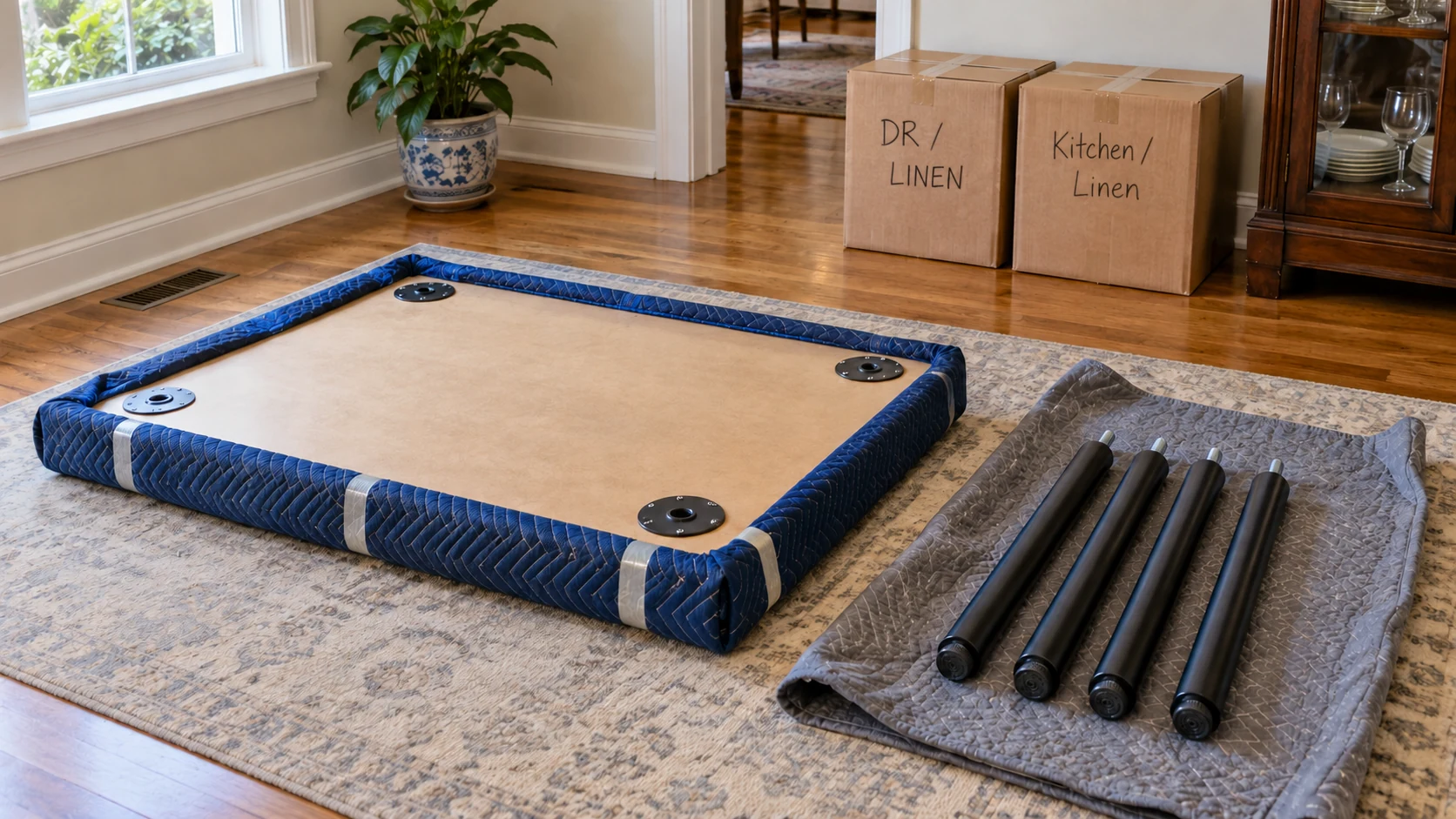
This preparation detail shows the already protected body and four removed legs grouped on an open common blanket before that package is closed. It is one furniture task within an occupied room, not a claim that the whole household is ready to load. Fixed antique joinery and integral supports require an individual handling decision. Do not force a joint apart merely because another table has removable legs.
Basic blanket protection, wrapping and tape have no separate surcharge. Cartons are separate. Basic working furniture disassembly and reassembly also have no separate surcharge, while complex construction or specialist handling needs review. Specify who will pack loose contents and identify artwork, unusually heavy items and pieces requiring a particular method before the estimate is finalized.
For a substantial direct household shipment, loading builds from the front of the truck into a dense mixed wall of protected furniture, cartons and unbranded customer totes. Retention and the finishing row must suit those shapes. A small consolidated pickup has a different footprint. Neither the appearance of a single protected piece nor a chosen carton group substitutes for reviewing the whole inventory and securing the actual load.
Example 1: Scranton to Hudson, New York with a close receiving handoff
Consider a household leaving a porch-front Scranton house for a Hudson apartment. The shipment includes a sofa, two dressers, a removable-leg table, a bed and cartons from the kitchen and bedrooms. The household receives the new keys the afternoon before delivery. The practical concern is the receiving entrance: a first landing leads to a turn that the sofa must negotiate before reaching the apartment.
Review the furniture dimensions and the route through both buildings. At pickup, settle the lawful truck position and the porch stair before cartons accumulate in the hall. At Hudson, identify the entrance, stair turn, work hours and who can hold the door or direct placement. If the sofa will not pass as configured, discuss its actual construction and a suitable handling plan before the truck is loaded.
The illustrative reference is 149 road miles, with normal direct planning of 1–2 days after pickup and loading. A suitable close domestic shipment may be reviewed for a same-day or next-day handoff when all stages support it. The household should not book an inflexible building slot solely from that possibility. Confirm the actual appointment and keep keys and access instructions with the receiving contact.
If only a smaller selection is moving and the apartment can receive flexibly, review consolidated delivery with up to 30 days for this close domestic example. The inventory must still include the furniture and all packed cartons. If possession or the building slot is uncertain, resolve that dependency before choosing the delivery model or add a separately agreed storage stage.
After arrival, confirm the agreed rooms, remove furniture protection and complete basic reassembly and placement. Carton contents can stay packed unless unpacking was separately included. The close distance reduces the travel span; it does not remove the need for a usable stair route and a complete receiving handoff.
Example 2: Scranton to Port Orange, Florida with separate household travel
Suppose a household leaves a Scranton upper-floor apartment for a Port Orange home. The inventory includes bedroom furniture, a desk, a living-room group, kitchen cartons and customer totes. The household plans to travel separately, arriving ahead of the shipment. At pickup, the stair landing and lawful curb position control how the crew works; at delivery, possession and the first rooms to set up control the handoff.
Make the room inventory explicit, including pieces stored elsewhere in the building. Photograph the stair turns and show where the truck could work without assuming that a residential permit reserves the space. Review any metered-block hood arrangement and the actual carry distance. Prepare protected removable furniture parts as matched groups, and keep the main route available while the larger pieces pass.
The illustrative reference is 1041 road miles, with normal direct planning of 2–3 days after pickup and loading. Direct provides the dedicated truck and same crew for the agreed stages. The household’s own arrival, travel bags and personal documents are separate from that truck schedule. A flight or hotel reservation should follow a confirmed receiving plan rather than an illustrative table alone.
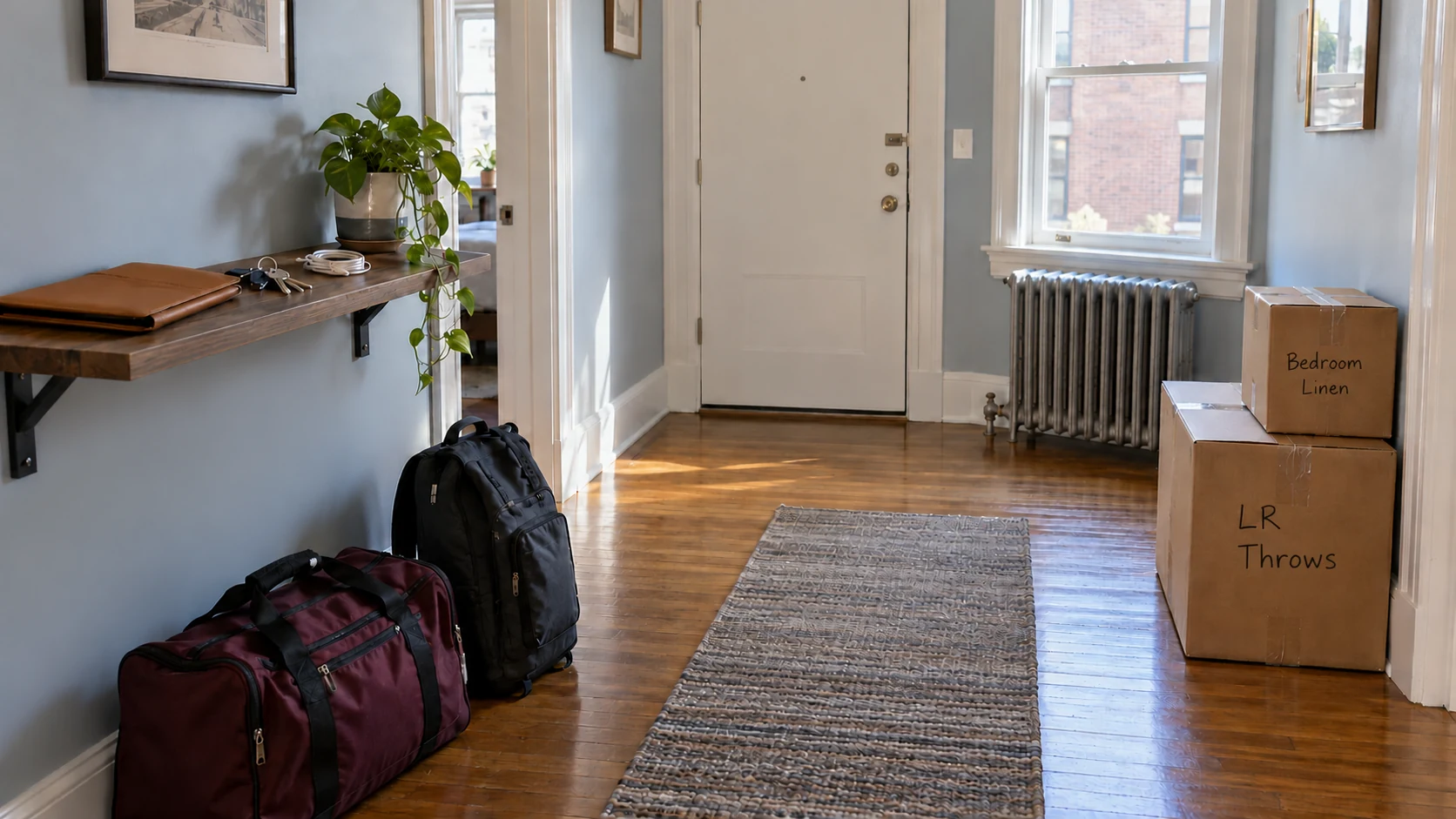
For a smaller shipment and flexible Florida receipt, consolidated delivery may use up to 60 days. Review where the household will stay, what belongings it needs before the truck arrives and who can receive if the owner is away. Storage and later delivery are separately agreed if possession does not line up. A delayed drive or delivery does not raise the agreed flat price for unchanged inventory, access and services.
At Port Orange, identify the lawful truck position, entrance, room plan and any owner or association conditions for that actual address. This example does not assign a universal Florida permit or building rule. Confirm beds and essential furniture placement first, then follow the agreed carton-unpacking scope rather than assuming every kitchen item will be put away.
Example 3: Scranton to Lévis, Quebec with a smaller selected shipment
Consider a household moving a smaller selection from Scranton to Lévis, a City in Quebec’s Chaudière-Appalaches region. The shipment contains a compact seating piece, a dresser, a dismantled bed, a table and cartons. The household can receive flexibly but needs a clear plan for shipment documents, personal travel and the destination entrance. A photograph of four selected containers illustrates inventory review; it is not the entire shipment.
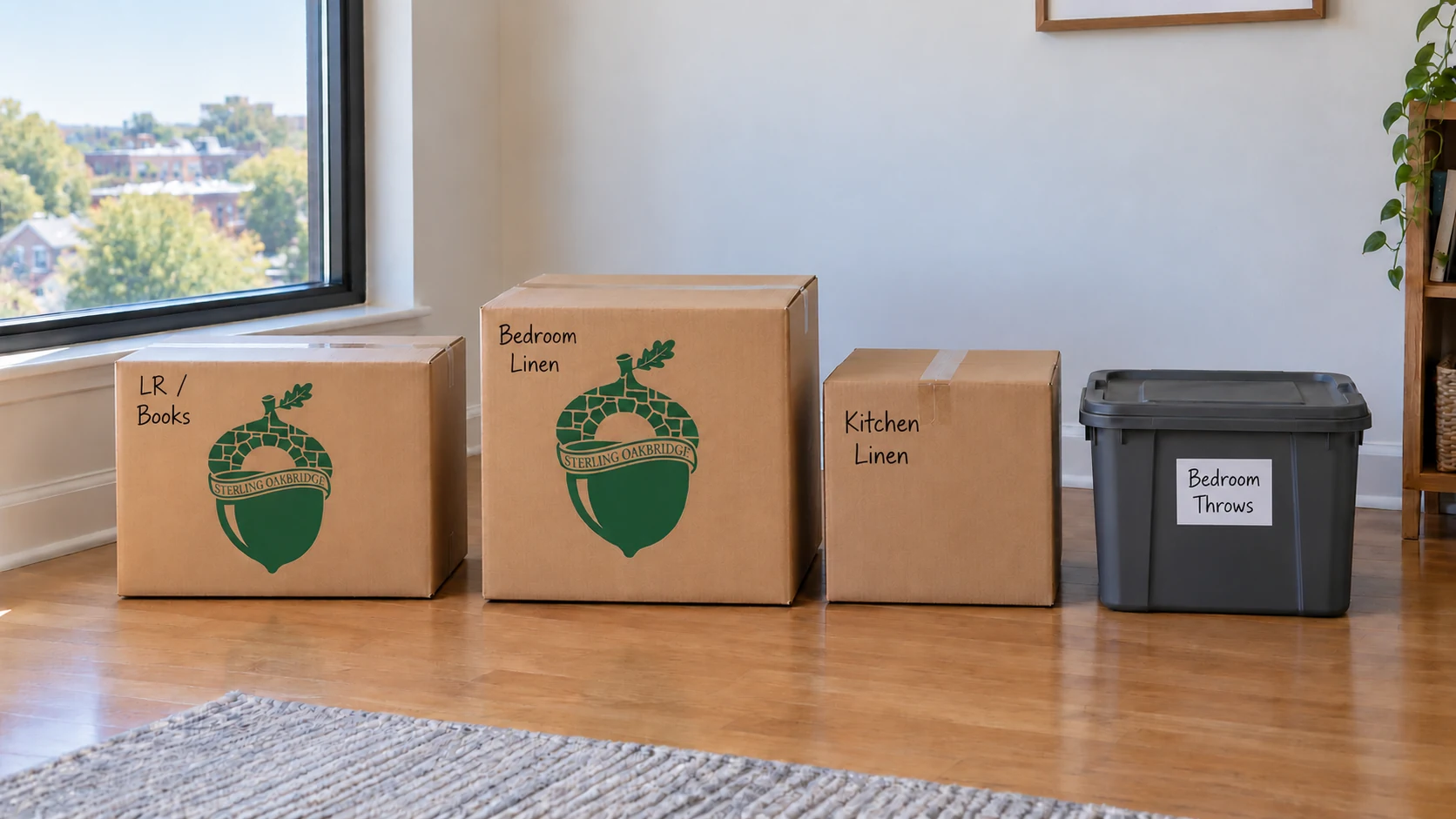
Separate the packed carton count from the furniture list and identify the customer totes. For removable-leg pieces, keep protected parts associated with the correct body. Confirm who packs the contents and which personal records travel with the household. Give the receiving contact an accurate room and piece plan so a flexible delivery does not become an improvised inventory check at the door.
The illustrative reference is 539 road miles, with normal direct planning of 1–2 days after pickup and loading. Canada remains a cross-border plan at this comparatively close distance. For consolidated delivery, the example uses up to 60 days rather than the close domestic 30-day allowance. Direct is separately reviewed around the dedicated truck, same crew and actual document and access requirements.
Confirm the relevant shipment and personal documents, household travel dates and authorized receiving contact before booking. Border processing can affect the practical plan, and the inventory needs its own review. A moving booking does not establish immigration permission or guarantee admission of every item. Avoid assuming that an informal household list is sufficient for every crossing circumstance.
At Lévis, verify the actual truck approach, entrance, work hours and any property requirements. Arrange keys before the agreed arrival and describe the room in which the largest piece will be placed. If possession is delayed, review the alternative and any separately agreed storage before pickup. The goal is a coherent smaller-shipment plan with a real receiving contact, not a promise of a particular customs outcome.
Example 4: Scranton to Spokane, Washington with a planned final room
Suppose a household leaves a Scranton house for Spokane and wants a writing desk restored to use after delivery. Its larger inventory also includes beds, living-room furniture, cartons and other protected pieces. The desk has safely removable legs. The pickup plan protects its body first, removes and packs the matching legs together, and keeps the hardware associated with that piece throughout transport.
Before pickup, review the rooms and any basement or attic contents that belong in the shipment. A substantial direct load needs the appropriate vehicle and secure mixed loading, with supplies stowed out of the carrying path. The receiving household should identify the room for the largest furniture early, so cartons do not occupy the required footprint while pieces are being placed.
The illustrative reference is 2495 road miles, with normal direct planning of 4–5 days after pickup and loading. Direct uses a dedicated truck and the same crew for the agreed pickup and delivery. Spokane is in Washington: consolidated delivery needs an individually agreed window. California’s up-to 90-day allowance is not transferred to this route because both destinations are in the West.
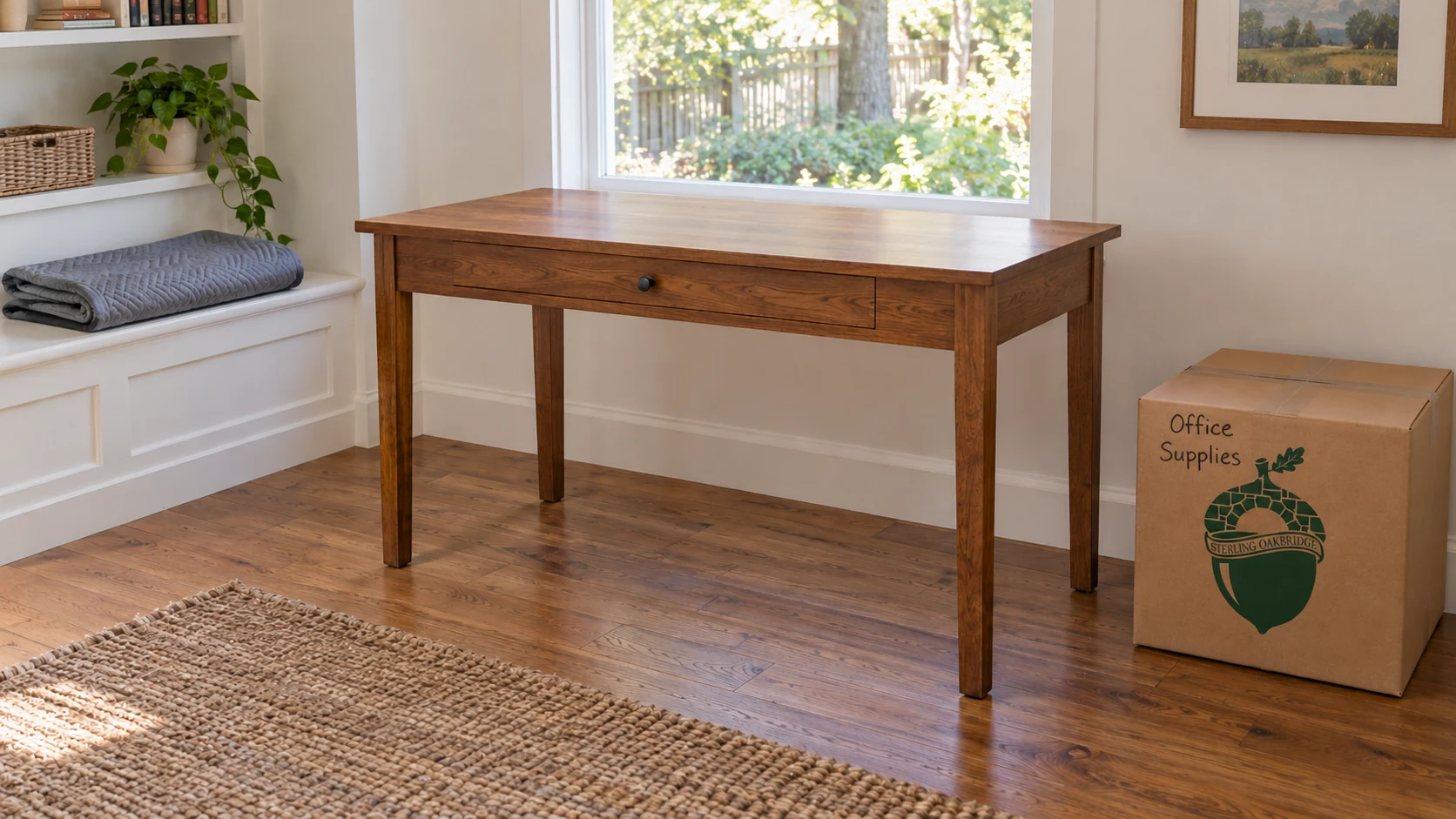
The receiving image depicts the completed desk placement and basic reassembly, with protection removed. Normal installed bare legs are appropriate at this finished stage. A remaining sealed carton and folded used quilt do not mean that every carton has been unpacked or that device setup is included. The useful result is the agreed furniture in its room, supported correctly and ready for the household’s next steps.
Confirm the actual Spokane property approach, doors, work hours and receiving contact. If the household cannot be present, agree who may direct placement and report a problem. Identify carton unpacking, packaging removal or complex furniture work separately. A longer journey makes those decisions more valuable before departure; it does not add them automatically to standard delivery.
Keep the written price connected to inventory and access
The agreed long-distance flat rate does not rise because travel or delivery takes longer. That holds for the reviewed inventory, access and services. Adding furniture, changing the usable entrance, introducing storage or requesting extra unpacking changes the work and is reviewed and agreed separately in writing. Report those changes before the crew must improvise around them.
Send a room inventory, carton estimate, furniture dimensions where relevant, both addresses, floors, steps, elevators and carrying distances. Include the proposed truck position, property permissions, uncertain permit or meter-hood arrangements, possession date and firm receiving restrictions. Identify specialist items and the division of packing work. These facts give the estimate a practical scope rather than relying on the drive alone.
Carton unpacking, putting contents away and removing carton packaging are separate tasks with time in the scope. Furniture protection is removed during delivery, with agreed basic reassembly and placement completed. If there is a storage gap, define that stage and later delivery explicitly. Do not treat consolidated flexibility as free storage or leave disposal items beside the shipment expecting them to be included.
Finish the departure route and leave unwanted items on their own plan
Keep personal bags, keys, chargers and records out of the loading inventory. Clear the usable hall and stair route while allowing the next large piece to pass. Confirm the final carton count and inspect the rooms included in the shipment. The preparation sequence can be staged room by room without describing an occupied home as wholly finished before its loose contents are packed.
Winter access has a local legal baseline. Under [Scranton’s sidewalk code](https://ecode 360.com/29553372), residential premises have 24 hours after snow or ice ceases to clear at least a 3-foot path; business premises have 4 hours and the full width. When cessation occurs during darkness, the clock begins at daybreak. Assign the property responsibility and arrange a carrying route usable for the furniture, while checking current street restrictions and conditions.
Plan unwanted goods separately. DPW’s collection guidance says ordinary garbage is collected first and larger items depend on remaining truck space; metal-containing items need the appropriate separate arrangement. Call dispatch at 570-348-4178 about the actual item and date. That guidance does not promise that a bulk piece will disappear before key handoff.
Confirm recycling placement and larger carton quantities with DPW. The City distinguishes front or side-curb recycling from garbage placement that may use an alley or court. Keep emptied packaging and unwanted furniture outside the shipment list, and arrange any separate removal before the household loses access to the property. Do not dismantle an item unsafely to fit an assumed collection rule.
Long-distance moving questions
Where can I arrange long-distance pickup around Scranton?
We can review long-distance pickup in Scranton and nearby Lackawanna County addresses, including Dunmore and Clarks Summit boroughs. These are separate municipalities. Confirm the actual property, jurisdiction, entrance, inventory, truck position and dates before applying Scranton City procedures; a Scranton mailing address alone does not establish City jurisdiction.
Can a longer move within Pennsylvania use this planning process?
Yes. Send the actual pickup and delivery addresses, inventory, dates and access details. A longer Pennsylvania shipment may need a long-distance plan; a nearby interstate address does not by itself choose direct or consolidated delivery. We review the actual work before agreeing the service.
What is direct dedicated delivery?
Direct delivery uses a dedicated truck for your shipment and the same crew for the agreed pickup and delivery. Confirm both building routes, the inventory, vehicle arrangement and receiving access. The written plan sets the actual dates and services; a route illustration is not an appointment.
When is a consolidated shipment useful?
Consolidated delivery is especially useful for a smaller shipment, illustratively around 300–400 cubic feet or less, when the receiving date is flexible. That is not a minimum volume. The complete inventory still needs review, and the shipment receives its own agreed window. Same-crew delivery and free storage are not assumed.
When does the delivery window start?
After pickup and loading are complete. The four route illustrations show normal planning windows, not exact arrival appointments or truck-route certification. A suitable close domestic shipment may be reviewed for same-day or next-day delivery when loading, the route and receiving access support it.
What consolidated windows apply to the example destinations?
Hudson, New York illustrates a suitable close domestic route with up to 30 days. Port Orange, Florida and Lévis, Quebec each use up to 60 days; Canada’s window applies even when its distance is relatively close. Spokane, Washington needs an individually agreed consolidated window. California’s allowance of up to 90 days is specific to California.
Will a road or delivery delay increase the agreed flat price?
No. For unchanged inventory, access and services, the agreed long-distance flat price holds when travel or delivery takes longer. Added belongings, changed access, storage or other extra tasks change the scope and are reviewed and agreed separately in writing.
Who handles Scranton permit-area parking and meter hoods?
The Police Department administers the residential parking article. Ask whether its contractor provision applies to the particular household move. For metered streets within that permit area, the provision requires both the applicable permit and hoods from the parking vendor. Park Scranton / The Car Park can be reached at 570-343-6519 for the exact operator process.
Does the contractor permit guarantee a moving-truck space?
No. The code says a permit does not guarantee a space or override other parking prohibitions. The contractor provision lists up to 30 days and $5 per 30-day cycle, with reissuance and simultaneous-permit limits. These are program terms, not a universal moving reservation or meter-hood price. Confirm eligibility, the exact position and any separate approval first.
Can I use an alley or court for loading?
Review the actual controller, signs, truck dimensions, turn and working footprint. A private court requires the owner’s permission and a usable route. A public right-of-way follows City parking/loading rules and any applicable occupancy review. Ordinance 29-2026 designates the specified Moir Court segment southbound one-way with no parking on either side; verify current signs and the particular street before relying on a court.
Can the North Main Avenue car detour be used for the truck?
Review the carrier’s actual approach. The City’s January 2026 bridge notice gives trucks Interstate 81 exits 191A or190, distinct from the suggested ordinary-car detour. Recheck current project status, truck restrictions and signs near pickup. The earlier notice does not establish the road’s physical open or closed status on your date.
What sidewalk snow-clearing rule applies in Scranton?
For residential premises, the published code requires a path at least 3 feet wide within 24 hours after snowfall or ice formation ceases. Business premises have a 4-hour requirement and the full sidewalk width. If cessation occurs during darkness, the period begins at daybreak. Assign the actual property responsibility and prepare a carrying route suitable for your pieces.
Are removable long table or desk legs transported attached?
They are normally removed when the construction permits safe removal. Protect the body first, keep the actual joints accessible, turn the protected body upside down on stable padding, then remove the legs and protect them together with associated hardware. Integral or fixed joinery needs individual review. Do not force destructive dismantling.
Are basic protection and working reassembly separately charged?
Basic blanket protection, wrapping and tape have no separate surcharge; cartons are separate. Basic working furniture disassembly and reassembly also have no separate surcharge. Identify complex construction, specialist pieces and who packs the loose contents before the written estimate is finalized.
Does delivery include putting away the contents of every carton?
Furniture protection is removed during delivery, and agreed basic reassembly and placement are completed. Carton unpacking, putting contents away and removing carton packaging are separate tasks requiring their own time and scope. Identify the rooms and cartons for that work before pickup.
What should travel with the household?
Keep keys, identity and shipment records, necessary personal documents, chargers and first-night essentials accessible to the household. Use a manageable personal bag and closed folio without leaving them on furniture being loaded. Confirm which belongings are excluded from the truck inventory and who will hold them during handoff.
Can Sterling plan a household move to Lévis, Quebec?
Yes. Canada is within reviewed household coverage, and Lévis, Quebec is one illustration. Confirm shipment and relevant personal documents, inventory, the household’s travel plan, dates and an authorized receiving contact. Border processing can affect the plan; a moving booking does not establish immigration permission or automatic admission of every item.
What if possession and delivery dates do not align?
Identify the gap before booking. Storage is a separately agreed stage, with its receiving conditions and later delivery planned explicitly. Confirm who holds the keys, whether the building accepts the planned arrival and what alternative is available if access changes. Consolidated scheduling does not automatically include free storage.
How should I arrange unwanted furniture and leftover cartons?
Keep disposal separate from the moving inventory. Scranton DPW says ordinary garbage is collected first and larger items depend on remaining truck space; metal-containing items need the appropriate separate arrangement. Call DPW dispatch at 570-348-4178 for the actual item and date. Confirm recycling placement and larger carton quantities rather than promising bulk collection or dismantling an item unsafely.
Explore long-distance destinations from Scranton
These destinations illustrate household shipments from Scranton, Pennsylvania, within Sterling’s reviewed United States and Canada coverage. Review both addresses, the inventory and access, then agree the actual shipment, services and receiving window.
Northeast and nearby interstate examples
- Hudson, New York
- Albany, New York
- New York City, New York
- Buffalo, New York
- Philadelphia, Pennsylvania
- Pittsburgh, Pennsylvania
- Newark, New Jersey
- Boston, Massachusetts
Southeast and Florida
- Richmond, Virginia
- Raleigh, North Carolina
- Charlotte, North Carolina
- Charleston, South Carolina
- Atlanta, Georgia
- Port Orange, Florida
- Jacksonville, Florida
- Orlando, Florida
- Tampa, Florida
Midwest and Texas
- Columbus, Ohio
- Chicago, Illinois
- Indianapolis, Indiana
- Dallas, Texas
- Houston, Texas
Mountain West and Southwest
- Denver, Colorado
- Salt Lake City, Utah
- Phoenix, Arizona
- Tucson, Arizona
- Las Vegas, Nevada
West Coast
- Spokane, Washington
- Seattle, Washington
- Portland, Oregon
- San Francisco, California
- San Diego, California
Canada
- Lévis, Quebec
- Sherbrooke, Quebec
- Montreal, Quebec
- Toronto, Ontario
- Ottawa, Ontario
- Moncton, New Brunswick
- Vancouver, British Columbia