

Virginia / Moving services
Movers in Chesapeake, VA
Bring the whole Chesapeake move into view: the belongings you are keeping, the route from each room to the vehicle, and the home or business ready to receive them. Sterling Oakbridge provides moving, packing, storage and specialist work with an agreed scope. Share the addresses, dates and access details so the estimate reflects the actual job.
01 /
Make the address and shipment your starting point
Chesapeake, Virginia is the independent city in Hampton Roads. South Norfolk is part of Chesapeake, despite its name: the Virginia Department of Historic Resources describes its closely spaced wood-frame houses and front porches. Use the municipality of the actual property when planning access. Norfolk's permit procedure does not become the Chesapeake procedure when a street name or neighborhood sounds similar.
Describe what is moving before choosing the vehicle or crew. Include the garage, shed, attic access, a storage unit and belongings at another address. Separate items you will keep from furniture you want removed and the personal bags you will carry yourself. An inventory photograph should show the contents and large pieces; access photographs should show the route they must take.
A house, townhouse or apartment needs more than a room count. An outside step, an internal turn, a shared lift or a long driveway can change the carrying work. If a large item was assembled in its room, identify it before assuming it can leave whole. Tell us what delivery should leave usable first: a bed, kitchen essentials, a work area or a room kept clear while other rooms receive cartons.
02 /
Choose moving, packing and storage by the work
Sterling Oakbridge provides local and interstate household moves, commercial moving, packing and storage. Choose the work you need, then let us review the inventory, access and timing for your estimate.
| Moving help | What we can include | What to send |
|---|---|---|
| Local residential moving | Loading, transport, delivery and basic furniture disassembly and reassembly | Both addresses, inventory, dates and the route through each property |
| Interstate moving | Pickup, transport and delivery arrangements, with storage when needed | Destination, date constraints and the person receiving the shipment |
| Commercial moving | Office and business furniture, equipment and agreed preparation, including moves with building restrictions | Business type, equipment list, building rules and the work schedule to protect |
| Packing and unpacking | Selected-item or full packing, preparation before move day and optional box unpacking | What you will pack and what you want us to prepare |
| Storage and staged delivery | Storage between addresses and an agreed receiving and delivery plan | Expected dates, contents and anything you need to access during storage |
| Designer and hotel furniture receiving | Receiving, storage and delivery of furniture to an agreed plan | Expected shipments, delivery instructions and the final receiving site |
For a straightforward household move, a clear list and route photographs help establish the work. A fuller home, restricted access or specialist pieces may need a closer review. You do not have to decide the survey method yourself; describe the shipment and the planning team will recommend the useful next step.
Choose the division of packing explicitly. You may want us to prepare fragile kitchen contents while you pack clothing, or have the crew pack the whole retained shipment. Identify what must stay available until departure, what can be prepared earlier and who is responsible for the final unpacked groups. Boxes supplied for the move are a separate charge from packing labor.
If there is a gap between properties, plan storage as a receiving stage. Identify what goes into storage, what you need sooner, how later access works and who will accept the next delivery. The storage, handling and second-delivery charges need agreement before this becomes the fallback for missing keys or an unfinished home.
03 /
Plan the business restart as well as the transport
A Chesapeake business move needs a person who can approve the inventory and a person who controls access at each property. Identify which desks, cabinets, sealed records and equipment will move, what remains in service and the order in which the receiving rooms need to become usable. Keep landlord fixtures, employee belongings and supplier-controlled equipment outside the shipment unless the responsible party authorizes them.
Send loading and freight-elevator instructions, permitted hours, protection requirements, COI details and any union-access condition for review. A property receiving a form or certificate is not the same as approving the proposed move. Name the contact who can release the loading area and the person who can change the sequence if one room remains occupied.
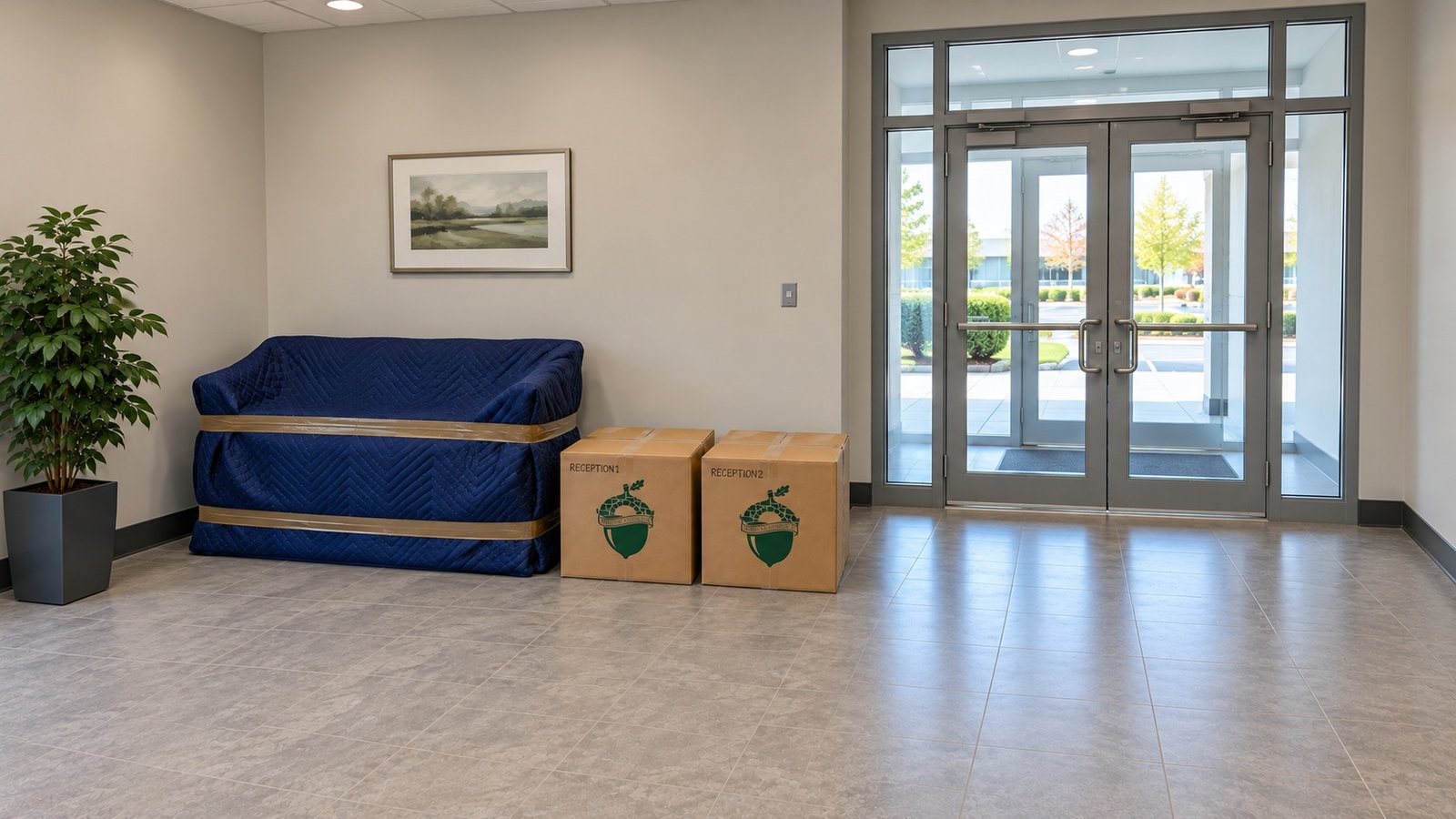
For a hypothetical office move, the reception group might be collected first while technical equipment remains operational until its owner releases it. The business decides its restart priorities, the properties control their access and the mover reviews the resulting labor and transport stages. Keep technical disconnection and reconnection responsibilities distinct; transporting equipment does not commission a working system at the new site.
IT transport and disconnection are available; arrange reconnection and system startup with your IT team. Crane work is outside our service scope.
We can also quote island moves, recycling, move-out cleaning and car shipping. For an island destination, provide the exact address so the vehicle or freight crossing, receiving arrangements and final delivery can be reviewed together.
04 /
Follow the carrying route beyond the first door
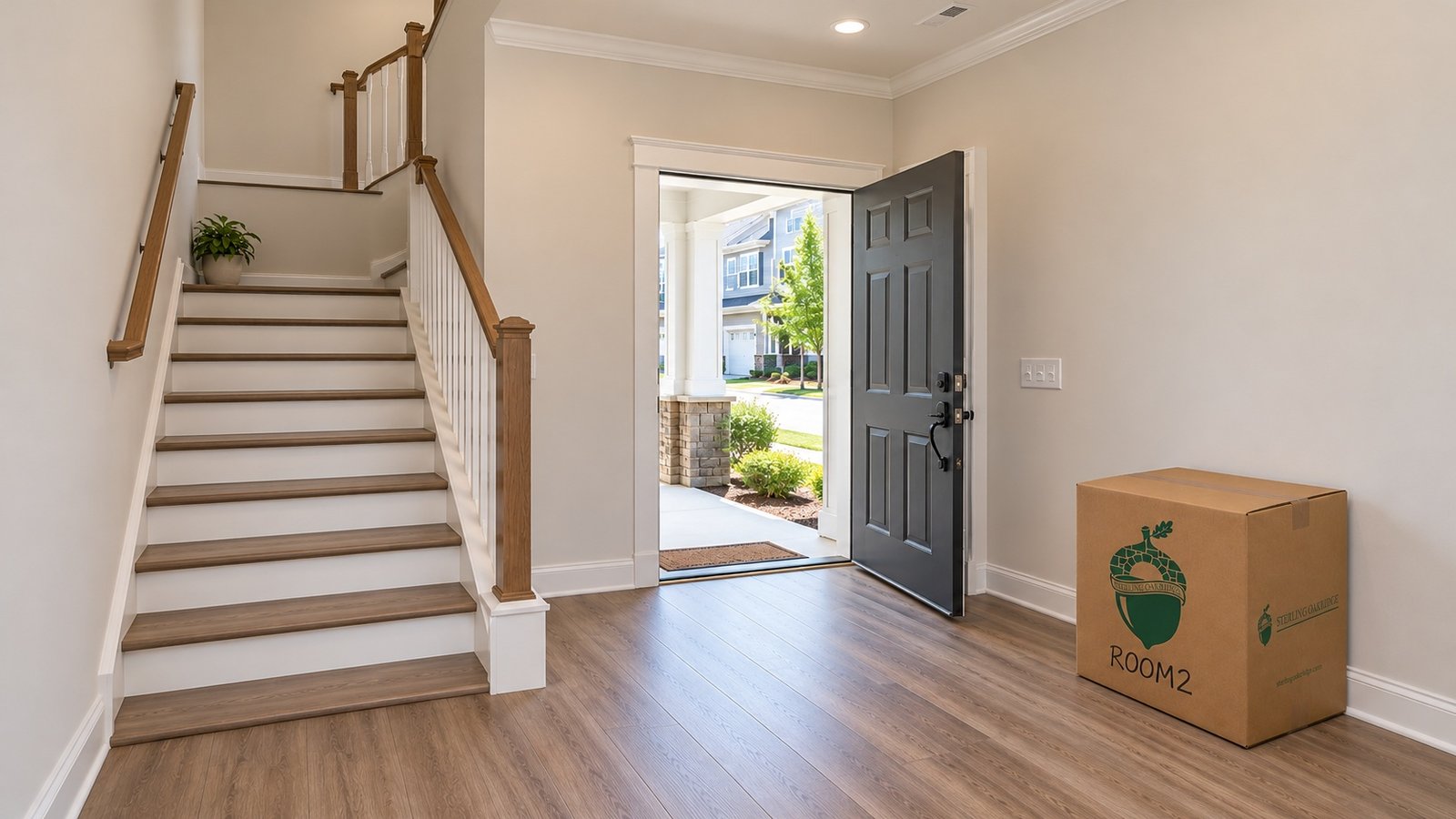
Show the complete approach from the proposed vehicle position to each important room. A driveway photograph should include its entrance, slope, turning area and overhead restrictions, rather than only the house at the far end. For a porch, include both landings and the door swing. For an apartment or townhouse, show every stair flight and tight turn.
| Part of the move | What to show or describe | Permission or decision owner |
|---|---|---|
| Vehicle approach | Entry width, overhead clearance, turning and actual stopping position | Carrier reviews vehicle fit; street or property authority controls use |
| Outside carry | Surface, distance, grade, gates and steps | Property contact and mover |
| Shared building route | Door openings, corners, all lifts, transfers and allowed hours | Building manager or authorized resource owner |
| Final room | Last turn, large-piece dimensions and placement priority | You, with handling reviewed by the mover |
Do not treat a wide garage opening as proof of access to a narrower interior door. Include large furniture dimensions and photographs with the surrounding space visible. Explain which doors can remain open, who supplies keys or cards and whether any part of the route crosses someone else's property. Keep exits, drainage and normal pedestrian movement usable.
For a short moving window, shift agreed preparation earlier only when the property permits it. Packing or materials delivery beforehand needs its own access arrangement. The carrying period should begin with decisions settled, room labels ready and a receiving contact available. Report a failed lift or changed entrance before the original route becomes the basis for dispatch.
We can coordinate building COIs, moving-truck permit arrangements, elevator scheduling and moves that require union labor. Send the building instructions and management contact early. We can also arrange materials and packing before the carrying window when the property permits that access.
The agreed plan should identify who submits each request, who approves it and which municipal or building charges apply. An application is one step; the required access and time still need confirmation.
05 /
Separate truck access from hauling permits and container rules
First identify whether loading can take place at a suitable private position or needs public-street space. A private driveway or loading court requires the owner's permission and review of the actual vehicle, surface, overhead space and working footprint. Include the rear doors and any selected loading equipment in that footprint; do not let a car-sized parking space stand in for a truck plan.
For public-street arrangements or traffic effects, begin with Chesapeake Traffic Engineering, which oversees traffic control and lists its contact at 757-382-6101. Give the exact street position, vehicle dimensions, date, hours and any sidewalk or lane effect. Have the City identify the applicable approval and permitted setup before the move relies on that space. We can coordinate the agreed arrangements; an unconfirmed enquiry is not a held parking position.
The City's Hauling & Moving Permit page describes overweight and over-dimensional vehicle configurations. It lists thresholds including over 13 feet 6 inches in height, over 8 feet 6 inches in width, and over 40 feet for a single vehicle or 65 feet for a combination, alongside weight and axle limits. That is a separate vehicle-and-route process, not an ordinary curb-space reservation. Its eBUILD applications replace fax or email submissions, and a state permit does not automatically cover all City-maintained roads.
Traffic Engineering also identifies through-truck restrictions for vehicles over 1½ tons, with an exception for pickups and deliveries. Preserve that exception without treating it as permission to park anywhere or ignore another restriction. The City's residential commercial-vehicle guidance concerns parking and storage as an accessory residential use. Have the actual loading and waiting arrangement reviewed; do not use that page to invent a universal exemption for moving trucks.
Portable storage is another distinct choice. On qualifying single-family or two-family residential property, the container rules include a maximum of two containers, notification within 24 hours of placement and a limit of 16 consecutive days and 16 days per calendar year. The owner of the container and property owner or occupant share notification responsibility. Front-yard placement has its own 10-foot curb or pavement setback. These lot rules do not grant public-street space. The longer extension requires the stated damaged-property and renovation conditions plus zoning approval; it is not a routine longer moving allowance.

06 /
Assign packing, personal essentials and furniture preparation
Labor, materials and optional work
| Item or task | How it is charged |
|---|---|
| Basic furniture disassembly and reassembly | Part of your moving labor time, without a separate basic assembly fee |
| Moving blankets, shrink wrap and tape | No separate charge for these basic protection materials |
| Boxes supplied for your move | Charged separately |
| Packing | Charged for working time; boxes are separate |
| Unwrapping furniture | Part of delivery |
| Unpacking the contents of boxes | Optional work, charged for working time |
| Packaging and waste removal | Charged separately |
| Complex furniture and other specialist work | Individually quoted after review |
Tell us which tasks you want completed and which materials you need. Your estimate should distinguish moving labor, boxes, specialist work and removal charges.
Make a packing list by responsibility: what the crew prepares, what you will finish and what travels with you. Take documents, medicines, keys, chargers and the supplies needed during a receiving delay out of the shipment before packing begins. For children, pets or anyone who needs uninterrupted access, arrange a safe place away from active carrying.
Tell us about glass components, delicate finishes, existing damage, loose parts and furniture assembled inside a room. Protective wrapping and disassembly address different needs. A piece should be prepared according to its construction and carrying route, with related parts kept identifiable. Complex furniture and specialist equipment need review before the work is assumed to be basic assembly.
Specialist services by individual quote
| What needs attention | Work available for review |
|---|---|
| Complex furniture | Bunk beds, Murphy beds, large flat-pack wardrobes and specialist sofa disassembly and reassembly |
| Heavy items | Pianos and grand pianos, safes, gym equipment and pool tables |
| Art and collections | Fine-art handling, soft packing, custom crates and crating to an agreed museum or collection specification |
| Hanging and installation | Pictures, mirrors, wall-mounted TVs, curtain hardware and chandeliers, with the removal, installation and any technical work scoped separately |
| Business equipment | Office furniture systems, restaurant refrigerators and ranges, and industrial equipment assessed for the specific item and route |
Send photographs, dimensions, make or model where relevant, and the route through both properties. Describe exactly what needs to be taken apart, moved or installed. We review the method and required work before providing an individual quote.
At delivery, distinguish unwrapping furniture from opening and putting away carton contents. Optional unpacking is charged for working time and packaging removal has a separate charge. If you want organizing or other agreed help, describe the rooms and the result. A complete request identifies the work rather than leaving the crew to infer it from unopened cartons.

07 /
Read the estimate for your route and scope
Local moves: estimated hours, not a fixed total
Most local moves are priced by working time. Your estimate sets out the hourly basis, any minimum hours and the work and materials to be charged separately. Estimated hours help us plan the crew and whether the work can fit the proposed day; they are not a maximum charge or a promise that the move will finish within that time.
A move estimated at six hours may take eight if traffic delays the truck, an elevator is shared rather than reserved, packing is unfinished or the inventory or plan changes. Tell us about changes early. If the work needs preparation on another day or a separate delivery stage, we will review those arrangements with you. Charging follows the written terms for the move.
Long-distance flat rates: the same scope, the same price
For a long-distance move quoted at a flat rate, the agreed price stays the same when the shipment and agreed work stay the same. Added belongings, omitted items, extra packing or changed access and delivery requirements can change the scope and price. Keep the inventory, packing responsibilities and pickup and delivery conditions in writing, and have additions reviewed before the affected work begins.
The practical cost drivers are inventory, packing, stairs or lifts, carry distance, access periods, extra stops and any storage or removal stage. A garage at the end of a long approach can require more carrying than a larger ground-floor room close to loading. Describe the route rather than relying on floor area to explain it.
For applicable Virginia household-goods work, §46.2-2157 distinguishes an ordinary estimate from one the carrier binds. An ordinary estimate is not a maximum. The binding provision retains an exception for destination accessorial tariff charges unknown until actual delivery and a sight survey, and a written estimate comes with the approved shipper information booklet. Identify the actual estimate type, listed work and tariff terms.
The Virginia DMV household-goods guidance addresses filed tariff rates for deliveries over 30 miles. Apply the appropriate Virginia-only documents to that shipment rather than assuming all longer moves use interstate flat-rate terms. Ask for the carrier's legal name and applicable moving documents for your actual route.
Review additions before the affected work: another garage, a storage stop, unfinished packing or a different receiving entrance. Keep the accepted inventory and access details with the written estimate. Identify municipal, property, storage and separately priced service charges so the plan and price describe the same job.
08 /
Agree the delivery model and what happens at receiving
Direct and consolidated long-distance moving
Our direct long-distance service uses a dedicated truck and the same moving crew at pickup and delivery. For a suitable small shipment, ask about consolidated delivery with a wider agreed receiving window. We serve destinations throughout the United States and Canada. Confirm pickup, delivery and any storage stages in the written move plan. The planning team performs a separate role from the moving crew.
The move plan should identify what is packed by whom, the usable loading position, access at both ends and the person accepting the shipment. At receiving, we place cartons and furniture in agreed rooms, unwrap furniture and complete agreed basic reassembly. Mark the first-use items before loading order is settled.
An appointment for keys, a building's lift reservation and a shipment's delivery window are different constraints. Bring them together before relying on a date. For a small consolidated shipment, a wider receiving window needs a workable receiving contact and accepted arrangements; it does not turn into a same-day appointment because the old lease ends then.
Choose protection before the move
Discuss the basic liability option and higher protection available at an additional charge before moving day. Have the selected level, cost, limits and claims process recorded in your moving documents. Tell us about artwork and other high-value items in advance so their declared values and any special requirements can be reviewed.
For interstate household-goods moves, Full Value Protection applies unless you select Released Value through the required written waiver. Valuation is the mover’s level of liability; it is different from a separate insurance policy. Review the FMCSA explanation of liability and protection and the terms for your particular move.
09 /
Keep weather and the regional truck route in the plan
The City's flood information says flooding can affect areas outside a mapped flood zone. Consider the approach road and receiving entrance as well as the property's location. Its hurricane instructions direct residents to official updates and evacuation advice, and warn against walking or driving through floodwater.
Before a weather-sensitive move, name who monitors alerts and who can change dispatch or receiving. Set a decision time before the vehicle depends on a route that may be unusable. Have an accepted alternative, its costs and restart conditions in place. A dry living room does not make a flooded street approach passable, and moving blankets do not solve unsafe access.
For travel through the region, VDOT's truck restrictions distinguish bridge and tunnel limits and identify temporary restrictions and traffic information. The carrier reviews the actual loaded vehicle, lawful route and current conditions. A passenger-car route or the name of a nearby bridge does not certify that the truck can use it.
Choose dates from actual lease, key, school, business and property commitments. If dates are flexible, send alternatives for review. There is no universal promise of a quieter day, lower price or available crew at a particular point in the month.
10 /
Resolve unwanted items and a fallback before dispatch
Separate belongings being moved from unwanted furniture well before the truck arrives. For eligible City-served residences, Chesapeake bulk collection includes household furniture and mattresses, with limits. A telephone request is due by 5 p.m. on the work day before collection; the online request cutoff is 11:59 p.m. on the day before collection. Bulk may not go out earlier than three work days before the normal collection day.
Household bulk is limited to one pile up to 4 feet wide, 4 feet high and 10 feet long per residence per week, with 12 collections per calendar year. Follow the stated separation, placement and material restrictions; the program does not add a special unlimited collection for move-out garbage. Building waste arrangements and a separately quoted commercial removal destination need their own confirmation. Do not assume a resident-only disposal route accepts a mover's vehicle or all renovation debris.
| If the original plan fails | Decision owner and deadline | Alternative to accept before resuming |
|---|---|---|
| Truck position cannot be used | Applicant/property access holder and mover, before dispatch | A lawful reviewed position with changed carrying scope, or a revised date |
| Keys or a required lift are unavailable | Your authorized contact and the property owner of access, before the vehicle relies on receiving | Another permitted route, confirmed holding/storage stage or accepted receiving time, with charges |
| Flooding or a road closure blocks approach | Carrier reviews route; property's contact confirms receiving | Usable approach, accepted delivery time and written revised instructions |
| Packing or removal is unfinished | You and the move planner, before the original scope is used | Agreed extra preparation, time or another stage, keeping removal separate from retained goods |
For the relevant fallback, record the trigger, deadline, decision-maker, confirmed destination, people affected, additional costs and conditions for restarting. A facility's phone number or a pending access request is not a confirmed receiving arrangement. Keep personal essentials and accommodation plans independent of a shipment that may need to wait.
11 /
Send the details for a useful estimate
Let the scope determine the survey
A clear item list may be enough for a small, straightforward job. More belongings, full packing, specialist items or restricted access can call for a video review or an in-person visit. Floor area helps describe the property, but the contents and work matter too.
Start by sending what you know. Our move-planning team will recommend the right level of review so the estimate reflects the job. You do not need to choose a survey method or work out every measurement before contacting us.
The survey helps us choose staffing, time and preparation for the actual job. The person reviewing your move is not necessarily part of the moving crew.
Send both addresses, preferred dates and an alternative, the inventory, packing choices, route photographs and building instructions. Include garage or storage contents, large-piece dimensions and any unresolved truck-position approval. Explain what must be ready first at delivery and who can accept it.
For an interstate household-goods move, the federal Protect Your Move resource helps frame the carrier and document checks. Keep the estimate, agreed work and operational instructions together, then report changes before the affected stage begins.
12 /
Questions before you move
Do you provide household moving within Chesapeake?
Yes. Household moving is available for agreed Chesapeake work. Send both addresses, dates, inventory and access conditions so we can review availability, the actual work and the written estimate for that route.
Is South Norfolk part of Norfolk for moving permits?
South Norfolk is part of the City of Chesapeake. Use the actual property's jurisdiction; Norfolk's separate street procedure does not automatically apply there. A move into Norfolk or another neighboring city needs the rules at that receiving address too.
Can you move an office or other business?
Yes. We can prepare, carry, transport and place business furniture and equipment, with specialist work reviewed for the items. Identify the inventory owner, both access contacts and restart priorities. IT reconnection and system startup remain with your IT team.
Is a Hauling & Moving Permit an ordinary parking reservation?
No. Chesapeake's process addresses overweight or over-dimensional vehicle configurations and their routes. It is not evidence that ordinary curb space has been reserved. Have the actual loading position and any traffic effect reviewed separately with the City's responsible staff.
Where should a public-street loading question start?
Start with Chesapeake Traffic Engineering at 757-382-6101, supplying the exact position, vehicle dimensions, date, hours and lane or sidewalk effects. Obtain the applicable approval and accepted setup before dispatch relies on that space. We can coordinate the agreed arrangements; an enquiry does not hold a position.
Can we assume a private driveway fits the moving truck?
No. The carrier needs the entrance, overhead clearance, slope, surface, turns and working position reviewed for the actual vehicle. The property's authorized contact must permit use. A driveway that fits a car may not provide the truck's turning or rear working space.
Do through-truck restrictions prohibit every delivery?
Traffic Engineering states a pickup-and-delivery exception to its listed through-truck restrictions for vehicles over 1½ tons. That exception does not waive other vehicle, parking or route restrictions. The carrier must review the actual route and the current posted conditions.
Can I keep a moving container on a residential lot for 16 days?
Qualifying single-family or two-family lots may use the City's conditional short-term container rules: no more than two, notice within 24 hours, and no more than 16 consecutive days or 16 days in the calendar year, with placement and material limits. Container owner and property owner or occupant share notice responsibility. This is not permission to occupy the public street.
Does the container rule give everyone a 90-day moving allowance?
No. The extension beyond the initial 16 days depends on the stated damaged-property and renovation conditions, required building permit and zoning approval. It is not a routine extension for any move. Use the applicable property and placement rules before arranging delivery.
What should I show for a townhouse or older porch entrance?
Photograph the complete approach, every step and landing, door swing, interior turn and final room. Include large-piece dimensions with space around the measurement visible. The first door alone does not explain the route farther inside.
What if the route needs more than one elevator?
Confirm every lift's usable dimensions, booking, access and shared-use terms, plus the transfer between them and any remaining stairs. Reserving one lift leaves the other parts of the carrying chain unresolved.
Are basic furniture assembly and packing materials included?
Basic furniture disassembly and reassembly use your moving labor time without a separate basic assembly fee. Moving blankets, shrink wrap and tape have no separate material charge. Boxes are charged separately. Complex furniture and specialist work receive individual quotes.
Can you pack only the fragile groups I select?
Yes. Partial packing can cover selected rooms or groups. Agree what you will finish, what the crew prepares and what remains available until departure. Packing uses working time and supplied cartons are charged separately.
Can you unpack boxes and remove the packaging?
Furniture is unwrapped as part of delivery. We can also unpack the contents of boxes as optional work charged for time. Packaging and waste removal are charged separately; include the help you want in your request.
Is every Virginia written estimate binding?
No. An ordinary estimate is not a maximum. Applicable binding terms retain the statutory exception for destination accessorial tariff charges unknown until delivery and a sight survey. Read the estimate type, included work and tariff terms, with the required shipper information booklet.
Does a Virginia-only shipment automatically use an interstate flat rate?
No. Apply the appropriate Virginia intrastate documents and rates to that shipment. DMV identifies filed tariff rates for deliveries over 30 miles in its household-goods regime. Interstate flat-rate language does not replace those terms.
Does an agreed long-distance flat rate rise with road delays?
For a shipment quoted on that basis, the same agreed inventory and service scope mean the same price. Added contents, packing or changed access and delivery requirements need written review. Distinguish a scope change from travel taking longer by itself.
Can storage cover a gap between homes?
Yes, storage can be quoted and planned between addresses. Agree the facility, receiving and access arrangements, handling, charges and later delivery before relying on it. A contact number or pending enquiry does not establish an available receiving stage.
When must I request City bulk pickup?
For an eligible City-served residence, call by 5 p.m. on the work day before collection or submit the online request by 11:59 p.m. on the day before collection. These are different cutoffs. Follow the normal collection schedule and keep a fallback if the property must be empty sooner.
Is move-out furniture collection unlimited?
No. Household bulk is limited to one 4-by-4-by-10-foot pile per residence per week and 12 collections per calendar year. Do not set it out earlier than three work days before collection. Material and placement rules still apply; the City does not add a special unlimited collection for moving garbage.
What if flooding prevents the truck reaching the property?
Activate the agreed decision process before dispatch or receiving relies on that approach. The carrier reviews the route and the property's contact confirms usable access. Resume only with a safe route, accepted time and any revised handling or storage scope agreed.
Who can approve a change when keys or a lift are unavailable?
Your named contact approves the household or business choice, while the property controls access to its doors and lifts. The mover reviews the changed handling and transport. Agree the alternative, deadline, costs and restart condition before the original plan fails.
What do you need for the first estimate discussion?
Send both addresses, inventory, dates, packing division and route photographs. Include garage or storage contents, building instructions, truck-position questions and the first-use receiving priorities. We will recommend the level of review needed for a useful written estimate.
Your next step
Tell us about your Chesapeake move
Share the addresses, inventory, access and receiving priorities. We will review the work and the next step for your Chesapeake estimate.
Sources & useful local resources
Official procedures and local resources are linked beside the answers above. Reopen the relevant page when arranging a date: fees, schedules and application requirements can change.
Official Chesapeake procedures and moving resources
- Traffic Engineering: contacts and through-truck restrictionsCity of Chesapeake
- Flood information and Chesapeake alertsCity of Chesapeake
- Hurricane preparation, response and safe returnCity of Chesapeake
- Portable storage containers: eligible lots, notice, duration and placementCity of Chesapeake
- Commercial vehicle parking and storage on residential lotsCity of Chesapeake
- Code of Virginia §46.2-2157: written estimatesVirginia General Assembly
- Bulk collection: eligibility, limits and distinct request deadlinesCity of Chesapeake
- Overweight and over-dimensional hauling permitsCity of Chesapeake
- South Norfolk Historic District in ChesapeakeVirginia Department of Historic Resources
- Virginia household-goods carrier and tariff requirementsVirginia Department of Motor Vehicles
- Interstate household-goods liability and protectionFederal Motor Carrier Safety Administration
- Protect Your MoveFederal Motor Carrier Safety Administration
- Virginia truck, bridge and tunnel restrictionsVirginia Department of Transportation