West Virginia / City relocation guide

Moving to Beckley

Choose a Beckley home with its daily routes and move-in arrangements in view. This guide connects local geography with school enrollment, household services, curb rules and the questions to resolve before arrival.

Older brick shopfronts beside a rising street, with people outside a cafe and shop.
Try the streets and errands that would form part of your ordinary week.

01 /

Start with the address, then build a working week

Before choosing a Beckley home, connect three decisions: where the property actually sits, how you will use it each day and how your belongings will reach the rooms. A neighborhood name can help you start looking, but it does not determine a school assignment, utility district or legal truck position.

Make a short list of the trips that recur in your household: work, school, shopping, appointments and recreation. Try those journeys at the times you expect to make them, including the return trip. At the home, walk the driveway, entrance, stairs and internal turns with your largest furniture in mind. The last few yards can matter as much as the road journey.

For each shortlisted address, record who supplies water, sewer, refuse collection and energy, what the lease includes, and which connections need a new account. If you are moving with children, begin the school process while preparing the address and records. Keep unresolved approvals separate from confirmed bookings so a convenient proposed date does not become an accidental promise.

02 /

Understand the city, county and local reference areas

Beckley is a city in Raleigh County, West Virginia. Use the municipal boundary when deciding whether a City rule applies; do not substitute the wider Beckley postal area or the county as a whole. Nearby destinations and service districts can use familiar Beckley-area descriptions while following different administrative arrangements.

The adopted Beckley 2045 comprehensive plan describes an older downtown core and several surrounding neighborhoods. Maxwell Hill lies in the northwest, Woodcrest in the northeast, and the plan describes East Park’s boundaries as less clearly defined. These are useful geographic descriptions, not guarantees that every property within a named area has the same housing, access or public services.

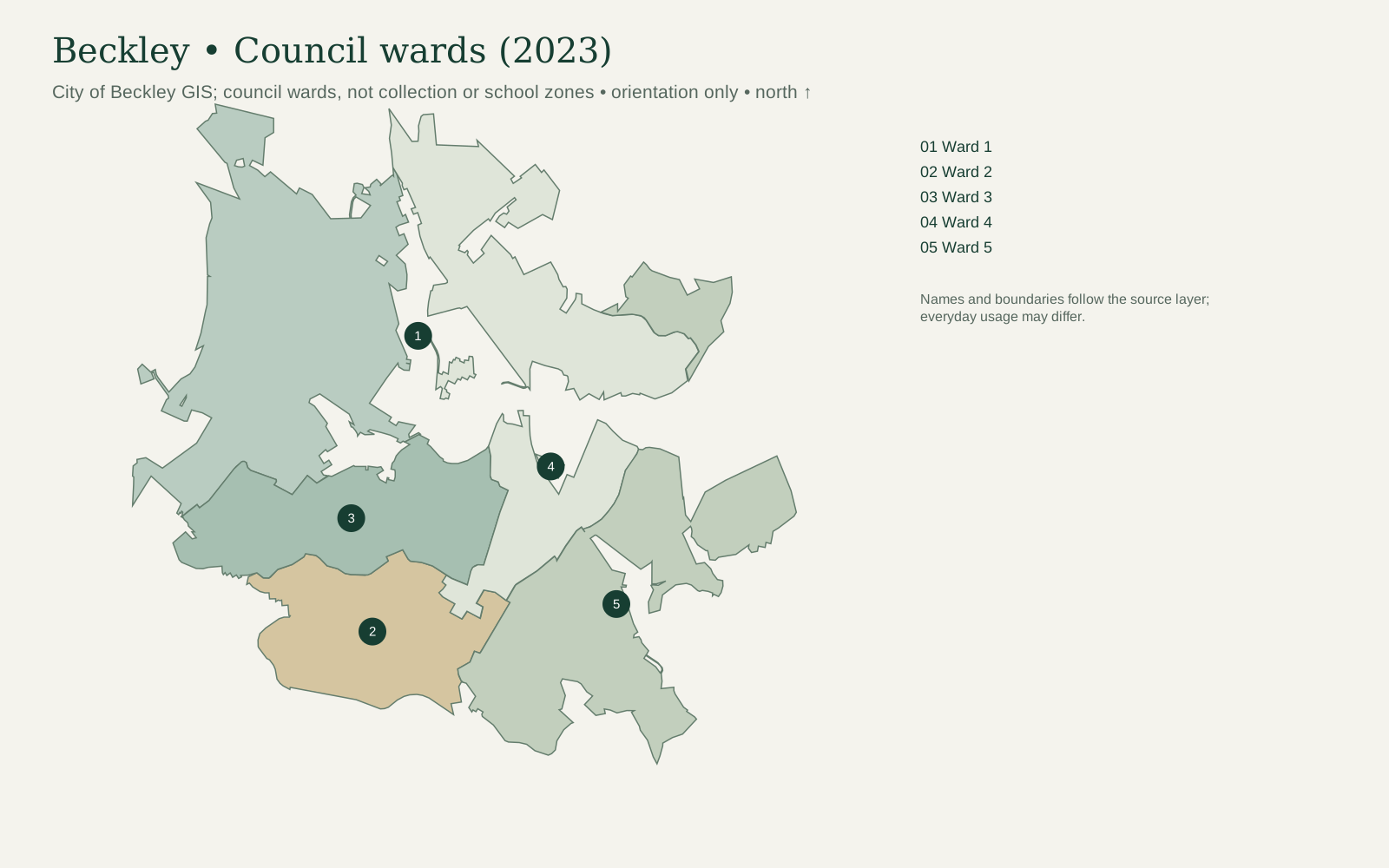
The orientation map uses five City GIS council wards from 2023. It shows the shape and subdivisions of the municipal area; it is not a map of the neighborhoods compared below. Council wards also differ from recycling collection zones, school attendance areas and approved truck routes. Ask the responsible department about the exact address for those decisions.

WVU Tech is in Beckley: its official physical address is 512 South Kanawha Street, while its mailing address is 410 Neville Street. Use the destination building and receiving entrance for a delivery rather than the university’s general mailing address. The presence of the campus does not establish a specific rental turnover date or a citywide peak moving season.

Five City of Beckley council wards from the official 2023 GIS layer.
The numbered key identifies the five council wards in the 2023 City GIS layer. These boundaries are not neighborhood limits, school attendance zones or recycling routes. Open full-size map.

03 /

Find the area that fits your routine

These six comparisons combine named neighborhoods with clearly identified areas around civic, campus and park reference points. They use separate primary sources; the park and campus areas are orientation aids, not claimed official neighborhood boundaries. Property checks and journey questions are advice for a viewing, not verified conditions at every home.

Downtown / Courthouse Square

The City identifies Courthouse Square as its B-3 historic zone, with a distinct review process for changes to buildings. This is a downtown civic and commercial reference area, rather than a promise that every block has the same housing.

Courthouse Square planning and historic review ↗
Housing & setting
If considering an upper-floor home, inspect the residential entrance, internal stairs and separation from ground-floor deliveries. Confirm the actual lawful residential use with the owner.
Daily travel
Try the walk to your everyday destinations and confirm where a resident vehicle can stand. A convenient downtown location does not reserve the frontage for unloading.
Before choosing
Obtain the building’s moving instructions. If access work would change the structure, ask the owner about applicable historic review before making an arrangement.

Maxwell Hill

Maxwell Hill is in the northwestern part of the city in the comprehensive plan. Its City-operated community center and shelter provide concrete local reference points for comparing an address.

Maxwell Hill community facilities ↗
Housing & setting
Walk the driveway and the route to the living floor. Ask how exterior maintenance is divided if a home is rented or shares an approach.
Daily travel
Test the journey from the actual home to work and school; a neighborhood label does not establish the school attendance area or a bus stop.
Before choosing
Check the park approach you would use and the property’s loading position. Community-facility parking is not automatically available for a household move.

Woodcrest

The adopted 2024 plan places Woodcrest in the northeast of Beckley, beside the northern and eastern corporate limits, with the East Beckley Bypass meeting Stanaford Road just west of the area.

Beckley 2045 — neighborhood geography ↗
Housing & setting
Compare actual construction, layout and maintenance. The plan’s description of Woodcrest as a newer neighborhood is relative and does not establish the age of any listed house.
Daily travel
Try the required junctions and everyday routes at your household’s usual times. Check pedestrian continuity on the specific route rather than inferring it from road proximity.
Before choosing
Verify the municipal boundary and service accounts for a property near the edge of the city. Measure the approach and confirm space for the delivery vehicle.

New River Park area

Use New River Park as a recreation reference point when looking at nearby homes. The City describes shelters at the park entrance and behind the pool area, with different facilities and reservation arrangements.

New River Park facilities ↗
Housing & setting
Assess each property’s own rooms, outdoor storage and access. Proximity to the park does not establish private yard space or a particular housing type.
Daily travel
Walk the actual home-to-park route and identify the entrance that connects to the activity you want. Check any crossing, slope or missing segment before counting it as an everyday walk.
Before choosing
Ask about seasonal facility operation and event activity. Keep private receiving access separate from any public park parking or shelter booking.

South Kanawha / WVU Tech area

WVU Tech’s campus map identifies buildings and access within its Beckley campus around South Kanawha Street. This comparison uses the campus as an orientation point, not an official neighborhood boundary.

WVU Tech campus map ↗
Housing & setting
For a private rental, inspect the exact unit and confirm the lease, utility responsibility and receiving arrangements. University residence procedures apply only to the relevant campus accommodation.
Daily travel
Use the destination building on the campus map and test the complete route from the home. The general mailing address does not identify the entrance for a class, appointment or delivery.
Before choosing
Ask the property or university contact about permitted delivery hours and parking. Do not assume an academic calendar guarantees a lease handover date.

North Eisenhower / Freedom Park area

Freedom Park is identified on North Eisenhower Drive in the City plan. Its current facilities page describes basketball courts, a skate park, playground and shelters, making it another specific recreation reference point.

Freedom Park facilities ↗
Housing & setting
Compare the rooms and access of the actual available property. A nearby sports facility does not establish housing size, price or the condition of a home.
Daily travel
Try the route across and along the surrounding streets at the times you expect to use it. Confirm how the trip connects to school, work and shopping.
Before choosing
Check the usable park entrance and any current facility notices. For the move itself, identify authorized private or public loading space at the home.

04 /

Compare the home with citywide housing evidence

The ACS 2024 five-year estimates describe the City of Beckley over 2020–2024. Of an estimated 7,050 occupied homes, 3,907 were owner occupied and 3,143 renter occupied: about 55.4% and 44.6%. Those percentages use occupied homes as their denominator, not all housing units.

Citywide measureACS 2024 five-year estimateWhat it helps you compare
Median gross rent$869 per month; margin of error ±$72Historical context for cash-rent households, including applicable utilities
Median owner-occupied value$158,000; margin of error ±$12,759A survey estimate of value, not a current sale price
Detached single-unit homes6,402 of 8,628 housing units, about 74.2%Structure mix across all units
Homes built before 19401,394 of 8,628 housing units, about 16.2%Reason to inspect the actual layout and condition of older housing

These are sample estimates with uncertainty, not current listings or neighborhood-level price comparisons. The owner and renter counts have margins of error of ±403 and ±371; the total occupied count has a margin of ±375. A newer listing can differ substantially in size, condition and included services. Compare the complete monthly cost of actual available homes.

At a viewing, test the route your largest item would take. Check the width of each door after allowing for the open leaf, the turn onto the staircase, the landing and the destination room. Ask which appliances remain, who maintains exterior steps and drainage, and whether a landlord must approve changes. Building age alone does not establish a defect, and a renovated kitchen does not prove the whole receiving route has changed.

For a rental, get the parking space, storage area, utility responsibility and move-in instructions in writing. For a purchase, coordinate possession with the people who can actually release the keys. Photograph the agreed condition and meter readings when you take over, while keeping personal documents in your own records.

A round dining table, chairs and sideboard with two branded cartons in a partly packed home.
Check room dimensions and preserve a clear route while preparing the household.

05 /

Test the actual journey and its return

The Raleigh County Community Action Association operates public transportation under a contract with the New River Transit Authority. Its transportation page identifies service in Raleigh and Fayette counties and directs riders to dispatch at 304-894-8917 for current schedules and fares. NRTA also publishes its own route information; availability needs to be checked against the specific origin, destination and day.

When comparing homes, ask for the route in both directions, the nearest usable boarding point, the last return journey and what happens on weekends or holidays. If you need a route deviation, accessible boarding, an attendant or another accommodation, describe that need to dispatch before depending on the trip. A bus passing near the property does not establish that it can stop at the driveway or operate at the time you need.

Use the operator’s current schedule and fare for the journey you are planning; an old route diagram is not a dependable basis for a daily commute. RCCAA’s separately arranged group or contract transportation is subject to available vehicles and drivers; it is not an automatic substitute for a regular route.

For walking, try the complete route between the home and the destination, including crossings and changes in grade. The 2024 City plan identifies sidewalk gaps in parts of the network; a short straight-line distance is not proof of a continuous pedestrian route. For driving, compare your real work and school hours rather than using an uncongested sample trip. Ask a prospective building about resident parking and visitor access separately from moving-truck arrangements.

Two passengers waiting beside a bus shelter on a gently rising street with brick shops and parked cars.
Check the current service day, boarding point and return journey for your routine.

06 /

Use the current enrollment path and confirm the assignment

Begin with the Raleigh County Schools enrollment hub and the physical address where the student will live. Contact the district or receiving school to confirm the home attendance area before relying on a property listing or a nearby school sign. The county serves several communities; living near a school does not by itself establish assignment.

New and returning K–12 students

The current 2026–27 K–12 registration form collects student and guardian information, physical and mailing addresses, grade, previous school and educational needs. It lists an updated immunization record, a Vital Statistics birth certificate and two proofs of physical residency. A Social Security card is recommended. Kindergarten also needs the specified well-child and dental documentation; students coming from private school or home school are asked for transcripts.

Submit the household’s own information through the district’s form, then complete the school’s follow-up. During the regular school year, the form says a school representative will contact the family within five business days to finalize registration and explain next steps. An automated receipt is not the completed enrollment, a bus assignment or confirmation of athletic eligibility. If no follow-up arrives, contact the school or the district at 304-256-4500.

Kindergarten, pre-kindergarten and school choice

The current early-years guidance uses age five before July 1 for kindergarten and age four before July 1 for pre-kindergarten. Kindergarten normally begins with the home-district school. The 2026–27 pre-kindergarten application asks families for three preferred sites, but placement is based on need and available places, with no guarantee of a first choice or of the same school later used for kindergarten.

The pre-kindergarten form lists the initial April 2026 placement deadline and subsequent spring contacts, but also states that late applications are accepted. For an arrival later in the year, ask about the current placement process rather than treating the past first-round dates as a new deadline. Prepare the requested birth, health, immunization, dental and household-income documentation and follow the program’s instructions for providing it. Confirm the placement before making school-dependent travel or childcare arrangements.

If requesting a different school, use the in-county transfer form or out-of-county form for the actual situation. Permission is requested each year and depends on capacity and stated conditions; a student may need to return to the attendance zone if enrollment increases. Parents provide transportation for an approved transfer. The forms require school and district approval, with additional superintendent and Board approval on the out-of-county form; approval does not itself grant athletic eligibility.

Records, support and the school bus

A family in transitional housing should speak with the attendance and homeless liaison at 304-256-4500, extension 3360, before postponing enrollment because ordinary address documents are missing. The district’s McKinney-Vento information describes enrollment and attendance while records are arranged and assistance with school continuity. Explain the actual living situation so the district can identify the appropriate support; sharing a home is not by itself a decision about eligibility.

After assignment, use the bus schedule page: select the school area and school, then expand the relevant bus number to read its streets and approximate times. Confirm the student’s actual route and stop with Transportation at 304-256-4560, especially after an address change. A route list is not an address-based enrollment decision. Arrange a workable first-day plan while the school confirms the details.

Discuss medication, health plans and required records with the school nurse through the School Health Services page. Keep these records and the prior school’s contact information available to you rather than inside the moving shipment.

07 /

Establish sewer service before the water account

Confirm the providers for the actual property with the owner or manager. A city address and a provider’s general service territory do not prove that every unit has an individual meter or that the tenant opens every account. Record which services are included in the lease, who must apply, and the dates when you have possession and can provide access.

Sewer and water

For an existing residence served by Beckley Sanitary Board, the residential signup instructions require an office visit to 301 South Heber Street, an application, photo identification and a $50 security deposit. Outstanding balances must be resolved. The linked sewer application asks for the service property, account holder and ownership or rental information. A new sewer extension or a property in another district follows its own process.

Beckley Water’s existing-meter start instructions require evidence that sewer service has already been established with the applicable district. For a new residential account, bring photo identification, the physical service address, contact information and the applicable $40 deposit in cash or by check. Renters also need the lease and landlord contact details; the company requests the prior occupant’s name. The account requires the customer’s signature. Confirm the actual order and service date with the office, rather than assuming that having paid both deposits means the water is already on.

Existing customers can request a transfer of location, subject to account review and office approval. Coordinate the old stop date, new start date and forwarding address. When leaving, the discontinuation instructions ask for notice a few days beforehand so a final reading can be arranged. Tell the Sanitary Board about departure as well: its account remains open until it receives the final water reading. Retain the confirmation of each service change.

Electricity, gas and communications

For an address served by Appalachian Power, the start-service process first identifies the location by complete address or meter number. Enter the apartment or suite where applicable. The public first stage does not confirm a connection at an unentered address. Its West Virginia deposit guidance describes customer-specific deposits and a possible utility credit letter; do not budget a single universal electric deposit from another household’s experience.

If Mountaineer Gas supplies the property, apply by phone at 800-834-2070 with the service location or meter number, previous account details if applicable, contact and billing information, and a future date for access. The turn-on guidance calls for at least one business day’s notice and someone available for service personnel; orders are worked on weekdays excluding holidays. This is a scheduling prerequisite, not a guaranteed appointment. New construction or a new gas connection requires an availability and installation discussion.

Check internet availability at the full unit address and ask about any installation visit or landlord permission. Keep essential communications available during the handoff. Before delivery, confirm that lighting, the receiving entrance and any equipment needed to use the building are actually operational.

08 /

Separate weekly trash, recycling and move-out items

Ask the owner or manager who collects the property’s refuse and whether service is already included. Municipal recycling and a private trash subscription are different arrangements. For a shared building, confirm the permitted collection point and who books bulky items; do not set furniture beside a communal container without instructions.

Weekly trash and larger items

Beckley Garbage Disposal’s residential guidance says trash must be at the curb by 5 a.m., explicitly replacing older 7 a.m. information. It lists a six-bag household limit and asks customers to call ahead for extra material. Start an account through the provider at 304-252-6051 and confirm the actual address and collection day.

The same provider describes two bulky items per month, arranged at least one business day in advance. Put the accepted items out on the scheduled pickup day. Tell the office exactly what you have: a mattress and box spring, a sofa, a disassembled bed or a refrigerant appliance are different items. Its general bulky-item wording does not establish a universal mattress wrapping rule or acceptance of every mixed move-out pile.

City recycling

The City’s curbside recycling instructions use a 7 a.m. set-out time and separate clear bags for paper, plastics numbered 1 and 2, and rinsed aluminum or steel cans. Flatten large cardboard at the bottom of the blue bin, with bagged materials above. Glass, foam, shopping bags and several other materials are excluded; check the published list before mixing packing waste into recycling.

The page explicitly says recycling wards differ from voting wards. Its calendar heading is not clearly current, so confirm the property’s present route and holiday adjustment with Public Works at 304-256-1740. Private cardboard drop-off and the county recycling center have their own accepted-material lists. A symbol on packaging does not make it accepted by every collection stream.

Mattresses, donations and the landfill

Last Chance Mercantile at the county landfill accepts selected reusable donations but explicitly excludes mattresses and box springs, damaged or stained upholstery and broken appliances. Donations may be refused, and staff do not undertake loading or unloading. Arrange acceptance before transporting a large item there.

For a mattress without a confirmed collection, contact Raleigh County Solid Waste Authority at 304-255-9335 about the exact item, preparation and vehicle. The landfill rate page currently lists $47.03 per ton and a $12 truck minimum for 500 pounds or less. Its Saturday closing time differs from the homepage; confirm hours before travelling, particularly near closing. Do not infer a mattress-specific price from a general vehicle charge.

The county’s Free Day has separate limits: the last working Thursday of the month, one residential household load up to a pickup-truck quantity and no more than 516 pounds, secured or tarped. Commercial and contract haulers are excluded. Check residency, item and vehicle eligibility first; hiring a moving crew does not make its disposal trip a free resident visit. Keep a confirmed alternative if collection or donation cannot happen before possession ends.

09 /

Follow the permit path for the operation you actually need

First identify the property’s jurisdiction and decide whether the truck can load entirely on authorized private space. Get the owner’s permission and verify that the surface, grade, turning area and doorway route work for the vehicle. Public curb space is a separate decision, even when the resident owns the adjoining house.

Residential streets and oversize vehicles

City Code 14-1 defines oversize vehicles broadly, including specified vehicles with authorized gross weight of at least 10,000 pounds, more than two axles or height over eight feet, as well as listed vehicle types. Send the actual vehicle dimensions and registration details to the authority when asking how the rule applies.

Under Article VIII of the traffic code, oversize parking on residential streets or in the specified residential zones is generally restricted. Section 14-823 allows attended loading, unloading or service to property in the same block, limited to the necessary work and subject to other parking rules. The operator must remain constantly with the vehicle. The same section contains a council-permit route for good cause and a state/federal-highway exception; neither should be assumed to apply to a household’s proposed stop.

Loading zones, meters and backing to the curb

An established loading zone permits active loading and unloading, with a 15-minute limit unless the chief of police grants special permission for longer. Sections 14-820–821 require a permit from the chief of police for backing to the curb to receive or discharge a load, and require that permit to be carried by the driver or in the vehicle. A citizen may request a loading zone in writing on the police-prescribed form, but establishing a zone is distinct from booking a household’s delivery.

Contact Parking Enforcement at 304-256-1720 to identify the appropriate police contact, and the City parking office at 304-256-1750 or 304-256-1768 for a proposed reservation. Supply the date, duration, exact street frontage, vehicle dimensions and whether you need several spaces, rear loading or a longer loading-zone stay. The online free reservation application is for businesses operating in city limits and requires Parking Commission approval; it is not a published blanket household exemption.

Confirm which applicant must act, the form, fee, lead time, posting arrangements and any supervision. No complete household booking timetable or fee was established in the published material. Meter payments and monthly parking contracts do not by themselves reserve a moving footprint. Keep the approval and its conditions with the crew, and arrange an authorized fallback if the intended position is occupied.

Public-space obstructions and the approach route

Chapter 12 requires recorder-treasurer permission for boxes or other articles that obstruct a street or sidewalk. Blocking off a public area requires a permit from the mayor or chief of police. Ask the City about a proposed container or equipment footprint before placing it; a permit to excavate or relocate an entire building is a different process.

Keep sidewalks, driveways, fire lanes, bus stops and crossings usable. Code 14-802 includes a 15-foot hydrant clearance and other location-specific restrictions; an active crew or hazard lights do not cancel them. Section 14-550 permits necessary local delivery or pickup exceptions to certain heavy-truck street restrictions, but the carrier still needs a suitable route and must follow applicable signs. Check the approach with the actual vehicle, including any separate road authority where relevant.

10 /

Resolve the internal route with the property manager

At a house, identify the entrance you can actually use, the available landing and the route into each receiving room. At a shared building, obtain written moving hours, elevator or service-door arrangements and required protection. Ask who has authority to unlock the route or approve an alternative when another activity overlaps the delivery.

Photographs should show the complete stair flight and turns, not only a close view of the front door. Measure the narrowest opening and large furniture; include overhead clearance and anything that cannot be removed. A side door may shorten the carry but still require permission or involve a steeper path.

The City’s building-permit guidance concerns construction and related work, including moving a structure. It does not make routine household delivery a building-relocation project. If a proposed access change would alter a building, ask the owner and Code Enforcement which approvals apply before arranging the work. The mover’s handling plan should use the approved existing route unless a different arrangement has been agreed.

11 /

Try the nearby park and errands as ordinary trips

Beckley’s parks and recreation system includes neighborhood facilities and the Lewis McManus Trail. Compare the route from a prospective home to the entrance you would use: a park shown close to the property may require a different crossing or approach than the map first suggests. Check the relevant facility before relying on an activity, opening date or reservation.

Maxwell Hill has a community center and shelter, New River Park has several gathering areas, and Freedom Park provides courts, a skate park and a playground. Shelter reservations and seasonal operations are separate from ordinary access to a public space. Some notices on the general parks page still refer to 2025, so confirm the current season instead of transferring an old pool schedule to your arrival.

Build an everyday circuit that suits your household: groceries, a pharmacy, a place to walk and the services you regularly use. Try carrying a shopping bag along the route and consider the return in poor weather. Use that practical experience alongside the home’s price and layout rather than selecting an area from a broad reputation or an unsupported ranking.

A parent and teenager passing a basketball on a park court, with a path and playground beyond.
Try the actual route to nearby recreation before deciding a location works for you.

12 /

Assign winter preparation and check current notices

Under the City’s sidewalk code, the responsible occupants, owners and agents must normally remove snow and ice within three hours. Snow falling or ice forming between 6 p.m. and 6 a.m. must be cleared before 11 a.m.; Sundays and legal holidays are exceptions in the provision. The rule also addresses water from gutters and downspouts reaching the sidewalk. Agree who will do the work, particularly when you are not yet staying at the property.

For a delivery, inspect the driveway, sidewalk, steps and landing close to arrival. Leave a clear route and keep cleared material away from drainage. Temporary signs for street clearing, sweeping or other city work can change the available curb space; the published traffic code requires drivers to follow those restrictions.

Public Works identifies winter street maintenance, spring household cleanup and fall leaf and small-limb cleanup among its duties. Those annual programs do not establish an on-demand move-out collection or the date for a particular block. Check current notices and confirm the collection arrangement you need before leaving items outside.

If possession, weather or a campus housing appointment changes the receiving time, update the delivery plan. Keep necessary medicines, documents and a change of clothes with the household so a delayed shipment does not leave immediate needs inaccessible.

A resident clearing light snow from a sidewalk beside a house, leaving the gutter and entrance route clear.
Assign sidewalk clearing and inspect the receiving route shortly before delivery.

13 /

Use a short arrival sequence and a workable alternative

Before departure, keep the addresses, building contact, utility confirmations, school contact and any written loading permission in one accessible place. Record which condition is still pending and who can resolve it. A tentative approval should not be presented to the crew as an available reserved space.

WhenUseful checkIf it is unresolved
Before choosing the datePossession, household inventory, curb and receiving routeKeep the date provisional and discuss another window
Before the truck leavesKeys, usable lighting and the agreed loading positionContact the owner or authority and confirm the alternative
During deliveryPlacement, clear circulation and items travelling with youResolve room or route questions before further handling
During the first weekSchool follow-up, refuse day, utility billing and daily travelUse the responsible provider rather than copying a neighbor’s arrangement

At handover, photograph the condition, read the meters where appropriate and confirm which keys or access devices have been supplied. Arrange any accepted bulky collection or donation separately from the shipment. After delivery, check the rooms and keep the agreed moving documents with your household records.

Use the Beckley moving page to discuss the inventory, access, packing and transport scope. A useful backup plan names a lawful alternative location, a person able to release the building and the consequences of a changed date; it does not depend on improvised curb restrictions.

14 /

Questions before you arrive

Does a Beckley mailing address mean the home is in the City?

Verify the municipal boundary and actual service districts. A postal place name does not establish that city parking, recycling or the same water and sewer account procedures apply.

Should sewer or water be arranged first?

For an existing meter served by Beckley Water, the company requires a receipt showing sewer service has been established with the applicable sewer district. Confirm each provider and the actual activation date.

Can I choose a school and assume the bus will serve it?

Confirm the home attendance area first. Transfers require approval under the district’s conditions, and parents provide transportation for an approved transfer. Bus route and stop confirmation is a separate step.

What should I do with an unwanted mattress?

Ask the refuse provider to accept and schedule the specific item, including any required preparation. Last Chance Mercantile does not accept mattresses or box springs. Confirm the landfill alternative before transporting one.

Is a parking meter enough permission for a moving truck?

Meter payment does not establish a reserved multi-space footprint, a longer loading-zone stay or a permit for backing to the curb. Confirm the operation with the City and Police before relying on the position.

Can I use the ward map to choose a school or recycling day?

No. The map depicts council wards from the City’s 2023 GIS layer. Neighborhood descriptions, school assignments and recycling collection areas have different purposes and boundaries.

Your next step

Bring the plan together

Use the Beckley moving page to prepare the inventory, access details and questions for your estimate.

Sources & useful local resources

Official procedures and local resources are linked beside the answers above. Reopen the relevant page when arranging a date: fees, schedules and application requirements can change.

Place, housing and everyday life

Parking, access and seasonal preparation

School enrollment and transportation

Utilities and household accounts

Waste, recycling and disposal

Public transportation