West Virginia / City relocation guide

Moving to Morgantown

Moving to Morgantown means matching the home to its hillside approach, campus connections and everyday trips. Compare the actual building and household routine, then arrange school placement, utility handoff, collection and street access before the final moving date.

Woman walking on a riverside path as a cyclist rides away beside apartments and trees
Test the complete route between the home and everyday destinations.

01 /

Begin with the address, the household and the handoff

Make the first decision at the scale of the actual home. Record its municipality, entrance, parking arrangement and the destinations the household must reach regularly. A neighborhood description can help narrow the search, but it cannot establish the school assignment, accessible route or vehicle space at a particular building.

Build a short comparison using the same questions for each property: usable space, recurring housing costs, stairs and slopes, parking, daily travel, school arrangements and the timing of possession. Visit at the hour you would normally leave or return. If a service depends on a booking, test how you would arrange both directions and what happens when the schedule changes.

02 /

Separate the city, neighborhood and mailing address

This guide concerns Morgantown city in Monongalia County, West Virginia. City limits, a postal address, a school attendance area and a transit service zone are different boundaries. Establish which municipality controls the property and the relevant street before applying the procedures on this page.

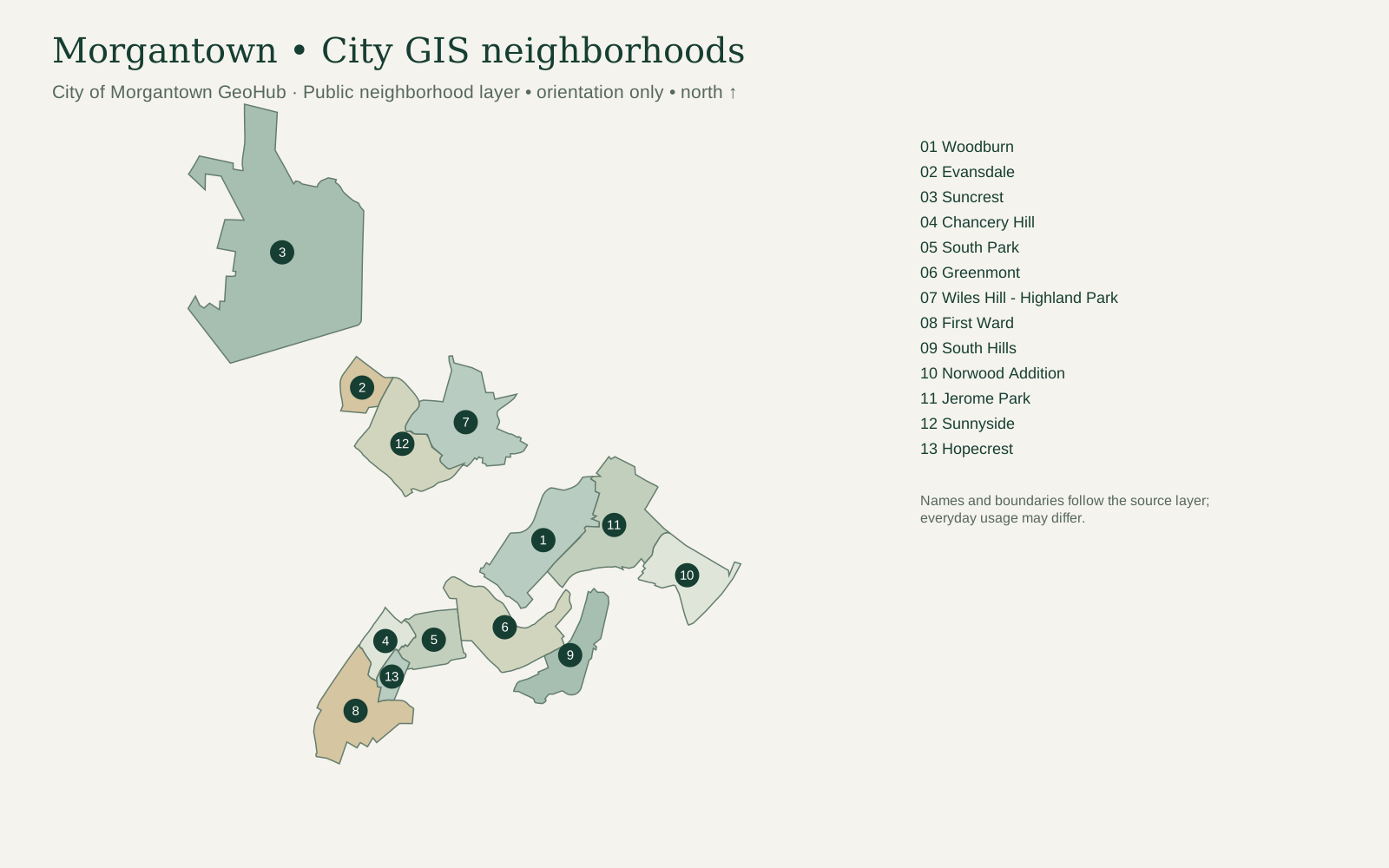
The City maps page links to Morgantown's GeoHub. Our orientation map redraws the public City neighborhood layer, which contains thirteen named areas. It preserves the source geography and identifies the areas by a numbered key. The layer does not cover every place discussed in this guide: Downtown is a useful comparison area without a separate Downtown polygon in that source.

Use the map to understand relationships, not to settle a parcel line, school placement, flood determination or truck route. A neighborhood name used by a landlord may cover a different informal area. The City GIS South Park neighborhood and the historic district described below are also different kinds of boundaries.

WVU's Downtown, Sunnyside and Evansdale housing areas are within the Morgantown setting, while nearby Westover, Star City and Granville are separate municipalities. The home-to-campus trip still depends on the actual entrance, crossings, slopes and service hours. A nearby campus label is not a walking-time or year-round transit guarantee.

Morgantown City GIS map with thirteen numbered neighborhood areas and a key, north upward
City of Morgantown GeoHub public neighborhood layer. Source areas for orientation; not a complete municipal outline, school zones, parcels or a truck route. Downtown has no separate polygon in this layer. Open full-size map.

03 /

Find the area that fits your routine

These six comparisons use City planning, historic records, university geography and neighborhood facilities. Historic sources do not establish current condition or vacancies. City GIS polygons, historic-district boundaries and everyday place names serve different purposes; compare the actual property and daily route.

Downtown

The 2013 City plan describes the commercial core as a compact grid with short blocks and varied mixed uses.

2013 Comprehensive Plan: land management and neighborhood character ↗
Housing & setting
Inspect the actual apartment or reused upper floor, receiving entrance and shared circulation.
Daily travel
Test the connection to Walnut or Beechurst and the last useful return on the travel date.
Before choosing
Confirm street meters, the legal waste district and any service-elevator arrangement.

South Park

The 1990 historic-district nomination describes a hillside residential area south of downtown, small lots and varied early-twentieth-century house types.

South Park Historic District nomination, 1990 ↗
Housing & setting
Measure porch steps, the slope and the narrowest interior turn; a historic description does not establish present condition.
Daily travel
Check the actual connection to the Orange Line and the route across Deckers Creek.
Before choosing
Distinguish the historic district from the City neighborhood polygon and inspect the receiving grade.

Sunnyside

WVU identifies Sunnyside as a housing, campus-dining and retail area connected with Downtown and Evansdale.

Residence halls by campus area ↗
Housing & setting
Confirm whether the property is a university residence hall or a private lease and which furniture is already provided.
Daily travel
Test the campus trip on both an ordinary semester day and a break or weekend.
Before choosing
Get the current move-in instructions from the actual manager; a campus location label is not an access reservation.

Evansdale

The City association page identifies an area west of University Drive with streets including Rawley, Oakland, Vassar and Riverview.

Evansdale Neighborhood Association area ↗
Housing & setting
Inspect the individual house or apartment rather than assuming a uniform building type from the neighborhood name.
Daily travel
Check the route to the actual campus destination and an appropriate PRT station or bus stop.
Before choosing
Separate university property rules from municipal street permission and private-building access.

Woodburn

The association bylaws define a residential neighborhood through a detailed street boundary including Richwood, Whitemoore and adjoining streets.

Woodburn Association of Neighbors bylaws, adopted 2006 ↗
Housing & setting
Check the particular entrance, shared areas and grade before choosing the receiving route.
Daily travel
Walk the actual park or trail connection; a footpath is not a certified accessible route.
Before choosing
The association definition is not a parcel survey or school attendance boundary.

Wiles Hill / Highland Park

The former Wiles Hill school now provides a BOPARC community-center anchor for this neighborhood comparison.

Wiles Hill Community Center ↗
Housing & setting
Compare the actual home and its access, without assigning a single housing type to the whole area.
Daily travel
Test the trip from the front door to Eureka Drive and the destinations used during the week.
Before choosing
Confirm the center program, hours and registration; nearby facilities do not establish available care.

04 /

Compare the home, recurring costs and receiving space

The ACS 2024 five-year estimates for Morgantown city describe the 2020–2024 survey period. They provide a citywide baseline for comparing housing questions, not current availability, an advertised lease or the value of an individual property.

MeasureMorgantown estimatePractical use
Occupied housing units11,946Denominator for the tenure shares
Owner / renter share43.7% / 56.3%Compare both types without assuming a vacancy
Median gross rent$937Historical survey measure, not a current offer
Median owner-occupied value$259,400Survey estimate, not a sale-price quotation
Single-unit detached share46.4%Share of all housing units
Units in two-to-four-unit buildings21.4%Ask about shared entrances and accounts
Built before 194023.4%Inspect actual condition and alterations

The structure and age shares use all 13,879 housing units; the tenure shares use occupied units. All are estimates with sampling uncertainty. They cannot tell you whether a particular home has a usable entrance, a current opening or affordable total monthly costs.

For a rental, separate rent from utility deposits, recurring services, parking and any building charges. Ask who holds the water and refuse accounts, where carts are stored and whether parking is assigned. Record the permitted delivery entrance and hours, especially in a building with multiple units or a shared stair.

For a purchase, include the driveway grade, retaining walls, porch, steps and usable openings in your inspection and handoff questions. Older construction can create a mismatch between a spacious room and a tight route into it. Measure the limiting turn and doorway before deciding which large pieces will travel.

WVU's residence-hall location guide distinguishes Downtown, Sunnyside and Evansdale. That is a campus orientation source, not a list of available private rentals. Confirm the precise housing arrangement, occupancy dates, furniture already provided and any move-in appointment with the responsible manager.

Small open Sterling Oakbridge book carton beside a low bookshelf in an attic office, with a desk beneath the dormer window
Use small cartons for books and keep the route from low storage to the doorway clear.

05 /

Plan around the service and the university calendar

Mountain Line and WVU's PRT serve different travel needs. Begin with the Mountain Line route map and schedules, then check the actual boarding point, direction, last return and current operating notice. A line near the property does not guarantee a useful trip at your required hour.

The Orange Line connects South Park and First Ward with destinations including Morgantown High School, White Park and the Mountaineer Mall area. Its published regular service is hourly, Monday through Saturday. Check the individual timepoint and early-service note instead of applying the broad route span to every stop.

For campus connections, the Blue & Gold route carries a Fall 2026 banner that differs from an older summary lower on the same page. The dated August 2026 service notice is the relevant starting point: some services continue through university breaks while others do not. Read the current route-specific notice before committing to a late class, shift or appointment.

OptionPublished arrangementDecision before travel
Mountain Line fixed routeRoute-specific timetable and fareStop, direction, operating day and return
RideMonOn-demand service within its areaCoverage at both ends and live availability
Approved route deviationOperations review before the first requestLocation approval and dispatch arrangement
WVU PRTFive stations; semester scheduleStation access and current closure calendar

The Mountain Line fare page lists ordinary one-way cash fares in the 75-cent to $1 range and says a transfer costs the applicable fare again. Mobile products can have different prices. If using Token Transit, activate at boarding as instructed; an activated single ticket has a short validity window. Confirm the fare and method for the service you actually choose.

The Property Tax Bus Pass program is not an automatic benefit of a Morgantown address. It depends on qualifying county property taxes and the operator's allocation and verification process. Landlords or employers may make an eligible allocation, but a tenant should confirm that arrangement. The page describes annual review and a usual processing period of two to four weeks; do not base an immediate first-week trip on an unissued pass.

RideMon serves its specified zone through an on-demand booking system, with a posted 75-cent one-way passenger fare. The service does not take advance reservations. Confirm both addresses, the current operating span, party size and mobility needs with Mountain Line at 304-291-7433. Its page identifies connections to fixed routes; a booking inside the zone does not promise direct service anywhere in the county.

A fixed-route deviation is a separate process. Mountain Line describes deviations up to three-quarters of a mile where the bus can safely reach the location and rejoin the route. Operations must review the location and provide the initial approval in writing. Only after that approval should you rely on the stated ability to call as little as fifteen minutes ahead. The posted added fare is 50 cents; confirm the trip with dispatch.

The operator's accessibility information explains lifts, ramps, kneeling and assistance. Discuss the actual boarding location and mobility device before the first necessary trip. An accessible vehicle alone does not resolve an uncleared walk, steep approach or unusable pickup point.

WVU's five PRT stations are Walnut and Beechurst for the downtown area, Engineering and Towers at Evansdale, and Health Sciences. Under the PRT fare rules, registered Morgantown-campus students and active faculty or staff use their Mountaineer ID for free entry; everyone else pays 50 cents. This includes visitors and people whose enrollment is at another WVU campus or online.

The PRT operating calendar is essential: normal semester hours are 6:30 a.m.–10:15 p.m. Monday through Friday and 9:30 a.m.–5 p.m. Saturday, with Sunday closed. The system does not run during summer break and publishes holiday, recess and event adjustments. The Fall 2026 list includes October 9 and November 22–29 closures. Keep a workable alternative for a day when the PRT or your connecting bus is unavailable.

Two people approaching a glazed bus shelter on a sidewalk beside shops and a tree-lined street
Check the actual boarding point, operating calendar and return trip.

06 /

Contact the receiving school before submitting student forms

Monongalia County Schools directs families to contact the school before enrollment. Start with the exact residential address, grade, previous school and intended first day. The county district serves more than Morgantown city, so the neighborhood map above is not an attendance map.

The district's attendance-area map expressly warns against using it alone to make a housing decision. Boundaries can change with growth, and the district asks families to confirm placement at 304-291-9210. Obtain the receiving school's confirmation before relying on a property advertisement or a map pin.

  1. Identify the receiving school for the address and grade and tell it whether the child is new, returning or transferring.
  2. Use the appropriate current-year student data form and obtain the school's document checklist.
  3. Arrange proof of age and residence, previous records and any applicable custody or guardianship documents with the school.
  4. Resolve health records and support needs with the school staff and nurse.
  5. Confirm admission, first attendance day, bus arrangements and dismissal separately.

The public student data form lets the applicant choose the school year and school. Its new-student acknowledgement says the family must contact the school to provide proof of age and residence. Completing the online information is therefore one step, not a complete admission or proof that uploaded documents have been accepted. No family should assume the previous occupant's school arrangement transfers with the home.

For kindergarten, the 2026–27 registration flyer uses a June 30, 2026 age-five cutoff and includes children already enrolled in an onsite or collaborative Monongalia County Schools Pre-K program. Its wording alternates between “prior to” and “on or before” that date, so confirm a boundary-date case with the district. Its April registration and visitation dates are past; arriving families should ask for current intake instructions. Help with kindergarten registration is listed at 304-291-9210 extension 1770.

Pre-K has a separate Early Childhood contact route. The district's form and older slide handout show different extensions, so use the main number and ask for that department. The same handout refers to a 2025–26 paper form; ask the school for the version appropriate to the current year rather than using an older paper copy automatically.

A transfer request is distinct from ordinary enrollment at the assigned school. The transfer instructions accept applications for the next school year from February 1 through May 31. From June 1 through the rest of the school year, applicants must use the out-of-season form, which is considered only for extenuating circumstances. Prepare the student's physical address, grade, guardian contacts and any applicable guardianship and school-history records. New applicants from outside the county also need current grade, attendance and discipline reports. A request does not guarantee placement.

The district's health page lists a current health check and dental form for Pre-K, kindergarten and grades 2, 7 and 12. It also supplies immunization information and forms for medication, dietary needs and student health. Give the nurse the actual records and resolve the child's current requirements directly; a general website summary is not an individual medical determination.

If temporary housing or missing records are complicating the move, contact the school's Outreach Facilitator or McKinney-Vento support route. The district places outreach facilitators in its schools and offers a self-referral form. Explain the circumstances early so staff can identify the appropriate enrollment support instead of letting an unresolved ordinary checklist become a silent delay.

The Transportation Department asks families to enroll separately for bus information and alerts. Its routes are being updated, with reviewed routes marked on the site; confirm the exact stop, pickup, return and first service day at 304-983-8215. Bus registration is not school admission, and an alert subscription is not confirmation that a particular route has been assigned.

Arrange after-school care, pickup permissions and early-release coverage independently. Ask who can collect the child, whether the care place is actually available and how a closure or late bus changes the plan. Keep the school contact, transport confirmation and household fallback together for the first week.

07 /

Coordinate the old and new accounts by address

Begin with the lease, closing documents or current property bill to identify the actual providers and who is responsible for each account. A utility name on a neighborhood website does not establish service at every Morgantown mailing address. Prepare the old and new service addresses, contact details, requested dates and forwarding address before starting requests.

ServicePublished starting pointHandoff to confirm
ElectricityFirstEnergy move request for an eligible addressStart date, old stop date and separate occupant account
Water and related MUB billingNew service or location transferDeposit, dates and access for final reading
Gas, where supplied by HopeStart, stop or transfer requestMeter access, fee, account and AutoPay
Internet and building servicesProvider and property managerInstallation access and an actual appointment

FirstEnergy's moving request allows requests well ahead of the move, but online changes may require at least two business days and are not scheduled for weekends or holidays. Its current preparation guidance advises calling at least three days ahead for a move. Submit early and obtain the date confirmation; a requested date is not a guarantee of activation.

The new occupant needs their own electricity account rather than the previous resident's account number. Deposits may apply. The stop-service guidance warns that disconnection can occur in the morning of the selected day, so coordinate the last day you need power with the provider. Keep the two addresses and dates explicit if they overlap.

Morgantown Utility Board's new-service instructions require a $125 security deposit before processing. Its linked application begins with identity, contact and customer information. Prepare the requested information privately through the provider's official process and confirm the address, service date and any access requirement with MUB at 304-292-8443. This guide does not establish a universal activation turnaround.

For a move within the service area, use MUB's location-transfer route. The transfer form distinguishes the old account and effective transfer date from the new address and service-start date, and asks for forwarding information. Confirm how the two dates fit your actual possession and use of each property.

MUB's end-service page makes an important point for an inside meter: the account remains in the customer's name until MUB can enter to obtain the final reading. Arrange access with the person holding the keys. Sending a stop request, moving out or returning keys to a landlord does not by itself resolve that stated condition.

The MUB customer information separates billing and utility responsibilities from the hauler's collection work. Ask which water, wastewater, stormwater and refuse charges appear at the address, who receives the bill and whether the landlord or occupant holds the account. Confirm containers and pickup with the collection provider; a billing change alone does not explain the street's setout arrangement.

If the address uses Hope Gas, its service-change instructions list 800-688-4673 and a $30 start or transfer fee, with a possible deposit. An adult at least eighteen must be available when inside, fenced or otherwise restricted meter access requires entry; an accessible outside meter on an active transfer may not require someone present. Describe the property and ask what must be ready, including other utilities needed for appliance testing.

Hope treats a transfer as a new account: the old deposit does not transfer automatically, AutoPay must be established again and the old service must be stopped explicitly. Ask about overlap and the final bill. Confirm the operator at the exact address before applying these instructions to a property served by another gas company.

For internet, book the actual installation and building access rather than relying on a general coverage map. Keep a first-week alternative for work or essential communications. Finish the handoff by recording confirmations, final readings where applicable, forwarding details and the person responsible for any unresolved visit.

08 /

Separate ordinary collection, bulk items and the downtown window

Confirm the service arrangement for the exact property before moving boxes or unwanted furniture to the curb. A single-unit home, a multi-unit building and a downtown business may use different account, container and collection arrangements. Ask the owner or manager who subscribes, which containers belong to the property and where they are stored between collections.

Morgantown Code article 1139 identifies Republic Services as the contractor and sets the City's collection framework. It distinguishes residential and commercial arrangements, requires appropriate subscription and gives the owner and occupant responsibilities. Do not assume that every rental is billed in the same way or that a building's shared cart has unlimited capacity.

For the ordinary collection window, the code allows setout after 6 p.m. on the preceding evening, requires it by 6 a.m. on collection day and calls for containers to be returned to storage by 9 p.m. that day. The designated Downtown Solid Waste Collection District has a narrower rule: set out no more than two hours before the scheduled pickup and return containers no more than two hours afterward. Confirm whether the address is in that defined district; the informal word Downtown alone does not settle it.

Use the contractor-provided or City-authorized container with a working lid and keep the route accessible. The code restricts ordinary storage in a front yard or on a front porch visible from the public way, subject to the stated waiver process. Arrange a lawful storage position with the manager rather than leaving containers in the furniture-carrying path or a shared exit.

For cartons, empty and flatten them and follow the hauler's current sorting instructions. The code describes recycling alongside regular residential refuse collection, but the current address schedule and accepted preparation still need confirmation. Do not treat every item carrying a recycling symbol as accepted packaging or fill another property's bin without permission.

The bulk allowance in article 1139 is one bulky item per unit on each regular collection date. Additional items require a separate arrangement with the contractor and may carry a fee. The definition includes mattresses, bed springs, furniture and appliances. Count a mattress and a box spring as separate items when asking what the day's allowance covers, and confirm the actual pickup arrangement before placing either outside.

Republic's bulk-waste guidance directs residents to address-specific service information and calls for mattresses to be wrapped in plastic. Ask about the exact item, quantity, wrapping, placement, any required scheduling and charges at your property. The municipal allowance is not permission to leave an entire cleared apartment at the curb or beside a communal dumpster.

Construction debris is outside ordinary collection under the operative collection rule and needs separate arrangements. The code also provides on-call electronic-waste collection at least monthly and limits household hazardous waste to designated collection opportunities. Confirm an actual date and accepted materials rather than treating those provisions as an always-open drop-off service.

Before departure, divide belongings into what travels, what has a confirmed collection or donation arrangement and what needs another provider. Keep every rejected or unconfirmed item inside the authorized storage area until the responsible service confirms the next step. Build disposal into the schedule early enough that it does not compete with the moving vehicle, building access or the final property handoff.

09 /

Follow the full Morgantown street-access sequence

Describe the operation before asking for permission: exact address, date, hours, vehicle dimensions, desired meters, working length and any ramp, lift, container or pedestrian diversion. Establish who owns the street and whether the work remains entirely on private property. A postal address or a building's parking agreement does not answer that question.

The City's right-of-way instructions require a permit for work on, or closure of, a City sidewalk or roadway. The road-closure application must be submitted more than 48 hours before the proposed closure. That is a submission requirement; leave time for review, revisions and coordination rather than planning around a guaranteed two-day approval.

  1. Confirm the street authority and send the full layout to Engineering and Public Works.
  2. Ask which right-of-way approval and traffic or pedestrian arrangements apply to this move.
  3. If meters are involved, identify the spaces and request availability from the Parking Authority.
  4. Complete the required City approval before buying public-street meter bags.
  5. Confirm payment, installation, the vehicle hangtag and the approved start and end times.
  6. Match the approved public-space arrangement to the receiving entrance and building window.

Engineering and Public Works lists Building Maintenance and Permitting at 389 Spruce Street, 304-284-7412. Use that contact to confirm the applicable application route. The Morgantown Access Portal page now points to a changed portal address and describes account-based applications. The public portal reaches a login screen; confirm the correct right-of-way application with staff rather than choosing an unrelated building or vending permit.

For a necessary street closure, the City assigns the applicant notification responsibilities, including the relevant utilities and MECCA's non-emergency number, 304-599-6382. It also requires vehicle or pedestrian passage to be maintained using the appropriate traffic-control measures. Ask staff what arrangement is acceptable for the proposed operation; household cones do not independently create a legal street closure.

The Morgantown Parking Authority program requires an Engineering right-of-way permit for public-street or right-of-way meter reservations and describes that permit as no-charge in this process. Meter bags themselves are paid. Contact the Authority at 304-284-7435 to confirm the meters, dates, current invoice and installation. The City's separate page shows a different parking telephone number; the Authority's own current contact and form agree on this number.

Posted meter-bag categoryUp to 10 hours24 hours
Green Zone streets$21 per meter per day$24 per meter per day
Other streets or off-street areas$15 per meter per day$18 per meter per day

Those are the Authority's posted rates labeled effective April 18, 2022; confirm the current charge before relying on them. Its Green Zone list includes High, Fayette, Walnut, Chancery Row, Foundry and Chestnut. The page lists higher rates after two weeks and separate two-space charges for roll-off or storage containers. A container's two-space category does not establish how many spaces every moving truck needs.

The actual meter-bag request form asks for contact details, locations, period and purpose. Requests for more than four spaces require two weeks of advance notice. It also says the hangtag must be displayed while parked at the bagged meter. The Authority's reservation explanation describes its staff locking the bags onto meters and removing them afterward; do not improvise a reservation with a homemade covering.

A red-marked loading zone is a separate regulated use. Follow the posted hours, commercial-loading conditions and any required Authority permit. Do not leave an inactive vehicle there as an all-day substitute for the agreed reservation. Ordinary paid parking is likewise not exclusive use or permission to exceed the posted maximum time.

Before dispatch, confirm the installed arrangement and the contact who can resolve an occupied space or changed street condition. If the approved position fails, pause and use a separately authorized alternative with a workable carrying route. Do not move the operation into a crosswalk, driveway, opposing lane or sidewalk merely because it is nearby.

10 /

Connect the curb approval to the building’s permission

Public-street permission ends at a different boundary from the landlord’s or association’s authority. You may have an approved curb position and still lack permission to use a driveway, service entrance or elevator. Obtain both sets of conditions and make them compatible with the planned sequence.

Trace the route from the proposed truck position to the final room. Include a vestibule, half-flight, courtyard, basement turn or second elevator if the route uses one. Measure the narrowest openings and the turning space for the largest pieces. Share photographs of the actual path, with doors and gates in the position they will have during the move.

Ask who can reserve and release the elevator, whether other occupants share it, how long the slot lasts and what happens if it is late or unavailable. Establish whether the building requires a certificate of insurance, specific protection, a union arrangement or another contractor condition. These are questions for that property, not claims about every Morgantown building.

Identify the recipient and basis of each access payment or deposit, its due date and any return conditions. Keep receipts with the reservation. A fee paid to a building does not itself reserve a City street space, and a City approval does not authorize work beyond the building’s allowed hours.

When an access window is short, ask what may be prepared earlier: protected staging, elevator lining or packed cartons in an approved area. Keep corridors and exits usable. Plan the pickup and destination windows in travel order, allowing for the actual work between them. If one point slips, name who decides whether to continue, pause or use the agreed alternative.

11 /

Test neighborhood connections beyond the listing

Make the daily trip from the actual front door. A park, trail or community center can be a useful local anchor, but the approach may include a hill, a crossing or a link that is less convenient when carrying groceries or accompanying a child. Test the return as well as the outbound walk.

BOPARC's pocket-park directory places Woodburn Park off Richwood Avenue and describes its walking track, play areas and street parking. It also identifies Eaton Park and the small Suncrest Lake park area. These are different neighborhood facilities; confirm the chosen site's current conditions and opening arrangements instead of transferring one park's amenities to another.

The Wiles Hill Community Center occupies the former school at 287 Eureka Drive. The operator describes its long history as a neighborhood school and its later conversion to a community facility. Check the current program and registration arrangement if an activity is part of your household routine; proximity does not establish an available place.

The BOPARC trail information describes Whitemoore's footpath connection between Woodburn and the Deckers Creek Rail Trail. A footpath connection is not a promise of a step-free or all-weather route. Inspect the surface, grade and access point that you would actually use, including any seasonal maintenance limitations.

People entering a brick community center with a clear approach, steps and a bicycle rack
Test the route to local activities and confirm the program you plan to use.

12 /

Account for snow routes and campus arrival periods

The City's snow plan prioritizes major arterial and busy collector roads before secondary, lower-volume and dead-end streets. Emergency assistance can redirect equipment. A main road being clear does not guarantee the same condition on the final side street or steep private approach.

Residents and businesses must clear adjacent sidewalks within 24 hours after a storm ends, and the City says to pile snow in the yard instead of the street. Agree with the landlord or owner who clears the sidewalk, private walk, steps and landing before the move. Keep accumulated snow from obstructing the driveway sightline or narrowing the carrying route.

If a person cannot clear the sidewalk and has no available neighbor, friend or family help, the City directs them to Code Enforcement at 304-284-7401 for assistance. Contact the office about the actual situation; do not assume an automatic same-day service or that the moving crew has been booked to perform snow removal.

WVU's Fall 2026 move-in instructions scheduled residence-hall arrivals for August 13–15 with reserved two-hour slots after a room assignment. Those dates are historical at this guide's check date. For a later arrival, contact the hall for its current instructions and confirmation rather than using the old event schedule.

The published process limits the student unloading zone to a single vehicle and excludes trailers, directs residents along the hall's assigned approach and asks the vehicle to leave the unloading zone promptly once empty. A two-hour short-term parking window is not two hours of unattended unloading-zone storage. Confirm whether and how a professional delivery can fit the current arrangement.

Check campus and transport calendars when the household depends on them. PRT closure periods and bus routes that pause during breaks can change a normal weekly routine. Prepare an alternative trip and keep essential items with the household if snow, an unavailable receiving window or a campus access change delays delivery.

Resident clearing snow from a private walk beside a cleared sidewalk on a hillside street
Assign both sidewalk and private-route clearance before arrival.

13 /

Make a first-week plan and a usable fallback

Work backward from when you can actually receive the belongings. Write down the person releasing keys, the confirmed possession time, the building reservation and the legal vehicle position. The household’s preferred date is not a substitute for those confirmations. Update the mover when one of them changes.

Before pickupOn arrivalDuring the first week
Confirm possession, street and building permissions, services and inventory.Check the route, keys, utilities and room destinations.Finish school and account follow-ups, collection arrangements and condition records.
Keep documents, medication and essentials with the household.Keep shared corridors and exits open while unloading.Flatten and sort cartons without overfilling the covered cart.
Name the fallback decision-maker and deadline.Pause the affected step when an approval or safe route fails.Close the remaining tasks with their responsible contacts.

A useful Plan B states the trigger, decision time, responsible person and confirmed alternative. For example, if the seller cannot release the home by the agreed checkpoint, the authorized person must decide before the receiving window disappears. A revised date, approved alternative location or storage needs actual availability, access and agreed costs.

Plan for people as well as furniture. Keep essential belongings reachable, decide where the household can wait and preserve medication, childcare and pet arrangements. Identify who notifies the building, utility contact and moving company. State what confirmation is required to resume the original plan.

If the move is urgent, separate what can still be arranged from deadlines that cannot be compressed. Describe the remaining uncertainty openly. A submitted permit, a voicemail to a landlord or a tentative storage inquiry does not equal permission, keys or capacity.

When you are ready to discuss the work, use the Morgantown estimate section with the inventory, access details and open questions. Keep the administrative checklist alongside the move plan so the shipment, household and receiving property are ready for the same handoff.

14 /

Questions before you arrive

Can I choose a school using the attendance map alone?

The district warns against using the map alone for a housing decision. Confirm the exact address and grade with Monongalia County Schools, then contact the receiving school before completing the student forms.

Does the PRT run throughout the year?

Its published normal service follows the fall and spring semesters, with Sunday, summer-break and listed holiday or recess closures. Check the current calendar and plan an alternative for the full trip.

When does my MUB account end if the meter is indoors?

MUB says the account remains in your name until it can enter for the final reading. Arrange access and confirm the completed handoff; sending the request or returning keys alone does not satisfy that condition.

Can I leave several mattresses beside the cart?

The City code allows one bulky item per unit on a regular collection date; additional items need a contractor arrangement and may cost extra. Confirm each mattress or box spring, wrapping, placement and the actual pickup with Republic first.

How early should I request meter bags?

The form requires two weeks of notice for more than four spaces. The separate City road-closure application requires more than 48 hours. Ask early about the actual layout, availability and approvals rather than treating either interval as guaranteed processing.

Are downtown container hours the same as elsewhere?

The defined Downtown Solid Waste Collection District allows setout no more than two hours before pickup and return no more than two hours after. Confirm the address and schedule with the City or hauler before using the ordinary residential window.

What must be confirmed before loading starts?

Possession, keys, the receiving window, building access and the lawful vehicle position must work together. Name the person who decides if one fails and arrange a real alternative with capacity, access, costs and household essentials covered.

Your next step

Bring the plan together

Use the Morgantown moving page to prepare the inventory, access details and questions for your estimate.

Sources & useful local resources

Official procedures and local resources are linked beside the answers above. Reopen the relevant page when arranging a date: fees, schedules and application requirements can change.

Housing

Schools

Utilities and waste

Campus and travel

City geography and access

Neighborhood orientation

Parks and everyday life

Daily travel