Colorado / City relocation guide

Moving to Denver, CO: choose a home and settle in

Denver offers central rail connections, older residential streets, park-centered routines and northeastern neighborhoods with a different daily geography. Start with the home and ordinary week you want to live. Then turn schools, household accounts and receiving access into an arrival plan you can use.

Whole recessed glass entrance and level paved approach between planted beds at a contemporary condominium building.
Compare the shared entrance and complete street-to-door approach before choosing a home. Representative illustration.

01 /

Start with the ordinary week you want to live

Choosing a home: compare the six areas below with the same list of regular destinations: work or study, groceries, care, an evening visit and somewhere to spend time outdoors. Denver offers several very different ways to put those activities together. A neighborhood name alone cannot tell you how well a particular address will work.

Moving with children: read the school section before treating a nearby campus as a place secured for your child. Put enrollment, care and the adult journey on the same calendar. Keep student and health records with the household during travel.

Address already chosen: start with possession, household accounts, waste collection, the building route and the arrival sequence. Assign each unresolved item to someone who can act before dispatch. For the company’s interstate service and estimate process, use Denver moving services.

02 /

Understand the city and the places you are comparing

This guide covers the City and County of Denver, Colorado, Census place 0820000. A Denver mailing address or a regional home-search result can also describe a location outside the municipality. Establish the actual jurisdiction before applying the City’s collection, street or school procedures.

The map uses Denver’s statistical-neighborhood geometry. The six highlighted comparison areas sometimes combine adjoining statistical neighborhoods: Downtown combines CBD and Union Station; the park comparison combines Washington Park, Washington Park West and Platt Park. These are practical search groupings, not new official districts. Other unhighlighted neighborhoods remain part of the city.

The municipal map context includes the South Platte River, I-25, I-70, Colfax Avenue, Broadway and Speer Boulevard, helping explain the urban connections. Existing A Line geography shows the link through Union Station, 38th & Blake and Central Park toward the airport. The inset retains the city’s airport extension. The map is an orientation aid, not a school assignment, parcel survey, legal truck route or prediction of journey time.

Use the map to narrow a search, then follow the actual approach to each home. Notice the side of a major road, the station entrance, the crossing with shopping bags and the final door. A short straight line can conceal a long walk around a block or an inconvenient transfer.

Denver statistical neighborhood boundaries with six highlighted comparison groups, main roads, South Platte River, existing A Line and a whole-city airport inset.
Compare the six highlighted groups, then use the exact home and destination for a journey decision. The inset retains the airport extension. Statistical neighborhoods are not school or property boundaries; roads do not establish a legal truck route. Open the map and zoom to read the detailed labels. Explore the map.

Denver neighborhoods and daily connections

Open image

Scroll to move around the map. Use + and − to change its size. With a keyboard, focus the map and use the arrow keys.

Denver statistical neighborhood boundaries with six highlighted comparison groups, main roads, South Platte River, existing A Line and a whole-city airport inset.

03 /

Six starting points for an address search

These six comparison groups help organize a search; they are not ranked recommendations or a complete list of Denver neighborhoods. The map shows which statistical neighborhoods each group contains. Compare the actual home, cost, daily connections and responsibilities before choosing an address.

Downtown: CBD and Union Station

Start here when central destinations and rail connections are priorities. Union Station and the older LoDo context provide a different setting from an address farther into CBD; the comparison group covers both. VISIT DENVER describes historic buildings reused for shops and restaurants around LoDo.

VISIT DENVER: Downtown: CBD and Union Station context — source
Housing & setting
Compare the actual apartment or condominium, daylight, internal levels, shared entrance and assigned parking. A high-rise can have both a common lift and a separate stair inside the unit.
Daily travel
Union Station provides the A Line connection. Follow the actual station approach and the journey to your own workplace; a Downtown label does not identify the right entrance or eliminate transfers.
Before choosing
Test groceries, evening noise and the return after an activity. Establish the receiving door and lift window before treating the street frontage as a loading position.

Capitol Hill and Cheesman Park

Compare these adjoining statistical neighborhoods for a central routine with a park-oriented alternative to the station district. The broader visitor context includes Capitol Hill’s older mansions and nearby cultural destinations; Golden Triangle is a related destination, not part of this map’s highlighted group.

VISIT DENVER: Capitol Hill and Cheesman Park context — source
Housing & setting
Inspect an older home or shared building for room layout, stairs, laundry and storage. Building age and an attractive exterior do not establish present condition, noise separation or accessible entry.
Daily travel
Try the actual bus journey and the walk to everyday destinations. The useful connection may differ on either side of a major street; do not substitute the A Line for a route that does not reach it directly.
Before choosing
Compare a weekday evening, a grocery trip and the park approach. Confirm the particular address’s parking and maintenance responsibilities instead of assigning them from the neighborhood name.

Highland and Jefferson Park

This comparison sits west of the South Platte and I-25 from central Downtown. Highland’s visitor guide describes a mixture of Victorian-era buildings and newer architecture in LoHi. Its wider “Highlands” coverage also reaches other neighborhoods; this highlighted group is narrower.

VISIT DENVER: Highland and Jefferson Park context — source
Housing & setting
Compare an older house, attached home or newer interior on its own terms. Follow internal stairs and the outside-to-inside transition, and establish the actual garage or parking arrangement.
Daily travel
A river or highway crossing can shape the journey into Downtown. Try the complete walk, cycle or transit connection to the destination rather than relying on a skyline view or apparent straight-line proximity.
Before choosing
Look at the home during the hours you expect to use its surrounding streets. A restaurant district may suit an evening routine while leaving a separate grocery or care journey to solve.

Washington Park, Washington Park West and Platt Park

Start here when regular park time and nearby shopping streets are part of the week. Washington Park’s lakes and paths, South Gaylord’s shops and South Pearl’s dining provide distinct destinations across the wider comparison, not one compact doorstep experience.

VISIT DENVER: Washington Park, Washington Park West and Platt Park context — source
Housing & setting
Compare the exact home, usable outdoor space, storage and upkeep. A park-side search and a home closer to a shopping street can produce different entrance and daily-travel arrangements.
Daily travel
Test the real connection to work and care from each candidate. A home near the park does not automatically have the same station access as a home farther west; build the journey around the actual stop and return.
Before choosing
Walk the full grocery and park route, including crossings. Establish who maintains any yard and clears the sidewalk, and how guests and deliveries reach the home.

Cherry Creek

Compare this area when shopping, dining and services around Cherry Creek North are useful repeated destinations. The shopping center and the North district are separate parts of that context; their presence does not prove that every necessary errand is close to every home.

VISIT DENVER: Cherry Creek context — source
Housing & setting
Inspect the actual townhouse, condominium or other offered home. An open living room can connect to bedrooms on another floor, so compare the internal route as well as the total area.
Daily travel
Try the bus or driving journey to the places outside the district that you use most. Retail access is a different benefit from direct airport rail access; keep both questions on the comparison sheet.
Before choosing
Obtain the written parking, association and receiving arrangements. Compare the ordinary housing and travel costs rather than using the district’s retail image as a budget estimate.

Central Park

Use this comparison for the city’s northeastern residential and open-space context. The visitor guide groups Central Park with Lowry and Northfield; the map highlights only the City’s Central Park statistical neighborhood. Those wider labels should not be treated as interchangeable addresses.

VISIT DENVER: Central Park context — source
Housing & setting
Compare the actual house or attached/shared home, outside maintenance, garage, storage and internal levels. The neighborhood name does not specify the age or arrangement of the building offered to you.
Daily travel
The A Line has a Central Park station, but the neighborhood extends well beyond its immediate approach. Try the door-to-platform journey and the trip to groceries and care before relying on a car-free plan.
Before choosing
Put the home, station, chosen park and regular destinations on the same map. Confirm the school result and providers from the exact address; proximity to a park does not decide either.

04 /

Compare the rooms, building and route into the home

Compare a high-rise apartment, an older attached house and a larger townhouse as different operating arrangements. A condominium may offer a shared lift and assigned garage while keeping some rooms on an internal stair. An older porch entrance can introduce steps before the front door. A larger attached home can still have a narrow turn between floors. Measure the route that your own furniture will use.

Three Denver listing snapshots illustrate different home forms, not a market average
Example read October 20, 2026Listing descriptionAsking price at that reading
366 N Sherman Street, Speer1905 end-unit townhouse; 977 square feet; covered porch and basement rooms$425,000
1020 15th Street, apartment 42D, CBD1967 condominium building; 3,592-square-foot unit with an internal spiral stair$999,900
245 Adams Street, Cherry Creek1978 townhouse; 2,917 square feet; open living space and upstairs bedrooms$1,595,000

These deliberately different examples are asking-price snapshots, not appraisals, current availability, a typical Denver budget or a representative sample. Their useful lesson is the difference in rooms, levels and responsibilities. Compare current written terms for the actual home you are considering; the purchase price does not include every cost of ownership.

During a viewing, open the storage space, find the laundry arrangement and establish where a bicycle, stroller or seasonal equipment would go. In a shared building, identify the assigned parking space, deliveries, guest entry and any separately rented storage. In an older home, inspect floor changes and the route to basement rooms. A photograph can show a stair without proving that a cabinet fits around it.

Before signing, obtain the actual division of responsibilities: repairs, outside upkeep, snow clearing, shared charges and permitted move-in hours. Keep the agreement with the housing documents. If an important condition is unresolved, make it part of the decision before giving up another workable home.

Townhouse living and dining room, a whole straight stair and one closed Book carton beside a bookshelf.
Compare usable rooms, internal level changes and the route your belongings will need. Representative illustration.

05 /

Put the full recurring cost beside the initial cash needed

A useful comparison has two totals: the normal month and the money due to obtain and set up the home. Use written offers for the same household, dates and included services. A lower housing payment can be offset by parking, association charges, separate utilities or repeated paid rides.

Compare the same cost categories at every address
CategoryPut on the comparison sheetResolve with
HomeRent and required charges, or financing, taxes, insurance and association obligationsLease, seller, lender and association documents
OperationElectricity, gas where used, water, waste, internet and maintenance responsibilitiesActual property arrangement and provider terms
TravelTransit, parking, necessary rides and repeated out-of-town tripsThe week the household actually intends to live
SetupDeposits, agreed building charges, account setup, essential replacements and the move itselfAccepted written terms and estimate

RTD provides a concrete transport reference: the standard Day Pass is $5.50 without airport service; the $10 Airport Day Pass includes the airport and the RTD network. The latter is a day product, rather than a charge for every one-way airport ride. A standard Monthly Pass costs $88 and includes airport travel; it covers a calendar month, not any rolling 30 days. Eligibility-based fares have separate terms. Use the product that fits the dates and journeys you expect.

Do not substitute a citywide survey rent, a single listing or someone else’s utility bill for the home’s actual terms. Leave uncertain charges visible on the sheet and ask the responsible party for the missing amount. The decision is easier when an unresolved fee has an owner and a deadline.

06 /

A car-free routine can work when the whole week connects

Denver can work without a car for a household whose shopping, regular activities and useful transit connections fit around a central address. Downtown and the Union Station context are sensible starting points; a Capitol Hill address can also support a routine based on nearby destinations and the right bus connections. Neither label guarantees an easy trip to every job, school or appointment. A scattered metro-wide routine is harder to sustain without substantial time or paid rides.

The A Line timetable connects Denver Airport with Union Station through stations including Central Park and 38th & Blake. That makes the actual station approach useful when comparing addresses. Central Park is also a large neighborhood: a home carrying its name is not necessarily a short walk from its station. Read the service for your direction and operating day, including the trip home.

Try an ordinary grocery trip with bags, a care or medical journey, one evening out and a weekend visit. Include crossings, waiting, transfers and the walk from the final stop. Inspect the return at the time the activity ends; a convenient morning departure does not prove a convenient late return. An occasional taxi or ride service may be a sensible budgeted tool, but availability and price must suit the actual journey.

A bicycle can extend the practical range when the route, intersections, weather and secure storage fit the rider. Walk or ride the connection before relying on it. A line on a general map does not establish continuous comfortable riding, and a park path does not necessarily solve the journey to work. Keep a usable alternative for weather or a disrupted connection.

Before committing to the address, try two normal weekday sequences and an evening or weekend one. If the trial repeatedly requires expensive or uncertain rides, change the address comparison or include a car in the household plan. Someone without a driver’s license needs a fallback that does not involve renting and driving.

07 /

Separate mountain-town travel from reaching a trailhead

You can reach selected mountain towns without driving. Bustang’s West Line runs between Denver and Grand Junction, with Union Station and stops such as Frisco Transit Center and Vail Transportation Center. Those hubs offer a different proposition from a bus to every hike, ski accommodation or remote trailhead.

Choose the destination and operating date, then assemble the outward trip, the onward leg and the last useful return. If an onward connection or an overnight stay is needed, obtain its current operating arrangement before buying around it. A published connection name does not establish that two services meet on your date or that luggage space is reserved.

For a person without a license, a town-centered outing with a verified coach and usable last leg is a practical starting point. For a driver, a rental can be another option under its actual eligibility and booking terms. Neither plan should depend on an unconfirmed late pickup or an assumed trailhead shuttle.

08 /

Use the exact address and the current-year enrollment route

For 2026–27 current-year enrollment, Denver Public Schools’ instructions distinguish a boundary school from an enrollment zone. Denver-resident K–12 students are guaranteed a place at their boundary school or at one school in their zone. A zone does not guarantee the family’s preferred school. ECE and out-of-district students do not have that same space guarantee.

Enter the complete home address in DPS SchoolFinder, reached from the enrollment page. If the results identify enrollment-zone schools, follow the zone process. Otherwise the first school listed is the boundary school. For that boundary-school route, contact the school directly and prepare proof of address and immunization records; grades 9–12 also require transcripts. For a zone or a non-boundary choice, use the SchoolChoice application route.

Give the responsible school or SchoolChoice team the child’s grade, intended start and the address result. Establish the next action and accepted placement before organizing attendance, transport or care. The enrollment hotline is 720-423-3493. Administrative transfer addresses a different situation and should not replace the ordinary process for a household moving address.

Compare homes using the family’s whole day: arrival entrance, pickup, care hours and the adult return. A nearby campus, property advertisement or statistical-neighborhood boundary is not an enrollment decision. If your move concerns a later school year, use that year’s current instructions rather than carrying the 2026–27 process or deadlines forward.

09 /

Test useful places along the routes you will repeat

Choose a real grocery destination, an open library and a park or regular activity for each candidate home. Test them alongside work and care. Shopping and restaurants can make an area attractive without supplying the particular food shop, appointment or evening return your household needs.

The Denver Public Library location directory provides concrete starting points: Central Library at 10 W. 14th Avenue Parkway, Ross–Cherry Creek at 305 Milwaukee Street and Decker at 1501 S. Logan Street. Choose a branch by its actual journey, opening times and useful activities. At this guide’s October 2026 reading, Ross–Broadway, Eugene Field and Hampden were listed closed for bond renovations. A nearby branch name on an older map is not proof of an open destination.

For outdoor time, compare the actual route into Washington Park with the parks and open-space context around Central Park. The useful distinction is how often your household can reach and enjoy the place during an ordinary week. A trail or park in the wider district does not make every home directly connected to it.

Keep a small arrival directory: property contact, school, essential healthcare arrangements, providers and City service route. Save accepted appointments and reference numbers where the responsible adult can reach them without unpacking a computer. Add favorite places after the essential routine works.

Two adults walk beside a Denver neighborhood park edge with brick buildings, a skyline and distant mountains.
A city routine and a mountain outing are separate journeys. Compare the whole everyday route. Representative illustration.

10 /

Arrange water, energy and internet as separate handovers

Start with the lease, management or closing team. Establish what is included, what is individually billed and who can open a locked meter or equipment room. Keys do not automatically open new utility accounts. Keep the requested date, accepted confirmation and any access appointment with the possession plan.

Denver Water’s start-or-stop instructions tell private parties—including buyers, sellers, landlords and tenants—to call 303-893-2444, Monday–Friday, 7:30 a.m.–5:30 p.m. Prepare the service address, billing address, phone number and start or end date. Title companies have a separate online property-sale route. Its stated response of up to two business days belongs to that route; it is not a universal promise that every incoming household’s service will be activated within that period.

For an address using Xcel Energy, the Colorado moving-service page separates starting new service, transferring existing service and stopping service. Use the route for the account holder and the home’s actual electricity and gas arrangement. If the service is physically turned off, the start-service instructions direct you to 800-895-4999. Construction is a separate process. Do not assume a submitted form or a prior occupant’s lights establishes your accepted account and activation.

Arrange internet installation and return of old equipment separately. Coordinate any technician visit with someone authorized to provide access. Record accessible meter readings at handover and retain confirmations. If essential service remains unresolved, settle temporary accommodation and the goods receiving plan before relying on the new home for arrival.

11 /

Put ordinary collection and unwanted contents on the calendar

First establish whether the address uses City Solid Waste Management service or a building’s private arrangement. Ask management for the actual containers and responsible account holder. For City-serviced properties, Denver’s current collection hub describes weekly trash and compost, every-other-week recycling and a nine-week bulky-item cycle. Use the address-specific calendar rather than guessing from a neighboring street.

The collection and reminders page gives the day’s 6 a.m.–5 p.m. collection window and cart-placement instructions. Keep lids closed and two feet clear on either side; its alley instructions require a separate four-foot clearance. Carts stay with the old property when you move. Notify the service and use its Transfer of Service route through Denver Utilities Online; for waste-billing questions, call 303-446-3733. This waste account is separate from Denver Water.

Trash billing depends on cart size, with 35-, 65- and 95-gallon options; recycling and compost are included without an additional charge. Obtain the current amount and the property’s actual billing arrangement before adding it to the budget. Separate flattened moving cardboard from ordinary refuse and follow the current recycling instructions for the load you have.

Large-item collection is every nine weeks on the scheduled regular collection day, up to five large items and ten bags. Put accepted items out by 6 a.m. on that scheduled day, with two feet of clearance. Mattresses must be bagged or wrapped. Appliances, electronics, hazardous materials and construction debris do not belong in the ordinary bulky pile.

If your lease ends before the next bulky date, arrange an accepted donation or appropriate private collection before surrendering access. Confirm who takes the actual items, when, the price and who releases them. A place in a directory is not an accepted pickup. For residents served by Solid Waste Management, the City describes a separate free appliance appointment through 311; eligibility and booking belong to that service. Keep appliances out of the regular bulk load.

12 /

Give changing weather and clearing duties an owner

Prepare the path from loading position to room for the actual conditions, including entrance steps, shaded surfaces and transitions to indoor floors. Assign who clears and maintains the route, who can provide access before arrival and when they will report that it is ready. A property’s legal snow-removal clock is not a reason to begin carrying across ice.

Denver’s snow instructions require residential sidewalks cleared by the next day after a storm; businesses must begin immediately after snowfall ends. Keep those initial duties separate from the different deadlines that follow an official notice. Establish whether the tenant, owner or manager carries the property’s responsibility.

Check CDOT’s current travel resources when the journey is affected by Colorado road conditions. A clear entrance does not prove a clear mountain route. Keep timing flexible enough for a safe receiving decision, and tell everyone with a fixed appointment when a delay changes the plan.

In warmer conditions, prepare drinking water, shade or indoor waiting space and access to the rooms the household will use first. Treat the actual forecast and the home’s working equipment as inputs. A description of Denver’s sunshine does not establish comfortable conditions on the arrival date.

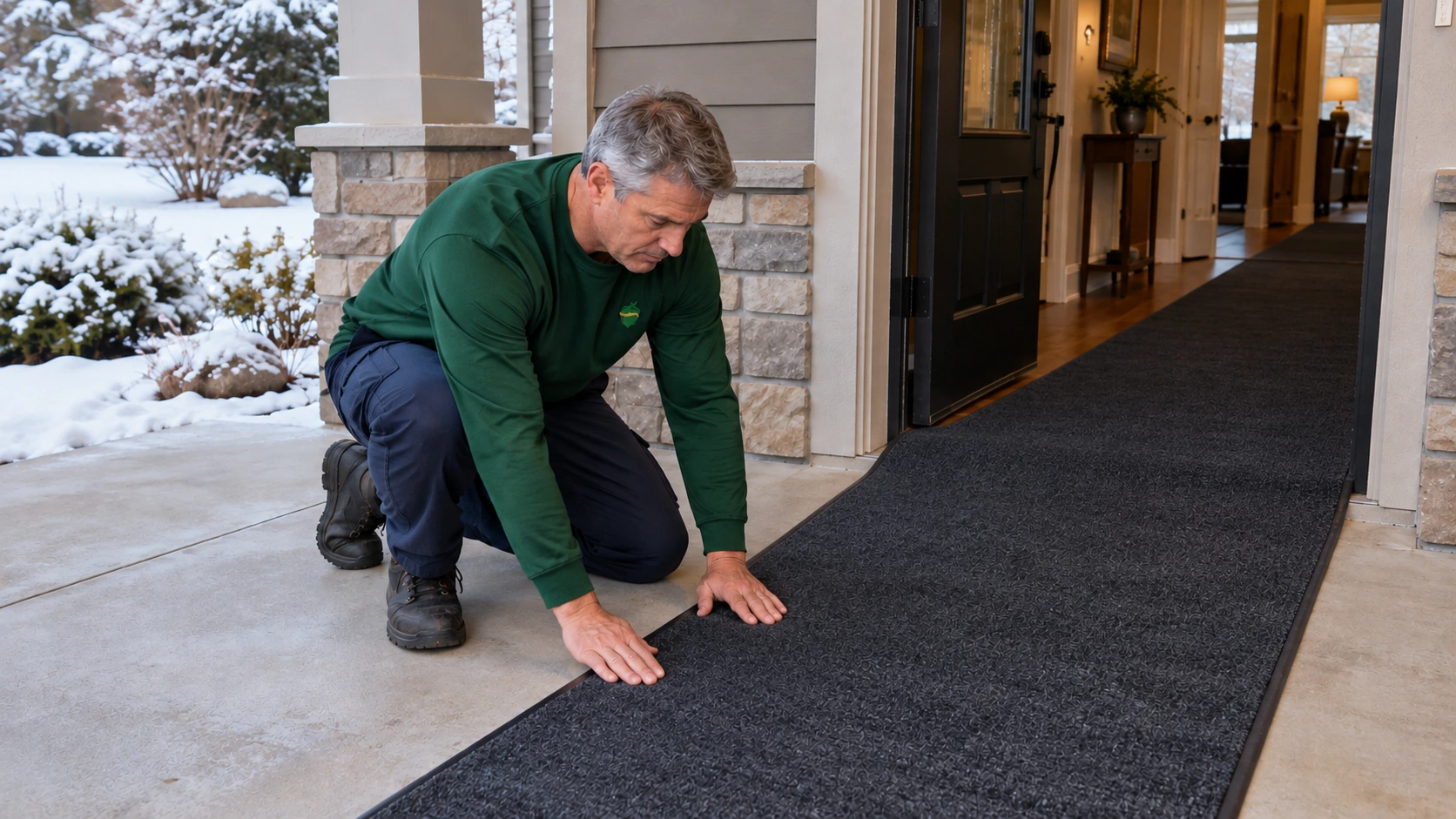
Male worker flattens a continuous dark protective runner across a covered entry threshold.
Flatten the runner before receiving work and keep the cleared entrance dry. Representative illustration.

13 /

Separate building permission from permission to use the street

The manager can approve the building’s receiving arrangement; that approval does not reserve public curb space. DOTI’s moving-truck guidance distinguishes the public-space process from an ordinary permitted parking position. Give the planner the actual street, metered status, proposed vehicle position and any use of sidewalk or traffic space.

For unmetered street occupancy, use the City’s Street Occupancy and E-Permits route. Prepare the occupancy worksheet and required traffic-control material. The Street Occupancy Request Worksheet gives minimum review time of five full business days for residential streets and ten for collector or arterial streets, excluding the submission day. These are review minimums, not guaranteed approvals.

Metered positions use the separate meter-bagging procedure. With more than 72 business hours, the instructions encourage the online route; with less time, use the stated form-and-email process. A late request does not guarantee same-day permission. A red bag prohibits all parking, including loading; a yellow bag identifies the authorized permittee’s arrangement.

For a residential no-parking arrangement, follow the conditions of the approved traffic-control plan, including its advance-sign requirements. The 24-hour posting provision is not permission to invent and post your own signs. Keep the actual approval, dates and location in the move file.

Choose an authorized alternative before dispatch if the intended position cannot be secured. Have the responsible property contact and move planner assess its carrying route, timing and any cost change. Do not solve a failed curb request by blocking a sidewalk or assuming a building employee can waive City restrictions.

14 /

Trace every door, turn and level before reserving the window

Walk from the approved loading position through the receiving door, corridor, lift or stairs and into the final room. Record clear widths and heights, lift-door and cabin dimensions, stair turns, intermediate landings and internal level changes. Include the route from a garage and any door that only a manager can unlock. A service lift does not remove the need to inspect a townhouse’s or apartment’s internal stair.

Give management the proposed date, arrival range and access arrangement. Obtain its move-in hours, lift reservation, protection requirements, required insurance documents and any agreed charges. Identify who supplies each document and who confirms acceptance. A request sent to the manager is still an unresolved reservation until the receiving arrangement is accepted.

Compare the retained furniture with the narrowest useful part of that route. Identify pieces needing agreed preparation or another feasible method before packing around an assumption. Do not infer fit from room area, a listing photograph or a broad lobby. Keep personal documents, medication and essential records with the household rather than in the shipment.

Send the actual access information to the move planner with the inventory. The Denver service page’s access section explains the company’s planning scope. Changes to inventory, carrying distance, stairs or the accepted receiving window belong in the updated written plan.

15 /

Make the arrival sequence and the fallback executable

Turn the chosen address into a receiving plan
WhenHousehold actionEvidence to keep
Before dispatchEstablish possession, essential services, legal loading position, building route and receiving window.Accepted confirmations, responsible contacts and access notes.
At the decision deadlineIf a key condition is unresolved, the household decision-maker, property contact and move planner choose the accepted alternative.Who authorizes it, usable time, people’s accommodation and the goods arrangement.
On arrivalOpen and inspect the route, identify rooms and protect access to essentials.Receiving contact, condition notes and unresolved items.
After the first nightComplete accounts, collection, school attendance and the ordinary weekly routine.Appointments, confirmations and the address-specific calendar.

If keys, the lift or essential utilities are delayed, decide before dispatch or before losing a usable alternative window. Set that decision time in advance. The authorized household decision-maker, property contact and move planner can agree a later receiving slot, an authorized alternative address or reserved storage. Establish who can accept the goods and whether the chosen resource actually has space and access for them.

Keep the people’s plan alongside the goods plan: accommodation, medication, school or work needs, documents and a first-night bag. Agree the changed transport, handling, storage or accommodation charges with the responsible provider, and notify anyone whose appointment is affected. A storage phone number is not a reservation. Resume when possession, essential services, the loading position and the receiving window are confirmed.

For a driver becoming a Colorado resident, Colorado DMV’s new-resident instructions set a 30-day license and 90-day vehicle-registration requirement after residency is established. They identify residency through operating a business, employment or 90 consecutive days in the state, with specific exceptions. Use the current eligibility and appointment instructions; do not treat an educational stay or a general visit as automatically having the same status. Put the applicable deadline in the household calendar.

16 /

Questions before you arrive

How do I know whether Denver City rules apply to my address?

Establish the actual municipality, then the school and service arrangements for the complete address. This guide covers the City and County of Denver; a Denver postal label or metro-wide listing can describe somewhere outside it. The orientation map helps distinguish city geography, while the property and responsible agencies establish the address-specific process.

Where should I begin comparing homes?

Begin with Downtown and Union Station for a routine centered on central connections; compare Capitol Hill and Cheesman Park for a central and park-oriented alternative, Highland and Jefferson Park for a west-of-river setting, the Washington Park group for regular park time, Cherry Creek for its shopping-and-services context, and Central Park for its northeastern setting. Test each actual address against the same work, groceries, care and evening journeys; these are starting points rather than rankings.

Can I live in Denver without a car?

Yes, when your home puts regular shopping, activities and a useful transit connection into a workable routine. Downtown and Union Station are sensible starting comparisons, and some Capitol Hill addresses can fit well. Test groceries with bags, care, an evening return and weekend travel. Scattered metro-wide commitments may require substantial paid rides or a car; proximity to one station alone does not solve the whole week.

Can I reach the mountains if I do not have a driver’s license?

Yes, selected mountain-town trips can use Bustang’s West Line from Union Station to hubs including Frisco Transit Center and Vail Transportation Center. Choose the operating date, onward journey and return before committing. A town stop is not a service to every trailhead. Someone without a license needs a verified connection, walking route or accepted ride for the last leg; a rental car is not their fallback.

Is RTD’s $10 airport product a one-way fare?

The $10 Airport Day Pass is a day product that includes airport service and the RTD network. The standard $5.50 Day Pass excludes airport travel. A standard $88 Monthly Pass includes airport service and covers a calendar month. Choose the current product for your actual dates and journeys; any eligibility-based fare has its own conditions.

What should I compare besides the advertised housing payment?

Compare required building or association charges, utilities, waste, insurance, parking, maintenance and the transport your weekly routine needs. Keep deposits and setup costs in a separate initial-cash total. Use current written terms for the actual home. The three dated sale listings in this guide illustrate different housing forms and asking prices; they do not establish a typical Denver rent or purchase budget.

How do I enroll a child after moving during 2026–27?

Use the exact home address in DPS SchoolFinder. For the boundary-school result, contact that school directly with address and immunization records; grades 9–12 also need transcripts. If the result identifies an enrollment zone, or you seek a non-boundary choice, use the SchoolChoice application route. Establish accepted placement and the first attendance date before relying on the school or care schedule.

Does an enrollment-zone address guarantee my preferred school?

No. For current-year 2026–27 enrollment, Denver-resident K–12 students are guaranteed a boundary-school place or one place within their enrollment zone, rather than their preferred zone school. ECE and out-of-district students do not have the same space guarantee. Use the address result and the SchoolChoice team to establish the actual next step.

How do I arrange the water handover?

Private buyers, sellers, landlords and tenants use Denver Water’s phone route at 303-893-2444, Monday–Friday, 7:30 a.m.–5:30 p.m. Have the service and billing addresses, phone number and start or end date ready. Title companies use a separate online sale process; its up-to-two-business-day response is not a general activation promise for every household. First establish whether your unit’s water is individually billed or included.

Do keys automatically start electricity and gas in my name?

No. For a property using Xcel Energy, select its Colorado start, transfer or stop route for the responsible account holder. If electricity or gas is physically turned off, its start instructions direct you to 800-895-4999. Retain the accepted request and any access appointment, and establish the actual activation before relying on the home for arrival.

How often does Denver collect trash, recycling and bulky items?

For City-serviced addresses, trash and compost are weekly, recycling is every other week and large-item collection runs on a nine-week cycle. Use the exact address’s calendar and the property’s containers. A managed building may have a private arrangement. Keep City waste billing and its transfer process separate from Denver Water, and leave the old property’s carts there when you move.

Can I leave an unwanted mattress outside on move-out day?

Only if that is the address’s scheduled large-item day and the mattress meets the City’s preparation and placement instructions. Bag or wrap it, place it by 6 a.m. on the scheduled day and keep two feet of clearance. The cycle is every nine weeks, with a five-large-item and ten-bag limit. If the date misses your lease end, arrange an accepted donation or appropriate private collection before you lose access.

Can old appliances go in the regular bulky pile?

No. Appliances are excluded from the ordinary large-item route. Denver describes a separate free appliance appointment through 311 for residents served by Solid Waste Management. Establish eligibility, the accepted appointment and placement before releasing the item; a building’s private service arrangement may require a different provider.

Does my building’s move-in approval reserve the street?

No. Management approves the building arrangement; DOTI controls the relevant public-space process. Establish whether the position is metered, needs street occupancy or is an otherwise legal parking location. Use the meter procedure or the Street Occupancy/E-Permits route that applies, obtain the actual approval and retain its conditions. Do not use a blocked sidewalk as a fallback.

How much time should I allow for a Denver street-occupancy request?

The City worksheet gives minimum review time of five full business days for residential streets and ten for collector or arterial streets, excluding the submission day. Meter bagging has its own process, including a different route below 72 business hours. These are planning and review conditions, not guaranteed approval. Set an earlier household decision deadline so an authorized alternative remains usable.

What should I measure before moving into a shared building or townhouse?

Trace the complete loading-to-room route: receiving door, corridors, lift door and cabin, stairs, landings, internal turns and final room. Compare the retained furniture with the narrowest parts and record who unlocks each controlled door. Obtain accepted receiving hours, lift reservation, protection and document requirements; a broad lobby or large room area does not establish that the whole route works.

Who should clear a snowy entrance?

Assign the responsible tenant, owner or manager before arrival and have that person confirm a usable route. Denver’s initial rule requires residential sidewalks cleared by the next day after a storm, while businesses must begin immediately after snowfall ends. The legal clock is separate from the practical decision to carry safely: do not begin across ice because the deadline has not yet elapsed.

What if possession, the lift or essential utilities are delayed?

At the agreed decision deadline, the household decision-maker, property contact and move planner choose an accepted later window, authorized receiving address or reserved storage. Confirm space and access for the goods, people’s accommodation, charges and notifications. A telephone number is not a booking. Resume after possession, essential services, loading access and the receiving window are confirmed.

Your next step

Bring the plan together

Use the chosen address, retained belongings and accepted receiving arrangement to prepare the move. The Denver moving page explains interstate service and the estimate process.

Sources & useful local resources

Official procedures and local resources are linked beside the answers above. Reopen the relevant page when arranging a date: fees, schedules and application requirements can change.

City geography

Area context

Dated housing examples

Daily transport and fares

Mountain-town travel

Current-year school enrollment

Libraries

Water account handover

Energy accounts

Household collection

Denver loading and winter access

Travel conditions and resident-driver deadlines