Maryland / City relocation guide

Moving to Gaithersburg, MD: choose the home and the week

Compare Gaithersburg homes with the errands, rail choices, school-year decisions and household arrangements that make an address work. Then bring the chosen home into an accepted arrival plan.

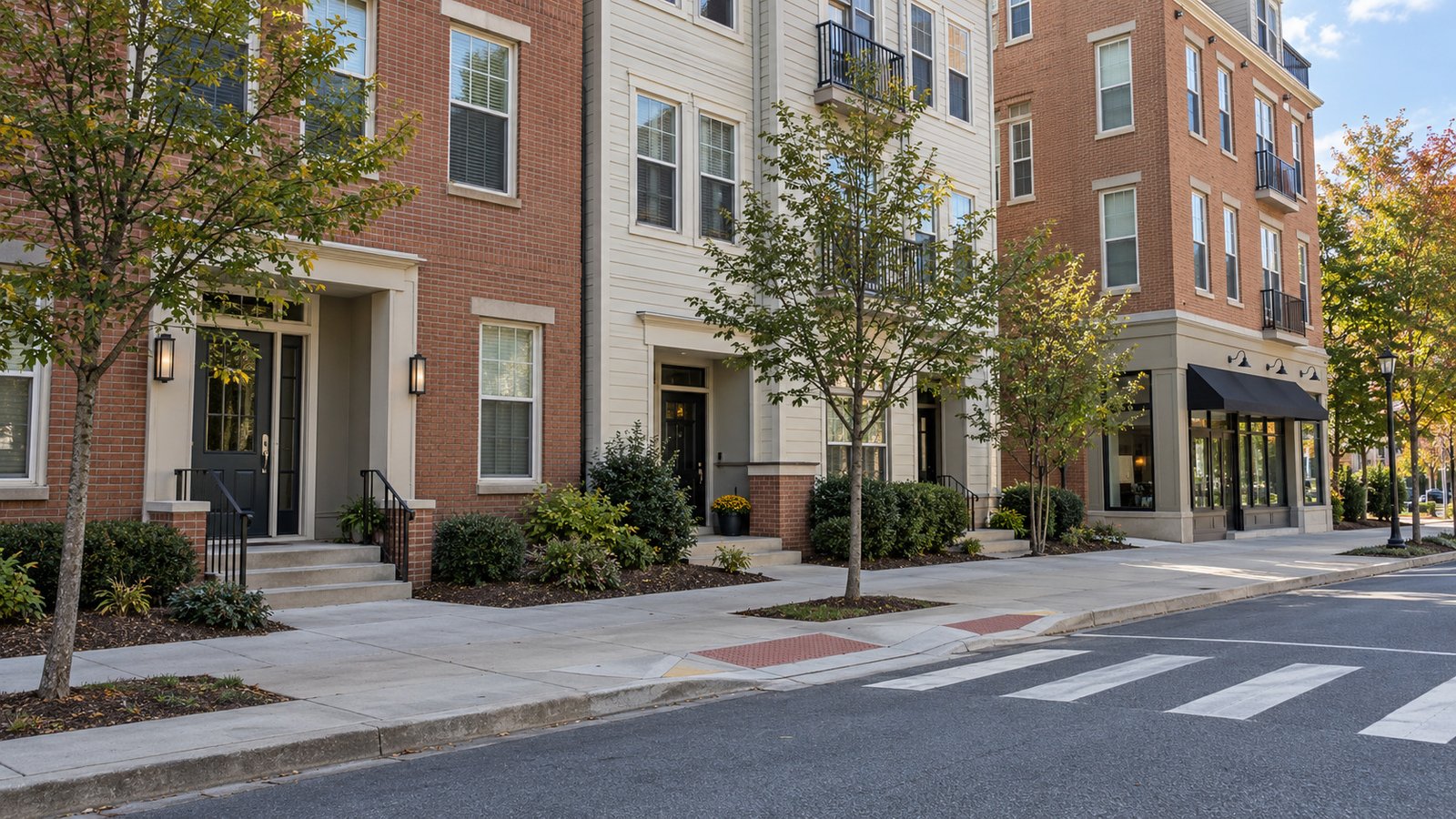
Three varied brick-and-siding residential frontages and a small shop meet a continuous sidewalk and painted crossing.
Compare the dwelling entrance and the walking connection beyond it.

01 /

Find the address that supports your week

Gaithersburg offers several different ways to arrange an ordinary week: a home near the Olde Towne rail station, the connected streets of Kentlands and Lakelands, Crown's shops and apartments, or a house in an established residential community. The useful comparison is the home together with the journeys, obligations and costs it creates.

  • Choosing a home: compare the six settings, usable rooms and the full household budget; then test the journeys you would repeat.
  • Moving with children: resolve the address, school year and registration before building the school-and-care routine.
  • Address already chosen: work through accounts, collection, accepted building access and the arrival sequence.

The area descriptions are starting points for a viewing. They do not rank residents, promise a school, establish a local office or replace the terms of a particular home.

02 /

The city, the mailing address and the map

This guide concerns the City of Gaithersburg in Montgomery County, Maryland. A Gaithersburg postal address alone does not establish that a property lies inside the city. Settle the municipality and exact unit before applying a collection arrangement, street rule or housing procedure. School attendance is a separate address-and-grade decision.

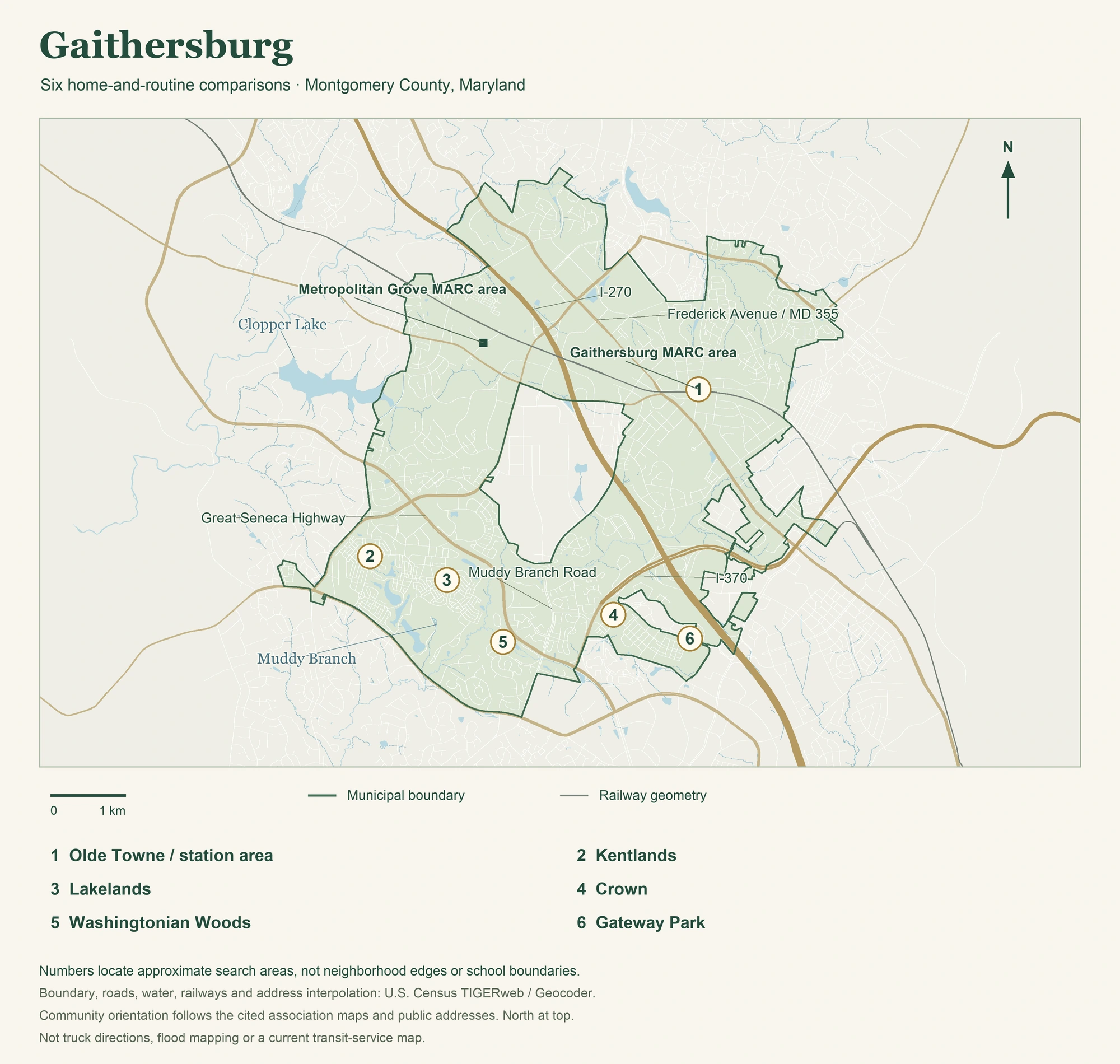
Olde Towne and the Gaithersburg MARC station provide an eastern reference point; Kentlands and Lakelands sit on the western side of the comparison. Crown, Gateway Park and Washingtonian Woods help orient the southern settings. I-270, I-370, Frederick Avenue/MD 355, Great Seneca Highway and Muddy Branch Road are useful bearings. They are not interchangeable routes for every destination or vehicle.

The map retains the Census municipal boundary and adds mapped roads, water and railway geometry. Numbered points identify approximate comparison areas, rather than their boundaries. Station-area markers help orient a search; they do not locate a surveyed boarding entrance. The map does not show school catchments, flood risk, current closures or approved truck directions.

Gaithersburg municipal boundary, six approximate home-comparison markers, roads, railways, Clopper Lake, Muddy Branch and two MARC station areas.
Use the numbered key to compare six home-and-routine settings. Search markers are approximate; the map does not show school boundaries or legal truck directions. Explore the map.

03 /

Six places to begin an address comparison

Start with the routines and property features that matter to your household. These selected areas help you compare; school assignment and building access have their own checks below.

Olde Towne and the station area

Start here when a weekday rail connection and an established center matter more than a single planned development. The station is a useful anchor, while the actual walk and home still need a viewing.

Crossings at Olde Towne: actual apartment types and location ↗
Housing & setting
This is not exclusively old houses: the Crossings at Olde Towne operator offers one-, two- and three-bedroom apartments at 200 Olde Towne Avenue. Compare an actual apartment with other offered homes; review entrances, shared corridors, storage, meters and the room you would receive.
Daily travel
Walk to the platform and to ordinary errands from the offered address. Match the actual MARC train and return with the household routine; a convenient weekday rail journey does not provide weekend service.
Before choosing
The tradeoff is the chosen central connection versus the unit’s layout, shared access and street setting. Test noise at useful hours and obtain building acceptance for the move. Do not infer affordable-program eligibility or current availability from a general description.

Kentlands: connected streets and distinct districts

Kentlands Citizens Assembly describes a mixed-use neighborhood with several districts, pocket parks and a street grid adjusted to the terrain. Compare the particular district and path to errands rather than treating the name as one uniform setting.

Kentlands Citizens Assembly: districts and neighborhood form ↗
Housing & setting
Look at the offered home’s levels, retained storage, association terms and private approach. A house near shops can still have stairs, a rear entrance or a garage arrangement that changes everyday use and delivery.
Daily travel
Test the actual food-shop walk and the connection toward the rail or Metro service you need. Internal walkability is useful for some errands; a trip across the wider area still needs a suitable service and return.
Before choosing
The tradeoff is a connected local routine versus the actual property’s space, obligations and longer journeys. Obtain current association documents and amenity eligibility; review public and private vehicle positions separately.

Lakelands: homes, paths and community facilities

Lakelands Community Association describes adjoining Kentlands, with single-family homes and townhomes on smaller lots, sidewalks, paths and community facilities. It is a separate association context to investigate for an offered home.

Lakelands Community Association: housing and everyday setting ↗
Housing & setting
Compare usable rooms, outdoor upkeep and storage with the actual association and ownership documents. Smaller lots do not by themselves establish a smaller total bill or less responsibility for the resident.
Daily travel
Walk the route to the shops, activity or path entrance you would use. Add the connection to regional travel and its return; being next to another community does not make every route or crossing equally convenient.
Before choosing
The tradeoff is a compact local pattern and shared facilities versus the home’s layout, dues and access terms. Verify whether the owner or tenant receives the relevant facility access, how it is arranged and who accepts a delivery vehicle.

Crown: shops alongside several housing choices

Use Downtown Crown’s Crown Park Avenue shopping setting as an orientation point. It is the retail destination; the surrounding home and its management need their own comparison.

Downtown Crown: retail location and individual-store context ↗
Housing & setting
The area includes operator-described apartments such as Rockwell at Crown and builder-described single-family homes. Compare the actual offering and documents rather than extending one building’s services, parking or amenities to all of Crown.
Daily travel
Test the walk between the offered entrance and daily shops, then plan the separate connection to Shady Grove or the destination beyond it. A nearby highway interchange does not predict a door-to-door commute.
Before choosing
The tradeoff is the particular shopping connection versus its cost, building rules, noise and shared approach. Establish which parking belongs to the dwelling and which belongs to retail or visitors. Do not assume an advertised home is still available.

Washingtonian Woods: an established house-and-park setting

The association documents its single-family home builders and floorplans, with Washingtonian Woods Park as a local outdoor reference. Compare a specific home and route rather than treating every nearby postal listing as the same association.

Washingtonian Woods HOA: actual builders and home floorplans ↗
Housing & setting
Look at the full floorplan, basement, garage, storage and outside responsibilities. A broad main-level room can be reached by a narrower stair or turn. Read the current property and association documents before assigning maintenance or facility rights.
Daily travel
Include the park entrance, shopping and the connection to regional travel in the same weekly test. The practical question is the complete route and return from the address, not a straight-line distance to another district.
Before choosing
The tradeoff is the chosen home’s rooms and outdoor setting versus upkeep and travel. The HOA’s historical material is not evidence that a proposed facility has opened; school lists also need the current MCPS year-and-grade check.

Gateway Park: townhomes between Crown and Rio

The association identifies Gateway Park as a townhouse community between Rio Lakefront and Crown Farm. It provides a useful comparison for someone seeking that southern shopping setting with a distinct HOA arrangement.

Gateway Park HOA: community, location and management ↗
Housing & setting
Review the townhome’s complete stair chain, garage use, storage and association documents. The offered home may connect several living levels even when the street approach is short.
Daily travel
Try the actual walk toward the errand you would repeat, including crossings and the load on the return. Put any longer journey and evening return into the same test before relying on the nearby retail setting.
Before choosing
The tradeoff is a townhome and the particular location versus levels and association obligations. Gateway Park’s own operational FAQ restricts routine resident use of visitor spaces; an apparently empty visitor bay does not become your household’s regular space or an accepted moving position.

04 /

Compare usable space and the complete bill

A detached house, townhouse and apartment can solve the same bedroom requirement in different ways. Count the rooms you can actually use, the storage you will retain and the work needed to maintain them. A basement room, balcony store or garage adds something useful only when its condition, permitted use and access fit the household.

Walk the path from the accepted entrance to every intended room. Include outside steps, vestibules, stairs and their turning landings, all lifts, shared corridors and doors. A large kitchen or living room does not make the route to it wide enough for every piece of furniture. Show an unusually large item in its protected transport size before choosing a carrying method.

Compare the same complete budget at each home
Cost or obligationWhat to obtain
Rent or ownershipThe actual lease charges or financing, property taxes and insurance; distinguish an advertised payment from the full commitment
Association and buildingDues, included work, parking and storage rights, amenity eligibility, move charges and any approval process
Household operationElectricity, existing gas, water/sewer, internet and collection responsibilities, with deposits or setup work where applicable
The whole weekTransit, accepted parking, fuel, paid rides, food deliveries and care journeys that the address actually requires
The transitionOverlap between homes, packing and transport, extra stops, an accepted receiving slot and any confirmed storage stage

Request the documents and recent bills that belong to the offered property. A sale listing, an asking rent and an automated valuation describe different things; none establishes a current citywide household budget. Compare a small set of real choices using the same categories.

For a rental, establish who handles repairs, meters, waste storage and the private approach. For an association property, obtain the current rules and account status from the owner and manager. A visitor space, clubhouse or garage shown during a viewing does not establish that your household can use it on the terms you need.

An open stocked pantry and one closed compact branded carton stand beside a clear kitchen floor and working appliances.
Compare retained storage with the room left for everyday use.

05 /

Choose the train for the destination

There are two distinct rail choices to understand. MARC's Brunswick Line is a weekday commuter service. Metrorail's Red Line at Shady Grove is a separate network, reached by the appropriate walk, bus or other connection from the home. A Gaithersburg address is not itself a Metro station.

Washington-bound MARC

The Brunswick timetable effective September 28, 2026 lists Gaithersburg and Metropolitan Grove. Most morning eastbound trains continue toward Washington Union Station; the published regular return is in the afternoon and evening. Use the train number as well as the destination. Do not assume this provides a late-night or weekend return.

MDOT's station directory places Gaithersburg at 5 S. Summit Avenue and Metropolitan Grove at 3 Metropolitan Court. The directory and timetable also identify bus connections. Compare the complete home-to-platform route, the service needed after alighting and the return. A listed station parking supply does not reserve a space for you.

The direct Baltimore option

Under the operator's new Brunswick–Camden through service, a weekday train leaves Gaithersburg at 6:41 a.m. for Baltimore Camden, arriving at 7:59 a.m.; the return leaves Camden at 5 p.m. and reaches Gaithersburg at 6:16 p.m. These trains bypass Washington Union Station. This is a specific commuter round trip, rather than an all-day Baltimore service.

Metro and the first and last leg

Shady Grove's Red Line information publishes service on weekdays and weekends, with different first and last trains. For a journey outside MARC's useful window, compare that option and the actual connection to the station. Read the direction, day and alert together; a service that runs later is only useful if you can still get home from it.

For an appointment or flight, include walking, waiting, changes and the part beyond the destination station. Check the current elevator status when the journey depends on one. Timetable arrival is not a guaranteed door-to-door arrival.

A painted crossing links two aligned curb ramps and continuous sidewalks between brick-and-siding homes.
Test the crossing and the return with the things you would carry.

06 /

Can life work without a car?

Yes, for a household whose address puts daily errands within usable walking reach and whose regular longer journeys fit the available services. Begin with Kentlands/Lakelands or the Crown shopping setting if nearby errands are the priority; begin with the Olde Towne station connection if the weekday MARC journey is central. These are different starting points, not a promise that either solves every trip.

The associations describe connected streets, sidewalks and local destinations in Kentlands and Lakelands. Downtown Crown provides another cluster of shops and services. From any proposed home, walk the actual grocery route with the amount you would carry. Include crossings, gradients, lighting, weather and returning after dark.

Test work or study, food shopping, a recurring appointment, an evening activity and a weekend visit. Add school or care trips where relevant. MARC's weekday pattern makes a convenient work trip a poor substitute for the whole test. Metro's weekend operation still leaves the home-to-station connection to solve.

For heavy shopping, compare a feasible carrying trip with delivery actually available to the address. For a late or outlying journey, arrange an accepted lift or booked ride and include its cost; availability and accessible-vehicle needs require their own confirmation. A person without a driving licence cannot rely on renting a car. A bicycle can extend some journeys when the rider, route, storage and current carriage rules fit, but a recreational path is not automatically a practical route to every destination.

If an essential regular journey lacks a dependable return, choose a better-connected address or resolve that travel arrangement before signing. That is a more useful threshold than the number of nearby routes or a single successful commute.

07 /

Register for the right address and school year

Montgomery County Public Schools assigns the home school by bona fide residence. Start with the district's enrollment process and address locator, then contact the assigned school. A nearby campus, an estate listing and an association's school list are not an admission decision.

  1. Establish the complete home address, child's grade and intended school year.
  2. Use ParentVUE online registration, or contact the school for the paper process and assistance.
  3. Provide the required identity, age, residency and health records, together with previous school records and an existing IEP where applicable.
  4. Resolve missing documents and obtain the school's confirmation and start arrangements. Keep the contact and next action visible until the application is complete.

The district's proof checklist distinguishes homeowners, renters and shared housing. It lists a current property tax bill for homeowners and a current lease for renters; an expired lease term requires the lease and a current utility bill. Shared housing uses a signed, notarized disclosure and the specified supporting records. The district has a separate process for students experiencing homelessness. Ask the school to resolve an unusual document situation.

For kindergarten in 2026–2027, MCPS states that children must be five by September 1. Registration is available online and through the school; preschool/Head Start and special programs have separate eligibility and application paths. Do not treat an ordinary school registration as a place in a separate program.

Look beyond the first school year

On March 26, 2026, the Board adopted secondary boundary and program changes beginning in fall 2027, including relocating Thomas S. Wootton High School to Crown Farm. Transition exceptions can affect particular grades and program placements. Use the Board Adopted Boundaries resources and ask MCPS about both the arrival year and the following year for the exact address and child. Older study options and a generic neighborhood school label do not settle that question.

Then put school travel, any approved bus arrangement, care hours and work commitments into one routine. Submitting the application is a step toward enrollment; it is not confirmation that every part of that routine is ready.

08 /

Build a repeatable local routine

Choose useful everyday places rather than a long sightseeing list. Put the food shop, a library visit, outdoor time and recurring appointments on the same weekly plan. Compare the home-to-door journey and the return at the hours the household needs.

Washingtonian Woods Park offers a neighborhood-scale example: the association identifies its entrance at 341 Upshire Circle and describes walking trails, courts, a field, lake and playground. A park near one comparison area is not automatically a short walk from another. Check the entrance and facilities that matter to your household.

For a larger outing, Seneca Creek State Park lists its Clopper Road address at 11950 Clopper Road. The park offers trails and the Clopper Lake day-use setting. Its current page reports the Black Rock parking closure and temporary closure of the Recycled Tire Playground, with other small play areas available. Do not build an outing around a feature assumed to be open. Swimming and wading are not permitted in Clopper Lake.

A library or activity can make an address more useful even when it lies outside the municipal boundary. Select the branch or venue first, then use its current hours and registration requirements for the day. School, association and public facilities have different membership or booking arrangements; a nearby building does not establish eligibility.

Make one ordinary-week trial before committing: obtain food, reach the recurring activity and get home at the planned time. A weekend trial may expose a connection that a weekday commute misses.

A continuous paved park path curves beside open lawn and trees,with a complete bench on a separate paved pad.
Include a usable outdoor route in the ordinary weekly routine.

09 /

Separate accounts from physical service

Begin with the lease or closing documents and the meters serving the exact unit. Identify the account holder, charges included with the home, responsibility start date and any work requiring access. Water running during a viewing does not establish your future billing or activation arrangement.

WSSC Water assigns accounts to property owners; tenants can receive secondary bills. Moving between properties requires both start and stop requests. The online procedure accepts requests up to ten days before the move and separately describes processing timing. Keep the confirmation and follow up through it, rather than submitting duplicates. If water is off, state that in the request and contact WSSC about its additional restoration requirements; a billing request is not a guaranteed physical turn-on appointment. Customer service is 301-206-4001.

Make each household connection an accepted arrangement
ConnectionBefore arrival
Electricity and existing gasUse the actual property's utility bill or manager's record to identify the distributor and services present. Obtain the accepted start date and any appointment; choosing an energy supplier is a different decision.
Water and sewerSettle the owner/tenant billing arrangement, both old and new property requests where needed, and whether supply is already operating.
InternetCheck serviceability for the unit, installation permission, equipment and the accepted appointment. Keep a feasible temporary connection until the service works.
Trash and recyclingIdentify each actual collection arrangement, containers, storage location, collection day and a separate route for unwanted furniture.

Gateway Park's own FAQ identifies Pepco, Washington Gas and WSSC for that community. That is a useful property-specific starting point, not a reason to assign the same electricity distributor to every Gaithersburg postal address. For Pepco properties, the start, move or stop service path separates those requests.

Keep the account numbers, accepted dates and responsible contacts in a private household file. Test the services you need for the first night before sending the entire household to a home that cannot yet receive it.

10 /

Plan everyday collection and the cleanout separately

Establish the arrangement belonging to the property before putting materials outside. The city's refuse code requires adequate storage and regular removal. For multifamily dwellings, the owner or resident manager supplies the required containers; single-family and townhouse responsibilities fall on the owner and/or occupant. The code also prohibits using another party's container without the required consent. A nearby shared bin is not an overflow solution.

Keep ordinary refuse, accepted recyclables and unwanted furniture as separate tasks. Flatten and store dry moving cartons without blocking the doorway or shared corridor, then use the applicable recycling instructions. Ask the building or association about its actual containers and collection service; household recycling and bulky disposal need not use the same booking.

Gateway Park provides a concrete local example. Its current operational FAQ lists Tuesday/Friday trash and Wednesday city recycling. It provides one prearranged bulk pickup per household per year through TRIPLE-R at 301-990-3533, with renovation/construction debris excluded. Those are Gateway Park's terms. They do not grant the same allowance to another community or authorize an unbooked sofa at the curb.

For a cleanout, send the actual item list, quantity and address to the responsible service before choosing a collection date. Obtain acceptance, placement instructions and any charge. If it cannot receive the material in time, arrange a suitable accepted private service or keep the items in an authorized place until collection. Keep the people, shipment and waste routes distinct on moving day.

11 /

A household parking space is not a moving reservation

Separate public roadway restrictions from the rights granted by the property or association. Gateway Park, for example, limits visitor spaces to visitors rather than routine resident parking. A resident's right to park a car also does not establish that a large moving vehicle can use the same space.

Gaithersburg Code §14-10 restricts commercial-vehicle parking on public roadways, with exceptions for actual loading/unloading or an operator actively working at a property within reasonable distance. This is a limited active-work exception. It does not reserve the curb, remove other restrictions or establish private-property permission.

  1. Identify the actual municipality, road or private property owner and proposed working position.
  2. Describe the vehicle, date, duration and carrying route to the party authorized to approve it.
  3. Obtain the applicable authorization, current fee or timing instructions and any required signs or booking before treating the position as available.
  4. Keep a confirmed alternative and the decision deadline if the first position cannot be used.

Do not use cones, a resident permit or an informal car arrangement as a substitute for the required acceptance. If a street arrangement remains unresolved close to the date, move the decision back to the planning contact before dispatch rather than assuming the crew can settle it on arrival.

12 /

Make the entire receiving route usable

An accepted entrance is only the start. Trace the vehicle position, private path, outside steps, threshold, every stair and turning landing, all lifts and transfers, shared corridor and final room. Compare the dimensions with the protected item, including hands and turning clearance. Obtain permission before selecting a different entrance.

For a managed building, identify the person who accepts the moving slot and any COI, protection, deposit or labor-access requirement. Ask whether lifts are shared, what happens if another booking runs late and when work must finish. A submitted request is not an accepted booking, and one lift reservation does not automatically include another lift or street space.

When the carrying window is short, arrange materials and allowed preparation beforehand. Keep the actual carry inside the accepted period. Decide which large pieces need basic disassembly, special preparation or a different reviewed method before the slot starts. A shorter slot does not make an unreviewed oversized item fit.

Leave people, pets and an ordinary route through the home outside the working area. Keep keys, medicines, essential documents, chargers and the first night's necessities with the household. The room plan should let the receiving person direct placement without blocking access to the next room.

13 /

Prepare the approach and agree the fallback

Before a wet, hot or freezing moving day, review the whole private approach as well as the road journey. The owner, occupant or manager should identify who will clear leaves, water, snow or ice and when the route will be checked. Arrange the work before the crew needs the route; do not assume that a transport booking includes property clearance.

In warm weather, keep drinking water, needed medicines and a place for people and pets outside the work path. During rain, protect the planned indoor route without creating loose edges or blocked doors. A route that looked suitable in dry daylight may need another accepted arrangement when wet or dark.

A fallback that can actually be used
DecisionAgree before the alternative is lost
Trigger and deadlineKeys are not released, the booked lift fails, the working position is refused or weather makes the approach unusable. Set a decision time before dispatch or before the reserved alternative expires.
Authority and resourceName the customer representative and planning contact; obtain an accepted later slot, another approved route, a separate stage or actually available storage.
People, things and costConfirm where people and pets stay, which essentials remain with them, what happens to the shipment and the agreed extra work, waiting or storage charges.
RestartResume after keys, a receiving person, the route and required bookings are confirmed; send the revised plan to everyone who will use it.

A storage contact is not a reservation. A building that agrees to discuss another slot has not accepted it yet. Record the confirmed option and its deadline in the same file as the primary plan.

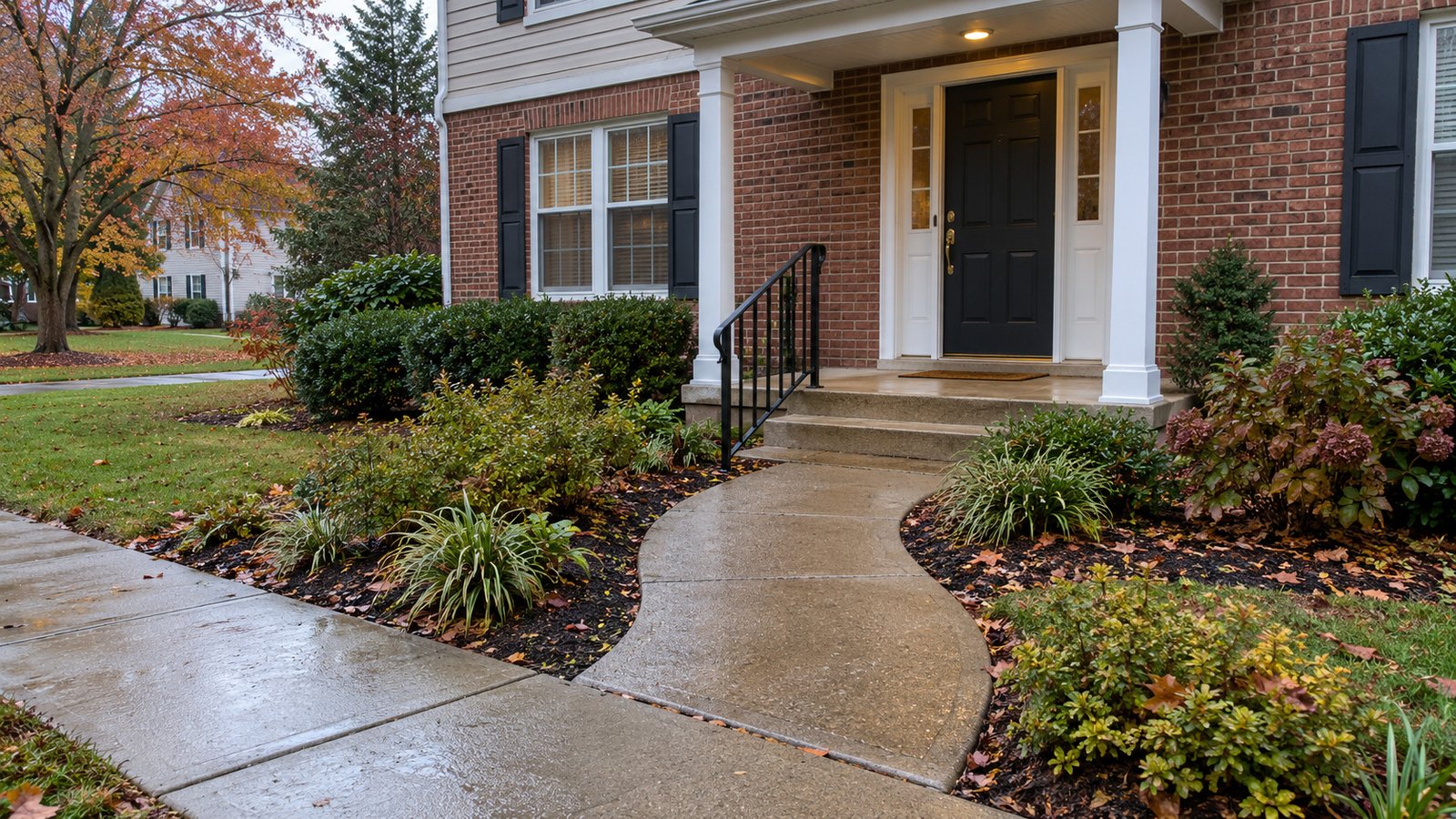
A clear curved private path and shallow steps lead from a wet public sidewalk to a sheltered brick-house landing.
Review the approach again when weather changes the surface.

14 /

Put the final decisions in order

  1. Before choosing the home: compare the municipality, usable layout, full costs and five ordinary journeys. For children, include both the arrival school year and the next one.
  2. Once the address is accepted: begin school and household service processes; identify the owner or manager, collection arrangements and receiving responsibilities.
  3. Before confirming the move plan: provide the inventory, both addresses, every carrying transition, chosen preparation and date constraints. Obtain accepted working positions and building slots.
  4. Before dispatch: check keys, service availability, the receiving person, current access conditions and the fallback decision deadline. Keep the essentials with the household.
  5. At arrival: open the agreed route, direct the first rooms, keep shared access clear and separate cartons from waste. Follow up on outstanding school, utility or collection confirmations.

For help with the shipment, the Gaithersburg moving-services page explains packing, preparation, transport, delivery and the estimate process. The useful starting information is the actual contents, addresses, access and result you need on arrival.

15 /

Questions before you arrive

Does a Gaithersburg mailing address establish city jurisdiction?

No. Establish the actual municipality and exact unit before using a city collection or roadway rule. The mailing area, school assignment and private association are separate checks. Use the orientation map as a starting point, then resolve the offered property with its owner or responsible authority.

Where should I begin comparing homes?

Begin with the routine you want: Olde Towne for the station connection; Kentlands and Lakelands for their connected local streets; Crown for the retail setting; Washingtonian Woods for a particular house-and-park comparison; Gateway Park for a townhome near Crown and Rio. These are starting points, not rankings. Compare actual layouts, documents, costs and the full week of journeys.

Can I live in Gaithersburg without a car?

Yes, when the chosen home supports daily errands on foot and the household’s longer journeys have usable outbound and return services. Kentlands/Lakelands and Crown are useful places to begin a local-errand comparison; Olde Towne can suit a weekday rail priority. Test groceries, appointments, evening activities and weekend visits as well as work. Resolve essential gaps with an accepted lift, booked ride or address-confirmed delivery and its cost. A rental car is not a fallback without a driving licence.

Is MARC an all-week alternative to Metro?

No. The Brunswick timetable is a Monday–Friday commuter schedule. Shady Grove is on the separate Metro Red Line, which publishes weekday and weekend operation. A practical plan includes the home-to-station connection and the return, rather than assuming that one nearby rail service covers every day.

Can I take a direct train to Baltimore?

The September 28, 2026 through service provides a weekday commuter round trip: Gaithersburg 6:41 a.m. to Baltimore Camden 7:59 a.m., returning from Camden 5 p.m. to Gaithersburg 6:16 p.m. It bypasses Washington Union Station. Use the current timetable and alerts; this is a specific pair of trains, not an all-day service.

How do I establish my child’s school?

Use the MCPS address locator with the full home address, grade and school year, then work with the assigned school through registration. For a stay spanning 2027–2028, ask about the adopted secondary boundary transition as well as the first year. A nearby campus, HOA list or property listing does not establish placement.

What residency documents should I prepare?

MCPS distinguishes a current property tax bill for homeowners, a current lease for renters and its specified disclosure/supporting-record process for shared housing. An expired lease term needs the lease and a current utility bill. Gather identity, age and required health records too. The school resolves unusual situations; students experiencing homelessness have a separate process.

When can a child start kindergarten?

For 2026–2027, MCPS states eligibility at age five by September 1. Begin through ParentVUE or the school and complete the required records and confirmation. Preschool, Head Start and special programs have separate eligibility and applications; the ordinary kindergarten process does not establish a place in them.

Will an old neighborhood school list remain valid?

Do not rely on it for a future school year. MCPS adopted secondary boundary and program changes beginning in fall 2027, including the move of Wootton High School to Crown Farm. Grade and program transition exceptions can apply. Use Board Adopted Boundaries and ask MCPS to resolve the exact address, child and year.

Does the water account transfer automatically when I move?

No. WSSC assigns accounts to property owners; tenants can receive secondary bills. A move between properties needs both start and stop requests. Keep the request confirmation and resolve whether supply is operating. If the water is off, follow WSSC’s additional restoration requirements rather than assuming that a billing request schedules turn-on.

Can unwanted furniture go out with the moving cartons?

Separate the furniture booking from accepted recycling. In Gateway Park, the HOA lists one prearranged bulk pickup per household per year through TRIPLE-R, excluding renovation/construction debris. Other properties need their own applicable arrangement. Obtain item acceptance, the date, placement and any charge before putting a sofa outside.

Can we use an empty visitor bay for the move?

Only after the authorized property or association contact accepts the actual vehicle and work. Gateway Park restricts routine resident use of visitor spaces. A car parking right, an empty bay and a limited public-road active-work exception do not reserve a truck position. Settle private acceptance and public restrictions separately.

What should a building accept before delivery?

The vehicle position and full carrying route, every lift or stair transfer, work window, protection and any COI, deposit or labor-access requirement. Identify the approving person and deadline, retain the accepted booking and receiving contact, and agree the alternative if the slot fails. A submitted request is not acceptance.

Can we swim at Clopper Lake?

No. Maryland DNR prohibits swimming and wading in Clopper Lake. Use its trail and day-use opportunities instead, and read current alerts before choosing a play area or parking entrance. A lake shown on an orientation map is not permission for swimming.

What does the guide map establish?

It locates the municipality, mapped roads, water, railways and approximate comparison areas. Use it to orient an address search, then inspect actual journeys and documents. It does not draw neighborhood or school boundaries, show flood risk, promise current transport operation or authorize a truck route.

What if keys or the receiving route are not ready?

Use the decision deadline agreed before dispatch or before a reserved alternative expires. The authorized customer representative and planning contact choose a confirmed later slot, another approved route, a separate stage or actually available storage. Agree extra work and cost, where people stay and which essentials remain with them. Resume after keys, a receiving person and required access are confirmed.

Your next step

Bring the plan together

Connect the chosen home, household arrangements and accepted receiving route. Explore packing, transport, delivery and the estimate process for your Gaithersburg move.

Sources & useful local resources

Official procedures and local resources are linked beside the answers above. Reopen the relevant page when arranging a date: fees, schedules and application requirements can change.

Places and housing

Transport

Schools

Home services and local responsibilities

Everyday outdoor places

Plan your Gaithersburg move

Review direct and consolidated delivery, pickup access and receiving dates before choosing your moving plan.

  • Long-distance moving

    Direct and consolidated household moving from Gaithersburg, Maryland, throughout the United States and Canada.

  • Full packing and unpacking

    Full or selected Gaithersburg packing, with a usable final night, separate home/storage groups, priority unpacking and an agreed material handoff.