Massachusetts / City relocation guide

Moving to Hyannis

Hyannis combines a downtown Main Street, a working harbor and residential areas within the Town of Barnstable. Compare the actual home with the trips and services you will use, then settle enrollment, utility handoff, disposal and the receiving route before moving day.

View through an open bookshop door toward a brick sidewalk, a pedestrian and small shops.
Walk the final approach from the street to the entrance you will use.

01 /

Make the home work for your ordinary week

Begin with the decisions that would change whether a property works for you. Establish the lease or closing terms, the rooms and storage you actually need, and the way you will reach work, school, care and groceries. A weekend visit to the waterfront tests a different routine from a weekday departure in rain.

Keep a short address file: the full street and unit, owner or manager, possession date, utilities included in the agreement, parking entitlement and school-registration contact. Separate what is promised in writing from something still to be checked. A reserved apartment parking space may not accommodate a commercial moving vehicle.

Walk the candidate home's entrance and the route to the largest room with its largest furniture in mind. Record the narrowest opening, stair turn, threshold and outdoor surface. If you will need a different entrance, ask who can authorize it and whether it remains available throughout the receiving window.

Use this guide in three passes. First compare the areas and daily trips. Next complete the school, service and disposal arrangements. Finally bring the lawful vehicle position and building handoff together in the arrival plan. The Hyannis moving estimate page helps turn the inventory and access information into a defined scope.

02 /

Hyannis, Barnstable and the names on an address

Hyannis is a village of the Town of Barnstable, not a separate municipality with its own town service departments. The Barnstable County Registry village directory also lists Hyannis Port and West Hyannis Port as address names within Barnstable. Use the actual property location when deciding which municipality, road owner, utility or school process applies.

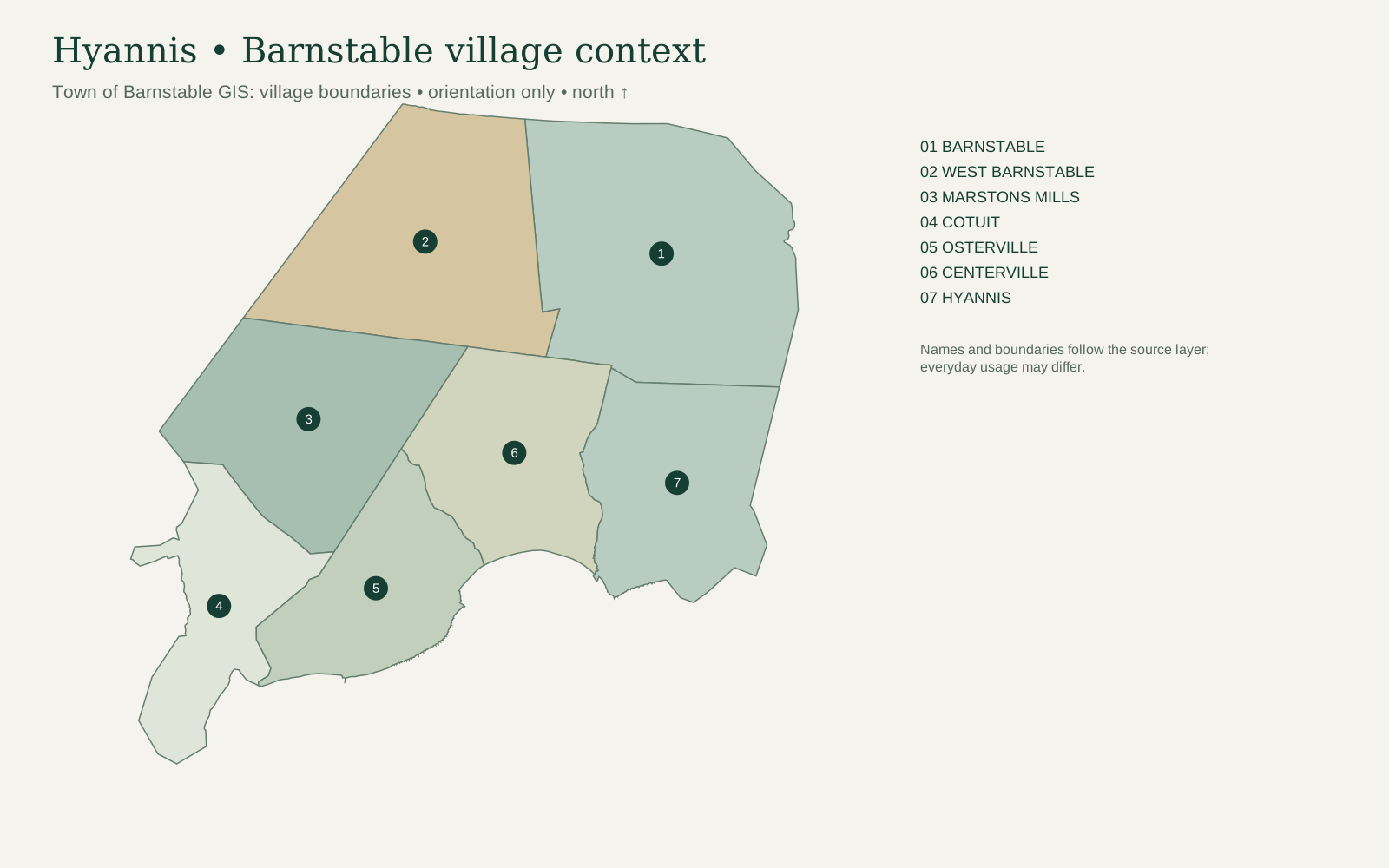
The map below redraws the Town GIS village polygons. Its seven names are Barnstable, West Barnstable, Marstons Mills, Cotuit, Osterville, Centerville and Hyannis. Hyannis is number seven. These are Town-wide context areas; the other six are not neighborhoods inside Hyannis.

The six comparisons farther down this guide describe smaller parts of Hyannis. Historic districts, commercial corridors and waterfront planning areas have different purposes and can overlap. Their names are useful for comparing setting and access, but a boundary on this map is not a school assignment, flood determination, property survey or approved moving route.

A postal or listing label can hide a practical distinction. Check the municipality and unit on the agreement, the location of the actual entrance, and whether the last part of the route is public or private. Give providers the full address rather than just a village name. For an edge-of-area property, resolve jurisdiction before adopting a neighboring town's procedures.

Town of Barnstable GIS village map with seven numbered areas; Hyannis is number seven at the eastern end
Official Town GIS village boundaries provide context for Hyannis. The six smaller area comparisons are separate; this is not a parcel, school, flood or truck-route map. Open full-size map.

03 /

Find the area that fits your routine

These six comparisons use distinct primary records for parts of Hyannis. Some describe historic fabric or planning-study conditions; inspect current buildings, availability and routes separately. The seven village polygons on the Town-wide map are a different layer.

Main Street core

Downtown design standards describe overlapping growth and historic-review areas with a concentrated mix of residential and commercial uses. The street-facing setting differs from a detached-house block.

Downtown Hyannis unified design standards, November 2024 ↗
Housing & setting
For a home above or behind commercial space, confirm the unit entrance, stair, sound exposure and private storage.
Daily travel
Test the walk to the actual Crosstown stop and the return at your usual time.
Before choosing
Separate customer parking from a household space and ask how a delivery reaches the residential door.

Pleasant and School Streets, north of South Street

The National Register nomination describes a compact group of nineteenth-century Greek Revival cottages on parallel streets between Main and South, linked to the maritime history of Hyannis.

Pleasant/School Street Historic District nomination, description ↗
Housing & setting
Look at the current cottage layout, ceiling heights, additions and stair turns; the historic record is not a condition survey.
Daily travel
Walk the real connection to downtown and the harbor, including the crossings on the route.
Before choosing
Verify the parcel, entrance and legal parking. The historic district is different from a school-attendance boundary.

Hyannis Port historic area

The historic nomination describes a coastal resort-era district of wood-frame houses on small lots, an irregular curved street pattern and many late-nineteenth- and early-twentieth-century buildings.

Hyannis Port Historic District nomination, description ↗
Housing & setting
Compare the actual year-round living arrangement, storage and access; historic summer-resort origins do not determine a present lease.
Daily travel
Test the trip from this specific address to groceries, work and transit instead of using a downtown distance.
Before choosing
Check the driveway turn, private-road obligations and weather-sensitive lower entrances. No protected view or waterfront access is implied.

Ocean Street and the inner harbor

The Town’s 2024 harbor report describes ferry, fishing, park, restaurant and parking uses along the western edge of the inner harbor. It is a working waterfront with both public and private land.

Hyannis Harbor: existing land uses and design recommendations, 2024 ↗
Housing & setting
For nearby housing, establish the actual residential entrance, lease term, outdoor space and service responsibilities.
Daily travel
Inspect the route through waterfront activity to Main Street and your daily destinations.
Before choosing
Distinguish public walking access from private lots and marinas; check the exact parcel and current flood information.

West Main Street corridor

The Cape Cod Commission’s 2021 audit describes the link between Route 28 and downtown as a mixture of residential and commercial uses, with schools and other destinations near the West End.

West End Rotary road audit: West Main corridor, October 2021 ↗
Housing & setting
Compare a house or apartment’s setback, driveway and usable indoor space with the activity at its own frontage.
Daily travel
Use the current Crosstown timetable and inspect the actual crossing; the older audit is not a current traffic-control diagram.
Before choosing
Check the driveway sight line and proposed truck position. Do not assume that an audit recommendation has been implemented.

Camp Street and Yarmouth Road residential context

The Commission’s 2020 design review identifies nineteenth-century residential neighborhoods along Camp Street and Yarmouth Road among the downtown character areas. Its proposed design changes are distinct from observed historic form.

Downtown neighborhood character and proposed design changes, 2020 ↗
Housing & setting
Inspect the present dwelling, any conversion or outbuilding and the space included in the agreement.
Daily travel
Test the route from the exact home to downtown destinations and the intended boarding point.
Before choosing
Confirm municipal and parcel boundaries, current permitted use and the complete carrying path. Proposed accessory housing is not proof of an available unit.

04 /

Compare the dwelling, the agreement and the usable space

The available ACS 2024 five-year estimates here describe all of Barnstable Town, not Hyannis alone. They report about 75.7% owner occupancy and 24.3% renter occupancy among occupied homes, median gross rent of $1,917 and median owner-occupied value of $602,500. These are survey estimates covering 2020–2024, not September 2026 listings or quotes for a particular home.

In the same Town-wide data, about 80.9% of housing units are detached one-unit homes and 10.1% were built before 1940. The structure and age figures use all housing units, while tenure uses occupied units. Do not use them to predict the mix on a Hyannis street, the condition of a building or a property's availability.

For a rental, confirm the actual term, renewal provisions, occupancy date, included services and responsibility for snow, landscaping and refuse. A furnished or short-term offering may not meet a year-round household's needs. Ask what remains in the unit and whether any existing furniture must be moved by the owner before your delivery.

For a purchase, coordinate possession and key release separately from the moving arrival. Record the heating fuel, water supplier, sewer or other wastewater arrangement and any private-road or shared-driveway responsibilities. A service described as available nearby is not proof of a connection at the house.

Inspect the spaces that affect everyday use: bedroom circulation, storage, laundry access, electrical outlets, ventilation and the route from the car or sidewalk. In an older cottage, low ceilings or an upstairs turn can limit furniture even when the room dimensions look adequate. In a converted building, check the unit entrance and any shared stair instead of relying on the street-facing door.

Historic character is an orientation aid, not a report on present condition. If the home needs exterior alterations to solve an access problem, the downtown design standards identify separate review jurisdictions. Ask the owner and Town about the actual proposal before assuming a railing, opening or exterior element can be changed for moving day.

An open Sterling Oakbridge wardrobe carton stands on the floor beside a bed and an open clothes closet.
Place a wardrobe carton outside the closet so hanging clothes and the route through the bedroom remain accessible.

05 /

Test the full trip, including the return

The Hyannis Crosstown links the transportation center, Main and West Main Streets, household destinations and shopping areas. Its September 8, 2026–January 22, 2027 timetable is Monday through Saturday and identifies on-request destinations and school-day exceptions. Read the row and footnote for your stop; the existence of a route does not establish Sunday service or a late return.

The Barnstable Villager connects downtown Hyannis with the Barnstable Courthouse via Routes 132 and 6A. For either service, include the walk to the boarding point, crossings, waiting and the last leg after leaving the bus. A shopping center's road frontage may be some distance from its usable pedestrian entrance.

CCRTA's current fare page lists its fixed routes as fare-free. That does not make every CCRTA product free. DART and SmartDART have separate fares and booking rules. Budget and plan against the actual service you intend to use, and recheck rates before travel.

Current access notice: beginning September 8, 2026, work at Hyannis Transportation Center closes a segment of Transportation Avenue from Main Street/Center Street to CCRTA's west lot. CCRTA directs customers to on-site signs. This is a construction access change, not a statement that the transportation center or all buses are closed. Allow for the current approach when planning a connection.

Booked and accessible alternatives

DART is a general-public door-to-door service by appointment. Tuesday–Saturday reservations must be made by noon the previous day; Sunday and Monday requests, and Tuesday when Monday is a holiday, are due by 5 p.m. on Friday. Same-day changes and reservations are not permitted. Call 800-352-7155 with exact addresses, the required arrival time and the return trip; Sunday availability is limited and operating times vary.

DART's listed fare is $3 for adults and youth, or $1.50 for seniors and people with disabilities. Follow the operator's eligibility and payment instructions. The driver can assist to the first-floor outside door while remaining within sight of the vehicle, but cannot enter the home or negotiate steps with a mobility device. A door-to-door label does not remove the need for an accessible approach.

SmartDART is an on-demand service with a Barnstable/Yarmouth zone. The published Barnstable hours are Monday–Saturday, 7:30 a.m.–6 p.m., excluding listed holidays. Other Cape towns and zones have different boundaries and hours; “Cape-wide” does not mean one unrestricted ride across the whole Cape. The page provides app booking and SmartACCESS telephone help at 508-418-3278.

ADA paratransit is a separate shared-ride service within three-quarters of a mile of fixed routes for eligible riders. Complete the eligibility application before treating it as an available daily arrangement. Its reservation instructions call for at least one day ahead, a confirmed return if needed and allowance for a pickup window. Explain the real entrance and assistance needed to the operator.

The Hyannis Trolley is described as a Memorial Day–Labor Day service. Do not build a September or winter routine around the summer trolley. Test the current year-round option and a fallback for the actual day and time you need.

White and blue shuttle bus beside a town sidewalk, with passengers and bicycles nearby.
Check the current route, boarding point and return trip for everyday journeys.

06 /

Complete registration, placement and the travel arrangement

Start with Barnstable Public Schools Student Registration. A full-time Town address matters; the village name by itself does not select an elementary school. Ask the Family & Community Engagement Center to confirm the school for the precise street, house number and unit before arranging a school-dependent lease or commute.

The district links an attendance-area street list dated March 16, 2026. Its address ranges and school-name columns are printed in separate groups of pages, so a single extracted page can be misleading. Use the complete document as a reference and obtain the district's address-specific placement confirmation. Charter, private, resident-choice and nonresident-choice routes are separate from ordinary home-school assignment.

Registration steps

  1. Gather the records. Prepare the registering adult's photo ID, the child's age record, recent residence evidence, previous school records and applicable health, custody or education-plan documents.
  2. Submit online pre-registration through the district's Aspen link. Pre-registration is not completed enrollment. Keep the confirmation and resolve any incomplete item with the center.
  3. Book the in-person appointment. The page directs families to the Family & Community Engagement Center at the Hyannis Youth & Community Center, 141 Bassett Lane, and asks that appointments be booked at least 24 hours ahead.
  4. Confirm the outcome. Obtain the assigned school, start date, any remaining records and the contact for your child's first day. Arrange transportation as a separate step.

The main registration contact is 508-862-4953, option 8 or extension 1845. Use the current main contact rather than an older number within the long FAQ. Ask about interpretation or assistance when booking, and check the appointment location before travelling.

The published ordinary residency path asks for two proofs with the parent's or guardian's name and address, dated within 45 days. Acceptable items include documents listed by the district such as utility, housing or official records; the exact combination matters. Its FAQ provides a new-utility service-order option for recently arrived families and an affidavit route for shared housing. Ask the registrar how those apply before assuming the absence of a first bill prevents registration.

For age, the district lists a birth or baptismal certificate or hospital birth record. It also asks for health and immunization records, a recent physical and applicable lead-test documentation for younger children, plus IEP, 504, custody or other records when relevant. Request the current checklist for the child's grade and circumstances; send private records through the district's designated process.

Bring recent report cards for grades K–8 and the requested course, grade and prior transcript records for high school. A high-school transfer can require course review as well as residence verification. Families experiencing homelessness or in foster-care circumstances have immediate-enrollment protections described on the registration page; contact the center for help rather than waiting to assemble every ordinary document.

Kindergarten, preschool and choice

The 2026–27 kindergarten panel says a child must be five on or before September 8, 2026, while the general FAQ says September 1. If the birth date falls near that boundary, ask the registrar to determine the applicable rule. This guide does not choose between the conflicting statements or determine a child's eligibility. May screening and choice dates shown on the page have already passed; a later arrival needs the current registration path.

Children already enrolled in the district's Early Childhood Education & Learning Center have a separate transition process. The ECELC admissions page says peer preschool applications for 2026–27 are closed, with a limited waitlist. Special-education evaluation is a different route from a peer opening; use the center's contact for that process rather than interpreting a closed peer application as a closed evaluation service.

Resident choice, Barnstable Community Innovation School requests and nonresident choice each have their own forms, timing and space decisions. A request is not a placement guarantee. Confirm whether a program remains open at the point you apply and how a placement would affect transport. Report a subsequent change of address through the district's stated process; a move within Town can change the assigned school.

School transportation

On the 2026–27 transportation page, all bus riders need a valid current pass. Fees apply to requested transportation for grades K–6 within two miles and for all grades 7–12. The regular first- and second-child charge is $275 each, with a $550 family maximum. The lower June 30 early-payment rate is an expired deadline, not the current price for a new September application.

Free meals under the district's CEP program do not automatically establish a transportation-fee waiver. Follow the Financial Benefit Application and information-sharing process through Food Services. Nonmandated riders are subject to seat availability and route or walk-zone rules. Confirm a usable stop and start date rather than treating payment alone as a guaranteed new route.

Passes are collected in person, not mailed. After the August pickup event, the page directs families to the Transportation Office at 835 Falmouth Road; the general line is 508-790-6478. For late applicants, changes beginning September 28 remain subject to space. Arrange an interim school trip until the district confirms the actual service.

07 /

Identify the supplier and the account handoff

Use the actual service address, unit, meter and occupancy date. Establish which bills are included, which accounts you must open and who authorizes access. A supplier name on a listing is not a completed account transfer, and a building with gas nearby may use a different heating fuel.

ServiceStarting pointBefore possession
ElectricityEversource / NSTAR Electric for Barnstable in the state utility finderConfirm the unit and start date; use the provider's account process.
Natural gas, where connectedNational Grid / Boston Gas in the state finderRequest the required visit and arrange access.
WaterActual water district or system on the property's billSeparate a property-closing final read from a tenant billing question.
Sewer or other wastewater arrangementOwner's property records and Town service contactConfirm connection and responsibility; a water account does not answer everything.

The Massachusetts DPU finder identifies the Barnstable electric and gas providers and cautions that service availability must be established for the location. Eversource start-service page requires an Eversource.com user ID for an online request. Choose the correct Town and service, then obtain confirmation of the effective date rather than assuming the online submission activates the meter immediately.

National Grid Massachusetts gas asks for five to seven days' notice to arrange a crew visit to turn service on or off. Its start, stop and transfer contact is 800-233-5325, Monday–Friday, 7 a.m.–7 p.m. Arrange the actual appointment and access with the provider; the notice interval is not a guaranteed activation date and does not establish a new gas connection.

The Town's Hyannis Water System page gives a customer contact of 508-775-0063 at 47 Old Yarmouth Road. Barnstable has multiple water suppliers, so identify the provider from the real property account. Do not route a house to Hyannis Water solely because its listing uses a Hyannis-area name.

For a property sale served by Hyannis Water, the final-read request asks for two weeks' advance notice and offers Monday, Thursday or Friday readings. It collects closing and occupancy details, meter access, existing-owner forwarding and new-owner billing information. Keep a read near the closing as the provider directs and notify it if the closing changes or is cancelled. A tenant should first ask how the lease and owner's account allocate water charges; the closing form is not automatically the tenant procedure.

The Town sewer-billing page supplies a separate billing contact, 508-790-6335. Confirm whether the property is connected and who receives that bill. For internet and other services, check unit-specific availability, installation access and any equipment that stays or must be returned. Keep the old services active through the period they are actually needed and record both stop and start confirmations.

08 /

Separate routine collection from the move-out clearout

Ask the owner or manager how everyday refuse is handled at the property, which containers you may use, and whether a contracted hauler or shared building service has its own rules. Do not put a moving clearout at the curb on the assumption that a Town permit buys a pickup. Barnstable's Transfer Station and Recycling Center is at 45 Flint Street, Marstons Mills; its published hours are 7:30 a.m.–3:30 p.m. seven days a week, excluding listed holidays and possible weather closures.

The station uses license-plate recognition. The 2026–27 residential permit application connects eligibility with a property owner or year-round tenant and the registered vehicle. Supply the requested registration and residence evidence; a vehicle registered outside Barnstable, a leased car or a business-registered vehicle has additional documentation steps. Contact the office before arriving with a rental truck, different plate or newly changed vehicle.

The July 1, 2026–June 30, 2027 fee schedule lists $410 for the first residential permit and $40 for a second. The stated allowance is eight 30-gallon bags of household trash weekly plus basic recyclables. This is not unlimited disposal of furniture, renovation debris or the contents of an entire home. Ask the station about eligibility and any applicable reduced-fee process.

Item or visitPublished 2026–27 chargePractical distinction
Passenger vehicle without permit: household trash$10 per bagIncludes basic recyclables; check vehicle and material eligibility.
Passenger vehicle: basic recyclables only$10 per visitSeparate from a permitted household's allowance.
Clean, recyclable mattress or box spring$40 per itemA mattress and box spring are two items.
Dirty or stained, nonrecyclable mattress or box spring$55 per itemCondition changes the category; confirm acceptance.
Couch or ordinary furniture$25 per itemSectional couches have a separate $10-per-four-foot-section rate.

Before loading a bulky item, call 508-420-2258 about its material, condition, size, preparation and the vehicle you will bring. The public fee table is not a reservation or a promise that every load is accepted. Keep an alternative arranged if a donation recipient, buyer or disposal facility declines the item.

Follow the recycling preparation instructions: empty and flatten cardboard, remove noncardboard packing material, and keep it free of food remnants. Plastic film, foam and packing peanuts do not belong in the cardboard stream. Separate the station's accepted paper, container and glass streams as directed rather than leaving a mixed carton of packing leftovers.

Identify paint, chemicals, electronics, sharps, batteries and construction materials before packing the disposal load. Obtain the correct route from the station or the relevant household hazardous-waste program; do not mix them into ordinary moving trash. An old rules PDF and a current fee sheet can have different dates, so use the current schedule and direct material-specific confirmation for the actual visit.

09 /

Arrange the curb, public route and private access together

Begin with the precise location and operation, not the generic question “Do movers need a permit?” Identify whether the vehicle would be on a Town street, a state road, a municipal lot or private property; how long it needs to remain; and whether loading affects the sidewalk, a travel lane or neighboring access.

1. Contact the responsible parking authority

Barnstable Parking Management handles Town parking permits. Its Main Street vendor and contractor page describes temporary parking beyond the usual two-hour limit for hired providers serving businesses or residents on Main Street. Present your exact move to the office at 508-862-4673 and ask whether it qualifies.

Provide the street and unit, desired date and hours, applicant and on-day contact, vehicle type, length and width, and the working space for loading. Explain the entrance being served, any ramp or lift and the route pedestrians would retain. Ask about the current application, fee, submission interval, official posting and whether exclusive use can be approved.

The contractor page's application link leads to a valet-parking packet. That packet describes a different operation; its fee, insurance and sign-offs are not evidence of moving-truck requirements. Obtain the correct instructions from Parking Management. The webpage also gives different office locations in its body and sidebar, so confirm where to go before making an in-person trip.

2. Establish what approval permits

An extension of a time limit is not automatically a reservation of one or more spaces. Confirm the exact footprint, dates and hours, how any authorized restriction is displayed and who handles an occupied space. Keep the written decision and conditions available to the person directing the move. Informal cones or a paid meter do not create exclusive use.

Under the Town parking code, service zones are for actual loading or unloading for no more than thirty minutes. Ordinary parking restrictions still protect sidewalks, bike paths, crossings, driveways and other clearances. Park within marked spaces where provided. A vehicle that needs more space or a longer operation requires an arrangement confirmed by the authority, not an assumption that “loading” excuses every restriction.

The code's overnight provision applies to specified streets in Schedule 2; it is not a blanket rule for every Barnstable street. Check the actual street, signs and temporary restrictions. Arrange waiting and overnight vehicle placement separately from the active unloading period.

3. Resolve road ownership and any wider impact

The Town roadway-maintenance page distinguishes Town-maintained public roads, private roads and state roads such as Routes 28, 132 and 6A. Maintenance exceptions do not make every approval interchangeable. The Highway Division contact is 508-790-6330. Ask the relevant Town office to identify the authority for your address and to direct any state-road question to MassDOT.

If a ramp, lift, vehicle or carrying operation would restrict the sidewalk or travel lane, describe that separately. Ask which additional permission, traffic arrangement or police coordination is required and who must arrange it. A building manager's agreement covers only matters that manager controls. Do not use a road-opening or excavation application as a substitute for instructions about a moving operation.

4. Agree the fallback before the date

Confirm the building's entrance and receiving hours alongside the public-space arrangement. Identify who can change the window and how to reach that person during the move. If approval is delayed or the proposed position is unusable, contact the authority and mover before arrival. An alternative needs its own lawful position, carrying route, permission and cost agreement.

No verified universal moving-permit fee or submission deadline was established for Hyannis. Ask Parking Management early enough to resolve the specific operation, especially if public access may be affected. An urgent date does not establish an exemption. Keep the household's waiting plan and essentials separate from any delayed load.

10 /

Trace one continuous route to the receiving room

Walk from the proposed vehicle position to the actual unit, then continue to the rooms receiving the largest pieces. Include the outdoor surface, steps, landing, threshold, door swing, hallway turn and any internal stair. Photograph the limiting parts with enough context to understand how they connect.

A small cottage may have a side entrance that is easier than the front, but using it can involve a private yard, gate or shared drive. Obtain permission for the entire route. Do not remove a railing, alter a historic exterior or cross an adjoining parcel on the strength of a verbal suggestion from someone who cannot authorize it.

For an apartment or mixed-use building, identify the service door, elevator size, reservation window, protection requirements and who has keys. Ask whether deposits or other access charges apply and who receives them. Check that residential unloading can coexist with customers, deliveries and required exits; a shop's opening hours are not necessarily the building's moving hours.

Measure clear openings rather than nominal door sizes. Include stair landings and the space needed to turn a rigid piece. Discuss disassembly, protection and any item that still lacks a workable route with the mover before pickup. The moving-page access checklist helps connect those measurements to the estimate.

Agree who prepares the property, clears loose obstacles and deals with rain or snow on private surfaces. The person handing over keys should also know which rooms or entrances are unavailable. If a route changes, review the effect on carrying distance, equipment and the receiving window before work resumes.

11 /

Compare a weekday routine with the harbor visit

The Town's Hyannis Harbor project describes a working and recreational waterfront with competing daily uses. The 2024 land-use report identifies ferry operations, commercial fishing, parks, small parking areas and a waterfront walking connection around Ocean Street. A home near that activity should be evaluated from its actual entrance and parking arrangement, not only from its distance to the water.

Try a grocery trip, a recurring appointment and one regular leisure destination. Include the things you carry and the return journey. Inspect crossings and the transition between a parking lot and sidewalk. A convenient bus route still needs an appropriate boarding point and a timetable compatible with your schedule.

For a waterfront walk, identify the public connection rather than treating every marina, pier or parking area as unrestricted. The planning documents distinguish public and private uses. Check current access, surfaces and operating conditions; the conceptual improvements illustrated in a plan are not proof that every path has been rebuilt.

If visitors, a second car or a service provider will come regularly, establish where they may stop and whether the property agreement permits it. Keep that daily parking question separate from a one-time moving arrangement. Test the routine at a realistic time before treating the neighborhood as a fit.

Woman reading a map on a waterfront bench near a pedestrian path and harbor boats.
Compare daily walking routes with the places you expect to use.

12 /

Check the weather-sensitive parts of the home and route

At a coastal property, ask about the lower entrance, basement use, drainage and the location of utilities and stored belongings. The Town's harbor planning page links flood studies and its interactive flood-zone map. Use the actual parcel and current professional or official advice for a property decision; neither a village label nor a representative photograph determines flood exposure.

Distinguish a planning recommendation from completed protection. The harbor documents illustrate possible future changes as well as existing conditions. Do not infer that a road has been raised, a wall built or a low entry protected because the proposal appears in a public report.

For winter, the DPW operations page sets different priorities and target intervals for different storm categories. Roads, secondary streets and sidewalks may be addressed at different stages, and major events can bring additional parking restrictions. Check the current notice and the actual approach before the move; a cleared main road does not establish a cleared private landing.

Assign someone to inspect and prepare the receiving path shortly before arrival. If wind, water, ice or snow makes it unusable, identify who can authorize a different window and what happens to the household and shipment meanwhile. Keep the critical documents, keys, medication and overnight essentials accessible if the plan changes.

Rain-damp path beside a cedar-shingle house, with a resident adjusting a shutter and a downspout draining onto gravel.
Arrange a clear approach and check current weather before unloading.

13 /

Turn the remaining uncertainties into a workable arrival plan

Before the final week, bring together the possession date, school outcome, utility start dates, waste arrangement and moving access. Each needs a named owner and a confirmation. An application receipt, a proposed curb space or a landlord's intention is not the same as a completed arrangement.

DecisionUseful confirmationIf unresolved
Keys and unit accessNamed person, time, usable entrance and receiving windowSet a decision time and an approved later window.
Truck positionAuthority, location, hours and any posting or access conditionsResolve a separate lawful alternative before arrival.
School and travelEnrollment outcome, first day and confirmed transportKeep contact with the center and arrange the interim trip.
UtilitiesCorrect meter or account, effective dates and required appointmentsAsk the provider what remains and who supplies access.
Bulky disposalAccepted material, vehicle eligibility and current feeKeep the item out of an unapproved curb pile.

A useful fallback explains what triggers it, who decides and what happens next. If closing is delayed, establish where the household can wait and whether a storage or revised delivery stage is actually available. Agree access and costs before treating it as settled.

On arrival, walk the route again, identify items that stay and confirm the rooms for delivery. Keep children, pets and visitors away from the work area. Retain the inventory, provider confirmations and building contacts until the handoffs are complete, then update the appropriate accounts and district if the address or timing changes.

Use the Hyannis moving estimate to describe the inventory, services and access that are confirmed, together with the decisions still open. That allows a change in the property or receiving plan to be addressed before it becomes a moving-day surprise.

14 /

Questions before you arrive

Is Hyannis a separate town?

No. It is a village within the Town of Barnstable. Confirm the actual municipality, road owner, school assignment and utility provider for the property; a village or postal name does not answer every service question.

Are the housing figures specific to Hyannis?

No. The ACS 2024 five-year figures in this guide describe all of Barnstable Town and cover 2020–2024. They are context for comparison, not current listings or estimates for an individual Hyannis area.

What if the kindergarten birthday is between September 1 and September 8?

Ask the district registrar to resolve the applicable cutoff. The 2026–27 panel and the general FAQ currently give different dates. Do not infer eligibility from this guide.

Does the residential transfer-station permit include mattresses?

Mattresses and box springs have separate per-item fees in the 2026–27 schedule. Condition affects the category. Ask the station about preparation, acceptance and the vehicle you will use before loading them.

Are all CCRTA trips free?

The current fare-free listing concerns fixed routes. DART, SmartDART and other service types have their own fares, eligibility or booking requirements. Check the actual trip and its return.

Can a tenant use the Hyannis Water closing form?

First ask the provider and owner how the lease allocates water charges. The final-read form is designed around a property closing and seller/buyer handoff; it is not automatically the procedure for a tenant move.

What should I resolve first if my move is close?

Confirm possession and the usable receiving route, contact Parking Management about the exact vehicle operation, and start any utility appointments and school process. Identify a real interim plan for each unresolved dependency rather than relying on an assumed exemption or same-day service.

Your next step

Bring the plan together

Use the Hyannis moving page to prepare the inventory, access details and questions for your estimate.

Sources & useful local resources

Official procedures and local resources are linked beside the answers above. Reopen the relevant page when arranging a date: fees, schedules and application requirements can change.

Housing and geography

Town services and access

Neighborhood evidence

Daily travel

Schools

Household utilities