New Hampshire / City relocation guide

Moving to Manchester, NH

Compare the actual Manchester home and the routines around it. This guide connects six neighborhood settings with schools, transport, service handoffs, disposal and the City decisions that affect arrival.

Dog walker and seated reader on a park path beside residential streets.
Test the ordinary walking connections around the candidate home.

01 /

Start with the decisions that could change your address

Manchester offers several distinct ways to live within a relatively connected urban area: central mixed-use streets, older residential blocks on either side of the Merrimack and southeastern neighborhoods near major roads. Begin with the routines that matter to your household, then compare the particular dwelling. The most appealing room in a listing may have a difficult stair turn, no agreed cart storage or a receiving door on another side of the building.

If you are still choosing, use the neighborhood comparisons and housing section to build a shortlist. If children are moving with you, check school assignment and registration early. If the address is decided, work through utilities, waste and the curb process before committing the delivery window. Several approvals can be needed for the same arrival: possession of the home, permission from the building and permission to occupy public space.

The guide concerns the City of Manchester, New Hampshire. A familiar postal name, a real-estate neighborhood description and the boundary used by a utility or school can differ. Keep the complete address, unit and municipality on every request. For the moving services and estimate conversation, use the Manchester moving page.

02 /

Use the right Manchester map for the decision

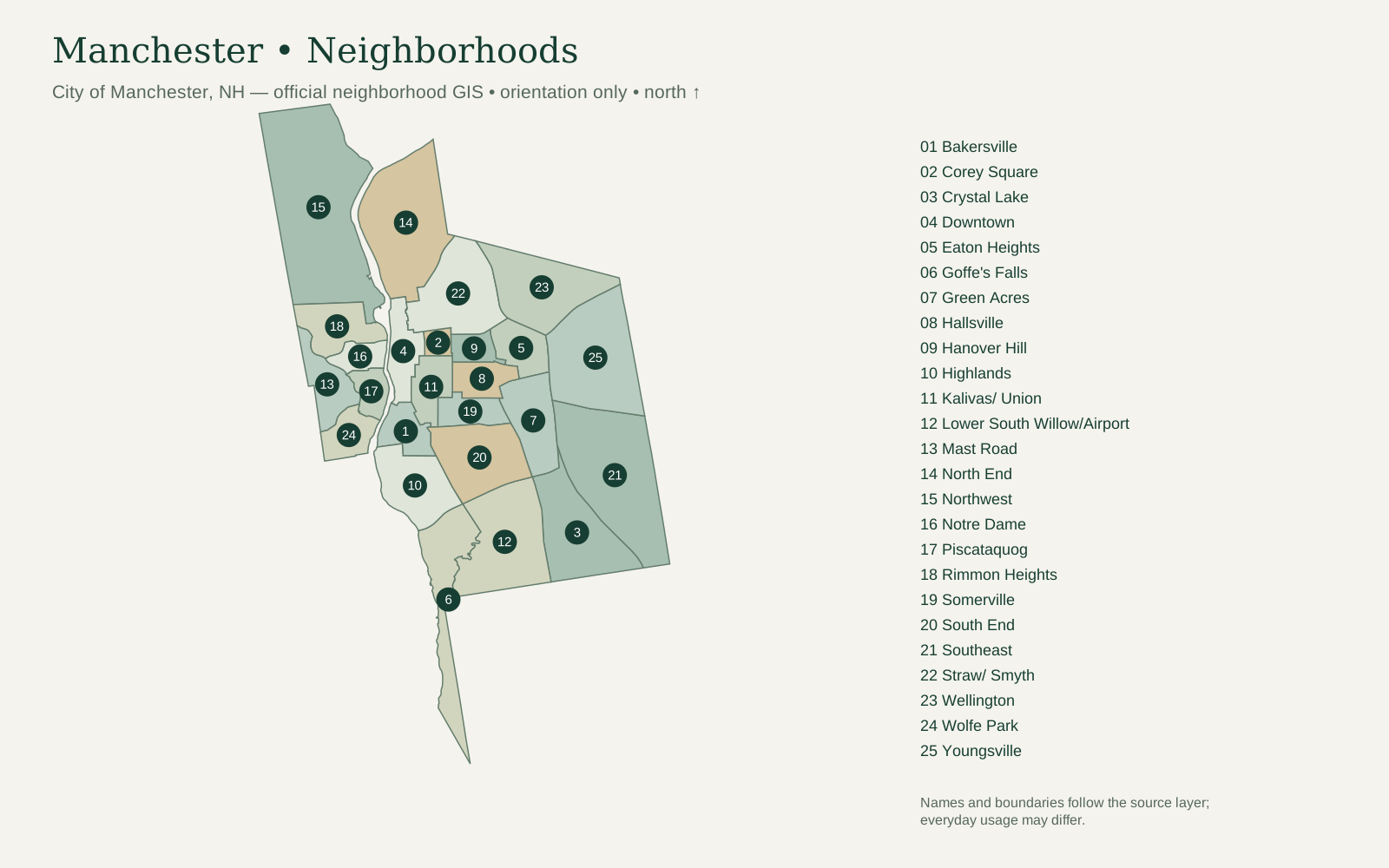
The City's neighborhood introduction explains that Planning defined 25 neighborhoods using historical facts and natural boundaries. The official neighborhood GIS layer supplies the geometry used in the orientation map below. These areas give a useful vocabulary for discussing a home; they do not establish school placement, flood conditions, zoning or the legal use of a particular apartment.

The Merrimack is an important divider in the local descriptions. Downtown lies along its eastern side, while Rimmon Heights and Piscataquog provide two different West Side settings. The North End reaches toward the Hooksett boundary, and Crystal Lake sits in the southeastern part of the City near the Londonderry line. A destination on the other side of a river or major road should be tested through its actual crossing and entrance.

Read the six comparisons as selected starting points, not a ranking of all 25 neighborhoods. Their historical introductions describe street patterns, topography and building context. They do not verify current rentals, interior layouts or the condition of a specific block. Visit the exact frontage and the receiving entrance before converting a general impression into a lease or moving plan.

Test trips from the actual home to school, work and regular errands in both directions. A nearby bridge or highway does not establish which crossing or interchange serves the property.

The map shows all 25 City GIS neighborhoods. Use the full-size view for labels; the six modules below explain selected settings in more detail. Keep school lookup, property records and any parcel-specific professional advice separate from this orientation map.

City of Manchester GIS map showing 25 numbered neighborhoods
City of Manchester neighborhood geometry for orientation. These areas do not establish parcel boundaries, school assignments, flood zones, zoning or approved truck routes; the six written comparisons cover selected neighborhoods. Open full-size map.

03 /

Find the area that fits your routine

These six comparisons use distinct City neighborhood histories to explain selected settings. The map covers all 25 official neighborhood polygons. Historical descriptions do not establish current vacancy, condition, school placement or permission to load at a particular property.

Downtown

The eastern-bank core has a planned street pattern and brick mill buildings reused for business, cultural and educational purposes.

Downtown neighborhood history and boundaries ↗
Housing & setting
For an apartment in a mixed-use or converted building, verify lawful residential use, the receiving door and any elevator reservation rather than inferring them from the exterior.
Daily travel
Test the actual Downtown or Millyard trip and the relevant MTA stop in both directions.
Before choosing
Ask which entrance serves the unit, how the truck may load and whether the address falls in the separate Downtown Collection Zone.

North End

The historical description includes Gothic, Queen Anne and Italianate houses, with denser business frontage toward the south and a different scale farther north.

North End neighborhood history and boundaries ↗
Housing & setting
Compare the actual layout, stairs, yard approach and heating arrangement. A broad neighborhood label does not establish one house type or price.
Daily travel
Check the route from the particular block to work, school and everyday destinations; the northern boundary reaches the Hooksett town line.
Before choosing
Confirm the municipality at an edge address, the receiving path and private winter maintenance responsibilities.

Rimmon Heights

This West Side neighborhood sits on a plateau between the Merrimack and Piscataquog, below Rock Rimmon, with Amory Street along its southern edge.

Rimmon Heights neighborhood history and boundaries ↗
Housing & setting
Inspect the street-to-door grade, porch and usable storage at the actual dwelling. The general topography is not a parcel-level flood or access assessment.
Daily travel
Test the particular river crossing and its approaches instead of comparing straight-line distances with Downtown.
Before choosing
Measure the receiving route and check the lawful vehicle position, especially where a slope or shared entrance changes the plan.

Piscataquog / Granite Square

The West Side setting is organized around South Main Street, with the rivers and Queen City Avenue helping define the neighborhood.

Piscataquog neighborhood history and boundaries ↗
Housing & setting
If a home is close to the business spine, distinguish the residential entrance, permitted storage and deliveries from neighboring commercial activity.
Daily travel
Walk the actual South Main crossing and check any bus journey through its correct boarding and return stops.
Before choosing
Confirm the unit’s services, cart location, truck position and whether a rear approach is public or privately controlled.

Corey Square

Beside Downtown, the area bounded by Pearl, Ashland, Manchester and Union includes angular streets that depart from the central grid.

Corey Square neighborhood history and boundaries ↗
Housing & setting
Compare the individual building and unit: door turns, shared halls, stairs, light and storage matter more than a broad central-city description.
Daily travel
Test the real walking route through its intersections and crossings; a diagonal street pattern can change the practical path.
Before choosing
Record the authorized receiving entrance and whether nearby curb space can lawfully serve it during the proposed window.

Crystal Lake

The southeastern neighborhood is framed by I-293, I-93, the Londonderry boundary and South Mammoth Road, around the lake setting.

Crystal Lake neighborhood history and boundaries ↗
Housing & setting
Check the exact property’s dwelling layout, access, heating fuel and municipal service arrangements rather than assuming one suburban housing pattern.
Daily travel
Time the actual route to a usable highway entrance or bus stop; adjacency to a highway is not the same as convenient access.
Before choosing
Verify an edge address’s municipality and the local receiving route. A lake-related name does not establish current swimming or public-access conditions.

04 /

Compare the dwelling, the route and the full monthly cost

The ACS 2024 five-year housing tables describe Manchester over 2020–2024. Of an estimated 49,162 occupied housing units, 23,929 were owner-occupied and 25,233 renter-occupied: about 48.7% owners and 51.3% renters. These estimates describe the City as a whole; they cannot tell you the tenure of a particular block or the availability of a listing today.

The same release reports $1,564 median gross rent and $365,600 median owner-occupied home value. Gross rent includes relevant utility costs, and owner value is an estimate for occupied homes rather than a current sale-price quotation. Use both to understand the historical scale of the market, then compare current properties with the same bedrooms, condition, included costs and lease terms.

Among all 52,108 housing units, 18,618 were detached single-family units, about 35.7%, and 14,628 were built before 1940, about 28.1%. The denominator here is all housing units, not occupied units. Age suggests useful questions about stairs, doors, storage and maintenance; it does not establish that a building is unsafe, inaccessible or unsuitable.

CompareRecord for each actual home
Monthly costRent or ownership costs, heating fuel, electricity, water allocation, parking and any mandatory charges
Usable spaceRoom dimensions, ceiling slopes, closets, permitted storage and the furniture route
AccessReceiving door, stairs or elevator, shared spaces and authorized loading position
Daily workLaundry, carts, deliveries, internet availability and winter maintenance

At a viewing, open the interior doors you are permitted to inspect and measure the limiting turn. A wardrobe may fit on a bedroom wall yet fail to clear a landing. Check whether a basement storage area stays accessible, whether an attic has usable headroom, and whether the lease permits belongings in a shared porch or hall. Photographs taken from the doorway often hide the narrowest passage behind the camera.

Ask which utilities are separately metered and which are included. Establish the fuel serving the actual heating system; the existence of natural gas in the city does not mean every property uses it. Request the building's rules for moving, floor protection, entry, delivery hours and any insurance certificate before booking the arrival.

For an ownership purchase, carry unresolved access and service questions through closing. Obtain the incoming account information, keys, cart ownership and any agreed repairs in writing. The moving plan should reflect the condition and permissions that will exist at possession, rather than those shown in a previous advertisement.

Closed Sterling Oakbridge wardrobe and medium cartons stand in a bedroom with a partly open sliding-door closet and a wooden dresser.
Stage packed clothing in the room, outside the closet, while keeping the doorway and access to storage usable.

05 /

Test the route in both directions

Manchester Transit Authority's route and schedule directory is the starting point for a particular journey. The linked June 2026 system map distinguishes local services, regional routes and circulators. Use it to identify a candidate route, then check the timetable for the direction, day and stop you need. A line on a map does not promise the same service all day or at weekends.

The current fare page lists a standard fixed-route fare of $2, a $5 day pass, a $20 seven-day pass and a $60 31-day pass. Reduced fares have eligibility and identification conditions. The farebox can issue fare credit rather than cash change; check the accepted payment method before the first trip. Regional or special services should be checked on their own terms.

The Green DASH, Route 41 serves Downtown and the Millyard on weekdays without a fare. The current system map also identifies Route 42 for Northside Plaza and Livingston Park as a circulator. Neither should be assumed to solve a late return or every neighborhood trip. Check the actual operating day and final useful departure before planning a work shift, appointment or school pickup around it.

Walk the last part of the journey as well as timing the ride. Locate the stop on the correct side of the road, identify a usable crossing and check the entrance at the destination. A route that reaches the right block can still be impractical if its return stop requires a difficult crossing, or if a building's accessible entrance is elsewhere. Repeat the check for the person who will actually use the route.

For disability-related travel needs, the StepSaver passenger brochure describes an application-based, shared, origin-to-destination service associated with the fixed-route area. It lists $4 one way and $8 round trip, with a personal care attendant riding free, and explains presumptive eligibility when an application has not been processed within 21 days. Contact MTA about the individual application and service area; this guide does not determine eligibility.

StepSaver requires advance reservations rather than same-day requests. Its brochure and website differ on some late operating hours and telephone menu details, so call 603-623-8801 to confirm the current booking instructions, pickup window and return trip. Explain any mobility aid, companion or access need when arranging the journey. An application or outbound booking alone is not a confirmed return.

If the household mainly drives, test the actual route and parking at both ends. Separate ordinary commuting from a moving vehicle's route, height, turning and stopping requirements. Keep an interim travel arrangement for the first days while school transport, service appointments and normal routines are being confirmed.

Commuter unlocking a bicycle beside a clear sidewalk, with pedestrians and street traffic beyond.
Test the final approach, crossings and daily travel routine.

06 /

Complete the school handoff before relying on a first day

Manchester School District's 2026–27 registration page distinguishes new students and those returning from another school system from continuing MSD students, who are registered automatically. Kindergarten students must be five by September 30. Ask the district about other grades or preschool arrangements rather than extending the kindergarten rule to a different program.

Begin with the City school lookup for the complete residential address and the student's grade. Neighborhood names and proximity to a school are not assignments. The district checks the selected school against the address, grade and submitted records; it can correct a selection during review. Confirm the receiving school and entrance before arranging the first journey.

The current registration list calls for a birth certificate, two proofs of Manchester residence, a well-child examination and immunization record. Listed residence evidence includes utility documentation, a lease or rent receipt with landlord information, suitable agency documentation or ownership evidence. The page says the physical must be completed or an appointment made before school starts. Ask the receiving school about acceptable documents and any individual health-record question.

  1. Prepare the records. Gather residence evidence, the child's identification and prior-school details. Bring relevant education or support plans, emergency contacts and language information.
  2. Use a computer for Aspen. The district says online registration must be completed on a laptop or desktop rather than a phone. Create or use the appropriate parent account through the official registration page.
  3. Select the correct year and student. Complete one registration for each child, checking the address and school. Save progress and resume the existing form if interrupted.
  4. Upload and submit. Follow the document prompts and watch for the review status. Submission is the start of review, not final acceptance.
  5. Resolve corrections. Resume the returned record, supply the missing information and resubmit. Obtain acceptance and the practical instructions for attendance.

The linked Aspen instructions explain the distinction between “Awaiting Review,” a returned record needing attention and an accepted registration. They also describe family contacts, previous schooling, language, health information and relevant IEP or 504 records. Some examples in older instructions refer to past school years; choose the current year and use the live registration page for current events and dates.

For help, the registration page offers walk-in assistance at the Welcome Center, 148 Concord Street, Monday–Friday, 8 a.m.–4 p.m., and contacts for multilingual support. Confirm the current arrangements before traveling. If an existing account is not working, ask for account help rather than making duplicate student registrations. Keep copies of submission and acceptance messages.

Families in unstable housing have a separate route. MSD's McKinney-Vento guidance states that eligible students can enroll immediately even when ordinary residence, birth, school or medical records are missing, and addresses school-of-origin and transportation decisions. Contact the district liaison through 603-624-6300, extension 140, rather than waiting to assemble the standard packet. The district determines the applicable support and best-interest arrangements.

School transportation needs its own confirmation. The 2026–27 transport page describes a distance rule around 1.5 miles, but its summary says “more than” while its FAQ says “at” that distance. Safety and disability-related exceptions are separate, and the linked policy page was unavailable when checked. Ask the school or district transport office at 603-624-6300, option 7 to confirm eligibility for the actual address.

Report the new address, ask for the assigned stop and pickup time, and confirm when any change takes effect. A bus request inside registration is not an assigned seat or immediate route change. Before the first day, settle attendance, records still needed, meal arrangements, dismissal contacts and a backup journey if transport is not yet ready.

07 /

Separate the owner handoff from household service requests

Make a service list for the exact unit before taking possession: water and sewer, electricity, heating fuel, internet and any building-managed services. Record who holds each account, which charges are included in the lease and who will attend an access appointment. A light or tap working at a viewing does not prove the incoming account or responsibility has been settled.

For a property sale, Manchester Water Works' account instructions say the title company or closing attorney should request final billing at least two weeks before closing. The request includes the closing and final-bill dates, seller and buyer information, bill destination and the buyer's mailing and contact details. The new owner's account is created through that process; water is normally not shut off simply because ownership changes.

The Water Works rules define the customer as the property owner and say the payment obligation cannot be transferred to a tenant by a private agreement. A lease can still allocate costs between landlord and renter, so establish what you pay and how without assuming that the utility will put the account in a tenant's name. Confirm meter access, correspondence and the effective handoff with Water Works at 603-624-6494.

Payment-system change: when checked on September 26, 2026, the Water Works home page said the old payment portal had closed September 18, new bills would follow September 28 and Tyler Payments would become available October 1. The older account page still mentions Paymentus. Use the current Water Works notice or office to confirm the live payment and registration route; do not assume a saved card or automatic payment carries over.

The City's Sewer and Stormwater division handles wastewater services. Ask the owner and billing office how sewer charges are accounted for at the property, whether any final reading or closing adjustment is needed and where future correspondence will go. A new water customer record should not be treated as proof that every separate lease or billing question has been resolved.

Eversource's New Hampshire electric service-area list includes Manchester. Its start-service page requires an Eversource user ID for an online request. Use the actual street and unit and obtain a confirmed start date, any meter-access instructions and the outgoing stop arrangement. Account-specific identification, charges and appointment availability are determined in the provider's process; this guide does not promise same-day activation.

Where the property has Liberty natural gas, its moving instructions distinguish starting, transferring and stopping service. Starting service requires an adult aged at least 18 to be present because a technician must enter to check or light the relevant appliances and connections. Existing customers use My Account's Services menu for transfer or stop requests; a past-due balance may need additional paperwork. Confirm the appointment before planning an empty-home delivery around it.

For oil, propane or other heating arrangements, identify the actual supplier and any tank or service agreement with the owner. Confirm internet at the exact unit, including installation access and equipment return at the old address. Keep appointment references and provider contacts with your arrival documents. If essential service is delayed, agree the usable receiving and overnight arrangements before furniture arrives.

08 /

Plan cartons, bulky furniture and mattresses as separate streams

The City's trash instructions say municipal collection is automatically active for eligible properties receiving the service; an ordinary move does not require a new activation call. Collection is along public streets, so check the building's actual arrangement before assuming a private community, alley or private way has the same service. Ask the owner where carts belong and which unit uses them.

Manchester requires approved green trash carts and blue recycling carts. The cart page says these belong to residents or property owners, not the City. Establish ownership and what stays with the property. Current published purchase prices are $85 for a 95-gallon green cart, $70 for a 65-gallon green cart and $85 for a 95-gallon blue cart, with delivery and card-processing charges separately listed. Check whether a usable cart is already included before ordering.

Use the address schedule lookup and place carts out by 7 a.m., with handles toward the property, contents inside and the lid closed. Keep the sidewalk open. The trash page gives two feet of clearance while the 2026–27 guide and recycling instructions show three feet; allow at least three feet where feasible and ask DPW about a constrained frontage. Empty trash carts must leave the right-of-way by 6 p.m. on collection day.

For moving cartons, follow the recycling instructions: material goes loose in the blue cart, and the guide calls for clean, dry, flattened cardboard. Do not add plastic bags, foam or wrapping film to that stream. Most areas have weekly collection, while the designated Downtown Collection Zone has Monday, Wednesday and Friday service and mandatory recycling. Confirm the zone for the address rather than using the neighborhood name as the answer.

The City has a limited residential overflow-bag program for occasional extra trash; the allowance depends on the number of units at the property. The special bags come from DPW with proof of residency. This is not permission to leave an unlimited move-out pile beside the carts. Arrange additional accepted disposal before the last day of possession if the normal capacity will be insufficient.

The bulky-item program offers eligible Manchester residents curbside collection for $25 for up to five items. It excludes commercial locations, private communities and private ways. Qualifying examples include sofas, chairs, mattresses and box springs; construction debris, electronics, pressurized containers and glass have separate restrictions or disposal routes.

  1. List the actual items and check their eligibility, including whether a mattress and box spring count separately.
  2. Use the City request and payment process. The pickup form says staff contact you to schedule the day; a requested date is not a booking.
  3. Wait for confirmation. Put only the listed items out, no earlier than 4 p.m. the preceding day.
  4. Keep sidewalks, driveways and roads clear, and do not lean objects against poles or other structures. Ask about any condition or preparation requirement for your items.
  5. Contact the City promptly if cancelling; the form says cancellations less than 24 hours before collection are not refunded.

An alternative is the Drop Off Facility at 500 Dunbarton Road. A residential annual permit costs $5 and requires evidence of Manchester residency. Only residents of the source address qualify for the residential permit; landlords, property managers and contractors follow the commercial rules. Published hours are weekdays 7:30 a.m.–3 p.m., with the scale closing at 2:45, and the first and third Saturdays 7:30 a.m.–1 p.m., scale closing at 12:45. Saturday access is for residents.

Confirm drop-off charges before loading: the live bulky-item page says ten free items annually, but the fee sheet updated July 2026 lists the first five nonmetal bulky items without charge and $25 for each mattress or box spring. Those are different from the $25 curbside pickup for up to five items. Call 603-624-6504 with the items, condition, vehicle and permit status to confirm the applicable allowance and total.

Keep batteries, hazardous products, electronics and remodeling debris out of the ordinary cartons-and-trash plan. Check the appropriate facility stream and current event arrangements. Household disposal permission does not automatically authorize a moving contractor to use a resident allowance on your behalf; agree who transports what and where it will be accepted.

09 /

Confirm the public-space procedure before reserving the move

The first distinction is between a vehicle standing lawfully in an ordinary space, a commercial space arrangement and an operation that obstructs public space. Manchester's parking overview and Pay and Display guidelines are related, but the detailed document refers to construction work in two-hour zones. Ask Parking whether the proposed home or business move qualifies; do not present that program as an automatic moving-truck reservation.

Parking's number is 603-624-6580. Provide the receiving address and unit, side of the street, date, start and finish, vehicle length and the space needed for any ramp or liftgate. Include the pedestrian route and any effect on a driveway, crosswalk, bus stop or neighboring entrance. A street photograph and a simple measured sketch help distinguish an ordinary parking request from a wider obstruction.

  1. Identify the activity. Explain whether the vehicle can stand entirely within a lawful space and whether any part of loading will enter a sidewalk or lane.
  2. Confirm the applicable program. Ask Parking about commercial eligibility and Highway about any Encumbrance requirement. Name the actual applicant and responsible contractor.
  3. Confirm cost and space. The commercial guideline lists $20 per day per 18 feet unless stalls are marked, and further permits for a longer footprint. Verify how the complete operation will be counted.
  4. Resolve controls and notice. Ask who places permits, meter bags or official signs, when they must be installed and how an occupied space is handled. The guideline makes the renter responsible for reserving the space but does not answer every moving scenario.
  5. Obtain and keep approval. Match its address, dates, hours and footprint to the building's receiving window. A submitted request, payment or private cone is not sufficient evidence of all approvals.

The separate Encumbrance process covers temporary narrowing or closure of public sidewalks and lanes and other right-of-way obstructions. It calls for at least 48 hours' notice and an approved traffic-control or detour plan. The application asks for the street or sidewalk involved, address or from/to limits, purpose, dates and applicant contacts. Approval and prepayment must precede the work, and a copy of the approved permit stays at the site.

The accompanying plan must show the location, north arrow, affected streets, controls, detours and personnel as applicable. The City's instructions require coordination with Police, Fire, MTA and Parking. Ask Highway at 603-624-6444 which departments and controls are needed for this particular loading arrangement. Forty-eight hours is a minimum notice requirement, not a guaranteed decision time or a recommendation to wait until two days before the move.

The insurance and bonding instructions require the relevant insurance documentation and distinguish encumbrance-only work from bonded construction. Obtain the applicable certificate wording and submission instructions from the City and coordinate them with the contractor. No single household-moving fee or universal sign-posting interval was verified in this chain; those details remain questions for the responsible office.

Inspect posted parking restrictions again before arrival and arrange a fallback that accepts the actual vehicle. If the agreed space is occupied, contact the authority using the confirmed procedure. Do not block a lane or move another person's property to improvise a replacement. A building manager's approval governs its own property and does not by itself waive City restrictions.

10 /

Check permission and dimensions along the whole route

At the receiving property, identify the door authorized for the unit and inspect every stage between it and the truck. In a shared building, the resident entrance, service door, mail area and refuse route can be different. Confirm who can unlock the chosen door and whether it remains usable during the moving window.

Measure the clear opening with doors in their working positions. Record vestibule depth, stair width, landing turns, low ceilings and any elevator opening, cabin size or capacity. Compare the largest furniture with those limits before moving day. A photo facing straight through a doorway rarely explains the turn immediately beyond it.

Ask the property manager for written requirements covering hours, reservations, insurance certificates, protective materials and any deposits. Confirm that approved protection can remain in place for the necessary period without obstructing residents or fire routes. If furniture preparation is needed, agree the method and hardware handling with the mover in advance.

For a house, look beyond the front room: gate width, retaining walls, porch steps, side paths, soft lawns and the door swing can determine the practical route. A private driveway still needs permission and sufficient dimensions. Do not assume a loaded moving vehicle can use a slope or surface simply because a passenger car can park there.

Keep the handoff simple enough to use: the confirmed entrance, the contact with keys, the dimensions that limit the route and the response if something has changed. If the only proposed alternative crosses another unit or neighboring land, obtain authorization before treating it as a backup. Recheck the route after repairs, deliveries or weather affect it.

11 /

Try the household routine before filling the calendar

A neighborhood comparison becomes useful when it connects to an ordinary week. Test the grocery trip, laundry arrangement, pharmacy or care appointment and the route home after dark at the hours you expect to travel. For a bus journey, check the last useful return; for a car journey, check the actual parking and entrance at the destination.

Inside the home, locate the practical services that listings often leave unclear. Establish laundry hours or hookup arrangements, secure parcel delivery, permitted bicycle storage, cart space and internet installation access. A room suitable for working at home also needs usable outlets, a workable connection and a door or layout that suits the household's routine.

Compare households with the same priorities rather than ranking neighborhoods by a single label. One person may need a short trip to several central destinations, another a particular school or support service. Keep the real constraints visible: step-free access, a late shift, regular appointments, a pet's routine or the need to attend a utility appointment.

Use the first week to check assumptions before adding commitments. Confirm that keys and entry systems work, record the waste day, finish account handoffs and learn the receiving arrangements for future deliveries. If a daily task depends on an unconfirmed service, keep a practical temporary option until the provider or building has confirmed it.

Shopper selecting an apple in a neighborhood grocery, with another person checking a list.
Try the recurring errands and their connection to the home.

12 /

Read the winter rule by month and check emergency notices

The City's overnight winter notice applies from December 1 at 1 a.m. to April 15 at 6 a.m.. During ordinary winter nights, the 1–6 a.m. rule uses the odd-numbered side in an odd-numbered calendar month and the even-numbered side in an even month. It does not alternate by the day's date. Locations with only one legal daytime parking side have a separate exception, and overnight parking in circular cul-de-sacs is prohibited.

During a declared snow emergency, vehicles must leave City streets. Ordinary winter-side permission does not override the emergency. Check the notice before overnight staging and again before departure. Listed emergency lots have their own windows and restrictions; do not assume they accept a large commercial vehicle or provide an exclusive place to hold a shipment.

The City's snow tips explain that snowbanks can prevent collection and access, and prohibit pushing snow or ice into a public street, sidewalk or other right-of-way. Keep the truck position, approach and steps clear as separate tasks. A plowed road can coexist with an obstructed driveway end or icy private landing.

For rented dwellings, Housing Code §150.061 places a duty on the owner to maintain the relevant sidewalks, walks, steps and driveways safely and free of snow, ice and obstructions. The published code version is 2025 S-25; confirm current property responsibilities and arrangements with the owner. The sources checked do not establish a universal citywide homeowner clearance deadline, so do not borrow one from another Manchester.

Agree who checks the route shortly before arrival and who can authorize a change. If conditions make the confirmed plan unusable, coordinate a later window, another authorized receiving position or an agreed storage stage. Each option requires permission, access and a clear understanding of the effect on the move; an unconfirmed fallback is still an open task.

Covered side passage and cleared private walk leading toward a person shoveling beside a driveway.
Assign winter clearance for the actual receiving route and check it before arrival.

13 /

Bring the confirmations together for the first week

Before finalizing the arrival, bring the separate decisions into one usable record. Keep the address and unit, possession time, building contact, authorized receiving door, approved truck position and service appointments together. Mark which arrangements are confirmed and which still need a decision. This is particularly useful when a landlord, closing agent, provider and moving crew are working to different schedules.

StageUseful completion evidence
Before committing the deliveryPossession and keys, measured receiving route, agreed scope and building requirements
Before occupying public spaceApplicable City approval, controls, dates, footprint and occupied-space instructions
Before leaving the old homeAccount stop and start arrangements, disposal booking, retained documents and first-night kit
Before the first school or work journeyAccepted registration or appointment, actual entrance, transport confirmation and return plan
During the first weekWorking services, billing access, correct collection day and resolved handoff questions

Immediately before moving day, recheck changes rather than repeating every earlier conversation: a new street notice, an occupied loading position, delayed keys, a utility appointment or a changed building window. Tell the relevant people which part changed and get a workable response. A previously acceptable plan may need a small adjustment; that adjustment still needs the right permission.

At the old home, leave only what the handoff agreement allows, remove the agreed waste and record the account responsibilities. At the new home, keep the receiving route clear and direct goods to the intended rooms. Afterward, close out remaining records and confirmations while the people responsible for them are still available.

For inventory, packing, furniture preparation, storage and the estimate, return to the Manchester moving estimate section. The more clearly you can distinguish a preference from a confirmed arrangement, the easier it is to plan the work around the actual home.

14 /

Questions before you arrive

Which Manchester does this guide cover?

The City of Manchester, New Hampshire. The map and housing estimates use that city; neighboring municipalities and other places named Manchester have different procedures.

Do neighborhood boundaries determine the school?

No. Use the City school lookup for the address and confirm the assignment with Manchester School District. Submit the current registration and obtain acceptance, attendance instructions and separate transport confirmation.

Can I assume a water account transfers like electricity?

No. Water Works defines the customer as the owner and has a closing-agent process for property sales. Renters should clarify included costs with the owner. Check the current billing platform and account instructions with Water Works.

Is a mattress free at the drop-off facility?

Do not assume so. The July 2026 fee sheet lists $25 per mattress or box spring, while the live page and PDF disagree on the general annual bulky-item allowance. Confirm the exact items and charges before traveling.

Does winter parking alternate by date?

Manchester’s ordinary overnight winter rule follows odd and even calendar months, with location-specific exceptions. A declared snow emergency prohibits street parking and overrides that ordinary arrangement.

Does an Encumbrance request guarantee a delivery slot?

No. It is a City approval process for the proposed public-space obstruction, with a minimum notice requirement. Building access, possession, parking controls and the moving company’s scheduling remain separate confirmations.

What if a service or possession date changes?

Update the affected people and confirm a usable alternative before relying on it. Keep temporary travel, receiving or storage arrangements specific to the actual household, property and dates.

Your next step

Bring the plan together

Use the Manchester moving page to prepare the inventory, access details and questions for your estimate.

Sources & useful local resources

Official procedures and local resources are linked beside the answers above. Reopen the relevant page when arranging a date: fees, schedules and application requirements can change.

Official sources and practical references