Washington / City relocation guide

Moving to Seattle, WA

Choose the address around the journeys, rooms and responsibilities your household will use every week. Then prepare the accounts and first days before the furniture arrives.

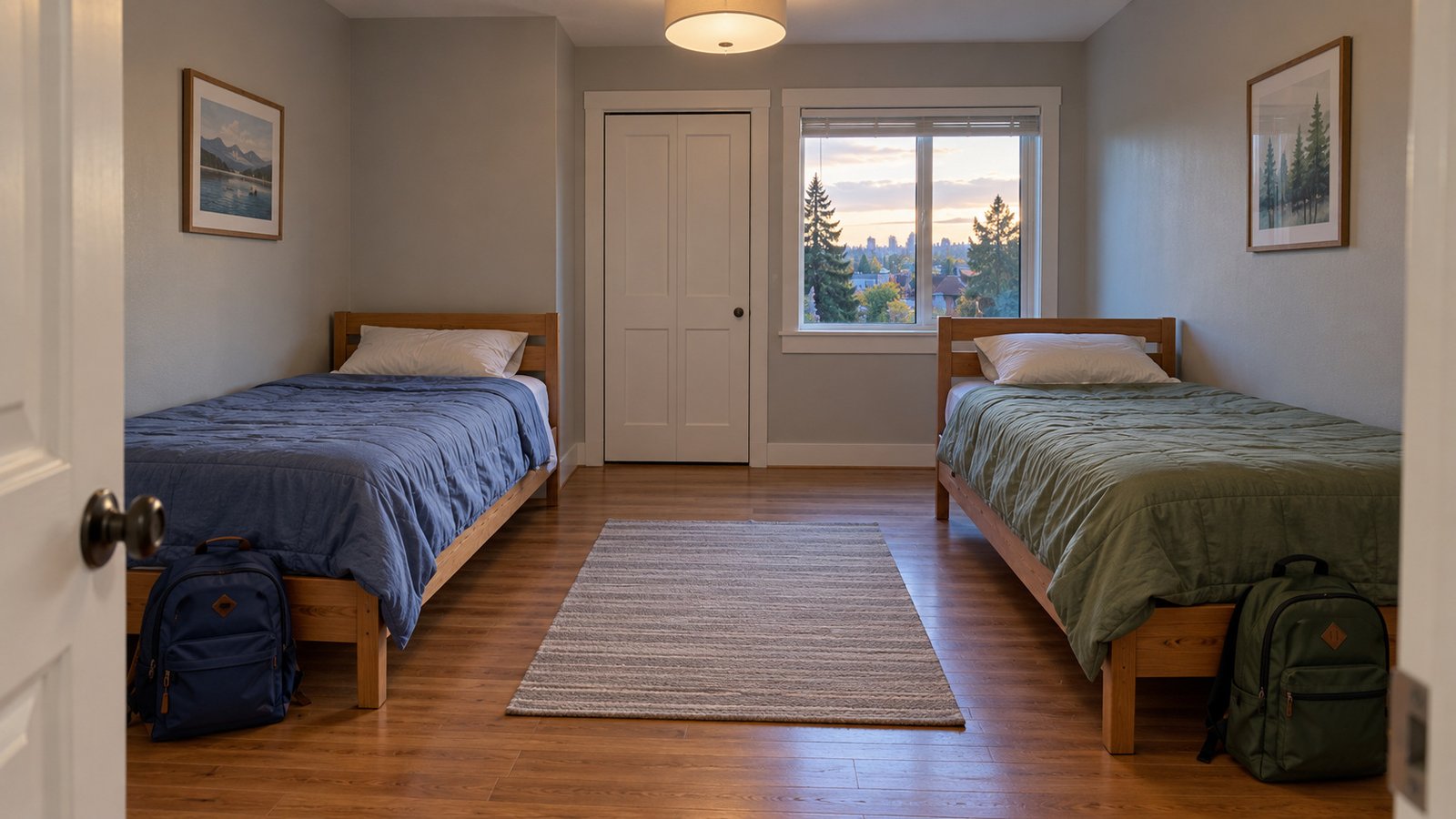
Two single beds with blue and green covers stand beside a clear central route and two small overnight backpacks.
Make both sleeping places and the route to the closet usable before general unpacking. Representative shared-bedroom arrangement for the first night.

01 /

Choose a home around the week you need to live

Seattle can support a week built around walking and transit, but the address matters more than the city name. Hills, water, a large site or the last connection home can separate a promising map location from a workable routine. Compare the home and the ordinary journeys together.

Still choosing an address: use the eight starting points below to shortlist different settings. Then test two actual homes against groceries, work or study, an evening return and a weekend outing. Include the walk from the usable entrance, carrying bags, rather than timing only the train.

Moving with children: establish the address-based school process and a separate accepted care arrangement before treating the household schedule as settled. A nearby school and a submitted application do not finish those decisions.

Already have the keys date: go to accounts, collection and the first-week plan. Keep the property manager, utility account holder and household’s travel arrangements in the same plan. The Seattle moving page covers Sterling Oakbridge’s confirmed long-distance origin service, estimate and receiving arrangements.

02 /

Read the City, the water and the reference points separately

This guide concerns the incorporated City of Seattle in King County. A Seattle postal label, a county service and the municipal boundary are different things. Establish the actual property and service owner before applying a procedure to an address.

The original map retains the complete City boundary and adds selected roads, water and eight approximate search references. Downtown uses Westlake as its rail reference; South Lake Union uses the Terry Avenue N lakeside vicinity. Ballard’s reference is near its library, and the Junction reference is near 42nd Avenue SW. The other rail points locate Capitol Hill, U District, Northgate and Columbia City. These points are not formal neighborhood polygons, school zones, surveyed entrances or legal vehicle routes.

Puget Sound lies to the west and Lake Washington to the east; Lake Union and the Ship Canal help explain why apparently close destinations may need a bridge or a longer connection. I-5 and SR 99 provide north–south orientation and I-90 an eastern connection. A road line on this map does not approve a truck route, a crossing or today’s travel conditions.

The numbered places are deliberately different starting points, not a ranking or a complete list. In particular, Northgate and Lake City are distinct searches, and a West Seattle address is not automatically near either the Junction or the Water Taxi dock.

A three-story red-brick apartment building stands behind a short path and a complete stepped shared entrance.
Compare the shared entrance and steps with the flat you are considering; a street view does not show its internal stairs or lift access. Representative Seattle-style apartment housing.
Complete Seattle municipal boundary, selected roads and water with eight approximate address-search reference points.
The complete City boundary and eight approximate search references. Points are not formal neighborhoods, school zones or surveyed entrances. No transit routes or legal truck directions are drawn. Explore the map.

03 /

Eight different starting points for an address search

These are selected editorial starting points, not ranked or formally bounded neighborhoods. Compare the actual home, agreement and journey. Source links below lead to the dated local and transport references.

Downtown

A central search around retail, work, restaurants, Pike Place and performing arts; activity can change sharply from block to block.

Neighborhood and transport sources ↗
Housing & setting
Compare a managed apartment or condominium with its actual lift, storage, laundry and parking terms. Ask which charges and services accompany the unit.
Daily travel
Westlake supplies a useful 1 and 2 Line reference. The waterfront, a particular office and the station entrance are separate endpoints; check the complete walk and elevation change.
Before choosing
Visit the exact block during your ordinary evening as well as the workday. Resolve building access, street noise and grocery carrying before choosing for a short commute alone.

South Lake Union

Lake Union, technology and medical workplaces share an area with maritime and industrial history. The lakeside and the workplace block can offer different daily routines.

Neighborhood and transport sources ↗
Housing & setting
Look at the specific managed unit, daylight, cooling, work space and included services. A newer building description does not establish usable storage or furniture access.
Daily travel
Compare the real bus or streetcar connection and the walk to Link. A South Lake Union label does not place a rail station at the door.
Before choosing
Price the home and the trips beyond work together. Try an evening food shop and the return from a regular activity rather than assuming proximity to employment solves the week.

Ballard

Commercial streets, Nordic heritage and a working-waterfront setting support a different search from the central rail corridor. Golden Gardens and the Locks are distinct outing destinations.

Neighborhood and transport sources ↗
Housing & setting
Compare apartments near the commercial core with homes on quieter residential blocks. Inspect steps, shared access and the actual agreement; the area name establishes neither a house type nor a price.
Daily travel
Investigate the D Line bus corridor for the actual address and destination. Ballard is not a current Link station, and the walk from a residential street still matters.
Before choosing
Use a grocery return, the library and a late trip as repeat tests. A park or waterfront destination may need another journey rather than being a short walk from every Ballard home.

Capitol Hill

Broadway and Pike/Pine offer shops, dining and nightlife; Cal Anderson and Volunteer Park provide different public-space anchors. The hill contains varied residential streets.

Neighborhood and transport sources ↗
Housing & setting
Inspect an older shared-entry apartment as carefully as a newer managed unit. Check internal stairs, room use, sound and the route from the building entrance.
Daily travel
Capitol Hill station connects with the 1 and 2 Lines. A station-centered address can be a strong car-free starting point when groceries and other repeated destinations also work.
Before choosing
Walk the actual slope and return after the hour you normally socialize or collect a child. A familiar park or nightlife label does not describe every block or building.

University District

The UW setting combines study, shops, cultural institutions and residential streets. The campus, University Village and the U District commercial core are different destinations.

Neighborhood and transport sources ↗
Housing & setting
Compare the actual lease, shared-space arrangement, bedroom privacy, storage and everyday noise. Choose for the household’s usable layout rather than a broad university-area label.
Daily travel
U District station and University of Washington station are different stops. Locate the building or campus entrance you need before choosing the rail walk.
Before choosing
Test a grocery trip and a journey when the household is not following a campus schedule. Include the final walk across a large site and the weekend return.

Northgate

A northern search with a rail interchange, shopping and the Iceplex as reference points. Nearby Lake City has its own locations and connections.

Neighborhood and transport sources ↗
Housing & setting
Compare the unit and surrounding residential block, including the walk out of a development, storage and parking obligations. A Northgate label does not describe one uniform station catchment.
Daily travel
Northgate station serves the 1 and 2 Lines and connecting buses. Verify the actual entrance-to-platform journey and the return connection from your home.
Before choosing
Keep a station-side apartment separate from a home requiring an extra bus or a difficult crossing. Repeat the shopping trip with bags and inspect the evening walk.

West Seattle Junction

The Alaska Junction commercial center is one of several West Seattle settings. Alki, Admiral and the Seacrest waterfront are separate places across a hilly peninsula.

Neighborhood and transport sources ↗
Housing & setting
Compare an apartment near the center with a house farther into residential streets. Follow the real slope, entrance and usable rooms before relying on a short map distance.
Daily travel
The C Line serves the Junction corridor. Water Taxi travel uses Seacrest, not a dock at the Junction; the 773 shuttle and its return timetable create another stage.
Before choosing
Test a bus-based week and the complete boat alternative on your travel day. A short crossing does not include the trip to the dock, waiting or the last shuttle home.

Columbia City

Rainier Avenue’s local shops and dining offer a southeast Seattle starting point. Broader Rainier Valley destinations such as Seward Park and Kubota Garden are additional journeys.

Neighborhood and transport sources ↗
Housing & setting
Compare the individual apartment, condominium or house and the path from its door. Establish maintenance, storage and shared-service terms from the actual property documents.
Daily travel
Columbia City station is on the 1 Line. The station on Martin Luther King Jr Way S and a particular Rainier Avenue destination require a real connecting walk.
Before choosing
Test that walk with shopping, at night and in rain. Do not assume every place carrying the Columbia City or Rainier Valley name is within the same easy rail walk.

04 /

Compare the agreement and the usable home

For a shared-entry apartment, trace internal stairs, laundry and storage as well as the front steps. In a condominium, obtain association rules, charges, elevator arrangements and the right contact for common areas. At a townhouse, follow the route between the garage, entrance and living floors. For a detached home, identify the actual responsibility for outside maintenance, drainage and services. Architecture suggests questions; the agreement supplies the obligations.

Read the floor plan as a lived room: beds and closet doors must remain usable, a desk needs a chair that can move, and kitchen storage should work without filling the aisle. Measure the actual furniture and separately check every doorway, turn, stair landing and elevator opening. A piece fitting the room does not establish that it can reach the room.

Put both shortlisted homes through the same comparison
DecisionEvidence to obtainEffect on the household
Regular paymentCurrent rent or financing, required insurance, tax and association charges where applicableEstablish the recurring commitment rather than the advertised figure alone.
Included servicesWater, sewer, waste, energy, internet, parking, storage and laundry termsAvoid paying twice in the comparison or overlooking an account to open.
Cash before keysActual application terms, deposits, setup and building chargesKeep one-time cash needs separate from the monthly budget.
Room and accessUsable layout, appliance openings, stairs, lifts and approved receiving timeResolve daily circulation and the furniture’s route before arrival.

A current asking price, a recorded sale and a statistical housing estimate answer different questions. Use the actual property and documents for your decision. The illustrative photographs show representative housing situations rather than available listings, customer jobs or measured accessibility.

A compact galley kitchen has parallel counters, closed appliances and a small closed Cookbooks carton beside its clear central aisle.
Compare the actual kitchen’s storage, appliance openings and walking space before deciding where packed contents can wait. Representative Seattle-style condominium interior.

05 /

Add the repeated journeys and the setup cash

Build the regular total from the housing commitment, separately paid services, food, routine travel, care and existing household obligations. Keep deposits, moving work, setup and first-week purchases in another column. Name uncertain items and their owner instead of filling the gap with a citywide average.

King County Metro’s ordinary adult fare is $3 under the schedule effective September 1, 2025. Its adult regional day pass is $6 and covers eligible trips up to a $3 fare; a physical ORCA card costs $3 separately. Higher fares require the difference, and exclusions include Washington State Ferries and Kitsap Fast Ferries. Youth 18 and under ride free under the listed terms; reduced fares require the relevant eligibility.

As a simple comparison, two eligible $3 trips on a day total $6. More separate travel that day may make the applicable day pass useful. This is arithmetic for those journeys, not a promise of automatic fare capping or one pass covering every boat. Metro lists a $108 monthly pass at the $3 fare value; compare it with the actual number and type of trips.

For a West Seattle boat routine, the current Water Taxi adult fare is $5.25 with ORCA or $6.25 cash, separate from the ordinary $3 bus figure. Include any difference above your pass value and the connection to the dock. A home that reduces rent but creates repeated paid rides or care gaps needs those costs in the same decision.

06 /

Use current Link, bus and boat connections

The 1 Line connects Lynnwood, Northgate, the University and Downtown corridor, southeast Seattle, SeaTac and Federal Way. The 2 Line connects Lynnwood and Downtown Redmond through the shared northern corridor, Judkins Park, Mercer Island and Bellevue. International District/Chinatown is a transfer point between the lines. Choose the destination and correct train, rather than treating every Link service as the airport train.

Sound Transit describes Link as operating seven days, roughly 5 AM to midnight Monday–Saturday and 6 AM to midnight Sundays and holidays, with intervals varying by time. Those broad hours do not establish your last usable train or connection. Sounder is chiefly a weekday rush-hour and selected-event service, not an all-day substitute for Link.

Tap ORCA before boarding the bus or Link; Link and buses do not require a tap off. Sounder does. Participating ORCA services provide up to two hours of transfer credit with any fare difference payable. A Metro paper cash transfer or Transit GO ticket does not create the same cross-agency transfer. Metro also lists contactless bank-card and device payment; check the actual method and terms you will use.

The C Line is a current bus connection through South Lake Union, Downtown and the West Seattle Junction corridor. Investigate the D Line for Ballard. RapidRide J and R are future projects on the current overview, not existing routes to rely on when choosing today’s home.

The West Seattle Water Taxi uses Seacrest at 1660 Harbor Avenue SW and Downtown Pier 50 at 801 Alaskan Way, with access from Yesler Way. Its current seasonal schedule runs October 10, 2026–April 9, 2027. The crossing takes about 10–15 minutes, but reaching the dock, boarding and the 773 or 775 shuttle are additional stages. Check the correct day’s full return, including the last shuttle.

Two casually dressed adult passengers wait beside a complete bus-stop pole on a continuing Seattle-style sidewalk.
Include the waiting place and the walk beyond it when testing a transit-based week. Representative Seattle-style waiting scene, not a named stop or service timetable.

07 /

Where can you make a complete week work without driving?

Begin near a usable Link entrance with groceries and other repeated destinations within a workable walk: selected Downtown, Capitol Hill, U District, Northgate and Columbia City addresses are sensible starting points. Compare the actual block and entrance. Ballard and the West Seattle Junction can support a bus-based routine, but they require a different check of frequency, transfers and late returns. Neither has a current Link station at its center.

Run five tests: a food shop carried home; the ordinary work or study journey; a medical or administrative visit; a social evening; and a weekend park or cultural outing. Add school collection when relevant. Hills, large crossings, bags and rain belong in the test. A remote job removes a commute, not the rest of the week.

Some Metro Night Owl routes provide overnight connections. That does not make every route or station an overnight service. Find the final usable connection all the way home and price an available alternative. Metro’s Night Stop request between 8 PM and 5 AM is a separate driver-approved drop-off provision with location restrictions, not permission to board anywhere or a promise that your bus runs all night.

For a regular outdoor outing, choose a specific Green Lake path access or an Alki waterfront destination and test both directions on the relevant weekend. For travel farther away, Amtrak Cascades lists Seattle, Portland and Vancouver, BC among its corridor stations. Buy an itinerary with an attainable return and station connections; a rail corridor does not guarantee a convenient same-day outing, a seat or international entry.

A person without a license can combine usable transit, deliveries, an available taxi or ride-hail and specific help someone has agreed to provide. Arrange the return before leaving the network. A rental or car-share is useful only for an eligible driver; it does not solve a non-driver’s trip by itself. If repeated late journeys need paid rides, budget them before choosing the address.

08 /

Finish the address, registration and care decisions

Use Seattle Public Schools' Find Your School tool for the complete address and applicable grade. Read the attendance-area result and resolve a question with Admissions. A nearby campus, neighborhood name or map point does not determine assignment. Option schools, choice applications and some required services can follow different assignment rules.

New-student registration for 2026–27 is open. SPS lists kindergarten age as five by August 31. Its enrollment instructions call for parent or guardian photo identification, two accepted current address proofs dated within the preceding eight weeks, the applicable age evidence and the required immunization or exemption records. For a lease, the instructions identify the first and signed last pages. Follow the actual grade and household circumstances instead of treating one example as the only accepted document.

Complete the district’s review and obtain the accepted school and start arrangement. If conventional residence documents do not fit, contact Admissions about the appropriate route; families experiencing homelessness should ask about McKinney-Vento support and applicable documentation exceptions. This guide does not decide a child’s eligibility or require a family to invent an address document.

Afterschool care needs its own accepted place, hours, cost and authorized collection arrangement. A school application or care waitlist does not cover supervision. Test the collecting adult’s actual journey and identify who will cover a gap.

If school is settled but care is still pending

Have the parent or guardian confirm the school’s start arrangement and separately contact the care provider about the actual application status. Set a decision date before the first uncovered afternoon. Name an adult who has agreed to supervise and can make the pickup; confirm the school’s authorization process. Until a place is accepted, use that agreed cover or revise the household’s schedule rather than relying on a waitlist.

09 /

Try the repeated public places, not only the landmarks

A grocery return and a regular public place are useful first tests of a location. Ballard Branch at 5614 22nd Avenue NW and Columbia Branch at 4721 Rainier Avenue S list Wi-Fi, computers and study facilities. Check branch hours and the terms for any room or activity. A 24-hour book return does not mean the library building is open all night.

For a regular walk, Green Lake’s paved inner loop is 2.8 miles. Its published path rules separate pedestrians toward the lakeside from wheeled users on the outside; follow the posted direction and yield rules. Alki offers a waterfront path setting. Pick the actual access and return journey, rather than assuming either destination is next to every Seattle home.

Public outdoor space, a museum, a class and a reserved court have different hours and admission or booking terms. Lifeguard coverage is seasonal, and a pleasant lakeside image does not establish swimming permission or a safe water temperature. Choose the activity you will repeat and verify its current arrangements.

A broad paved path curves beside a grassy shoreline and open lake in a Seattle-style setting.
Test a regular outdoor outing and its return journey as part of the week. Representative Seattle-style lakeside path, not a photograph of a named park.

10 /

Separate the account holder from the person paying

Seattle’s New to the Area guidance says owners and tenants may hold electric accounts. For residential water, sewer and solid waste accounts, SPU generally requires the property owner as account holder; existing pre-2012 tenant accounts can continue until closed. A lease may require a tenant to pay charges while the owner retains the account. Resolve both the named holder and the payment arrangement with the landlord.

Start with the actual address and service agreement. Record who opens electricity, who maintains the SPU account, what is included and how a tenant reports a leak or service problem. Identify any gas and internet providers for the property separately. A City address does not establish a single provider for every service.

The online start process can use identity-verification questions. The guidance says a failed online identity check cannot be resolved by opening the account by phone; the walk-in route requires government photo identification. Keep a practical appointment plan if the online route fails. Do not assume an unconfirmed online request means service is ready.

For home internet, obtain the provider's accepted installation or start arrangement for the actual unit and test it before a work deadline. If it will not be ready, arrange an available connection or a place suitable for the work with its hours, cost and return journey. Ballard and Columbia libraries list Wi-Fi and computers during branch hours, but a room, seat or private-call space is not reserved by this guide. Confirm the alternative before the first meeting rather than making a public branch responsible for an unagreed workday.

For closing service, SPU asks for the effective date, meter reading and forwarding address; responsibility continues until the account is closed. The current start/stop page lists a $60 water closing meter-reading charge, a $10 garbage/recycling/compost opening charge and no sewer opening or closing charge. These are specific account fees, not monthly household averages.

If a renter is told to open the water account

Compare the lease instruction with SPU’s residential account-holder rule. Ask the owner or manager to confirm the existing account and the agreed way you pay or receive a bill copy. If the property has an exceptional account arrangement, resolve it with SPU before duplicating an account or assuming a missed bill belongs to someone else. Keep the electric start request separate.

11 /

Arrange ordinary collection and bulky removal separately

For SPU single-family service, garbage and compost are collected weekly and recycling every other week. Apartments and condominiums may have more frequent service. Obtain the property’s actual container location, sorting instructions and calendar. Seattle Housing Authority customers have a separate garbage and food/yard-waste contact through SHA.

Flatten suitable empty cartons and follow the collector’s sorting and setout rules; do not leave packaging in a common route. A mattress, sofa or appliance needs its own accepted disposal or removal arrangement. SPU Special Item Pickup charges the utility account and requires authorization; apartment renters should coordinate with the owner or manager.

The current special-pickup schedule lists large furniture and appliances at $31 per item and specified older refrigerant appliances at $39.25, subject to item limits and acceptance. The 2026 free annual battery pickup and Special Item Box pickup are separate benefits; they do not make a sofa pickup free. Check the actual category before budgeting or reserving.

Wait for confirmation before placing an item outside. For the stated single-family pickup procedure, put accepted items out by 7 AM in a flat, level, street-accessible position without stairs; multifamily buildings must arrange a position and access the unfamiliar driver can actually use. A locked gate or fob-only area needs resolution beforehand.

If the unwanted sofa must leave before keys are returned

Ask the authorized account holder or manager to obtain an accepted pickup date and position before the lease deadline. If that date will not work, arrange another accepted removal service with its charge and access in writing. Keep the sofa out of the shipment inventory only after the separate plan is real; a reservation request or a place beside the bin does not complete removal.

12 /

Prepare the home and journeys for the actual season

For rain, give wet coats and footwear a place that keeps the entrance usable and protect walking surfaces appropriately. For a cold or icy day, check the actual route, slopes and current transit alerts. Seattle’s winter response prioritizes a defined arterial network; a treated main road does not establish a clear residential hill or footpath.

For warmer periods, ask how the particular rooms stay usable: shade, ventilation, installed cooling and a practical place to go if the home overheats. The City’s heat-safety page carries a dated July 2026 alert; that historic notice is not an October forecast or proof that a cooling site is open today. Use current official conditions and facility notices when the need arises.

Test an evening route as it will actually be used, with the slope, lighting and return connection. A station page’s elevator status can change. Check current accessibility and service alerts for the intended trip and agree an alternative if a required element is unavailable.

13 /

Arrange the position, vehicle route and building access separately

Begin with a lawful vehicle position and the entire carrying route: public approach, gate, every step and landing, door opening, turn, shared corridor, lift and room. A garage opening or front-lobby photograph alone is incomplete. Send the building's written receiving hours, protection and certificate-of-insurance requirements to the planner before committing to a slot.

For Seattle public curb space, the Temporary No Parking procedure distinguishes paid and non-paid spaces. Paid-space applications identify the actual curbspace; non-paid spaces require the easels, application and generated Public Notice on the signs. SDOT recommends complete signs and notice 72 hours ahead; its enforcement explanation separately states a 24-hour notice minimum. Use the preparation recommendation rather than treating a late request as a booked space.

The separate TNP conditions require a Restricted Area Permit for an eligible vehicle occupying the zone. Peak restrictions and limits on already restricted spaces remain. A curb reservation does not approve the actual vehicle's Downtown or over-legal route, and private standing space needs the property owner's acceptance. Have the operator assess the vehicle and route while the household and property contact settle the receiving window.

Before dispatch, confirm the position, posting owner, charges, building booking and the person who can admit the crew. If a lift or position fails, use a named decision contact and an accepted later slot or assessed alternate route; include the additional work and charges before proceeding. A waiting truck does not authorize a blocked sidewalk, exit or unapproved stair carry. The Seattle curb and vehicle section retains the detailed City procedures.

14 /

Make the first night and the first week usable

Before dispatch or travel, confirm possession, the admitting contact, permitted receiving hours and the furniture route. A unit number alone does not open a shared entrance or reserve an elevator. Resolve curb space and vehicle restrictions separately through the process on the Seattle moving page; a parking arrangement is not a truck-route approval.

Keep medicines, documents, keys, chargers, clothing and the first meals with the household. Make the required sleeping places, bathroom and kitchen basics usable before general unpacking fills the floor. Decide the larger furniture positions while the routes to closets and doors are still clear. Unwrapped furniture, emptied cartons and removed packaging are different finishes.

A first-week plan with a named owner and a useful finish
WhenFinish to confirmWho must act
Before arrivalKeys, authorized receiver, building slot and accepted vehicle/access planHousehold, property contact and move planner
First nightUsable beds, bathroom, basic food, chargers and clear room routesHousehold and agreed receiving help
First working daysAccepted account arrangements, collection calendar and school start/care coverRelevant account holder, parent or guardian and providers
Before the week repeatsTested shopping and return journeys, regular activity and resolved leftover packagingHousehold and the authorized collector or removal provider

If possession is delayed after the household has travelled

Set a decision deadline with the property contact and move planner before goods are committed to an unavailable receiving slot. Identify the person authorized to change the shipment plan, an accepted holding or alternate receiving arrangement, its intake and release contacts, and the household’s overnight accommodation. Record extra handling, storage and later-delivery charges. Resume only after keys, access and an authorized receiver are confirmed.

15 /

Questions before you arrive

Where should I start if I want to live without a car?

Start with an actual home near usable Link access and everyday shopping in selected Downtown, Capitol Hill, U District, Northgate or Columbia City locations. Test groceries, an evening and a weekend return as well as work. Ballard and the Junction require a bus-based comparison; a neighborhood name alone does not establish a convenient week.

Does Ballard have a current Link station?

No. Investigate the D Line bus corridor and the walk from the actual home. Check the complete journey and late return, including transfers. The Locks, Golden Gardens and a particular residential block are different endpoints; do not treat every Ballard address as one easy walk.

Is the West Seattle Water Taxi at the Junction?

No. It uses Seacrest on Harbor Avenue SW and Downtown Pier 50. Reaching the dock, waiting and a 773 or 775 shuttle are additional stages beyond the roughly 10–15 minute crossing. Use the correct day in the October 10, 2026–April 9, 2027 schedule and check the last connection home.

Are U District and University of Washington the same stop?

No. They are distinct Link stops. Locate the actual campus building, University Village destination or residential entrance before comparing the walk. A broad university-area label cannot establish which station and final connection fit your routine.

How much is the ordinary Metro adult fare?

Metro lists $3 under the schedule effective September 1, 2025. Its $6 adult regional day pass covers eligible trips up to a $3 fare, with higher-fare differences and exclusions. A physical ORCA card costs $3 separately. Youth and reduced fares have their own terms; the day pass is not a claim of automatic fare capping.

Do I tap off Link or a Metro bus?

No: tap ORCA before boarding, but do not tap off those services. Sounder requires a tap off. Participating ORCA services provide up to two hours of transfer credit with any difference payable. Metro cash paper transfers and Transit GO tickets do not provide the same cross-agency transfer.

Can I count on a train home after midnight?

Do not assume that. Sound Transit gives broad Link operating hours around midnight, and the final useful trip depends on the station, day and every connection home. Some Metro Night Owl routes operate overnight. Identify your actual final journey and an available alternative before choosing an address around late work or social trips.

What can a non-driver do for trips beyond the normal transit routine?

Combine a verified transit journey with deliveries, an available taxi or ride-hail or a specific agreed ride. Cascades provides a rail corridor including Seattle and Portland, but reserve an attainable outward and return itinerary with station connections. A rental vehicle requires an eligible driver and does not by itself solve a non-driver’s journey.

What should I compare beyond the advertised housing payment?

Compare required insurance, applicable tax or association charges, separately paid services, parking, storage, laundry and the repeated travel created by the location. Keep deposits and setup cash separate. Obtain the actual lease or ownership documents and test usable rooms and furniture access before accepting the comparison.

Does a nearby school establish my child’s assignment?

No. Use SPS Find Your School for the complete address and grade, then resolve the result and start arrangement with Admissions. Option schools, choice applications and some required services can follow different rules. An editorial area point or a property listing is not an assignment.

What does SPS ask a new household to prepare?

The current 2026–27 instructions include parent or guardian photo ID, two accepted address proofs dated within eight weeks, applicable age evidence and immunization or exemption records. Kindergarten age is five by August 31. Follow the grade-specific process and ask Admissions about alternatives or applicable exceptions when ordinary documents do not fit.

Does school enrollment also secure afterschool care?

No. Care requires a separate accepted place, hours, cost and collection authorization. Set a decision date and identify an adult who has agreed to supervise and can reach pickup. A care waitlist or a submitted school form does not cover an unsupervised afternoon.

Can a residential renter put SPU water service in their name?

SPU generally requires the owner as residential water, sewer and solid-waste account holder. Existing pre-2012 tenant accounts can continue until closed. The lease may make the tenant pay while the owner holds the account. Resolve the named account and payment method with the owner; electric accounts may be held by owners or tenants.

What if the online utility identity check fails?

Seattle’s guidance directs that case to a walk-in visit with government photo identification; it says the account cannot then be opened by phone. Arrange that visit and confirm the accepted start rather than assuming an unsuccessful online request established service. Keep owner-held SPU accounts separate from your electric request.

How often are ordinary SPU containers collected?

For single-family service, garbage and compost are weekly and recycling every other week. Multifamily service can be more frequent. Obtain the actual address calendar and building instructions. Seattle Housing Authority customers use SHA for garbage and food/yard-waste collection information.

Can I leave a sofa beside the building’s bins?

Arrange an accepted bulky-item pickup or removal first. SPU charges the utility account, and apartment renters should involve the owner or manager. Confirm the item, date, charge and flat accessible pickup position; do not place it outside before confirmation. The free annual battery and Special Item Box pickups are separate from a sofa pickup.

Are library book returns proof the building is always open?

No. Ballard and Columbia branches list 24-hour book returns separately from their building hours. Check the actual branch schedule for Wi-Fi, computers, study or an activity, plus any booking terms. An outdoor return slot does not provide overnight indoor access.

Does the map show official neighborhoods or school zones?

No. It retains the complete incorporated Seattle boundary, selected Census roads and water and eight approximate search references. Rail points come from station data and the other points from address geocoding. They do not draw transit routes, surveyed entrances, school zones or legal truck directions.

What should be usable on the first night?

Prioritize the required sleeping places, bathroom, simple food, essential medicines and documents, keys and chargers. Keep routes to doors and closets clear while placing the larger furniture. General unpacking and packaging removal can be separate tasks; agree them explicitly instead of assuming delivery finishes the whole home.

What should change if the receiving keys are delayed?

Before the shipment commits to an unavailable slot, use a named decision contact and deadline. Obtain accepted holding or alternate receiving, its intake and release arrangements, the household’s overnight place and the extra charges. Confirm keys, access and an authorized receiver before resuming delivery; an address alone does not create acceptance.

Your next step

Bring the plan together

Bring both addresses, the household priorities and accepted access arrangements into one move plan. The Seattle moving page explains the confirmed long-distance origin service and estimate process.

Sources & useful local resources

Use the primary sources below for the corresponding topic. Check the current procedure, fare, timetable and opening arrangements for the date you need.

Places to begin an address search

Travel, fares and the complete return

School registration and assignment

Household accounts and collection

Libraries, outdoor routines and seasonal preparation

Original map sources

Moving access and winter streets

Plan your Seattle move

Compare the services for your actual inventory, access and dates.

  • Long-distance moving

    Long-distance household moving from Seattle, Washington, to destinations in the United States and Canada.